Here is a problem that appears in Chinese EV owner communities with remarkable regularity, and that most home EV charging guides handle with a single unhelpful sentence.
An EV owner in a Beijing 老旧小区 (old residential compound built in the 1990s) gets their home charger installed. The first evening, they plug in the car at 7pm, start the rice cooker and air conditioning, and 20 minutes later the circuit breaker trips. The entire apartment loses power. They reset the breaker. It trips again within minutes.
The standard guide answer: “You need a panel upgrade.”
A panel upgrade in a 1990s Beijing 老旧小区 costs ¥8,000-¥25,000 and requires both State Grid involvement and building management cooperation. For many residents in old Chinese apartment blocks — where electrical infrastructure was designed for households consuming 2-4 kW, not the 12-20 kW that a modern household with EV charging, air conditioning, induction cooking, and electric water heating can demand — a panel upgrade is either financially difficult, logistically complex, or both.
But panel upgrades are not the only solution. Load balancing technology — specifically designed to prevent EV charging from tripping circuit breakers by dynamically adjusting charging current in real time — addresses this problem directly and at dramatically lower cost.
This guide on load balancing EV chargers 2026 avoid tripping breakers in old Chinese apartment blocks covers the complete load balancing landscape for Chinese residential EV charging — what load balancing is and how it works in the Chinese electrical context, which Chinese apartment scenarios genuinely need it, which charger products provide it, and the specific financial comparison between load balancing hardware and the panel upgrade alternative.
Understanding the Old Chinese Apartment Electrical Problem
Why Old Chinese Apartment Blocks Have Electrical Capacity Problems
China’s massive urban construction boom of the 1980s and 1990s produced tens of millions of apartments with electrical infrastructure designed for the appliance loads of that era:
1980s-1990s Chinese apartment electrical design standard:
- Apartment supply: Single-phase 220V, 20-30A (4.4-6.6 kW total)
- Design assumption: Refrigerator (0.2 kW), lighting (0.5 kW), television (0.2 kW), occasional fan or small AC unit (1.5 kW)
- Total anticipated load: 2-3 kW
- Safety margin in design: 10-15A headroom
2026 Chinese household actual load:
- Air conditioning (split unit, cooling mode): 1.5-4.5 kW
- Induction cooking (2 burners): 3.5-5.0 kW
- Electric water heater (instant type): 5.5-8.0 kW
- Refrigerator: 0.2 kW
- Washing machine: 1.0-2.0 kW
- EV charging (7 kW): 7.0 kW
- Lighting and miscellaneous: 0.5-1.0 kW
- Peak coincident load potential: 18-28 kW on a 20-30A supply
The gap between the supply capacity (4.4-6.6 kW on 20A-30A) and the potential demand (18-28 kW) is enormous in older Chinese apartments. Modern apartments have panel upgrades built into the construction — older apartments carry the original infrastructure.
The Dedicated EV Charging Circuit — The Standard Solution and Its Limitations
As established throughout our Chinese charging guides, the standard home EV charger installation uses a dedicated circuit from the apartment’s consumer unit to the parking space. This dedicated circuit has its own circuit breaker and meter — separate from the apartment’s household circuits.
In most cases, the dedicated circuit solves the problem. EV charging load is on a separate circuit and cannot trip the apartment’s household breaker. The EV circuit breaker is sized for EV charging (typically 40A for a 32A continuous charge).
But the dedicated circuit approach has limitations in old apartment blocks:
Limitation 1: The building’s main supply cannot support additional dedicated load In a 1990s apartment building where the main transformer was sized for 30A per apartment, adding a 32A dedicated EV charging circuit to every apartment would require 64A total per apartment — more than double the original design capacity. The transformer serving the building must be upgraded before individual dedicated circuits can be added at full 32A.
This is the building-level capacity constraint that causes State Grid to reject dedicated meter applications in some old buildings. It is not the apartment’s consumer unit that is the problem — it is the building’s supply infrastructure.
Limitation 2: The apartment has an upgraded supply but limited headroom Some old apartments have had their supply upgraded to 40-60A (8.8-13.2 kW) through previous renovations. A 32A dedicated EV charging circuit leaves only 8-28A for household use — which is manageable on quiet evenings but creates breaker trip risk when high-draw appliances run simultaneously during the evening arrival/plug-in period.
This is the household-level coincident load problem. The dedicated circuit doesn’t trip — but the household circuit does when EV arrival at 7pm coincides with dinner cooking and air conditioning.
The Two Scenarios Where Load Balancing Is Relevant
Scenario A: Shared circuit with household (no dedicated circuit possible) The apartment cannot obtain a dedicated circuit — building capacity is insufficient. EV charging must share the household circuit. Load balancing on the EV charger prevents the EV charging from exhausting the shared circuit’s available headroom.
Scenario B: Dedicated circuit but household has limited headroom The dedicated circuit exists and the EV circuit itself is fine — but the household circuit trips when EV charging coincides with high household loads on a shared main panel.
These two scenarios require different load balancing approaches, which the charger recommendations section addresses.
What Load Balancing Actually Does — The Technology Explained
Basic Dynamic Load Management
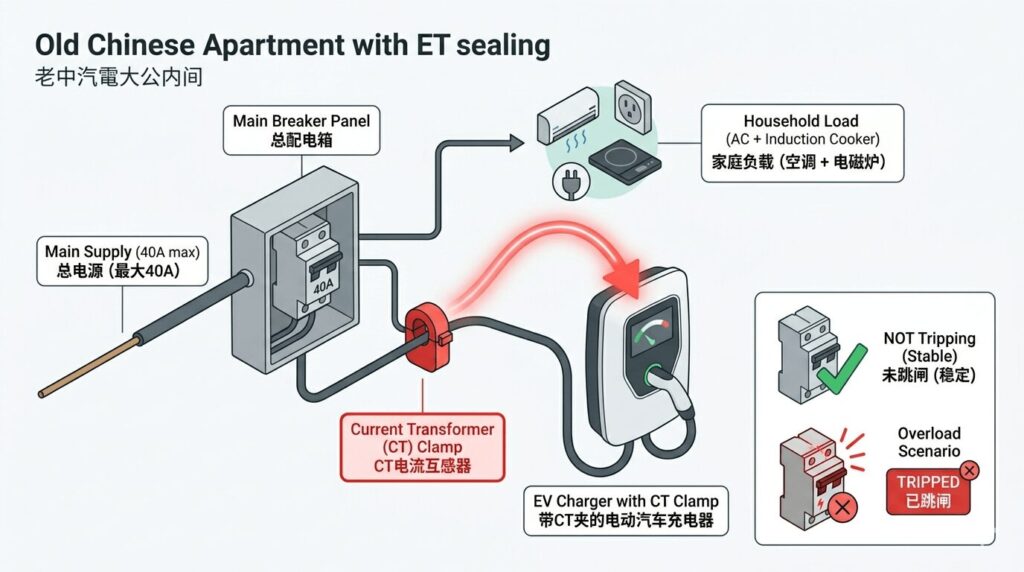
The core function: A load-balancing EV charger monitors the total electrical current being drawn from the supply (either the entire panel or specific circuits) in real time. When monitored current is high, the charger reduces EV charging current. When monitored current is low, the charger increases EV charging current — up to the maximum configured rate.
How real-time monitoring works: A Current Transformer (CT) clamp is installed on the main supply conductor (or specific circuit conductors). The CT clamp measures current flow in real time — updating typically every 1-3 seconds. The charger receives this data and adjusts output current accordingly.
The response chain:
- CT clamp measures: household drawing 35A on 40A supply
- Available headroom: 40A – 35A = 5A
- Charger reduces to 5A (1.1 kW)
- 30 minutes later: air conditioning turns off
- CT clamp measures: household drawing 8A
- Available headroom: 40A – 8A = 32A
- Charger ramps up to 32A (7 kW)
This dynamic adjustment happens automatically, continuously, without owner intervention.
AI-Enhanced Load Balancing
Advanced load balancing in premium chargers (Huawei FusionCharge, Emporia Pro equivalent in China) adds predictive capabilities:
Pattern learning: After 2-4 weeks of monitoring, the system learns household consumption patterns — when air conditioning typically runs, when cooking peaks, when the household is typically in low-load overnight mode. It anticipates load increases rather than only reacting to them.
Pre-emptive adjustment: The AI knows that cooking typically begins at 6:30pm and peaks at 7pm. Rather than waiting for cooking to start (and potentially causing a brief overcurrent before the CT clamp triggers a reduction), the AI pre-emptively reduces EV charging at 6:15pm.
For old Chinese apartments, this predictive capability is valuable: The brief overcurrent period between a high-draw appliance switching on and the CT clamp triggering a charger reduction can itself trip an already-tight circuit breaker. Pre-emptive reduction eliminates this gap.
Multi-Unit Load Balancing
For residential compounds with multiple EV chargers sharing a common supply — the collective charging infrastructure scenario — multi-unit load balancing coordinates multiple chargers within a total supply capacity:
How it works: An Equalizer or Hub device (Easee Equalizer in European market; StarCharge or TELD multi-unit management systems in China) communicates with all connected chargers and distributes available supply capacity dynamically.
If 4 chargers share a 100A supply and total household load is 40A:
- Available for EV charging: 100A – 40A = 60A
- Distributed across 4 chargers: 15A each (3.3 kW each)
- As some vehicles reach target SOC and stop charging: remaining supply redistributed to still-charging vehicles
This collective load management is the solution for old apartment compounds where collective charging infrastructure is being installed but building supply capacity limits simultaneous charging sessions.
The Chinese Electrical Context — How Load Balancing Interacts with China’s Wiring Standards
The Dedicated Meter Distinction
As established throughout this guide series, Chinese home EV charging regulations require a dedicated electricity meter for EV charging circuits in most compounds. This dedicated meter creates a separate measured circuit for EV charging.
Load balancing implication of dedicated metering:
Scenario A (dedicated circuit, shared panel): The EV circuit has its own meter and breaker. Load balancing must manage the interaction between the EV circuit and the household circuit at the panel level — ensuring combined draw doesn’t exceed the main panel capacity.
Scenario B (shared circuit, no dedicated meter — less common but exists): Load balancing manages EV charging on the shared circuit directly — keeping combined household + EV draw within the circuit’s rated capacity.
The Old Building Wiring Standards
Chinese residential wiring in buildings constructed before 2000 often uses:
- Aluminium conductors (铝芯导线) rather than copper — aluminium has higher resistance per mm² and ages less predictably than copper
- 2.5mm² conductors for circuits that carry loads continuously (modern standards specify 4-6mm² for EV charging circuits)
- Early-generation circuit breakers with less precise trip curves
These characteristics mean that old apartment wiring has lower effective safe capacity than modern equivalents at the same rated amperage. A circuit breaker rated 20A in 1990s aluminium wiring should be treated as having approximately 75-80% of the effective safe continuous capacity of a modern copper circuit.
Load balancing calibration for old building wiring: When configuring a load balancing charger for old apartment wiring, set the maximum total load threshold to 75-80% of the circuit breaker rating rather than the full rating:
- 20A breaker, 1990s aluminium wiring: set maximum load threshold at 15-16A
- 30A breaker, 1990s aluminium wiring: set maximum load threshold at 22-24A
- 40A panel (post-renovation copper): set maximum load threshold at 32A
This conservative threshold accounts for the real-world safe capacity of ageing wiring rather than the nominal rated capacity.
Chinese Load Balancing Products — What Actually Works
Product Category 1: Integrated CT Clamp Load Balancing Chargers
These are EV home chargers with CT clamp monitoring built into the product package — the charger and monitoring hardware are purchased and installed together.
Product 1: Autel MaxiCharger with Dynamic Load Management (奥创动态负荷管理)
Price: ¥1,299-¥2,499 (load management variant) CT clamp included: ✅ Yes Installation: CT clamp on main supply conductor + charger installation Load management type: Dynamic real-time adjustment Response time: Approximately 2 seconds Minimum charging threshold: 6A (1.3 kW — ensures charging continues even at maximum household load) Maximum adjustment range: 6A-32A App: Autel Charge — shows real-time load and charger adjustment OCPP: 1.6 ✅ IP Rating: IP65
How Autel’s load management works in a Chinese old apartment:
The CT clamp is installed on the main supply conductors entering the apartment’s consumer unit. The charger continuously monitors total household draw and adjusts its own output to stay within the configured safe total.
Example configuration for 40A main supply:
- Configured maximum total: 38A (95% of 40A — safety margin)
- Household draws 25A (air conditioning + cooking): Charger reduces to 13A (2.9 kW)
- Household draws 5A (late night, low load): Charger ramps to 32A (7 kW)
The Autel load management advantage over competing Chinese products: Autel’s CT clamp measurement frequency (every 1-2 seconds) and response latency (2 seconds) is among the fastest of any Chinese home EV charger with load management. This fast response prevents the brief overcurrent periods that can trip sensitive old apartment circuit breakers before the charger has responded to the load spike.
Who should choose Autel load management: Old apartment owners who also need IP65 (outdoor parking) or -30°C (northern China) specification alongside load management — Autel combines all three capabilities in one product where most competitors separate them.
Product 2: Huawei FusionCharge with Vue Load Management (华为融合充电+负荷监测)
Price: ¥1,800-¥4,500 (within Huawei ecosystem) Monitoring: Huawei Smart Energy Monitor (CT clamp) + FusionCharge charger Load management type: AI-predictive + real-time adjustment Response: Pre-emptive + reactive (fastest available) Minimum threshold: 5A (1.1 kW) Maximum range: 5A-32A Integration: Full HarmonyOS home energy management
The Huawei load management distinction:
Huawei’s AI-predictive load management goes beyond the reactive CT clamp approach of standard load balancing. By learning household consumption patterns, the FusionCharge system pre-emptively reduces EV charging 5-10 minutes before predictable household load peaks — eliminating the brief overcurrent gap that reactive-only systems experience.
For old Chinese apartments where circuit breakers have lower effective margins than their rated values (due to ageing wiring), this predictive approach is specifically valuable — it prevents the brief overloads that reactive systems can’t fully eliminate.
The Huawei ecosystem requirement: Maximum value requires the full Huawei smart home ecosystem — smart home energy monitor, possibly Huawei solar and LUNA storage. As a standalone load balancing solution, Huawei is more expensive than Autel or dedicated load balancing products.
Product 3: StarCharge S Series with External CT Clamp (星星充电负荷监测版)
Price: ¥1,100-¥1,600 (CT clamp variant) CT clamp: Optional add-on (¥200-¥400) or bundled in specific variants Load management type: Reactive real-time Response: 3-5 seconds Minimum threshold: 6A Integration: 星星充电 app
The StarCharge CT clamp option: StarCharge’s base S Series smart charger does not include CT clamp load management by default. The CT clamp variant — either bundled or as an add-on — adds reactive load management to the market-leading residential charger.
The cost comparison: StarCharge S1 base: ¥999 StarCharge CT clamp add-on: ¥200-¥400 Total with load management: ¥1,199-¥1,399
Versus Autel with integrated load management: ¥1,299-¥2,499
StarCharge with CT clamp add-on is cost-competitive with Autel’s entry load management variant — with the advantage of StarCharge’s nationwide service network and 物业 approval familiarity.
The StarCharge response time limitation: At 3-5 seconds response time (versus Autel’s 2 seconds), StarCharge’s load management is slightly more prone to brief overcurrent periods when fast-switching high-draw appliances (instant water heaters, air conditioning compressor start) create sudden load spikes. For most old apartment scenarios, 3-5 seconds is adequate. For buildings with particularly sensitive or ageing circuit breakers, Autel’s 2-second response provides better protection.
Product Category 2: Retrofit Load Management Devices
For Chinese EV owners who have already installed a home charger without load management and are now experiencing breaker trips, retrofit solutions add load management capability to existing installations.
Retrofit Option A: China Energy Monitor + Smart Plug Controller
The DIY retrofit approach:
Step 1: Install a CT clamp energy monitor (Emporia Vue equivalent in China: 小米智能插座Pro or similar smart energy monitor) on the main supply conductors.
Step 2: Connect the energy monitor’s output to the EV charger’s smart scheduling function via the charger’s API or through Mi Home/HarmonyOS automation.
Step 3: Configure automation: “If total household load exceeds 30A, reduce EV charging to minimum; if household load drops below 15A, restore EV charging to maximum.”
Cost: ¥150-¥400 for CT monitoring hardware + software configuration time
Limitation: This approach works for smart chargers with adjustable output current (Autel, some StarCharge variants) through API control. It does not work for basic chargers without adjustable current output. Response time is 10-30 seconds — slower than integrated solutions.
For old apartment owners who have already installed a basic smart charger: This retrofit approach is the most cost-effective path to load management without replacing the charger.
Retrofit Option B: Dedicated Load Management Module
Some Chinese electrical accessory manufacturers produce standalone load management modules that can be installed between the electrical panel and the existing EV charger — monitoring the supply and signalling the charger to reduce current.
Compatible with: Chargers that accept external control signals (typically through OCPP or dedicated input terminals)
Cost: ¥400-¥800 for the module + ¥300-¥500 for electrician installation
When to use: Existing charger is good quality and appropriate for the installation environment but lacks integrated load management.
Product Category 3: Multi-Unit Load Balancing for Collective Charging
For old apartment compounds installing collective charging infrastructure, multi-unit load balancing manages multiple chargers within a constrained shared supply.
Multi-Unit Option: StarCharge Multi-Charger Management System
Applicable scenario: 4-20 charging points sharing a common supply in an old compound’s car park.
How it works: A StarCharge management hub monitors the total supply capacity and distributes available current dynamically across all connected chargers. As vehicles reach target SOC and stop charging, released capacity is redistributed to still-charging vehicles.
Cost: ¥3,000-¥8,000 for the hub + ¥1,000-¥1,800 per individual charging point + installation
Versus individual load-balancing chargers: For 8 charging points in a collective installation, individual load-balancing chargers (8 × ¥1,500 = ¥12,000) versus StarCharge multi-unit system (¥5,000 hub + 8 × ¥1,200 point = ¥14,600) — similar total cost, with the StarCharge system providing more sophisticated coordination.
The Specific Old Apartment Scenarios — Solutions by Building Type
Scenario 1: 1980s-1990s State-Owned Work Unit Housing (单位房/公房)
Electrical characteristics:
- Main supply per apartment: 20-30A (4.4-6.6 kW)
- Wiring: Often aluminium, 1.5-2.5mm²
- Consumer unit: Limited circuit capacity, original installation
- Parking: Surface-level or simple basement, often without EV charging infrastructure
The specific challenge: State-owned work unit housing often has building-level electrical constraints that prevent individual dedicated circuit additions. The building transformer may be sized for 1980s load assumptions — adding EV charging across multiple apartments would require transformer upgrades.
The load balancing solution: Load balancing on the EV charger configured to operate within the apartment’s existing supply — without requiring a dedicated circuit or building infrastructure upgrade.
Configuration:
- Main supply: 20A
- Safe maximum for old aluminium wiring: 16A (80% of 20A)
- Configure load management maximum household + EV: 16A
- Maximum EV charging when household load is 2A (sleeping): 14A (3.1 kW)
- Maximum EV charging when household load is 12A (evening activity): 4A (0.88 kW)
Recommended charger: StarCharge S Series with CT clamp option (¥1,199-¥1,399) — familiar to 物业 in this building type, adequate load management capability, cost-effective.
Charging time reality at this configuration: At maximum 14A average effective charging (most of overnight window): approximately 3.1 kW effective rate. BYD Han EV, 20-80% at 3.1 kW: approximately 14.9 hours. This does not complete overnight in a single session.
The practical management strategy: For large-battery EVs (over 60 kWh) in 1980s work unit housing with 20A supply: home charging covers approximately 25 kWh per night (3.1 kW × 8 hours). This covers approximately 130 km of driving. For drivers covering under 100 km daily, this is adequate. For higher-mileage drivers, supplement with public DC fast charging 1-2 times per week.
Scenario 2: 1990s Commodity Housing (商品房, 20-40A Supply)
Electrical characteristics:
- Main supply: 30-40A (6.6-8.8 kW) — some upgraded post-construction
- Wiring: Mix of aluminium and copper, varying quality
- Consumer unit: 6-8 circuit positions, original or partially upgraded
- Parking: Underground car park, typically with distribution boards but limited per-space capacity
The specific challenge: This is the most common scenario for load balancing problems in Chinese cities. The 30-40A supply was upgraded from original 20A at some point — providing more headroom but still limited for simultaneous EV charging and modern household loads.
The load balancing solution: Dedicated EV circuit (separate from household) with load balancing monitoring the household circuit to prevent combined household + EV (if on shared panel) from exceeding main panel capacity.
Configuration for 40A main supply:
- Household circuit maximum: 30A
- Dedicated EV circuit maximum: 32A
- Combined total possible: 62A — exceeds 40A main
- Load management configured: Total panel maximum 38A
- If household draws 25A: EV reduces to 13A (2.9 kW)
- If household draws 5A: EV runs at 32A (7 kW)
Recommended charger: Autel MaxiCharger with CT clamp load management (¥1,299-¥2,499) — 2-second response for the moderate-tightness panel scenario, IP65 for underground parking.
Charging time at this configuration (median scenario): Typical evening household load pattern: high (20-30A) from 6pm-11pm, dropping to low (5-10A) from 11pm-7am. TOU valley rate starts at 11pm — coincides with household load dropping. Effective EV charging rate 11pm-7am: approximately 22-30A average (5-6.6 kW). BYD Han EV, 20-80% at 5.5 kW average: approximately 8.4 hours — fits in TOU window.
Scenario 3: Old Apartment with Recent Panel Upgrade (40-60A Post-Renovation Supply)
Electrical characteristics:
- Main supply: 40-60A post-renovation (8.8-13.2 kW)
- Wiring: Mixed or fully replaced copper
- Consumer unit: Modern 12-16 circuit positions
- Parking: Dedicated circuit available
The specific challenge: This scenario often does NOT need load balancing — the panel capacity is sufficient for EV charging with normal household load coexistence. But owners who have recently experienced a breaker trip assume load balancing is necessary when the actual issue may be a different problem.
Diagnostic approach before buying load balancing:
Step 1: Check the EV charging circuit breaker rating against the charger amperage setting. If the charger is set to 32A but the circuit breaker is 30A: immediate trip on startup. Solution: reduce charger to 24A or upgrade circuit breaker to 40A.
Step 2: Check whether the breaker trips on the EV circuit or the household circuit. If EV circuit trips: the dedicated circuit is undersized for the charger setting. If household circuit trips: coincident household loads are the issue — load balancing relevant.
Step 3: Check breaker age and condition. Breakers over 15-20 years old may have degraded trip mechanisms — tripping at 80% of rated current rather than 100%. An ageing 30A breaker that trips at 24A is not an EV charging problem — it’s a breaker replacement problem (¥50-¥150 for a licensed electrician to replace).
For post-renovation 40-60A apartments where load balancing is genuinely needed: Recommended charger: Autel MaxiCharger or StarCharge with CT clamp — configure maximum total at 90% of panel capacity. The load management provides a comfortable safety margin without limiting charging speed significantly.
Scenario 4: Rural Self-Built Housing (农村自建房) with Limited Supply
Electrical characteristics:
- Main supply: Single-phase 220V, 20-40A
- Wiring: Variable quality, sometimes direct rural distribution connection
- Voltage stability: Variable — rural grid voltage may fluctuate between 190-240V
- No parking structure — vehicle parked in yard or beside house
The specific rural challenge: Rural household supply is shared with agricultural equipment, workshop tools, and sometimes neighbouring households through shared transformers. Peak agricultural demand periods can cause significant voltage depression and reduced effective supply capacity.
Load balancing in rural context: A CT clamp monitoring the supply at the rural household meter provides load management that prevents EV charging from causing household circuit trips during peak rural grid demand periods.
Additional rural specification: Voltage-tolerant charger: 180V-264V input range (rather than standard 220V ±10%) to handle rural grid voltage fluctuation.
Recommended charger: Autel MaxiCharger with CT clamp + wide voltage input specification — the combination of load management, wide voltage tolerance, IP65 for outdoor rural installation, and -30°C for northern rural is uniquely covered by Autel in the mainstream consumer market.
Load Balancing vs Panel Upgrade — The Financial Comparison
This is the decision most old apartment owners face: pay for load balancing hardware, or upgrade the electrical panel?
Panel Upgrade Costs in Chinese Residential Context
Individual apartment panel upgrade:
- Replacing consumer unit and circuit breakers: ¥500-¥1,500
- Rewiring (if old aluminium wiring requires replacement): ¥3,000-¥10,000+
- State Grid supply upgrade (if main supply must increase): ¥1,000-¥5,000
- Total apartment panel upgrade: ¥4,500-¥16,500
Building-level infrastructure upgrade: For buildings where the main transformer or distribution infrastructure limits individual apartment capacity:
- Transformer upgrade: ¥20,000-¥100,000+ (shared across building, owner contribution ¥200-¥2,000)
- New distribution boards: ¥5,000-¥15,000
- Supply cable upgrade: ¥3,000-¥20,000
- Building-level upgrade: ¥28,000-¥135,000 total (individual contribution ¥200-¥5,000+)
Load Balancing Hardware Costs
Integrated load balancing charger: StarCharge with CT: ¥1,199-¥1,399 Autel MaxiCharger with load management: ¥1,299-¥2,499
The direct comparison for the most common old apartment scenario:
| Solution | Cost | Annual TOU Saving | Effective Speed |
|---|---|---|---|
| Load balancing charger | ¥1,299-¥2,499 | ¥1,670/yr | 4-6 kW average |
| Apartment panel upgrade only | ¥4,500-¥16,500 | ¥1,670/yr | 6.6 kW full speed |
| Building infrastructure upgrade (contribution) | ¥200-¥5,000 | ¥1,670/yr | 6.6 kW full speed |
The financial case for load balancing over panel upgrade:
For most old apartment scenarios where the practical average overnight charging rate with load balancing is 4-6 kW:
- TOU electricity savings are identical to full panel upgrade — same ¥1,670/year
- The charging speed difference (4-6 kW vs 6.6 kW) translates to approximately 1-2 hours additional overnight charging time
- This timing difference matters for large batteries and tight schedules — but for most drivers covering under 120 km daily, 4-6 kW overnight is adequate
Over 5 years:
Load balancing approach:
- Hardware: ¥1,800 (average)
- 5-year TOU electricity: ¥8,350 (5 × ¥1,670)
- 5-year total: ¥10,150
Panel upgrade approach (¥8,000 average including rewiring):
- Panel upgrade: ¥8,000
- Charger (StarCharge S1): ¥999
- Installation: ¥1,700
- 5-year TOU electricity: ¥8,350
- 5-year total: ¥19,049
The load balancing approach saves ¥8,899 over 5 years for comparable annual electricity savings. For the specific constraint of limited panel capacity in an old apartment, load balancing is far more cost-effective than panel upgrade for owners who can manage with 4-6 kW average overnight charging speed.
The Configuration Guide — Setting Up Load Balancing Correctly
Step 1: Determine Your Safe Total Load Threshold
For modern copper wiring with rated panel: Safe maximum = Panel rated capacity × 80% Example: 40A panel → set maximum at 32A
For 1990s aluminium wiring: Safe maximum = Panel rated capacity × 75% Example: 30A panel → set maximum at 22-23A
For buildings with known voltage fluctuation (rural or old urban): Safe maximum = Panel rated capacity × 70% Example: 30A panel → set maximum at 21A
Step 2: Install the CT Clamp Correctly
CT clamp placement: The CT clamp must fully surround the conductor it measures — it cannot be clamped partway. For single-phase supply: clamp on the live conductor entering the consumer unit.
CT clamp polarity: Most CT clamps have a directional arrow indicating current flow direction. If installed backwards, the charger will misread load direction and may behave incorrectly. If the app shows negative consumption when household is clearly drawing power, reverse the CT clamp orientation.
CT clamp position for apartment with dedicated EV circuit: For maximum protection, install the CT clamp on the main supply conductor BEFORE the split into household circuit and EV circuit — monitoring total panel draw including both.
Step 3: Configure the Minimum Charging Threshold
Why minimum threshold matters: Without a minimum charging threshold, load management might reduce EV charging to zero during high household demand — stopping the charging session entirely. Setting a minimum of 6A (1.3 kW) ensures the charging session continues at minimum rate even during peak household demand, maintaining the EVSE-vehicle connection and session continuity.
For Chinese EVs: 6A minimum is the standard GB/T minimum charging current. Any charger set below 6A will disconnect the session — configure minimum at exactly 6A.
Step 4: Test the System
The test sequence:
- Plug in vehicle and confirm charging starts at maximum rate
- Turn on air conditioning + induction cooking simultaneously
- Confirm charger reduces output within 3-10 seconds (depending on product)
- Confirm no breaker trips
- Turn off high-draw appliances
- Confirm charger ramps back up within 1 minute
If breaker still trips during test: The load management response may be too slow for the specific circuit breaker’s trip curve. Reduce the maximum load threshold by an additional 10%. If trips persist after threshold reduction, an electrician should assess whether the circuit breaker itself needs replacement due to ageing trip mechanism.
Internal Links — Further Reading on Clean Energy Bazaar
The load balancing EV chargers 2026 avoid tripping breakers in old Chinese apartment blocks guide is the electrical capacity companion to the installation guides in the Chinese market content cluster.
For the home EV charger buying guide covering charger selection before load management requirements are factored in, our find the right EV charger for your home China edition guide covers the complete pre-purchase decision. For the professional installation costs guide covering what panel upgrades cost versus installation alternatives, our professional EV charger installation costs 2026 what State Grid chargers vs private companies charge guide covers every cost component. For the smart feature value analysis establishing the financial framework for load management decisions, our smart EV chargers 2026 AI load balancing vs standard features worth the extra cost in China guide covers the cost-benefit analysis. For the apartment rights guide covering how to escalate building-level capacity constraints to the relevant authorities, our apartment EV charging solutions 2026 China HOA rules property manager permissions and fixed parking rights guide covers every regulatory path. For the tier 1 vs rural guide that contextualises old apartment electrical challenges within China’s geographic diversity, our tier 1 vs tier 2 city charging solutions for Beijing high-rises vs Chengdu villas vs rural villages guide covers every location type. And for the European equivalent load balancing guide covering Emporia Pro and similar solutions in the Western market, our load balancing EV chargers 2026 avoid tripping breakers US homes European apartments guide provides the international comparison.
Final Thoughts
The load balancing EV chargers 2026 avoid tripping breakers in old Chinese apartment blocks analysis produces clear guidance for the millions of Chinese EV owners in older residential buildings who face electrical capacity constraints.
The fundamental finding: Load balancing is the cost-effective solution for most old apartment electrical capacity constraints — delivering identical annual TOU savings to a full panel upgrade at a fraction of the cost.
The specific recommendations:
1980s state-owned work unit housing (20-30A supply): StarCharge S Series with CT clamp option (¥1,199-¥1,399). Configure at 75% of rated capacity for aluminium wiring safety. Accept 2-4 kW average overnight charging as the operational reality — adequate for drivers under 100 km daily.
1990s commodity housing (30-40A supply): Autel MaxiCharger with integrated CT clamp load management (¥1,299-¥2,499). The 2-second response time provides better protection than StarCharge’s 3-5 seconds for moderately tight panels. IP65 for underground parking.
Rural self-built housing with supply constraints: Autel MaxiCharger with CT clamp + wide voltage input tolerance. The combination of load management, voltage tolerance, and IP65 outdoor protection addresses every rural charging challenge in one product.
Old apartment where load balancing hardware has already been tested and fails: The breaker trips are likely caused by aged breaker mechanism rather than genuine overload. Replace the circuit breaker (¥50-¥150, licensed electrician) before investing in load management hardware — it may solve the problem entirely.
Panel upgrade — when is it the right choice over load balancing: When the household’s actual daily charging requirement regularly exceeds what load balancing can deliver within the constrained supply. If you drive 150+ km daily in a large-battery BEV (NIO ET5 100 kWh, Zeekr 001) from a 20A supply — 4 kWh overnight from load-managed charging is genuinely insufficient and a panel upgrade becomes necessary.
For everyone else: configure the load balancing, set the correct threshold, verify with the warm test, and capture the ¥1,670/year TOU saving. The circuit breaker will not trip again.