Here is the question that every informed Chinese EV buyer is asking in the second half of 2026.
The EV charging market is moving fast — faster in China than anywhere else on earth. V2G (vehicle-to-grid) technology that was a pilot curiosity in 2024 is approaching commercial deployment in China’s most advanced electricity market cities. Solid-state batteries that were laboratory demonstrations in 2023 are entering the first production vehicles in 2026. ChaoJi ultra-fast charging infrastructure is expanding from premium motorway locations toward urban deployment. AI energy management systems are moving from industrial to residential scale.
Buying a home EV charger in this environment creates a specific risk: buying hardware that becomes functionally obsolete within 18-24 months because a technology transition has occurred that the charger cannot support.
But there is an opposite and equally real risk: delaying a purchase or paying unjustified premiums for “future-ready” features that will not be commercially deployed for 3-5 years — if ever at the residential scale.
This guide on upcoming EV charger trends 2026-2027 V2G solid-state batteries and what to buy now in China navigates both risks honestly. For each major emerging technology, it assesses: what is the current commercial reality, what is the realistic deployment timeline for Chinese residential users, what home charger hardware requirement does it create when it does arrive, and what should buyers do today — wait, prepare, or invest?
The result is a buying decision framework that neither dismisses future technology as irrelevant nor capitulates to premature future-proofing premiums.
The Technology Assessment Framework
Before evaluating specific technologies, establishing the framework prevents the most common future-proofing mistakes.
The Three Deployment States
Every emerging EV charging technology sits in one of three states:
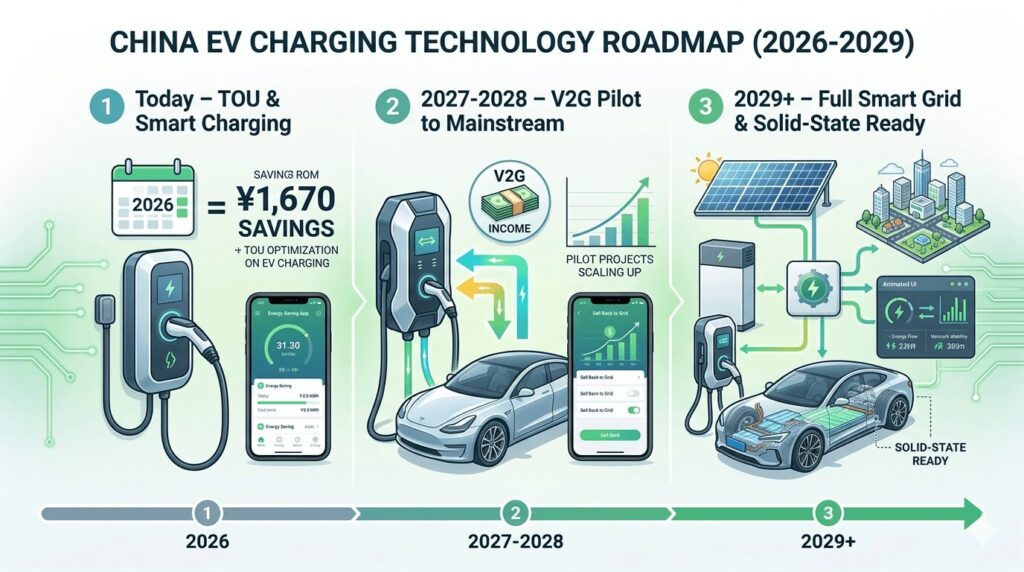
State 1: Commercially deployed and scalable Technology is available, working, and financially justified today. Hardware investment is immediate and certain. Examples: TOU scheduling, AI load balancing, OCPP 1.6 demand response in pilot cities.
State 2: Technically proven, commercially early Technology works and is available in limited commercial form. Mainstream residential deployment is 12-36 months away. Hardware investment today provides real but modest first-mover benefit. Examples: V2G for specific vehicle-charger combinations, ChaoJi DC infrastructure expansion.
State 3: Technically promising, commercially uncertain Technology is real but commercial scale deployment faces significant barriers — regulatory, economic, or technical. Residential availability is 3-7+ years away. Hardware investment today for this technology is premature. Examples: Residential solid-state battery charging optimisation, widespread V2G grid income for average owners.
Understanding which state each technology occupies determines whether buying hardware to support it today is rational.
Technology 1: V2G — Vehicle-to-Grid Bidirectional Charging
What V2G Is
V2G (Vehicle-to-Grid, 车网互动 in Chinese) is the ability of an EV to not just receive electricity from the grid but to return electricity to the grid — discharging the vehicle battery to supply power during peak demand periods.
At home, V2H (Vehicle-to-Home, 车家互联) is the residential variant: discharging the EV battery to power household appliances, particularly during grid outages or during peak electricity price periods.
The Chinese V2G Context — Further Advanced Than Most English Coverage Acknowledges
China’s V2G development has advanced significantly beyond what Western EV media typically covers. The combination of:
- National policy support (NEA V2G roadmap published 2024)
- State Grid’s vehicle-grid interaction pilot programmes in 5 cities
- CATL’s Shenxing battery designed with V2G in mind
- NIO’s power ecosystem infrastructure
- BYD’s V2H capability on specific models
…has created a genuinely more advanced V2G landscape than Europe or the US in 2026.
The Current V2G Commercial Reality in China (2026)
What is actually deployed:
BYD Han EV + BYD V2L/V2H adapter: BYD’s Han EV (select variants from 2024 model year onward) supports Vehicle-to-Load (V2L) — powering external appliances directly from the vehicle battery. The BYD V2H capability (powering the entire home) is available on the Han EV through specific inverter units sold separately.
NIO battery swap system indirect V2G: NIO’s swap stations effectively act as grid-connected battery buffers — NIO Power manages charging and discharging of swap batteries in coordination with State Grid’s demand signals. Individual NIO owners don’t directly participate in V2G in the same way as direct-connect home V2G systems, but NIO’s infrastructure is functionally performing grid services.
State Grid V2G Pilot Programme (in Beijing, Shanghai, Shenzhen, Guangzhou, Chengdu): Approximately 50,000 EV owners in these pilot cities are enrolled in V2G demand response programmes — their EVs can receive grid instructions to pause charging or discharge to grid during peak demand events. Compensation: ¥0.50-¥1.50 per kWh discharged to grid during pilot events.
The pilot programme annual income: For an active V2G pilot participant in Shanghai:
- Average discharge events: 50-80 per year (growing)
- Average discharge per event: 10-20 kWh
- Compensation rate: ¥0.80/kWh average
- Annual V2G income: 65 events × 15 kWh × ¥0.80 = ¥780/year
Current vehicles that can participate in Chinese V2G pilot:
- BYD Han EV (V2H equipped variants)
- NIO ET5/ET7 (through NIO Power ecosystem)
- Specific fleet vehicles with OEM V2G support
- Several commercial vehicle types
What is NOT yet deployed at residential scale: Full residential V2G where any owner can discharge their EV battery to the home grid through a standard home charger — earning ongoing grid income through a commercially mature programme — is not available to most Chinese residential EV owners in 2026.
The V2G Home Charger Hardware Requirement
What home charger hardware does V2G require?
V2G requires a bidirectional charger — a charger that can both push electricity into the vehicle battery and pull electricity from the vehicle battery for grid export or home use. Standard home EV chargers are unidirectional — they only push electricity into the vehicle.
The bidirectional charger technology: An AC bidirectional home charger requires power electronics that can operate in both directions — inverting DC from the vehicle battery to AC for grid export. This is significantly more complex (and expensive) than standard one-way charging electronics.
Bidirectional home chargers available in China (2026):
BYD V2H Home Energy System:
- Compatible with: BYD Han EV (specific V2H variants)
- Bidirectional power: Up to 6.6 kW V2H discharge
- Price: ¥8,000-¥15,000 for complete V2H system
- Installation: Professional installation required, additional circuit work
- Current availability: Limited, expanding
NIO Power Pack (household unit):
- Functions within NIO Power ecosystem
- Integrates with NIO swap station infrastructure
- Price: ¥12,000-¥25,000 for residential V2G setup
- Current availability: Pilot availability, expanding
Huawei FusionCharge V2G roadmap: Huawei Digital Power has announced bidirectional capability for FusionCharge — not yet commercially available for residential use in 2026. Expected: 2027.
International products (limited China availability): Wallbox Quasar 2 (European product) — not GB/T compatible, not commercially available in China.
The V2G Financial Assessment for Chinese Residential Owners
Current pilot programme V2G income (enrolled participants, 2026): ¥780/year (estimated for active Shanghai pilot participant)
Cost of V2G-capable home hardware: BYD V2H system: ¥8,000-¥15,000 Payback from V2G income alone: ¥11,500 average ÷ ¥780/year = 14.7 years
The honest V2G financial assessment for 2026: V2G as a financial investment in home charging hardware is not justified for most Chinese residential owners today. The V2G income (¥780/year in pilot programme) does not recover the premium hardware cost within a reasonable timeframe.
When will the financial case improve? As V2G programmes scale from pilot to mainstream (estimated 2027-2029 in major Chinese cities):
- More frequent discharge events: 150-200/year
- Higher compensation rates: ¥1.00-¥2.00/kWh
- Potential annual V2G income: ¥2,250-¥6,000/year
- Payback on ¥11,500 hardware: 2-5 years
At mainstream deployment with higher income, V2G hardware investment becomes financially compelling. The transition is approximately 18-36 months away.
What to Buy Now for V2G Preparation
The OCPP 2.0 preparation approach: OCPP 2.0 is the communication protocol that enables V2G participation in China’s smart grid programmes. Chargers with OCPP 2.0 can receive V2G commands and participate in future programmes without hardware replacement — if the charger hardware also has bidirectional capability (which most current OCPP 2.0 chargers do not).
The realistic V2G preparation for 2026 buyers:
For BYD Han EV owners who specifically want V2G now: Buy the BYD V2H system if the ¥8,000-¥15,000 investment aligns with your financial situation. The technology works, income is real (if modest), and battery backup value during power outages adds utility beyond pure grid income.
For all other Chinese EV owners: Do not buy bidirectional home charger hardware specifically for V2G in 2026. Instead:
- Buy a charger with OCPP 1.6 or 2.0 for demand response programme access today (¥200-¥800/year income)
- When V2G programmes reach commercial maturity in your city (2027-2029), reassess hardware replacement — by which time the total cost of bidirectional chargers will have fallen significantly from current prices
- The ¥1,670/year TOU saving from a standard smart charger purchased today continues to accrue while you wait for V2G to become commercially viable
V2G readiness verdict: Monitor, not act. Buy OCPP for demand response today. Revisit V2G hardware in 2027-2028.
Technology 2: Solid-State Batteries — The Home Charging Implication
What Solid-State Batteries Are
Solid-state batteries replace the liquid electrolyte in conventional lithium-ion batteries with a solid electrolyte material. This change offers theoretical advantages:
- Higher energy density (more range per kg)
- Better safety (no flammable liquid electrolyte)
- Faster charging capability (some solid-state chemistries support 10C+ charging rates)
- Better performance at temperature extremes
The Chinese Solid-State Battery Commercialisation Status (2026)
What is actually shipping:
Toyota solid-state pilot (Chinese market cooperation): Toyota’s solid-state battery technology, developed with Panasonic/Prime Planet, is in limited pilot production — not in mainstream Chinese market vehicles.
NIO’s semi-solid-state 150 kWh battery: NIO’s 150 kWh battery pack for the ET5 and ET7 uses semi-solid-state technology (ionic gel electrolyte rather than true solid-state) — this is a genuine production product but not a fully solid-state battery.
CATL’s solid-state battery timeline: CATL has announced solid-state battery production targets — initially for aerospace and specialty applications, with automotive-grade solid-state targeted for 2027-2028. CATL’s CEO has been careful to distinguish between “solid-state” and “semi-solid-state” in public statements.
BYD’s solid-state development: BYD is developing solid-state batteries internally — anticipated production timelines are 2027-2030 for automotive scale.
The honest solid-state battery commercialisation assessment (2026): True all-solid-state batteries in mainstream Chinese EVs are a 2028-2032 phenomenon for the mass market. Semi-solid-state batteries (like NIO’s 150 kWh pack) are here now in premium vehicles.
Does Solid-State Battery Technology Change Home Charger Requirements?
The straightforward answer: Not for AC home charging.
Solid-state batteries, like current liquid electrolyte batteries, charge from AC home chargers through the vehicle’s OBC. The OBC converts incoming AC to DC at the battery’s voltage — whether that battery has liquid or solid electrolyte is irrelevant to the OBC’s function.
What solid-state batteries may change for DC fast charging: Some solid-state chemistries (particularly lithium-metal anodes) support very high C-rate charging — theoretically 10C or higher. At 10C, a 100 kWh solid-state battery could theoretically accept 1,000 kW of DC charging. This would require next-generation DC fast charging infrastructure well beyond anything currently deployed.
What this means for home charger buying decisions: Solid-state batteries will not change home AC charger requirements. The OBC is the ceiling for home charging regardless of battery chemistry.
Solid-state readiness verdict: No home charger action required. The transition to solid-state batteries will not affect home AC charging hardware.
Technology 3: ChaoJi Ultra-Fast Public Charging Expansion
What ChaoJi Expansion Means
ChaoJi (超级充电接口) — China’s next-generation ultra-fast charging standard supporting up to 900 kW — is expanding from premium motorway service area installations into urban and suburban public charging locations.
ChaoJi deployment status (2026):
- Motorway premium hubs: Several hundred ChaoJi-capable stations
- Urban ultra-fast hubs (tier-1 cities): Expanding rapidly — State Grid and private operators installing ChaoJi-capable equipment at major urban charging destinations
- Timeline to widespread urban coverage: 2027-2028 for tier-1 cities, 2028-2030 for tier-2
What ChaoJi Means for Home Charging Hardware
Nothing. ChaoJi is a public DC fast charging standard. Home AC charging is unaffected by ChaoJi deployment.
What ChaoJi does mean for vehicle buying decisions: Vehicles designed to accept ChaoJi ultra-fast charging speeds (400-900 kW DC) will charge faster at ChaoJi-equipped public stations. For drivers who frequently use public DC fast charging for long-distance travel, ChaoJi-capable vehicle OEM specification matters.
For home charger buying decisions: ChaoJi expansion has zero impact on home charger hardware requirements.
ChaoJi readiness verdict: No home charger action. Monitor vehicle buying decisions for DC charging speed specifications.
Technology 4: AI Energy Management at Residential Scale
The AI Energy Management Trajectory
As covered in our smart charger comparison guide, AI energy management for residential EV charging ranges from Level 1 (departure learning) to Level 4 (full ecosystem optimisation with solar, storage, and grid).
The trajectory in China (2026-2027):
Becoming standard (2026-2027): Level 2 AI (dynamic TOU optimisation, price forecasting integration) moving from premium to mid-range charger products.
Expanding (2027-2028): Level 3 AI (solar + EV coordination) becoming standard in products from Huawei, Sungrow, Growatt — not just premium tier.
Emerging (2027-2030): Level 4 AI (full grid arbitrage, V2G coordination, demand response integration) — currently only in premium Huawei ecosystem, moving toward broader availability as V2G programmes scale.
What AI Advancement Means for Buying Decisions
For buyers in 2026: Level 1-2 AI (available in StarCharge S Series, Xiaomi charger) delivers the primary value — ¥1,670/year TOU saving. This value is fully captured by current products.
For 2027-2028 buyers: Level 2-3 AI becoming standard will deliver better electricity optimisation than 2026 products — but the incremental annual saving improvement (¥50-¥300/year) doesn’t justify waiting to buy.
AI advancement verdict: Current products capture 90%+ of available AI value. Buying now is correct. Future AI improvements are incremental, not transformative, for most residential users.
Technology 5: OCPP 2.0 and Smart Grid Integration
The OCPP 2.0 Deployment Timeline in China
OCPP 2.0.1 — the advanced charging protocol enabling bidirectional communication, enhanced security, and V2G integration — is deploying in Chinese public charging infrastructure faster than in residential applications.
Public charging OCPP 2.0 deployment: State Grid’s new installations from 2025 onward increasingly specify OCPP 2.0 — creating a public charging infrastructure that is V2G and smart grid ready.
Residential charger OCPP 2.0 availability: Currently only in premium products (Ginlong Solis, Huawei FusionCharge, some Autel variants). Moving toward mid-range products in 2027-2028.
Residential demand response programme OCPP requirements: Current Beijing and Shanghai pilot programmes work with OCPP 1.6 — OCPP 2.0 is not required to participate in 2026. Future mainstream V2G programmes: expected to require OCPP 2.0.
The OCPP 2.0 buying decision:
For owners buying in 2026 planning 5-year ownership: OCPP 1.6 is sufficient for all current programmes. OCPP 2.0 adds ¥300-¥600 premium for future V2G access — worth it for Shenzhen/Shanghai long-term owners who will be in the first wave of V2G programme expansion.
For owners buying in 2026 planning 3-year ownership or less: OCPP 1.6 is appropriate. By replacement time, OCPP 2.0 will be standard.
Technology 6: Wireless Inductive Charging (无线充电)
What Wireless EV Charging Is
Wireless inductive charging for EVs uses the same principle as wireless phone charging — an electromagnetic field transfers energy between a ground-mounted coil (installed in the parking space) and a receiving coil on the vehicle’s underbody.
The appeal: No connector, no cable — park the car over the charging pad and charging begins automatically.
The Chinese Wireless EV Charging Status (2026)
National standard published: GB/T 38775 defines China’s wireless EV charging standard — covering frequencies, power levels, and safety requirements.
Vehicles with wireless charging receivers:
- GAC Aion LX Plus: wireless charging option
- Some BYD models: wireless charging pilot option
- Li Auto MEGA: wireless charging receiver option on premium variants
- Several 2025-2026 model year premium Chinese EVs
Home wireless charging system availability: Limited commercial availability — primarily from GAC’s energy division, some specialist manufacturers. Price: ¥8,000-¥20,000 for home inductive charging pad + installation.
Power levels: Current Chinese home wireless charging: 3.3-7.2 kW — comparable to standard AC home charging.
Does Wireless Charging Change Home Charger Decisions?
For most Chinese EV owners in 2026: No. Wireless home charging hardware is expensive (¥8,000-¥20,000) and only compatible with vehicles that have wireless receiving coils fitted. Vehicles with receiving coils are a small minority.
For owners with wireless-equipped premium EVs: The ¥8,000-¥20,000 wireless home charging system versus a ¥1,299-¥2,499 standard wired charger:
- Same charging speed (7 kW maximum in current implementations)
- Same annual TOU saving (¥1,670/year)
- Additional cost: ¥6,000-¥18,000
- Additional benefit: Eliminating daily connector plug/unplug (approximately 15 seconds saved)
The payback on wireless at 15 seconds/day time saving: At ¥50/hour time value: 15 seconds × 365 = ¥76/year ¥12,000 premium ÷ ¥76/year = 158 years payback
Wireless charging verdict: Interesting technology, commercially early, financially unjustified for residential use in 2026. Reassess in 2028-2030 when prices may fall significantly.
Technology 7: Sodium-Ion Battery EVs and Charging Implications
Sodium-Ion Battery Commercialisation
CATL’s sodium-ion battery cells — announced 2021, entering commercial production 2023-2024 — are beginning to appear in Chinese entry-level EVs:
Sodium-ion vehicles in Chinese market (2026):
- JAC Yiwei 3 (奇瑞) with CATL sodium-ion cells
- Chery ANT (蚂蚁) entry models
- Several other entry-level Chinese EVs in development
Sodium-ion battery charging characteristics:
- Charging voltage: Lower than lithium-ion (~3.0V per cell vs 3.7V for LFP)
- Maximum charge rate: 2-3C (slower than CATL Shenxing lithium, faster than standard LFP)
- Cold weather advantage: Better performance at -20°C than lithium-ion
- Home charging: Compatible with standard GB/T AC chargers through the vehicle’s OBC
Sodium-Ion and Home Charger Requirements
No change required. Sodium-ion EVs use the same GB/T charging connectors and the same OBC-mediated AC charging as lithium-ion EVs. A standard certified 7 kW home charger charges sodium-ion vehicles identically to lithium-ion vehicles.
The OBC manages the specific charging parameters for sodium-ion chemistry (lower voltage, slightly different charge curve) — the home charger simply delivers AC electricity as requested.
Sodium-ion verdict: No home charger action required.
Technology 8: Battery Swapping Expansion (NIO and Beyond)
The Battery Swap Technology Trajectory
NIO’s battery swap network — 2,300+ stations in 2026 — is the most developed battery swap ecosystem globally. As NIO expands and as competitors develop swap ecosystems, the role of battery swap in Chinese EV charging evolves.
CATL’s battery swap ambitions: CATL has established a battery swap initiative (巧克力换电) targeting commercial vehicles and potentially passenger cars — creating a multi-brand swap ecosystem where CATL supplies the standardised swappable battery packs.
BAIC ARCFOX and other OEMs: Several Chinese OEMs beyond NIO are developing swap-compatible models — potentially creating a broader swap ecosystem.
What Battery Swap Expansion Means for Home Chargers
For NIO owners: Home charging remains the most financially efficient daily energy source (¥0.34/kWh TOU) versus swap (¥25-¥35/swap). Battery swap expansion strengthens the long-distance and emergency charging case without undermining home charging economics.
For potential swap ecosystem participants: A home charger remains the daily energy foundation even for vehicles that can swap — the economics of TOU home charging vs swap costs mean home charging is almost always the rational daily choice.
Battery swap verdict: Reinforces rather than replaces home charging investment.
The Buying Decision Matrix — What to Do Now
This is the section most readers want: a clear framework for deciding what to buy today given the technology trajectory.
Decision Framework by Owner Profile
Profile 1: Standard Chinese Apartment Owner, BYD or NIO Vehicle, 3-5 Year Horizon
Technology trajectory relevant to this profile:
- V2G: Not commercially viable at residential scale for 2-3 years
- Solid-state: No home charging impact
- AI: Current products capture 90%+ of value
- OCPP: 1.6 sufficient for current programmes
What to buy today: StarCharge S1 or Xiaomi EV Charger (¥899-¥1,399)
- Full TOU scheduling: ¥1,670/year savings
- Smart home integration where applicable
- No premium for features that won’t deliver return in ownership horizon
What to skip:
- OCPP 2.0 premium — no current programme requires it
- V2G hardware — not commercially justified
- “Future-ready” premiums for wireless or solid-state
Profile 2: Shenzhen or Shanghai Resident, Xpeng G9 or Zeekr 001, 7-10 Year Horizon
Technology trajectory relevant:
- V2G: Will be commercially viable in Shenzhen/Shanghai within 2-4 years
- OCPP 2.0: Will be required for mainstream V2G in 3-5 years
- Demand response: Currently active, growing income
What to buy today: Autel MaxiCharger (OCPP 1.6, IP65) or Ginlong Solis (OCPP 2.0, IP66)
- OCPP 1.6: Demand response income now (¥200-¥800/year)
- OCPP 2.0 (Ginlong): Position for V2G access without hardware replacement
- IP65/IP66: Long-term weather protection for 10-year ownership
The OCPP 2.0 upgrade justification for long-horizon Shenzhen owners: Premium over OCPP 1.6: ¥300-¥600 Expected additional value from V2G access (when available): ¥500-¥1,500/year Payback: 0.2-1.2 years when V2G programmes deploy
Profile 3: Huawei Ecosystem User, Villa with Solar, Any Premium EV
Technology trajectory relevant:
- AI: Full Level 4 ecosystem value available today (Huawei FusionCharge)
- V2G: Huawei has clearest V2G roadmap — FusionCharge V2G expected 2027
- Solar: Immediately deployable solar divert value
What to buy today: Huawei Digital Power FusionCharge
- AI energy management: ¥2,650-¥2,850/year combined savings
- Solar integration: Deployed immediately
- V2G preparation: Huawei’s announced 2027 bidirectional capability means same hardware may be upgradeable via OTA
The Huawei V2G upgrade path: Huawei has specifically indicated that FusionCharge will receive bidirectional V2G capability through software/firmware update for compatible hardware variants. Buying the FusionCharge now — within the Huawei ecosystem — positions for V2G without hardware replacement for Huawei ecosystem users.
This is the strongest argument for a premium purchase today with genuine future value: the Huawei FusionCharge’s V2G capability may be software-unlockable rather than requiring hardware replacement.
Profile 4: NIO ET5 150 kWh Owner, Long-Term Beijing Resident
Technology trajectory relevant:
- V2G: NIO already has partial V2G ecosystem involvement
- CATL Ningle: Battery health optimisation applicable now
- Demand response: Beijing pilot programme active
What to buy today: NIO Home Charger (via NIO programme) + register for Beijing demand response programme
The NIO programme’s subsidised or free charger pricing, managed installation, and ecosystem integration provides the best combination of immediate value and future readiness for NIO owners. CATL Ningle as alternative if NIO programme unavailable at promotional pricing.
Profile 5: Rural Township Owner, Li Auto L9 EREV, Cost-Sensitive
Technology trajectory relevant:
- V2G: Rural programmes will be the last to deploy — 2030+ realistically
- Solid-state: No impact on AC home charging
- All emerging technologies: Low relevance within 5-year rural ownership horizon
What to buy today: StarCharge S1 (¥899) or ChargeWay basic (¥680) + car built-in timer
- TOU savings: ¥800-¥1,200/year (if TOU available in rural area)
- Zero premium for features that won’t deploy in rural areas during ownership horizon
- EREV architecture means charging urgency is lower anyway
The “Future-Proof” Premium Honesty Assessment
Paying for Future V2G Today
Scenarios where the premium is justified:
- BYD Han EV owner who specifically wants V2H for power outage backup (non-financial utility value)
- Huawei ecosystem user buying FusionCharge where V2G OTA upgrade may avoid hardware replacement
- Very long-term ownership (10+ years) in Shenzhen or Shanghai where V2G will certainly deploy within ownership horizon
Scenarios where the premium is not justified:
- Standard apartment owner with 5-year horizon
- Rural or tier-2 city owner where V2G programmes will deploy late
- Any owner where the ¥5,000-¥15,000 V2G hardware premium takes more than 5 years to recover
Paying for OCPP 2.0 Today
Justified: Long-horizon Shenzhen/Shanghai/Beijing owners (7-10 year), OCPP 2.0 premium under ¥600.
Not justified: Short-horizon (under 5 years), rural owners, tier-2/3 cities where demand response programmes are distant.
The Technology Timeline Summary
| Technology | Current Value | Residential Readiness | Action Today |
|---|---|---|---|
| TOU Scheduling | ✅ ¥1,670/yr | Deployed everywhere | Buy now |
| AI Level 1-2 | ✅ ¥50-150/yr extra | Available | Buy if cost-effective |
| AI Level 3-4 | ✅ ¥780+/yr | Huawei ecosystem now | Buy if ecosystem match |
| OCPP 1.6 Demand Response | ✅ ¥200-800/yr | Active pilot cities | Buy for 5+ year horizon |
| OCPP 2.0 | ⚠️ ¥0 now / ¥500-1500 future | 2-3 years | Pay if modest premium |
| V2G Pilot Income | ⚠️ ¥780/yr pilot | Limited pilot | Buy standard, monitor |
| V2G Mainstream | ❌ Not ready | 2027-2029 | Wait, buy OCPP now |
| V2H (BYD Han specific) | ✅ Working now | Limited models | Buy if specific need |
| Huawei V2G OTA | ⚠️ Announced 2027 | Ecosystem specific | Buy FusionCharge now if ecosystem |
| Wireless Charging | ❌ Very expensive | 2028-2030 | Skip entirely |
| Solid-State Battery | ❌ No home impact | Irrelevant | No action |
| Sodium-Ion | ✅ Works with standard | Current | No action needed |
| ChaoJi DC | ✅ Public stations | Public, not home | No home action |
| Blockchain | ❌ No value | Unknown | Skip entirely |
The Practical “Buy Now” Recommendations for 2026 Chinese EV Buyers
Tier 1 Recommendation: For Most Chinese Buyers
Buy: StarCharge S1 (¥899-¥1,099)
Rationale:
- Captures ¥1,670/year TOU savings — the dominant value
- 3-year warranty within ownership horizon
- Widest 物业 approval recognition
- No premium for technologies that won’t deliver return
- If V2G becomes compelling in 2028-2029, replacement cost ¥899-¥1,099 is modest
Total opportunity cost of not buying OCPP: Missing ¥200-¥800/year demand response in pilot cities — add Autel (OCPP 1.6) if in Beijing, Shanghai, or Shenzhen.
Tier 2 Recommendation: For Long-Horizon or Advanced Users
Buy: Autel MaxiCharger (¥1,299-¥2,499)
Rationale:
- OCPP 1.6 for current demand response income
- IP65 for environmental longevity
- -30°C for northern China
- Best positioned for near-term programme participation
- 3-year warranty with industrial quality suggesting 7-10 year hardware life
Tier 3 Recommendation: For Full Ecosystem Users
Buy: Huawei FusionCharge (¥1,800-¥4,500) within Huawei ecosystem
Rationale:
- Full Level 4 AI value today
- Solar + storage integration delivering ¥2,650-¥2,850/year combined
- Announced V2G OTA upgrade path for 2027
- Best future-proofing with genuine current financial justification
What NOT to Buy in 2026
Do not buy:
- Products with “5G cellular” premium — no value for home charging
- “Blockchain energy ledger” premium — no residential value in 2026
- “Wireless charging ready” premium — hardware too expensive, limited vehicle compatibility
- Full V2G bidirectional hardware (except BYD V2H for specific use case) — premature for most
- Any premium justified solely by solid-state battery compatibility claims
Internal Links — Further Reading on Clean Energy Bazaar
The upcoming EV charger trends 2026-2027 V2G solid-state batteries and what to buy now in China guide is the forward-looking companion to the product comparison guides in the Chinese market content cluster.
For the smart charger AI comparison that contextualises AI energy management development, our best smart EV chargers China 2026 Huawei Digital Power vs Xiaomi vs local innovators guide covers every platform. For the smart feature value analysis that established the financial framework applied to emerging technologies here, our smart EV chargers 2026 AI load balancing vs standard features worth the extra cost in China guide provides the methodology. For the local rebates guide covering demand response programme income available from OCPP-compliant chargers, our local utility rebates for EV charging 2026 Shenzhen Shanghai Beijing guide covers every programme. For the connectivity guide covering OCPP, 5G, and digital yuan in the current context, our best smart connectivity WiFi 5G digital yuan payments in Chinese smart chargers guide covers every feature. For the NIO battery swap vs charging guide that contextualises V2G within NIO’s power ecosystem, our best EV charger for NIO Xpeng and Li Auto home solutions for battery swap vs charging guide covers the NIO ecosystem. And for the European and US equivalent of this future-looking guide, our upcoming EV charger trends 2026-2027 V2G bidirectional what to buy now guide provides the Western market comparison.
Final Thoughts
The upcoming EV charger trends 2026-2027 V2G solid-state batteries and what to buy now in China analysis produces a clear, honest framework that neither dismisses future technology nor capitulates to premature investment.
The three honest conclusions:
Conclusion 1: TOU scheduling is the technology that matters most today. Nothing on the emerging technology horizon will deliver more annual financial return to Chinese EV owners than TOU scheduling in 2026. A ¥999 StarCharge S1 with TOU scheduling saves ¥1,670/year. A ¥15,000 V2G bidirectional system currently earns ¥780/year in pilot income. The technology that is deployed and working today has far more value than the technology that is announced and aspirational.
Conclusion 2: OCPP 1.6 and the Huawei ecosystem are the legitimate future-proofing investments. For long-horizon owners in China’s most advanced electricity market cities, OCPP 1.6 (¥300-¥500 premium) captures demand response income now and positions for V2G access as programmes scale. The Huawei FusionCharge ecosystem — for Huawei users with solar — represents genuine current value with a credible V2G upgrade path. These are the only two technology preparation investments that have coherent financial cases in 2026.
Conclusion 3: V2G hardware will be worth buying — but in 2027-2029, not 2026. The V2G financial case improves dramatically as programmes scale from pilot to mainstream. The correct strategy is: capture TOU savings now with a standard smart charger, monitor V2G programme development, and make the bidirectional hardware investment when programmes in your city reach commercial scale. By that time, bidirectional hardware prices will also have fallen from current levels.
Buy what works today. Prepare for what’s coming tomorrow. Skip what is merely promised.