Here’s the situation most EV buyers face when they start researching home chargers.
They open a comparison guide. There are twelve chargers listed. The spec sheet has seventeen rows. Half the terms are unfamiliar. The guide recommends different chargers for different scenarios. The scenarios don’t quite match their situation. They open three more browser tabs. An hour later they’re more confused than when they started.
This guide is the answer to that experience.
The interactive EV charger selector tool US NACS J1772 or Europe Type 2 edition walks you through seven questions — each one eliminating options that don’t fit your situation, narrowing the field from dozens of chargers to a specific recommendation for your car, your home’s electrical supply, your location, your budget, and your priorities. No spec sheet fluency required. No cross-referencing multiple guides. Just seven questions and a specific answer.
The tool covers the complete current market for both the US (NACS and J1772) and European (Type 2) markets. It accounts for apartment vs house, solar vs no solar, budget vs premium, renter vs owner, cold climate vs temperate — every variable that actually changes the right answer.
Work through it in order. Stop at the recommendation that matches your path. Your charger is at the end.

Before You Start — Four Things to Know About Your Situation
Before working through the selector questions, gather these four pieces of information. None requires specialist knowledge — just a few minutes checking your car’s documentation and your home’s electrical setup.
1. What EV do you drive and what is its maximum AC charging rate?
Check your owner’s manual under charging specifications. The number you need is the maximum AC charging power — not the DC fast charging rate.
Common examples:
- Tesla Model Y Long Range (US): 11.5 kW (NACS)
- Tesla Model 3 RWD (US): 7.2 kW (NACS)
- Chevrolet Bolt EV (US): 7.2 kW (J1772)
- Ford F-150 Lightning (US): 19.2 kW (NACS)
- Volkswagen ID.4 (Europe): 7.2 kW or 11 kW (Type 2)
- Hyundai Ioniq 5 (Europe): 11 kW (Type 2)
- BMW iX (Europe): 11 kW (Type 2)
- Renault 5 E-Tech (Europe): 7.2 kW or 11 kW (Type 2)
- Myenergi-compatible vehicles (UK): 7.2-22 kW (Type 2)
This number is the ceiling your charger needs to reach — buying a charger rated higher than this number wastes money.
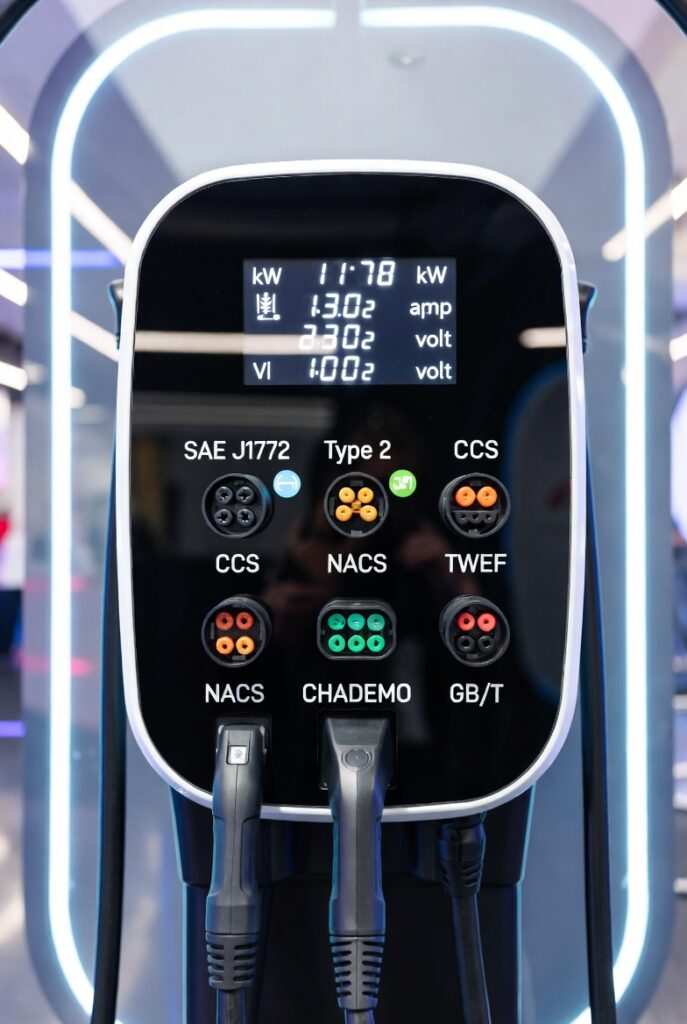
2. What connector does your car use?
- NACS: Tesla (all), Ford 2025+, GM 2025+, Rivian 2025+, Honda 2025+, most new US vehicles
- J1772: Chevrolet Bolt, older Ford Mach-E, older Hyundai/Kia US spec, VW ID.4 (US), older non-Tesla US EVs
- Type 2: Every EV sold in Europe and UK without exception
3. Is your home’s electrical supply single-phase or three-phase?
- UK: Almost all homes are single-phase (maximum 7.4 kW home charging regardless of car capability)
- US: Single-phase 240V (standard) — no three-phase in residential
- Continental Europe: Single-phase or three-phase (check your meter or ask your electrician)
If you don’t know, check your electricity meter or consumer unit. Single-phase meters have one live wire connection. Three-phase have three.
4. What is your realistic all-in budget?
Include installation costs in your budget estimate. A $399 charger with $500 installation is a $899 decision, not a $399 one. Include the installation cost when assessing your budget.
The Interactive EV Charger Selector Tool — US NACS/J1772 or Europe Type 2 Edition
Work through each question in sequence. Each answer takes you to the next relevant question or directly to a specific recommendation. Follow your path — don’t read ahead.
Question 1: Which market are you in?
A) United States or Canada → Go to Question 2 (US Path)
B) United Kingdom → Go to Question 2 (UK Path)
C) Continental Europe (Germany, France, Netherlands, Scandinavia, Spain, Italy, etc.) → Go to Question 2 (Europe Path)
US PATH
Question 2 (US): What connector does your EV use?
A) NACS (Tesla, Ford 2025+, GM 2025+, Rivian 2025+, Honda 2025+, most new vehicles) → Go to Question 3 (US — NACS)
B) J1772 (Chevrolet Bolt, older Ford Mach-E, VW ID.4 US, older Hyundai/Kia US, pre-2025 non-Tesla) → Go to Question 3 (US — J1772)
C) I have both vehicles (mixed household with NACS and J1772) → US Recommendation: Tesla Universal Wall Connector ($595)
The Tesla Universal Wall Connector includes a J1772 adapter in the box, making it natively compatible with both NACS and J1772 vehicles from a single installed unit. The 48A delivery, 4-year warranty, and load sharing capability for two-unit installations make it the cleanest solution for mixed connector households.
Your action: Confirm both vehicles’ maximum AC acceptance rates. If the J1772 vehicle accepts only 32A, set the Universal Wall Connector to 32A mode and it charges both vehicles optimally.
Question 3 (US — NACS): Do you have rooftop solar panels installed or planned within 2 years?
A) Yes — I have solar or plan to install it within 2 years → Go to Question 4 (US — NACS — Solar)
B) No solar, not planning solar → Go to Question 4 (US — NACS — No Solar)
Question 4 (US — NACS — Solar): What is your home’s electrical panel capacity?
A) 200-amp panel → US Recommendation: Emporia Pro NACS ($399 + Vue $175)
The Emporia Pro’s native NACS connector eliminates adapter complexity. Solar integration via the Vue whole-home energy monitor is the most cost-effective solar divert solution in the US market — charging from surplus solar rather than grid electricity, saving $400-$600 annually for typical California/Texas/Arizona solar households. At $574 all-in, the federal tax credit and utility rebate (where available) can reduce net cost to under $200.
Your charger: Emporia Pro NACS version Companion device: Emporia Vue energy monitor Annual saving (solar + TOU): $700-$1,200 depending on solar system and tariff
B) 100-amp panel → US Recommendation: Emporia Pro NACS ($399 + Vue $175)
The Emporia Pro wins here for two reasons simultaneously. The Vue solar integration saves on electricity costs. The load management monitors total home consumption and prevents breaker trips on the 100-amp panel — eliminating the need for a $1,500-$4,000 panel upgrade. For 100-amp panel homeowners with solar, the Emporia Pro + Vue delivers more combined financial value than any other single home EV charger product in the US market.
Your action: Have the Vue installed at the same time as the Emporia Pro. Configure load management settings in the Emporia app to your panel’s safe maximum.
Question 4 (US — NACS — No Solar): What is your home’s electrical panel capacity?
A) 200-amp panel with available circuit capacity → Go to Question 5 (US — NACS — 200A — No Solar)
B) 100-amp panel → US Recommendation: Emporia Pro NACS ($399) or ChargePoint Home Flex ($699)
On a 100-amp panel without solar, the choice is between the Emporia Pro’s load management capability ($399, avoids panel upgrade) and the ChargePoint Home Flex’s adjustable amperage ($699, manual panel headroom management).
If your baseline home consumption leaves 20+ amps of headroom: Emporia Pro — load management prevents occasional breaker trips without constant speed reduction.
If your panel is frequently near capacity (HVAC + water heater + cooking simultaneously): ChargePoint Home Flex set to 24-32A — predictable, consistent charging speed within safe panel limits.
C) I don’t know my panel capacity → Have an electrician assess your panel before buying any 48A charger. If assessment isn’t immediately possible, buy the ChargePoint Home Flex (adjustable 16-48A) and start at 32A until assessment is complete.
Question 5 (US — NACS — 200A — No Solar): What is your budget and primary priority?
A) Best integration with Tesla vehicles / maximum reliability / longest warranty → US Recommendation: Tesla Wall Connector Gen 3 ($425)
Hardwired only, 48A, 24-foot cable, 4-year warranty, seamless Tesla app integration, OTA updates, load sharing for two-unit installations. The cleanest NACS home charging solution available at a mid-range price.
B) Best value with smart features (TOU scheduling, load management, app monitoring) → US Recommendation: Emporia Pro NACS ($399)
At $26 less than the Tesla Wall Connector, the Emporia Pro delivers TOU scheduling, energy monitoring, and load management that the Wall Connector lacks. For NACS vehicle owners who want smart features without paying ChargePoint prices.
C) Maximum flexibility and network integration → US Recommendation: ChargePoint Home Flex ($699) with NACS adapter
Adjustable amperage, OCPP 1.6, ChargePoint network integration, NEMA 14-50 plug option. The premium price buys flexibility and established brand infrastructure.
D) Budget priority — reliable charging at lowest cost → US Recommendation: Grizzl-E Smart ($329) with NACS adapter
IP67 weather resistance, 40A (9.6 kW), WiFi scheduling, 3-year warranty. The most weather-resistant budget smart charger with NACS adapter compatibility.
E) Cold climate (Minnesota, Wisconsin, Montana, Canada) — weather resistance is paramount → US Recommendation: Grizzl-E Ultimate ($399-$449) with NACS adapter
IP67, -40°C operating temperature, internal heating element, cold-rated cable, aluminium enclosure. The most capable cold weather home EV charger in North America at this price point. NACS adapter included or available separately.
Question 3 (US — J1772): Do you have rooftop solar panels?
A) Yes — solar installed or planned → US Recommendation: Emporia Pro J1772 ($399 + Vue $175)
Same solar integration excellence as the NACS version — the Emporia Pro is available in J1772 at the same price. Solar divert and load management in one unit at the most competitive price in the US market.
B) No solar → Go to Question 4 (US — J1772 — No Solar)
Question 4 (US — J1772 — No Solar): What is your situation?
A) I own my home and plan to stay 3+ years → Go to Question 5 (US — J1772 — Homeowner)
B) I rent or plan to move within 2 years → US Recommendation: JuiceBox 40 ($549) or Lectron 240V EVSE ($189-$229)
If you want smart features: JuiceBox 40 — NEMA 14-50 plug (portable), 40A, TOU scheduling, utility demand response integration. Takes with you when you move.
If budget is primary: Lectron 240V EVSE — J1772 or NACS, NEMA 14-50 plug, 40A, genuine plug-in no-installation option. The cheapest capable portable Level 2 EVSE in the US market.
C) Cold climate (northern states, Canada) → US Recommendation: Grizzl-E Ultimate J1772 ($399-$449)
The unbeatable cold weather specification for J1772 vehicles in cold US climates. IP67, -40°C, internal heating. The Grizzl-E Duo ($299-$349) is the portable version for renters who need cold weather capability with portability.
Question 5 (US — J1772 — Homeowner): What is your budget range?
A) Under $300 — reliable charging at minimum cost → US Recommendation: Grizzl-E Classic J1772 ($229)
The best budget home EV charger for J1772 vehicles. 40A (9.6 kW), IP67, -40°C, 3-year warranty, aluminium enclosure. Exceeds the charging rate of J1772 vehicles that accept only 32A (Chevrolet Bolt, many others). No smart features — for flat-rate tariff users this is the optimal cost-minimising choice.
B) $300-$500 — smart features without premium pricing → US Recommendation: Grizzl-E Smart J1772 ($329) or Emporia Pro J1772 ($399)
Grizzl-E Smart: IP67 weather resistance + WiFi scheduling. Best for cold/wet climates where hardware durability matters as much as software.
Emporia Pro: Load management + TOU scheduling + energy monitoring. Best for 100-amp panels or buyers who want the most comprehensive smart feature set under $400.
C) $500-$800 — established brand, maximum flexibility → US Recommendation: ChargePoint Home Flex J1772 ($699)
Adjustable amperage (16-48A), OCPP 1.6, ChargePoint network integration, NEMA 14-50 plug option, 3-year warranty. The most flexible and comprehensively supported J1772 home charger in the US market. Future-proofed for panel changes and future vehicles through adjustable amperage.
D) Over $800 — or panel upgrade required alongside charger → Consider the Emporia Pro + Vue ($574) for load management that may avoid the panel upgrade. Get electrical assessment before committing to panel upgrade + any charger.
UK PATH
Question 2 (UK): Do you own your home or rent?
A) I own my property (house or flat) → Go to Question 3 (UK — Owner)
B) I rent → UK Recommendation: Portable EVSE + Negotiate NEMA equivalent
In the UK, a 32A commando socket installation (the UK equivalent of NEMA 14-50) with a portable Type 2 EVSE is the most practical option for renters. The Masterplug EVPOD2UK (£149-£199) plugs into a standard 13A socket for slow charging or a 32A commando for full 7.2 kW Level 2.
Your action: Negotiate with your landlord for a commando socket installation (typically £100-£200). Once installed, the portable EVSE provides full Level 2 charging that you take with you when you move.
Question 3 (UK — Owner): House or flat?
A) House with driveway or garage → Go to Question 4 (UK — House)
B) Flat with designated parking space → Go to Question 4 (UK — Flat)
C) Flat without dedicated parking / street parking only → UK Recommendation: Rely on public charging + check local authority on-street charging programme
For UK flat owners without parking access, the primary path is:
- Contact your local council about the On-Street Residential ChargePoint Scheme (ORCS) — many UK councils are installing on-street charging specifically for residents without off-street parking
- Use Pod Point, BP Pulse, or Osprey networks for regular charging
- Investigate workplace charging as a primary home charging substitute
This is the hardest UK scenario and no home charger solves it — the challenge is physical access, not hardware.
Question 4 (UK — House): Do you have rooftop solar panels?
A) Yes — solar installed or planned within 2 years → UK Recommendation: Myenergi Zappi (£699-£849)
The Zappi is the definitive answer for UK homeowners with solar. Eco+ mode charges exclusively from surplus solar generation — nothing from the grid. On a typical 4 kWp UK system, this saves £200-£400 annually in charging costs. The three-year warranty, OZEV eligibility, and Myenergi ecosystem integration (Eddi, Libbi) make this the best long-term solar EV charging investment in the UK market.
Your OZEV eligibility: House owners are NOT currently eligible for the OZEV EVHS grant. The grant applies to flat owners only since April 2022. Budget for full cost.
B) No solar — on Octopus Agile or planning to switch → UK Recommendation: Ohme Home Pro (£699-£799)
The Ohme Home Pro’s direct Octopus Agile API integration captures the cheapest 30-minute price windows automatically — generating £50-£150 additional annual savings versus a basic scheduled charger on the same tariff. For Octopus Agile users, this is the highest-ROI smart feature available in the UK market.
C) No solar — on Octopus Go, OVO Drive Anytime, or standard TOU overnight tariff → UK Recommendation: Wallbox Pulsar Plus (£649-£799)
For fixed overnight window tariffs, any smart charger with scheduling captures the full TOU saving. The Wallbox Pulsar Plus earns its recommendation here through bidirectional charging hardware readiness — when V2H becomes available for your vehicle, you’re positioned to participate without new hardware. The mature app, wide installer network, and 2-year warranty round out a strong overall package.
D) No solar — on standard rate tariff, no TOU plans → UK Recommendation: Easee One (£549-£649)
For UK homeowners on standard rate tariffs who want a quality charger without the solar premium, the Easee One delivers excellent charging efficiency, dynamic load balancing, 3-year warranty, and competitive pricing. The lack of Octopus/OVO API integration is irrelevant if you’re not on those tariffs.
Question 4 (UK — Flat): Is your flat eligible for the OZEV grant?
A) Yes — I am the flat owner (leaseholder) → Go to Question 5 (UK — Flat — OZEV Eligible)
B) I’m not sure about OZEV eligibility → Check eligibility at gov.uk/electric-vehicle-homecharge-scheme before purchasing. You need: to own/lease a qualifying EV, designated parking space, OZEV-approved charger, OZEV-registered installer. If eligible, the £350 grant significantly changes the net cost calculation.
Question 5 (UK — Flat — OZEV Eligible): What is your priority?
A) Solar panels present — maximise self-consumption → UK Recommendation: Myenergi Zappi (£699-£849) After OZEV grant: £349-£499 unit cost before installation
B) Octopus Agile — maximise dynamic tariff savings → UK Recommendation: Ohme Home Pro (£699-£799) After OZEV grant: £349-£449 unit cost before installation
C) Standard TOU / Octopus Go — smart features, good all-rounder → UK Recommendation: Wallbox Pulsar Plus (£649-£799) After OZEV grant: £299-£449 unit cost before installation
D) Budget priority after grant → UK Recommendation: Rolec WallPod EV Home (£449-£549) After OZEV grant: £99-£199 unit cost before installation — the lowest net hardware cost of any OZEV-approved smart charger.
EUROPE PATH
Question 2 (Europe): Which country are you in?
A) Germany → Go to Question 3 (Europe — Germany)
B) France → Go to Question 3 (Europe — France)
C) Netherlands or Belgium → Go to Question 3 (Europe — Netherlands/Belgium)
D) Norway, Sweden, Denmark, Finland → Go to Question 3 (Europe — Scandinavia)
E) Spain or Portugal → Go to Question 3 (Europe — Iberia)
F) Italy → Go to Question 3 (Europe — Italy)
G) Other European country → Go to Question 3 (Europe — General)
Question 3 (Europe — Germany): Do you have three-phase supply and an 11 kW capable EV?
A) Yes — three-phase supply + 11 kW EV (VW ID.4 Pro Performance, BMW iX, Hyundai Ioniq 5, etc.) → European Recommendation: Easee One Three-Phase (€499-€649)
Three-phase 22 kW delivery covers the 11 kW maximum of your vehicle with headroom for a future higher-spec EV. Dynamic load sharing for multi-EV households. Norwegian engineering quality. OCPP compliance for Tibber or other German dynamic pricing integration. 3-year warranty.
B) Single-phase supply or 7.2 kW EV (standard VW ID.3, Renault 5, Peugeot e-208, etc.) → European Recommendation: Wallbox Pulsar Plus Single-Phase (€699-€849)
7.4 kW single-phase delivery, bidirectional hardware readiness, mature app, pan-European installer network. KfW financing reduces effective cost. Best overall smart charger for German single-phase homes.
C) I have solar panels → European Recommendation: Myenergi Zappi (€749-€899)
Solar divert is the highest-value smart feature for German homeowners given Germany’s €0.30-€0.40/kWh grid electricity rates. The financial benefit of avoiding grid electricity with solar surplus is higher in Germany than almost any other European market.
Question 3 (Europe — France): Are you in an apartment or house? And is ADVENIR available?
A) Apartment with individual parking space → European Recommendation: Easee One (€499-€649) — Apply for ADVENIR first
ADVENIR subsidy covers up to €960 for individual apartment installations. After ADVENIR + TVA reduction (5.5% vs 20%), your net hardware + installation cost can approach zero. Apply for ADVENIR through an approved installer before purchasing — some application windows have limited budgets.
Effective recommended charger after incentives: Any ADVENIR-approved charger at near-zero cost. The Easee One is on the approved list and offers excellent value.
B) House — solar present or planned → European Recommendation: Myenergi Zappi (€749-€899)
French electricity rates are lower than Germany (approximately €0.23-€0.26/kWh) but Heures Creuses + solar divert still creates compelling savings. The Zappi is available in France and compatible with French solar systems.
C) House — no solar, standard installation → European Recommendation: Wallbox Pulsar Plus (€699-€849)
Standard French house installation — single-phase in most of France. TVA at 5.5% rather than 20% reduces effective cost automatically. ADVENIR for individual houses provides smaller subsidies than apartments but worth applying for.
Question 3 (Europe — Netherlands/Belgium): Do you want to apply for the SEEH subsidy (Netherlands)?
A) Yes — Dutch homeowner, will apply for SEEH → European Recommendation: Easee One (€499-€649)
SEEH covers 30% of purchase and installation costs up to €1,500. The Easee One + standard installation (€400) = €899 before SEEH. After 30% SEEH: €629. Combined with Easee’s dynamic load balancing and 3-year warranty, this represents exceptional value in the Dutch market.
Apply SEEH: Through the RVO portal at rvo.nl before the annual budget runs out (typically early in the year).
B) Belgian homeowner — Flemish, Walloon, or Brussels region → Check your regional incentive scheme (VEKA for Flanders, SPW for Wallonia, Bruxelles Environnement for Brussels) before purchasing. Each provides €100-€500 for qualifying installations.
European Recommendation: Wallbox Pulsar Plus (€699-€849) — broad Belgian installer network, bidirectional readiness, mature app.
C) No subsidy — want best value charger for three-phase home → European Recommendation: Easee One Three-Phase (€499-€649)
The best value three-phase capable smart charger in the Benelux market. Dynamic load sharing between multiple Easee units is particularly relevant for Dutch apartment buildings where multiple residents charge simultaneously.
Question 3 (Europe — Scandinavia): Are you in Norway?
A) Norway — want Tibber integration and Enova grant → European Recommendation: Easee One (€499-€649) + apply for Enova grant (approximately €260)
Easee is a Norwegian brand. The Easee One was designed for Norwegian conditions and has native Tibber API integration — the combination of Nordpool spot pricing optimisation and Enova grant creates one of the strongest ROI cases in any European market.
B) Sweden — want Rotavdrag tax deduction + green technology deduction → European Recommendation: Easee One or Wallbox Pulsar Plus
Swedish tax deductions reduce the effective installation cost by 15-30%. The Rotavdrag (30% of labour) and green technology deduction (15% of total cost) can reduce net cost by SEK 2,000-5,000 depending on installation complexity.
C) Denmark or Finland — standard installation → European Recommendation: Wallbox Pulsar Plus or Easee One
Denmark and Finland have fewer market-specific charger recommendations. The Wallbox Pulsar Plus (broad pan-European support) or Easee One (Nordic engineering, Tibber integration) are both strong choices.
Question 3 (Europe — Iberia): Spain or Portugal?
A) Spain — applying for MOVES III → European Recommendation: Wallbox Pulsar Plus (€699-€849)
MOVES III provides up to €500 for home EV charger installation. Applied through your autonomous community’s energy agency. The Wallbox Pulsar Plus is on most approved lists and has the broadest Spanish installer network of any premium charger.
After MOVES III: €199-€349 effective unit cost in best case.
B) Portugal — want reduced IVA (6% vs 23%) → European Recommendation: Wallbox Pulsar Plus or Easee One
Portugal’s 6% IVA on qualifying EV charging equipment applies automatically — no application required. A 17% VAT saving on a €699-€849 charger saves €119-€144 automatically.
Question 3 (Europe — Italy): Have you applied for or are you eligible for the Bonus Colonnine?
A) Yes — Bonus Colonnine available (application window open) → European Recommendation: Wallbox Pulsar Plus (€749)
The Bonus Colonnine covers 80% of purchase and installation costs up to €1,500. On a €749 charger with €400 installation (€1,149 total): 80% = €919 subsidy, net cost = €230. This is the most generous home EV charger subsidy in Europe. Apply before the window closes — budgets typically exhaust within hours or days of opening.
Your action: Check applicability at the official Italian government portal. Prepare your documentation (fiscal code, charger specs, installer details) before the application window opens.
B) Bonus Colonnine not currently available → European Recommendation: Easee One (€499-€649) or Wallbox Pulsar Plus (€699-€849)
Without the Bonus Colonnine, Italy’s net charger cost reverts to full price. The Easee One represents the best value at full price in the Italian market.
Question 3 (Europe — General): What is your primary priority for your European Type 2 home charger?
A) Best overall smart charger — broad installer network, mature app, bidirectional readiness → European Recommendation: Wallbox Pulsar Plus (£649-£799 / €699-€849)
The pan-European benchmark. Wide installer network across all European markets. Bidirectional hardware readiness. Available in single-phase (7.4 kW) and three-phase (22 kW). Best overall recommendation for European buyers without a specific country incentive or feature priority.
B) Best for solar self-consumption → European Recommendation: Myenergi Zappi (£699-£849 / €749-€899)
Available across Europe (primary market UK, but available in European markets). Solar divert is the highest-value smart feature for solar-owning EV drivers regardless of market. Financial payback within 1-2 years for typical solar households.
C) Best value smart charger — competitive price, 3-year warranty, good load balancing → European Recommendation: Easee One (£549-£649 / €499-€649)
Norwegian engineering, best standby efficiency of any mainstream smart charger, dynamic load balancing, 3-year warranty, available in single-phase and three-phase. The strongest value proposition in the European market at this price point.
D) Best for multi-unit apartment building → European Recommendation: Zaptec Go (£549-£649 / €499-€599) or Easee One
Multi-user billing and dynamic load balancing make the Zaptec Go specifically suitable for apartment building installations. Easee One’s multi-unit load sharing is equally appropriate for buildings where individual billing is less critical.
E) Best premium option — design quality, OCPP 2.0.1, commercial-grade reliability → European Recommendation: Andersen A2 (£1,199-£1,999) or ABB Terra AC W7 (£849-£1,200)
Andersen A2: Premium aesthetics, brushed aluminium, integrated cable management, OCPP 2.0.1. The charger for buyers who care as much about how the installation looks as what it does.
ABB Terra AC W7: Commercial-grade reliability, highest charging efficiency in comparison (97-98%), OCPP 2.0.1, 5-year extended warranty option. The charger for buyers who want industrial engineering standards in a residential product.
The Quick Reference Summary — All Recommendations at a Glance
US Market Recommendations
| Scenario | Recommended Charger | Price | Key Feature |
|---|---|---|---|
| NACS, solar, 200A panel | Emporia Pro NACS + Vue | $574 | Solar divert + TOU |
| NACS, solar, 100A panel | Emporia Pro NACS + Vue | $574 | Solar + load management |
| NACS, no solar, Tesla | Tesla Wall Connector | $425 | Tesla integration, 4yr warranty |
| NACS, no solar, value | Emporia Pro NACS | $399 | Smart features, best value |
| NACS, no solar, flexible | ChargePoint Home Flex | $699 | Adjustable A, OCPP |
| NACS, mixed household | Tesla Universal WC | $595 | J1772 adapter included |
| NACS, cold climate | Grizzl-E Ultimate + adapter | $399-$449 | IP67, -40°C, heating |
| J1772, solar | Emporia Pro J1772 + Vue | $574 | Solar divert |
| J1772, standard | ChargePoint Home Flex | $699 | Flexible, established brand |
| J1772, budget | Grizzl-E Classic | $229 | IP67, 40A, 3yr warranty |
| J1772, renter | JuiceBox 40 | $549 | Portable NEMA 14-50 |
| J1772, ultra-budget | Lectron 240V EVSE | $189 | Portable plug-in |
UK Market Recommendations
| Scenario | Recommended Charger | Price | OZEV After Grant |
|---|---|---|---|
| House, solar | Myenergi Zappi | £699-£849 | N/A (houses not eligible) |
| House, Octopus Agile | Ohme Home Pro | £699-£799 | N/A |
| House, Octopus Go | Wallbox Pulsar Plus | £649-£799 | N/A |
| House, standard rate | Easee One | £549-£649 | N/A |
| Flat, solar, OZEV | Myenergi Zappi | £699-£849 | £349-£499 unit |
| Flat, Agile, OZEV | Ohme Home Pro | £699-£799 | £349-£449 unit |
| Flat, Go, OZEV | Wallbox Pulsar Plus | £649-£799 | £299-£449 unit |
| Flat, budget, OZEV | Rolec WallPod | £449-£549 | £99-£199 unit |
| Renter | Masterplug EVPOD2UK | £149-£199 | N/A |
European Market Recommendations
| Country/Scenario | Recommended Charger | Key Incentive | Net Cost |
|---|---|---|---|
| Germany, three-phase 11kW EV | Easee One Three-Phase | KfW financing | €499-€649 |
| Germany, single-phase | Wallbox Pulsar Plus | KfW financing | €699-€849 |
| Germany, solar | Myenergi Zappi | N/A | €749-€899 |
| France, apartment | Easee One | ADVENIR + TVA | €0-€200 |
| France, house, solar | Myenergi Zappi | TVA (5.5%) | €700-€850 |
| Netherlands, SEEH | Easee One | SEEH 30% | €350-€500 |
| Norway, Tibber | Easee One | Enova €260 | €240-€390 |
| Sweden | Easee One | Rotavdrag | €300-€500 |
| Spain, MOVES III | Wallbox Pulsar Plus | MOVES III €500 | €200-€350 |
| Italy, Bonus Colonnine | Wallbox Pulsar Plus | 80% up to €1,500 | €230 |
| General Europe, best value | Easee One | Varies | €499-€649 |
| General Europe, best overall | Wallbox Pulsar Plus | Varies | €699-€849 |
| General Europe, solar | Myenergi Zappi | Varies | €749-€899 |
| General Europe, premium | Andersen A2 | Varies | €1,299-€2,199 |
After Your Recommendation — The Five Actions to Take Next
Once you’ve identified your recommended charger through the interactive EV charger selector tool US NACS J1772 or Europe Type 2 edition, these are the next steps in the right order:
Action 1: Verify Your Charger is on the Relevant Approved Lists
Before purchasing, confirm the charger qualifies for any incentive you plan to claim:
- UK OZEV: Check the approved product list at ozev.gov.uk
- US Energy Star: Check energystar.gov for Energy Star certification
- ADVENIR (France): Check advenir-ev.fr
- SEEH (Netherlands): Check rvo.nl
- MOVES III (Spain): Check your autonomous community’s approved list
Hardware not on the approved list disqualifies you from the grant. Check before purchasing.
Action 2: Get Your Electrical Assessment Done Before Ordering
An electrician’s assessment takes 30-60 minutes and tells you: your panel’s available capacity, the optimal cable route, any panel or supply upgrades required, and an accurate installation quote. Do this before ordering your charger — not after.
Action 3: Apply for Any Grant That Requires Pre-Approval
Several incentive programmes require application and approval before installation begins. In the UK, the OZEV grant is applied for by your installer — choose your installer before purchasing. In France, ADVENIR application through an approved installer precedes installation. In the US, some utility rebate programmes require pre-registration.
Action 4: Choose Your Electricity Tariff Simultaneously
The tariff switch and charger installation should happen simultaneously — or the tariff switch first. UK EV owners switching to Octopus Go or Agile should complete the switch before their first charging session. US EV owners should enrol in their utility’s EV TOU rate before or at installation.
Action 5: Book an OZEV-Registered or Nationally Certified Installer
In the UK, only OZEV-registered installers can certify the installation for grant purposes and provide the required Electrical Installation Certificate. In Europe, nationally certified electricians are required for all new circuit work. Don’t use an uncertified installer — the grant and warranty implications make it a false economy.
Why This Interactive Tool Gives Different Answers for Different People
The interactive EV charger selector tool US NACS J1772 or Europe Type 2 edition produces different recommendations for different buyers because the genuinely right charger depends on factors that fixed top-ten lists can’t account for.
The buyer who gets the Tesla Wall Connector recommendation is a NACS vehicle owner in a 200-amp panel home without solar and without specific TOU optimisation needs — for whom the Tesla’s seamless integration and 4-year warranty are the highest-value features.
The buyer who gets the Emporia Pro recommendation is a NACS or J1772 vehicle owner with either solar panels, a 100-amp panel that needs load management, or a priority on maximum smart features per dollar — for whom the Emporia’s feature density at $399 is unmatched.
The buyer who gets the Myenergi Zappi recommendation has solar panels — in the UK or Europe — where solar divert is the highest-value smart feature available and where the Zappi’s Eco+ mode delivers a financial benefit that no competing charger at any price matches.
The buyer who gets the Rolec WallPod recommendation is a UK flat owner after the OZEV grant with a priority on minimum net cost and reliable charging without premium features they won’t use.
None of these recommendations is universally right. All of them are right for the specific situation that leads to them. That’s what the selector tool is for.
Internal Links — Further Reading on Clean Energy Bazaar
The interactive EV charger selector tool US NACS J1772 or Europe Type 2 edition points you to a specific charger. These guides tell you everything about that charger and the decisions surrounding it.
For the full US home charger comparison covering every charger recommended in the US path, our best home EV chargers 2026 US comparison covers ten options honestly. For the UK and European market, our best Level 2 EV chargers UK Europe 2026 guide covers every major option. For the financial case behind every recommendation — ROI calculations with rebates included — our EV home charger ROI calculator 2026 gives exact payback periods. For the time-of-use savings that most recommendations depend on, our time-of-use EV charging savings guide covers every tariff and charger combination. For US rebates that reduce the net cost of every US recommendation, our US EV charger rebates by state 2026 guide covers every major programme. For European grants reducing European recommendation costs, our EV home charging incentives Europe 2026 guide covers every country. For installation cost context for every recommendation, our professional EV charger installation costs 2026 guide covers every market. And for understanding every spec mentioned in any recommendation, our EV charger specs 2026 guide translates everything into plain language.
Final Thoughts
The interactive EV charger selector tool US NACS J1772 or Europe Type 2 edition exists because the right home EV charger is not the same for everyone — and the generic “just buy the Tesla Wall Connector” or “just get a Wallbox” advice that dominates EV communities ignores the variables that actually determine which charger delivers the most value for a specific buyer.
Work through the questions honestly. The answer at the end of your path is a specific charger that fits your car’s connector, your home’s electrical supply, your location’s grant eligibility, your driving pattern, and your budget — not a generalised recommendation that requires you to figure out whether it applies to you.
If you’ve followed the path and have a recommendation, the next step is the five actions above. If you’re unsure about any of your answers — particularly panel capacity or supply type — get the electrical assessment done first. That single piece of information is the most important input to the entire selector tool.
Your charger is at the end of the path. The questions are designed to get you there.