Here’s the question that almost nobody asks when buying a home EV charger — and almost everybody wishes they had asked three years into ownership.
“What happens when it goes wrong?”
The EV charger buying conversation focuses almost entirely on purchase price, charging speed, smart features, and connector compatibility. These are legitimate criteria. But a home EV charger is a piece of electrical hardware that you’ll use every day for 7-10 years, in conditions ranging from mild indoor garage installations to fully exposed outdoor wall mounting in coastal rain, winter frost, and summer heat.
Over that 7-10 year lifespan, things happen. Connectors wear. Firmware updates break features. WiFi modules lose connectivity. Cable jackets crack after sustained cold. Displays fail. Warranty coverage runs out. And the question of whether the manufacturer still supports your hardware — through software updates, replacement parts, and service infrastructure — becomes more relevant than the charging speed specification it superseded.
This guide on EV charger maintenance 2026 brand comparison US Grizzl-E vs Europe Wallbox addresses the long-term ownership question honestly. It covers what home EV charger maintenance actually involves, what the most common failure modes are across brands, how Grizzl-E and Wallbox specifically compare on reliability, warranty terms, and service infrastructure, and what the true long-term ownership cost picture looks like when maintenance is included.
What EV Charger Maintenance Actually Involves
Before comparing specific brands, establishing what home EV charger maintenance realistically covers prevents both over-preparation and under-preparation.
What Home EV Chargers Don’t Need
Contrary to what the complexity of their spec sheets suggests, home EV chargers have relatively few moving parts and relatively low maintenance requirements compared to most home electrical appliances. They don’t need:
- Annual servicing by a qualified engineer (unlike gas boilers)
- Regular fluid changes or lubrication (unlike petrol vehicles)
- Filter replacement (unlike air conditioning or water heating systems)
- Mechanical calibration (unlike garage door openers or precision appliances)
The maintenance reality for most home EV charger owners is closer to “occasional cleaning and annual inspection” than “regular professional servicing.”
What Home EV Chargers Do Need
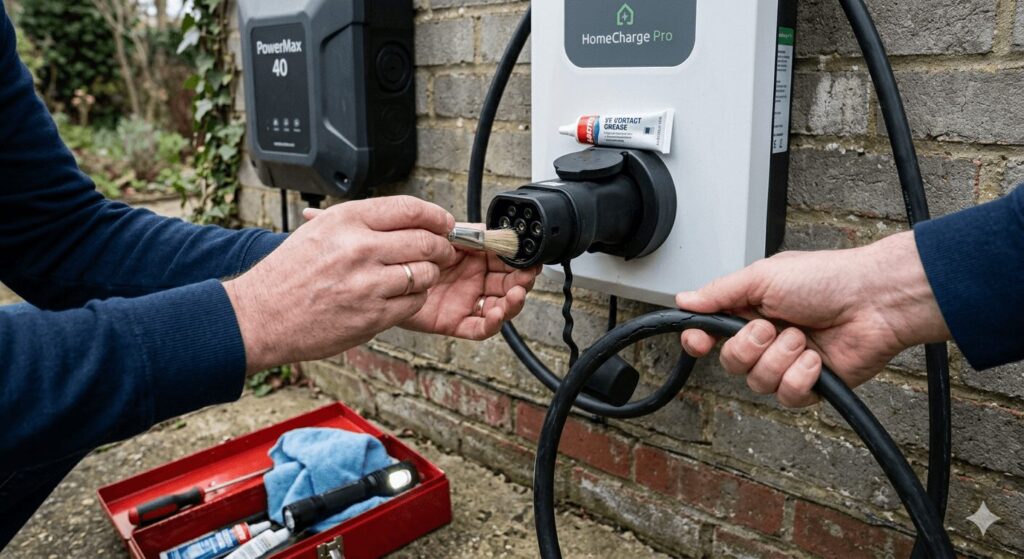
Connector inspection and cleaning (every 6-12 months): The charging connector — the physical plug that connects to your car — is the highest-wear component of any home EV charger. It experiences physical insertion and removal every day, exposure to weather and contamination, and electrical arcing that gradually degrades the contact surfaces.
Visual inspection checks for:
- Pin corrosion (particularly in coastal environments or high-humidity areas)
- Physical damage to the connector housing (cracks, deformation from repeated use or rough handling)
- Locking mechanism function (the click that confirms secure connection)
- Cable jacket condition near the connector body (stress cracking, particularly on cheaper cables in cold climates)
Cleaning procedure:
- Dry soft brush to remove dust and debris
- Compressed air for internal contact areas
- Dielectric grease application to contact pins (small amount — prevents corrosion and ice bonding)
- Never use water directly on the connector
Cable inspection (every 6 months): Run your hand along the full cable length checking for:
- Stiffening or hardening of the cable jacket (indicates degradation from UV or cold)
- Cracks in the jacket, particularly near connectors and any bend points
- Visible copper conductor through jacket damage (immediate replacement required)
- Unusual warmth during charging (may indicate internal conductor damage)
Mounting hardware check (annually): Verify that the charger remains securely mounted on the wall. Thermal expansion and contraction cycles in outdoor installations can gradually loosen mounting hardware. Check and re-torque mounting screws annually for exposed outdoor installations.
Firmware updates (as released): Smart charger firmware updates are released by manufacturers to fix bugs, improve efficiency, add features, and maintain compatibility with evolving vehicle software. Most smart chargers (Emporia Pro, ChargePoint, Wallbox, Myenergi) update automatically over WiFi — but confirming updates are being received and applied requires periodic app checks.
WiFi and connectivity verification (quarterly): Confirm your smart charger maintains reliable network connectivity. Most smart charger apps show connection status. A charger that has silently lost WiFi connectivity is not scheduling TOU charging — which could cost you significantly on electricity costs.
What Requires Professional Attention
Any fault codes or error indicators: Most smart chargers display error codes through their app or on-unit indicator lights. Don’t attempt to diagnose electrical faults yourself — contact the manufacturer’s support or an OZEV-registered/licensed electrician.
Any signs of water ingress: Discolouration, rust, or condensation inside the charger housing indicates water has penetrated. Stop using the charger and contact the manufacturer.
Any physical damage to the charger housing: Cracked enclosures from impact or UV degradation compromise the IP protection that keeps weather out of electronics. Replace or repair before water damage occurs.
Cable replacement: A damaged cable should be replaced — this is typically a manufacturer or qualified electrician job for hardwired chargers. For portable EVSEs, the cable replacement may be a user-serviceable task on some products.
The Most Common Home EV Charger Failure Modes — Industry Data
Understanding what actually fails on home EV chargers across the market provides useful context for the brand comparison.
Failure Mode 1: Connector Degradation (Most Common)
The Type 2, J1772, or NACS connector is the component with the shortest expected lifespan relative to the rest of the charger hardware. Rated for typically 10,000 insertion cycles by IEC standards, daily use delivers approximately 3,650 cycles over 10 years — well within the rated life. But real-world conditions (contamination, rough handling, cold stiffening, UV degradation of the connector housing) often shorten effective connector life.
Typical symptoms: Intermittent charging initiation failures, connector won’t lock securely, visible pin corrosion, reduced power delivery.
Resolution: Connector replacement — typically a manufacturer warranty job within warranty, a user-serviceable or electrician job out of warranty. Connector replacement cost: £30-£80 (UK), $30-$80 (US) for parts.
Brand variation: Chargers with metal connector housings (some ABB, some commercial-grade options) last longer than plastic-housed connectors in harsh environments. Budget charger connectors typically show degradation faster than premium alternatives.
Failure Mode 2: Smart Features and WiFi Module Failures (Increasingly Common)
As smart chargers become more common and as their software ecosystems age, firmware corruption, WiFi module failures, and app backend changes have become the second most common failure mode category.
Typical symptoms: Charger loses WiFi connectivity permanently, scheduled charging stops working, app cannot communicate with charger, charger gets stuck in error state after firmware update.
Resolution: Factory reset (resolves many firmware issues), WiFi module replacement (less common, more complex), contact manufacturer support. Many smart charger WiFi issues are resolved through software rather than hardware intervention.
Brand variation: This is where manufacturer software support longevity matters enormously. A charger brand that discontinues software support or ceases operations leaves owners with smart hardware that can only be used as a dumb charger — all scheduling, monitoring, and integration features permanently offline.
Failure Mode 3: Contactor Failure
The contactor is the internal switching component that opens and closes the charging circuit when a vehicle connects and disconnects. It’s rated for a large number of switching cycles but can fail through arcing damage, contamination, or simple end-of-life wear.
Typical symptoms: Charger powers on but doesn’t initiate charging, or charging stops unexpectedly mid-session.
Resolution: Contactor replacement — typically not user-serviceable, requires manufacturer repair or electrician intervention. Cost: £50-£150 including labour.
Brand variation: Higher-quality contactors in premium chargers (Wallbox, ABB) have longer rated cycle lives than contactors in budget alternatives.
Failure Mode 4: Display and LED Indicator Failure
Display screens and LED status indicators are electronic components with finite lifespans — particularly when exposed to sustained UV radiation in outdoor installations or temperature extremes.
Typical symptoms: Display becomes dim, blank, or shows corrupted information. LED indicators stop functioning.
Resolution: Display replacement (complex) or operating without display confirmation (functional but reduced feedback). For chargers without displays (Grizzl-E Classic) this failure mode doesn’t apply.
Brand variation: Chargers without displays (Grizzl-E Classic, some Easee variants) avoid this failure mode entirely. The simplicity of non-display designs is a genuine reliability advantage.
Failure Mode 5: Cable Jacket Degradation
The charging cable jacket — the outer insulation layer — degrades over time through UV exposure, ozone, temperature cycling, and physical wear. In cold climates, PVC jackets crack and harden. In high-UV environments, UV-stabilised jackets outperform standard alternatives.
Typical symptoms: Visible cracking or stiffening of the cable jacket, particularly near connectors and bend points.
Resolution: Cable replacement. For portable EVSEs, straightforward. For hardwired tethered chargers, a manufacturer warranty or electrician job.
Brand variation: Cold-rated cable compounds (Grizzl-E, certain Hypervolt variants) significantly outperform standard PVC in cold climates. UV-stabilised jackets outperform standard in high-UV outdoor installations.
Grizzl-E — Long-Term Reliability and Maintenance Profile
The Grizzl-E Brand Context
Grizzl-E is a Canadian EV charger brand that has built its reputation specifically around durability and cold weather performance rather than smart feature density. The brand occupies a distinctive position in the North American market — not the feature-richest charger, not the cheapest, but consistently the most discussed charger in EV owner communities specifically in the context of long-term reliability.
Understanding the Grizzl-E maintenance profile requires understanding the design philosophy: fewer components, simpler electronics, more robust physical enclosure. The Grizzl-E Classic has no display, no WiFi module (in the basic version), no energy monitoring hardware — every component that isn’t there is a component that can’t fail.
Grizzl-E Classic — Maintenance Profile
Hardware design for maintenance:
Aluminium enclosure: The Grizzl-E Classic’s aluminium alloy enclosure is more dimensionally stable across temperature extremes than polycarbonate alternatives. Metal enclosures don’t crack from UV exposure, don’t deform in sustained heat, and don’t become brittle in sustained cold. The aluminium enclosure is the single most important reliability design choice in the Grizzl-E Classic.
IP67 rated: Full waterproofing to 1 metre immersion depth. In practice for a wall-mounted charger, this means genuinely excellent rain and ice protection. The IP67 rating is more robust than the IP55 rating of most competing chargers — rain driving into an outdoor-mounted charger reaches the IP67 Grizzl-E less effectively than the IP55 alternatives.
-40°C cold-rated cable: The proprietary cold-rated cable compound used in the Grizzl-E Classic and Ultimate maintains flexibility at -40°C where standard PVC cables stiffen and can crack. This cable specification is the second most important reliability advantage in cold climate installations.
Minimal smart electronics: The Classic version’s absence of WiFi, display, and energy monitoring hardware means the failure modes associated with these components simply don’t exist. The Classic’s electronics are limited to the core charging control circuit — a simpler, more robust arrangement than smart charger alternatives.
Connector: Grizzl-E uses J1772 connectors (or NACS on newer variants) sourced from established connector manufacturers. User reports indicate connector longevity comparable to mid-range competitors — not the premium longevity of industrial-grade connectors, but not the early degradation occasionally reported on budget alternatives.
Grizzl-E Smart — Maintenance Profile
The Grizzl-E Smart adds WiFi connectivity, TOU scheduling, and app monitoring to the Classic’s hardware foundation — introducing the smart feature failure modes the Classic avoids.
App and WiFi reliability: Owner community reports on the Grizzl-E Smart’s WiFi connectivity are mixed. The WiFi module occasionally loses connectivity after router changes or power cycles and requires manual reset procedures. This is a known limitation that Grizzl-E has addressed in firmware updates but hasn’t completely eliminated. For owners who actively use the smart scheduling features, this periodic reconnection issue is an annoyance that requires occasional manual intervention.
Firmware update history: Grizzl-E has released regular firmware updates for the Smart variant — addressing WiFi stability, adding features, and maintaining compatibility with evolving vehicle software. The update cadence is slower than ChargePoint or Tesla but consistent enough to suggest ongoing software support.
Grizzl-E Ultimate — Maintenance Profile
The Grizzl-E Ultimate adds internal heating, 48A capability, and smart features to the Classic’s durability foundation.
Internal heating element: The internal heating element is both the Ultimate’s most distinctive feature and an additional maintenance consideration. The heating element warms the charger’s electronics before startup at very low temperatures — preventing cold-temperature startup failures. Over the charger’s lifespan, the heating element adds a component that can fail (typically through overheating or element degradation) but in practice, Grizzl-E Ultimate owner reports of heating element failures are rare in available community data.
Maintenance implication: The Ultimate requires periodic verification that the internal heating activates at cold temperatures — a functional test best done on the first genuinely cold morning of each winter season.
Grizzl-E Warranty — The Detailed Terms
Standard warranty: 3 years on all Grizzl-E products
What the warranty covers:
- Manufacturing defects in hardware
- Electronic component failures not caused by user damage or improper installation
- Cable defects within warranty period
What the warranty doesn’t cover:
- Physical damage from impact, improper installation, or user modification
- Failures caused by electrical supply problems (surges, incorrect voltage)
- Normal wear on connector contacts
- Damage from installation in conditions exceeding the rated specifications
Warranty claim process: Grizzl-E’s warranty claim process has been consistently reviewed positively by owners in North American EV owner communities. The process involves:
- Contact Grizzl-E support with description and photos of the fault
- Remote diagnostic assessment by support team
- Replacement unit dispatch or repair authorisation
- Typically 3-7 business day resolution for straightforward warranty claims
The warranty claim experience: Owner forum reviews on Reddit’s r/electricvehicles and specific EV owner communities consistently rate Grizzl-E’s warranty service above average — direct communication with knowledgeable support staff, responsive replacement dispatch, and minimal bureaucracy compared to larger brand alternatives.
Grizzl-E Out-of-Warranty Maintenance
Parts availability: Grizzl-E’s relatively straightforward design uses standard components for many parts — circuit breakers, cable connectors, and enclosure hardware are replaceable through standard electrical supply channels. The proprietary components (control board, cold-rated cable) require manufacturer or authorised parts.
Grizzl-E’s stated commitment: As a brand built on community reputation in a specific niche (cold weather, outdoor durability), Grizzl-E has strong business incentives to maintain parts availability and support beyond warranty. Brand trust in the North American EV charging community is Grizzl-E’s primary competitive asset — support abandonment would significantly damage this.
Post-warranty failure cost estimates:
- Connector replacement (J1772 or NACS): $30-$60 parts + installation
- WiFi module replacement (Smart/Ultimate): $40-$80 parts + labour
- Control board replacement: $80-$150 parts + labour
- Full cable replacement: $60-$100 parts + labour
5-year maintenance cost estimate (Grizzl-E Classic): For a typically installed Grizzl-E Classic in normal conditions (not extreme cold, covered installation):
- Routine maintenance (connector cleaning, cable inspection): $0-$20 in materials over 5 years
- No expected component failures within 5 years based on owner community data
- Estimated 5-year maintenance cost: $0-$30
For a Grizzl-E Classic in exposed outdoor installation in extreme cold (Minnesota, Montana, Alberta):
- Cable end fittings may require inspection and replacement after year 4-5: $30-$60
- Annual dielectric grease application: $5/year
- Estimated 5-year maintenance cost: $35-$85
Wallbox — Long-Term Reliability and Maintenance Profile
The Wallbox Brand Context
Wallbox is a Spanish EV charging company founded in 2015, headquartered in Barcelona, with strong European market presence and a growing US footprint. Unlike Grizzl-E’s durability-focused positioning, Wallbox competes on smart features, design quality, and ecosystem depth — the Wallbox Pulsar Plus and Commander 2 are featured chargers precisely because of their combination of smart functionality, bidirectional hardware readiness, and wide installer networks.
The Wallbox maintenance profile reflects a different design philosophy from Grizzl-E — more complex smart hardware, design-oriented form factor, and a larger global support infrastructure.
Wallbox Pulsar Plus — Maintenance Profile
Hardware design for maintenance:
Polycarbonate enclosure (IP55): The Pulsar Plus uses a polycarbonate housing rated IP55 — adequate for outdoor installation but less robust than the Grizzl-E’s IP67 aluminium in harsh conditions. Polycarbonate can yellow and become slightly brittle after 5-7 years of direct UV exposure in high-UV climates (Southern Spain, California, Australia). In the UK, Northern Europe, and most US installations, UV degradation is less of a concern.
Smart electronics density: The Pulsar Plus contains significantly more electronics than the Grizzl-E Classic — WiFi module, Bluetooth, energy monitoring circuitry, display interface, and the bidirectional hardware preparation components that distinguish it from simpler alternatives. More electronics means more potential failure points, but Wallbox’s engineering quality is generally regarded as adequate to premium for a consumer product.
Cable: The Pulsar Plus tethered cable is standard European specification — adequate for typical European installation conditions. Not specifically cold-rated for sustained extreme cold (Grizzl-E’s specific advantage).
Connector: Wallbox uses Type 2 connectors sourced from established European connector manufacturers. User reports indicate connector longevity that’s comparable to market average — adequate for daily use in typical conditions.
Wallbox Reliability — The Community Data
Wallbox has a larger installed base than Grizzl-E — having sold significantly more units across European markets — which means more owner feedback is available across community platforms (Reddit, specific EV owner forums, Trustpilot reviews).
Areas where Wallbox performs well:
- Hardware build quality relative to price point receives generally positive reviews
- The Pulsar Plus’s core charging function (delivering power to the vehicle) is reliable in normal conditions
- Physical installation quality is consistently reviewed well
Areas where Wallbox has received criticism:
App stability: The Wallbox app has received inconsistent reviews over the years — the app has been through significant updates, some of which temporarily broke features or changed user interfaces in ways that frustrated established users. App reliability has improved in more recent versions but the update history includes periods of reduced stability.
WiFi connectivity issues: Similar to Grizzl-E Smart and other WiFi-connected chargers, the Wallbox Pulsar Plus occasionally loses WiFi connectivity after network changes or updates. Owner reports indicate this is resolved through app reconnection in most cases but is reported more frequently than for some competing chargers.
Customer support response times: This is the most consistent criticism in Wallbox owner community reviews. During periods of high demand (new product launches, widespread firmware update issues), Wallbox customer support response times have been reported as slow — sometimes 5-10 business days for initial responses.
Specific firmware update issues: Several firmware update events have caused Wallbox Pulsar Plus units to lose smart features temporarily — TOU scheduling not working after an update, energy monitoring showing incorrect data, connectivity dropping after automatic updates. Most of these have been resolved in subsequent updates but the pattern of update-introduced issues appears more frequently in Wallbox community reviews than in Grizzl-E or ChargePoint reviews.
Wallbox Commander 2 — Maintenance Profile
The Commander 2 is Wallbox’s premium residential/commercial charger with higher power capability and bidirectional functionality. Its maintenance profile differs from the Pulsar Plus:
Higher component complexity: Bidirectional hardware capability adds significant electronics complexity — the AC-DC-AC power conversion components required for bidirectional operation are more sophisticated than standard AC charging circuits. This additional complexity means more potential failure points.
Higher repair cost: Commander 2 repairs are more expensive than Pulsar Plus repairs due to the greater component complexity and the need for specialist service in some cases.
For most residential users: The Commander 2’s bidirectional functionality isn’t yet commercially active for most residential users — the hardware capability awaits software activation for compatible vehicles. This means owners are paying the maintenance complexity premium of bidirectional hardware while only using the AC charging functionality.
Wallbox Warranty — The Detailed Terms
Standard warranty: 2 years (standard) — this is the shortest standard warranty in the mainstream European charger market comparison
Extended warranty: Available for purchase — typically extends to 3 or 5 years for additional cost. Worth noting that the Grizzl-E Classic, Myenergi Zappi, Easee One, and Hypervolt Home 3 Pro all provide 3-year standard warranties without additional cost.
What the warranty covers:
- Manufacturing defects in hardware components
- Electronic failures not caused by improper installation or user damage
- Software/firmware issues that prevent normal function
What the warranty doesn’t cover:
- Physical damage from impact or improper installation
- Electrical supply problems causing damage
- Normal connector wear
- Damage from non-standard installation environments
Warranty claim process: Wallbox’s warranty claim process has been reviewed inconsistently. The process involves:
- Contact Wallbox support through the app or website
- Remote diagnostic assessment
- On-site service dispatch (for complex issues) or replacement unit
The service response time concern: The most consistent negative review pattern for Wallbox warranty service is response time — particularly during busy periods. Several owner reviews describe 10-15 business day turnarounds for warranty replacements during peak demand periods. For an owner whose primary home charging is out of service for two weeks, this is a significant inconvenience.
Wallbox Out-of-Warranty Maintenance
Parts availability: Wallbox’s European headquarters and Spanish manufacturing base means European parts availability is generally adequate. US parts availability is less established given Wallbox’s more recent US market entry.
Service network: Wallbox has a certified installer and service network across European markets — finding a qualified service engineer for out-of-warranty repair is easier in the UK, Germany, France, and the Netherlands than for some less established brands.
Post-warranty failure cost estimates (Europe):
- Connector replacement (Type 2): €30-€60 parts + installation
- WiFi module replacement: €50-€100 parts + labour
- Control board replacement: €100-€200 parts + labour
- Full cable replacement: €80-€150 parts + labour
5-year maintenance cost estimate (Wallbox Pulsar Plus): For a typically installed Wallbox Pulsar Plus in normal UK or European conditions:
- Routine maintenance (connector cleaning, annual inspection): £0-£20 in materials
- Possible app/WiFi reset procedures: Negligible cost (time, no parts)
- Low probability hardware failure within 5 years
- Estimated 5-year maintenance cost (hardware): £20-£50
The 2-year warranty gap: The most significant Wallbox maintenance consideration is the 2-year warranty period relative to competitors offering 3 years standard. The 3rd year — when warranty would otherwise cover defects on a 3-year product — is out-of-warranty for Wallbox. Out-of-warranty repair costs in year 3 average approximately £80-£200 for component failures. This represents a genuine additional expected cost relative to 3-year warranty competitors.
Direct Comparison — Grizzl-E vs Wallbox on Every Maintenance Dimension
Reliability Comparison Table
| Dimension | Grizzl-E Classic | Grizzl-E Ultimate | Wallbox Pulsar Plus | Wallbox Commander 2 |
|---|---|---|---|---|
| Enclosure material | Aluminium alloy | Aluminium alloy | Polycarbonate | Polycarbonate |
| IP rating | IP67 | IP67 | IP55 | IP54 |
| Min operating temp | -40°C | -40°C | -25°C | -25°C |
| Cold-rated cable | ✅ Yes | ✅ Yes | ❌ No | ❌ No |
| Internal heating | ❌ No | ✅ Yes | ❌ No | ❌ No |
| Smart electronics | Minimal | Moderate | Moderate | High |
| Display | ❌ No | LED only | ✅ Yes | ✅ Yes |
| Standard warranty | 3 years | 3 years | 2 years | 2 years |
| Extended warranty | Not offered | Not offered | Available (cost) | Available (cost) |
| App stability | Basic/moderate | Basic/moderate | Mixed reviews | Mixed reviews |
| Support response | ✅ Fast (reported) | ✅ Fast (reported) | ⚠️ Variable (reported) | ⚠️ Variable (reported) |
| Parts availability | Moderate | Moderate | Good (EU) | Good (EU) |
| Service network | Limited (US/Canada) | Limited (US/Canada) | ✅ Wide (Europe) | ✅ Wide (Europe) |
Warranty Value Comparison
| Aspect | Grizzl-E (3yr) | Wallbox (2yr) | Difference |
|---|---|---|---|
| Years covered | 3 | 2 | 1 additional year for Grizzl-E |
| Year 3 coverage | ✅ Included | ❌ Out of warranty | Grizzl-E covers year 3 at no cost |
| Extended warranty option | ❌ Not available | ✅ Available (cost) | Wallbox offers extension but at additional cost |
| Typical year 3 failure cost | $0 (in warranty) | $80-$200 (out of warranty) | $80-$200 advantage for Grizzl-E |
| Warranty claim experience | ✅ Positive reviews | ⚠️ Mixed reviews | Grizzl-E advantage on claim experience |
Long-Term Ownership Cost Comparison (5 Years)
| Cost Component | Grizzl-E Classic | Wallbox Pulsar Plus UK |
|---|---|---|
| Hardware purchase | $229 | £649-£799 |
| Installation | $500 | £350-£500 |
| Net after incentives (typical) | ~$580 | ~£749 (house owner, no OZEV) |
| 5-year routine maintenance | $15-$30 | £20-£40 |
| Expected warranty claims within 3yr | $0 (covered) | £0 (covered, 2yr) |
| Year 3 potential repair cost | $0 (still in warranty) | £80-£200 (out of warranty) |
| App/WiFi issue resolution time | Low burden | Moderate burden |
| Estimated 5-year maintenance total | $15-$30 | £100-£240 |
Note: These are maintenance costs only — not total cost of ownership which includes the significant electricity cost differences between a dumb charger (Grizzl-E Classic) and a smart charger on TOU (Wallbox Pulsar Plus). The Wallbox’s 5-year electricity savings from TOU scheduling easily exceed the maintenance cost difference — the maintenance comparison is one dimension of total ownership cost, not the whole picture.
Expanding the Comparison — How Other Major Brands Compare on Maintenance
The EV charger maintenance 2026 brand comparison US Grizzl-E vs Europe Wallbox comparison is most useful when contextualised against other major brands in both markets.
US Market — Maintenance Comparison
ChargePoint Home Flex:
- Warranty: 3 years
- Known maintenance issues: Occasional WiFi connectivity loss, app backend changes that affect scheduling — addressed responsively in firmware updates
- Support quality: Consistently reviewed positively — ChargePoint’s network business means support infrastructure is more established than standalone charger brands
- Parts availability: Good through ChargePoint’s service network
- 5-year maintenance estimate: $20-$60
Tesla Wall Connector Gen3:
- Warranty: 4 years — the longest standard warranty of any mainstream US home EV charger
- Known maintenance issues: Very few hardware failures reported in owner communities. Tesla’s manufacturing quality and OTA update infrastructure are genuine reliability advantages
- Support quality: Good — Tesla’s service infrastructure handles Wall Connector issues within the broader Tesla support ecosystem
- Parts availability: Good through Tesla service
- 5-year maintenance estimate: $10-$30 (lowest expected maintenance cost of any smart US charger)
Emporia Pro:
- Warranty: 3 years
- Known maintenance issues: WiFi reconnection issues after router changes (reported in owner community). Vue energy monitor occasionally loses sync with charger — requires app reset
- Support quality: Good — Emporia’s responsive support is a consistent positive in user reviews
- Parts availability: Adequate — newer brand means parts ecosystem is less established than ChargePoint or Tesla
- 5-year maintenance estimate: $20-$50
JuiceBox 40 (Enel X Way):
- Warranty: 3 years
- Known maintenance issues: JuiceBox has experienced app backend changes following Enel X Way’s corporate restructuring that temporarily disrupted scheduling functions for some users
- Support quality: Variable — corporate changes at Enel X Way created a period of uncertain support quality in 2023-2024 that has since improved
- 5-year maintenance estimate: $20-$60
- Long-term risk note: The JuiceBox brand has changed corporate ownership multiple times. Brand ownership changes are a long-term support risk worth noting for buyers with a 7-10 year ownership horizon.
European Market — Maintenance Comparison
Myenergi Zappi:
- Warranty: 3 years
- Known maintenance issues: CT clamp (current transformer for solar monitoring) occasionally requires repositioning if solar readings become inaccurate. App redesigns have been reviewed inconsistently during transitions
- Support quality: UK-based support team reviewed positively for technical knowledge and responsiveness. Specific solar integration issues receive knowledgeable responses
- Parts availability: Good — UK-based manufacturer maintains parts supply directly
- 5-year maintenance estimate: £20-£50
Easee One:
- Warranty: 3 years
- Known maintenance issues: The hub-based WiFi architecture means hub failures affect all connected devices — a single point of failure that charger-integrated WiFi avoids. IP54 rating means weatherproofing is less robust than competitors for exposed outdoor installations
- Support quality: Good — Norwegian support team reviewed positively for technical responses
- Parts availability: Good across Scandinavian and European markets
- 5-year maintenance estimate: £15-£45
Hypervolt Home 3 Pro:
- Warranty: 3 years
- Known maintenance issues: Generally positive reliability reviews. Hypervolt is a newer UK brand (founded 2019) with a shorter track record than Wallbox but positive owner community feedback
- Support quality: UK-based support consistently reviewed positively — faster response times than Wallbox in UK community comparisons
- Parts availability: Adequate — UK-specific market means parts supply is UK-focused
- 5-year maintenance estimate: £20-£50
- Important note: As a newer brand, Hypervolt’s long-term support commitment is less established than Wallbox or Myenergi. The company’s business longevity over a 7-10 year charger lifespan is a more meaningful uncertainty than for established brands.
Ohme Home Pro:
- Warranty: 2 years (same as Wallbox — the shortest standard warranty among UK premium chargers)
- Known maintenance issues: Always-on API connectivity creates higher standby power draw and more continuous network activity — this additional network activity introduces slightly higher WiFi module stress than less network-active chargers
- Support quality: UK-based, reviewed positively for Octopus-specific technical support
- 5-year maintenance estimate: £25-£65
ABB Terra AC W7:
- Warranty: 2 years standard, 5 years extended available
- Known maintenance issues: Very few — ABB’s industrial engineering heritage produces hardware with reliability track records that exceed consumer-grade alternatives. The 5-year extended warranty option reflects ABB’s confidence in the hardware’s longevity
- Support quality: ABB’s industrial service infrastructure is the most established of any charger brand in this comparison — global service network, certified engineers, remote diagnostics
- Parts availability: Excellent — ABB’s industrial parts supply chain operates globally
- 5-year maintenance estimate: £10-£30 (lowest expected maintenance cost in European market)
- The ABB maintenance summary: Higher purchase price, lowest long-term maintenance cost, most established service infrastructure of any consumer home EV charger. If minimising maintenance burden over a 10-year ownership period is the priority, no competing charger approaches the ABB Terra AC W7.
The Software Longevity Risk — The Maintenance Factor Nobody Discusses
This section covers the maintenance dimension that most buyers ignore until it becomes a problem — and that the Grizzl-E vs Wallbox comparison highlights differently for each brand.
Why Software Longevity Matters for a 7-10 Year Charger
A home EV charger bought in 2026 should still be working in 2033-2036. Over that period:
- Multiple smartphone operating system versions will have been released
- The APIs that smart chargers use to communicate with cars, utilities, and tariff providers will have changed
- Some charging networks and tariff providers will have been acquired, restructured, or discontinued
- OCPP standards may have evolved from 1.6 to 2.0.1 to beyond
A charger that relies on manufacturer software support for its smart features (scheduling, monitoring, tariff API) loses those features if the manufacturer ceases support — either by going out of business, discontinuing the product line, or simply stopping updates.
The Grizzl-E Classic Software Longevity Position
The Grizzl-E Classic has essentially zero software longevity risk — because it has essentially no software. The Classic charges your car when plugged in, at the rate you’ve set with the DIP switches, without requiring any software support whatsoever. You could use a Grizzl-E Classic in 2033 without any manufacturer involvement and it would work identically to how it worked in 2026.
This is the Classic’s most profound long-term reliability advantage — it cannot become obsolete through software abandonment because there is no software to abandon.
The Grizzl-E Smart and Ultimate software risk: The Smart and Ultimate variants add WiFi and app dependency — introducing software longevity risk. Grizzl-E’s smaller scale relative to ChargePoint or Tesla means their software support infrastructure is less established. If Grizzl-E were acquired or faced financial difficulties, Smart/Ultimate owners would lose smart features while Classic owners would be unaffected.
The Wallbox Software Longevity Position
The Wallbox Pulsar Plus’s value proposition is substantially built on its smart features — TOU scheduling, load management, energy monitoring, and bidirectional hardware readiness. All of these require ongoing software support to function.
Wallbox’s software longevity indicators:
- Wallbox raised €150 million in funding in 2021 and listed on NYSE in the same year — suggesting a business with established financing
- The NYSE listing creates transparency and governance requirements that provide better visibility into Wallbox’s financial health than private companies
- Wallbox’s pan-European installer network and service infrastructure represents significant sunk cost that incentivises ongoing operation
- The bidirectional hardware roadmap requires sustained software development — Wallbox has committed to activating V2H capability for compatible vehicles
The software longevity risk: Despite these indicators, Wallbox’s trajectory since NYSE listing has included periods of significant stock price decline and cost restructuring. Business viability is not guaranteed for any technology company over a 7-10 year horizon. Buyers planning a 7-10 year ownership period should factor in the possibility of app feature degradation if Wallbox’s business circumstances change.
For buyers concerned about software longevity: ChargePoint (largest US charging network, deeply integrated with network infrastructure business), Tesla (Wall Connector software tied to Tesla vehicle ecosystem — very high software continuation confidence), and Myenergi (UK manufacturer, direct parts and support) all have stronger software longevity cases than most standalone charger brands.
When to Replace vs Repair — The Decision Framework
After 5-7 years of ownership, home EV charger owners sometimes face the repair vs replacement decision. Here’s the honest framework:
Repair Makes Sense When
- The failure is a single component (connector, cable, WiFi module) with available parts at reasonable cost
- The repair cost is less than 40% of the replacement cost (hardware + installation)
- The charger otherwise functions correctly
- The charger’s specification still matches your vehicle’s charging requirements
- Software support is still active and the manufacturer is still trading
Replacement Makes Sense When
- Multiple components have failed or are showing degradation
- The manufacturer has ceased software support for your model
- Your vehicle’s charging requirements have changed (new EV with different connector or higher AC acceptance rate)
- New features (bidirectional V2H, higher power) would deliver meaningful value
- The total repair cost exceeds 50% of replacement cost
The specific Grizzl-E Classic replacement decision: The Classic’s hardware simplicity means repairs are cheaper and simpler than for smart charger alternatives. The most likely scenario requiring replacement is connector wear after 8-10 years of daily use — at which point the hardware cost ($229) and installation ($200-$300 for existing circuit) makes replacement more cost-effective than component repair.
The specific Wallbox replacement decision: For a Wallbox Pulsar Plus owner in year 6-7 facing an out-of-warranty smart electronics failure, the repair cost (£100-£200) versus a new Wallbox (£649+ installation) makes repair the obvious choice for a hardware failure. But if software support has been discontinued or the specific unit’s firmware is no longer receiving updates, replacement with a current model is more appropriate.
Maintenance Best Practices — The Annual Checklist
A simple annual maintenance checklist appropriate for both Grizzl-E and Wallbox owners, and applicable to all home EV chargers:
Annual Spring Maintenance (Post-Winter)
Physical inspection:
- Inspect entire cable length for jacket cracking, stiffening, or visible damage — particularly in cold climate installations
- Check connector housing for cracks or physical damage
- Inspect pin contacts for corrosion or discolouration
- Verify mounting hardware tightness — retighten if any movement detected
- Check cable management (tethering hooks, hangers) for wear
Cleaning:
- Brush connector pins clean with dry soft brush
- Apply fresh dielectric grease to connector contacts (small amount)
- Wipe down charger enclosure with dry cloth
- Clear any debris from cable entry points and drainage channels
Software/connectivity:
- Confirm firmware is current — check manufacturer app for pending updates
- Verify WiFi connectivity is active and scheduled charging is working
- Test TOU scheduling by checking that the charger initiates charging at the scheduled time
- Verify energy monitoring data is recording accurately (if applicable)
Annual Autumn Maintenance (Pre-Winter)
Winter preparation:
- Re-apply dielectric grease to connector contacts before winter freeze-thaw season
- Apply UV-protective treatment to cable jacket if exposed to high UV (optional but extends cable life in sunny climates)
- Verify cable flexibility — flex the cable manually across its full length. Any stiff sections in a non-cold-rated cable indicate degradation that will worsen in winter
- For Grizzl-E Ultimate: Test internal heating activation by checking the startup behaviour on the first cold morning of the season
- For smart chargers: Confirm scheduling is correctly set for winter departure times (earlier pre-conditioning in cold weather)
- Check IP rating integrity — inspect enclosure seals and cable glands for any signs of deterioration
Internal Links — Further Reading on Clean Energy Bazaar
The EV charger maintenance 2026 brand comparison US Grizzl-E vs Europe Wallbox is the long-term ownership companion to the buying guides across this site.
For the cold weather performance guide that explains why the Grizzl-E’s -40°C specification matters specifically in northern US winters, our winter EV charging guide 2026 cold weather performance US Northeast vs Europe covers the full cold weather picture. For the IP rating explanation that puts the Grizzl-E’s IP67 vs Wallbox’s IP55 in plain language context, our weatherproof EV chargers 2026 IP ratings guide covers every rating honestly. For the warranty comparison table covering all 15 major chargers including every brand in this maintenance comparison, our visual side-by-side 15 top EV chargers 2026 US and Europe compared covers every specification. For the 5-year true cost analysis that puts maintenance costs in their correct proportion relative to electricity costs, our 5-year true cost of home EV charger ownership 2026 US vs Europe comparison covers every component. For the ROI calculation that determines when maintenance costs affect break-even timing, our EV home charger ROI calculator 2026 gives exact payback periods. And for the cold weather hardware comparison that directly addresses why Grizzl-E and Hypervolt are compared specifically for cold climate applications, our Grizzl-E Ultimate vs Hypervolt Home 3 Pro cold weather comparison covers both products in depth.
Final Thoughts
The EV charger maintenance 2026 brand comparison US Grizzl-E vs Europe Wallbox analysis produces conclusions that the purchase-focused comparisons miss.
The Grizzl-E maintenance summary: The Grizzl-E Classic is the most maintenance-resistant home EV charger in the North American market — not because of superior component quality, but because of component minimalism. No WiFi module means no WiFi failures. No display means no display failures. Aluminium enclosure means no UV or cold brittleness. -40°C cable means no cold weather cable cracking. IP67 means no water ingress in any realistic installation condition. The 3-year warranty and documented positive warranty claim experience complete a compelling long-term ownership picture. For buyers in cold climates who want a charger that requires almost nothing of them over its lifespan, nothing in the North American market approaches the Classic’s total maintenance case.
The Wallbox maintenance summary: The Wallbox Pulsar Plus is a good charger with adequate reliability for typical European installation conditions. Its 2-year standard warranty is the most significant maintenance disadvantage relative to 3-year competitors. The app and WiFi reliability issues are real but manageable — typically resolved through reset procedures rather than hardware replacement. The service network advantage over less established brands is meaningful for post-warranty support. For most UK and European installations, the Wallbox Pulsar Plus will operate adequately for 7-10 years with minimal maintenance intervention beyond routine connector care. The bidirectional hardware readiness that drives many buyers to the Wallbox adds component complexity that slightly increases long-term maintenance exposure — a worthwhile trade-off for buyers who will benefit from V2H when activated.
The honest overall maintenance recommendation:
For buyers whose primary concern is long-term reliability and minimal maintenance burden: The Grizzl-E Classic (US), ABB Terra AC W7 (Europe), or Tesla Wall Connector Gen3 (US) represent the lowest expected maintenance burden of their respective markets.
For buyers who want smart features with adequate maintenance profiles: ChargePoint Home Flex (US, 3yr warranty, established support), Myenergi Zappi (UK, 3yr warranty, UK-based support), and Easee One (Europe, 3yr warranty, 7 years of Nordic market data) all combine smart features with better warranty terms and support profiles than the Wallbox.
For buyers where the Wallbox’s specific bidirectional roadmap is the deciding factor: The 2-year warranty limitation and mixed support reviews are the maintenance trade-offs worth making for the V2H positioning — accept and plan for them rather than being surprised by them.
Maintenance is one dimension of a multi-dimensional buying decision. But it’s the dimension that matters most in year 6, when your charger is out of warranty, 100 metres from the nearest qualified electrician, and it’s December.