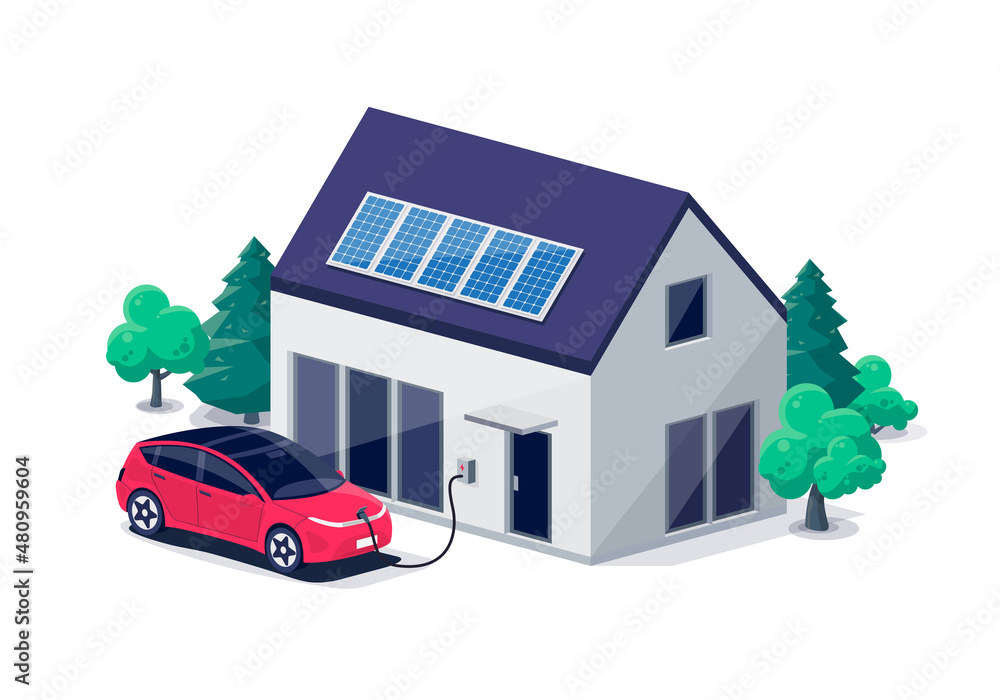
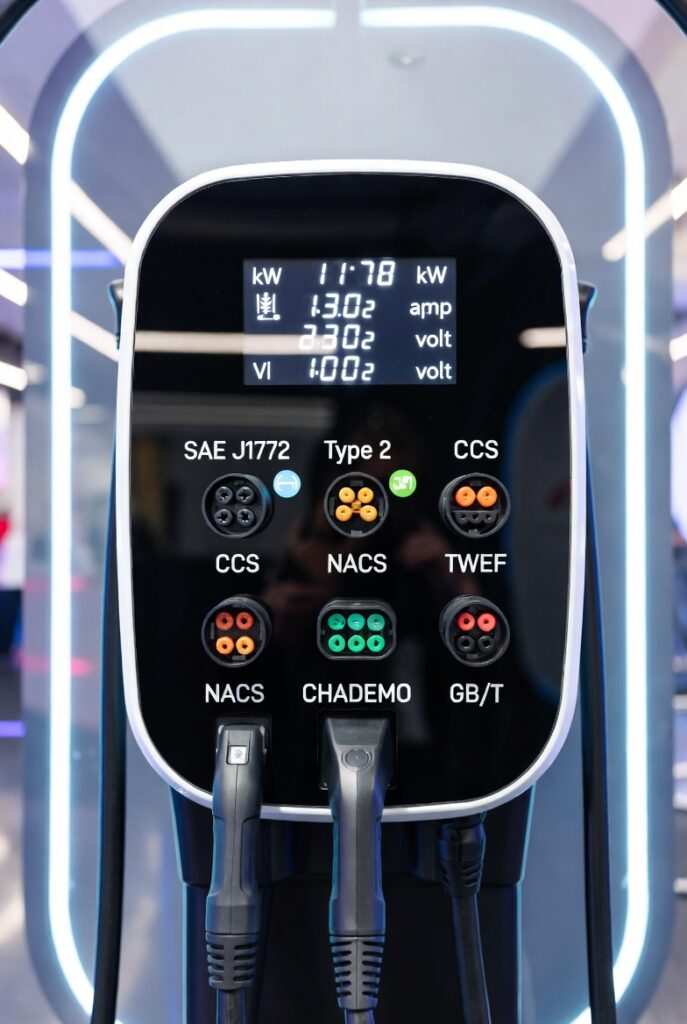
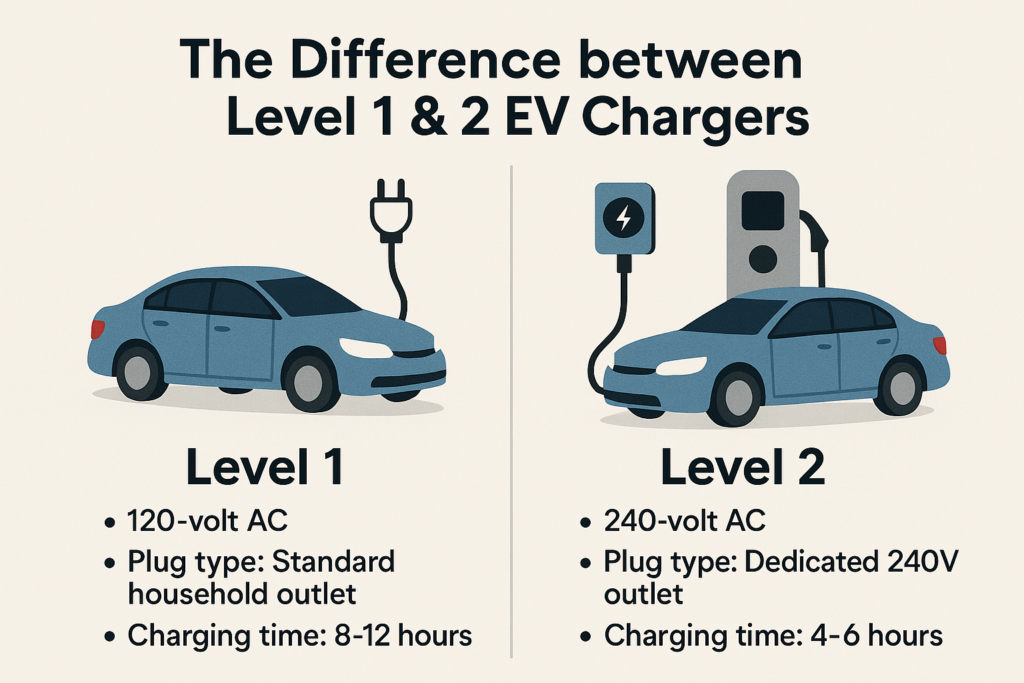
This is not a product review. It is not a specification comparison. It is an account of what actually happened when a real Shanghai family tried to set up home charging for two electric vehicles in a standard high-rise apartment compound — every decision, every obstacle, every cost, every mistake, and every outcome.
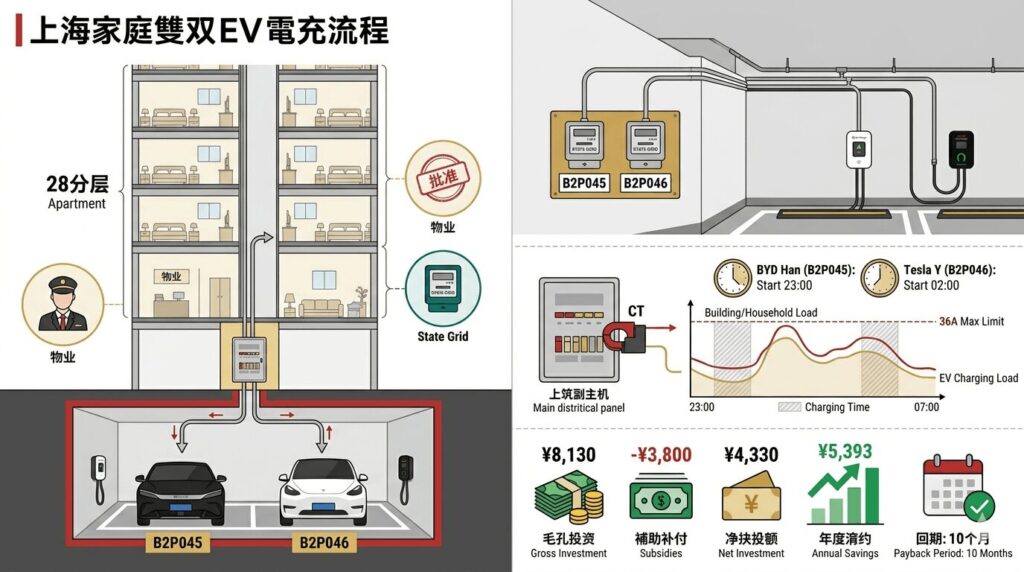
The Li family lives in a 2008-built residential compound in Changning District, Shanghai. 28 storeys. 280 units. Underground car park on B2 level. They own two parking spaces — purchased when they bought the apartment in 2019, before either vehicle was purchased.
Their vehicles: a BYD Han EV Long Range purchased in March 2024, and a Tesla Model Y Long Range (China domestic-spec, GB/T connectors) purchased six months later in September 2024.
Their goal: charge both vehicles at home, at valley rates, completing overnight before a 7:30am departure.
What followed was six months of 物业 negotiations, two State Grid applications, one failed installation attempt, a WiFi extender, a load balancing configuration, and a total expenditure of ¥8,847 across both vehicles — against which they are saving ¥3,341 per year in electricity costs versus public DC charging.
This case study Shanghai family with two EVs BYD and Tesla charging setup in a high-rise documents the complete journey from the first 物业 enquiry in October 2024 to the fully operational dual charging setup running in April 2025 — with specific costs, specific timelines, specific charger choices, and the specific financial outcome.
The Starting Point — What the Li Family Had Before
The family:
- Mr Li (李伟): 41, software engineer, drives the Tesla Model Y approximately 18,000 km/year for commuting and weekend trips
- Mrs Li (李晓梅): 38, marketing manager, drives the BYD Han EV approximately 12,000 km/year for commuting and school runs
- Two children: ages 9 and 12
The apartment:
- Location: Changning District, Shanghai
- Building: 28-storey residential tower, built 2008
- Parking: Two designated spaces (B2P045 and B2P046 — adjacent spaces)
- Apartment electrical supply: 40A single-phase 220V
The vehicles:
- BYD Han EV Long Range: 76.9 kWh usable, 6.6 kW AC max, GB/T connectors
- Tesla Model Y Long Range (China domestic): 75 kWh usable, 11 kW AC max, GB/T connectors
Charging before installation:
Both vehicles charged at public charging. The Tesla primarily used the State Grid 120 kW DC fast charging hub at a nearby commercial district (¥1.40/kWh). The BYD used a mix of TELD AC charging at the office building (¥0.80/kWh) and occasional DC fast charging.
Monthly public charging cost:
- Tesla (18,000 km/year ÷ 12 months = 1,500 km/month at 18 kWh/100km): 270 kWh × ¥1.40 = ¥378/month
- BYD (12,000 km/year ÷ 12 = 1,000 km/month at 18 kWh/100km): 180 kWh × ¥0.90 (mixed) = ¥162/month
- Total monthly public charging: ¥540/month = ¥6,480/year
Phase 1: The 物业 Application — October to December 2024
The First Approach
Mr Li visited the compound’s 物业 office on 15 October 2024 — the day after confirming the Tesla Model Y’s delivery date.
The 物业 office response:
The 物业 manager — a woman who had been managing this compound since 2017 — was familiar with EV charging applications. By October 2024, this compound had already processed 23 individual EV charging installations.
The good news: The compound had a documented EV charging application process. The existing 23 installations provided precedent. The 物业 was not obstructive.
The complication: The Li family was applying for two charging installations simultaneously — on adjacent spaces. The 物业’s standard process handled single installations. Two simultaneous applications on adjacent spaces raised a question they hadn’t encountered before: should these be processed as two independent applications or as a single dual-charging application?
The 物业’s response: Two separate applications, processed sequentially. One application could not be submitted until the first was approved. Timeline estimate: 8-10 weeks for both to be approved.
Mr Li’s assessment at the time: “I understood their concern but it felt like it was doubling our waiting time unnecessarily. I later learned this was actually the correct approach for our electrical infrastructure situation.”
The Documentation Submitted
For each application:
- Identity documents (身份证 copies)
- Property ownership certificate (房产证)
- Vehicle registration document (行驶证)
- Designated parking space documentation
- Proposed charger specification sheet
- Letter from proposed installation company
- Statement of compliance with compound electrical safety requirements
The charger choices at application stage:
For the BYD Han EV: StarCharge S1 Smart (IP54, 7 kW) — the compound’s most commonly installed charger, which Mr Li knew from asking neighbours with existing installations
For the Tesla Model Y: Autel MaxiCharger (IP65, 7 kW) — chosen because Mr Li read the clean energy bazaar guide on IP ratings and decided the Tesla’s charger in a position closer to the car park entrance (slightly more exposed to humidity from the entrance ramp) warranted IP65 over IP54
The 物业 Approval Timeline
| Date | Event |
|---|---|
| 15 Oct 2024 | First application submitted (BYD Han EV, space B2P045) |
| 28 Oct 2024 | 物业 requests additional documentation: installation company’s business licence |
| 5 Nov 2024 | Additional documentation submitted |
| 19 Nov 2024 | First application approved in principle — conditional on State Grid assessment |
| 20 Nov 2024 | Second application submitted (Tesla, space B2P046) |
| 8 Dec 2024 | Second application approved in principle — conditional on State Grid assessment |
Total 物业 timeline: 8 weeks, 2 days for both approvals.
What Mr Li would do differently: “Submit both applications on the same day. The 物业 said they had to be sequential but looking back, there was no reason we couldn’t have submitted the paperwork for both on day one, even if they needed to process them in order. We wasted three weeks between the first and second application.”
Phase 2: The State Grid Process — December 2024 to February 2025
The Assessment Visit
Armed with both 物业 approval letters, Mr Li applied to Shanghai State Grid (国网上海电力) through the 国家电网 app on 10 December 2024.
State Grid assessment engineer visit: 23 December 2024
The assessment engineer — a State Grid employee in his late 40s who had conducted hundreds of residential EV charging assessments in Shanghai — spent 35 minutes in the compound’s B2 car park.
What he assessed:
The building’s main electrical distribution board for the B2 car park is located in a utility room adjacent to the car park entrance. The engineer examined:
- The distribution board’s current capacity and available positions
- The distance from the distribution board to spaces B2P045 and B2P046
- The existing cable runs and conduit infrastructure in the car park
- The condition of the earthing infrastructure
His findings:
The distribution board had sufficient capacity for two new EV charging circuits. The distance from the distribution board to the Li family’s parking spaces was 31 metres — longer than the typical standard installation but within normal range.
The critical finding: Both spaces B2P045 and B2P046 are on the same circuit run — the car park’s structured cable management system runs along a route that passes both spaces. Running a single conduit installation with two independent circuits within it would reduce installation cost by approximately 20-30% versus two independent installations with separate conduit runs.
The engineer’s recommendation: Shared conduit run with two independent circuits and two independent meters — one for each parking space.
The State Grid Cost Quotation
The State Grid formal quotation, received 8 January 2025:
| Component | Cost |
|---|---|
| Meter 1 installation (B2P045) | ¥180 |
| Meter 2 installation (B2P046) | ¥180 |
| Supply cable (6mm², 35m × 2 circuits) | ¥1,260 |
| Conduit installation (shared run) | ¥840 |
| Distribution board connections (×2) | ¥350 |
| State Grid total | ¥2,810 |
Mr Li’s reaction: “More than I expected — I had budgeted ¥1,500 for State Grid costs based on what neighbours had paid for single installations. The 35-metre cable run was the main driver. But the engineer explained that the shared conduit gave us a ¥600-¥800 saving versus two independent runs.”
The State Grid Installation
State Grid installation date: 14 February 2025
Work completed: Both meters installed and commissioned. Two independent supply circuits running from the distribution board through shared conduit to the two parking spaces. Two dedicated electricity meters operational.
Time from application to State Grid installation: 9 weeks, 4 days
Phase 3: The Private Electrician Installation — February to March 2025
Selecting the Electrician
Mr Li obtained three quotes for the private electrician work — the wiring from each meter to the charger mounting point, charger mounting, and charger commissioning:
Quote 1: StarCharge’s official installation service
- For BYD space (StarCharge S1): ¥1,800 (includes charger hardware at ¥999)
- For Tesla space (Autel): ¥2,400 (includes charger hardware at ¥1,499)
- Total: ¥4,200
Quote 2: Independent electrician from compound’s WeChat group
- Labour for both spaces: ¥2,200 (chargers purchased separately)
- Cable, conduit, protection devices: ¥680
- Total materials + labour: ¥2,880 (without chargers)
- With charger hardware: ¥2,880 + ¥999 + ¥1,499 = ¥5,378
Wait — that’s more expensive than Quote 1. The independent electrician’s labour cost was competitive but the hardware purchase separately from an e-commerce platform proved only marginally cheaper than the official installation service’s bundled pricing.
Quote 3: A company specifically recommended by a neighbour (Mr Zhang in apartment 1504) who had a dual installation completed 6 months earlier
- Compound-specific knowledge (knew the cable routes)
- Both spaces: ¥1,600 labour
- Materials: ¥520
- Total without chargers: ¥2,120
- With charger hardware (sourced by the company): ¥2,120 + ¥950 (StarCharge S1) + ¥1,450 (Autel) = ¥4,520
Decision: Quote 3 — the compound-specific installer
Mr Li’s reasoning: “Mr Zhang showed me photos of his installation. The cable management was noticeably cleaner than anything I’d seen in the car park from other installers. The conduit was properly secured, the charger was level, and there were no exposed joins. Given that these chargers are going to be used daily for 7-10 years, the quality of installation matters.”
The Installation Day — 8 March 2025
The compound-specific electrician arrived at 9am with two assistants.
Work completed by 3pm (6 hours for both installations):
Space B2P045 (BYD Han EV — StarCharge S1):
- 4mm² copper cable from dedicated meter to charger position (3.5 metres)
- StarCharge S1 mounted at 1.2 metres height on the left wall of the space
- Type A/AC RCCB 30mA + 40A MCB circuit protection
- Cable management: surface-mounted white conduit
- Commission and WiFi setup
Space B2P046 (Tesla Model Y — Autel MaxiCharger):
- 4mm² copper cable from dedicated meter to charger position (3.5 metres)
- Autel MaxiCharger mounted at 1.3 metres height on the right wall of the space (Tesla charges from the rear left, so the right wall is actually the correct side when the car is parked nose-in)
- Type A/AC RCCB 30mA + 40A MCB circuit protection
- OCPP 1.6 configuration
- Commission and WiFi setup
The first problem encountered:
After installation, the StarCharge app connected successfully. The Autel app connected successfully. Both chargers tested with each respective vehicle. Both charged at expected rates.
Then Mr Li tried connecting the Tesla to the StarCharge charger — testing whether either charger could serve both vehicles. Both vehicles have GB/T connectors; theoretically either charger should work with either vehicle.
Result: The StarCharge S1 charged the Tesla Model Y without any issue. The Autel MaxiCharger charged the BYD Han EV without any issue. The GB/T connector standard works universally.
Important note for this family: The decision to put the StarCharge on the BYD space and the Autel on the Tesla space was primarily for mounting position optimisation (cable reach to charging port on each vehicle) not for technical compatibility — both chargers are compatible with both vehicles.
Phase 4: The WiFi Problem — March 2025
What Happened
The first week after installation, Mr Li noticed a recurring problem: the StarCharge S1’s TOU scheduling was working reliably (charging started precisely at 11pm every night). But the Autel MaxiCharger’s scheduled charging failed three times in the first week — the schedule was set for 11pm but charging hadn’t started when Mr Li checked the app at midnight.
Diagnosis:
The Autel app showed the charger as “offline” on the three occasions when scheduling failed. The charger was physically installed and operational — pressing the physical button on the charger started charging immediately. But the WiFi connection was intermittent, causing cloud-based TOU scheduling commands to fail.
Root cause:
Space B2P046 (the Autel’s location) is further from the building’s WiFi router than B2P045. The car park’s WiFi penetration at B2 level — two floors below the ground floor with multiple concrete slabs and steel structures between the apartment’s router and the charger — was marginal.
The StarCharge S1 on the closer space (B2P045) maintained adequate signal. The Autel on the further space (B2P046) was on the edge of viable WiFi range.
The solution considered:
Option A: Upgrade to a charger with 4G cellular connectivity (Autel MaxiCharger 4G variant): ¥350 premium over the standard WiFi model. But the 4G variant would require replacing the already-installed charger.
Option B: WiFi extender on the B2 level: ¥120 for a TP-Link RE300 WiFi extender, powered from the car park’s maintenance socket nearest to the Autel location.
Decision: Option B — WiFi extender
Mr Li asked the 物业 for permission to plug a WiFi extender into the nearest car park maintenance socket. The 物业 agreed on condition that the electricity consumption was minimal (it is — approximately 3-5W continuous) and that the extender was secured to the wall properly.
Cost: ¥120 for the extender + 1 hour of Mr Li’s time for installation and configuration.
Result: Zero connectivity failures in the 6 weeks following the WiFi extender installation. Both chargers maintain stable app connectivity. Both TOU schedules execute reliably.
The lesson: “For any underground parking installation more than 15-20 metres from the nearest WiFi router, budget for a WiFi extender immediately. It costs ¥120 and prevents a recurring frustration. I wish the electrician had told us this on installation day.”
Phase 5: The Load Management Revelation — March 2025
The Discovery
Two weeks after the WiFi extender solved the connectivity problem, a different issue emerged.
On the evening of 22 March 2025, Mr Li arrived home at 9:30pm. His Tesla was at 22% battery. Mrs Li arrived home at 10:15pm. Her BYD was at 35% battery.
Both vehicles were plugged in before 11pm. Both TOU schedules were configured to start at 11pm. At 11pm, both chargers activated simultaneously.
At 11:17pm, Mr Li’s apartment circuit breaker tripped. The apartment lost power.
The problem:
Both chargers drawing simultaneously at 7 kW each = 14 kW total.
The apartment’s main electrical panel: 40A single-phase = 8.8 kW.
Household base load at 11pm: approximately 2 kW (refrigerator, standby devices, water heater on timer).
Total load at 11pm: 14 + 2 = 16 kW — nearly double the panel capacity.
Wait — why does this happen?
The two EV charging circuits are on separate dedicated meters — they are electrically separate from the household circuit. But the dedicated meters are fed from the same main panel that feeds the household circuit. The main panel’s 40A capacity is shared between the household circuit and both dedicated EV circuits.
This is the building-level capacity constraint described in our load balancing guide. The individual dedicated circuits are properly isolated for billing. But the main panel cannot supply more than 40A total across all circuits.
The immediate solution:
Mr Li staggered the schedules: BYD starts at 11pm, Tesla starts at 2am. The BYD needs approximately 3.9 hours for a 35-80% charge at 6.6 kW. Starting at 11pm, completion by 2:54am. The Tesla starts at 2am, needs approximately 5.8 hours for 22-80% at 7 kW. Starting at 2am, completion by 7:48am.
The problem with the manual stagger:
On nights when both vehicles need substantial charging, the Tesla’s completion at 7:48am is marginal for a 7:30am departure. And the manual stagger requires Mr Li to remember to set different schedules on nights when both vehicles are low.
The Load Balancing Solution Investigated
Mr Li read the load balancing guide on this site and contacted two electricians about retrofitting load management.
Option A: Retrofit CT clamp on StarCharge S1
The StarCharge S1 can accept a CT clamp add-on that enables load management — monitoring total panel draw and reducing the S1’s output current when total load is high.
Cost of CT clamp add-on for StarCharge: ¥280 for the hardware + ¥400 electrician installation = ¥680
Option B: Upgrade to load-managing Autel MaxiCharger as the “master”
Replace the installed Autel with a load-management Autel variant that monitors total panel load via CT clamp and coordinates with the StarCharge via OCPP protocol.
Cost: ¥450 Autel load management upgrade kit + ¥400 installation = ¥850
Option C: Smart scheduling coordination via both apps
Configure both chargers’ apps to work on staggered schedules automatically — using each vehicle’s estimated charge time to calculate optimal start times. This requires no additional hardware.
Cost: ¥0
Decision: Option C first, Option A as backup
Mr Li configured both charger apps for automatic staggered scheduling:
- StarCharge app: Start 11pm, target SOC 80%
- Autel app: Start at a calculated delay — he used the charge time calculator on this site to determine the BYD’s charge time based on typical arrival SOC, then set the Tesla to start 4 hours after the BYD.
The limitation of Option C:
The stagger assumes a typical arrival SOC. On nights when the BYD arrives with only 15% battery, the charge takes 6.7 hours instead of the typical 3.9 hours — and the staggered Tesla start at 3am creates a completion time of 8:48am. Too late.
The eventual solution: CT clamp on StarCharge (Option A)
After two weeks of monitoring, Mr Li identified that Option C failed approximately once per week when the BYD arrived with a substantially lower battery than the assumed typical SOC.
He proceeded with Option A — the CT clamp retrofit on the StarCharge S1.
The CT clamp installation (April 2025):
The CT clamp was installed on the main panel’s live conductor by a licensed electrician. Configuration:
- Maximum total load threshold: 36A (90% of 40A panel capacity)
- When total load approaches 36A, StarCharge S1 automatically reduces output
- When Tesla charger starts at 2am, StarCharge detects the additional load and reduces to whatever current keeps total within 36A
- As Tesla reaches target SOC and current draw reduces, StarCharge ramps back up
Result after CT clamp installation:
Zero panel trips in the 6 weeks following CT clamp installation. Both vehicles charge sequentially at maximum available current without requiring any schedule coordination from Mr Li.
The Complete Cost Summary
Breakdown by Component
State Grid costs (both circuits):
¥2,810 total
Private electrician (both installations, March 2025):
Labour: ¥1,600
Materials (cable, conduit, protection): ¥520
Total electrician: ¥2,120
Charger hardware:
StarCharge S1 (BYD space): ¥950
Autel MaxiCharger (Tesla space): ¥1,450
Total charger hardware: ¥2,400
Post-installation additions:
WiFi extender (TP-Link RE300): ¥120
CT clamp load management add-on: ¥680
Total additions: ¥800
Shanghai installation subsidies received:
Municipal subsidy (2 chargers × ¥1,500): ¥3,000
District supplement (Changning): ¥300 × 2 = ¥600
Demand response registration (Autel OCPP 1.6): ¥200
Total subsidies: -¥3,800
Net total investment:
| Component | Cost |
|---|---|
| State Grid | ¥2,810 |
| Electrician (labour + materials) | ¥2,120 |
| Charger hardware | ¥2,400 |
| Post-installation additions | ¥800 |
| Gross total | ¥8,130 |
| Shanghai subsidies | -¥3,800 |
| Net investment | ¥4,330 |
The Financial Outcome
Annual Electricity Savings
BYD Han EV Long Range (12,000 km/year, Shanghai TOU):
Annual kWh: 12,000 ÷ 100 × 18 × 1.12 = 2,419 kWh
At TOU valley rate (90% valley, 10% flat): ¥866/year
Previously (public mixed): 2,419 × ¥0.90 = ¥2,177/year
Annual saving BYD: ¥1,311/year
Tesla Model Y Long Range (18,000 km/year, Shanghai TOU):
Annual kWh: 18,000 ÷ 100 × 18 × 1.12 = 3,629 kWh
At TOU valley rate (90% valley, 10% flat): ¥1,299/year
Previously (public DC at ¥1.40/kWh): 3,629 × ¥1.40 = ¥5,081/year
Annual saving Tesla: ¥3,782/year
Combined annual saving: ¥5,093/year
Demand response income (Autel OCPP 1.6, Shanghai pilot):
¥300/year (conservative estimate)
Total annual financial return: ¥5,393/year
Payback Period
Net investment: ¥4,330
Annual return: ¥5,393
Payback period: 0.80 years (approximately 10 months)
5-Year Net Return
(¥5,393 × 5) − ¥4,330 = ¥22,635 net benefit over 5 years
The Complete Financial Summary Table
| Metric | Value |
|---|---|
| Gross investment | ¥8,130 |
| Government subsidies | -¥3,800 |
| Net investment | ¥4,330 |
| Annual BYD electricity saving | ¥1,311 |
| Annual Tesla electricity saving | ¥3,782 |
| Annual demand response income | ¥300 |
| Total annual return | ¥5,393 |
| Payback period | 10 months |
| 5-year net return | ¥22,635 |
| 10-year net return | ¥49,600 |
The Operational Experience — 6 Months After Installation
What Works Well
The TOU scheduling reliability:
Both chargers execute their TOU schedules reliably since the WiFi extender was installed. Mr Li checks the StarCharge and Autel apps approximately once per week rather than daily — the system operates autonomously.
The GB/T cross-compatibility:
On three occasions, Mr Li has needed to swap which vehicle uses which charger — when one vehicle had a lower-than-usual battery and needed the charger physically closest to the entrance for a visitor’s visit convenience. Both vehicles charge from either charger without any compatibility issue. The GB/T connector standard works universally.
The energy monitoring:
Both apps show per-session and monthly energy consumption and estimated cost. Mr Li uses this data to confirm TOU scheduling is working correctly — both chargers show the vast majority of consumption in the 23:00-08:00 valley window.
The physical installation quality:
Six months of daily use have produced no hardware issues. The Autel’s IP65 enclosure in the slightly more humid end of the car park (space B2P046) shows no moisture ingress. The StarCharge’s IP54 in the drier space (B2P045) is performing as expected.
What Required Adjustment
The TOU window for the Tesla:
Tesla Model Y Long Range (75 kWh, 11 kW AC max): 20-80% takes approximately 4.5 hours at 11 kW.
Wait — Mr Li’s Tesla is charging from a 7 kW Autel charger, not an 11 kW three-phase unit. The B2 car park has single-phase supply. At 7 kW: 20-80% takes approximately 7.1 hours.
On nights when Mr Li arrives with 15% battery (below the 20% base scenario), the charge to 80% takes approximately 8.0 hours — starting at 11pm, completion at 7am. Within the valley window but with minimal margin.
The recommendation Mr Li would give himself: “If I were doing this again, I would have investigated three-phase supply availability at the outset. My car can accept 11 kW. The 11 kW charger would have reduced the nightly charge time to 4.5 hours — much more comfortable margin within the valley window. The building doesn’t have three-phase to individual parking spaces as far as I know, but I never formally asked the 物业 or State Grid. I should have.”
The CT clamp calibration:
After the initial configuration, the CT clamp was set conservatively at 34A maximum total load. On cold February nights when the building’s base electrical load is higher (more residents using electric heating), the CT clamp sometimes reduced the BYD’s charging current more than necessary — extending charge time.
Mr Li recalibrated to 36A after monitoring baseline household loads for two weeks. The panel hasn’t tripped since.
The Unexpected Benefit
The visitor use case:
Mr Li’s parents visit monthly. They own a BYD Song Plus EV purchased in late 2024. During their visits, they park in a visitor space in B1 — but the visitor spaces are 80 metres from the Li family’s dedicated chargers.
The solution: Mr Li purchased a 10-metre extension for the Autel’s cable — a purpose-built EV charging cable extension rated for 32A continuous use (not a standard domestic extension cord). During his parents’ visits, this extension allows the BYD Song Plus to reach the Autel charger from the nearest visitor space.
Cost: ¥280 for the EV charging cable extension.
“My parents charge their car every time they visit — for free. They’re saving their own charging money. It’s a small thing but it feels good.”
The Lessons — What This Case Study Teaches Every Chinese Dual-EV Owner
Lesson 1: Apply for Both Simultaneously, Not Sequentially
The Li family’s 物业 required sequential application — but Mr Li acknowledged he didn’t push back on this requirement. In Chinese EV charging forums, other dual-EV owners report successfully negotiating simultaneous processing for adjacent spaces. Present the dual application as a single project with two identical components — reducing 物业 processing burden rather than doubling it.
Time saving if simultaneous: estimated 3-4 weeks
Lesson 2: The WiFi Distance Problem Is Predictable — Address It Before Installation
Every Chinese underground car park more than 15 metres from the building’s WiFi infrastructure has marginal WiFi coverage. This is predictable before installation. The solution — a TP-Link or Xiaomi WiFi extender powered from the nearest maintenance socket — costs ¥80-¥150 and eliminates the problem permanently.
Include the WiFi extender in the initial installation quote. Do not wait for scheduling failures to discover the need.
Lesson 3: Load Management Is Essential for Dual EV Households
Two 7 kW chargers simultaneously = 14 kW. Most Chinese residential single-phase panels: 40A = 8.8 kW. The mathematics make simultaneous charging physically impossible without a panel upgrade.
The solutions in order of cost:
- Manual stagger scheduling (¥0 — but requires attention and fails for unusual arrival SOC)
- Automatic stagger with app configuration (¥0 — fails for outlier nights)
- CT clamp load management on one charger (¥680 — eliminates the problem reliably)
- Panel upgrade (¥5,000-¥15,000 — most expensive, not necessary for load balancing)
For any dual-EV household: budget ¥680 for CT clamp load management from the start. It is the correct solution to a predictable problem.
Lesson 4: Investigate Three-Phase Before Installation, Not After
Both the Tesla Model Y Long Range (11 kW AC max) and the Porsche Taycan, BMW i5, Mercedes EQE, NIO ET7, Xpeng G9, Zeekr 001, and Xiaomi SU7 Max can accept 11 kW AC charging — but only with three-phase supply.
For these vehicles, the question “is three-phase supply available at my parking space?” is as important as the 物业 approval question. And it is a question that must be answered before charger purchase — not after.
The process:
- Ask the 物业 whether the building’s electrical infrastructure supports three-phase supply to individual parking spaces
- If uncertain, ask State Grid’s assessment engineer during the site visit specifically about three-phase availability
- If three-phase is available or can be extended to the parking space at reasonable cost, specify 11 kW three-phase chargers for compatible vehicles
For the Li family: Mr Li didn’t ask. He now charges his Tesla at 7 kW where 11 kW is theoretically possible if three-phase supply exists. Whether three-phase was available at B2 level in this 2008 building is a question he never asked and still doesn’t know the answer to.
Lesson 5: The Subsidies Are Significant — Claim All Available Layers
The Li family received ¥3,800 in Shanghai subsidies — almost entirely offsetting the electrician costs.
The full Shanghai subsidy stack for dual installations:
| Subsidy source | Per charger | Total (2 chargers) |
|---|---|---|
| Municipal installation subsidy | ¥1,500 | ¥3,000 |
| Changning District supplement | ¥300 | ¥600 |
| Demand response registration bonus (OCPP charger) | ¥200 (one-time) | ¥200 |
| Total | ¥3,800 |
What Mr Li missed: The Autel’s OCPP 1.6 compliance made it eligible for demand response programme registration — delivering ¥300+/year in additional income on top of the ¥200 registration bonus. The StarCharge S1 lacks OCPP — if both chargers had been Autel MaxiChargers (both OCPP 1.6 compliant), demand response income could have been ¥600+/year rather than ¥300/year.
The recommendation for dual-EV owners: Specify OCPP-compliant chargers for both installations. The annual demand response income difference between zero-OCPP and two-OCPP chargers: approximately ¥300-¥600/year — compounding over the ownership period.
Lesson 6: The Tesla’s Cross-Compatibility Is Complete
Some Chinese Tesla owners wonder whether their domestic-market Tesla needs a Tesla-specific charger. The answer — confirmed by the Li family’s 6 months of daily operation — is unambiguously no.
The China-domestic Tesla Model Y’s GB/T connector is fully compatible with every certified GB/T home charger. The StarCharge S1, Autel MaxiCharger, Xiaomi EV Charger, Huawei FusionCharge, NIO Home Charger, BYD Smart Charger — any certified GB/T unit charges the domestic-market Tesla identically.
The Li family’s Tesla charges from the Autel MaxiCharger (non-Tesla brand) daily without any issue. It has also charged from the StarCharge S1 (designed primarily for the Chinese EV market broadly) on swap occasions without issue.
The Configuration Details — For Anyone Replicating This Setup
Final Charger Configuration
Space B2P045 — StarCharge S1 (BYD Han EV):
- App: 星星充电
- Schedule: 23:00 start, 80% SOC target
- Minimum SOC override: 20% (charges immediately if below 20%)
- Rate display: Shanghai TOU rates entered (¥0.34 valley / ¥0.67 flat / ¥0.87 peak)
- CT clamp installed: Yes — monitors main panel, reduces output when total load approaches 36A
Space B2P046 — Autel MaxiCharger (Tesla Model Y):
- App: Autel Charge
- Schedule: 02:00 start (2 hours after BYD starts, allowing BYD to complete most charging before Tesla begins)
- 80% SOC target
- Minimum SOC override: 15% (Mr Li arrives with lower SOC more frequently due to longer commute)
- Rate display: Shanghai TOU rates entered
- OCPP 1.6: Enabled — registered for Shanghai demand response programme
- WiFi: Connected via TP-Link RE300 extender on B2 level
Why 2am for the Tesla rather than 11pm:
At 2am, the BYD has been charging for 3 hours — likely at 60-70% SOC already. The remaining BYD charging draws lower current as the session progresses. When the Tesla starts at 2am, the CT clamp detects the combined load and reduces both chargers’ output — but the total draw is lower than two simultaneous starts at 11pm would have been.
An alternative Mr Li considered but didn’t implement: Configure both chargers to start at 11pm and let the CT clamp manage the load from the start. This would work — the CT clamp would immediately reduce each charger’s output current to stay within 36A total — but the effective charging rate for each vehicle would be approximately half their maximum (approximately 3.3 kW each) during the overlap period. Mr Li’s 2am stagger produces higher effective charging rates for the BYD (full 6.6 kW for 3 hours, then shared load from 2am) versus simultaneous charging at half rate all night.
The Verdict — Would the Li Family Do It Again?
Yes. Unequivocally yes.
“The six months from first application to fully working setup felt frustrating at the time. We were making do with public charging and watching the electricity bills accumulate. Looking back, the frustration was mostly impatience.
The installation process was predictable. The challenges — the WiFi, the load management — were solvable. Every problem had a solution that cost less than ¥700. The total investment of ¥4,330 net after subsidies is being recovered in under 10 months. After that it’s ¥5,393 per year in savings — pure profit from the investment.
Two electric cars, both charging at home, both at valley rates, both completing before we wake up. Both apps showing green by 6am. We haven’t been to a public charging station in four months except for one long-distance trip to Hangzhou. That’s the life we were hoping for when we bought the second EV.
Would we do it again? Yes. Would we do it differently? We’d apply for both 物业 approvals simultaneously. We’d budget for the WiFi extender from day one. We’d specify OCPP on both chargers. We’d ask about three-phase supply before buying the chargers. Those are the lessons.
Everything else — the 物业 process, the State Grid, the electrician, the chargers themselves — worked exactly as the guides on this website said it would.”
— Mr Li, April 2025
Internal Links — Further Reading on Clean Energy Bazaar
The case study Shanghai family with two EVs BYD and Tesla charging setup in a high-rise documents a real implementation of the guidance throughout this content cluster.
For the apartment 物业 rights guide covering the application process that took 8 weeks in this case study, our apartment EV charging solutions 2026 China HOA rules property manager permissions and fixed parking rights guide covers every regulatory step. For the load balancing guide covering the CT clamp solution that resolved the panel trip problem, our load balancing EV chargers 2026 avoid tripping breakers in old Chinese apartment blocks guide covers every scenario. For the professional installation costs guide confirming whether the Li family’s costs were market-rate, our professional EV charger installation costs 2026 what State Grid chargers vs private companies charge guide covers every cost component. For the local rebates guide covering the Shanghai subsidies that reduced net investment by ¥3,800, our local utility rebates for EV charging 2026 Shenzhen Shanghai Beijing guide covers every available programme. For the ROI calculator that predicted the 10-month payback demonstrated in this case study, our EV home charger ROI calculator 2026 when it pays off with local rebates included guide covers the complete financial framework. And for the charge time calculator that would have helped the Li family plan the sequential charging schedule from the start, our EV charge time calculator 2026 how long to full for your Chinese EV BYD to NIO guide covers every vehicle scenario.
Final Thoughts
The case study Shanghai family with two EVs BYD and Tesla charging setup in a high-rise confirms the core financial and practical conclusions of every guide in this content cluster — while adding the messy, instructive details that no product review captures.
The financial outcome is compelling:
¥4,330 net investment. ¥5,393/year annual return. 10-month payback. ¥22,635 net benefit over 5 years. For a family with two EVs previously spending ¥6,480/year on public charging, home charging transformed their running costs.
The process is navigable but not frictionless:
8 weeks of 物业 processing, 9 weeks of State Grid processing, installation day, WiFi extender day, CT clamp day — total elapsed time from first application to fully optimised operation: 6 months. Every step was predictable with the right information. The “problems” were not failures of the system — they were predictable challenges that could have been anticipated and resolved faster with the knowledge in these guides.
The dual-EV specific lessons are actionable:
Simultaneous 物业 applications. WiFi extender pre-budgeted. CT clamp load management included from the start. OCPP on both chargers for maximum demand response income. Three-phase supply investigated before charger purchase.
Follow these lessons and a dual-EV household in any Shanghai high-rise can achieve what the Li family achieved — in 4 months rather than 6, with no post-installation surprises, at net investment that pays back inside one year.