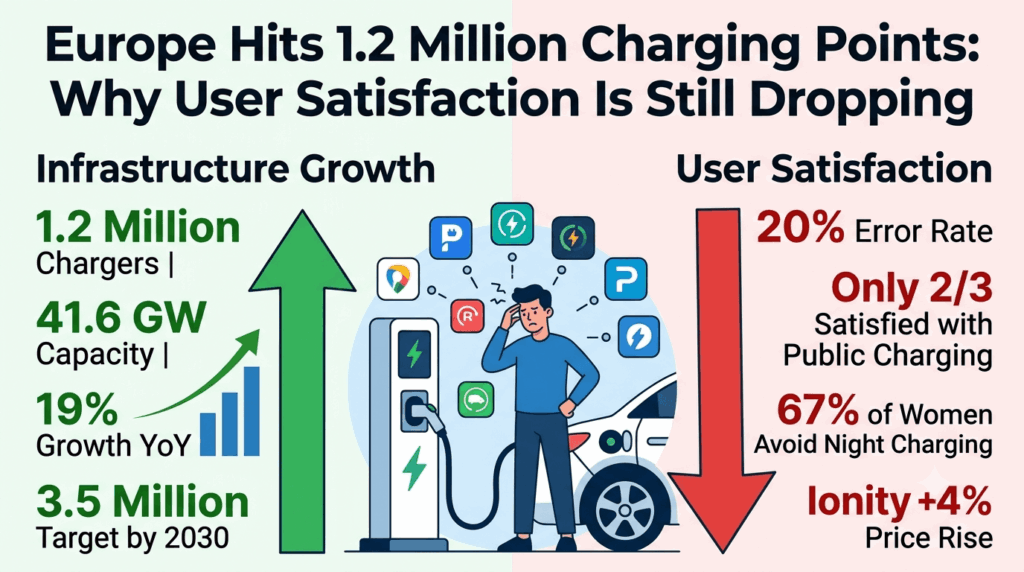
Europe hits 1.2 million charging points: why user satisfaction is still dropping - infographic showing 1.2 million chargers and 41.6 GW capacity alongside 20 percent error rates, Ionity price increases, and 67 percent of women avoiding nighttime charging
EV charging

Europe Hits 1.2 Million Charging Points: Why User Satisfaction Is Still Dropping

Europe hits 1.2 million charging points: why user satisfaction is still dropping. The EU surpassed 1.2 million public chargers with 41.6 GW of capacity in June 2026. Yet 20% of charging sessions fail, Ionity raised prices 4%, Circle K now matches petrol per kilometre in Ireland, and 67% of female drivers avoid nighttime charging. This analysis breaks down the payment friction, the rising costs, the safety concerns, and the regulatory gaps that are undermining the charging experience.
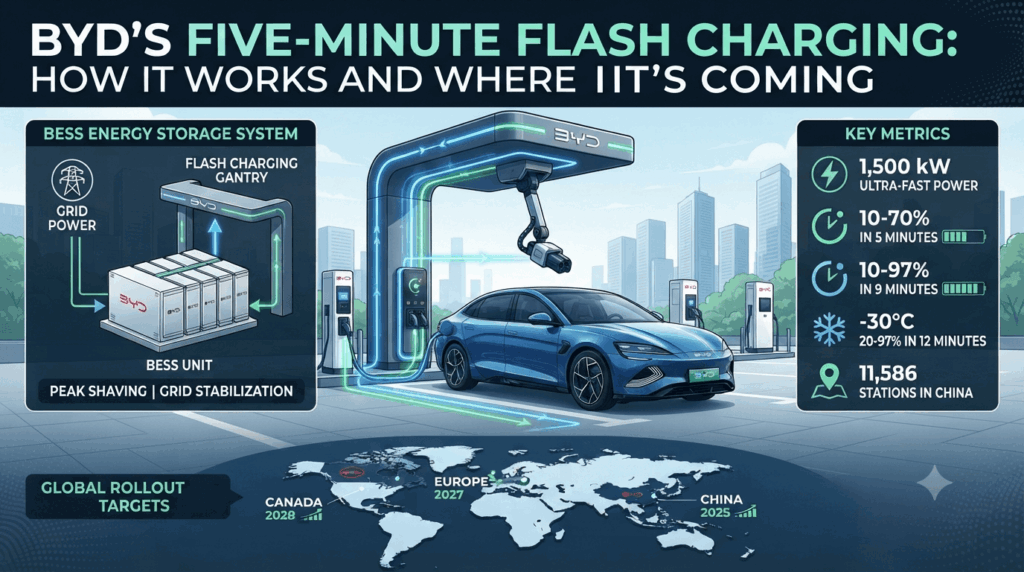
BYD's five-minute flash charging: how it works and where it's coming - infographic showing 1,500 kW charging power, 10 to 70 percent in five minutes, 10 to 97 percent in nine minutes, minus 30°C performance in twelve minutes, and 11,586 stations built in China
EV charging

BYD’s Five-Minute Flash Charging: How It Works and Where It’s Coming

BYD’s five-minute flash charging: how it works and where it’s coming. The 1,500 kW FLASH Charging system delivers 10% to 70% in five minutes and 10% to 97% in nine minutes, with 20% to 97% taking just twelve minutes at minus 30°C. BYD has built 11,586 stations in China, is rolling out 3,000 in Europe, and plans 6,000 internationally by 2027. This analysis breaks down the Super e-Platform, the second-generation Blade Battery, the BESS grid solution, and the competitive context.

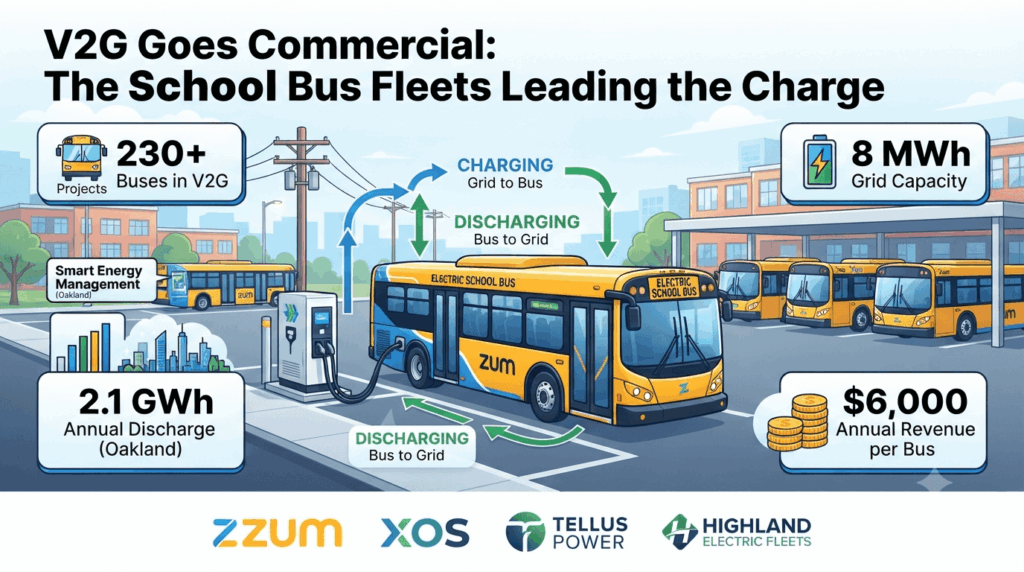
V2G goes commercial: the school bus fleets leading the charge - infographic showing 230 electric school buses supplying 8 MWh to the grid, Zum's 74-bus Oakland fleet returning 2.1 GWh annually, and $6,000 annual V2G revenue per bus
EV charging

V2G Goes Commercial: The School Bus Fleets Leading the Charge

V2G goes commercial: the school bus fleets leading the charge. Zum’s 74-bus Oakland fleet returns 2.1 GWh annually to the grid. Xos entered production V2G in April 2026. About 230 electric school buses now supply 8 MWh to strained grids. This analysis breaks down the economics, the utility programs, the key operators, and the path to scale for the unlikely but perfect V2G platform.

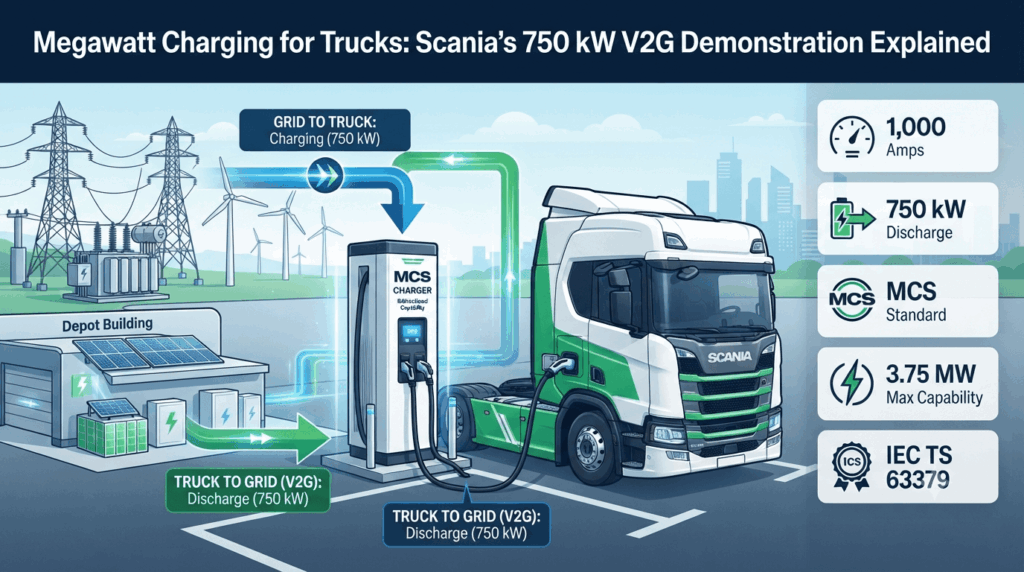
Megawatt charging for trucks: Scania's 750 kW V2G demonstration explained - infographic showing an electric truck connected to a Megawatt Charging System with bidirectional energy flow at 1,000 amps and 750 kW, and the MCS standard capability of 3.75 MW
EV charging

Megawatt Charging for Trucks: Scania’s 750 kW V2G Demonstration Explained

Megawatt charging for trucks: Scania’s 750 kW V2G demonstration explained. On May 26, 2026, Scania achieved one of the world’s first vehicle-to-grid implementations for heavy commercial vehicles using the Megawatt Charging System. The system pushed 1,000 amps and 750 kW back into the grid. This analysis breaks down the MCS standard, the 3.75 MW capability, the depot charging use case, the economics of V2G for fleet operators, and the challenges that remain before parked trucks become revenue-generating assets.

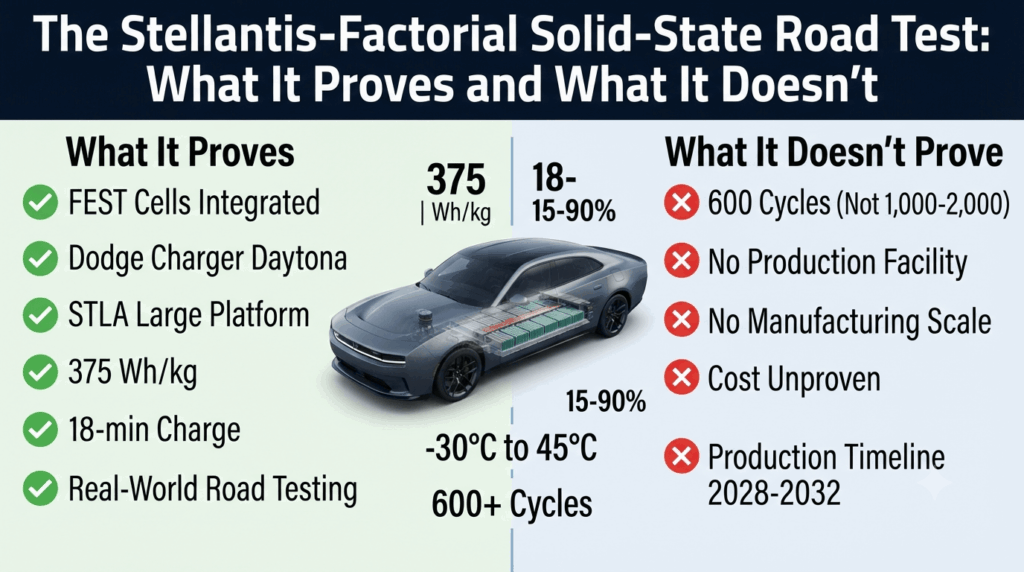
The Stellantis-Factorial solid-state road test: what it proves and what it doesn't - infographic showing FEST cells integrated into a Dodge Charger Daytona with 375 Wh/kg energy density and 18-minute charging, but 600 cycles short of automotive qualification and no production facility announced
EV charging

The Stellantis-Factorial Solid-State Road Test: What It Proves and What It Doesn’t

The Stellantis-Factorial solid-state road test: what it proves and what it doesn’t. FEST cells are now logging real-world miles in a Dodge Charger Daytona. The integration required a patented mechanical architecture and validated on a production platform. But 600 cycles is still short of automotive qualification, manufacturing scale does not yet exist, and the road test does not change the fundamental timeline. Here is the honest assessment.

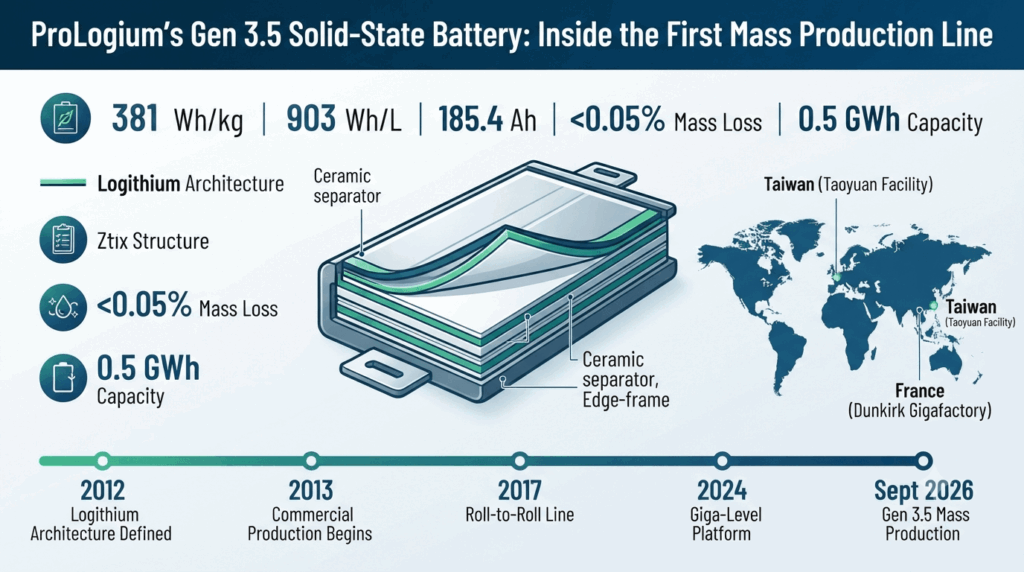
ProLogium's Gen 3.5 solid-state battery: inside the first mass production line - infographic showing 381 Wh/kg energy density, 903 Wh/L volumetric density, 185.4 Ah cell capacity, all-solid-state classification under GB/T standard, and the manufacturing journey from 2012 to 2026
EV charging

ProLogium’s Gen 3.5 Solid-State Battery: Inside the First Mass Production Line

ProLogium’s Gen 3.5 solid-state battery: inside the first mass production line. The Taoyuan facility is manufacturing 185.4 Ah all-solid-state cells at 381 Wh/kg, verified by TÜV and classified as all-solid-state by UL Solutions under China’s GB/T 43568-2026 standard. This analysis breaks down the Logithium architecture, the roll-to-roll ceramic coating process, the Dunkirk gigafactory plan, the Mercedes-Benz partnership, and what the first true mass production of solid-state cells actually proves.

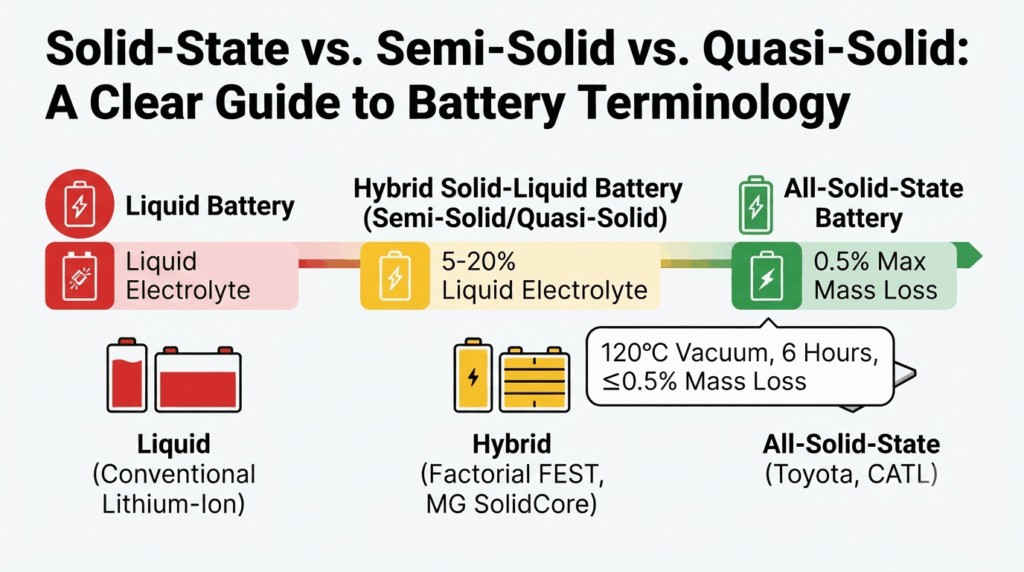
Solid-state vs. semi-solid vs. quasi-solid: a clear guide to battery terminology - infographic showing three battery categories with liquid battery, hybrid solid-liquid battery at 5-20 percent liquid, and all-solid-state battery with 0.5 percent max mass loss under China's GB/T 43568-2026 standard
EV charging

Solid-State vs. Semi-Solid vs. Quasi-Solid: A Clear Guide to Battery Terminology

Solid-state vs. semi-solid vs. quasi-solid: a clear guide to battery terminology. China’s new national standard GB/T 43568-2026 has finally drawn the line between these confusing labels. This guide explains the three official categories, the quantitative test that defines all-solid-state, the companies using each technology, and why the terminology matters for consumers, investors, and policymakers.

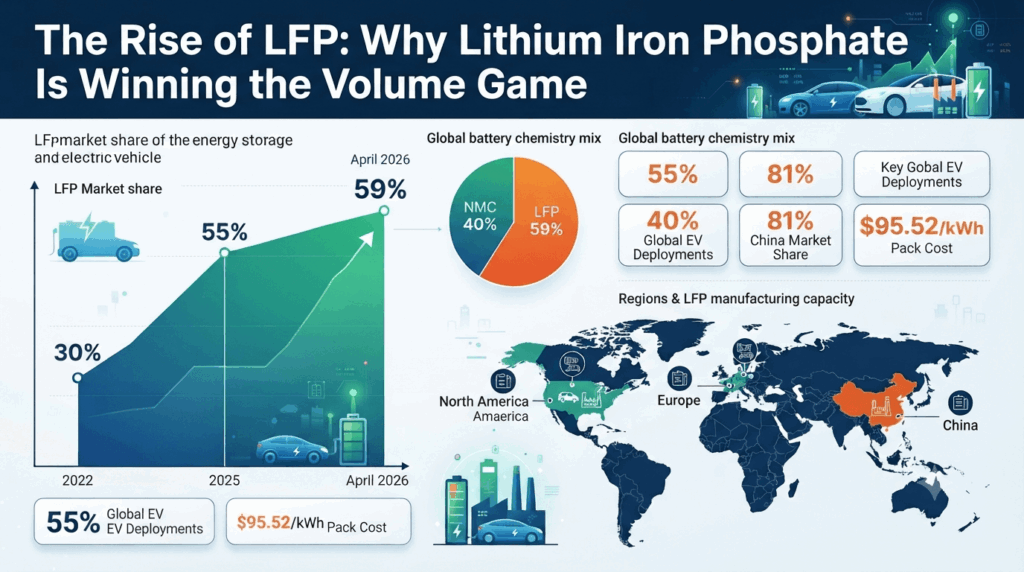
The rise of LFP: why lithium iron phosphate is winning the volume game - infographic showing LFP capturing 55 percent of global EV battery deployments, costing 40 percent less than NMC, reaching 81 percent market share in China, and $95.52 per kWh pack cost
EV charging

The Rise of LFP: Why Lithium Iron Phosphate Is Winning the Volume Game

The rise of LFP: why lithium iron phosphate is winning the volume game. LFP now powers more than 55% of global EV battery deployments, costs over 40% less than NMC, and is being scaled by CATL, BYD, Tesla, Volkswagen, and Stellantis. This analysis breaks down the market share data, the cost advantage, the technology breakthroughs that eliminated LFP’s performance penalties, and the global supply chain realignment that has made LFP the default chemistry for mass-market electric vehicles.

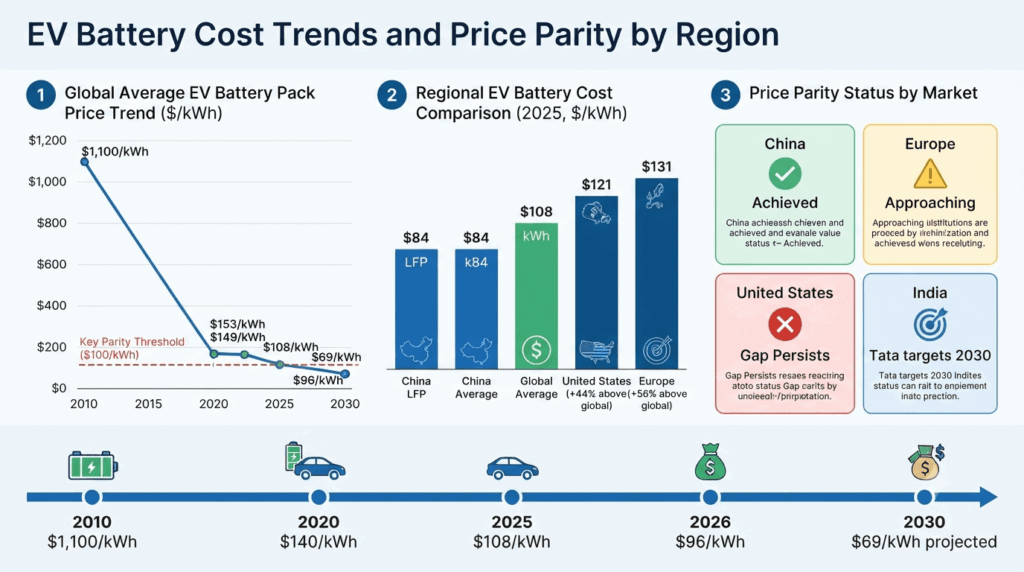
EV battery costs fall below $100/kWh: what it means for price parity - infographic showing global battery pack prices falling from $1,100 per kWh in 2010 to $108 per kWh in 2025 and $96 per kWh projected for 2026, with China LFP at $84 per kWh and the $100 per kWh price parity threshold
EV charging

EV Battery Costs Fall Below $100/kWh: What It Means for Price Parity

EV battery costs fall below $100/kWh: what it means for price parity. Global battery pack prices fell to a record low of $108 per kWh in 2025, with China LFP packs at $84/kWh and Argonne modeling $96/kWh for 2026. But price parity is not a single event. This analysis breaks down the numbers, the four drivers of cost decline, the regional disparities that remain, and what the threshold actually changes for buyers in China, Europe, the US, and emerging markets.

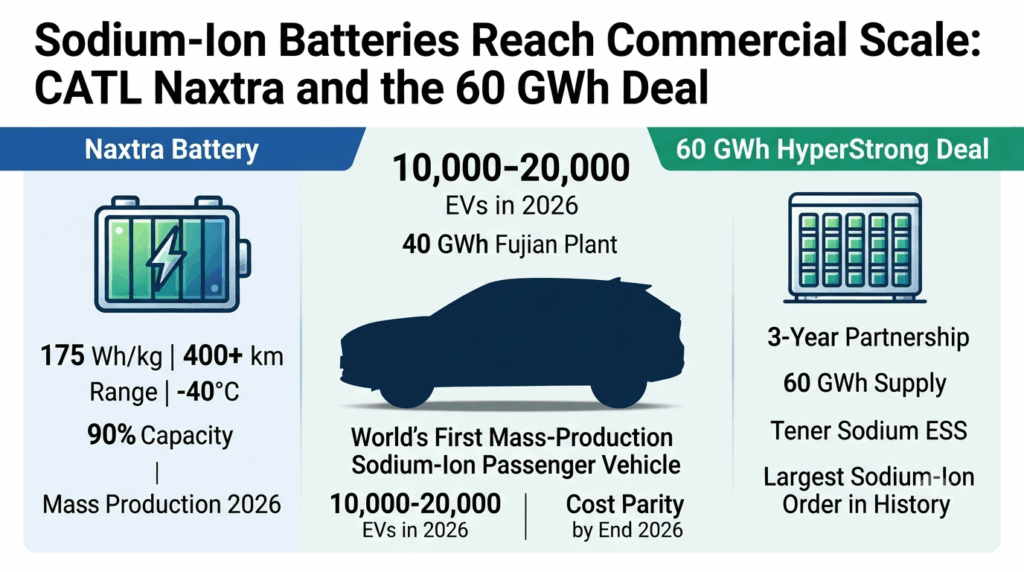
Sodium-ion batteries reach commercial scale: CATL Naxtra and the 60 GWh deal - infographic showing Naxtra at 175 Wh/kg with 400+ km range, the Changan Nevo A06 as the first mass-production sodium-ion passenger vehicle, and the 60 GWh HyperStrong supply agreement
EV charging

Sodium-Ion Batteries Reach Commercial Scale: CATL Naxtra and the 60 GWh Deal

Sodium-ion batteries reach commercial scale: CATL Naxtra and the 60 GWh deal. The Changan Nevo A06 entered the market as the world’s first mass-production sodium-ion passenger vehicle. CATL and HyperStrong signed the largest sodium-ion supply agreement in history covering 60 GWh. This analysis breaks down the Naxtra battery specifications, the cold-weather advantage, the manufacturing ramp, the cost trajectory, and what the dual-chemistry future actually looks like.

Scroll to Top