Europe has built the chargers. Now it has to build the experience.
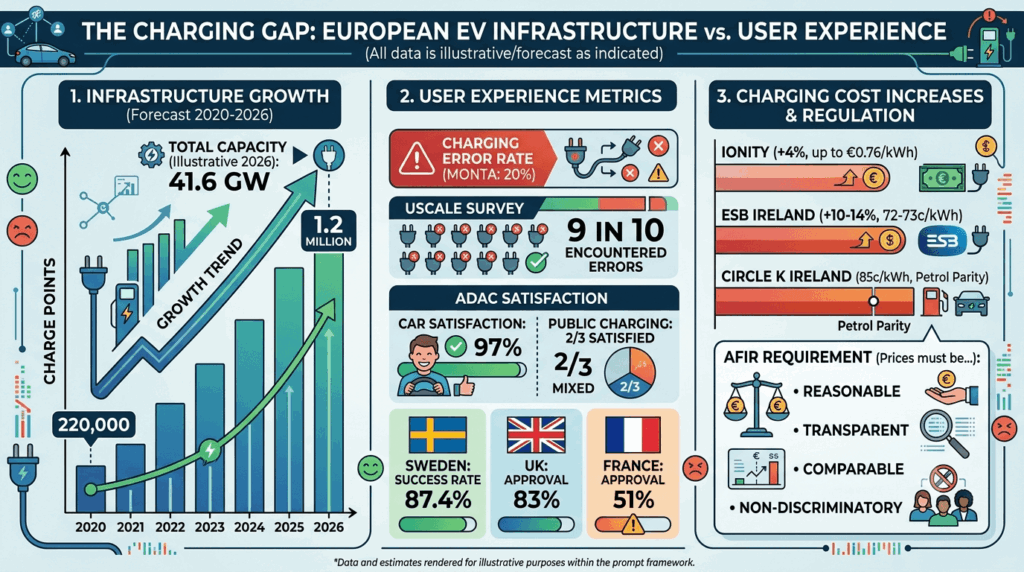
By mid-2026, the European Union had surpassed 1.2 million publicly accessible charging points. The total charging capacity of public stations reached 41.6 GW in June 2026, a 29% increase year on year. The gridX Charging Report 2026 recorded 1.22 million charge points across 32 markets in 2025, a 19.1% increase.
The infrastructure numbers are impressive. The user satisfaction numbers are not.
An ADAC survey of 1,060 German EV drivers published in September 2026 found that 97% were satisfied with their cars. But only about two-thirds expressed satisfaction with public charging infrastructure. And 56% of users, rising to 67% of female users, reported modifying or avoiding nighttime charging due to safety concerns.
The gap between what Europe has built and what drivers actually experience is the defining tension of the continent’s EV transition. This is why the chargers are multiplying while the frustration is mounting.
The Chargers Are There. The Experience Is Not.
The infrastructure build-out has been genuine. The Netherlands leads with 202,833 public charge points, followed by Germany with 200,830 and France with 186,717. The 2025 growth rate of 19% in charge point numbers was matched by a 36% increase in total charging capacity, reflecting a shift toward higher-power installations.
Eastern European countries recorded the fastest growth. Latvia increased charging capacity by 139%, Estonia by 118%, and Romania by 111%. The geographic distribution is broadening, even if the absolute numbers remain concentrated in Western Europe.
But the availability of chargers does not automatically translate into a functional charging experience. Data from Monta, a charging service provider, puts the public charging error rate at approximately 20%. The Uscale 2025 survey, which polled around 1,600 EV drivers, found that nine out of ten had encountered charging errors, with 30% experiencing them very frequently.
A 2026 survey of charging network operators found that 59% identified charger reliability and stability as the industry’s top challenge, surpassing energy constraints for the first time in the report’s history.
The reliability problem is not evenly distributed. In Sweden, 87.4% of public charging sessions were successful in the second quarter of 2026, with chargers available 95.57% of the time. But country-level averages mask significant variation. The United Kingdom records an 83% approval rating for charging infrastructure, while France sees only 51%.
The Payment Problem: Multiple Apps, Opaque Pricing, Unpredictable Bills
The most persistent source of frustration is not broken chargers. It is payment.
A 2026 position paper from BEUC, the European Consumer Organisation, identified the core problem: “confusing pricing, opaque billing methods, and highly diverse payment options”. The organisation noted that the issue is “increasingly less so due to a lack of charging stations” and more about the structural failures of the payment ecosystem.
The fragmentation is acute for drivers crossing borders. A European Parliament question in September 2026 highlighted that “drivers may face different prices for the same charging session depending on whether they use an operator’s RFID card, a mobile application, a QR code or a bank card”.
The problem is not just price variation. It is that prices are often not available before charging begins. The TRAN Committee study found that price information is frequently unavailable prior to the start of a charging session. A BEUC analysis of the Dutch market found that only 50% of invoices matched the prices that were publicly available in advance.
AFIR, the EU’s Alternative Fuels Infrastructure Regulation, was supposed to solve this. Article 5 requires that prices be “reasonable, easily and clearly comparable, transparent and non-discriminatory”. But the European Commission itself acknowledged in August 2026 that implementation and enforcement “remain incomplete, fragmented and uneven”.
AFIR does require card payment at stations above 50 kW. Existing stations have until 1 January 2027 to retrofit. But BEUC has argued that the sub-50 kW exemption forces most users onto apps, badges, or QR codes, and has called for its removal. The organisation also recommends making energy-based pricing in euros per kilowatt-hour mandatory for all public charging points, including those below 50 kW.
The Cost Problem: Public Charging Is Getting More Expensive
While the charging experience remains frustrating, it is also becoming more costly.
On 1 July 2026, Ionity raised its charging prices by an average of 4% across most of its European network. In Germany, ad-hoc charging now costs up to €0.76 per kilowatt-hour. Subscription prices start at €0.41 per kilowatt-hour.
Ionity attributed the increase to higher wholesale electricity prices. “Following recent developments in European energy markets, wholesale electricity prices have settled at a higher level than before,” the company stated.
Ionity is not alone. In Ireland, Circle K increased its public charge-point prices from 81.5 cent per kilowatt-hour to 85 cent, a 4% jump that made its charging fees “at least as expensive as petrol or diesel at the pump on a per-kilometre basis”. ESB raised its standard pay-as-you-go rates from 64-66 cent to 72-73 cent per kilowatt-hour, an increase of between 10% and 14%.
The TRAN Committee study found that public charging is “still significantly more expensive than charging at home or at work and often appears unreasonably high, non-transparent, complex and not user-friendly”. The same study noted that the same charging session often leads to different final costs depending on the provider, app, card, or payment method used by the consumer.
For drivers without access to home charging, the cost advantage of electric vehicles is eroding. When public charging costs exceed €0.80 per kilowatt-hour, the per-kilometre cost can match or exceed that of a fuel-efficient petrol car. In Ireland, that threshold has already been crossed.
The Safety Problem That Nobody Talks About
A dimension of the user satisfaction problem that receives less attention is personal safety, particularly for women.
The ADAC survey found that 67% of female EV drivers modify or avoid nighttime charging due to a lack of lighting and the isolation of charging points. A UK study on charging hub user experience identified “perceptions of safety, security, and hygiene” as among the highest expectations, and found dissatisfaction with remote assistance and service information provision.
This is not a technological problem. It is a design and planning problem. Charging stations located in poorly lit areas, with no amenities, and no staff presence create an experience that is fundamentally different from refuelling at a staffed petrol station. For a significant portion of the population, that difference affects when and whether they charge.
What Is Being Done
The European Commission is reviewing AFIR and plans to adopt a proposal for its revision by the end of 2026. The review addresses user aspects including price transparency and enforcement.
Germany has moved ahead with national legislation. A draft law published in February 2026 proposes fines for incomplete pricing information, requiring the price per kilowatt-hour and any time-based price components to be clearly displayed before the charging process begins. The law would empower state price authorities to penalise violations of AFIR price transparency rules as administrative offences.
Consumer organisations are pushing for more. BEUC’s recommendations include mandatory energy-based pricing, full price disclosure before charging, mandatory receipts after each session, and empowering national authorities to conduct market checks by mandating data sharing of pricing structures.
The Chargemap 2026 ranking of charging networks, based on 433,775 user ratings, identified Electra as a major winner across Europe, with the network dominating in five countries. Tesla, once the benchmark for reliable charging, receded in the rankings. The shift suggests that user satisfaction is not determined by network size or brand recognition. It is determined by the quality of the individual charging experience.
The Honest Assessment
Europe has achieved something remarkable. The continent built 1.2 million public charging points in less than a decade, a near five-fold increase from 2020. The charging capacity is growing faster than the charger count, reflecting a shift toward higher-power infrastructure that reduces charging times.
But the user experience has not kept pace. A 20% error rate is not a technological inevitability. It is a service quality failure. Opaque pricing is not an unavoidable consequence of market complexity. It is a regulatory failure. Nighttime charging safety concerns are not a niche issue. They affect more than half of users and two-thirds of women.
The infrastructure milestone matters. It enables the transition. But the transition will not be complete until drivers can charge without frustration, without uncertainty, and without fear.
Europe has built the chargers. Now it needs to build the experience.