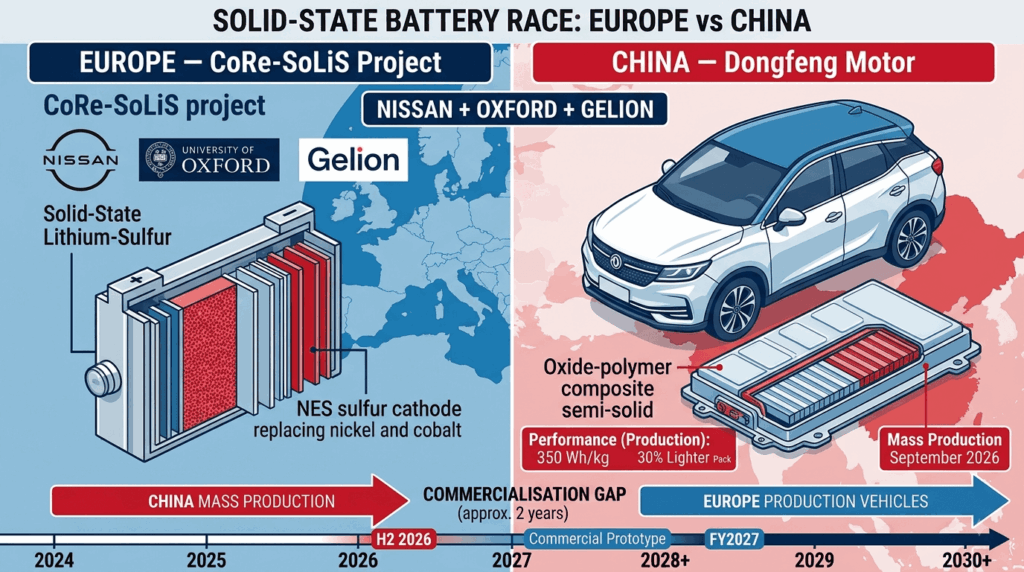
Europe focus: Nissan Europe/Oxford/Gelion; Dongfeng's planned mass production (H2 2026) — split infographic showing European CoRe-SoLiS project with Gelion NES sulfur cathode 402 Wh/kg and Dongfeng solid-state battery with 350 Wh/kg, 1,000+ km range entering mass production in H2 2026
EV charging

Europe Focus: Nissan Europe/Oxford/Gelion; Dongfeng’s Planned Mass Production (H2 2026) — The Honest Complete Guide

Europe focus: Nissan Europe/Oxford/Gelion; Dongfeng’s planned mass production (H2 2026) — and the honest assessment is that the two fronts could not be more different in their stage of development. This complete guide breaks down the CoRe-SoLiS project (£3.4 million, £2.4 million Innovate UK funding, Gelion NES sulfur cathode technology with 402 Wh/kg demonstrated), Dongfeng’s mass production announcement (350 Wh/kg oxide-polymer composite semi-solid battery, 1,000+ km range, September 2026 production), and what these developments mean for the global solid-state race. We analyse the technology, the timelines, the Europe-China commercialisation gap, and what this all means for today’s EV buyers.
EV charging

US Focus: Factorial Energy’s Partnership with Stellantis; SwRI and SMU Collaborative Research — The Honest Complete Guide

US focus: Factorial Energy’s partnership with Stellantis; SwRI and SMU collaborative research — and the honest assessment is that the United States is mounting a credible two-front push to commercialise solid-state battery technology. This complete guide breaks down the Stellantis-Factorial partnership (9.5% equity stake, Dodge Charger Daytona road testing, 375 Wh/kg FEST cells with 18-minute charging), the SwRI-SMU research collaboration (ultra-thin films to stabilise the anode-electrolyte interface, $128,896 SPARKS grant), and what these developments mean for the US position in the global solid-state race. We analyse the technology, the timelines, and what this all means for today’s EV buyers.
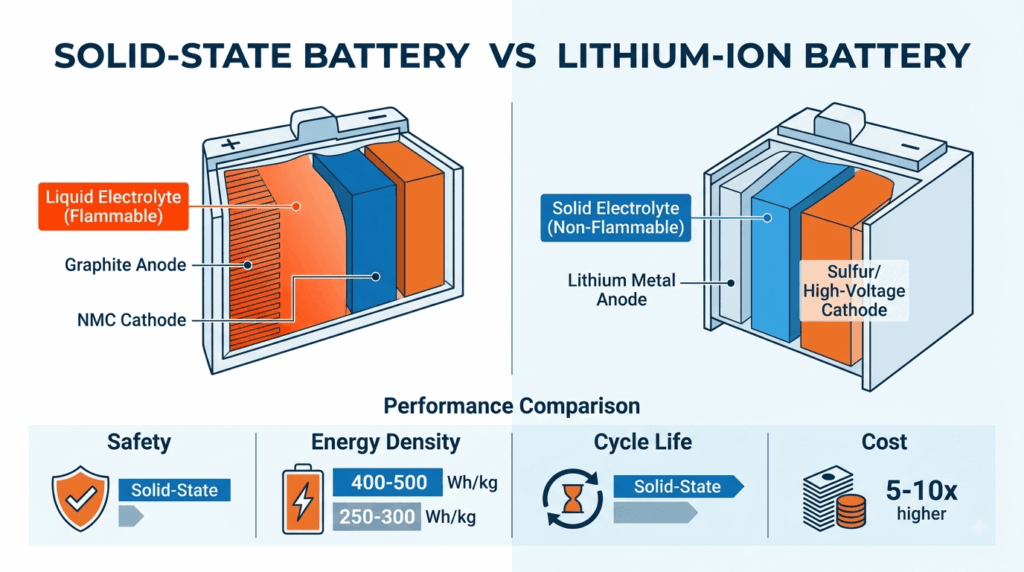
Solid-state vs. lithium-ion: safety, range, and cost compared — infographic showing solid-state battery with non-flammable solid electrolyte, lithium metal anode, 400-500 Wh/kg energy density versus conventional lithium-ion with flammable liquid electrolyte, graphite anode, 250-300 Wh/kg energy density
EV charging

Solid-State vs. Lithium-Ion: Safety, Range, and Cost Compared — The Honest Complete Guide

Solid-state vs. lithium-ion: safety, range, and cost compared — and the honest assessment is that solid-state delivers genuine advantages in each dimension, but the magnitude varies dramatically and the timeline to commercialisation remains measured in years. This complete guide breaks down why solid-state is safer (and where the nuance matters), how energy density could double current capabilities, why cycle life could extend dramatically, and the honest numbers on the cost gap — currently 5-10x more expensive than lithium-ion. We analyse the mass-production hurdles, the semi-solid bridge technology, the global competitive landscape, and what this all means for today’s EV buyers.
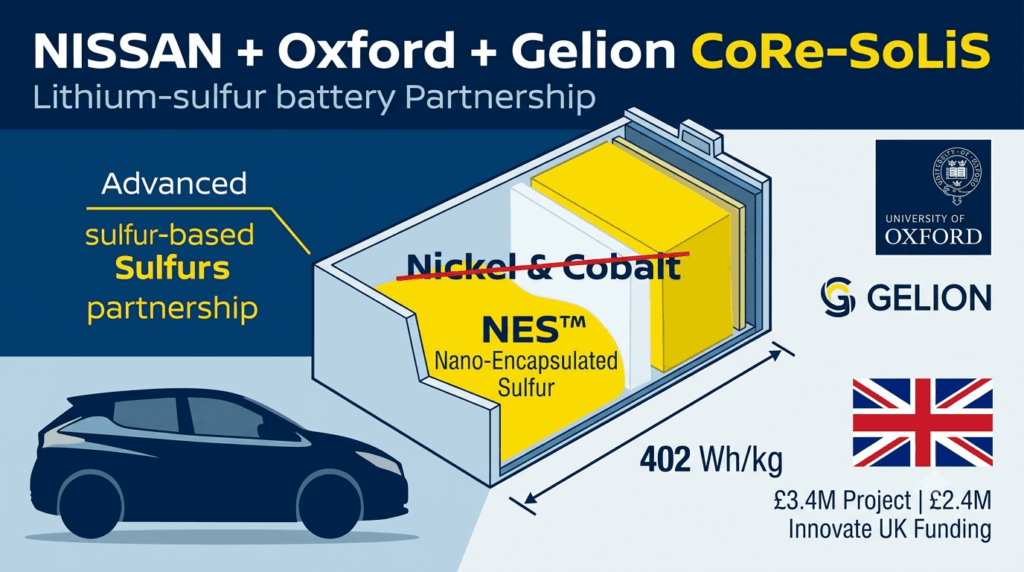
Nissan + Oxford + Gelion partnership – can lithium-sulfur break the cost barrier? Infographic showing the CoRe-SoLiS project replacing nickel and cobalt with Gelion NES nano-encapsulated sulfur cathode technology, 402 Wh/kg energy density, £3.4 million total cost with £2.4 million Innovate UK funding
EV charging

Nissan + Oxford + Gelion Partnership – Can Lithium-Sulfur Break the Cost Barrier? The Honest Complete Guide

Nissan + Oxford + Gelion partnership – can lithium-sulfur break the cost barrier? — and the £3.4 million CoRe-SoLiS project, backed by £2.4 million in UK government funding, is the most substantive attempt to answer that question in the Western battery industry. This complete guide breaks down Gelion’s NES sulfur cathode technology (402 Wh/kg demonstrated), Nissan’s solid-state expertise, Oxford University’s fundamental science, and the project’s potential to replace expensive nickel and cobalt with abundant, ultra-low-cost sulfur. We analyse the technology, the competitive “Cheaper Than China” thesis, the historical challenges of lithium-sulfur chemistry, and the honest timeline for when this technology might reach production vehicles.

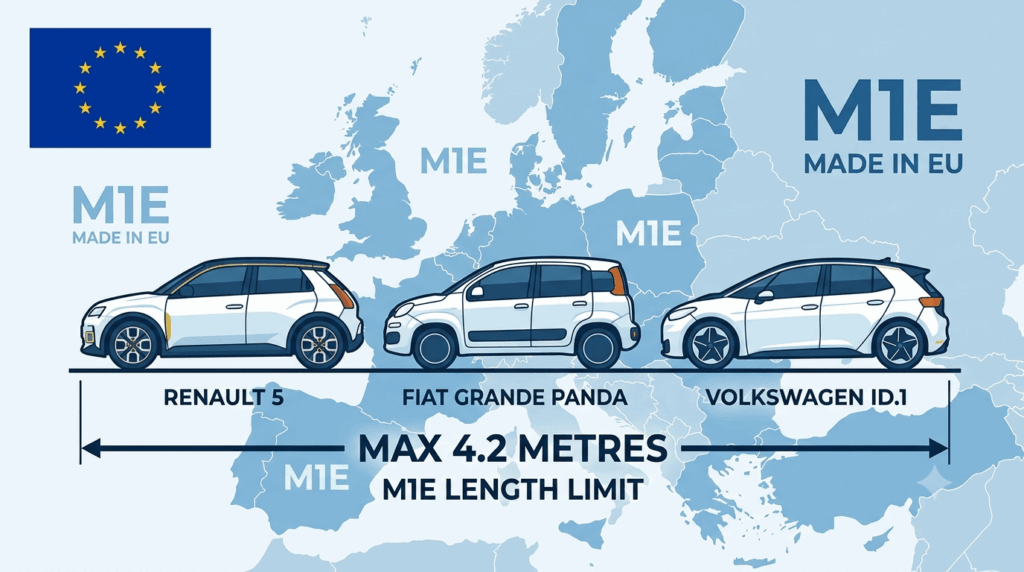
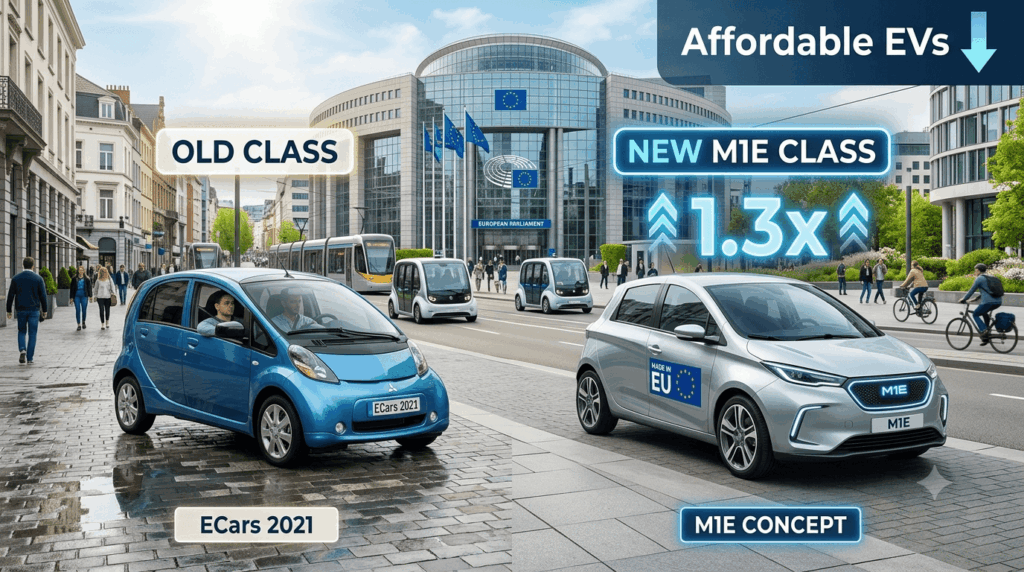
The EU's Omnibus automotive proposal a new small and affordable EV category is coming — infographic showing the M1E vehicle category for electric cars up to 4.2 metres in length, with Renault 5, Fiat Grande Panda and Volkswagen ID.1 models qualifying for the new classification, manufactured in the EU with super-credit incentives
EV charging

The EU’s ‘Omnibus’ Automotive Proposal – A New Small and Affordable EV Category is Coming 2026 — The Honest Complete Guide

The EU’s Omnibus automotive proposal a new small and affordable EV category is coming — and it represents one of the most practically significant elements of the December 2025 Automotive Package for European consumers who have been waiting for genuinely affordable small EVs at the €15,000-€20,000 price point. This complete guide breaks down the M1E vehicle category—covering EVs up to 4.2 metres in length with simplified certification requirements, ten years of regulatory stability, and super-credit incentives for European manufacturers. We analyse what the framework means for buyers, manufacturers, and the EU’s competition with Chinese EV imports, plus the honest timeline assessment for when M1E-category vehicles might actually reach showrooms.

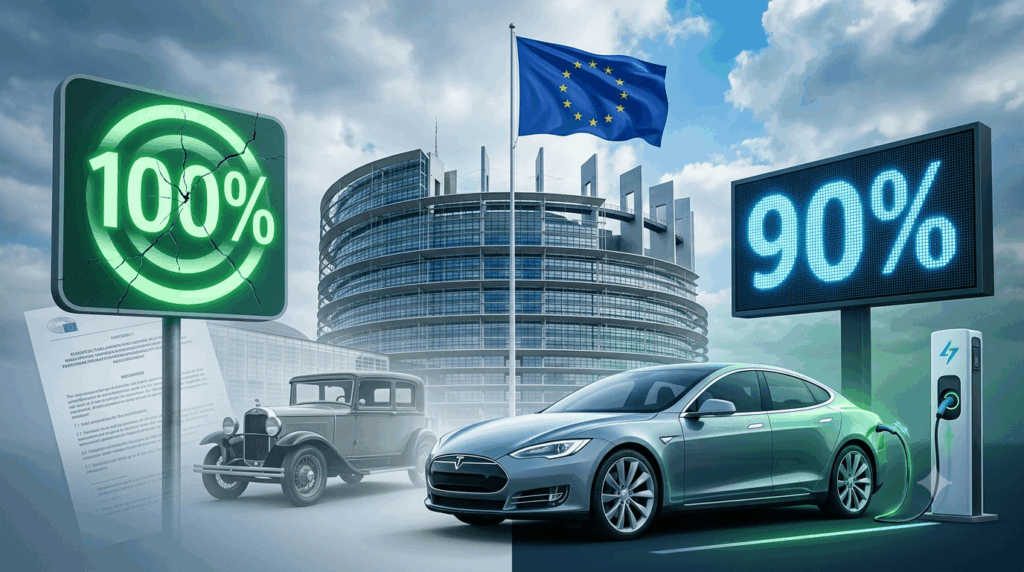
A photorealistic split-scene illustration of the EU 2035 ICE ban softened to 90 percent what does the December 2025 proposal mean now, showing a cracked 100% target fading into a glowing 90% sign over the European Parliament with an electric car charging in the foreground.
Uncategorized

EU 2035 ICE Ban Softened to 90 percent – What Does the December 2025 Proposal Mean Now? 2026 — The Honest Complete Guide

The EU 2035 ICE ban softened to 90 percent what does the December 2025 proposal mean now is the critical question for European car buyers, manufacturers, and investors navigating a shifting policy landscape. This complete guide cuts through the political spin to analyse the specific revision, the real-world impact on EV adoption and charging infrastructure, and whether the new 90% ZEV target represents a pragmatic recalibration or a concerning signal of regulatory uncertainty. We break down why the proposal emerged, what it means for your next car purchase, and how Europe’s revised timeline compares to global EV policies.

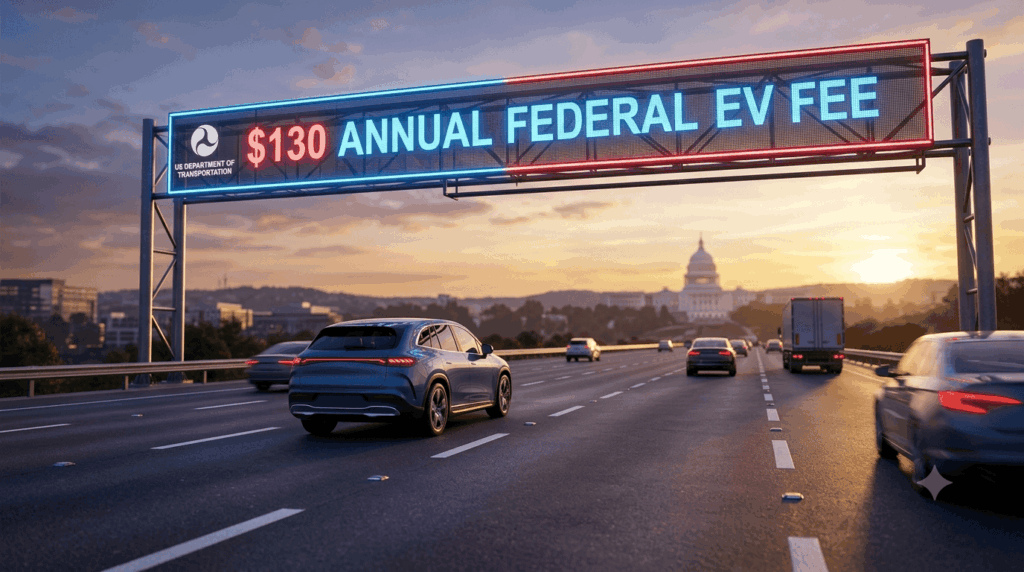
Featured banner image illustrating the new $130 federal EV fee proposal how much will you pay, showing an electric SUV on a US highway beneath a glowing $130 digital road sign and the US Capitol.
EV charging

The New $130 Federal EV Fee Proposal – How Much Will You Pay? 2026 — The Honest Complete Guide

The debate around the new $130 federal EV fee proposal how much will you pay is more complicated than the simple “fairness” arguments suggest. While the bipartisan bill aims to fund road maintenance by charging EV drivers a flat annual fee, our comprehensive analysis reveals that average-mileage BEV owners would actually pay 41% more than their gasoline counterparts do in federal fuel taxes. This guide provides the complete, honest breakdown, exploring how this fee stacks with high state registration costs in places like Georgia and Washington—forcing some owners to pay over $350 annually. We also dissect why the flat fee penalizes low-mileage drivers, examine the impact on lower-income households, and explain the current legislative status. Discover exactly what the numbers mean for your wallet and whether this proposed fee truly represents road-use equity.

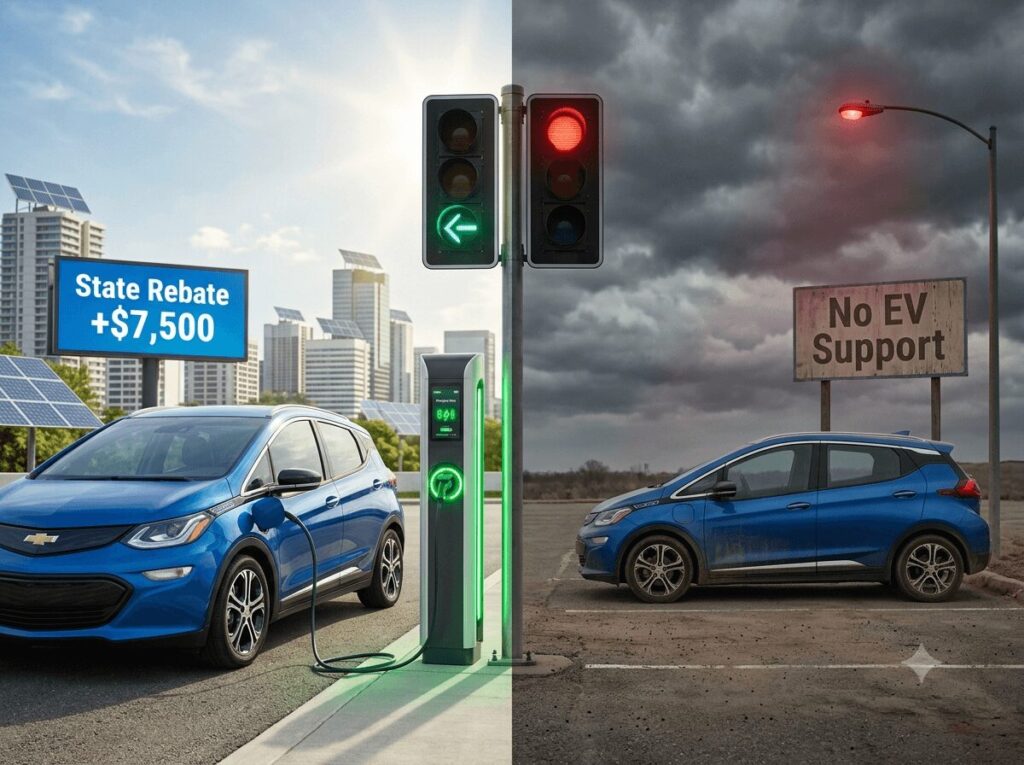
US state EV policy scorecard is your state a green light or red light - featured map showing California and Northeast as green leaders versus Texas and the Deep South as red light policy zones based on the June 2026 Brookings report.
EV charging

US State EV Policy Scorecard: Is Your State a ‘Green Light’ or ‘Red Light’? 2026 — The Honest Complete Guide

Where you live determines the true cost of EV ownership more than which vehicle you buy—and the US state EV policy scorecard is your state a green light or red light for purchase incentives, charging infrastructure, and electricity costs. Based on the June 2026 Brookings report, this complete guide ranks all 50 states across five policy dimensions, revealing why California EV owners receive up to $12,000 in state support while Texas and deep South buyers get zero. From Green Light leaders like Vermont and Massachusetts to Red Light laggards like Mississippi and Wyoming, discover where your state stands—and how to navigate the gap if you’re in a low-scoring state. Essential reading for every American EV buyer in 2026.

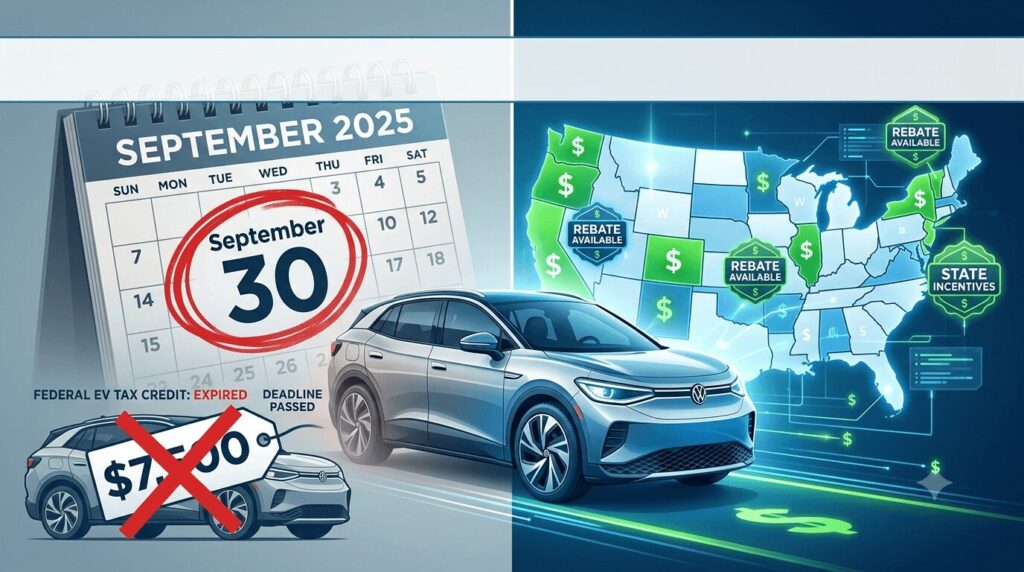
Map of US states with active EV rebate programs after the federal EV tax credit expired in 2026, showing Vermont's $5,000 new EV credit, California's $3,500 rebate, and other state incentives replacing the expired federal credit
Uncategorized

Federal EV Tax Credit Expired 2026 – Is an EV Still Worth It?

The federal EV tax credit expired on September 30, 2025, eliminating the $7,500 new EV and $4,000 used EV credits that millions of buyers relied on. But that doesn’t mean EVs are out of reach in 2026. State programs like Vermont’s $5,000 new / $2,500 used rebate, California’s $3,500 instant discount, and utility company incentives can still make electric vehicles affordable. This comprehensive guide breaks down everything you need to know now that the federal EV tax credit expired—including binding contract exceptions, state-by-state incentives, used EV opportunities, and whether an EV still makes financial sense for you in 2026.

Scroll to Top