Here is a reality about the Chinese smart EV charger market in 2026 that no Western EV charging guide has addressed.
The most technologically sophisticated home EV charging products in the world are not being sold in the UK or the United States. They are being sold in China — by technology companies that approach EV charging from a fundamentally different angle than the European and American charger brands that dominate English-language comparison guides.
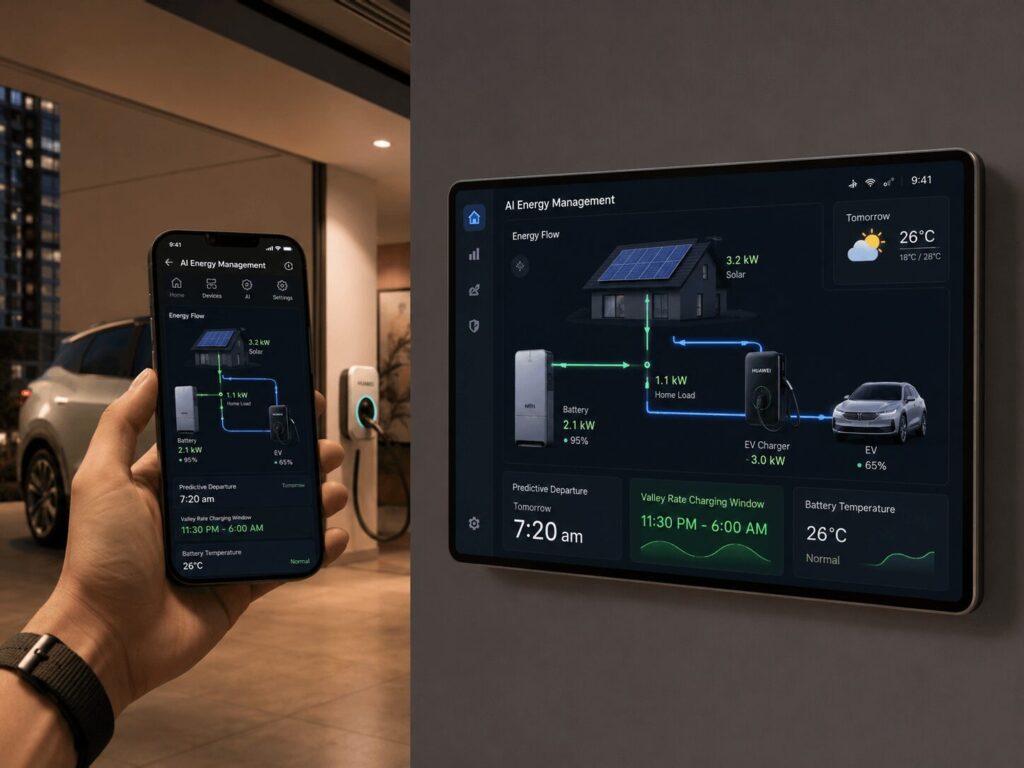
Huawei Digital Power brings AI-driven energy optimisation to residential EV charging — the same deep learning algorithms that manage Huawei’s data centre power infrastructure applied to deciding when and how fast your car charges based on real-time electricity pricing, solar generation, weather forecasts, and your personal departure patterns.
Xiaomi — now a genuine EV manufacturer with the SU7 sedan — has designed a home charging ecosystem where the charger, the car, the home’s smart devices, and the electricity supply are managed as a single integrated system through HyperOS.
Local innovators like Growatt, Ginlong Solis, and emerging AI-first startups are building charging products that the European market won’t see for 2-3 years.
This guide on the best smart EV chargers China 2026 Huawei Digital Power vs Xiaomi vs local innovators covers the smart charging technology that most English-language guides haven’t discovered yet. It is written honestly — the products are impressive but they have real limitations, and this guide covers both.
Why China’s Smart EV Charger Market Is Different
Before comparing specific products, understanding why China’s smart charger market has developed differently from Europe and the US frames every comparison that follows.
The Technology Company Entry Point
In Europe and the US, the home EV charger market is dominated by specialist EV charging companies — Wallbox, ChargePoint, Myenergi, Emporia. These companies started with EV charging and added smart features progressively.
In China, the smart charger market has been entered by technology conglomerates — Huawei, Xiaomi, and others — that started with technology platform capability and applied it to EV charging. The result is a different product philosophy:
European/US approach: Build a reliable EV charger, add WiFi, add app, add TOU scheduling, add energy monitoring.
Chinese tech company approach: Build a comprehensive energy management platform, extend it to include EV charging as one of several managed energy assets.
The practical difference: Chinese tech company smart chargers integrate EV charging into a broader home energy ecosystem with a sophistication that European specialist charger brands are still working toward.
The Smart Home Ecosystem Density
China has the world’s highest density of smart home device adoption — driven by Xiaomi, Huawei, Alibaba, and Baidu’s aggressive smart home ecosystem development. Chinese homes are more likely to have integrated smart home platforms managing lighting, climate, security, and appliances than equivalent European or American homes.
A smart EV charger that integrates with this existing smart home infrastructure delivers more value in China than in markets with less smart home penetration — because the integration has more to coordinate with.
The Electricity Market Context
China’s expanding residential time-of-use electricity pricing (居民分时电价) creates a high-value target for smart charging optimisation. The ¥0.50-0.60/kWh differential between peak and valley rates in major Chinese cities delivers ¥2,000-2,500 in annual savings for typical EV owners — a substantially higher optimisation prize than in most European markets.
This high-value target justifies sophisticated AI-driven scheduling optimisation that maximises valley rate utilisation in ways that simple timer-based scheduling cannot fully capture.
The Smart Charging Technology Stack — What Makes a Charger Genuinely Smart in 2026
Before comparing specific chargers, establishing what “smart” actually means in 2026 — beyond the basic WiFi + scheduling that all smart chargers provide — distinguishes genuinely advanced products from those with smart marketing.
Level 1 Smart: WiFi + Basic Scheduling
Every charger in the Chinese market described as “smart” has at minimum:
- WiFi connectivity
- Scheduled charging (start at X time, stop at Y time)
- Basic energy monitoring
- Remote start/stop via app
This is the baseline. It is not what differentiates the products in this guide.
Level 2 Smart: Dynamic TOU Optimisation
Chargers that go beyond fixed scheduling to:
- Integrate with electricity pricing data
- Automatically adjust scheduling based on actual rate changes
- Respond to utility demand response signals
- Provide accurate electricity cost calculations per session
Most of the chargers in this guide operate at this level.
Level 3 Smart: Ecosystem Integration
Chargers that coordinate EV charging with other home systems:
- Solar generation integration (charge from solar surplus)
- Battery storage integration (charge from stored solar/off-peak electricity)
- HVAC coordination (reduce EV charging during peak heating/cooling demand)
- Whole-home load management (prevent total consumption from exceeding supply limits)
Huawei Digital Power and Sungrow operate primarily at this level.
Level 4 Smart: AI-Driven Predictive Optimisation
The frontier level — chargers that use machine learning and predictive algorithms to:
- Learn departure patterns and pre-charge accordingly
- Forecast electricity prices and optimise charging windows
- Predict solar generation based on weather forecasts
- Coordinate multiple energy assets (solar, storage, EV, grid) as an integrated optimisation problem
- Improve performance over time as the AI learns from usage data
Huawei Digital Power’s most advanced products operate at this level — and this is what distinguishes them from every other charger in this comparison.
Charger 1: Huawei Digital Power Smart Charger (华为数字能源充电桩)
The AI-driven energy management pioneer
Background
Huawei Digital Power is Huawei’s energy technology division — a business that manages power infrastructure ranging from data centres and solar farms to smart grid components and home energy systems. It is not a consumer electronics brand that has added EV charging — it is an industrial energy management company that has applied its core competency to residential energy optimisation.
In 2023-2026, Huawei Digital Power expanded aggressively into residential smart energy — combining solar inverters, battery storage (Huawei LUNA), EV charging, and home energy management into a single AI-optimised platform called FusionSolar + FusionCharge.
Specifications
| Specification | Detail |
|---|---|
| Price | ¥1,800-¥4,500 (depending on variant and bundle) |
| Max Power | 7 kW (single-phase) / 11 kW (three-phase) |
| Connector | GB/T 20234.2-2015 |
| Installation | Hardwired |
| Cable Length | 5m tethered |
| IP Rating | IP65 |
| Operating Temp | -30°C to +55°C |
| Smart Features | AI scheduling, solar integration, battery coordination, whole-home management, predictive optimisation |
| Connectivity | WiFi, Ethernet, PLC |
| App | FusionSolar app / Huawei SmartHome |
| AI Platform | Huawei AI Energy Engine |
| Warranty | 5 years (with Huawei inverter) / 3 years (standalone) |
| GB/T Certification | GB/T 20234.2-2015 ✅ |
| OCPP | 2.0 ✅ |
Smart Features Breakdown
| Feature | Available |
|---|---|
| TOU Scheduling | ✅ AI-driven dynamic |
| Solar Integration | ✅ Best in class — FusionSolar |
| Battery Coordination | ✅ Yes — Huawei LUNA |
| AI Predictive Scheduling | ✅ Unique — departure prediction, price forecasting |
| Whole-Home Load Management | ✅ Yes — full home |
| Weather Forecast Integration | ✅ Yes — solar prediction |
| OCPP 2.0 | ✅ Industry-leading standard |
| HarmonyOS Integration | ✅ Full |
| Aito Vehicle Integration | ✅ Deep (Huawei/Aito owners) |
| Remote Diagnostics | ✅ Proactive |
| OTA Updates | ✅ Excellent |
| Energy Arbitrage | ✅ Buy cheap, store, use during peak |
The AI Energy Engine — What It Actually Does
This is the feature that makes Huawei Digital Power genuinely different from every other charger in the Chinese market — and from every charger in the global market at this price point.
The Huawei AI Energy Engine for residential EV charging:
The AI analyses multiple data streams simultaneously:
1. Departure pattern learning: Over the first 2-4 weeks of use, the AI learns your actual departure times from home — not the time you set in an app, but the time you actually disconnect the charger and leave. It identifies patterns: Monday-Friday departures consistently at 7:20am, Saturday departures typically between 8am and 10am, Sunday variable.
Using these learned patterns, the AI calculates backward: what charging rate is needed at what time to ensure the target SOC is reached at the right moment. It does not simply charge throughout the valley rate window — it charges as late as possible within the cheap rate window, preserving battery longevity while ensuring the car is ready.
2. Electricity price forecasting: In cities where real-time or day-ahead electricity pricing is available, the AI forecasts price periods and identifies the optimal charging windows — beyond the simple fixed valley rate window. In Shanghai, where TOU pricing has three tiers, the AI identifies which specific flat-rate periods are worth using versus strict valley-only charging based on the target SOC and departure time.
3. Solar generation forecasting: When connected to a Huawei FusionSolar system, the AI accesses weather forecast data to predict tomorrow’s solar generation. On a day forecast to be sunny, it reserves more charging for solar-covered periods. On a forecast cloudy day, it front-loads cheap grid charging to compensate for anticipated low solar generation.
4. Battery storage arbitrage: When a Huawei LUNA home battery is installed, the AI coordinates three energy assets simultaneously — solar generation, LUNA battery storage, and EV charging. The optimisation logic:
- Charge LUNA battery during the deepest valley electricity periods
- Charge EV from LUNA battery during peak periods (avoiding peak grid rates)
- Charge EV directly from solar surplus during generation periods
- Use grid only when LUNA and solar cannot cover requirements
For Shanghai homeowners with 5 kWp solar, Huawei LUNA 10 kWh storage, and a Huawei FusionCharge EV charger, the AI optimisation delivers combined annual savings that Huawei estimates at ¥5,000-¥8,000 across all three energy assets. Independent analysis from Chinese energy consultancies suggests ¥3,500-¥5,500 as a realistic range.
5. Vehicle integration (Aito/Huawei vehicles): For Aito vehicle owners — the EV brand using Huawei’s HarmonyOS intelligent connected car platform — the integration depth goes beyond standard GB/T communication:
- The charger reads battery temperature from the vehicle’s BMS directly
- Pre-conditioning is triggered by the charger based on departure schedule
- Charging rate is adjusted in real-time based on battery temperature and target SOC
- Health-optimised charging mode slows charging at high SOC to minimise degradation
The FusionSolar App Experience
The FusionSolar app is Huawei’s professional energy management interface — used commercially by solar farm operators and adapted for residential use. The adaptation is generally successful:
Strengths:
- Comprehensive real-time energy flow dashboard showing solar generation, battery state, EV charging, and grid import/export simultaneously
- AI recommendations (presented as push notifications) explaining why the system is making specific charging decisions
- Detailed energy cost analysis with accurate cost-per-session tracking
- Multi-home management — useful for families with multiple properties
Limitations:
- The professional heritage creates an interface that is data-dense but not always consumer-friendly — new users need 1-2 weeks to become comfortable with the full feature set
- EV-specific features are embedded within a broader solar management interface, requiring navigation through solar screens to reach EV-specific settings
Integration with HarmonyOS Smart Home
Huawei’s HarmonyOS smart home ecosystem — used by millions of Chinese households with Huawei phones and smart home devices — integrates with the FusionCharge system:
- Voice control: “小艺,开始给汽车充电” (Xiaoyi, start charging the car) through Huawei AI assistant
- Smart scene automation: The charger participates in “I’m home” and “leaving home” smart scenes
- Dashboard widget: EV charging status visible on Huawei phone home screen
- Smart home energy view: EV charging appears alongside other smart home energy consumption in the Huawei SmartHome app
The Honest Limitations
Price: The Huawei Digital Power standalone charger at ¥1,800-¥2,500 is competitive. But the AI capabilities reach their potential only within the full Huawei energy ecosystem — Huawei solar inverter, Huawei LUNA battery, Huawei FusionSolar management. Building this complete ecosystem costs ¥30,000-¥80,000+ depending on solar system size and battery capacity. The charger is the least expensive component of a significant investment.
Standalone value: Used as a standalone charger without Huawei solar and storage, the FusionCharge is a well-built IP65 charger with good TOU scheduling and HarmonyOS integration — but at ¥1,800-¥2,500, the premium over StarCharge (¥899-¥1,499) primarily buys Huawei brand quality and future ecosystem readiness rather than currently deployed AI features.
Non-Aito vehicle integration: The deepest AI integration features work best with Aito vehicles. NIO, BYD, Xpeng, and other brand vehicles get good smart charging but not the Aito-level BMS communication and departure-optimised charging.
Who Should Buy This
Huawei ecosystem users (HarmonyOS phone, Huawei solar, or planning Huawei solar) who want the most AI-sophisticated residential EV charging available in China. Aito vehicle owners who want the deepest vehicle-charger integration available. Villa and low-rise homeowners building a complete Huawei smart energy system. Budget-flexible buyers who want future-proof Level 4 AI smart charging capability.
Smart intelligence: Best in China (within Huawei ecosystem) Value for money: Good (excellent within full Huawei ecosystem) Build quality: Excellent Overall verdict: The most AI-sophisticated home EV charger in China. Full value requires the Huawei energy ecosystem — transformative for Huawei ecosystem users, less compelling as a standalone purchase.
Overall score: 9/10 (Huawei ecosystem) / 7/10 (standalone)
Charger 2: Xiaomi EV Charger (小米充电桩)
The HyperOS ecosystem integration for Xiaomi SU7 owners and smart home users
Background
Xiaomi’s entry into EV manufacturing with the SU7 sedan in 2024 created immediate demand for a Xiaomi-branded home charging solution that integrates with HyperOS — Xiaomi’s unified operating system connecting phones, tablets, smart home devices, cars, and home charging infrastructure.
The Xiaomi EV Charger is not Xiaomi’s first home energy product — Xiaomi has sold smart home products including power monitoring devices, smart plugs, and energy management hubs for years through the Mi Home ecosystem. The EV charger extends this ecosystem to include EV charging as a managed energy asset.
Specifications
| Specification | Detail |
|---|---|
| Price | ¥1,299-¥1,999 |
| Max Power | 7 kW (single-phase) / 11 kW (three-phase) |
| Connector | GB/T 20234.2-2015 |
| Installation | Hardwired |
| Cable Length | 5m tethered |
| IP Rating | IP55 |
| Operating Temp | -20°C to +50°C |
| Smart Features | TOU scheduling, energy monitoring, HyperOS integration, SU7 ecosystem |
| Connectivity | WiFi (2.4 GHz + 5 GHz dual-band), Bluetooth |
| App | 小米家 (Mi Home) / Xiaomi HyperOS |
| Warranty | 3 years |
| GB/T Certification | GB/T 20234.2-2015 ✅ |
| OCPP | 1.6 ✅ |
Smart Features Breakdown
| Feature | Available |
|---|---|
| TOU Scheduling | ✅ Excellent |
| Solar Integration | ⚠️ Limited (third-party) |
| Energy Monitoring | ✅ Good |
| HyperOS Integration | ✅ Deep |
| Xiaomi SU7 Integration | ✅ Deep — unique feature |
| Mi Home Scene Automation | ✅ Yes |
| Voice Control (小爱同学) | ✅ Yes |
| Smart Grid Response | ✅ Yes |
| OTA Updates | ✅ Frequent |
| Multi-device Coordination | ✅ Yes (Xiaomi smart home) |
The HyperOS Integration — What It Means Practically
Xiaomi’s HyperOS is the operating system connecting Xiaomi phones, tablets, smart TVs, smart home devices, and the Xiaomi SU7 car. The EV charger’s integration with this ecosystem creates coordination capabilities that are genuinely useful:
Phone-to-charger integration: When your Xiaomi phone detects that you are approaching home (geofencing or NFC home tag), HyperOS can automatically trigger the charger to prepare for connection. The “arriving home” smart scene:
- Smart lock unlocks
- Climate system adjusts to home comfort temperature
- EV charger activates and prepares for connection
- Smart lighting adjusts to evening mode All triggered automatically when you arrive within 200 metres of home.
Departure scene coordination: “Leaving home” smart scene includes:
- EV charger disconnection confirmed (or alert if still charging and departure is imminent)
- Smart home enters away mode
- Non-essential appliances powered down
- Security camera monitoring activates
SU7-specific integration: For Xiaomi SU7 owners, the integration goes significantly deeper:
- Car’s battery SOC visible in Mi Home app without opening the Xiaomi car app
- Charging schedule synchronised between car’s built-in scheduler and home charger
- Departure time set on phone updates both car pre-conditioning schedule and charger schedule simultaneously
- Energy cost tracking unified between home electricity and vehicle charging costs
小爱同学 voice control: Xiaomi’s AI voice assistant 小爱同学 (Xiaoqi) handles EV charging commands naturally:
- “小爱,明天早上7点之前把车充到80%” (Xiaoqi, charge the car to 80% before 7am tomorrow)
- “小爱,现在开始充电” (Xiaoqi, start charging now)
- “小爱,汽车充了多少了” (Xiaoqi, how much has the car charged?)
The natural language processing handles complex scheduling requests rather than requiring specific command syntax — a genuinely useful feature for daily use.
The TOU Optimisation Quality
Xiaomi’s TOU scheduling is well-implemented — reliable, configurable, and with good electricity cost tracking. The 小爱同学 voice interface makes schedule changes more convenient than navigating app menus, which is a practical differentiator for daily use.
The electricity cost accuracy is among the best in this comparison — Xiaomi’s Mi Home platform integrates with Chinese utility billing APIs in major cities, enabling automatic electricity rate configuration rather than manual rate entry.
The Mi Home Ecosystem Value
For Chinese EV owners with existing Xiaomi smart home installations — extremely common given Xiaomi’s dominant position in the Chinese smart home market — the Xiaomi EV Charger delivers ecosystem value that no other charger in this comparison can replicate:
Energy management view: All energy-consuming devices in the Xiaomi smart home are visible in a single Mi Home energy dashboard — smart air conditioners, washing machines, refrigerators, water heaters, and the EV charger. The combined view enables identifying peak consumption periods and scheduling EV charging to avoid household consumption peaks that approach supply limits.
Automation library: Mi Home’s extensive automation (自动化) library enables complex EV charging rules not possible on simpler charger apps:
- “If today’s electricity forecast is high price, don’t charge until valley period”
- “If battery is below 20%, charge immediately regardless of time”
- “If solar generation exceeds home consumption by 2 kW, activate EV charging”
- “If tomorrow’s weather forecast is cold, start pre-conditioning 45 minutes before departure”
These automations require connecting multiple smart home data sources — weather, electricity pricing APIs, solar monitoring — that only work within a fully developed smart home ecosystem like Mi Home.
The Honest Limitations
IP55 is limiting: Unlike Huawei and Autel’s IP65, the Xiaomi EV Charger’s IP55 rating is less appropriate for exposed outdoor installations. For underground car park installations (covered), IP55 is adequate. For open-air parking in cities with heavy rainfall (Guangzhou, Chengdu), IP65 is preferable.
Solar integration is limited: The Xiaomi EV Charger does not have native solar integration — it can receive solar generation data from third-party solar devices through the Mi Home platform, but the solar divert optimisation is less sophisticated than Huawei Digital Power or Sungrow’s native integration.
Non-SU7 vehicle integration: While the charger is technically compatible with all GB/T vehicles, the deep HyperOS integration features specifically serve Xiaomi SU7 owners. NIO, BYD, and Xpeng owners get good TOU scheduling and Mi Home automation but not the SU7’s vehicle-level data integration.
Newer brand in EV charging: Xiaomi’s consumer electronics heritage is strong but their EV charger product line is relatively new. Long-term reliability data over 5+ year ownership is less established than StarCharge or Schneider.
Who Should Buy This
Xiaomi SU7 owners — where the HyperOS ecosystem creates the most compelling vehicle-charger integration in the Chinese market. Xiaomi Mi Home smart home users who want EV charging integrated into their existing automation ecosystem. Tech-forward Chinese EV owners who prioritise voice control and smart home coordination over pure charging hardware specifications.
Smart intelligence: Excellent (within Xiaomi ecosystem) Value for money: Good Build quality: Good Overall verdict: The definitive choice for Xiaomi SU7 owners and Mi Home smart home users. Strong TOU optimisation with excellent voice control and scene automation. Limited appeal outside the Xiaomi ecosystem.
Overall score: 8.5/10 (Xiaomi ecosystem) / 7/10 (non-Xiaomi)
Charger 3: Growatt EV Charger (古瑞瓦特充电桩)
The solar integration alternative to Huawei for non-Huawei solar owners
Background
Growatt is China’s second-largest solar inverter manufacturer — manufacturing solar inverters, battery storage, and EV chargers that integrate into a complete home energy ecosystem. For Chinese EV owners with Growatt solar systems, the Growatt EV Charger delivers native solar integration comparable to Huawei FusionCharge within the Sungrow/Growatt ecosystem.
Specifications
| Specification | Detail |
|---|---|
| Price | ¥1,200-¥2,800 |
| Max Power | 7 kW (single-phase) / 11 kW (three-phase) |
| Connector | GB/T 20234.2-2015 |
| IP Rating | IP65 |
| Operating Temp | -25°C to +55°C |
| Smart Features | Solar divert, TOU scheduling, battery coordination, energy monitoring |
| App | ShinePhone (Growatt) |
| OCPP | 1.6 ✅ |
| Warranty | 5 years (with Growatt inverter) / 3 years (standalone) |
Smart Features Breakdown
| Feature | Available |
|---|---|
| TOU Scheduling | ✅ Yes |
| Solar Divert | ✅ Excellent (Growatt ecosystem) |
| Battery Coordination | ✅ Yes (Growatt ARK storage) |
| Energy Monitoring | ✅ Comprehensive |
| OCPP 1.6 | ✅ Yes |
| Third-party Solar Integration | ⚠️ Limited |
| OTA Updates | ✅ Yes |
What This Charger Does Best
Growatt’s solar integration is native to the Growatt ecosystem — for Chinese homeowners with Growatt solar inverters, this charger delivers:
Solar divert with three modes:
- Priority grid: Charges from grid during valley rates, ignores solar
- Priority solar: Charges from solar surplus, top-up from valley rate grid
- Solar only: Charges exclusively from solar surplus (equivalent to Zappi’s Eco+ mode)
Growatt ARK battery coordination: When Growatt ARK home battery storage is installed, the charger coordinates with battery to:
- Charge battery at valley rates
- Discharge battery to power EV during peak rates
- Combined solar + storage + grid optimisation
5-year warranty with Growatt system: The extended warranty when combined with Growatt inverter matches Huawei’s offering — a confident warranty statement about long-term hardware reliability.
The Honest Limitations
Outside the Growatt ecosystem, the charger becomes a good but not exceptional smart charger at a premium price. The ShinePhone app is designed around solar monitoring rather than consumer-friendly EV charging management. Brand recognition among non-solar Chinese EV owners is lower than StarCharge or Xiaomi — meaning after-sales service network in tier-2 and tier-3 cities may be less accessible.
Who Should Buy This
Chinese homeowners with Growatt solar installations who want native solar-EV integration. The direct alternative to Sungrow EV Charger for Growatt solar users.
Overall score: 8/10 (Growatt solar users) / 6.5/10 (standalone)
Charger 4: Ginlong Solis Smart EV Charger (固德威充电桩)
The emerging premium competitor with global quality standards
Background
Ginlong Technologies (Solis brand) is a Ningbo-based solar inverter manufacturer listed on the Shanghai Stock Exchange, competing with Sungrow and Growatt in the Chinese and global solar markets. Their EV charger product brings the same quality standards as their solar hardware.
Specifications
| Specification | Detail |
|---|---|
| Price | ¥1,500-¥3,200 |
| Max Power | 7 kW / 11 kW / 22 kW (three-phase) |
| Connector | GB/T 20234.2-2015 |
| IP Rating | IP66 |
| Operating Temp | -30°C to +60°C |
| Smart Features | Solar divert, TOU scheduling, load management, OCPP 2.0 |
| Warranty | 5 years |
| OCPP | 2.0 ✅ |
Smart Features Breakdown
| Feature | Available |
|---|---|
| TOU Scheduling | ✅ Advanced |
| Solar Integration | ✅ Solis ecosystem |
| OCPP 2.0 | ✅ Forward-looking |
| Load Management | ✅ Dynamic |
| 22 kW Three-Phase | ✅ Yes |
| IP66 | ✅ Best in comparison |
| -30°C to +60°C | ✅ Widest range |
What Makes Ginlong Solis Stand Out
IP66 rating — the highest weather protection in this entire comparison. IP66 means dust-tight and protected against powerful water jets — superior to the IP65 of Huawei, Autel, and Sungrow.
OCPP 2.0 — alongside Huawei, the only charger in this comparison with OCPP 2.0 (compared to 1.6 for most others). This forward-looking protocol compliance positions the Solis charger for sophisticated utility and smart grid programme participation as these programmes develop in China.
22 kW three-phase capability — combined with OCPP 2.0 and IP66, the Solis charger is the most technically comprehensive single charger in this comparison for three-phase villa installations.
-30°C to +60°C operating range — the widest of any charger in the Chinese market covered here. Relevant for both northern Chinese winters and southern Chinese summer heat.
The Honest Limitations
Lower brand recognition in the consumer EV charging market compared to Huawei, Xiaomi, or StarCharge — Solis is well-known among solar professionals but less known among general Chinese EV consumers. Smart home ecosystem integration is less developed than Huawei or Xiaomi — the charger is technically excellent but less integrated with consumer smart home platforms.
Who Should Buy This
Technically sophisticated Chinese EV owners who prioritise hardware specifications — IP66, OCPP 2.0, 22 kW three-phase, -30°C to +60°C range — over consumer app experience and smart home ecosystem integration. Villa homeowners with three-phase supply wanting maximum specification.
Overall score: 8.5/10 (specification-focused buyers)
Charger 5: Ampere Time Smart Charger (安培时充电桩)
The AI-first startup disrupting established brands
Background
Ampere Time is a 2021-founded Shenzhen startup that has positioned itself as China’s first “AI-native” home EV charger brand — designing the product around machine learning capability from inception rather than adding AI features to existing hardware.
Ampere Time has received significant venture capital funding from Chinese tech investors and has built a product that represents what the next generation of Chinese home EV chargers may look like.
Specifications
| Specification | Detail |
|---|---|
| Price | ¥1,500-¥2,500 |
| Max Power | 7 kW / 11 kW |
| Connector | GB/T 20234.2-2015 |
| IP Rating | IP65 |
| Operating Temp | -25°C to +55°C |
| AI Platform | Proprietary deep learning model |
| Smart Features | AI scheduling, predictive departure, price forecasting, adaptive learning |
| Connectivity | WiFi dual-band, Bluetooth 5.0, optional 4G |
| App | Ampere Time app |
| Warranty | 3 years |
Smart Features Breakdown
| Feature | Available |
|---|---|
| AI Departure Learning | ✅ Core feature |
| Price Forecasting | ✅ Yes |
| Solar Integration | ✅ Third-party |
| Adaptive Learning | ✅ Improves over time |
| Energy Monitoring | ✅ Excellent |
| TOU Scheduling | ✅ AI-optimised |
| 4G Connectivity Option | ✅ Unique |
| Multi-vehicle Learning | ✅ Household profile |
| Carbon Footprint Tracking | ✅ Yes |
The AI-First Differentiation
Ampere Time’s core differentiation is a departure prediction model that goes beyond simple schedule learning:
Multi-signal departure prediction: The AI analyses:
- Historical departure time patterns
- Day-of-week patterns
- Weather data (people tend to leave later in bad weather)
- Calendar integration (if departure is before a meeting, departure time is more reliable)
- Phone location context (if you’re still home at your usual departure time, the model extends charging optimisation)
The result is departure time predictions that are claimed to be accurate within 15 minutes for 85% of weekday departures after 30 days of learning — enabling more aggressive overnight charging optimisation than fixed-schedule approaches.
Electricity price forecasting: The AI model incorporates provincial electricity price historical data and real-time updates from utility APIs to forecast which time periods are cheapest beyond the published valley rate windows. In cities with complex multi-tier pricing, this forecasting identifies sub-optimal periods within the published valley rate window that are cheaper than the average valley rate.
4G connectivity option: Ampere Time offers an optional 4G connectivity module — the only charger in this comparison to offer cellular connectivity as an alternative to WiFi. For home charging setups in locations with poor WiFi signal (detached garages, basement parking far from router), 4G connectivity ensures uninterrupted smart charging without WiFi extension hardware.
Carbon footprint tracking: Ampere Time tracks and reports the carbon footprint of each charging session based on the electricity grid’s carbon intensity at the time of charging — a forward-looking feature for environmentally conscious Chinese EV owners.
The Honest Limitations
Ampere Time is a 3-year-old startup. Their technology is genuinely impressive but their long-term business continuity is less established than Huawei, Xiaomi, StarCharge, or Schneider. Buying a ¥2,000 smart charger from a startup with 3 years of track record carries more risk than buying from a brand with 10+ years in the market.
Service network coverage in tier-2 and tier-3 Chinese cities is thin — after-sales support may require remote troubleshooting rather than on-site service in many locations. The AI features require sustained cloud service infrastructure — if Ampere Time faces business difficulties, cloud-dependent AI features may degrade even if the hardware continues functioning.
Who Should Buy This
Tech-forward Chinese EV owners in tier-1 cities who want the most sophisticated AI scheduling available and are comfortable with a startup brand. Environmentally conscious EV owners who value carbon footprint tracking. Buyers with poor WiFi at their charging location who need 4G connectivity.
Overall score: 8/10 (tech adopters) / 6.5/10 (risk-averse buyers)
Charger 6: CATL Ningle Smart Charger (宁德时代家充)
The battery manufacturer’s home charging product
Background
CATL — Contemporary Amperex Technology, the world’s largest EV battery manufacturer — entered the home charging market with Ningle (宁的), a consumer brand specifically designed around CATL’s battery expertise.
The rationale is compelling: CATL makes the batteries in most Chinese EVs (BYD uses their own Blade Battery, but most other brands use CATL cells). A CATL home charger can communicate with CATL-cell vehicles at the battery cell level — not just through standard GB/T protocols but with deep cell-level monitoring that enables charging optimisation that other chargers cannot achieve.
Specifications
| Specification | Detail |
|---|---|
| Price | ¥1,200-¥2,200 |
| Max Power | 7 kW / 11 kW |
| Connector | GB/T 20234.2-2015 |
| IP Rating | IP55 |
| Operating Temp | -20°C to +50°C |
| Smart Features | Battery health optimisation, TOU scheduling, CATL cell-level communication |
| Connectivity | WiFi, optional Bluetooth |
| App | Ningle app |
| Warranty | 3 years |
Smart Features Breakdown
| Feature | Available |
|---|---|
| TOU Scheduling | ✅ Yes |
| Battery Health Optimisation | ✅ CATL cell-level |
| Temperature-Adaptive Charging | ✅ Yes |
| Cell Balance Monitoring | ✅ Yes (CATL vehicles) |
| Fast Charge vs Health Mode | ✅ Yes |
| Energy Monitoring | ✅ Good |
The CATL Cell-Level Integration Advantage
For Chinese EV owners with CATL-cell vehicles (NIO, Xpeng, Zeekr, Voyah, Deepal, and others), the CATL Ningle charger’s cell-level communication provides:
Battery health optimisation: Rather than charging to a target SOC percentage, the Ningle charger can charge to an optimal cell voltage determined by current cell temperature, cell age, and usage patterns. This is more precise than SOC-percentage targeting and reduces battery degradation over the charger’s lifetime.
Temperature-adaptive charging: The charger knows the actual cell temperatures in the battery — not the management system’s averaged temperature reading, but individual cell module temperatures. Charging rate is adjusted to maintain cell temperatures within optimal ranges throughout the charging session.
Shenxing battery support: For NIO, Zeekr, and other vehicles equipped with CATL’s Shenxing ultra-fast battery cells, the Ningle charger enables the specific charging protocol that preserves Shenxing cell longevity at higher charging rates.
The Honest Limitations
IP55 is below the IP65 of the more premium options in this comparison. The cell-level advantage applies specifically to CATL-cell vehicles — BYD Blade Battery vehicles receive no additional benefit since BYD makes their own cells. The Ningle brand is newer and less established than CATL’s core industrial brand.
Who Should Buy This
Chinese EV owners with CATL-cell vehicles (NIO, Xpeng, Zeekr, Voyah) who prioritise long-term battery health over other features. Owners of CATL Shenxing-equipped vehicles who want charging optimised for the Shenxing cell chemistry.
Overall score: 8/10 (CATL-cell vehicles) / 6.5/10 (other vehicles)
Charger 7: Leapmotor/Chery Yundong AI Charger (跃充/奇瑞云动AI充电桩)
The automotive OEM smart charging ecosystem
Background
Several Chinese automotive OEMs beyond the major brands (BYD, NIO, Xpeng) have developed smart home charging products that integrate with their specific vehicle ecosystems. Leapmotor and Chery’s Yundong represent this category — smart chargers designed specifically for their vehicle brands with OEM-level integration.
What Makes OEM Smart Chargers Relevant
For owners of Leapmotor C11, C01, or T03 vehicles, or Chery Exlantix and Omoda EVs, the OEM-supplied charger delivers:
OEM vehicle integration:
- Native communication with the vehicle’s BMS through proprietary protocols beyond standard GB/T
- Battery pre-conditioning managed by the charger in coordination with the vehicle’s thermal management
- Service notifications pushed from the vehicle to the charger app
- Charging history linked to vehicle maintenance records
OEM installation support: Both Leapmotor and Chery Yundong offer dealer-managed installation services similar to NIO’s programme — reducing 物业 friction through OEM service teams with installation experience.
Competitive pricing: OEM chargers are frequently bundled with vehicle purchase at discounted or zero cost — making them financially compelling regardless of technical comparison with third-party alternatives.
Who Should Buy This
Leapmotor and Chery EV owners, especially where OEM installation support reduces the 物业 approval burden or where bundle pricing makes the OEM charger free or heavily discounted.
Overall score: 7/10 (specific OEM vehicle owners)
The Complete Smart Feature Comparison Table
| Feature | Huawei FusionCharge | Xiaomi EV | Growatt | Ginlong Solis | Ampere Time | CATL Ningle | OEM Brands |
|---|---|---|---|---|---|---|---|
| Price | ¥1,800-4,500 | ¥1,299-1,999 | ¥1,200-2,800 | ¥1,500-3,200 | ¥1,500-2,500 | ¥1,200-2,200 | ¥0-1,500 |
| IP Rating | IP65 | IP55 | IP65 | IP66 | IP65 | IP55 | IP54-55 |
| Min Temp | -30°C | -20°C | -25°C | -30°C | -25°C | -20°C | -20°C |
| OCPP | 2.0 | 1.6 | 1.6 | 2.0 | 1.6 | N/A | N/A |
| AI Level | Level 4 | Level 3 | Level 2 | Level 2 | Level 4 | Level 3 | Level 2 |
| Solar Integ | ✅ Best | ⚠️ Limited | ✅ Native | ✅ Native | ⚠️ Third-party | ❌ | ❌ |
| Battery Storage | ✅ LUNA | ❌ | ✅ ARK | ✅ Solis | ❌ | ❌ | ❌ |
| Voice Control | ✅ Xiaoyi | ✅ 小爱 | ❌ | ❌ | ❌ | ❌ | Limited |
| Smart Home | ✅ HarmonyOS | ✅ Mi Home | ❌ | ❌ | ❌ | ❌ | ❌ |
| EV Brand App | ✅ Aito | ✅ SU7 | ❌ | ❌ | ❌ | ✅ CATL | ✅ OEM |
| Cell Optimise | ❌ | ❌ | ❌ | ❌ | ❌ | ✅ CATL | ✅ OEM |
| Warranty | 3-5yr | 3yr | 3-5yr | 5yr | 3yr | 3yr | 3yr |
| Brand Track | ✅ Excellent | ✅ Excellent | ✅ Good | ✅ Good | ⚠️ New | ⚠️ New | ✅ OEM |
The AI Capability Ranking
Since this comparison focuses on smart EV chargers, a specific AI capability ranking is warranted:
| Rank | Charger | AI Level | Key AI Feature |
|---|---|---|---|
| 1 | Huawei Digital Power | Level 4 | Full predictive ecosystem optimisation |
| 2= | Ampere Time | Level 4 | Departure prediction + price forecasting |
| 3 | Xiaomi | Level 3 | HyperOS automation + SU7 integration |
| 4= | CATL Ningle | Level 3 | Cell-level battery health AI |
| 4= | Growatt | Level 3 | Solar + storage + EV AI coordination |
| 6 | Ginlong Solis | Level 2 | Advanced OCPP scheduling |
| 7 | OEM brands | Level 2 | Vehicle-specific TOU |
The Smart Charger Decision Framework
If you are deeply embedded in the Huawei ecosystem
→ Huawei Digital Power FusionCharge The AI sophistication and ecosystem depth justify the premium for Huawei users. Particularly compelling for Aito vehicle owners and users planning Huawei solar installation.
If you own a Xiaomi SU7 or have Mi Home smart home
→ Xiaomi EV Charger The HyperOS integration and 小爱同学 voice control create the most seamless daily charging experience for Xiaomi ecosystem users.
If you have Growatt solar panels
→ Growatt EV Charger Native solar ecosystem integration delivers the financial return that justifies the premium over StarCharge.
If you want maximum hardware specifications
→ Ginlong Solis Smart Charger IP66 + OCPP 2.0 + 22 kW three-phase + -30°C to +60°C — the most complete hardware specification in this comparison.
If you drive a CATL-cell EV and prioritise battery longevity
→ CATL Ningle Cell-level optimisation for NIO, Xpeng, Zeekr owners — the only way to charge at the battery cell level rather than the management system level.
If you want cutting-edge AI without full ecosystem commitment
→ Ampere Time The most sophisticated AI scheduling without requiring Huawei or Xiaomi ecosystem buy-in. Accept the startup risk for the AI benefit.
If you want best smart charger value without ecosystem commitment
→ StarCharge S Series (from our previous comparison) The best value smart charger without specific ecosystem requirements — the benchmark that all seven chargers in this comparison need to justify their premium against.
The Annual Savings Comparison — Smart Features vs Standard Charging
All seven chargers deliver different smart feature value depending on your specific situation:
| Charger | TOU Saving | Solar Saving | AI Optimisation Bonus | Total Annual Saving |
|---|---|---|---|---|
| Huawei (full ecosystem, Shanghai) | ¥2,154 | ¥780 | ¥200-400 | ¥3,134-3,334 |
| Xiaomi (SU7, Mi Home, Shanghai) | ¥2,154 | ¥0 | ¥150-250 | ¥2,304-2,404 |
| Growatt (Growatt solar, Shanghai) | ¥2,154 | ¥780 | ¥100-200 | ¥3,034-3,134 |
| Ginlong Solis (no solar) | ¥2,154 | ¥0 | ¥100-150 | ¥2,254-2,304 |
| Ampere Time (no solar) | ¥2,154 | ¥0 | ¥200-350 | ¥2,354-2,504 |
| CATL Ningle | ¥2,154 | ¥0 | ¥0 (indirect battery saving) | ¥2,154 |
| StarCharge S (baseline) | ¥2,154 | ¥0 | ¥0 | ¥2,154 |
The honest insight: The TOU saving (¥2,154 for Shanghai 20,000 km/year) is the dominant saving regardless of charger brand. The AI optimisation bonus from Huawei or Ampere Time adds ¥200-400 more — meaningful but not transformative relative to the TOU baseline. Solar integration adds ¥780 where applicable.
The most financially impactful decision remains: switch to TOU pricing and configure valley rate scheduling. Every charger in this comparison delivers this saving equally — the smart intelligence above this baseline is valuable but secondary.
Internal Links — Further Reading on Clean Energy Bazaar
The best smart EV chargers China 2026 Huawei Digital Power vs Xiaomi vs local innovators guide is the advanced smart charging companion within the Chinese market content cluster.
For the general home EV charger comparison covering all major Chinese brands, our best home EV chargers 2026 top 7 comparison for Chinese homeowners Star Charge Autel guide covers the broader market. For the complete buying framework before choosing any charger, our find the right EV charger for your home China edition guide covers the 物业 process and decision framework. For the technical specifications that explain every smart feature mentioned in this guide, our understanding EV charger specs 2026 kW amps 800V architecture and the new GB standards guide translates everything into plain language. For the smart connectivity comparison covering the equivalent discussion in European and US markets, our best smart connectivity Wi-Fi app solar integration US Emporia vs Europe Zappi guide provides the Western market equivalent. And for the upcoming trends including V2G bidirectional that will extend smart charger capabilities, our upcoming EV charger trends 2026-2027 V2G bidirectional guide covers the global direction including Chinese market developments.
Final Thoughts
The best smart EV chargers China 2026 Huawei Digital Power vs Xiaomi vs local innovators comparison reveals a Chinese smart EV charger market that is more sophisticated than most English-language EV content acknowledges.
Huawei Digital Power’s Level 4 AI — predictive departure learning, solar generation forecasting, multi-asset energy arbitrage — represents the current global frontier of residential EV charging intelligence, not just the Chinese frontier.
Xiaomi’s HyperOS integration demonstrates what whole-home EV charging coordination looks like when the charger is designed as part of an ecosystem rather than as a standalone product with ecosystem integration bolted on.
CATL’s cell-level battery optimisation addresses a dimension of charging intelligence that no Western charger has yet commercialised.
The final recommendations:
For Huawei ecosystem users building a complete home energy system: Huawei Digital Power FusionCharge — nothing else comes close in AI capability and ecosystem depth.
For Xiaomi SU7 owners and Mi Home users: Xiaomi EV Charger — the most seamless daily experience for Xiaomi ecosystem users.
For solar-equipped villa homeowners without Huawei: Growatt or Ginlong Solis depending on existing solar brand.
For battery health-focused CATL-cell vehicle owners: CATL Ningle — cell-level optimisation that no other charger delivers.
For tech-forward early adopters: Ampere Time — the AI startup’s departure prediction and price forecasting push the boundaries of standalone smart charger intelligence.
For most Chinese apartment owners who want smart charging without ecosystem complexity: StarCharge S Series — because the ¥1,000-¥3,500 premium of every charger in this guide over StarCharge must be justified by features you will actually use, and for most users the TOU saving that StarCharge delivers equally is the dominant financial benefit.
The smartest charger for you is the one that integrates with your existing digital ecosystem, fits your installation environment, and delivers the smart features you will actually configure and use — not the one with the longest feature list.