Here is the question that every Chinese EV owner eventually asks after spending two hours reading charger comparison guides.
“Do I actually need all of this?”
The smart charger market in China in 2026 offers home EV charging products ranging from ¥600 for a basic certified GB/T unit to ¥4,500 for a Huawei AI-powered energy management system. Between those two endpoints is a spectrum of features — AI load balancing, solar divert, departure prediction, battery cell optimisation, OCPP 2.0 compliance, HarmonyOS integration, carbon tracking — each adding cost, each promising value.
The honest question is not which features exist. It is which features deliver financial return that justifies their cost for a specific Chinese EV owner in a specific situation. And the honest answer is that some features pay back within months while others are impressive technology that most buyers will never extract meaningful value from.
This guide on smart EV chargers 2026 AI load balancing vs standard features worth the extra cost in China does the calculation that most comparison guides avoid. For each smart feature category — AI load balancing, TOU scheduling, solar integration, departure prediction, OCPP compliance, ecosystem integration — it calculates the annual financial value, the premium cost over a basic charger, and the payback period. Then it tells you honestly which features are worth paying for, which are worth paying for in specific circumstances, and which are impressive but financially marginal for most Chinese residential charging scenarios.
The Framework — How to Calculate Whether a Feature Is Worth Its Cost
Before evaluating specific features, establishing the financial framework prevents the most common mistake in smart charger buying: paying for technology because it exists rather than because it delivers proportionate return.
The Feature Value Calculation
Annual feature value: The specific, quantifiable financial saving that a feature delivers annually. Not theoretical maximum value under ideal conditions — the realistic value for a typical Chinese urban EV owner driving 20,000 km/year in a city with residential TOU pricing.
Feature premium cost: The additional cost of the charger with this feature versus the equivalent charger without it. Not the total charger price — the marginal cost attributable to the specific feature.
Payback period: Feature premium cost ÷ Annual feature value = Years to break even on the feature premium.
5-year net return: (Annual feature value × 5) – Feature premium cost = Net 5-year financial return from the feature.
Decision rule:
- Payback under 18 months: Buy the feature without hesitation
- Payback 18-36 months: Buy if the feature also delivers non-financial value (convenience, battery longevity)
- Payback 36-60 months: Consider carefully — only if the feature is specifically relevant to your situation
- Payback over 60 months: The feature premium is unlikely to be financially justified for most buyers
Feature 1: TOU Scheduling (谷电计划 / Time-of-Use Scheduling)
What It Is
TOU scheduling allows the charger to automatically charge during designated valley rate electricity periods — typically 11pm-8am in most Chinese cities — rather than charging immediately when the vehicle is plugged in.
The Annual Value — Calculated Honestly
Shanghai residential TOU electricity rates (2026):
- Peak: ¥0.87/kWh (8am-11am, 6pm-11pm)
- Flat: ¥0.67/kWh (11am-6pm)
- Valley: ¥0.34/kWh (11pm-8am)
Typical Chinese EV owner charging scenario: Annual charging: 20,000 km ÷ 5.5 km/kWh × 1.12 efficiency factor = approximately 4,073 kWh/year
Without TOU scheduling (plugging in at 7pm, charging immediately at flat/peak rates): Estimated charging mix: 40% at peak rate, 60% at flat rate 4,073 kWh × ((0.40 × ¥0.87) + (0.60 × ¥0.67)) = 4,073 × ¥0.750 = ¥3,055/year
With TOU scheduling (all charging during valley rate 11pm-8am): 4,073 kWh × ¥0.34 = ¥1,385/year
Annual TOU saving: ¥1,670/year
The car’s built-in timer alternative: Many Chinese EVs — BYD, NIO, Xpeng, Tesla China — have built-in charging timers. Can you achieve the same TOU saving with the car timer rather than a smart charger?
Yes — for fixed-window TOU tariffs where the valley rate window is consistent. The car’s built-in timer set to charge during 11pm-8am captures most of the TOU saving without requiring a smart charger.
This is the most important context for the TOU feature: For Chinese EV owners with built-in car timers and simple fixed-window TOU pricing, the TOU scheduling feature of a smart charger adds convenience (manage from the charger app rather than the car app) but not additional financial value. The TOU saving is available regardless.
The smart charger TOU advantage over car timer: For cities with more complex pricing structures (multiple rate tiers, day-ahead dynamic pricing in pilot areas), smart charger TOU with API pricing integration captures optimisation that a fixed car timer window cannot.
The Feature Premium
Cheapest certified GB/T home charger (basic, no scheduling): ¥600-¥800 Basic smart GB/T charger with TOU scheduling: ¥800-¥1,200
Feature premium for TOU scheduling: ¥200-¥400
The Verdict
For Chinese EV owners without built-in car timer:
- Annual value: ¥1,670
- Feature premium: ¥300
- Payback: 0.2 years (approximately 2 months)
- Decision: Buy immediately — most financially compelling feature in home EV charging
For Chinese EV owners with built-in car timer:
- Marginal annual value over car timer: ¥0-¥200 (convenience + dynamic pricing optimisation)
- Feature premium: ¥300
- Decision: Still worth buying for the app convenience and future dynamic pricing benefit, but the financial urgency is lower
TOU scheduling verdict: Essential. No other smart feature delivers comparable financial return per ¥ of premium. Even if you use your car’s built-in timer, the smart charger TOU feature adds value through monitoring, reporting, and dynamic pricing readiness.
Feature 2: AI Load Balancing (AI负荷均衡 / 动态负荷管理)
What It Is
AI load balancing monitors the home’s total electrical consumption in real time and dynamically adjusts the EV charger’s output to prevent the combined load from exceeding the electrical supply’s safe capacity. When other appliances draw heavily, the charger reduces EV charging speed. When other appliances stop, the charger increases back to maximum speed.
Is This Feature Relevant in China?
In the US and European markets, load balancing is a critical feature because:
- US homes often have 100-amp panels with limited headroom for simultaneous EV charging and high-draw appliances
- European apartment buildings have limited supply capacity where EV charging competes with other loads
The Chinese context is different — and this changes the relevance calculation significantly:
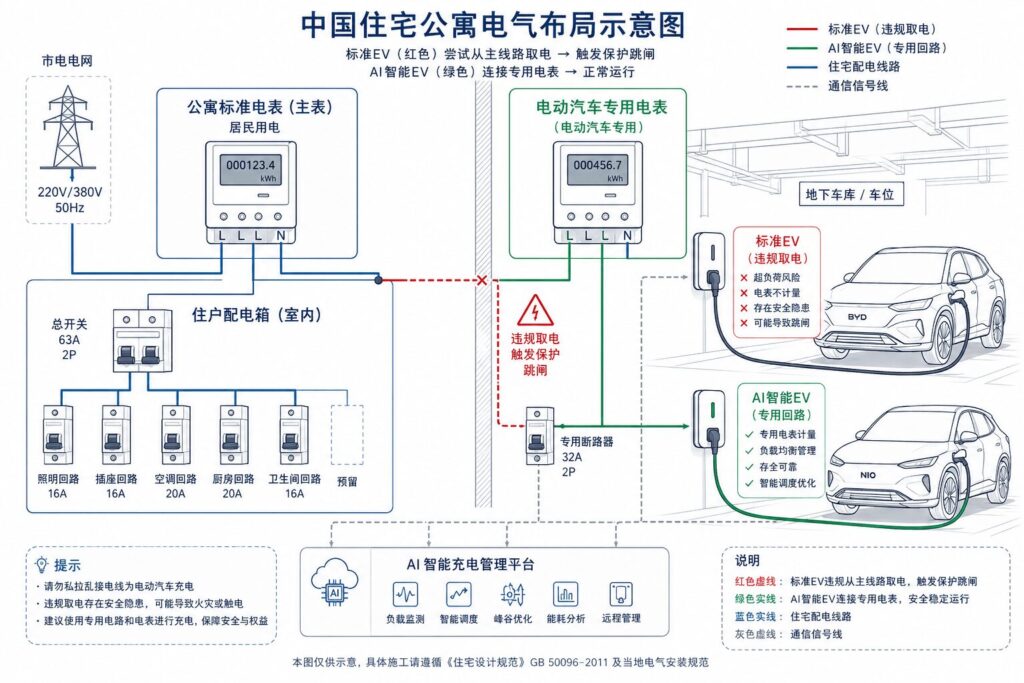
Chinese residential electrical supply structure: Standard Chinese apartment electrical supply is 220V single-phase with a dedicated meter for the apartment. The EV charging circuit typically has its own separate dedicated meter — separate from the apartment’s household electricity meter. This dedicated metering structure is specifically required by most Chinese residential compounds as part of the 物业 approval process.
The implication: Because EV charging in most Chinese apartment compounds uses a dedicated electrical supply with its own meter — separate from the household supply — the load conflict between EV charging and household appliances is managed by the separate circuit design rather than by load balancing software.
A Chinese apartment owner with a dedicated EV charging circuit plugging in their air conditioner, cooking, and EV charger simultaneously draws these loads from separate circuits — not the same circuit that load balancing would need to manage.
When IS load balancing relevant in China?
Scenario A: Villa or low-rise housing with shared main supply: Villa owners in China typically have a single main supply connection serving all loads — including any EV charging circuit. If the villa’s main supply capacity is limited, load balancing between EV charging and other villa loads is valuable.
Scenario B: Residential compounds with shared EV charging infrastructure: Where multiple residents share a common EV charging supply (collective charging infrastructure in the car park), multi-unit load balancing coordinates charging across multiple simultaneous sessions. This is the Easee Equalizer/Zaptec Pro scenario applied to Chinese residential compounds.
Scenario C: Older apartments where dedicated circuit isn’t feasible: Some older Chinese residential buildings cannot support a dedicated EV charging circuit due to building infrastructure limitations. In these cases, EV charging must share an existing circuit, and load balancing becomes relevant.
For most modern Chinese apartment owners with dedicated EV charging meters: Standard load balancing is not a necessary feature — the circuit design already prevents the load conflicts it’s designed to solve.
The Annual Value — For Applicable Scenarios
Villa owner with limited main supply (applicable scenario): Without load balancing: occasional circuit breaker trips requiring manual reset and restarting charging. Estimated annual inconvenience: 12-20 events. Value of preventing breaker trips: Time cost + potential food spoilage from power cut + charging session restart = approximately ¥200-¥500 indirect value annually.
Compound shared charging (collective scenario): Multi-unit load balancing enables more simultaneous charging sessions within fixed supply capacity. For 10 residents sharing a 60A supply, load balancing allows 5-6 simultaneous sessions at 12A each rather than 3 sessions at 20A each. The value is infrastructure efficiency rather than individual electricity saving.
The Feature Premium
Smart charger with load balancing vs without: ¥300-¥800 premium
For AI load balancing (machine learning optimised) vs basic dynamic load balancing: additional ¥300-¥600 premium
The Verdict
For Chinese apartment owners with dedicated EV charging circuit (most buyers):
- Annual value: ¥0-¥100 (minimal — circuit design already handles load separation)
- Feature premium: ¥300-¥800
- Payback: Never recovers for most apartment buyers
- Decision: Do not pay the load balancing premium if you have a dedicated EV charging circuit
For Chinese villa owners with shared main supply:
- Annual value: ¥200-¥500 (convenience + prevented trips)
- Feature premium: ¥500
- Payback: 1-2.5 years
- Decision: Worth buying for villa owners — but basic dynamic load balancing is sufficient, AI load balancing premium not justified
For collective compound charging infrastructure:
- Multi-unit load balancing is infrastructure-level — cost shared across multiple residents
- Per-resident premium: ¥200-¥400
- Value: Enables more simultaneous sessions — meaningful for the compound
- Decision: Include in collective compound installation specification
AI load balancing vs standard load balancing for the villa scenario: Standard dynamic load balancing (¥300-¥500 premium) is sufficient for villa load management. The AI load balancing premium (additional ¥300-¥600 over standard) uses machine learning to predict consumption patterns and pre-emptively adjust charging rather than reactively responding. For a 3-bedroom villa, the pre-emptive adjustment saves approximately 1-3 breaker trips annually versus reactive load balancing.
AI load balancing verdict for villa owners: The standard dynamic load balancing feature is worth buying. The additional AI premium over standard load balancing recovers slowly — approximately 3-5 years. Only buy AI load balancing if it comes bundled with other AI features (Huawei FusionCharge) that individually justify their costs.
Overall AI load balancing verdict: Relevant for villa owners and collective installations. Not necessary for most Chinese apartment owners with dedicated EV charging circuits. The most over-sold feature in the Chinese smart EV charger market for apartment buyers.
Feature 3: Solar Integration (太阳能充电 / 光伏联动)
What It Is
Solar integration allows the EV charger to detect surplus solar generation — electricity generated by rooftop panels that exceeds current home consumption — and divert this surplus to charge the EV rather than exporting it to the grid at feed-in tariff rates.
The Chinese Solar Context
Solar adoption in China is growing rapidly, particularly in:
- Villa and low-rise housing in tier-2 and tier-3 cities
- Rural residential properties
- Some newer urban residential developments with communal solar installations
- Commercial-residential mixed developments
Standard apartment buildings in Chinese tier-1 cities: Rooftop solar is uncommon due to rooftop rights being held by building management rather than individual owners. For most urban Chinese apartment dwellers, solar integration is currently not relevant.
The Annual Value — For Solar-Equipped Homes
Calculation (Shanghai, 5 kWp rooftop solar system):
Annual solar generation: approximately 5,000 kWh Home consumption (excluding EV): approximately 3,000 kWh Solar surplus available for EV charging: approximately 2,000 kWh
Without solar integration (export surplus at feed-in tariff): Export rate (上网电价): approximately ¥0.35-0.39/kWh Annual export income: 2,000 × ¥0.37 = ¥740
With solar integration (use surplus for EV charging instead of exporting): Surplus used for EV: 2,000 kWh (approximately 11,000 km range) Grid electricity saved at valley rate (¥0.34/kWh): 2,000 × ¥0.34 = ¥680
Wait — this calculates to less than exporting in this scenario: Solar divert saving from avoided grid import: ¥680 Minus: Foregone export income: ¥740 Net saving from solar divert: -¥60/year (actually costs ¥60 more than exporting in this case)
This is the honest Chinese solar divert calculation that most guides get wrong.
At Chinese feed-in tariff rates (¥0.35-0.39/kWh) and valley electricity rates (¥0.34/kWh), the financial case for solar divert over grid export is marginal or negative if you’re on valley rate pricing.
The solar divert financial case is stronger when:
A) You are NOT on TOU pricing (charging at standard/peak rates): Standard rate = ¥0.67-0.87/kWh Solar divert saving: 2,000 × (¥0.77 average – ¥0.37 export) = 2,000 × ¥0.40 = ¥800/year net saving
B) The feed-in tariff rate is lower (some provinces ¥0.25-0.30/kWh): Solar divert saving: 2,000 × (¥0.34 valley – ¥0.27 export) = 2,000 × ¥0.07 = ¥140/year net saving
C) You have a larger solar system with excess generation: 10 kWp system with 4,000 kWh surplus: net saving scales proportionally
The critical insight: Chinese EV owners already on optimal valley rate TOU pricing gain marginal additional financial benefit from solar divert — because the valley rate (¥0.34/kWh) is close to the feed-in tariff (¥0.37/kWh), and they’re already charging at the cheapest grid rate. Solar divert’s financial case is strongest for Chinese EV owners who are NOT yet on TOU pricing, or who have excess solar generation significantly exceeding EV charging needs.
The Feature Premium
Basic smart charger without solar: ¥800-¥1,500 Smart charger with solar integration: ¥1,500-¥3,500
Feature premium for solar integration: ¥700-¥2,000
The Verdict
For Chinese apartment owners without solar:
- Annual value: ¥0
- Decision: Do not pay the solar premium
For Chinese villa owners with solar, on valley rate TOU pricing:
- Annual value: ¥60-¥200 (marginal net benefit over exporting + TOU charging)
- Feature premium: ¥1,000-¥1,500
- Payback: 5-25 years
- Decision: Marginal financial case. Buy if solar integration is bundled within existing Sungrow/Growatt/Huawei ecosystem at lower marginal cost
For Chinese villa owners with solar, NOT on TOU pricing:
- Annual value: ¥600-¥1,000
- Feature premium: ¥1,000-¥1,500
- Payback: 1-2.5 years
- Decision: Switch to TOU pricing first (costs nothing, saves ¥1,670/year). Then evaluate solar integration as an additional optimisation
Solar integration verdict: Financially marginal for most Chinese EV owners on optimal TOU pricing. The action that matters most financially is switching to valley rate pricing — not adding solar integration hardware. Solar integration is a genuine benefit for non-TOU users and large-solar-system owners, but the financial case is weaker in the Chinese context than in the UK or European market where grid import vs export rate differentials are larger.
Feature 4: AI Departure Prediction (AI出行预测 / 智能出行学习)
What It Is
AI departure prediction uses machine learning to learn the EV owner’s actual departure patterns and optimise charging to complete as late as possible within the cheap rate window — maximising battery rest time at high SOC (which is marginally better for battery longevity) while ensuring the target SOC is reached by departure.
A basic TOU scheduler charges throughout the entire valley rate window (11pm-8am). An AI departure predictor charges from approximately 3am-8am on a weekday if it has learned that you typically depart at 7:30am — avoiding unnecessary time at high SOC and charging the battery with electricity as close to use as possible.
The Annual Value
Battery longevity benefit: Time at high SOC (above 80%) accelerates lithium-ion battery degradation slightly. By charging as late as possible before departure, AI departure prediction reduces the time the battery spends at high SOC.
Quantifying the battery longevity benefit: Battery degradation from unnecessary high-SOC time:
- Additional battery degradation rate: approximately 0.1-0.3% capacity per year from unnecessary high-SOC time
- Battery replacement cost for typical Chinese EV: ¥30,000-¥80,000
- Annual cost of unnecessary degradation: ¥30-¥240/year
More practically quantifiable: A battery managed with departure-optimised charging that lasts 10 years before needing replacement versus 9.5 years with basic TOU charging represents approximately 6 months of deferred ¥50,000 battery replacement cost = ¥25,000 deferred × time value ≈ ¥1,500-¥2,500 in present value over ownership period.
Electricity saving from departure optimisation: Negligible — the same valley rate electricity costs the same whether charged at 11pm or 4am.
The honest AI departure prediction value:
- Battery longevity benefit: ¥30-¥240/year (direct) / ¥300-¥500/year (deferred replacement amortised)
- Practical value to most owners: ¥50-¥200/year
The Feature Premium
Charger with basic TOU scheduling vs charger with AI departure prediction: The AI departure prediction feature typically adds ¥300-¥800 to charger cost.
The Verdict
Annual value: ¥50-¥200 Feature premium: ¥300-¥800 Payback: 1.5-16 years depending on assumptions
The honest assessment: AI departure prediction’s financial return is real but modest for most Chinese EV owners. The battery longevity benefit is genuine but small in annual terms. The convenience benefit — not having to manage a charging schedule when your departure time varies — is real but unquantifiable.
Decision framework:
- If AI departure prediction is bundled with other AI features you’re buying anyway (Huawei FusionCharge, Ampere Time): Yes, the bundled value is worthwhile
- If you are considering paying a specific premium solely for departure prediction: The financial case is weak — the feature’s convenience value is the primary justification
AI departure prediction verdict: A genuine benefit delivered poorly when sold as a standalone premium. Worthwhile as part of a comprehensive AI platform (Huawei, Ampere Time) but not worth a standalone ¥500-¥800 premium for most Chinese buyers.
Feature 5: OCPP 2.0 Compliance (开放充电点协议)
What It Is
OCPP (Open Charge Point Protocol) is the communication standard between EV chargers and energy management systems. OCPP 1.6 handles basic session management, billing, and monitoring. OCPP 2.0 adds:
- Bidirectional communication (V2G readiness)
- Device management and remote configuration
- Smart grid integration for demand response
- Enhanced security (ISO 15118 integration)
- Advanced metering and billing capability
The Annual Value in 2026 China
Current OCPP 2.0 value for Chinese residential owners:
For most Chinese residential EV owners in 2026, OCPP 2.0 compliance delivers:
- No additional current financial value versus OCPP 1.6
- Better positioning for future smart grid and V2G programmes
- Professional fleet management capability (relevant for commercial, not residential)
The honest OCPP 2.0 assessment for residential: Chinese utility demand response programmes for residential EV charging are in pilot stages in 2026 — not yet deployed at scale. The financial programmes that would reward OCPP 2.0-compliant residential chargers (demand response credits, V2G earnings) are 2-4 years from mainstream deployment.
Future value of OCPP 2.0: When Chinese utilities deploy residential demand response programmes that pay participants for charging flexibility — expected 2027-2030 — OCPP 2.0 chargers participate immediately. OCPP 1.6 chargers may require hardware upgrades to participate.
Potential future annual V2G/demand response income (2028-2030 estimate): Based on pilot programme data from Chinese utility trials: ¥500-¥1,500/year for active demand response participation with compatible hardware.
The Feature Premium
OCPP 1.6 vs OCPP 2.0 charger premium: ¥500-¥1,500
The Verdict
Current annual value (2026): ¥0 Future annual value (2028-2030 when programmes deploy): ¥500-¥1,500 Feature premium: ¥500-¥1,500 Payback: 2-6 years from programme deployment (4-8 years from purchase)
Decision framework:
- If OCPP 2.0 charger costs ¥500-¥800 more than OCPP 1.6 equivalent: Consider buying — future-proofing value justifies modest premium if you plan 7-10 year ownership
- If premium exceeds ¥1,000 for OCPP 2.0 alone: Difficult to justify on current financial basis — wait until programmes deploy or hardware prices equalise
OCPP 2.0 verdict: Future-proofing investment with real long-term value but zero current financial return. Appropriate for buyers planning 7-10 year ownership who can justify the premium on future programme participation potential. Not financially justified for buyers planning to replace hardware in 3-5 years.
Feature 6: Battery Storage Integration (储能联动)
What It Is
Integration between the home EV charger and a home battery storage system — Huawei LUNA, CATL Rena (if residential), or third-party storage. The integrated system:
- Charges home battery at valley rates
- Discharges home battery to power EV during peak periods (avoiding peak grid rates)
- Coordinates solar, battery, and EV charging as a single optimised energy system
The Annual Value in China
Scenario: Shanghai villa, Huawei LUNA 10 kWh battery, 5 kWp solar, 20,000 km EV annual driving
Without battery storage integration:
- EV charged at valley rate: ¥1,385/year electricity
- Home peak electricity (grid): ¥2,500/year
- Total annual electricity: ¥3,885/year
With battery storage + integration (optimal):
- Battery charges at valley rate (¥0.34/kWh): 10 kWh × 300 cycles/year × ¥0.34 = ¥1,020
- Battery discharges during peak (replaces ¥0.87/kWh peak rate): saves 3,000 kWh × (¥0.87-0.34) = ¥1,590
- EV partially charged from battery during peak: additional ¥200-400 saving
- Total estimated annual saving from battery integration: ¥1,790-¥1,990/year
BUT — the cost of the home battery storage system: Huawei LUNA 10 kWh: approximately ¥25,000-¥35,000 installed
The battery storage system payback (from grid arbitrage savings of ¥1,790/year): 14-20 years — well beyond the expected battery system lifespan of 10-15 years.
This is the honest battery storage financial reality for Chinese residential owners: Grid arbitrage alone does not financially justify home battery storage. Solar integration improves the case significantly for large solar systems but typically doesn’t create a sub-10-year payback.
The EV charger integration premium specifically: The premium for battery storage integration capability in the EV charger (versus a charger without integration): ¥300-¥800.
Given the battery storage system is unlikely to be purchased on pure financial grounds alone, the charger integration premium should be evaluated separately:
If you already own or are planning battery storage for non-financial reasons (grid independence, backup power during outages): the charger integration premium of ¥300-¥800 adds meaningful coordination value that is worth paying.
The Verdict
Annual value from battery integration (charger premium specifically): ¥200-¥400 incremental improvement over non-integrated approach (the majority of the battery saving is available even without deep charger integration)
Charger feature premium: ¥300-¥800 Payback: 1-4 years
Battery storage integration verdict: Worth paying the charger-level premium if you have or plan battery storage. The charger integration premium is reasonable — the battery storage system investment itself requires careful individual financial analysis that goes beyond this guide’s scope.
Feature 7: Ecosystem Integration (生态系统集成 — HarmonyOS, Mi Home)
What It Is
Integration between the EV charger and the Chinese smart home ecosystem platforms — Huawei HarmonyOS, Xiaomi Mi Home, Alibaba Tmall Genie. This enables:
- Voice control of charging (“小爱,开始充电”)
- Smart scene automation (charging triggers when you arrive home)
- Unified energy dashboard across all smart home devices
- Cross-device coordination (EV pre-conditioning triggers with home departure scene)
The Annual Value
Ecosystem integration delivers primarily non-financial value:
- Time saving: Approximately 2-3 minutes per day of manual charging management eliminated — approximately 12-18 hours annually. At median urban Chinese professional time value of ¥50-100/hour: ¥600-¥1,800/year in time value. This is a real but subjective value.
- Convenience value: Eliminating the need to open a separate charger app for most routine actions. High for daily users of smart home platforms, zero for users who don’t use smart home platforms.
- Error prevention: Automated charging prevents forgetting to plug in — estimated 3-5 forgotten charging events annually prevented = ¥100-¥300 in avoided public charging costs.
Quantifiable annual value: ¥100-¥300 (financial) + ¥600-¥1,800 (time value, subjective)
The Feature Premium
Basic smart charger vs ecosystem-integrated smart charger: ¥300-¥800
The Verdict
For Huawei phone/smart home users:
- Annual value: ¥700-¥2,100 (financial + time)
- Feature premium: ¥400-¥600
- Payback: 0.3-0.9 years
- Decision: Buy — the convenience and time value justify the premium clearly for existing ecosystem users
For Xiaomi Mi Home users:
- Same calculation — ecosystem integration value is high for existing Mi Home users
- Decision: Buy
For non-smart-home users:
- Annual value: ¥0-¥100 (no existing ecosystem to integrate with)
- Feature premium: ¥300-¥600
- Decision: Do not pay the ecosystem integration premium if you don’t already use the relevant smart home platform
Ecosystem integration verdict: Among the most financially justifiable smart features for existing Huawei and Xiaomi smart home platform users. Zero value for non-smart-home users. The decision hinges entirely on whether you actively use HarmonyOS or Mi Home today.
Feature 8: Carbon Footprint Tracking (碳足迹追踪)
What It Is
Real-time and historical tracking of the CO₂ emissions associated with EV charging — calculated from the electricity grid’s carbon intensity at the time of charging, with some products optimising charging to lower-carbon grid periods.
The Annual Value
Financial value: Zero — carbon tracking generates no direct financial return
Indirect financial value:
- Carbon credit programmes: Not yet available for individual residential EV owners in China
- ESG reporting: Relevant for commercial fleet operators, not residential owners
- Low-carbon charging optimisation: If the system specifically avoids high-carbon charging periods, this may add 5-10% renewable electricity to your charging mix — financial value ¥0-¥50/year at current Chinese carbon credit values
The Feature Premium
Carbon tracking is typically bundled with AI charger platforms (Ampere Time, Huawei) rather than sold as a standalone premium — the marginal cost is minimal.
The Verdict
Annual financial value: ¥0-¥50 Feature premium (marginal): ¥0-¥100 (usually bundled) Decision: Accept if bundled. Do not seek out or pay a premium specifically for carbon tracking.
Carbon tracking verdict: A values-aligned feature for environmentally motivated buyers. Zero financial return in current Chinese market. Worth including if free — not worth pursuing as a purchasing criterion.
Feature 9: Dual-Band WiFi and 4G Connectivity (双频WiFi / 4G连接)
What It Is
Advanced connectivity options: dual-band WiFi (2.4 GHz + 5 GHz) for more stable connectivity in dense urban environments, or 4G cellular connectivity for chargers in locations with poor WiFi coverage.
The Annual Value
Dual-band WiFi: In Chinese urban apartment buildings with dense WiFi environments (potentially 50+ networks visible in a tier-1 city apartment block), 2.4 GHz WiFi congestion can cause charger connectivity issues. Dual-band WiFi with 5 GHz option improves reliability.
Value: Prevents approximately 10-20 connectivity failures annually → ¥0 direct financial value but prevents schedule failures that could cost ¥50-200 in missed TOU sessions.
Annual value of dual-band WiFi: ¥50-¥200
4G connectivity: For chargers in underground car parks 30+ metres from the nearest router — a common scenario in large Chinese residential compounds — WiFi signal is often inadequate. 4G connectivity ensures uninterrupted smart charging regardless of WiFi coverage.
Value: Prevents systematic TOU scheduling failures for problematic WiFi locations.
Annual value for problematic WiFi location: ¥200-¥500 (recovering failed TOU savings) Annual value for good WiFi location: ¥0
The Feature Premium
Dual-band vs single-band WiFi: ¥100-¥300 premium 4G connectivity option: ¥300-¥600 additional
The Verdict
Dual-band WiFi: Worth paying if you’re in a dense urban building with potential 2.4 GHz congestion (i.e., most tier-1 city apartment buildings). The ¥100-¥300 premium is easily justified.
4G connectivity: Worth paying if your charging location has consistently poor WiFi coverage. Unnecessary if WiFi is reliably strong at your charger location. Check signal strength at your charger location before buying the 4G option.
The Master Feature Value Table
| Feature | Annual Value (Shanghai) | Feature Premium | Payback | Worth It? |
|---|---|---|---|---|
| TOU Scheduling | ¥1,670 | ¥200-400 | 2 months | ✅ Always |
| AI Load Balancing (apartment) | ¥0-100 | ¥300-800 | Never | ❌ No |
| AI Load Balancing (villa) | ¥200-500 | ¥500 | 1-2.5yr | ✅ Villa only |
| Solar Integration (TOU user) | ¥60-200 | ¥700-2,000 | 5-25yr | ⚠️ Marginal |
| Solar Integration (no TOU) | ¥600-1,000 | ¥700-2,000 | 1-3yr | ✅ Yes — then add TOU |
| AI Departure Prediction | ¥50-200 | ¥300-800 | 2-16yr | ⚠️ Bundled only |
| OCPP 2.0 | ¥0 now / ¥500-1,500 future | ¥500-1,500 | 4-8yr | ⚠️ Long-term owners |
| Battery Storage Integration | ¥200-400 (charger premium) | ¥300-800 | 1-4yr | ✅ If have storage |
| Ecosystem Integration (user) | ¥700-2,100 | ¥300-600 | <1yr | ✅ For ecosystem users |
| Ecosystem Integration (non-user) | ¥0-100 | ¥300-600 | Never | ❌ No |
| Carbon Tracking | ¥0-50 | ¥0-100 | N/A | ✅ If bundled free |
| Dual-band WiFi | ¥50-200 | ¥100-300 | 1-3yr | ✅ Urban buildings |
| 4G Connectivity | ¥0-500 | ¥300-600 | 1-Never | ✅ Poor WiFi only |
The Honest Buying Decision Matrix
Chinese Apartment Owner — Typical Scenario
Profile: Shanghai apartment, dedicated EV charging circuit, no solar, drives 20,000 km/year, uses Xiaomi Mi Home
Essential features:
- ✅ TOU scheduling — ¥1,670/year, ¥300 premium, 2-month payback
Worth buying:
- ✅ Ecosystem integration (Mi Home) — ¥700-2,100/year value, ¥400 premium, under 1 year payback
- ✅ Dual-band WiFi — ¥50-200/year, ¥200 premium, worth it in dense urban building
Not worth buying:
- ❌ AI load balancing — dedicated circuit eliminates the problem
- ❌ Solar integration — no solar
- ❌ AI departure prediction (standalone) — marginal return
- ❌ OCPP 2.0 (standalone) — no current return, plan to replace in 5 years anyway
Recommended charger: Xiaomi EV Charger (¥1,299-1,999) — TOU + Mi Home integration + dual-band WiFi in one product at competitive price
Total recommended spend: ¥1,299-1,999
Chinese Villa Owner — Solar + Huawei Ecosystem
Profile: Chengdu villa, shared main supply, 8 kWp Huawei solar, Huawei HarmonyOS home, drives 30,000 km/year, NOT yet on TOU pricing
Essential features:
- ✅ TOU scheduling — switch to TOU pricing immediately, ¥2,500/year saving
- ✅ Solar integration — substantial saving without TOU (switch to TOU first)
- ✅ AI load balancing — shared main supply requires load coordination
- ✅ Ecosystem integration — HarmonyOS user
Worth buying:
- ✅ Battery storage integration — planning Huawei LUNA for backup power
- ✅ AI departure prediction — bundled in Huawei platform
- ✅ OCPP 2.0 — 10-year ownership horizon, Huawei provides it
Recommended charger: Huawei Digital Power FusionCharge (¥2,500-4,500) with Huawei LUNA integration
Total recommended spend: ¥2,500-4,500 (charger) + Huawei ecosystem
Chinese Apartment Owner — No Smart Home, No Solar, Budget Conscious
Profile: Beijing apartment, dedicated EV charging circuit, no solar, no smart home, drives 15,000 km/year, budget priority
Essential features:
- ✅ TOU scheduling — ¥1,250/year saving, ¥300 premium, 3-month payback
Not worth buying:
- ❌ AI load balancing — dedicated circuit
- ❌ Solar integration — no solar
- ❌ Ecosystem integration — no smart home platform
- ❌ AI departure prediction — limited return, no ecosystem to integrate with
- ❌ OCPP 2.0 — no current return, budget priority
Recommended charger: StarCharge S Series (¥899-1,299) — reliable TOU scheduling, good service network, no premium for unused features
Total recommended spend: ¥899-1,299
The Total Smart Premium Cost-Benefit Over 5 Years
| Buyer Profile | Basic Charger | Smart Charger | 5yr Electricity | 5yr Total Smart | 5yr Total Basic | 5yr Net Smart Saving |
|---|---|---|---|---|---|---|
| Apartment, TOU only | ¥700 | ¥1,100 | ¥6,925 | ¥8,025 | ¥10,465* | ¥2,440 saved |
| Apartment, Mi Home | ¥700 | ¥1,600 | ¥6,925 | ¥8,525 | ¥10,465 | ¥1,940 saved |
| Villa, Huawei full | ¥700 | ¥4,000 | ¥5,200** | ¥9,200 | ¥15,465*** | ¥6,265 saved |
| Budget, no TOU | ¥600 | — | ¥10,183 | — | ¥10,783 | — |
*Without TOU, charging at blended peak/flat rates **With TOU + solar + AI optimisation ***Without any smart features, standard rate charging
The Most Common Smart Feature Mistakes Chinese EV Owners Make
Mistake 1: Paying for AI Load Balancing With a Dedicated EV Circuit
The most common premium paid unnecessarily. If your 物业 required a dedicated electricity meter for EV charging — which most do — you have a dedicated circuit, and load balancing solves a problem you don’t have.
Check: Does your EV charging circuit share a circuit breaker with your apartment’s household electricity? If no (separate meter), you don’t need load balancing.
Mistake 2: Buying Solar Integration Before Switching to TOU Pricing
TOU pricing saves ¥1,670/year. Solar integration (for a TOU user) saves ¥60-200/year net. Switch to TOU pricing first — it costs nothing and saves more.
Mistake 3: Paying for Ecosystem Integration Without Using the Ecosystem
Paying ¥400 more for HarmonyOS integration when you use a non-Huawei phone and have no Huawei smart home devices delivers zero additional value. The feature premium is only valuable if you actively use the ecosystem.
Mistake 4: Not Configuring TOU Scheduling After Installing a Smart Charger
The most expensive mistake. Buying a smart charger for TOU savings and never setting up the schedule. Annual cost: ¥1,670 in avoidable electricity costs — every year. Configuration takes 5 minutes.
Mistake 5: Prioritising AI Features Over TOU Scheduling Reliability
A charger with sophisticated AI departure prediction that has unreliable WiFi connectivity delivers less TOU value than a simple charger with rock-solid scheduling. Reliability of the core TOU function matters more than sophistication of the AI features above it.
Internal Links — Further Reading on Clean Energy Bazaar
Smart EV chargers 2026 AI load balancing vs standard features worth the extra cost in China is the financial analysis companion to the product comparison guides in the Chinese market content cluster.
For the full smart EV charger comparison covering Huawei Digital Power, Xiaomi, and local innovators, our best smart EV chargers China 2026 Huawei Digital Power vs Xiaomi vs local innovators guide covers every product in depth. For the general home EV charger comparison covering StarCharge, Autel, TELD, NIO, and BYD chargers, our best home EV chargers 2026 top 7 comparison for Chinese homeowners Star Charge Autel guide covers the broader market. For the complete buying framework including 物业 approval and installation decisions, our find the right EV charger for your home China edition guide covers every pre-purchase decision. For the Western market equivalent of this analysis — covering Emporia Pro vs Myenergi Zappi smart features — our best smart connectivity Wi-Fi app solar integration US Emporia vs Europe Zappi guide provides the European and US comparison. And for the load balancing guide covering apartment and villa scenarios in the Western context, our load balancing EV chargers 2026 guide covers every relevant scenario.
Final Thoughts
The smart EV chargers 2026 AI load balancing vs standard features worth the extra cost in China analysis produces a clear hierarchy of feature value for Chinese EV owners.
Always worth paying for:
- TOU scheduling — ¥1,670/year saving, ¥200-400 premium, 2-month payback. The most financially compelling single feature in home EV charging anywhere in the world. Never buy a home charger without it in a Chinese city with TOU pricing.
- Ecosystem integration (for existing users) — ¥700-2,100/year combined financial and time value, ¥300-600 premium, under 12-month payback for Huawei or Xiaomi smart home users. Zero value for non-users.
Worth paying for in specific circumstances: 3. AI load balancing — Villa owners with shared main supply only. Not necessary for apartment owners with dedicated EV charging circuits. 4. Battery storage integration — If you have or plan battery storage for any reason. 5. Solar integration — For owners not yet on TOU pricing. Marginal for TOU users. 6. Dual-band WiFi — For urban apartment buildings with dense 2.4 GHz environments. 7. 4G connectivity — For charging locations with poor WiFi coverage.
Worth paying for on a long-term ownership horizon: 8. OCPP 2.0 — For 7-10 year ownership plans where future smart grid programme participation justifies the premium.
Not worth paying for as standalone premium: 9. AI departure prediction (standalone) — Marginal return. Only justify as part of an AI platform where other features are simultaneously valuable. 10. Carbon tracking — Accept if free. Don’t pursue or pay premium for. 11. AI load balancing (apartment with dedicated circuit) — Solves a problem you don’t have.
The fundamental insight of this analysis: TOU scheduling is worth ¥1,670/year. Configure it immediately on installation day. Every other smart feature is a smaller optimisation on top of this dominant saving. Prioritise getting TOU right before evaluating any other feature’s worth.