Here’s the conversation that happens in Volkswagen ID.4 and ID.3 owner communities every week.
Someone posts that they just took delivery. They want to know which home charger to buy. The replies mention Wallbox, Easee, Pod Point, and ChargePoint in no particular order, with varying degrees of confidence and no explanation of why one is better for their specific situation than another.
What nobody explains — and what this guide does — is that the best EV charger Volkswagen ID.4 ID.3 Europe US question has genuinely different answers depending on where you live, which variant you own, and whether you have solar panels or a smart electricity tariff.
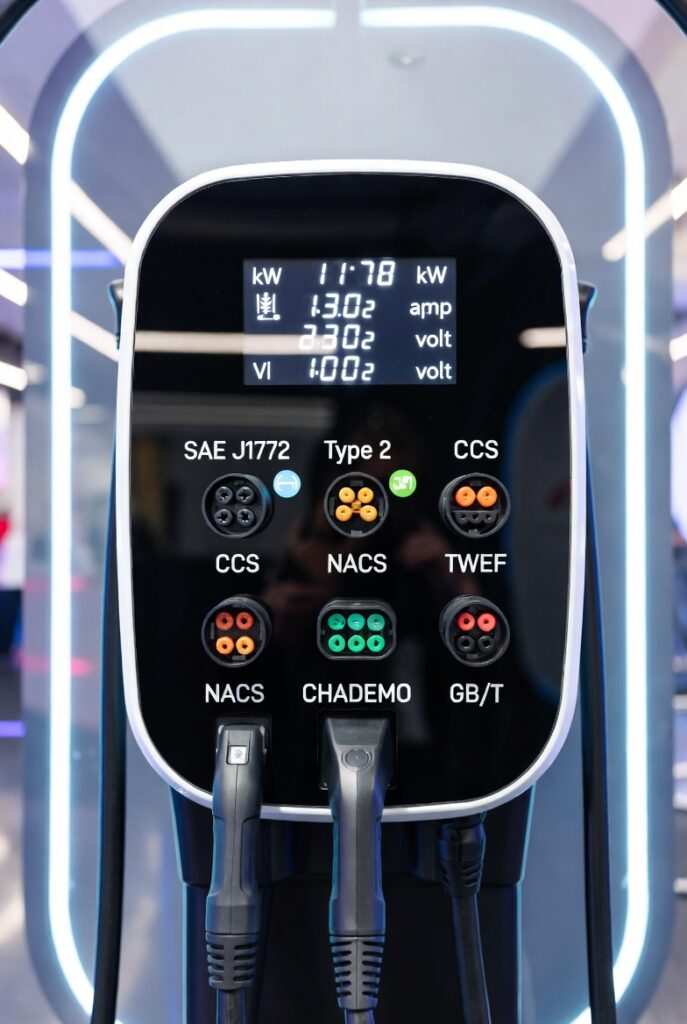
Because the ID.4 and ID.3 have specific charging characteristics that most generic home charger guides ignore. The ID.4 Pro Performance accepts 11 kW AC — but only with the optional 11 kW onboard charger upgrade in some markets. The base ID.4 and most ID.3 variants accept 7.2 kW AC as standard. Installing an 11 kW charger for a 7.2 kW car delivers the same speed as a cheaper 7.4 kW unit. And in the US, the VW ID.4 uses CCS1 for DC fast charging and J1772 for AC — not NACS — which changes the charger compatibility picture significantly from Tesla-focused guides.
This guide covers all of it honestly.
What Volkswagen ID.4 and ID.3 Owners Actually Need From a Home Charger
Before comparing chargers, it’s essential to know what your specific VW variant actually accepts — because this single specification changes which charger is worth buying.
Volkswagen ID.4 — Home Charging Specs
ID.4 Pro and ID.4 Pro Performance (Europe):
- Maximum AC charging rate: 11 kW (three-phase, 16A per phase, 400V) — standard on Pro Performance, optional upgrade on Pro in some markets
- Some markets default to 7.2 kW AC with 11 kW as a paid upgrade
- Connector: Type 2 (AC), CCS2 (DC fast charging)
- Battery: 77 kWh usable (Pro Performance), 52 kWh (Pure range)
- Full charge at 11 kW: approximately 7-8 hours
- Full charge at 7.2 kW: approximately 11 hours
ID.4 Pure and Pure Performance (Europe):
- Maximum AC charging rate: 7.2 kW (single-phase, 32A)
- Connector: Type 2 (AC), CCS2 (DC)
- Battery: 52 kWh usable
- Full charge at 7.2 kW: approximately 7-8 hours
ID.4 US (all variants):
- Maximum AC charging rate: 7.2 kW (32A, 240V) — the US ID.4 does not support 11 kW three-phase
- Connector: J1772 (AC), CCS1 (DC fast charging) — NOT NACS
- Battery: 62-82 kWh depending on variant
- Full charge at 7.2 kW: approximately 9-12 hours depending on battery size
Critical implication for US ID.4 owners: The US ID.4 uses J1772 for AC charging and CCS1 for DC fast charging — not NACS. Tesla Wall Connectors and NACS chargers do not natively charge a US ID.4 without a NACS-to-J1772 adapter. This is a VW-specific detail that Tesla-focused charger guides miss entirely.
Volkswagen ID.3 — Home Charging Specs
ID.3 Pro S and Pro Performance (Europe):
- Maximum AC charging rate: 11 kW (three-phase, 16A per phase) on Pro Performance; 7.2 kW on standard Pro
- Connector: Type 2 (AC), CCS2 (DC)
- Battery: 77 kWh (Pro S), 58 kWh (Pro)
- Full charge at 11 kW: approximately 7 hours (Pro S)
ID.3 Pure and Pure Performance (Europe):
- Maximum AC charging rate: 7.2 kW (single-phase, 32A)
- Connector: Type 2 (AC), CCS2 (DC)
- Battery: 45 kWh usable
- Full charge at 7.2 kW: approximately 6-7 hours
The three-phase question for ID.4 and ID.3 owners: Whether you can use 11 kW AC charging at home depends on two things simultaneously: whether your specific VW variant has the 11 kW onboard charger, and whether your home has three-phase electrical supply. In the UK, most homes are single-phase — capping home charging at 7.4 kW regardless of your car’s capability. In the Netherlands, Germany, Belgium, and Scandinavia, three-phase residential supply is more common and 11 kW home charging is genuinely accessible.
Europe — Best Home Chargers for VW ID.4 and ID.3
For Single-Phase UK and European Homes (7.4 kW Maximum)
The majority of UK homeowners with an ID.4 or ID.3 will charge at 7.4 kW regardless of their car’s onboard charger specification — because UK residential supply is single-phase. The charger choice in this scenario is about smart features, solar integration, installer network, and warranty rather than charging speed.
Wallbox Pulsar Plus — Best Overall for UK and European VW Owners
Price: £649-£799 (UK); €699-€849 (Europe) Connector: Type 2 tethered or untethered Max Power: 7.4 kW (single-phase) or 22 kW (three-phase) Installation: Hardwired Smart Features: App control, scheduled charging, energy monitoring, solar integration, bidirectional ready Warranty: 2 years OZEV Approved: Yes
The Wallbox Pulsar Plus earns its position as the benchmark recommendation for best EV charger Volkswagen ID.4 ID.3 Europe US comparisons in the UK and European market — not because it’s perfect but because it’s consistently good across every relevant dimension for VW owners.
For UK ID.4 and ID.3 owners on single-phase supply, the 7.4 kW single-phase version delivers the maximum home charging speed available. The compact form factor fits UK garage walls and narrow parking configurations where larger units are awkward. The app is among the best in the European home EV charger segment — scheduling, energy monitoring, and smart tariff compatibility all work reliably.
The bidirectional charging readiness is the forward-looking differentiator. Volkswagen has been developing V2H (vehicle-to-home) capability for the ID.4 and ID.3 — the ability to use your VW’s battery to power your home during peak hours. The Wallbox Pulsar Plus is positioned to support this when VW activates it through software on compatible hardware, which no competing charger in this price range can claim as credibly.
For European owners with three-phase supply and an 11 kW capable ID.4 or ID.3 variant, the Pulsar Plus’s three-phase 22 kW version delivers significantly more than the car needs — but at 11 kW the car benefits from the full three-phase capability of the charger.
Where it falls short: The 2-year warranty is shorter than the Hypervolt Home 3 Pro and Myenergi Zappi. Solar integration exists but is less sophisticated than the Zappi’s Eco/Eco+ mode system. Customer support response times have been criticised in some owner reviews.
Verdict: The best overall home charger for UK and European VW ID.4 and ID.3 owners who want a mature, well-supported unit with bidirectional readiness. If you have solar panels, read the Zappi section before deciding.
Myenergi Zappi — Best for Solar-Owning VW ID.4 and ID.3 Drivers
Price: £699-£849 (UK); €749-€899 (Europe) Connector: Type 2 tethered Max Power: 7.4 kW (single-phase) or 22 kW (three-phase) Installation: Hardwired Smart Features: Solar divert (Eco/Eco+ modes), app control, scheduled charging, energy monitoring Warranty: 3 years OZEV Approved: Yes
If you have solar panels on your roof and you own a VW ID.4 or ID.3, the Myenergi Zappi is the right home charger. Full stop.
The Zappi’s Eco+ mode charges your VW exclusively from surplus solar generation — nothing from the grid unless you explicitly switch modes. For a UK homeowner with a 4 kWp solar system generating 3,500 kWh annually, using Eco+ mode for EV charging rather than exporting surplus at 4-8p/kWh SEG rates and buying back at 24-28p/kWh saves approximately £250-£350 annually.
Over a 7-year ownership period that’s £1,750-£2,450 in cumulative savings — from a charger that costs £50-£100 more than the Wallbox Pulsar Plus. The Zappi’s premium over the Pulsar Plus is recovered within weeks for a solar household.
The three-phase 22 kW version covers European VW ID.4 and ID.3 owners with three-phase supply who have the 11 kW onboard charger upgrade — the Zappi delivers the full 11 kW the car accepts while optimising for solar generation throughout.
Where it falls short: The app and setup experience is less polished than the Wallbox Pulsar Plus. No bidirectional charging roadmap. For non-solar owners, the Zappi’s price premium is harder to justify.
Verdict: The best home charger for UK and European VW ID.4 and ID.3 owners with rooftop solar. If you don’t have solar and don’t plan to install it, the Wallbox Pulsar Plus delivers better overall smart features at a similar price.
Hypervolt Home 3 Pro — Best for UK Smart Tariff Users With a VW
Price: £899-£1,099 (UK) Connector: Type 2 tethered Max Power: 7.4 kW (single-phase) Installation: Hardwired Smart Features: Smart tariff API integration, app control, scheduled charging, energy monitoring, solar divert, dynamic load balancing Warranty: 3 years OZEV Approved: Yes
The Hypervolt Home 3 Pro is the right choice for UK ID.4 and ID.3 owners on Octopus Go, OVO Drive Anytime, or British Gas EV tariff who want direct API integration rather than generic scheduling.
Volkswagen’s own charging app integrates with UK smart tariffs to some degree — but the Hypervolt’s direct tariff API means the charger communicates in real time with your tariff’s pricing signal rather than just scheduling around a predetermined window. For ID.4 and ID.3 owners on Octopus Go’s guaranteed cheap overnight rate, the Hypervolt’s integration is seamless in a way that competing chargers achieve less consistently.
The dynamic load balancing is specifically useful for UK homes where the ID.4 Pro Performance’s 11 kW capability is unavailable on single-phase anyway — the Hypervolt’s load balancing ensures the maximum available 7.4 kW is delivered consistently without tripping breakers when other high-draw appliances are running.
Where it falls short: Single-phase only — no three-phase version, which limits relevance for continental European buyers. At £899-£1,099 it’s the most expensive charger in this section.
Verdict: Best for UK ID.4 and ID.3 owners on Octopus Go or dynamic smart tariffs who want the most seamless tariff integration available.
Easee One — Best for European Three-Phase ID.4 and ID.3 Owners
Price: £549-£649 (UK); €499-€649 (Europe) Connector: Type 2 untethered socket Max Power: 7.4 kW (single-phase) or 22 kW (three-phase) Installation: Hardwired Smart Features: App control, scheduled charging, energy monitoring, dynamic load balancing, multi-unit sharing Warranty: 3 years OZEV Approved: Yes
The Easee One is the strongest value proposition for continental European ID.4 and ID.3 owners with three-phase supply and 11 kW capable variants.
At €499-€649 it’s significantly less expensive than the Wallbox Pulsar Plus while delivering comparable smart features including dynamic load sharing between multiple Easee units — particularly relevant for households with two EVs including an ID.4. The three-phase 22 kW version delivers the ID.4’s maximum 11 kW AC charging capability while leaving headroom for future vehicles with higher AC acceptance rates.
The untethered socket design — you use your car’s own Type 2 cable — is more flexible for households with multiple EVs using different cable lengths, and means the cable itself rather than the installed unit is the wearing component.
Where it falls short: Less well known in the UK market — smaller UK installer network than Wallbox or Hypervolt. The untethered socket design is less convenient for daily solo use than a tethered cable.
Verdict: Best value home charger for continental European VW ID.4 and ID.3 owners with three-phase supply who want 11 kW charging at a competitive price.
Zaptec Go — Best for Apartment-Dwelling VW Owners in Europe
Price: £549-£649 (UK); €499-€599 (Europe) Connector: Type 2 untethered socket Max Power: 7.4 kW (single-phase) or 22 kW (three-phase) Installation: Hardwired Smart Features: App control, scheduled charging, energy monitoring, dynamic load balancing, multi-user billing Warranty: 3 years OZEV Approved: Yes
The Zaptec Go’s multi-user billing capability makes it the best home charger for VW ID.4 and ID.3 owners in apartment buildings or shared parking facilities across Europe.
Multiple drivers can access the same Zaptec unit with individual accounts, individual billing, and individual usage history. For apartment buildings where an ID.4 owner needs to share a charging point with other residents, or for office parking where the VW is one of several employee EVs, the Zaptec’s multi-user architecture is a genuine differentiator over single-user units.
Where it falls short: Smaller UK and European installer network than Wallbox. Untethered socket design is less convenient for solo daily use.
Verdict: Best for VW ID.4 and ID.3 owners in European apartment buildings or multi-user parking facilities.
US — Best Home Chargers for VW ID.4 Owners
The US ID.4 charging situation is fundamentally different from European — and this is where most online charger guides for VW owners fail.
The US ID.4 uses J1772 for AC charging and CCS1 for DC fast charging. It does NOT use NACS. This means NACS-native chargers like the Tesla Wall Connector require a NACS-to-J1772 adapter to charge a US ID.4 — and while adapters work, they add a connection point that wears over time and aren’t the cleanest long-term solution.
The US ID.4’s 7.2 kW (32A) maximum AC acceptance rate also means there’s no benefit to buying a 48A charger for this car — it charges at 32A regardless of what the charger can deliver.
ChargePoint Home Flex — Best Overall for US ID.4 Owners
Price: $699 Connector: J1772 Max Power: 11.5 kW (48A, 240V) — adjustable to 16A Installation: Hardwired or NEMA 14-50 plug Smart Features: App control, scheduled charging, energy monitoring, ChargePoint network integration, OCPP 1.6 Warranty: 3 years
The ChargePoint Home Flex is the strongest recommendation for best EV charger Volkswagen ID.4 ID.3 Europe US in the US market for one compelling reason: the adjustable amperage means you can set it to 32A to match the US ID.4’s maximum acceptance rate, and if you ever replace your ID.4 with a higher-spec EV, you simply adjust the setting upward without buying a new charger.
The native J1772 connector means no adapter needed for your US ID.4. The ChargePoint network integration is relevant for ID.4 owners who use ChargePoint public stations — your home charging history appears alongside your public charging sessions in one app, which is useful for expense tracking and understanding total EV running costs.
OCPP 1.6 compliance opens integration with third-party home energy management systems and utility demand response programs — more relevant for ID.4 owners than for Tesla owners given VW’s broader customer demographic.
Where it falls short: At $699 it’s the most expensive J1772 charger in this comparison. No solar integration. For US ID.4 owners who want solar divert, the Emporia Pro is the better choice.
Verdict: Best overall home charger for US ID.4 owners who want flexibility, smart features, and native J1772 compatibility without solar integration as a priority.
Emporia Pro (J1772 Version) — Best for Solar-Owning US ID.4 Owners
Price: $399 Connector: J1772 (NACS version also available) Max Power: 11.5 kW (48A, 240V) Installation: Hardwired or NEMA 14-50 plug Smart Features: App control, TOU scheduling, solar integration, load management, energy monitoring Warranty: 3 years IP Rating: IP66
The Emporia Pro J1772 version is the best home charger for US ID.4 owners with rooftop solar. The solar divert capability, load management, and IP66 weather resistance at $399 — $300 less than the ChargePoint Home Flex — makes it the best value smart charger for VW owners in the US market.
The US ID.4’s 32A maximum AC acceptance rate means the Emporia Pro’s 48A capability is underutilised — the car charges at 32A regardless. This doesn’t affect value for money since the Emporia Pro at $399 is already the lower-cost option.
The load management feature is particularly relevant for US ID.4 owners on 100-amp panels — monitoring total home draw and preventing breaker trips makes 32A EV charging practical alongside other high-draw appliances without a panel upgrade.
Solar divert works through the Emporia Vue energy monitor companion device ($150-$200 additional). For US ID.4 owners in California, Texas, Arizona, or Florida with meaningful solar generation, the annual savings justify this additional cost within 1-2 years.
Where it falls short: Solar integration requires the Emporia Vue companion device. The app has occasional stability issues in some owner reviews. Emporia is a newer brand with less established service infrastructure than ChargePoint.
Verdict: Best home charger for US ID.4 owners with rooftop solar or 100-amp panels who want the most smart capability per dollar.
Grizzl-E Classic (J1772) — Best Budget for US ID.4 Owners
Price: $229 Connector: J1772 Max Power: 9.6 kW (40A, 240V) Installation: Hardwired or NEMA 14-50 plug Smart Features: None Warranty: 3 years IP Rating: IP67
The Grizzl-E Classic is the best budget option for US ID.4 owners — and given the US ID.4’s 32A maximum AC acceptance rate, the Grizzl-E Classic’s 40A ceiling exceeds what the car needs at a fraction of the cost of premium alternatives.
At $229 with IP67 weather resistance and a 3-year warranty, the Grizzl-E Classic delivers reliable no-frills charging for any US ID.4 owner whose priority is straightforward overnight charging at minimal cost. The lack of smart features means no TOU scheduling — for flat-rate electricity tariff users this doesn’t matter.
For cold climate US ID.4 owners — Minnesota, Wisconsin, Colorado, Montana — the IP67 rating and -40°C operating temperature on the Grizzl-E Ultimate version ($399-$449) is worth the upgrade over the Classic’s standard temperature rating.
Verdict: Best budget home charger for US ID.4 owners who want reliable charging at minimal cost without smart features.
JuiceBox 32 — Best for Renting US ID.4 Owners
Price: $399 Connector: J1772 Max Power: 7.7 kW (32A, 240V) Installation: NEMA 14-50 plug (portable) or hardwired Smart Features: App control, scheduled charging, energy monitoring, Alexa/Google Home, utility demand response Warranty: 3 years
The JuiceBox 32 is specifically rated at 32A — matching the US ID.4’s maximum AC acceptance rate exactly. For ID.4 owners who want a smart charger that doesn’t over-specify hardware their car can’t use, the JuiceBox 32 delivers native 32A smart charging at a competitive price.
The NEMA 14-50 plug installation makes it portable — relevant for renters who want to take the charger when they move or for ID.4 owners who charge at multiple locations.
The utility demand response integration — Enel X Way’s partnership with US utilities — can generate bill credits for participants who allow temporary charging adjustments during grid stress events.
Where it falls short: At $399 for a 32A unit it’s the same price as the Emporia Pro’s 48A unit with more smart features. The value proposition is specifically the native 32A match with the US ID.4 and the portable installation option.
Verdict: Best for renting US ID.4 owners who want a smart charger matched to their car’s 32A acceptance rate with portable installation flexibility.
The Three-Phase Opportunity — European ID.4 and ID.3 Owners With 11 kW Capability
This section is specifically for European ID.4 Pro Performance and ID.3 Pro Performance owners who have the 11 kW onboard charger and three-phase residential supply.
If you have both, you can charge your ID.4 or ID.3 at 11 kW — adding roughly 65-75 km of range per hour rather than the 40-50 km/hour of single-phase 7.4 kW charging.
For a typical European commuter driving 60 km daily, the difference between 11 kW and 7.4 kW charging is the difference between a 50-minute charge and a 70-minute charge for a daily top-up. Over a year that’s roughly 12 hours of saved charging time. Whether that’s worth specifying a three-phase charger depends on how predictable your charging window is — if you’re plugging in overnight for 8+ hours anyway, the speed difference rarely matters in practice.
Where three-phase genuinely matters:
- You arrive home late and need to leave early the next morning with minimum time for charging
- You share the vehicle with a partner on different schedules and need to maximise charging in short windows
- You’re installing charging in a commercial or mixed-use context where turnaround time matters
Best three-phase chargers for European ID.4 and ID.3:
- Wallbox Pulsar Plus (22 kW three-phase, €699-€849) — best overall with bidirectional readiness
- Easee One (22 kW three-phase, €499-€649) — best value with dynamic load sharing
- Myenergi Zappi (22 kW three-phase, €749-€899) — best for solar homes
- ABB Terra AC W7 (22 kW three-phase, €899-€1,200) — best for commercial-grade reliability
The Onboard Charger Upgrade Question — Should You Pay for 11 kW?
Several VW markets offer the 11 kW onboard charger as a paid upgrade on the ID.4 and ID.3. The question of whether to pay for it interacts directly with the home charger buying decision.
It’s worth paying for 11 kW onboard charger if:
- You have three-phase residential supply (or plan to install it)
- You regularly need to charge in short windows
- You frequently use public 11 kW or 22 kW Type 2 public chargers that the upgrade would utilise
It’s not worth paying for 11 kW onboard charger if:
- Your home has single-phase supply only (UK, most of France, most of Spain)
- You charge overnight and always have 7+ hours available
- You primarily use DC fast charging on the road and home charging is just overnight top-up
This is the decision that many VW buyers make without thinking it through — and then either pay for an upgrade they can’t use at home, or miss an upgrade that would have genuinely sped up their charging at European public stations.
Head to Head — Best EV Charger Volkswagen ID.4 ID.3 Europe US
| Charger | Market | Price | Power | J1772/Type2 | Solar | Warranty | Best For |
|---|---|---|---|---|---|---|---|
| Wallbox Pulsar Plus | Europe/UK | £649-£799 | 7.4/22 kW | Type 2 | Basic | 2 years | Overall best Europe |
| Myenergi Zappi | Europe/UK | £699-£849 | 7.4/22 kW | Type 2 | Best in class | 3 years | Solar homes |
| Hypervolt Home 3 Pro | UK only | £899-£1,099 | 7.4 kW | Type 2 | Yes | 3 years | UK smart tariffs |
| Easee One | Europe | €499-€649 | 7.4/22 kW | Type 2 | No | 3 years | Three-phase Europe |
| Zaptec Go | Europe/UK | £549-£649 | 7.4/22 kW | Type 2 | No | 3 years | Apartments |
| ChargePoint Home Flex | US | $699 | 11.5 kW | J1772 | No | 3 years | US overall best |
| Emporia Pro | US | $399 | 11.5 kW | J1772 | Yes | 3 years | US solar homes |
| Grizzl-E Classic | US | $229 | 9.6 kW | J1772 | No | 3 years | US budget |
| JuiceBox 32 | US | $399 | 7.7 kW | J1772 | No | 3 years | US renters |
Five Mistakes VW ID.4 and ID.3 Owners Make When Buying a Home Charger
Mistake 1: Buying an 11 kW three-phase charger for a single-phase UK home The most common and most expensive mistake. A 22 kW three-phase Wallbox installed on a UK single-phase supply delivers 7.4 kW. You’ve paid a premium for capacity your home can’t provide. Confirm your supply type before buying anything rated above 7.4 kW.
Mistake 2: Paying for 11 kW onboard charger upgrade when you only have single-phase at home The inverse mistake. Paying VW’s 11 kW onboard charger upgrade fee when your home is single-phase means the upgrade only benefits you at three-phase public stations. Worthwhile if you use public Type 2 stations frequently, not if you primarily charge at home.
Mistake 3: US ID.4 owners buying NACS chargers The US ID.4 uses J1772 for AC charging. NACS chargers like the Tesla Wall Connector require a NACS-to-J1772 adapter — which works but adds an adapter wear point and isn’t the cleanest solution for a native J1772 vehicle.
Mistake 4: Buying a 48A charger for a US ID.4 that only accepts 32A The US ID.4 maxes out at 32A AC. A 48A charger charges it at 32A. The ChargePoint Home Flex’s adjustable amperage lets you set it to 32A initially — but you’re still paying $699 for capacity the car never uses. The JuiceBox 32 or Grizzl-E Classic match the car’s actual acceptance rate at lower prices.
Mistake 5: Not checking the OZEV grant for UK flat owners UK ID.4 and ID.3 owners living in flats are eligible for the £350 OZEV grant on OZEV-approved chargers — all the UK chargers on this list qualify. House-owning homeowners are not currently eligible for the EVHS. Flat owners should confirm eligibility and use an OZEV-registered installer.
Internal Links — Further Reading on Clean Energy Bazaar
The best EV charger Volkswagen ID.4 ID.3 Europe US comparison connects to a broader set of guides covering every dimension of this decision.
For the full European home charger market including all the chargers covered in this guide, our best Level 2 EV chargers UK Europe 2026 comparison covers Wallbox, Easee, Hypervolt, Myenergi Zappi and more honestly. For the detailed European three-way comparison between Wallbox, Zappi, and Andersen, our Wallbox vs Myenergi Zappi vs Andersen smart charger Europe 2026 guide goes deep on every relevant difference. For the full US home charger market, our best home EV chargers 2026 US comparison covers ten options honestly. For smart feature value — which features pay for themselves — our smart EV chargers 2026 features worth the cost guide gives specific payback timelines. For the apartment charging question relevant to ID.4 and ID.3 owners in European flats, our apartment EV charging solutions 2026 US Europe guide covers permissions, rights and practical solutions. And before finalising any purchase, our EV charger warranty comparison covers what warranty terms actually mean.
Final Thoughts
The best EV charger Volkswagen ID.4 ID.3 Europe US question has clearer answers once you know three things: your specific variant’s maximum AC charging rate, your home’s supply type (single-phase or three-phase), and whether you have or plan to install solar panels.
The honest summary:
- UK ID.4/ID.3 owner, no solar, single-phase: Wallbox Pulsar Plus — best overall with bidirectional readiness
- UK/European ID.4/ID.3 owner with solar: Myenergi Zappi — solar divert pays for itself within 1-2 years
- UK ID.4/ID.3 owner on Octopus Go: Hypervolt Home 3 Pro — best smart tariff API integration
- European ID.4/ID.3 owner, three-phase, want 11 kW: Easee One — best value three-phase option
- European apartment-dwelling ID.4/ID.3 owner: Zaptec Go — multi-user billing for shared installations
- US ID.4 owner, want flexibility: ChargePoint Home Flex — adjustable amperage, native J1772
- US ID.4 owner with solar: Emporia Pro J1772 — best solar integration at lowest cost
- US ID.4 owner on tight budget: Grizzl-E Classic — 40A exceeds car’s 32A need, lowest cost
- US ID.4 renting owner: JuiceBox 32 — portable, 32A matched to car, smart features
The worst outcome is buying hardware your car can’t fully use or your home can’t supply. Know your variant. Know your supply. The right charger follows from those two facts more directly than any spec sheet comparison can show.