The question that generated significant excitement in Chinese EV owner communities when BYD first suggested bidirectional charging capability for its vehicles — “can my EV power my home?” — has in 2026 transitioned from pure speculation to a more nuanced reality that deserves the same honest, technically-grounded assessment this guide series has applied to every other aspect of Chinese home EV charging.
The honest answer in 2026 is: it depends entirely on which specific BYD vehicle you own, which specific hardware you have installed, and what you mean by “power my home.” For the BYD Atto 3 specifically — the question this guide’s title poses — the answer is more qualified than the enthusiastic forum discussions suggest, and understanding exactly where the qualifications lie is the value this guide provides.
This guide on V2G in China 2026 can your BYD Atto 3 power your home during a blackout covers the complete technical and commercial reality of vehicle-to-home (V2H) and vehicle-to-grid (V2G) capability for Chinese EV owners in 2026 — what these technologies actually are, which specific BYD vehicles genuinely have V2H capability versus which are merely “V2G-ready” in a much more limited sense, what hardware is required to actually implement V2H at a Chinese residential property, the financial and practical case for this capability, and the honest technical assessment of whether and how the BYD Atto 3 specifically fits into this picture.
V2H vs V2G vs V2L — The Critical Distinctions Most Discussion Conflates
Understanding the Spectrum of Bidirectional Capability
The confusion that produces unrealistic expectations:
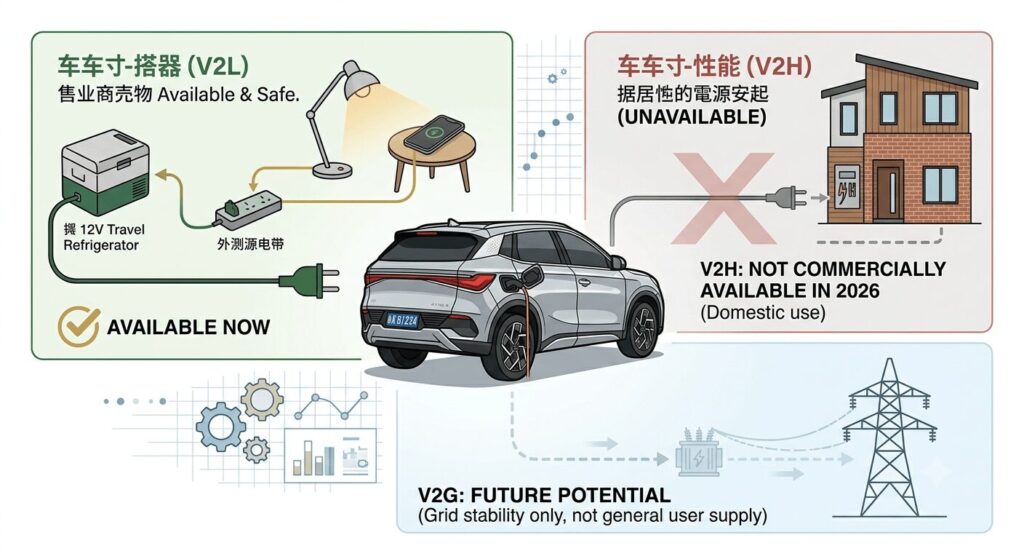
Chinese EV owner forum discussions of “V2G” frequently conflate three fundamentally different capabilities that have dramatically different technical requirements, different commercial availability status, and different practical utility for residential EV owners. This conflation produces discussions where owners believe their vehicle has “V2G capability” based on a manufacturer claim that actually refers to a much more limited bidirectional function than residential power backup.
Vehicle-to-Load (V2L, 车辆对负载):
V2L is the simplest bidirectional capability — the vehicle provides AC power through a standard socket (often built into the vehicle’s boot or accessible through an adapter from the charging port) that can power household appliances directly connected to the vehicle. This is essentially the EV acting as a large mobile power bank.
What V2L can do: Run appliances plugged directly into the vehicle’s socket — phone chargers, laptops, small kitchen appliances, lights, fans. Wattage limited to the V2L output specification (typically 2.2-3.6 kW for most Chinese EVs with this feature).
What V2L cannot do: Power a home’s fixed electrical circuits, provide power through the home’s wiring system, or run high-draw fixed appliances (HVAC systems, water heaters, induction stoves) that are connected to the building’s electrical infrastructure rather than portable plug-in sockets.
Vehicle-to-Home (V2H, 车辆对家庭):
V2H is genuinely what most Chinese EV owners mean when they ask “can my EV power my home during a blackout” — the ability to use the vehicle’s battery to power the home’s normal electrical circuits, through the home’s wiring, during a grid outage or peak-rate period.
What V2H requires that V2L doesn’t: A bidirectional charger unit (installed at the home) that can invert DC electricity from the vehicle battery to AC electricity compatible with the home’s wiring, combined with a transfer switch or automatic changeover switch that manages the transition between grid power and vehicle-supplied power.
What V2H can do: Power a home’s fixed circuits — lights, sockets, fixed appliances — from the vehicle battery, during a grid outage, at power levels determined by both the vehicle’s V2H output specification and the bidirectional charger unit’s rating.
Vehicle-to-Grid (V2G, 车辆对电网):
V2G is the most sophisticated bidirectional function — the vehicle battery exports electricity back to the public grid, controlled by grid signals and compensated by the grid operator through demand response programmes.
What V2G requires that V2H doesn’t: Grid synchronisation capability in the bidirectional charger (the exported AC must precisely match the grid’s frequency and phase), OCPP-based communication with the grid operator’s demand response platform, and specific regulatory approvals for residential export.
What V2G can do: Earn income from grid operators by exporting stored electricity during peak demand periods, as covered in our technology trends guide’s V2G section.
The BYD Atto 3 — What It Actually Has
The Atto 3’s Specific Bidirectional Capability Status in 2026
The technical reality for BYD Atto 3 owners:
The BYD Atto 3 (BYD Yuan Plus in China’s domestic market, 元PLUS) sold in China’s domestic market in 2024-2026 model years is equipped with:
V2L capability: Yes — the Atto 3 has a V2L outlet (typically 2.2 kW, 10A, accessible through an adapter from the charging port or through a dedicated outlet in certain market variants) that can power appliances directly connected to the vehicle.
V2H capability: As of mid-2026, the BYD Atto 3’s domestic China-market variant does not have a commercially available, government-certified V2H system that allows it to power a Chinese residential home’s fixed circuits through the home’s wiring during a grid outage. This is the honest answer to the headline question.
V2G capability: No commercially available residential V2G system for the Atto 3 in China’s domestic market as of mid-2026.
The important nuance about “V2G-ready” marketing:
BYD has made various statements about V2G readiness across its vehicle lineup in different markets and different contexts. Some of these statements refer to:
- Future software or hardware updates that may enable V2H or V2G
- Market-specific versions (some European market Atto 3 variants have different bidirectional specifications from the China domestic market version)
- The vehicle’s battery system being technically capable of bidirectional current flow as a physical matter, which is true but distinct from having an available, certified, commercially-sold system for residential home power supply
Chinese EV owners should specifically ask about their exact vehicle variant’s currently available, currently certified V2H system for China’s domestic market, rather than relying on general “BYD V2G capability” statements that may refer to other markets or future capabilities.
What the BYD Atto 3’s V2L Can Actually Do During a Blackout
The practical blackout power capability that the Atto 3 genuinely provides:
Despite the absence of full V2H capability, the Atto 3’s V2L function provides genuinely useful emergency power during a blackout — just through a different mechanism than powering the home’s fixed circuits:
Battery capacity available for V2L: The Atto 3’s battery is either 49.92 kWh or 60.48 kWh usable depending on variant. At a typical home charge level of 80% SOC, this provides 40-48 kWh of stored energy available for V2L use.
What 40-48 kWh can power via V2L:
| Appliance | Power draw | Hours from 40 kWh battery |
|---|---|---|
| LED lighting (10 × 10W) | 0.1 kW | 400 hours |
| Phone/laptop charging | 0.1-0.2 kW | 200-400 hours |
| Fan (medium) | 0.06 kW | 667 hours |
| Small refrigerator | 0.15 kW | 267 hours |
| Combined basic load | 0.5-1.0 kW | 40-80 hours |
The practical blackout scenario: During a typical Chinese residential power outage (most urban outages are hours-long rather than multi-day events), the Atto 3’s V2L can comfortably provide lighting, phone charging, refrigerator operation, and other essential portable appliance loads for the duration of most realistic outage scenarios.
What V2L cannot address: Fixed circuits — HVAC systems, electric water heaters, induction stoves, permanently-wired lighting circuits — require V2H capability to function from vehicle power.
Which Chinese EVs Genuinely Have V2H Capability in 2026
The Current V2H-Capable Chinese EV Landscape
BYD Han EV — the most developed V2H capability in BYD’s lineup:
As covered in our technology trends guide and our BYD Seal and Han guide, the BYD Han EV has the most developed V2H capability within BYD’s product range, with the BYD V2H home energy system commercially available for specific Han EV variants:
The BYD Han V2H system specifics:
- Bidirectional charging power: up to 6 kW (discharge to home)
- Requires: BYD-specific bidirectional home charger unit (separate purchase, approximately ¥8,000-¥15,000 for the complete system)
- System requires: dedicated electrical installation including transfer switch (adds ¥2,000-¥5,000 to installation cost)
- Compatible vehicles: Specific BYD Han EV variants (confirm compatibility for your exact model year and variant with BYD service)
- Certification status: Has received CCC certification for the bidirectional charging equipment in China’s domestic market — a meaningful distinction from “future-ready” claims
The Han V2H blackout capability:
At 6 kW bidirectional discharge, the BYD Han V2H system can power most Chinese household loads during a blackout — typical household loads of 1-4 kW are well within the 6 kW output, allowing continuous operation of lights, essential appliances, and even a single-unit air conditioner during outage periods.
At 80% SOC in a 76.9 kWh Han EV Long Range:
Available energy for home discharge: approximately 61.5 kWh
At 2 kW typical household load: 30.7 hours of home power supply
At 4 kW higher household load: 15.4 hours of home power supply
BYD Seal — V2H availability status:
The BYD Seal, despite sharing the Blade Battery technology with the Han EV, has different V2H availability status in China’s domestic market as of mid-2026. The Seal’s 800V architecture (covered extensively in our dedicated 800V guide) creates specific technical requirements for bidirectional charging hardware that differ from the Han EV’s 400V system, and the commercial V2H system for the Seal has been later to market than the Han EV system.
NIO vehicles — V2H through NIO Power ecosystem:
As covered in our NIO, Xpeng, and Li Auto guide, NIO’s energy management approach involves the NIO Power ecosystem rather than conventional V2H. The NIO Home Power Pack (家庭储能) is a separate energy storage unit that integrates with the NIO charging ecosystem rather than a bidirectional charger that directly uses the vehicle battery — a different architectural approach that provides home backup power capability through the Home Power Pack’s own battery rather than through the vehicle battery.
Li Auto vehicles — EREV architecture implications:
As covered in our Li Auto guide, Li Auto’s EREV vehicles have a different relationship to home backup power than pure BEVs — the petrol generator in EREV vehicles provides a range extension capability that itself constitutes a form of energy independence during grid outages for vehicle use, though the vehicles don’t have conventional V2H capability for powering home circuits.
The V2H Hardware Requirements — What Home Installation Looks Like
The Complete System Required for V2H in a Chinese Residential Property
The components beyond the vehicle:
A functional V2H system for a Chinese residential property — using a BYD Han EV as the reference vehicle since it has the most commercially available V2H system — requires:
Component 1: The bidirectional charger unit
Unlike standard one-way home chargers covered throughout this guide series, a bidirectional charger can both charge the vehicle battery from the grid (standard function) and discharge the vehicle battery to the home circuits (V2H function). This requires more sophisticated power electronics than standard chargers — specifically an inverter section that converts the vehicle battery’s DC to AC at the grid frequency and phase.
BYD’s specific bidirectional charger unit for China market:
Approximate price: ¥6,000-¥12,000 depending on specific model
Power rating: Up to 6 kW bidirectional
Certification: CCC certified for China’s domestic market
Component 2: The transfer switch / automatic changeover switch
The transfer switch is the critical safety component that prevents the V2H system from accidentally feeding power back into the public grid during an outage — which would create a dangerous situation for utility workers repairing the outage. This switch automatically disconnects the home’s connection to the public grid when it detects a grid outage, then allows the V2H system to power the home’s circuits from the vehicle battery in “island mode.”
In China specifically: The transfer switch requirement is mandated by both electrical safety standards and by State Grid/Southern Grid technical requirements for any system that can discharge power to residential circuits during grid outages.
Cost: ¥1,500-¥4,000 for the transfer switch hardware plus electrician installation
Component 3: The modified electrical installation
The home’s electrical system must be configured to work with the transfer switch — typically involving either:
- A dedicated “essential loads” sub-panel that the V2H system powers during outages (all non-essential loads remain unpowered), allowing the essential loads panel to be smaller and the V2H system capacity to be more efficiently allocated
- Or, for systems powering the entire home panel, a configuration that disconnects all circuits from the grid before enabling V2H power supply
Additional licensed electrician installation cost: ¥2,000-¥5,000 for the modified electrical installation
Total V2H system cost (BYD Han EV, complete installation):
Bidirectional charger: ¥8,000-¥12,000
Transfer switch: ¥1,500-¥4,000
Electrical installation: ¥2,000-¥5,000
Total: ¥11,500-¥21,000
Versus the standard home charger installation covered throughout this guide series:
Standard 7 kW smart charger + installation: ¥2,699-¥4,000
The V2H premium: ¥8,801-¥17,000 above standard installation — the core V2H value proposition must justify this premium, which our financial assessment below addresses.
The Financial Case for V2H in China — Honest Assessment
Scenario Analysis — When V2H Financial Logic Works vs Doesn’t
The blackout backup value:
The primary non-financial value of V2H is resilience during grid outages — the ability to continue powering essential home loads during what would otherwise be a powerless period. In China’s major urban EV markets, grid reliability is high — most Chinese urban residents experience infrequent, relatively brief power outages.
For typical urban Chinese EV owners: The frequency and duration of power outages in Beijing, Shanghai, Shenzhen, and similar cities doesn’t typically justify the ¥11,500-¥21,000 V2H system cost purely on backup power grounds — the same money buys significant backup power infrastructure through dedicated battery storage or portable generators at lower cost and without the dependency on having the vehicle at home when an outage occurs.
The energy arbitrage value:
V2H systems can, in principle, be used not only during outages but during normal operation for energy arbitrage — charging the vehicle battery at valley rates (¥0.30-¥0.34/kWh) and discharging it to the home during peak rates (¥0.85-¥0.87/kWh in Shanghai) to capture the rate differential.
The arbitrage calculation:
Peak-valley rate differential (Shanghai): ¥0.87 – ¥0.34 = ¥0.53/kWh
Realistic daily arbitrage kWh (limited by vehicle use and battery health considerations): approximately 5-10 kWh
Daily arbitrage revenue: 5-10 kWh × ¥0.53 = ¥2.65-¥5.30/day
Annual arbitrage revenue: ¥967-¥1,935/year
The battery degradation cost that the arbitrage calculation must account for:
Using the vehicle battery for daily arbitrage cycling — charging and discharging beyond what driving requires — imposes additional charge-discharge cycles that accelerate battery degradation compared to using the battery only for driving. The incremental cost of this degradation must be subtracted from the arbitrage revenue.
The V2G pilot income (for OCPP-equipped systems in pilot cities):
As covered in our technology trends guide, V2G pilot programme income for enrolled, OCPP-compliant bidirectional systems in Shanghai, Beijing, and Shenzhen ranges from approximately ¥200-¥800/year for active participants. Adding this to the arbitrage revenue:
Total combined V2H/V2G annual financial benefit: ¥1,167-¥2,735/year
Payback period calculation:
Total V2H system cost: ¥11,500-¥21,000
Annual financial benefit: ¥1,167-¥2,735
Payback: 4-18 years (wide range reflecting system cost and participation level variation)
The honest financial conclusion for 2026:
As established in our technology trends guide’s V2G section, the V2G financial case for most Chinese residential owners in 2026 does not yet have a compelling payback within a reasonable 5-7 year horizon. The 4-year lower bound of the payback range is achievable for the most cost-effective system installations in the highest V2G income cities with the most active arbitrage management — a combination that describes a minority of owners.
For the majority of Chinese EV owners, including BYD Atto 3 owners specifically, the financial case for investing in V2H hardware in 2026 is not yet compelling as a pure financial investment — though it becomes more compelling as system costs fall, V2G programme income scales, and electricity price differential widens further.
The Path to Genuine V2H for BYD Atto 3 Owners
What Atto 3 Owners Should Actually Do in 2026
Given the honest assessment above — no current commercially-available certified V2H system for the Atto 3 in China’s domestic market, and a financial case that doesn’t yet justify the V2H premium for most owners — the specific guidance for BYD Atto 3 owners is:
Step 1: Utilise the V2L capability you already have
The Atto 3’s V2L capability — the adapter allowing appliance power from the vehicle — is already installed and already available. For the blackout scenarios that motivate most V2H interest, V2L provides the essential portable appliance coverage that addresses the most acute needs during typical urban outage durations without any additional hardware investment.
Purchase the BYD V2L adapter (if not already owned): approximately ¥200-¥400
Identify which essential appliances in your home are accessible via portable plug-in power versus fixed wiring
Maintain a simple “outage kit” — portable lights, phone charging cables, small portable fan or heater — that works with V2L power
Step 2: Install a standard smart home charger with OCPP compliance
Rather than the bidirectional charger V2H requires (currently unavailable for the Atto 3 and significantly expensive for the Han EV), install a standard OCPP-compliant smart charger. This:
- Captures the full ¥1,670/year TOU savings available from any smart charger
- Positions for demand response programme income (¥200-¥800/year in pilot cities with OCPP)
- Positions for V2G programme participation when Atto 3 V2H systems become commercially available, without requiring charger replacement if the V2H system is compatible with the existing OCPP infrastructure
Step 3: Monitor BYD’s V2H roadmap for Atto 3 compatibility
BYD has an active V2H product development programme and has publicly discussed expanding V2H compatibility beyond the Han EV to additional models. Monitoring BYD’s official announcements — through the BYD app, BYD’s official WeChat account, and BYD dealer communications — for Atto 3-specific V2H system availability will identify when the investment becomes viable.
Step 4: Reassess the financial case in 2027-2028
As covered in our technology trends guide, V2G programme income is expected to scale meaningfully as programmes transition from pilot to mainstream deployment in leading cities. The financial case that doesn’t work in 2026 at ¥11,500-¥21,000 system cost and ¥1,167-¥2,735/year income may work in 2028 at potentially ¥6,000-¥10,000 system cost and ¥2,000-¥4,000/year income as programmes and technology both mature.
The V2H Landscape Looking Forward — 2026-2028
The Specific Developments That Will Change This Assessment
Development 1: CATL Shenxing battery V2H compatibility
CATL’s Shenxing battery cells, used in Zeekr 001 Performance and some Xpeng models covered throughout our vehicle guides, are specifically designed with V2H and V2G capability in mind. Commercial V2H systems for Shenxing-equipped vehicles are expected in 2027, potentially creating the most technically capable residential V2H options in the Chinese market.
Development 2: BYD’s V2H expansion roadmap
BYD has publicly committed to expanding bidirectional charging capability across its lineup rather than limiting it to the Han EV. The Seal (given its 800V architecture requiring different bidirectional hardware) and potentially the Atto 3 (with its more widely-owned base making commercial V2H system development financially attractive) are candidates for future V2H system availability, though firm timelines have not been publicly confirmed.
Development 3: Huawei FusionCharge bidirectional OTA
As covered in our technology trends guide, Huawei’s announced V2G OTA upgrade path for FusionCharge represents the most specific timeline for expanding residential V2G capability from a major established manufacturer — specifically relevant for the Huawei ecosystem users covered in our smart charger guides.
Development 4: V2G income programme scaling
The most significant driver of V2H/V2G investment viability is V2G programme income, which is currently limited by pilot programme scale rather than by technology readiness. As State Grid’s pilot programmes in Shanghai, Beijing, and Shenzhen scale toward mainstream participation, the income potential that makes V2H/V2G hardware investment financially compelling improves without any technology change.
Internal Links — Further Reading on Clean Energy Bazaar
The V2G in China 2026 can your BYD Atto 3 power your home during a blackout guide is the V2H/V2G-specific companion to the broader technology trends and product comparison guidance throughout this content cluster.
For the technology trends guide that established the V2G commercial timeline framework this guide builds upon, our upcoming EV charger trends 2026-2027 V2G solid-state batteries and what to buy now in China guide covers the complete future technology landscape. For the BYD Seal and Han guide that established the technical foundation for BYD’s bidirectional capability differentiation between models, our best home chargers for BYD Seal and Han owners 2026 compatibility with 800V systems guide covers every BYD specification. For the local rebates guide covering V2G pilot programme income from demand response programmes referenced in the financial assessment, our local utility rebates for EV charging 2026 Shenzhen Shanghai Beijing guide covers every available programme. For the smart charger connectivity guide covering OCPP compliance required for V2G programme participation, our best smart connectivity WiFi 5G digital yuan payments in Chinese smart chargers guide covers every connectivity specification. For the ROI calculator that provides the financial analysis framework adapted for V2H/V2G investment assessment throughout this guide, our EV home charger ROI calculator 2026 when it pays off with local rebates included guide covers the complete financial methodology. And for the NIO-specific coverage that details NIO’s alternative energy storage approach referenced in this guide, our best EV charger for NIO Xpeng and Li Auto home solutions for battery swap vs charging guide covers every NIO energy system consideration.
Final Thoughts
The V2G in China 2026 can your BYD Atto 3 power your home during a blackout question has a specific, honest answer: no — not through V2H fixed-circuit home power supply in the way that answer might be most desirable, because no commercially available, certified V2H system exists for the Atto 3’s domestic China market variant as of mid-2026. The Atto 3’s genuine V2L capability provides meaningful emergency power for portable appliance loads during outages, which addresses most practical blackout needs for typical urban outage durations, but is distinct from the full V2H capability that powering a home’s fixed circuits requires.
For Chinese EV owners across all brands who are specifically motivated by the V2H backup power use case in 2026: the BYD Han EV is the most accessible V2H-capable vehicle in China’s domestic market with a commercially available, CCC-certified bidirectional system. The financial case for V2H investment, even for Han EV owners, is not compelling as a pure financial investment at current system costs and income levels — but may become compelling within the 2027-2029 window as system costs fall and V2G programme income scales.
For BYD Atto 3 owners specifically: maximise your V2L capability for emergency use, install an OCPP-compliant standard smart charger to capture current TOU and demand response value, monitor BYD’s V2H roadmap for Atto 3 compatibility, and plan to reassess V2H investment in 2027-2028 when the technology availability and financial case will both have improved beyond what 2026 currently offers.
The bidirectional future for Chinese EV ownership is real, approaching, and in some vehicles already partially here. For the BYD Atto 3 specifically, it isn’t quite here yet — and honest guidance says wait rather than invest prematurely in infrastructure for capability that isn’t yet fully available for your specific vehicle.