The word “loopholes” in this guide’s title requires immediate and honest clarification. There are genuine legal rights, established regulatory frameworks, and documented escalation pathways that Chinese EV owners can exercise when 物业 management companies obstruct their legitimate home charging installation. These are not loopholes in the sense of exploiting ambiguities to circumvent legitimate authority — they are the legal mechanisms that Chinese law and regulation have established specifically to prevent 物业 companies from exercising illegitimate authority over residents’ fundamental property rights.
The “loophole” framing reflects how Chinese EV owners experience these mechanisms: as unexpected levers that work when the obvious direct approach has failed, that most owners don’t know exist until they’ve already experienced obstruction, and that, once known, transform a situation that felt legally hopeless into one with a clear, documented, and often surprisingly fast resolution path.
This guide on how to get permission to install a charger in a Chinese apartment the legal loopholes covers the complete legal framework — what Chinese law actually says about residents’ rights to install EV charging equipment, the specific provision by provision analysis of where 物业 authority ends and resident rights begin, the precise escalation mechanisms available when 物业 refuses or delays unreasonably, the documented outcomes that show these mechanisms work, and the practical, step-by-step process for exercising these rights effectively.
The Legal Foundation — What Chinese Law Actually Establishes
The Property Rights Framework
The fundamental legal basis for EV charging installation rights:
China’s property rights law framework — primarily the Civil Code (民法典) effective January 2021, which consolidated and superseded earlier property law — establishes the legal relationship between residential property owners (including owned parking spaces), the shared property of residential compounds, and 物业 management companies that serve as contracted managers of shared property.
The critical legal distinction:
The Civil Code, combined with the Regulations on Property Management (物业管理条例) and their implementation guidance, establishes a clear principle: 物业 management companies are contracted service providers managing shared property on behalf of owners — they are not owners of shared property themselves, and their authority extends only to management of genuinely shared infrastructure, not to dictating the use of individually-owned property (including individually-owned parking spaces) within its legitimate scope.
What this means for EV charging installation:
A resident who owns their parking space — or who holds a long-term designated use right to it — has property rights in that space that extend to reasonable improvements and installations on and around it, subject to safety requirements and applicable electrical standards. The EV charging installation, when conducted through the proper process (licensed electrician, dedicated meter, 3C certified equipment, proper protection devices), falls within the scope of legitimate property use that the owner’s rights encompass.
The 物业’s legitimate role in this process:
物业 has a legitimate role in coordinating EV charging installations — ensuring installations don’t compromise shared infrastructure capacity, verifying safety compliance, and managing the logistics of installation in shared infrastructure spaces like underground car parks. What 物业 does not have is the right to simply refuse compliant installations without substantiated safety or capacity grounds.
The Specific Regulatory Provisions
National Development and Reform Commission (NDRC) guidance:
NDRC has issued specific guidance on residential EV charging infrastructure that explicitly addresses the 物业 refusal problem, establishing that property management companies should not unreasonably refuse or obstruct EV charging installation applications from residents with designated parking spaces.
Ministry of Housing and Urban-Rural Development (MOHURD, 住建部) guidance:
MOHURD has issued guidance establishing specific processing timelines for 物业 to respond to EV charging installation applications — guidance that creates the basis for escalation when 物业 exceeds these timelines without substantiated grounds for refusal.
Municipal-level implementation — the most specific and most powerful provisions:
The most specific and most actionable legal provisions for most Chinese EV owners are at the municipal level, where cities including Shanghai, Beijing, Shenzhen, Guangzhou, Hangzhou, and many others have issued specific local regulations or implementation rules establishing:
Explicit timelines for 物业 application processing
Specific grounds on which 物业 may legitimately refuse
Mandatory response requirements
Specific escalation channels for residents when 物业 fails to comply
In some cities: default approval provisions where 物业 failure to respond within the specified timeline constitutes deemed approval
The Shenzhen framework — the strongest in China:
Shenzhen’s specific provisions represent the most resident-friendly municipal framework for EV charging installation rights in China. Shenzhen’s guidance establishes that for individually-owned parking spaces, installation is essentially a notification-only process — the owner notifies 物业 of their intention to install compliant charging equipment, and 物业’s role is to coordinate rather than approve or refuse. This framework has been cited in other cities’ subsequent guidance as a model for reducing administrative obstruction.
The Shanghai framework:
Shanghai’s specific provisions establish a 20-working-day response deadline for 物业 to process EV charging installation applications. Failure to respond within 20 working days without substantiated grounds creates a documented basis for escalation to the local housing authority (房管局) and utility company, who can intervene in the application process.
The Beijing framework:
Beijing’s provisions similarly establish specific timelines and escalation mechanisms, with the additional provision that Beijing’s Green Charging Programme subsidies are specifically conditioned on 物业 compliance — creating a financial incentive for 物业 management companies to process applications efficiently rather than obstruct them, as obstruction of subsidy-eligible installations creates additional accountability exposure.
Understanding Why 物业 Refuses — The Real Motivations
Effectively using legal rights requires understanding what is actually driving 物业 resistance, because the legal response differs depending on the genuine underlying motivation:
Motivation 1: Genuine Electrical Infrastructure Capacity Concern
The legitimate 物业 position:
Many older residential compounds (particularly pre-2000 buildings discussed throughout our load balancing and old apartment guides) have electrical distribution infrastructure that genuinely cannot support large numbers of simultaneous EV charging circuits without upgrade — a real technical limitation that 物业 has legitimate grounds to raise.
The legal position:
Physical infrastructure limitation is a legitimate, substantiable ground for declining or conditioning approval of an individual installation. However, it is a legitimate basis for conditioning installation on infrastructure upgrade (which may require collective action) rather than for permanent refusal without any proposed resolution path.
The response strategy:
When 物业 cites infrastructure capacity as their refusal ground, request a written technical assessment from the relevant utility (SGCC or Southern Grid) confirming the specific limitation and what infrastructure upgrade would be required to address it. This shifts the discussion from an abstract refusal to a concrete, solvable technical problem with a documented path to resolution.
Motivation 2: Revenue Sharing Desire
The less legitimate 物业 position:
Some 物业 management companies have sought to make EV charging installation approval contingent on revenue sharing arrangements — requiring residents to use a specific charging operator that has a commercial relationship with the 物业, from which the 物业 receives per-session revenue.
While revenue sharing arrangements between 物业 and charging operators are not inherently illegal (commercial relationships between 物业 and service providers are common in Chinese residential management), making individual residents’ installation approvals contingent on accepting a specific commercial operator arrangement as a condition of approval is increasingly legally questionable under the consumer protection and market regulation frameworks that municipal-level guidance has been addressing.
The response strategy:
If 物业 conditions approval on using a specific operator rather than the resident’s chosen certified equipment and installer, this is specifically the scenario that the NDRC’s “should not unreasonably refuse or obstruct” language targets. Document the specific condition 物业 has attached to approval and escalate through the channels covered below.
Motivation 3: Administrative Burden Avoidance
The most common and most addressable motivation:
Many 物业 management company refusals or extended delays reflect not a genuine objection to EV charging but simple administrative burden avoidance — 物业 staff who don’t know the process, don’t want the paperwork, or are simply unresponsive to any non-routine request.
The response strategy:
This is the motivation most directly addressed by the escalation mechanisms covered below — because administrative burden avoidance evaporates quickly when the escalation process creates more administrative burden than simply processing the original application.
Motivation 4: Misunderstanding of Their Own Authority
A surprisingly common situation:
Some 物业 staff, particularly in smaller or less professionally-managed compounds, refuse EV charging applications based on a genuine misunderstanding of their legal authority — believing they have broader discretion to refuse than they actually do, or unaware of the specific municipal regulations that constrain their authority.
The response strategy:
Providing 物业 with specific written reference to the applicable municipal-level provisions — rather than arguing in general terms — often resolves this situation without escalation, because 物业 staff who genuinely misunderstood their authority typically prefer to correct their position than to face formal escalation consequences.
The Escalation Ladder — The Specific Mechanisms in Order
Level 1: Written Formal Application With Regulatory Reference
Why written applications with explicit regulatory reference outperform verbal requests:
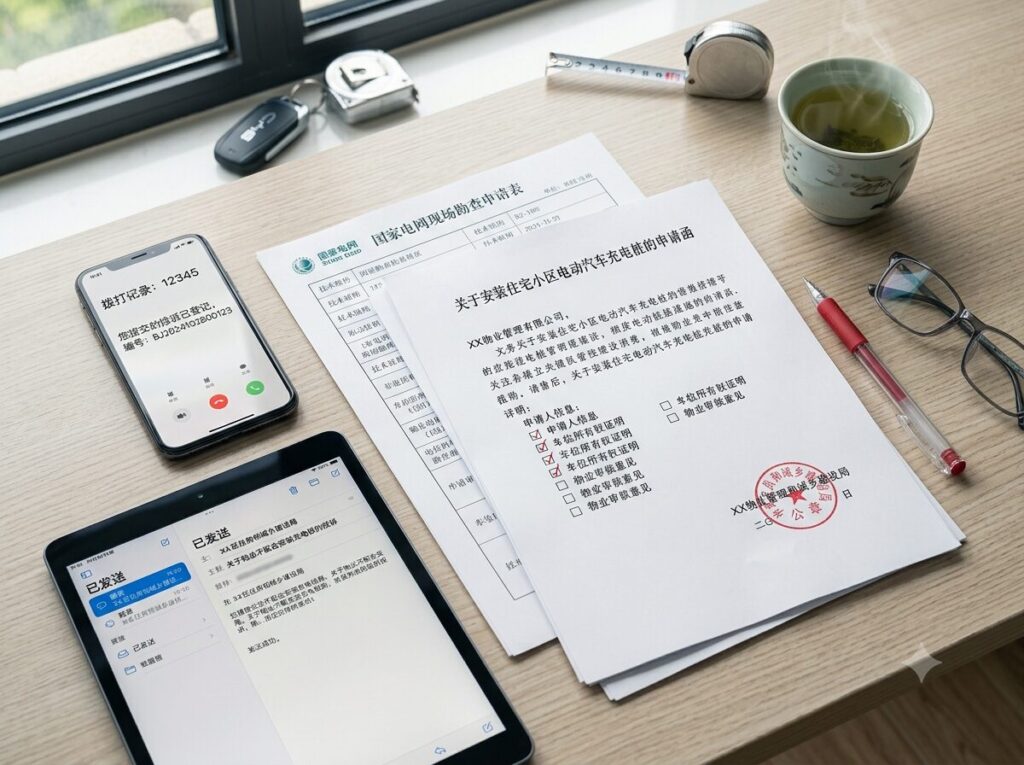
The single most effective upgrade from a typical 物业 approach is submitting a formal written application that explicitly references the specific municipal provisions establishing processing timelines and escalation rights, rather than a conversational request that leaves 物业 unlimited informal discretion.
The specific written application approach:
Your written application should include:
Section 1: The formal request
“I am applying for approval to install a home EV charging unit at my designated parking space [space number] in accordance with [specific municipal regulation reference], NDRC guidance on residential EV charging infrastructure, and the relevant provisions of the Civil Code regarding property owners’ rights to reasonable improvements to designated individual-use property.”
Section 2: The equipment specification
Specific charger model with 3C certification reference number, licensed electrician to be engaged (with their qualification reference), proposed dedicated circuit specification meeting applicable safety standards.
Section 3: The regulatory timeline reference
“I understand that [city name]’s specific provisions establish a [X]-working-day period for processing this application. I am formally noting today’s date [date] as the start of this processing period and will be following up accordingly.”
Section 4: Acknowledgment of legitimate grounds for conditions
“I understand that any conditions imposed on approval must be substantiated on safety or infrastructure capacity grounds under the applicable regulatory framework, and I am happy to discuss any such substantiated concerns directly.”
The psychological effect of this approach:
A 物业 staff member or manager receiving this letter understands immediately that this applicant knows their rights, knows the timeline, and knows the escalation path — none of which was apparent in a casual verbal request. This knowledge frequently produces a processing outcome that the verbal request did not, without requiring any actual escalation.
Level 2: The State Grid/Southern Grid Simultaneous Application Strategy
Why applying to the utility simultaneously with the 物业 application is more powerful than sequential application:
As covered in our professional installation costs guide, the standard approach is sequential — apply to 物业, get approval, then apply to SGCC for the meter installation. The simultaneous application strategy applies to both in parallel from day one.
The legal basis:
SGCC’s residential EV charging service guidelines establish that the utility is entitled to conduct a site assessment for any resident requesting EV charging service, even before 物业 approval is confirmed — the assessment is preparatory work that doesn’t require 物业 approval to initiate.
The strategic effect:
A State Grid assessment engineer visit to the compound’s underground car park — even if conditioned on 物业 approval before actual installation proceeds — creates compound-level visibility of the application that 物业 cannot ignore as easily as a simple written application. SGCC’s assessment engineer communicates with 物业 as part of their assessment process, creating an additional institutional pressure point alongside the resident’s own application.
The practical timing:
Submit the formal written 物业 application and the SGCC site assessment request on the same day. The SGCC assessment visit typically occurs within 2-3 weeks, creating useful momentum in the application process regardless of 物业’s initial responsiveness.
Level 3: The 12345 Government Hotline Complaint
The most underused and most effective single escalation mechanism:
China’s 12345 Government Service Hotline (政务服务便民热线) provides direct access to government service mediation for exactly the type of administrative obstruction that unreasonable 物业 EV charging refusal represents.
What 12345 does:
The 12345 system routes complaints to the relevant local government authority — typically the Street Office (街道办) or District Housing Authority (区住建局) — which has both the authority and the mandate to intervene in 物业 disputes and the institutional ability to contact 物业 management companies directly.
Why this is more effective than most owners expect:
Local government intervention through the 12345 system creates documented official attention on the specific 物业’s handling of the application. 物业 management companies operate under licensing and regulatory oversight that gives local government meaningful leverage — a 12345 complaint about EV charging obstruction that results in a formal enquiry from the local housing authority is a significantly more pressing concern for most 物业 management companies than any amount of resident lobbying.
The documented outcomes:
Chinese EV owner forums extensively document 12345 complaint outcomes for EV charging obstruction — the consistent pattern is that 物业 companies, upon receiving formal enquiry from the housing authority following a 12345 complaint, typically process the application within 1-2 weeks of the enquiry, even when they had been unresponsive for months to direct resident approaches.
How to file:
Call 12345 and explain the situation: “I am a residential property owner with a designated parking space at [address]. I have submitted a formal written application to my 物业 management company for EV charging installation approval [date] in accordance with [municipal regulation reference]. They have [not responded/refused without substantiation] after [time period]. I am requesting government service mediation.”
The complaint is logged with a reference number, assigned to the relevant authority, and the applicant is entitled to follow-up on the complaint status — creating a tracked record that itself applies ongoing institutional pressure.
Level 4: The Housing Authority (房管局) Formal Complaint
For persistent obstruction that 12345 mediation doesn’t resolve:
If the 12345 process produces a formal enquiry that 物业 fails to respond to adequately, the next level is a formal complaint to the local District Housing Authority (区住房和建设局 / 区住建局), which has direct regulatory authority over 物业 management company licensing and compliance.
The specific regulatory leverage:
物业 management companies in China operate under licenses issued and renewed by housing authorities. A formal complaint documenting persistent refusal to process EV charging installation applications in accordance with established municipal provisions creates a licensing compliance issue for the 物业 management company — a significantly more serious consequence than a simple resident complaint.
The formal complaint documentation:
A housing authority formal complaint is most effective when accompanied by:
- Copies of the original written application with date
- Any written response from 物业 (or documented absence of response after the specified timeline)
- Reference to the specific municipal provisions establishing the applicable timeline and escalation right
- Documentation of the 12345 complaint and its outcome
Level 5: The Owner Committee (业委会) Activation
Engaging the formal resident governance structure:
Chinese residential compounds with established 业委会 (Owner Committee) have a formal resident governance body that has specific legal standing to oversee 物业 management company performance and compliance. Bringing EV charging installation obstruction to the 业委会’s formal attention — particularly if multiple residents have experienced the same obstruction — creates an institutional rather than individual escalation.
The 业委会’s specific powers:
The 业委会 can formally direct 物业 management companies on compliance with applicable regulations, can commission independent assessments of infrastructure capacity (addressing the technical capacity concern 物业 may raise), and can initiate the process of changing 物业 management companies if persistent non-compliance creates sufficient owner dissatisfaction.
The collective power dimension:
A single resident’s EV charging obstruction complaint has limited 业委会 traction. Five or ten residents experiencing the same obstruction — which is increasingly common as EV adoption rates within compounds rise — creates a collective issue that commands 业委会 attention as a material property management compliance concern.
Organising effectively:
The most effective approach is to identify other EV-owning residents experiencing the same obstruction (through compound WeChat groups, direct conversation, or posting in common areas), document the collective scope of the issue, and present it collectively to the 业委会 rather than as individual separate concerns.
Level 6: Legal Action — The Nuclear Option Rarely Needed
The legal action threshold:
For the vast majority of Chinese EV charging obstruction situations, the escalation mechanisms at Levels 1-5 produce resolution without requiring formal legal action. However, where persistent, documented, unreasonable refusal continues through all prior escalation levels, formal legal action through the courts is available and has been successfully pursued in documented Chinese cases.
The legal theory:
A civil claim against a 物业 management company for ongoing unreasonable refusal to process an EV charging installation application can be brought under the property rights provisions of the Civil Code, claiming interference with the property owner’s legitimate use rights in their designated parking space.
The practical barrier:
Legal action requires significantly more time, cost, and administrative effort than the earlier escalation levels — typically months rather than the weeks that 12345 and housing authority escalation often produce. This is why legal action is appropriately the final-resort mechanism, deployed only when documented evidence of escalation through prior levels has not produced resolution.
The deterrent value:
Communicating in writing to 物业 that you are prepared to escalate to formal legal action — with specific reference to the legal theory and any precedent cases from your city — sometimes produces resolution without actually filing, because the litigation risk and associated costs and reputational consequences for the 物业 management company are themselves a meaningful deterrent.
The City-Specific Provisions That Matter Most
Shanghai — 20 Working Days and Deemed Approval
The specific Shanghai mechanism:
Shanghai’s municipal provisions establish the 20-working-day processing deadline referenced throughout this guide. The deemed approval provision — where failure to respond within the specified period with documented substantiated grounds constitutes approval — is particularly powerful because it removes the need for positive 物业 action when obstruction takes the form of simple non-response.
Practical application:
When 物业 fails to respond to a formal written Shanghai application within 20 working days, this creates the legal basis for submitting the SGCC meter application as if approval has been obtained — most Shanghai SGCC service centres will accept applications with documented deemed approval evidence rather than a formal 物业 approval letter.
Shenzhen — Notification Only for Owned Spaces
The strongest resident-side provision in China:
Shenzhen’s framework, as referenced earlier, effectively converts the 物业 approval requirement into a notification requirement for owners of individually-owned parking spaces — the owner notifies 物业 of the installation intention, and 物业’s role is to coordinate logistics rather than approve or refuse.
Practical application:
In Shenzhen, an owner who has submitted written notification and received no substantiated objection within the notification period can proceed with installation through the SGCC process without requiring a formal 物业 approval letter — a considerably stronger position than other cities’ approval-required frameworks.
Beijing — Subsidy Conditionality Creates Additional Leverage
The Beijing-specific mechanism:
Beijing’s Green Charging Programme subsidies — among the most generous in China per our local rebates guide — create a specific additional leverage point: because 物业 non-compliance with the programme’s requirements creates exposure under the programme’s accountability framework, Beijing 物业 companies face institutional pressure to facilitate rather than obstruct subsidy-eligible applications.
Practical application:
When escalating a Beijing application, explicitly reference the Green Charging Programme subsidy eligibility and the subsidy programme’s 物业 compliance requirements — this creates an additional institutional stake in the escalation outcome beyond the general housing authority accountability.
The Documentation System That Makes Escalation Work
The Record-Keeping Discipline That Determines Escalation Outcome
Why documentation is the practical foundation of effective escalation:
Every escalation mechanism covered in this guide — from the 12345 complaint through housing authority formal complaint to potential legal action — is significantly more effective with contemporaneous documentary evidence than with verbal accounts. The discipline of creating and maintaining a complete documentary record from the first application submission determines how effectively any subsequent escalation can be pursued.
The documentation system:
Document 1: Written application with proof of delivery
Submit the formal written application by a method that creates proof of delivery — registered mail (挂号信), in-person delivery with a signed receipt from 物业, or, where 物业 has an official WeChat or email channel, submission through that channel with screenshot evidence. The delivery proof with timestamp is the foundation of the escalation timeline.
Document 2: All 物业 responses (or documented non-responses)
Any written response from 物业 should be retained. For non-responses, document each follow-up attempt (date, method, staff member if known, outcome) to establish a pattern of non-response rather than relying on assertion alone.
Document 3: The regulatory provision summary
Prepare a one-page summary of the specific applicable provisions for your city — the timeline, the escalation mechanism, and the relevant authority — to include with any escalation submission. This document establishes that the escalation is grounded in specific legal authority rather than general resident frustration.
Document 4: Third-party correspondence
Retain copies of all correspondence with SGCC or Southern Grid regarding the concurrent assessment application, and any correspondence from other official channels.
The Practical Timeline — What to Expect
Typical Resolution Timelines by Escalation Level
| Escalation Level | Typical Resolution Timeline | Success Rate (Documented) |
|---|---|---|
| Formal written application with regulatory reference | 2-4 weeks | ~60% (for straightforward cases) |
| Simultaneous SGCC application | 3-6 weeks from dual submission | ~70% combined with Level 1 |
| 12345 complaint | 1-3 weeks after complaint filed | ~85% when properly documented |
| Housing authority formal complaint | 2-4 weeks after submission | ~90%+ with complete documentation |
| 业委会 activation (collective) | Variable, 4-12 weeks | High, especially for multiple residents |
| Legal action | 3-12 months | High but resource-intensive |
The honest expectation-setting:
For the majority of Chinese EV owners facing 物业 obstruction, the combination of Levels 1-3 — formal written application, concurrent SGCC application, and a promptly-filed 12345 complaint if the written application doesn’t produce timely response — resolves the obstruction within 4-8 weeks in most cases. The higher escalation levels (housing authority formal complaint, 业委会 activation) are needed less frequently but remain important fallback mechanisms for persistent obstruction.
What Doesn’t Constitute Legitimate 物业 Grounds for Refusal
As referenced above, 物业 may legitimately condition approval on substantiated safety or capacity grounds. The following are specifically NOT legitimate grounds under current Chinese regulatory frameworks:
“We don’t allow EV chargers in this compound” — a blanket prohibition without substantiated safety or capacity grounds is not legitimate.
“Too many people want chargers” — demand volume is not a legitimate individual application refusal ground; it is a legitimate basis for seeking collective infrastructure solutions.
“Our car park isn’t suitable” — without a specific, substantiated technical assessment, this assertion is not a valid refusal.
“You need to use our approved installer” — preferring a specific installer without requiring the resident to use them is legitimate information-sharing; making specific installer use a condition of approval is legitimately questionable.
“The decision needs to go to our headquarters” — internal governance processes are not a legitimate basis for exceeding the regulatory processing timeline.
“We’re busy” — administrative workload does not extend the regulatory processing deadline.
Internal Links — Further Reading on Clean Energy Bazaar
The how to get permission to install a charger in a Chinese apartment the legal loopholes guide is the rights-enforcement companion to the comprehensive installation guidance throughout this content cluster.
For our comprehensive apartment EV charging rights guide that established the foundational framework this escalation guide builds upon, our apartment EV charging solutions 2026 China HOA rules property manager permissions and fixed parking rights guide covers every regulatory pathway in full detail. For the professional installation costs guide covering what the installation process looks like once permission is finally obtained, our professional EV charger installation costs 2026 what State Grid chargers vs private companies charge guide covers every cost component. For the State Grid vs private networks guide covering the concurrent SGCC application strategy referenced in the Level 2 escalation mechanism, our State Grid SGCC vs private networks who offers the best home connection rate guide covers the complete connection process. For the local rebates guide confirming that subsidy eligibility creates additional escalation leverage in Beijing and other subsidy cities, our local utility rebates for EV charging 2026 Shenzhen Shanghai Beijing guide covers every available programme. For the case study that demonstrates what successful installation looks like after permission is obtained, our case study Shanghai family with two EVs BYD and Tesla charging setup in a high-rise guide covers the complete implementation. And for the no-fixed-parking guide covering alternatives when permission is genuinely unattainable, our urban parking vs rural garages how Chinese homeowners install EV chargers without a fixed spot guide covers every alternative approach.
Final Thoughts
The how to get permission to install a charger in a Chinese apartment the legal loopholes are not loopholes in any pejorative sense — they are the legal rights and regulatory mechanisms that Chinese law has established specifically to prevent the abuse of 物业 administrative authority over legitimate resident property rights. The reason they function as “loopholes” in practice is simply that most residents don’t know they exist, and most 物业 management companies rely on that ignorance to exercise illegitimate resistance with minimal accountability.
The practical toolkit this guide provides — the formal written application with regulatory reference, the concurrent SGCC application, the 12345 complaint with documented evidence, the housing authority formal complaint, the 业委会 collective activation — has produced the documented outcome that most residents who use it experience: permission obtained, typically within 4-8 weeks of committing to the escalation approach, for an installation that residents who accepted informal 物业 resistance remained without for months or years.
The three things that determine success in navigating 物业 obstruction: knowing your specific municipal provision and timeline, creating documentary evidence from the first application, and being willing to escalate promptly when the specified timeline is exceeded without substantiated grounds. Most 物业 management companies, confronted with a documented, legally-grounded escalation, process the application rather than sustain the obstruction — because the administrative and reputational consequences of sustained, documented, escalated non-compliance significantly exceed the effort of processing a compliant installation application.
Your charger. Your parking space. Your legal rights. Use them.