No two properties in China’s EV charging landscape present a more instructive contrast than an old Beijing hutong courtyard house and a new Shanghai apartment in a post-2015 high-rise development. The hutong represents China’s oldest urban residential form — courtyard houses arranged around the narrow lanes that characterise old Beijing’s inner districts, with electrical infrastructure that was never designed for anything more demanding than basic lighting and perhaps a few appliances. The new Shanghai apartment represents China’s most sophisticated contemporary residential development — high-rise towers built with EV charging infrastructure as a design consideration, modern electrical panels with ample capacity, and 物业 management companies that have processed dozens of EV charging installation applications.
Between these two extremes lies the complete spectrum of China’s diverse residential electrical infrastructure reality, and the contrast between them illuminates the core challenge that home power capacity upgrading represents for Chinese EV owners in 2026: there is no single answer to “can I upgrade my home’s electrical supply for EV charging?” because the answer depends entirely on which of these extremes your property resembles, and in what specific ways.
This guide on upgrading your home power capacity guide for old Beijing hutongs vs new Shanghai apartments provides the complete assessment — what power capacity upgrading actually involves at each technical layer, the specific electrical infrastructure realities of Beijing’s hutong residential stock versus Shanghai’s newer high-rise development, the realistic upgrade options and costs for each property type, and the practical decision framework for EV owners at either end of the spectrum and everywhere in between.
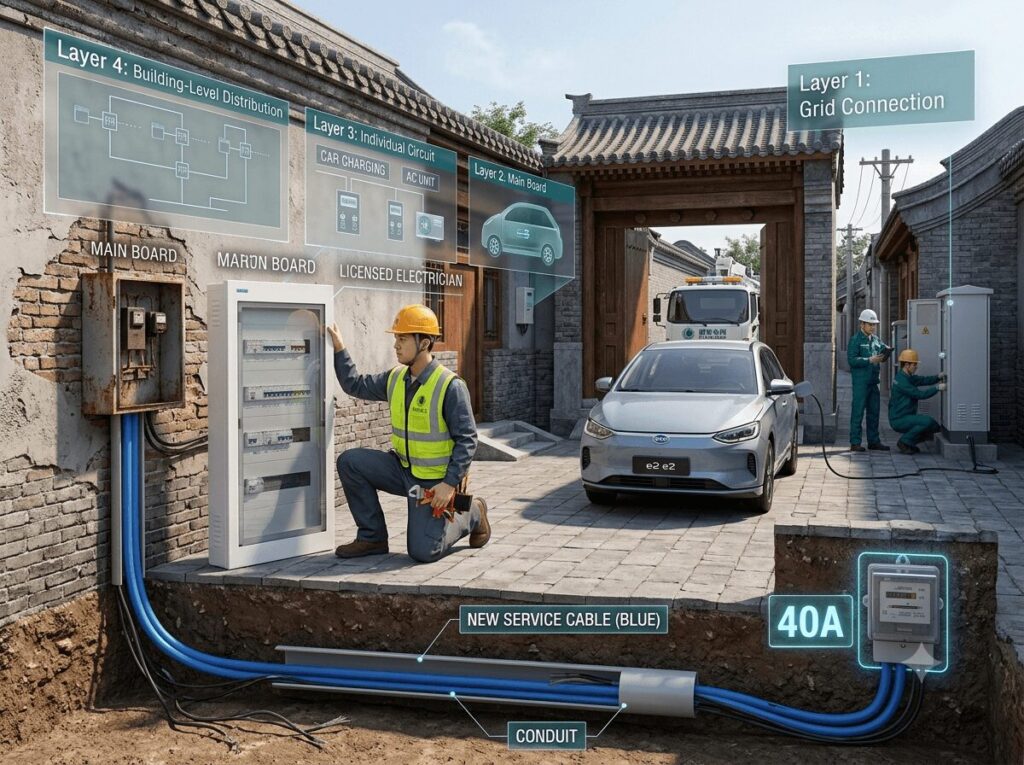
Understanding Home Power Capacity — The Four Technical Layers
What “Power Capacity” Actually Means for EV Charging
The common misconception:
When Chinese EV owners ask “can I upgrade my home’s power capacity for EV charging,” they are often imagining a single upgrade — like upgrading a phone’s storage — that simply increases the available power. The technical reality is that “home power capacity” is determined by four distinct layers of electrical infrastructure, each with its own upgrade requirements, costs, and technical constraints.
Layer 1: The Grid Connection (电网接入)
The physical connection from the public electricity grid to the property — the service cable running from the electricity distribution network to the property’s meter. This connection has a maximum capacity determined by the cable’s cross-section, the meter’s rating, and the distribution transformer serving the area.
In Chinese residential contexts, the grid connection capacity is typically:
Urban apartments: Set by the dedicated circuit application process (the standard residential EV charging installation process covered throughout this guide series) — each new dedicated EV charging circuit is a new grid connection point with its own meter
Hutong standalone properties: Typically a single service cable rated for the property’s total electrical supply — often substantially lower than modern residential standard for older hutong properties
Layer 2: The Main Distribution Board (总配电箱/主配电板)
The electrical panel inside the property where the incoming electrical supply is distributed to individual circuits. This panel has a maximum current rating and a specific number of circuit positions.
Layer 3: The Individual Circuit (支路/回路)
Each dedicated circuit within the property — the circuit specifically designated for EV charging in a properly-installed home charging setup. This circuit has its own circuit breaker and cable rated for specific current.
Layer 4: The Building-Level Distribution (楼栋配电室)
For apartment buildings, the building-level electrical distribution that feeds individual apartments and car park areas — the capacity of which determines what is available for EV charging at the apartment level, independent of the individual apartment’s own internal electrical capacity.
Why all four layers matter:
Upgrading one layer without addressing a constraint at another layer produces no functional improvement for EV charging. A hutong owner who upgrades their internal wiring but has a grid connection limited to 20A achieves nothing — the grid connection limit remains the binding constraint. A Shanghai apartment owner with a modern main distribution board but a car park distribution board with no available capacity achieves nothing from internal upgrades.
Identifying which layer is the binding constraint for a specific property is the first and most important technical step in any power capacity upgrade assessment.
Beijing Hutongs — The Most Challenging Residential Electrical Context
What Old Beijing Hutong Electrical Infrastructure Actually Is
The historical development of Beijing hutong electrical supply:
Beijing’s hutong courtyard houses (四合院 and 大杂院) were originally built during periods — often Ming and Qing dynasties, many structures dating to the 17th-19th centuries — when electricity didn’t exist. Electrical supply to hutong residential areas was retrofitted gradually during the 20th century, typically through overhead distribution wiring along the hutong lane that feeds individual properties through service connections of varying quality and capacity.
The specific infrastructure characteristics of hutong electrical supply:
The service cable entering a hutong property is typically:
Single-phase only: Hutong residential supply is universally single-phase in Beijing’s older inner districts, consistent with China’s residential supply architecture discussed in our three-phase homes guide but at the lower end of the single-phase capacity spectrum
Low rated capacity: Many hutong service connections were installed for households with very limited electrical loads — initial electrification of hutong areas often provided 5A, 10A, or 15A service connections that were not subsequently upgraded as electrical loads increased
Overhead distribution: Hutong areas typically use overhead distribution rather than the underground cable systems of modern residential developments — overhead cables in Beijing’s hutong areas are visible as the characteristic tangle of electrical, telecommunications, and cable TV wiring that runs above the hutong lanes
The distribution transformer context:
The distribution transformers serving hutong residential areas are often small, old, and operating at or near their rated capacity for the existing residential load. Unlike new residential developments where dedicated distribution transformers are designed for modern residential electrical loads including EV charging, hutong-area transformers were sized for the historical load and may have limited headroom for additional demand from EV charging on their network.
The grid-side constraint as the primary hutong barrier:
For most hutong properties, the primary constraint on home power capacity for EV charging is not the internal wiring — which can be upgraded relatively straightforwardly within the property’s footprint — but the grid-side supply: the service cable rating, the meter rating, and the distribution transformer capacity that together determine what electrical power can physically be delivered to the property.
The Beijing State Grid Hutong Context
How Beijing State Grid handles hutong service upgrades:
Beijing State Grid (国网北京市电力公司) has developed specific procedures for residential supply capacity upgrades in hutong and other older residential areas, driven partly by EV adoption pressure and partly by the general household electricity demand growth from air conditioning and modern appliances.
The formal capacity upgrade application:
A hutong property owner who wants to increase their service connection capacity — to accommodate an EV charging circuit in addition to the existing household load — must apply to Beijing State Grid for a supply capacity upgrade:
Application documentation: Property ownership documents, current meter information, proposed load calculation (what additional capacity is being requested and why)
Assessment process: State Grid engineers assess whether the existing service cable can be reused at higher current rating (sometimes possible with cable replacement if the existing route can accommodate a larger cable), whether the distribution transformer serving the hutong area has available capacity, and what works are required
Timeline: 30-60 working days for standard urban residential capacity upgrades; longer if distribution transformer work is required
The transformer constraint reality:
For hutong areas where the local distribution transformer is operating near capacity — a situation that Beijing State Grid’s technical teams assess during the upgrade application process — additional residential capacity may require transformer upgrade or the installation of additional distribution capacity. This transformer-level work is:
State Grid’s responsibility to design and execute (not the individual resident’s responsibility to fund in most cases)
Potentially lengthy in timeline (60-120 working days)
Potentially involving the hutong lane’s physical disruption for underground cable or overhead distribution modification
The important distinction from standard apartment EV charging installation:
The standard residential EV charging installation process covered throughout this guide series — dedicated meter application, private electrician installation — assumes that the property’s main electrical supply is adequate and that only a new branch circuit to the parking area is needed. For hutong properties where the main supply itself is inadequate, the upgrade process is fundamentally different: the main supply capacity must be increased first, and this involves State Grid infrastructure work that precedes any EV charging equipment installation.
The Realistic Hutong Upgrade Options
Option A: Full grid connection capacity upgrade
If the local distribution transformer has available capacity and the service cable can be replaced with a higher-rated alternative:
Beijing State Grid service capacity upgrade from (typical) 20A to 40A: ¥500-¥2,000 for the metering and connection work
New service cable if existing cable requires replacement: ¥1,000-¥5,000 depending on cable route and length
New main distribution board sized for the upgraded supply: ¥1,500-¥4,000
EV charging circuit from upgraded supply to vehicle location: ¥2,000-¥6,000 depending on distance and complexity
Total realistic range for a hutong with moderate infrastructure challenges: ¥5,000-¥17,000
Timeline: 3-6 months from application to completion in cases without transformer constraint
Option B: Transformer-upgrade-dependent scenario
Where the local distribution transformer is operating near or at capacity:
This option requires State Grid’s own infrastructure investment decision — not something the individual property owner can directly fund or expedite beyond making the application and potentially coordinating with neighbours to present a collective capacity request that State Grid may prioritise
Timeline: 6-18 months in cases requiring transformer work
Practical advice: In transformer-constrained hutong areas, presenting a collective capacity upgrade request from multiple hutong properties simultaneously may make State Grid’s infrastructure investment decision more commercially rational — the grid-level economics of transformer upgrade improve when multiple connections benefit from the work
Option C: Low-power portable solution as bridge
For hutong owners whose existing service connection — even after whatever capacity upgrade is possible — cannot reliably support sustained 7 kW EV charging:
The portable EVSE at Mode 2 (2.2 kW) or Mode 3 lower power setting represents a practical bridge, delivering meaningful charge over extended overnight periods even at lower power rates
At 2.2 kW, a 60 kWh EV battery at 20% SOC requires approximately 24.5 hours to reach 80% — clearly not adequate for regular overnight use
At a compromised 3.5 kW (possible if the service connection can be stabilised at 16A): 60 kWh at 20-80% requires approximately 10.3 hours — marginal but potentially usable for owners with two-night charging cycles
The honest hutong assessment:
Many old Beijing hutong properties face genuine electrical infrastructure constraints that make home EV charging either very expensive to properly implement or genuinely impractical given the specific infrastructure situation. This is not a failure of policy or regulation — it is the consequence of residential electrical infrastructure built for a fundamentally different era of electricity consumption being asked to serve modern high-power applications.
For hutong EV owners in the most constrained situations, the realistic 2026 options are:
Invest in the full grid upgrade process (potentially expensive, potentially lengthy, but achievable for properties where transformer capacity exists)
Accept that home charging is not currently viable and use nearby public charging infrastructure as the primary charging method
Consider whether the property itself — hutong courtyard houses are highly valued Beijing real estate but their EV charging constraints are a genuine limitation for EV owners
New Shanghai Apartments — The Much More Manageable Context
What Post-2015 Shanghai High-Rise Electrical Infrastructure Actually Is
The design generation that changed everything:
Shanghai residential high-rise development built since approximately 2015 — encompassing the substantial proportion of Shanghai’s residential stock that has been developed or redeveloped since that period — was designed against a fundamentally different electrical specification from either the older Shanghai apartment stock of the 1990s-2000s era or the hutong housing that represents Beijing’s oldest residential form.
The specific characteristics of new Shanghai high-rise electrical infrastructure:
Service connection capacity: New Shanghai apartments typically receive 40A or 60A single-phase service connections — substantially higher than older residential connections and sufficient for a dedicated EV charging circuit without upgrade
Distribution board provision: New Shanghai apartment distribution boards typically include 12-18 circuit positions, with one or more spare positions reserved for future circuits — including, in some developments built since 2018, positions specifically reserved for EV charging
Car park infrastructure provision: The most forward-designed Shanghai developments built since 2018-2020 have pre-installed conduit runs to parking spaces, pre-sized car park distribution boards for EV charging load, and in some cases pre-installed individual meters to designated parking spaces — reducing EV charging installation to a connection and equipment installation rather than a full infrastructure installation
Three-phase supply in premium developments: A small but growing proportion of new Shanghai developments — primarily those positioned at premium price points in Pudong, Qingpu, and similar districts — provide three-phase supply to individual apartments, enabling 11 kW AC home charging as discussed in our three-phase homes guide
The Standard New Shanghai Apartment Upgrade Requirement
For the majority of new Shanghai apartments (post-2015):
The “upgrade” required is not actually a power capacity upgrade at all — it is the standard dedicated EV charging circuit installation process covered throughout this guide series:
Shanghai State Grid dedicated EV charging meter application
Private electrician installation from dedicated meter to parking space charger position
Certified charger installation
The “upgrade” in this context:
The addition of a dedicated EV charging circuit to a panel with adequate capacity and available circuit positions is not a power capacity upgrade — it is a new circuit installation. The panel already has the capacity; the application process creates the formal metering and circuit that channels that capacity to the EV charging function.
Why this distinction matters:
Shanghai apartment owners who are told they need a “power capacity upgrade” for EV charging, when their apartment already has a 40A or 60A service connection with available panel capacity, are being misinformed — potentially by parties who benefit from the confusion. The standard EV charging installation process is adequate; a separate, additional power capacity upgrade is not necessary.
The specific Shanghai context where a genuine upgrade may be needed:
Where a Shanghai apartment does require genuine power capacity consideration:
Older Shanghai apartments (pre-2005 stock in areas like old Jing’an, old Huangpu, or other inner-city older residential stock) with 20A or 30A service connections that are already substantially utilised by household load — the addition of a 7 kW EV charging circuit to an already-loaded 20A connection would require capacity upgrade
Buildings where the car park distribution board has insufficient capacity for additional EV charging circuits — a situation that the building-level infrastructure assessment during the Southern Grid application process would identify
The Comparison Matrix — Hutong vs New Shanghai Apartment
| Factor | Old Beijing Hutong | New Shanghai Apartment (post-2015) |
|---|---|---|
| Service connection capacity | Typically 10-20A (older) | Typically 40-60A |
| Main panel capacity | Often inadequate | Generally adequate |
| Panel spare capacity | Often none | Usually 2-4 spare positions |
| Car park infrastructure | Usually none | Often pre-installed or partially installed |
| Grid connection upgrade needed? | Usually yes | Usually no |
| Primary constraint | Grid-side infrastructure | 物业 permission process |
| Realistic EV charging installation cost | ¥5,000-¥17,000+ | ¥2,500-¥6,000 (net of subsidies: ¥500-¥3,000) |
| Timeline | 3-18 months | 6-16 weeks |
| Subsidies available | Limited | Full Shanghai programme available |
| Practical difficulty | High | Moderate |
The Electrical Upgrade Cost Comparison
What Upgrading Each Property Type Actually Costs
The hutong upgrade cost breakdown:
Grid connection upgrade (State Grid application and works):
Service cable replacement (if required): ¥1,000-¥5,000
Meter upgrade: ¥200-¥800
Connection works: ¥500-¥1,500
Grid works subtotal: ¥1,700-¥7,300
Internal electrical upgrade:
New main distribution board: ¥1,500-¥4,000
Circuit wiring from board to vehicle location: ¥1,000-¥5,000 (highly variable based on distance and installation complexity in a traditional hutong property)
Protection devices and certification: ¥500-¥1,500
Internal works subtotal: ¥3,000-¥10,500
Charger hardware:
IP54 minimum, appropriate for covered hutong courtyard installation: ¥999-¥2,500
Hutong total: ¥5,699-¥20,300
The new Shanghai apartment cost breakdown:
State Grid dedicated meter installation:
Standard cable run (5-15m): ¥500-¥1,500
Meter and connection: ¥200-¥500
State Grid subtotal: ¥700-¥2,000
Private electrician installation:
Meter to charger wiring: ¥600-¥1,500
Protection devices: ¥200-¥500
Installation labour: ¥400-¥800
Electrician subtotal: ¥1,200-¥2,800
Charger hardware:
IP65 for Shanghai’s winter humidity: ¥1,299-¥2,500
Gross Shanghai total: ¥3,199-¥7,300
Less Shanghai subsidies (¥1,500-¥2,100): ¥1,099-¥5,800
The cost gap in concrete terms:
Even at the optimistic end of the hutong cost range and the pessimistic end of the Shanghai range, the hutong EV charging installation costs approximately 3-4× more than the new Shanghai apartment installation. At the average of each range, the ratio is approximately 5:1 — ¥13,000 versus ¥2,800 net.
This cost gap is not a policy failure or an installation industry pricing problem — it reflects the genuine engineering difference between installing one branch circuit in a property with adequate existing supply infrastructure versus rebuilding the electrical supply infrastructure for a property that was designed for a fundamentally different era of electrical consumption.
The Middle Ground — The Properties Between the Extremes
The Much More Common Properties That Don’t Fit Either Extreme
The 1990s-2000s Beijing apartment:
The largest single category of Beijing residential stock is neither hutong nor new high-rise — it is the 6-25 storey apartment blocks built during Beijing’s first major urbanisation period from the 1980s through early 2000s.
These properties’ electrical infrastructure typically:
Received 20-30A service connections at construction
Was designed for a household electrical load of 4-6 kW peak
Has been updated in some cases through property renovation programmes but not universally
Has car park electrical infrastructure that was designed for lighting and access control rather than EV charging
The typical upgrade requirement for 1990s-2000s Beijing apartments:
In most cases, the service connection capacity can be upgraded to 40A through State Grid’s standard residential capacity upgrade process without distribution transformer work — the distribution infrastructure for residential areas developed since the 1990s has generally been more generously sized than hutong-era infrastructure.
The realistic cost range: ¥3,000-¥10,000 depending on building-specific infrastructure and parking location distance from car park distribution
The 2005-2015 Shanghai apartment:
Shanghai’s 2005-2015 residential stock sits between the oldest inner-city apartments and the newest forward-designed developments. These properties typically have:
30-40A service connections — adequate for household load plus one EV charging circuit if carefully managed, but without the generous headroom of 2015+ developments
Car park distribution boards that exist and have some capacity, but may be operating closer to their rated capacity than newer developments
Standard individual apartment panels without designated EV charging circuit provisions
The typical upgrade requirement for 2005-2015 Shanghai apartments:
Standard dedicated EV charging circuit installation through the State Grid process is typically feasible without service connection upgrade — the 30-40A service is usually adequate for one EV charging circuit given that most EV owners charge during the night when household base load is low.
The realistic cost range: ¥2,500-¥6,500 before subsidies, ¥400-¥5,000 after Shanghai subsidy
The Practical Decision Framework
What Each Property Type Owner Should Actually Do
For hutong owners:
Step 1: Commission an electrical assessment from a licensed electrician (持证电工) specifically experienced with Beijing hutong properties — not just any electrician, but one who has navigated the specific regulatory and physical challenges of hutong electrical work. The assessment should specifically identify the service connection capacity, main panel condition, and vehicle parking location relative to the electrical infrastructure.
Step 2: Apply to Beijing State Grid for a capacity assessment and upgrade application. This application triggers the State Grid engineer visit that provides the authoritative assessment of what is possible from the grid side. Make this application before committing to any private electrical work or charger hardware purchase.
Step 3: If the State Grid assessment reveals transformer constraints, assess whether coordinating with neighbouring hutong properties on a collective capacity upgrade request — presented to State Grid as a single application — changes the economics of the transformer-side works.
Step 4: Based on the State Grid assessment outcome, make the realistic decision between full upgrade (when feasible and economically justified), partial upgrade with lower-power charging, or acceptance that nearby public charging is the primary solution for this property.
For new Shanghai apartment owners:
Step 1: Confirm that your apartment’s service connection is 40A or higher — check the meter and main distribution board (available through the property management records or visible on the main distribution board itself).
Step 2: Proceed directly to the standard EV charging installation process — State Grid dedicated meter application concurrent with 物业 application. No separate power capacity upgrade is needed before this process.
Step 3: Apply for Shanghai’s installation subsidies (covered in our local rebates guide) to minimise net installation cost.
Step 4: Select an IP65-rated charger (standard for Shanghai’s humidity, as detailed in our weatherproof charger guide) and engage a licensed installer for the private electrician installation.
Internal Links — Further Reading on Clean Energy Bazaar
The upgrading your home power capacity guide for old Beijing hutongs vs new Shanghai apartments guide connects to the installation, infrastructure, and city-specific guides throughout this content cluster.
For the professional installation costs guide covering the installation process that follows the power capacity upgrade for both property types, our professional EV charger installation costs 2026 what State Grid chargers vs private companies charge guide covers every cost component. For the SGCC vs private networks guide covering the State Grid capacity upgrade application process central to hutong upgrades, our State Grid SGCC vs private networks who offers the best home connection rate guide covers the connection process in detail. For the load balancing guide that covers the apartment-level electrical management that bridges the gap between available capacity and EV charging needs, our load balancing EV chargers 2026 avoid tripping breakers in old Chinese apartment blocks guide covers every load management solution. For the three-phase homes guide that covers why Shanghai’s newest developments enable faster charging than older stock, our three-phase power for homes Europe has it why doesn’t China use it for home charging guide covers the infrastructure architecture. For the tier 1 vs tier 2 city guide contextualising Beijing and Shanghai within China’s broader residential charging landscape, our tier 1 vs tier 2 city charging solutions for Beijing high-rises vs Chengdu villas vs rural villages guide covers every property type. And for the local rebates guide covering the Shanghai subsidies that significantly reduce new apartment installation costs, our local utility rebates for EV charging 2026 Shenzhen Shanghai Beijing guide covers every available programme.
Final Thoughts
The upgrading your home power capacity guide for old Beijing hutongs vs new Shanghai apartments comparison reveals what should by now be a familiar theme in this guide series: the single biggest variable in Chinese home EV charging is not which charger you buy or how much it costs — it is the specific electrical infrastructure reality of your specific property, which determines everything from what is technically possible through what it costs to the realistic timeline.
The contrast between an old Beijing hutong and a new Shanghai apartment makes this truth unmissable:
The hutong owner faces genuine infrastructure constraints that have accumulated over a century of electricity use in buildings designed for entirely different eras. Overcoming those constraints requires State Grid engagement, potential transformer-level infrastructure investment, and patient navigation of a process that can take months and cost tens of thousands of yuan — while still potentially not producing the full 7 kW home charging capability that a modern apartment achieves more simply.
The new Shanghai apartment owner, by contrast, faces primarily a permission and process challenge rather than an infrastructure challenge. The electrical capability is already there. The task is accessing it through the standard installation process with the documentation discipline and escalation readiness that this guide series has consistently recommended.
Between these extremes lies the overwhelming majority of Chinese residential EV owners — in apartments and houses of various vintages, with various electrical infrastructure histories, in various cities with various grid companies and various local regulatory frameworks. For all of them, the principle is the same: understand your specific infrastructure layer by layer, identify the binding constraint at each layer, address the binding constraints in the correct sequence, and build the charging solution that your specific property’s actual infrastructure supports rather than the one you might wish it supported.
The hutong constraints are real. The new Shanghai advantages are real. And the range between them encompasses every possible intermediate situation that Chinese EV owners face in 2026 — each of which has a specific, honest answer that this guide series has worked, article by article, to provide.