The relationship between Chinese EV owners and 物业 (物业管理公司, property management companies) over home charging installation has been one of the defining friction points in China’s EV adoption story — a friction point that has generated significant litigation, generated specific regulatory intervention, generated the municipal-level provisions discussed throughout this guide series, and continues to generate daily frustration for EV owners who have purchased vehicles, attempted to arrange home charging, and encountered institutional resistance that ranges from genuine technical concern through administrative laziness to outright bad-faith obstruction.
This guide on HOA obstruction how to sue or convince your property management in China addresses the complete spectrum of responses available to Chinese EV owners facing 物业 resistance — from the persuasion techniques that resolve the majority of cases without any formal process through the escalation mechanisms that resolve most of the remaining cases without litigation, to the legal action pathway that has been successfully pursued in documented Chinese cases when all other approaches have failed.
The guide series has addressed 物业 permission in our apartment charging solutions guide and our legal loopholes guide. This guide goes further and deeper specifically on the legal dimension — what Chinese law actually says about 物业 authority over EV charging, what documented court decisions have established as precedent, what the litigation process actually involves for individual residents, and — perhaps most usefully — the persuasion and negotiation strategies that frequently resolve apparent legal impasses without requiring any of the formal mechanisms at all.
Understanding What 物业 Is and Isn’t in Chinese Law
The Legal Relationship That Defines the Dispute
What 物业 actually is under Chinese law:
The term 物业管理公司 (property management company) describes a contracted service provider engaged by a residential compound’s owner community — typically formalised through an Owner Committee (业主委员会, 业委会) or, where no such committee exists, by the developer or local housing authority — to manage the compound’s common areas and shared facilities.
The critical legal characterisation:
Under China’s Civil Code (民法典), effective January 1, 2021, the legal relationship between 物业 and owners is a service contract relationship, not a governance relationship. 物业 is not a government body. 物业 is not an owner of the shared property. 物业 is a contracted service provider whose authority derives from the management contract and whose obligations include managing property in the interests of the collective ownership community.
Why this characterisation matters for EV charging disputes:
If 物业 were a government body, its decisions on EV charging installation would require different legal mechanisms to challenge. Because 物业 is a contracted service provider, its obstruction of legitimate owner activities can be challenged through:
Civil contract law (breach of the management contract’s obligations to owners)
Property rights law (interference with an owner’s legitimate use of their property)
Regulatory law (non-compliance with applicable municipal EV charging provisions)
Consumer protection law (in some characterisations, service quality failure)
This multi-legal-basis availability gives EV owners who pursue legal action more avenues than they might initially expect.
The authority limits that 物业 consistently exceeds:
As established in our apartment permissions guide, 物业’s legitimate authority in the EV charging context extends to:
Coordinating installation logistics in shared infrastructure spaces
Verifying safety compliance of proposed installations
Ensuring proposed installations don’t compromise shared infrastructure capacity
物业’s authority specifically does not extend to:
Requiring owners to use specific charging equipment suppliers at premium prices as a condition of approval
Charging administrative fees for processing EV charging applications (unless explicitly authorised by the management contract)
Indefinitely delaying applications without substantiated technical grounds
Refusing applications that meet all applicable safety and technical requirements without providing substantiated technical justification
The Persuasion Toolkit — Resolving Disputes Without Formal Process
The Strategies That Resolve Most Cases
Understanding why persuasion often works better than legal threat:
The majority of Chinese 物业 EV charging obstruction cases that are resolved without formal litigation or regulatory escalation are resolved through specific persuasion approaches that work with rather than against the institutional dynamics that produced the obstruction. Understanding why 物业 is obstructing — the real motivation, not the stated reason — is the prerequisite for effective persuasion.
Persuasion strategy 1: The information provision approach (for motivation: genuine ignorance)
As noted in our legal loopholes guide, a significant proportion of 物业 EV charging refusals reflect genuine ignorance of the applicable regulatory framework — 物业 staff who don’t know that residents have established rights in this area, who default to “no” as the safe answer for any non-routine request.
For this motivation, the most effective persuasion is specific regulatory education:
Prepare a one-page summary document containing:
- The specific municipal provision applicable to your city (20-working-day requirement, deemed approval provisions where applicable)
- The specific NDRC guidance establishing that 物业 should not unreasonably obstruct compliant installation
- The specific penalty or escalation mechanism that applies to non-compliance
The framing that works: Present this not as a legal threat but as helpful information — “I thought you might not be aware of the specific provisions that apply here” — which allows the 物业 staff member to comply without losing face over their previous incorrect position.
This approach works remarkably often because 物业 staff who genuinely didn’t know their authority limits have no institutional stake in maintaining an incorrect position once they understand the correct one.
Persuasion strategy 2: The economic alignment approach (for motivation: revenue concern)
Where 物业 obstruction is motivated by desire for a revenue-sharing arrangement from a preferred charging operator, the direct confrontational approach — “you have no right to demand this” — is accurate but typically counterproductive, triggering defensive entrenchment rather than resolution.
More effective approaches:
Propose an arrangement that gives 物业 the economic interest they’re seeking through legitimate rather than coercive means — specifically, offer to pay a reasonable administrative processing fee (¥200-¥500 is reasonable for actual administrative work; anything substantially higher is itself potentially challengeable) as explicit recognition of the administrative work your application requires.
Research what similar compounds in your area are providing as legitimate charging management arrangements and reference these comparables — “I understand compound X in Tianhe has an arrangement where [legitimate terms]” positions your offer within market norms.
If the 物业 is specifically pushing a particular charging operator arrangement, research the operator’s terms and, if they’re genuinely reasonable (not dramatically above market), consider whether accepting the arrangement is better than extended conflict — sometimes the economic calculation favours accepting a slightly suboptimal commercial arrangement over months of legal process cost.
Persuasion strategy 3: The collective approach (for motivation: administrative burden)
物业 that is obstructing primarily from administrative burden avoidance — not wanting the work of processing a non-routine application — responds to approaches that reduce the administrative burden rather than increasing it through regulatory confrontation.
Offer to prepare all documentation for the application in ready-to-submit format, provide the specific regulatory reference they need to cite in their approval, and minimise the decision-making required of 物业 by pre-answering every question their approval process typically requires.
The collective dimension amplifies this: five or ten EV-owning residents presenting a coordinated, document-ready collective application that 物业 can approve with minimal independent work represents a different administrative challenge than multiple individual residents each submitting separate, incomplete, informally-presented requests.
Persuasion strategy 4: The senior escalation within 物业 (for motivation: individual staff obstruction)
Not all 物业 obstruction represents a deliberate company-level policy decision. Some obstruction reflects individual 物业 staff members making conservative decisions without senior management involvement. Requesting escalation to the 物业 management company’s senior management — framed respectfully as “I’d appreciate the opportunity to discuss this with the decision-maker at your company” — sometimes reveals that senior management is more flexible than the frontline staff’s initial response suggested.
This approach is particularly effective when the frontline 物业 staff’s stated reasons are clearly inconsistent with the applicable regulatory framework — senior management who understand the regulatory risk of non-compliance may overrule frontline conservative decisions when made aware of the specific regulatory context.
The Formal Non-Litigation Mechanisms — The Middle Ground
The Escalation Tools That Work Without Court Action
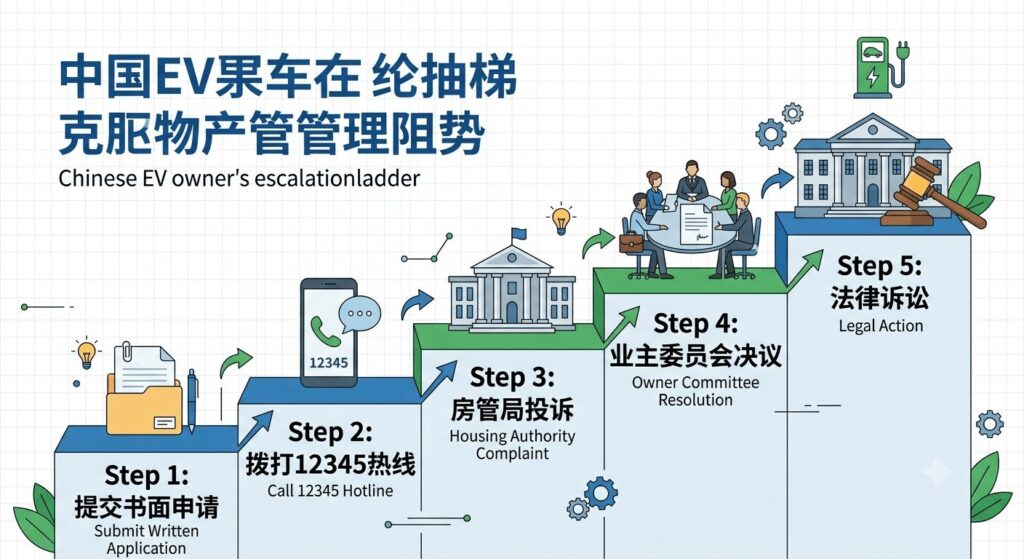
The complete escalation ladder applied to 物业 HOA obstruction:
As covered in our legal loopholes guide, the formal escalation mechanisms available when persuasion fails follow a sequence that this guide expands with specific detail on how each mechanism operates in practice:
Mechanism 1: The Written Formal Application
This has been covered extensively in our legal loopholes guide but warrants specific elaboration in the context of building a legal record for potential subsequent litigation:
The formal written application is not only a practical step — it is also the foundation of the legal record that subsequent escalation and potential litigation will rely on. Every element of the written application should be considered with this dual purpose in mind:
Date and delivery proof: The application date and proof of delivery to 物业 establishes the start of the regulatory processing clock. Use registered mail with delivery confirmation, in-person delivery to 物业 office with signed and stamped receipt, or delivery through the 物业’s official digital channel with time-stamped confirmation. “I submitted it verbally two months ago” has no legal weight — “I submitted it by registered mail on [date] as evidenced by the delivery confirmation” has full legal weight.
Regulatory reference specificity: Name the specific provision — not “the relevant regulation” but “Guangzhou Municipality’s specific implementation guidance issued [reference number] establishing a [X]-working-day processing timeline, and NDRC’s guidance on residential EV charging infrastructure dated [reference].” This specificity demonstrates regulatory knowledge that inhibits 物业 from claiming the deadline doesn’t apply.
Technical specification completeness: Include complete technical specifications for the proposed installation — charger model and 3C certification reference number, proposed electrician’s qualification certificate number, proposed circuit specification. A technically complete application that 物业 cannot cite for missing information removes their most common basis for delay.
Mechanism 2: The 12345 Complaint — More Powerful Than Most Owners Realise
The 12345 Government Service Hotline complaint, described in our legal loopholes guide, deserves specific elaboration on why it is so often the single most effective non-litigation escalation mechanism:
The institutional dynamics that make 12345 effective:
When a 12345 complaint about 物业 EV charging obstruction is received, the system routes it to the relevant local government authority — typically the Street Office (街道办) or District Housing Authority. This authority then:
Generates a formal enquiry to the specific 物业 management company referencing the complaint
Requires a formal response within a specified timeframe
Tracks the resolution outcome
For the 物业 management company, this creates a specific institutional dynamic that resident letters and verbal requests don’t: a formal government enquiry goes into the company’s regulatory record. 物业 management companies operate under licensing frameworks overseen by housing authorities, and accumulating formal regulatory enquiries — particularly on the same issue repeatedly — creates licence renewal risk that is a genuinely powerful motivator for compliance.
How to file a 12345 complaint that is maximally effective:
Provide the complaint with specific documentary evidence: date of written application with proof, specific 物业 response or documented non-response, specific regulation citing the applicable processing timeline. A complaint that can be resolved with a single letter from the housing authority is far more likely to generate that letter than a vague complaint that requires the authority to do investigative work.
Mechanism 3: The Housing Authority (房管局) Formal Complaint
Where the 12345 process produces a housing authority enquiry that 物业 fails to respond to adequately, the direct formal complaint to the District Housing Authority (区住房和建设局) represents the next level of formal engagement.
The specific evidentiary package for maximum effectiveness:
A formal housing authority complaint should include:
- Complete chronological record of all 物业 interactions with dates and documentation
- Copy of the original written application with delivery proof
- All written responses from 物业 (or documented evidence of non-responses)
- Reference to the specific regulatory provision establishing the processing obligation
- Evidence of the 12345 complaint and its outcome (or lack of outcome)
- A specific request for formal inspection of the 物业 management company’s compliance
This package demonstrates that the complaint is not a first-resort escalation but a properly-processed formal complaint after reasonable direct engagement — housing authorities respond more seriously to well-documented formal complaints than to initial complaint filings without a documented direct engagement history.
Mechanism 4: The Owner Committee (业委会) Formal Resolution
For compounds with an active 业委会, a formal 业委会 resolution directing 物业 to process the EV charging application within a specified timeframe represents a different type of institutional pressure — the 物业’s own contractual principal directing compliance.
The 业委会’s contractual leverage:
The 物业 management company’s contract is with the owner community, represented by the 业委会 where one exists. A formal 业委会 resolution:
Creates a contractual directive that 物业 must comply with or face breach of contract consequences
Provides a basis for non-renewal or termination of the 物业 management contract if persistent non-compliance continues
Shifts the institutional dynamic from “a resident is complaining” to “the 物业’s contractual client is directing compliance”
Activating the 业委会:
Bringing the EV charging obstruction issue to the 业委会 requires either:
Direct contact with 业委会 members (whose names and contact information should be publicly posted in the compound or available from the housing authority)
Formal request to the 业委会 for an agenda item at the next regular meeting
If multiple residents are affected, a collective petition to the 业委会 requesting emergency consideration
The Legal Action Pathway — When All Else Fails
The Realistic Assessment of EV Charging Litigation in China
First, the honest framing of litigation as a tool:
Legal action against 物业 management companies for EV charging obstruction is neither as common nor as straightforward as social media discussions sometimes suggest, nor is it as difficult or as inaccessible as the institutional dynamics might make it appear. The realistic picture is:
A small but growing number of Chinese courts have handled EV charging obstruction cases, producing a developing body of case law that is more favourable to residents than to 物业 in most documented decisions.
The litigation process is time-consuming (typically 6-18 months from filing to judgment in first-instance courts), financially modest in direct cost for straightforward cases (court filing fees are calculated on the claimed amount and are low for this category of claim), and emotionally demanding in ways that should be considered alongside the financial and legal analysis.
Litigation should be pursued after the non-litigation mechanisms above have genuinely been exhausted — not as a first resort but as a last resort when documented evidence of institutional non-compliance makes the litigation outcome predictably favourable and the alternatives genuinely exhausted.
The legal theories available:
Legal theory 1: Contract-based claim (违约之诉)
The 物业 management contract between 物业 and the owner community creates obligations on 物业 to provide property management services in accordance with applicable laws and regulations. If 物业’s refusal to process the EV charging application violates applicable regulatory requirements (the processing timeline, the obligation not to unreasonably obstruct compliant applications), this may constitute breach of the management contract.
Standing: Individual owners have standing to assert contract-based claims against 物业 as third-party beneficiaries of the management contract in many Chinese jurisdictions.
Available remedy: Contractual compliance orders, declaratory relief confirming the owner’s right to installation approval for a compliant application, potentially damages for documented financial loss caused by the obstruction.
Legal theory 2: Property rights infringement (侵权之诉)
Under Civil Code Articles 240 and 241, owners have the right to use their property within the scope of applicable laws and the property’s functional purpose. An owner with a designated parking space using that space for EV charging installation is exercising a legitimate property right.
物业’s interference with this legitimate property right, where the interference is not justified by the specific safety or capacity concerns that the regulatory framework authorises, may constitute a civil property rights infringement.
Standing: Direct standing for the individual affected owner.
Available remedy: Cessation of interference (the practical equivalent of requiring 物业 to approve the installation), declaratory relief, damages for financial loss.
Legal theory 3: Administrative complaint-driven enforcement
Rather than civil litigation between the resident and 物业, an alternative approach involves administrative enforcement: the resident files a formal administrative complaint with the housing authority or market regulation authority, which then exercises its own enforcement authority against the non-compliant 物业.
This approach transfers the legal burden from the resident (who must fund litigation) to the relevant administrative authority (which has its own enforcement resources) and may be faster and lower-cost than civil litigation — but depends on the administrative authority’s willingness to exercise enforcement, which varies by jurisdiction and by specific inspector.
The documented case law — what Chinese courts have actually decided:
The developing body of Chinese court decisions on EV charging obstruction cases has produced outcomes generally favourable to residents in cases where:
The resident’s application was for a compliant installation meeting applicable safety and technical standards
The 物业’s refusal was without substantiated technical grounds
The resident had followed the proper application process and documented the refusal
The applicable regulatory timeline had been exceeded without justified cause
Courts have ordered 物业 to approve installation applications, ordered 物业 to cease interference with residents’ charging activities, and in some cases awarded modest damages to residents who suffered documented financial harm from the obstruction (additional public charging costs incurred during the period of obstruction, for example).
Courts have been less favourable to residents in cases where:
The proposed installation genuinely raised technical safety concerns that the resident hadn’t addressed
The resident skipped the formal application process and proceeded to install without 物业 involvement
The claim was based primarily on general dissatisfaction rather than documented specific regulatory violation
The Litigation Process — What It Actually Involves
The Specific Steps for Residents Considering Legal Action
Step 1: Evidence consolidation
Before consulting a lawyer or filing any court documents, compile the complete documentary record:
All written applications with proof of delivery and dates
All written responses from 物业 (or documented evidence of non-responses)
Record of all verbal communications (date, 物业 staff name if known, substance of communication)
Regulatory provisions establishing the applicable obligations
Expert assessment from a licensed electrician confirming the installation’s technical compliance (this is important evidence that the refusal was not justified by genuine safety concerns)
Financial records documenting any additional cost incurred due to the obstruction (public charging fees during the obstruction period)
Photographic documentation of the parking space and building to establish the factual context
Step 2: Legal consultation
For EV charging obstruction cases, the relevant legal expertise combines property law, civil procedure, and some familiarity with the specific regulatory framework for EV charging. In major Chinese cities:
Legal aid organisations (法律援助中心) may provide free initial consultation for residents who meet income thresholds — worth exploring given the financial profiles of many residents facing 物业 obstruction
Consumer rights legal organisations have developed specific experience in this category of case as EV adoption has grown
Private lawyers specialising in property disputes — common in major cities — can typically assess the strength of a case in a one-hour paid consultation that is worth the cost for knowing whether litigation is realistic before committing to the process
Step 3: Pre-litigation mediation
Chinese civil procedure encourages pre-litigation mediation, and some courts require a mediation attempt before accepting certain categories of civil filing. For EV charging obstruction cases, pre-litigation mediation through:
The Dispute Resolution Committee of the 物业 management association (if one exists in your city)
Community-level mediation through the Street Office (街道办)
People’s Mediation Commission (人民调解委员会)
…can sometimes resolve cases more quickly than full litigation, particularly if mediation occurs after the resident has filed a formal complaint that demonstrates willingness to pursue the full legal process.
Step 4: Court filing
Civil cases against 物业 management companies are typically filed at the Basic People’s Court (基层人民法院) in the district where the compound is located. The filing requires:
Civil complaint (民事起诉状) specifying the parties, facts, legal basis, and specific relief requested
Evidence package (证据清单) with all documentary evidence indexed and submitted
Court filing fee payment (诉讼费, calculated on the claimed amount — typically low for this category of case)
Step 5: Court process
Chinese civil procedure in first-instance cases typically involves:
Case acceptance and defendant notification
Exchange of evidence and responses between parties
Court hearing (庭审) — typically one or more hearing sessions
Judgment (判决书) — typically within 6 months of filing for straightforward cases
The realistic litigation timeline:
From filing to first-instance judgment: 6-12 months
If 物业 appeals to intermediate court: additional 3-6 months
Step 6: Enforcement
If the court judgment orders 物业 to approve the installation, and 物业 fails to comply voluntarily, the judgment can be enforced through:
Application for compulsory execution (申请强制执行) to the court’s execution department
Inclusion of non-compliant 物业 on court’s enforcement defaulter list (失信被执行人名单) — a significant sanction that Chinese courts take seriously and that 物业 management companies have strong incentive to avoid
The Cost-Benefit Calculation — Is Litigation Worth It?
The Honest Financial and Practical Assessment
Direct litigation costs:
Court filing fees: typically ¥100-¥500 for the amounts involved in EV charging disputes
Lawyer fees: ¥5,000-¥20,000 for straightforward property dispute cases in major cities (varies significantly by city and lawyer)
Lost time: significant personal time investment in documentation, consultations, hearings
The damages recovery:
Chinese courts in EV charging obstruction cases have generally not awarded substantial damages — the primary relief has been compliance orders rather than financial compensation. The financial case for litigation purely as a damage recovery mechanism is weak.
The non-financial value:
The compelling reasons to pursue litigation in appropriate cases are primarily non-financial:
The principle that 物业 does not have legitimate authority to obstruct compliant installation — a principle worth asserting through the legal system in documented cases where the obstruction is clear
The precedent value — in compounds where multiple residents are affected, a successful court judgment establishes a precedent that benefits the full affected community
The deterrence value — a documented court judgment against a specific 物业 management company creates compliance pressure for that company across all compounds it manages
The honest threshold for recommending litigation:
Litigation makes practical sense when:
The non-litigation mechanisms (12345, housing authority formal complaint, 业委会 activation) have been genuinely exhausted with documented evidence
The 物业’s refusal is clearly non-compliant with applicable regulatory requirements (not a genuinely ambiguous technical question)
Multiple residents are affected, making the litigation’s precedent and community benefit proportionally larger
The resident has access to legal assistance (through legal aid or affordable property law specialist) that makes the lawyer cost manageable
The resident has the time and emotional capacity for a 6-12 month process
Litigation should not be pursued when:
Non-litigation mechanisms haven’t been tried or haven’t been tried with the documentary discipline that makes them effective
The 物业’s technical concerns are genuinely substantiated (in which case the appropriate response is addressing those concerns, not legal action)
The resident needs a charging solution quickly (litigation doesn’t produce quick outcomes)
Internal Links — Further Reading on Clean Energy Bazaar
The HOA obstruction how to sue or convince your property management in China guide is the legal depth companion to the apartment permissions and escalation guidance throughout this content cluster.
For the foundational apartment permissions guide covering the initial permission process and the basic escalation mechanisms this guide’s litigation content extends, our how to get permission to install a charger in a Chinese apartment the legal loopholes guide covers the complete permission and escalation framework. For the apartment EV charging solutions guide that covers the full regulatory background and major city provisions referenced throughout this guide, our apartment EV charging solutions 2026 China HOA rules property manager permissions and fixed parking rights guide covers every regulatory pathway. For the Guangzhou flywire fix guide that covers the specific high-rise context where this guide’s legal mechanisms are most often needed, our flywire fix legal safe options for high-rise owners in Guangzhou guide covers the Guangzhou-specific application. For the dual-EV case study that demonstrates what successful 物业 navigation looks like in practice, our case study Shanghai family with two EVs BYD and Tesla charging setup in a high-rise guide covers the complete real-world implementation. For the professional installation costs guide covering what the installation looks like once 物业 approval is finally obtained, our professional EV charger installation costs 2026 what State Grid chargers vs private companies charge guide covers every installation cost component. And for the local rebates guide confirming the subsidy value that makes overcoming 物业 obstruction financially worthwhile, our local utility rebates for EV charging 2026 Shenzhen Shanghai Beijing guide covers every available programme.
Final Thoughts
The HOA obstruction how to sue or convince your property management in China landscape, honestly assessed, is one where the legal framework increasingly favours residents with designated parking spaces who want compliant EV charging installation — not because Chinese courts are uniformly sympathetic to EV owners, but because the regulatory framework that has developed over the past five years has progressively defined and constrained 物业’s legitimate authority in ways that make legally-grounded obstruction increasingly difficult for 物业 to sustain.
The persuasion-first approach this guide advocates is not a concession to institutional power that residents should accept — it is a strategically rational approach to resolving the majority of cases faster and at lower cost than formal escalation or litigation, while preserving the formal mechanisms for the cases where persuasion genuinely doesn’t work.
The escalation ladder — written formal application, 12345 complaint, housing authority formal complaint, 业委会 activation — resolves the substantial majority of cases that persuasion doesn’t resolve, without requiring the time, cost, and emotional investment of litigation.
The litigation pathway, while genuinely a last resort, is a real and documented pathway with real precedent outcomes that have ordered 物业 compliance in cases where institutional obstruction was clear and non-litigation mechanisms were exhausted. The growing body of case law in this area makes litigation increasingly predictable in outcome rather than a gamble — a welcome development for residents in the minority of cases where the legal route is genuinely necessary.
Your parking space is your property. Your right to charge your vehicle at home is established in Chinese law and in progressive municipal regulatory frameworks across the country’s major EV-adopting cities. The path to exercising that right runs through persuasion where possible, formal escalation where necessary, and ultimately through the courts when everything else has been genuinely exhausted and the obstruction continues without substantiated justification.
The law is on your side. Use it wisely, use it methodically, and use it when the situation genuinely requires it — having started with the persuasion and escalation approaches that resolve most situations without requiring it at all.