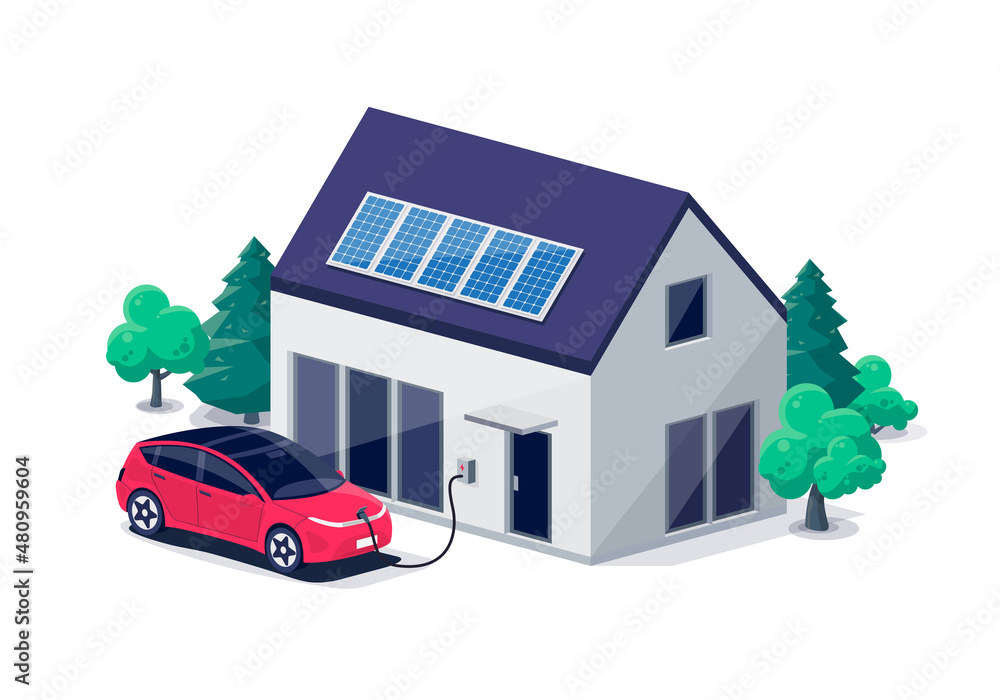
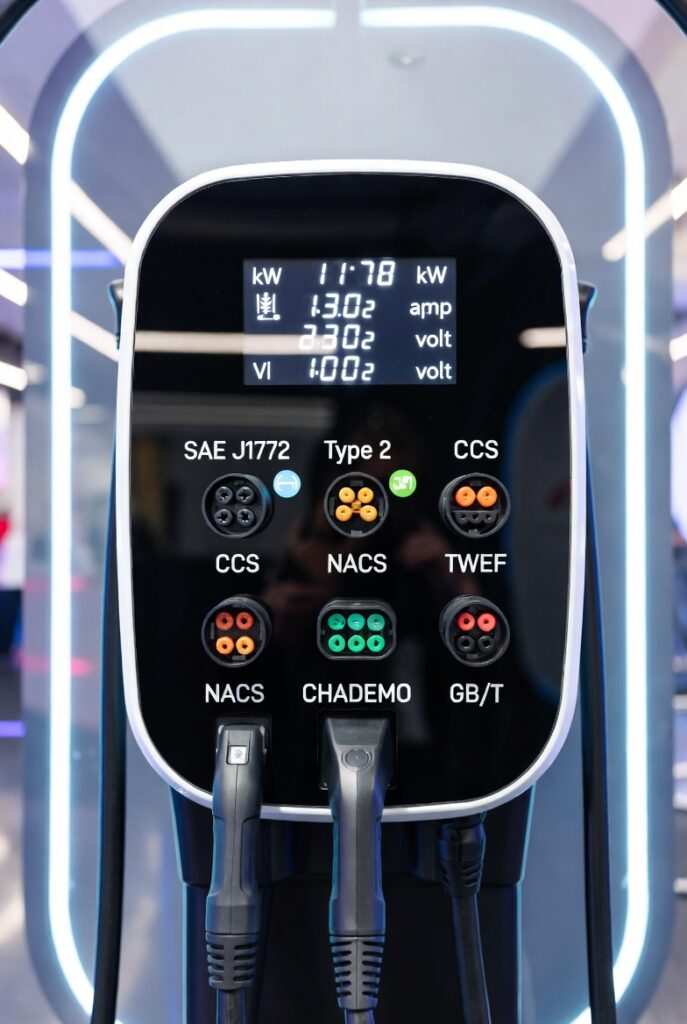
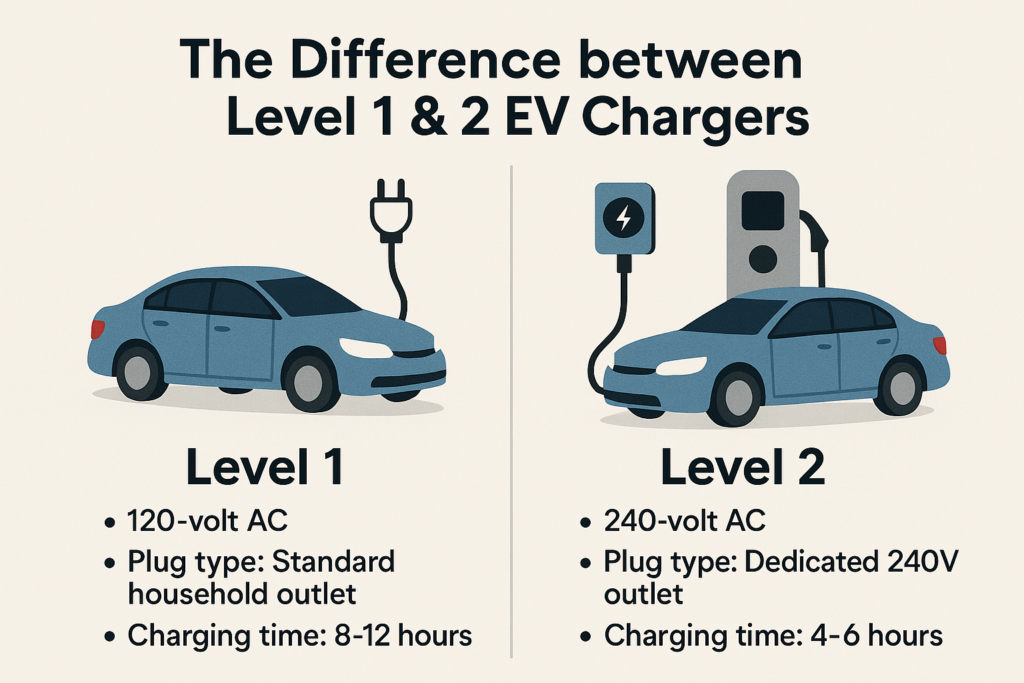
Here is the moment that many Chinese EV buyers experience within the first week of ownership.
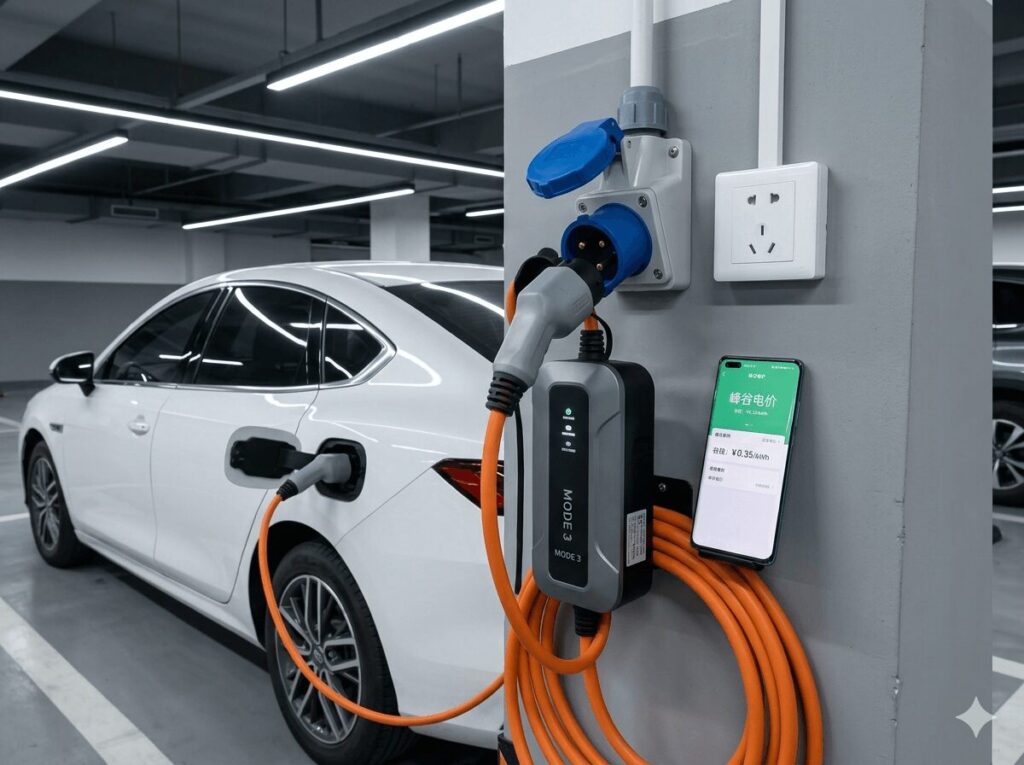
The car is delivered. The Mode 2 cable is in the boot — the portable charging cable that came with the vehicle. They drive home to their apartment in a residential compound in Chengdu, Shanghai, or Shenzhen. They have a parking space in the underground car park. They plug the Mode 2 cable into the standard socket near their space.
The car begins charging. Slowly — very slowly. At 2.3 kW from a standard 220V socket, it adds approximately 12-13 km of range per hour. For a driver covering 50 km daily, they need nearly 4 hours of charging. That works — barely.
But then they start thinking about a proper home charger. A 7 kW unit. Level 2 charging that fills the car in 6-8 hours overnight. They start researching the 物业 approval process. They discover it takes 4-12 weeks. They need a separate electricity meter application from the utility. They need a licensed electrician. They need to choose a brand from an approved list.
And they think: is there a faster path? Can they get 7 kW charging from a portable unit that plugs into a socket without going through the entire approval process?
This guide on portable vs hardwired home EV chargers best options for Chinese apartment dwellers answers that question honestly — covering what portable charging in China actually delivers, what hardwired charging requires and delivers, which scenario justifies the 物业 approval process, and the specific products that serve Chinese apartment dwellers in each scenario.
The Fundamental Distinction — What Portable and Hardwired Actually Mean
Before comparing options, clarifying what portable and hardwired mean in the Chinese residential context prevents the confusion that most online guides create by using these terms inconsistently.
Portable EV Charger (Portable EVSE / 随车充 / 便携式充电设备)
A portable EV charging unit is a self-contained device that:
- Plugs into an existing electrical socket on one end
- Connects to the vehicle’s GB/T charging port on the other end
- Requires no installation — no electrician, no dedicated circuit, no 物业 approval for the device itself
- Can be carried in the vehicle and used at different locations
The socket it plugs into determines the charging speed:
- Standard 220V socket (16A): up to 3.5 kW → approximately 18-19 km range per hour
- Dedicated 32A commando socket (32A): up to 7 kW → approximately 38-40 km range per hour
Critical distinction: The portable EVSE itself requires no 物业 approval — but if you want to install a new 32A dedicated socket specifically for faster portable charging, that socket installation DOES require 物业 approval and a licensed electrician.
Types of portable chargers in the Chinese market:
- Mode 2 EVSE (随车充): The cable included with the vehicle. Plugs into a standard 220V socket. Usually rated 10A-16A (2.2-3.5 kW). Limited to standard socket speeds.
- Mode 3 portable EVSE: A higher-quality portable unit that can plug into various socket types — standard 220V, 32A commando, or CEE sockets — delivering up to 7 kW from an appropriate socket.
Hardwired EV Charger (固定式充电桩 / 壁挂式充电桩)
A hardwired EV charger is a permanently installed unit that:
- Is wired directly to a dedicated electrical circuit — no plug
- Requires professional installation by a licensed electrician (持证电工)
- Requires 物业 approval for the electrical work and the dedicated meter
- Requires a separate electricity meter application from the utility (国家电网 or 南方电网)
- Stays at the property — cannot be moved when you change vehicles or move homes
- Delivers consistent 7 kW charging from a dedicated circuit
The two variants of hardwired installation:
- Socket-type hardwired: A 32A commando socket installed permanently — the portable EVSE then plugs into it. Technically hardwired (the socket requires installation) but the charger unit itself remains portable.
- Integrated hardwired charger: A complete charger unit with built-in electronics, display, and smart features permanently wired to the dedicated circuit. The most common “home charger” product in the Chinese market.
The Chinese Apartment Charging Decision Tree
The right choice between portable and hardwired depends on five factors that interact differently for different Chinese apartment owners:
Factor 1: Do you own or rent your parking space? Owners have stronger grounds for 物业 approval and permanent installation. Renters face additional barriers from space owners.
Factor 2: How long is your planned residence? Moving in 12 months means portable charging’s flexibility is more valuable. Staying 5+ years means hardwired pays back.
Factor 3: What is your daily driving distance? Under 40 km daily: standard socket portable charging is potentially adequate. Over 60 km daily: 7 kW charging becomes more important.
Factor 4: Does your parking space already have a 32A socket? If yes: you can achieve 7 kW charging from a portable EVSE without any 物业 process.
Factor 5: Has your 物业 already installed collective charging infrastructure? If yes: use the shared infrastructure — potentially the best solution requiring no individual approval.
Scenario Analysis — Which Approach Fits Your Situation
Scenario 1: You Own Your Parking Space, Long-Term Residence (3+ Years)
This is the classic hardwired installation scenario. You have the strongest case for 物业 approval, the longest time horizon to benefit from the investment, and the most compelling financial case for the one-time installation cost.
The hardwired financial case:
Annual TOU saving from 7 kW smart hardwired charger vs standard-socket portable:
- 7 kW hardwired with TOU scheduling: ¥1,385/year (valley rate)
- Standard socket portable (3.5 kW, plugged in immediately, no TOU): ¥2,600/year (blended rates)
- Annual saving: ¥1,215/year
Hardwired installation cost (typical Shanghai apartment):
- Smart 7 kW charger: ¥1,200
- Installation + meter: ¥2,000
- Total: ¥3,200
- Payback: 2.6 years
After payback, the hardwired charger saves ¥1,215/year over standard-socket portable charging — approximately ¥3,645 over the next 3 years (years 3-5 of ownership).
Recommendation: Pursue hardwired installation. Start the 物业 process now — allow 4-12 weeks. While waiting, use the included Mode 2 cable from the standard socket.
Best hardwired charger for this scenario: → StarCharge S Series smart 7 kW (¥899-¥1,299) for most owners → Xiaomi EV Charger (¥1,299-¥1,999) for Xiaomi Mi Home users → NIO/BYD/Xpeng manufacturer charger for brand ecosystem integration
Scenario 2: You Own Your Parking Space, Planning to Move in 12-18 Months
The portable-first, hardwired-later approach.
Installing a hardwired charger for 12-18 months of use before moving reduces the payback opportunity. However, completely avoiding a dedicated supply is also inefficient if 12-18 months of standard-socket charging is costly.
The optimal approach for this scenario:
Phase 1 (now): Apply to 物业 for permission to install a 32A commando socket only — not a full charger unit. A socket installation is simpler, cheaper, and more likely to be approved quickly than a full charger installation. A 32A commando socket with a Mode 3 portable EVSE delivers 7 kW charging — identical speed to a hardwired charger.
Why this is better:
- Simpler 物业 process (socket vs charger)
- Lower installation cost (socket: ¥800-¥1,500 vs full charger: ¥2,000-¥4,000)
- The portable EVSE goes with you when you move
- The socket adds value to the parking space (for the next owner or renter)
Phase 2 (new property): If staying 3+ years, install a full hardwired smart charger at the new property.
Best portable EVSE for 32A commando socket: → Mode 3 GB/T Portable EVSE with 32A commando plug: ¥400-¥900
Scenario 3: You Rent Your Parking Space, Long-Term Residence
The negotiated installation scenario.
You don’t own the parking space — you rent it from another owner. Installing a hardwired charger requires:
- Space owner’s written permission
- 物业 approval
- Separate electricity meter
The negotiation approach: Contact the space owner with a specific proposal:
- You will pay 100% of the installation costs
- You will leave the installation in place when your lease ends — adding value to their space
- You propose a 32A socket installation (simpler than a full charger unit — easier to agree)
- You offer to share the improved charging capability at a premium on your space lease renewal
Many space owners in Chinese residential compounds are cooperative if they understand the value-add nature of the request. Frame it as a property improvement, not a modification request.
If space owner refuses: → Use the compound’s shared charging infrastructure if available → Use the included Mode 2 cable from a standard socket → Rely primarily on public charging
If space owner agrees: → Same approach as Scenario 2 — 32A socket + portable EVSE
Scenario 4: You Rent Both Flat and Parking Space, Planning to Move Within 12 Months
The pure portable charging scenario.
No permanent installation is practical. The question is which portable charging option delivers the best daily charging experience.
If your space has a standard 220V socket:
- Mode 2 EVSE at 3.5 kW: adequate for under 45 km daily driving
- A better Mode 3 EVSE with a 16A plug (rated for 3.5 kW): delivers more reliable charging than the included Mode 2 cable
If your space has a 32A commando socket (pre-existing from a previous occupant’s installation):
- Mode 3 EVSE at 7 kW: full Level 2 speed without any installation
- Check with 物业 whether using the existing socket is permitted under your lease/parking terms
If your space has no socket of any kind:
- Apply to 物业 for permission to install a standard 220V outdoor socket near your space (the minimum approval requirement — much simpler than a full charger installation)
- A standard socket installation costs ¥200-¥500 and is often approved quickly
Scenario 5: Your Compound Already Has Collective EV Charging Infrastructure
The simplest scenario — use what exists.
Many newer Chinese residential compounds (post-2020 construction) have collective EV charging infrastructure installed in the car park by the 物业 or a third-party operator. These are public-access chargers within the compound — available to all residents with a payment app.
How to check: Look for charging stations in your compound’s car park. Check your compound’s app or notice boards. Ask 物业 directly.
If collective charging is available:
- Typical charging cost: ¥0.80-¥1.50/kWh (more expensive than dedicated home installation at valley rates)
- No installation required — scan QR code, charge, pay through app
- Available to all residents regardless of parking space ownership
The financial comparison:
Collective compound charging at ¥1.00/kWh vs dedicated home installation at valley rate ¥0.34/kWh: Annual additional cost: 4,073 kWh × (¥1.00 – ¥0.34) = ¥2,688/year more expensive
For long-term residents: the dedicated installation cost (¥3,200) versus ongoing collective charging premium (¥2,688/year) makes dedicated installation pay back in 1.2 years for 20,000 km/year drivers.
For shorter stays or lower mileage: collective charging at ¥1.00/kWh may be more economical than installation when the stay is under 18 months.
The Chinese Apartment Portable EVSE Options — What Actually Works
Option 1: The Included Mode 2 Cable (随车充 — 免费)
What it is: The portable charging cable included with every new Chinese EV. One end: standard 220V plug (10A or 16A). Other end: GB/T Type 2 connector.
Power delivered:
- 10A version (most common): 220V × 10A × 0.9 = 1.98 kW → approximately 10-11 km/hour
- 16A version (some manufacturers): 220V × 16A × 0.9 = 3.17 kW → approximately 16-17 km/hour
Cost: ¥0 — included with vehicle
The honest assessment: For a BYD Dolphin driver covering 40 km daily — daily energy replacement needed: approximately 7.3 kWh.
At 1.98 kW (10A Mode 2): 7.3 ÷ 1.98 = 3.7 hours to replace daily driving At 3.17 kW (16A Mode 2): 7.3 ÷ 3.17 = 2.3 hours to replace daily driving
Both are feasible with overnight parking of 8+ hours. For drivers covering under 40-50 km daily, the included Mode 2 cable is genuinely adequate for daily energy replacement — not comfortable, but functional.
The real limitation: The included Mode 2 cable draws sustained current from a standard Chinese residential socket that is typically not designed for 8-10 hour sustained high-current draw. Chinese standard sockets (16A rated) used for sustained EV charging can overheat if the socket contacts are worn or the wiring is undersized. This is a genuine safety concern — not theoretical.
The safety check before using Mode 2 overnight:
- Check that the socket appears in good condition — no discolouration, no physical damage
- After 30 minutes of charging, touch the plug and socket — if warm (not hot), acceptable. If hot, stop immediately
- Never use a power strip or extension cord with Mode 2 EV charging
When Mode 2 is adequate:
- Daily driving under 40 km
- Socket in good condition
- Short-term solution while 物业 process progresses
- Emergency charging when other options unavailable
When Mode 2 is not adequate:
- Daily driving over 60 km
- Vehicle with large battery (BYD Han EV, NIO ET5) where daily consumption requires more than available overnight charging time
- Long-term daily charging solution (socket wear and safety concerns)
Option 2: Upgraded 16A Mode 3 Portable EVSE (升级版便携充电器)
What it is: A higher-quality portable charging unit — not the included cable but a purpose-built portable EVSE. Same 16A plug as the included Mode 2 cable but with:
- Built-in RCCB (residual current circuit breaker) protection
- Temperature monitoring
- Higher-quality cable construction
- Some smart features (scheduling, monitoring)
Power delivered: 220V × 16A × 0.9 = 3.17 kW → approximately 16-17 km/hour
Cost: ¥300-¥800
The honest improvement over included Mode 2:
- Safety: Built-in RCCB protection is a meaningful safety improvement over the typically basic protection in included cables
- Reliability: Better cable construction and connector quality
- No speed increase: Still limited to 3.17 kW from a 16A socket — same speed as a good 16A Mode 2 cable
Recommended products:
BESEN BP-1105 (倍思充):
- Price: ¥350-¥500
- Power: 3.3 kW (16A, 220V)
- Features: RCCB protection, LED status indicator, IP55
- Cable: 5m
- Best for: Chinese apartment owners wanting safer 16A portable charging than the included cable
Pilot-EV Portable EVSE:
- Price: ¥400-¥650
- Power: 3.3 kW (16A)
- Features: Built-in protection, temperature monitoring
- Best for: Safety-conscious upgrade from included Mode 2
When this is the right choice:
- You need safer, more reliable 16A portable charging
- Standard socket is your only available option
- Daily driving is under 50 km and 16A speed is adequate
- You want built-in safety protection that the included cable doesn’t provide
Option 3: 32A Commando Socket + Mode 3 Portable EVSE (32A便携充电方案)
What it is: The most powerful portable charging solution available for Chinese apartment owners. A 32A commando socket is permanently installed at the parking space (requires 物业 approval and electrician for the socket) — then a portable Mode 3 EVSE plugs into it for 7 kW charging.
Power delivered: 220V × 32A × 0.88 = 6.2 kW (effective) → approximately 32-34 km/hour → approximately 256-272 km range added overnight (8-hour charge)
Cost:
- 32A socket installation: ¥800-¥1,500 (electrician + materials)
- Mode 3 portable EVSE: ¥400-¥1,200
- Total: ¥1,200-¥2,700
Comparison with full hardwired charger:
- Full hardwired smart charger installation: ¥3,000-¥5,000
- 32A socket + portable EVSE: ¥1,200-¥2,700
- Saving: ¥1,300-¥2,300
The practical difference between 32A portable and hardwired:
- Speed: Identical — both deliver approximately 6-7 kW
- Smart features: The portable EVSE typically has fewer smart features than a dedicated hardwired unit. Some portable EVSEs have app control and scheduling; most are simpler.
- Convenience: Hardwired charger has a permanently mounted cable management system. Portable requires connecting/disconnecting a separate cable.
- Portability: The portable EVSE goes with you when you move. The socket installation stays.
This is the optimal solution for Chinese renters who can negotiate a socket installation — or for owners who want faster approval (socket only vs full charger installation).
Recommended 32A portable EVSE products for China:
Autel MaxiCharger Portable AC (奥创便携充电器):
- Price: ¥600-¥900
- Power: up to 7 kW (32A, 220V)
- Features: App control, TOU scheduling, energy monitoring
- Cable: 5m GB/T tethered
- IP Rating: IP55
- Best for: Chinese EV owners wanting smart features with portable flexibility
ChargeWay (充威) GB/T Portable 32A:
- Price: ¥400-¥700
- Power: 7 kW (32A)
- Features: Basic — indicator light, overtemperature protection
- Cable: 5m GB/T
- Best for: Budget-conscious portable 7 kW charging without smart features
BESEN BP-3307 Smart Portable:
- Price: ¥500-¥800
- Power: 7 kW (32A)
- Features: WiFi, app scheduling, energy monitoring
- IP Rating: IP55
- Best for: Affordable smart portable charging with TOU scheduling
Option 4: NIO/Manufacturer-Supplied Portable Charging Bag (蔚来随行充电宝)
Specific to NIO owners — and worth mentioning as a unique Chinese market product:
NIO’s “Power Bank” (移动充电车) programme provides mobile charging vehicles — vans with large battery capacity that can charge NIO vehicles at any location. This is not a portable EVSE but a service — a NIO Power Bank vehicle drives to your location, connects to your car, and provides an emergency charge.
Not a daily charging solution but a genuinely unique emergency charging service available to NIO subscription members that changes the range anxiety equation for NIO owners in ways relevant to apartment dwellers without good home charging access.
The Hardwired Charger Options for Chinese Apartments
When Hardwired Is Worth the Process
Hardwired installation at a Chinese apartment is worth pursuing when:
- You own your parking space (strongest position for 物业 approval)
- You plan to stay 3+ years (payback period is within ownership horizon)
- You drive more than 50 km daily (where 7 kW makes meaningful time difference vs 3.5 kW)
- You want smart features (TOU scheduling, ecosystem integration) that portable EVSEs don’t provide as comprehensively
- You have or plan solar panels (solar integration requires hardwired smart charger)
The 物业 Process Reality Check
The most common reason Chinese EV owners abandon hardwired installation pursuit is the 物业 process difficulty. Here is an honest assessment:
物业 processes vary enormously:
Easy compounds (newer developments, 2018+):
- Pre-installed electrical infrastructure at each parking space
- Established approval process — standard documents, clear timeline
- Approval in 2-4 weeks
- Installation straightforward
Moderate compounds (2010-2018 construction):
- Cable routing required through compound infrastructure
- 物业 approval takes 4-8 weeks
- Dedicated meter application adds 3-6 weeks
- Manageable with patience
Difficult compounds (pre-2010, older 物业):
- No EV charging policy established
- 物业 unfamiliar with process
- Multiple escalation steps potentially needed
- Timeline unpredictable — potentially 3-6 months
The escalation toolkit for difficult 物业: As covered in our find the right EV charger for your home China edition guide, national and local government policies support residential EV charging installation. Referencing these policies in writing to your 物业 typically accelerates the process.
Hardwired Charger Recommendation by Profile
Profile A: BYD owner, standard apartment, budget conscious → StarCharge Smart 7 kW (¥899-¥1,299) Reliable TOU scheduling, good service network, competitive price. No premium for features you don’t need.
Profile B: NIO owner, wants brand ecosystem → NIO Home Charger (¥0-¥1,500 via NIO programme) Use NIO’s managed installation programme — subsidised pricing + managed 物业 coordination reduces installation friction significantly.
Profile C: Xiaomi SU7 or Mi Home user → Xiaomi EV Charger (¥1,299-¥1,999) HyperOS integration and 小爱同学 voice control deliver ecosystem value that justifies the modest premium over StarCharge.
Profile D: Huawei ecosystem, plans for solar → Huawei Digital Power FusionCharge (¥1,800-¥4,500) AI energy management is most valuable within the Huawei ecosystem. The premium is justified for Huawei users with solar plans.
Profile E: Villa owner, three-phase supply, maximum specification → Ginlong Solis Smart 11 kW (¥1,500-¥3,200) or Schneider EVLink 22 kW (¥2,000-¥4,500) Premium hardware for premium installations.
The Speed Comparison — What Each Option Actually Delivers
For the most common Chinese EVs, here is what each charging option delivers overnight:
BYD Dolphin (44.9 kWh usable, 6.6 kW max AC)
| Charging Option | Speed | 8-Hour Overnight Range Added |
|---|---|---|
| Mode 2 cable (10A) | 1.98 kW | 48 km |
| Mode 2 cable (16A) | 3.17 kW | 77 km |
| 32A portable EVSE | 5.8 kW (car limit) | 140 km |
| 7 kW hardwired | 5.8 kW (car limit) | 140 km |
| Collective compound (7 kW) | 5.8 kW (car limit) | 140 km |
Insight: For the BYD Dolphin, 32A portable and 7 kW hardwired deliver identical speed — the car’s 6.6 kW AC ceiling is the limit. If you drive under 77 km daily, a 16A Mode 2 cable covers daily driving from overnight charging. Only drivers covering 77-140 km daily need the 7 kW option.
BYD Han EV (76.9 kWh usable, 6.6 kW max AC)
| Charging Option | Speed | 8-Hour Overnight Range Added |
|---|---|---|
| Mode 2 cable (10A) | 1.98 kW | 28 km |
| Mode 2 cable (16A) | 3.17 kW | 45 km |
| 32A portable EVSE | 5.8 kW (car limit) | 130 km |
| 7 kW hardwired | 5.8 kW (car limit) | 130 km |
Insight: For BYD Han EV owners with large batteries and typical commutes over 50 km, the 10A Mode 2 cable adds only 28 km overnight — insufficient. The 16A Mode 2 cable covers 45 km — marginal for a 50 km commuter. A 7 kW installation (or 32A socket) is genuinely necessary for comfortable daily charging of a Han EV.
NIO ET5 (75 kWh usable, 11 kW max AC)
| Charging Option | Speed | 8-Hour Overnight Range Added |
|---|---|---|
| Mode 2 cable (10A) | 1.98 kW | 29 km |
| Mode 2 cable (16A) | 3.17 kW | 46 km |
| 32A portable EVSE | 6.2 kW | 135 km |
| 7 kW hardwired | 6.2 kW (limited by circuit, not car) | 135 km |
| 11 kW three-phase hardwired | 9.68 kW | 212 km |
Insight: NIO ET5 owners getting maximum value from their 11 kW AC capability need three-phase supply — very rare in Chinese apartment buildings. Single-phase supply limits to approximately 6-7 kW regardless of car capability. The practical difference between 7 kW and 11 kW for NIO ET5 apartment owners is zero unless three-phase supply is available.
The Cost-Benefit Summary — Portable vs Hardwired
The Total Cost of Ownership Over 3 Years
Scenario: Shanghai apartment, BYD Han EV, 20,000 km/year
Option 1: Mode 2 cable (included, no additional cost)
- Hardware: ¥0
- Installation: ¥0
- Annual electricity (charging immediately, blended rates): ¥3,055
- 3-year total: ¥9,165
Option 2: 16A upgraded portable EVSE
- Hardware: ¥500
- Installation: ¥0
- Annual electricity (similar to Mode 2, slightly better if timed manually): ¥2,800
- 3-year total: ¥8,900
Option 3: 32A socket + portable EVSE
- Hardware (EVSE): ¥600
- Socket installation: ¥1,200
- Total hardware + installation: ¥1,800
- Annual electricity (7 kW charging, manual TOU timing via car timer): ¥1,385
- 3-year total: ¥5,955
Option 4: Full hardwired smart 7 kW charger (StarCharge)
- Hardware: ¥1,200
- Installation + meter: ¥2,000
- Total hardware + installation: ¥3,200
- Annual electricity (7 kW charging, automatic TOU scheduling): ¥1,385
- 3-year total: ¥7,355
Wait — why is Option 4 (hardwired) more expensive than Option 3 (32A socket + portable) over 3 years?
Because Option 3’s lower installation cost (¥1,800 vs ¥3,200) saves ¥1,400 upfront, and both achieve the same electricity rate through the 7 kW charging at valley rates. The difference is that Option 4’s smart scheduling delivers automatic TOU optimisation while Option 3 relies on the car’s built-in timer.
Over 5 years:
- Option 3 (32A socket + portable): ¥1,800 + (5 × ¥1,385) = ¥8,725
- Option 4 (hardwired smart): ¥3,200 + (5 × ¥1,385) = ¥10,125
Option 3 is cheaper over 5 years — the lower installation cost of the 32A socket approach is never fully recovered by the hardwired charger’s smart features if the car timer handles TOU scheduling adequately.
When does the hardwired smart charger become more cost-effective than 32A socket + portable?
When the smart charger’s features deliver additional savings over the car timer:
- In cities with dynamic pricing beyond fixed valley windows (additional ¥200-400/year)
- For vehicles without built-in TOU timers
- For owners who value automatic management over manual car timer configuration
For most Chinese EV owners with built-in car timers: The 32A socket + portable EVSE combination delivers nearly identical electricity costs to a full hardwired smart charger at approximately ¥1,400 lower installation cost. The financial case for the full hardwired charger rests on smart features, convenience, and future-proofing rather than electricity cost savings.
The Practical Charging Guide — Making the Most of What You Have
If You Currently Use Mode 2 Cable
Maximise Mode 2 safety and effectiveness:
- Use your car’s built-in charging timer to delay charging until 11pm — immediately capturing valley rate savings even at 3 kW. Annual saving from TOU timing at 3 kW vs immediate charging: approximately ¥500-¥700/year.
- Check socket condition monthly. After plugging in, check socket temperature after 30 minutes — should be room temperature, not warm. Hot socket = call electrician.
- Never use an extension cord. The sustained current draw of EV charging is not safe through standard domestic extension cords.
- Check your car manufacturer’s guidance on Mode 2 sustained use. Most manufacturers design Mode 2 cables for temporary/emergency use rather than daily overnight charging. Some recommend not using Mode 2 for more than 8 hours continuously.
If You Have 32A Socket + Portable EVSE
Maximise the setup:
- Set your car’s built-in timer for valley rates (11pm-8am typically). At 7 kW overnight on valley rates, the BYD Han EV charges 20-80% in approximately 5.5 hours — the entire charge completes within the valley window.
- Store the portable EVSE properly. Coil the cable loosely — tight coiling causes internal conductor stress and reduces lifespan. A cable reel or wall-mounted hook keeps it organised.
- Annual connector inspection. The GB/T connector experiences more wear with a portable EVSE than a permanently mounted unit because it’s handled more frequently. Inspect annually, clean contacts, apply dielectric grease.
If You Have a Hardwired Smart Charger
Do these on installation day:
- Configure TOU scheduling immediately — set the valley rate window for your city. Shanghai: 11pm-8am. Beijing: 11pm-7am. Chengdu: 11pm-7am. Check your electricity bill for your specific valley window. Annual saving: ¥1,670.
- Connect to smart home ecosystem if applicable — HarmonyOS for Huawei phone users, Mi Home for Xiaomi users. Takes 5 minutes, delivers convenience value immediately.
- Set departure time in both the charger app and your car’s own app. Coordinated departure-time scheduling optimises both vehicle pre-conditioning and charging completion timing.
The Renter’s Charging Strategy — Specific Guidance
Chinese renters face the most complex home EV charging situation. This section provides specific step-by-step guidance.
Step 1: Assess What Exists
Before doing anything, identify what electrical infrastructure exists at your parking space:
- Standard 220V socket (common in older compounds)
- 32A commando socket (present in some compounds from previous tenant installations)
- No socket at all (common in older underground car parks)
- Compound-wide shared charging points (increasingly common in post-2020 compounds)
Step 2: Map Your Options
| What Exists | What You Can Do | Cost | Speed |
|---|---|---|---|
| Standard 220V socket | Mode 2 charging immediately | ¥0 | 3.5 kW |
| 32A commando socket | Mode 3 portable EVSE | ¥400-¥900 | 7 kW |
| No socket | Apply for basic socket installation | ¥200-¥500 | 3.5 kW (16A) |
| Compound shared charging | Pay-per-use | ¥0 setup | 7 kW |
Step 3: Make Your Request to 物业
Frame the request appropriately for your specific situation:
Asking for permission to use an existing socket: Simple — most 物业 will agree to this with a polite written request confirming you will ensure electrical safety.
Asking for a new standard 220V outdoor socket near your space: Low-impact request — a single 16A socket is cheap and quick to install. Approval often faster than for a full charger.
Asking for a 32A commando socket: More significant request — requires dedicated circuit from distribution board. Frame as a long-term improvement to the parking space. Offer to leave it in place.
Asking for a full GB/T charger installation: The most complex request for a renter — you need space owner permission AND 物业 approval AND utility meter application. Consider whether the 32A socket approach (half the cost, simpler approval) serves your needs.
Common Questions from Chinese Apartment EV Owners
“Can I use my Mode 2 cable in the compound car park’s general-purpose sockets?”
You can technically — if there are accessible 220V sockets in the car park. Whether you’re permitted to depends on your compound’s rules. Some 物业 permit this with electricity cost recovery through a metered arrangement. Others prohibit it. Check with 物业 before using sockets not designated for EV charging.
“My compound has charging stations but they’re always occupied. What do I do?”
This is increasingly common in Chinese residential compounds where collective charging infrastructure hasn’t kept pace with EV adoption.
Options:
- Apply to 物业 for individual space installation — the occupied collective charging problem strengthens your case
- Reserve charging stations in advance through the operator’s app (many collective charging operators offer reservation features)
- Charge at off-peak times (late evening or early morning)
- Advocate collectively with other EV-owning residents for expanded compound charging infrastructure
“I’m moving in 6 months. Should I just use public charging until I move?”
For a driver covering 50 km daily: 6 months × (public charging cost ¥1.00/kWh – valley rate ¥0.34/kWh) × 2,037 kWh = approximately ¥1,344 in additional electricity costs versus home valley rate charging.
A 32A socket (¥1,200) + portable EVSE (¥600) = ¥1,800 installation, paid back in approximately 16 months.
For a 6-month stay: Pure public charging may be more economical than socket installation if you’re driving moderate mileage. For 20,000 km/year drivers, the calculation favours installation even for 6 months.
“My vehicle came with a Mode 2 cable but I want something better. What’s the minimum improvement?”
The minimum meaningful improvement over an included Mode 2 cable is an upgraded Mode 3 EVSE with built-in RCCB protection (¥300-¥500). Same speed but genuinely safer — the RCCB protection is the most important safety upgrade available.
The maximum improvement without any 物业 process is a 32A commando socket installation (requires electrician, some 物业 approval) + portable Mode 3 EVSE — delivering 7 kW at lower cost than a full hardwired charger.
Internal Links — Further Reading on Clean Energy Bazaar
Portable vs hardwired home EV chargers best options for Chinese apartment dwellers is the apartment-specific guide within the Chinese market content cluster.
For the complete home EV charger buying framework covering the 物业 process and all pre-purchase decisions, our find the right EV charger for your home China edition guide covers every decision. For the full hardwired charger comparison covering StarCharge, Autel, TELD, NIO, and BYD chargers that represent the hardwired options discussed here, our best home EV chargers 2026 top 7 comparison for Chinese homeowners Star Charge Autel guide covers every specification. For the smart feature value analysis that determines when hardwired smart chargers justify their premium over simpler options, our smart EV chargers 2026 AI load balancing vs standard features worth the extra cost in China guide provides the financial analysis. For the European equivalent of this guide — covering apartment charging solutions in UK and European markets that share similar building management challenges, our apartment EV charging solutions 2026 US Europe guide provides the international comparison. For the European portable charging options guide that covers the Juice Booster 2 and equivalent products in the Western market context, our portable vs hardwired home EV chargers US Europe guide covers the full comparison. And for the charge time data showing how long each charging option takes for specific Chinese EVs, our EV charge time calculator 2026 covers every model.
Final Thoughts
The portable vs hardwired home EV chargers best options for Chinese apartment dwellers question has different answers for different apartment dwellers — but the decision tree is clearer than most guides suggest.
The honest recommendations by situation:
You own your parking space, staying 3+ years, drive 50+ km daily: Start the 物业 hardwired installation process now. A StarCharge smart 7 kW hardwired charger with TOU scheduling pays back in under 3 years and saves ¥1,200+/year for the remainder of your stay. Use Mode 2 while waiting.
You own your parking space, moving in 12-18 months: Apply for a 32A commando socket (simpler approval than full charger). Add a portable Mode 3 EVSE (¥500-¥800). Delivers 7 kW charging at lower total cost than a full hardwired installation. Portable EVSE goes with you when you move.
You rent your parking space: Negotiate a 32A socket with space owner. If they agree, the 32A socket + portable EVSE delivers 7 kW charging at the lowest practical installation cost. If they refuse, upgraded 16A Mode 3 EVSE (¥300-¥500) from an existing socket is the best available option.
You have access to compound collective charging: Use it for high-mileage needs. Supplement with Mode 2 from your space’s socket for daily top-ups if accessible. Calculate whether your annual mileage justifies individual installation over collective charging cost.
You rent flat and space, planning to move within 12 months: Upgraded 16A Mode 3 EVSE (¥300-¥500) + your car’s built-in TOU timer. Captures safety improvement and partial TOU savings with zero installation and full portability.
The most financially impactful action regardless of which option you choose: configure TOU valley rate charging immediately — through your car’s built-in timer if no smart charger, through the charger app if you have one. This single action is worth ¥700-¥1,670/year depending on charging speed and captures the majority of the financial value available from any home charging setup.