Xiamen occupies a specific position in China’s EV charging maintenance landscape that no inland city can replicate: it combines South China’s monsoon humidity, the Taiwan Strait’s salt-laden sea air, subtropical temperatures, and the particulate load of a densely developed coastal urban environment into a single maintenance challenge that is genuinely more demanding than anything most Chinese EV charging guides address.
This is not hyperbole. The salt air corrosion mechanism that affects electrical equipment in coastal environments — documented by marine engineering communities, naval electronics maintenance standards, and coastal infrastructure operators worldwide — operates at an entirely different timescale and severity from the inland humidity corrosion that our general maintenance guide addressed. In inland Guangzhou or Wuhan, a charger with good IP65 protection might require meaningful connector inspection after 24-36 months of operation. In coastal Xiamen, particularly in properties within 2-5 kilometres of the Taiwan Strait coastline or the harbour areas, the same IP65 charger may require meaningful inspection within 12-18 months and show accelerated degradation that surprises owners who correctly read the IP rating specifications but didn’t understand that IP ratings don’t account for salt-laden air specifically.
This guide on rust dust and humidity maintaining your outdoor charger in coastal Xiamen provides the complete, Xiamen-specific maintenance framework — the specific corrosion mechanisms that coastal environments impose on EV charging equipment, the Xiamen climate profile that determines maintenance scheduling, the specific inspection procedures appropriate for coastal installations, the equipment choices that perform best in coastal conditions, and the realistic maintenance calendar that protects outdoor charging equipment through Xiamen’s full seasonal cycle.
Why Coastal Xiamen Is a Specific Maintenance Challenge
The Compound Environmental Factors That Define Xiamen’s Charging Equipment Stress Profile
Factor 1: Salt-laden marine air (海盐空气)
The Taiwan Strait’s sea salt aerosol — microscopic saline droplets and salt crystal particles suspended in the coastal air — represents the primary and most distinctive corrosion driver for Xiamen outdoor electrical equipment.
The specific chemistry:
Sea salt aerosol is not simply “salty air.” It is a complex mixture of sodium chloride (NaCl, the dominant component), magnesium chloride, calcium chloride, and various sulfate compounds that deposit on surfaces and, in the presence of moisture (which Xiamen’s humidity consistently provides), create a highly conductive electrolytic solution on metal surfaces.
This electrolytic solution drives electrochemical corrosion at rates dramatically faster than the atmospheric oxidation that operates in non-coastal environments. The corrosion mechanism is galvanic in character — differences in electrical potential between different metals in the charging connector (copper contacts, steel springs, aluminium housing components) create microscopic galvanic cells where the electrolyte (the saline surface film) allows current to flow, oxidising the less noble metal at the cell’s anode.
The distance gradient that Xiamen-specific guidance must acknowledge:
Salt aerosol concentration decreases with distance from the coastal source. This creates a meaningful maintenance gradient within Xiamen’s geography:
Highest salt exposure: Binhai properties along the Xiamen island waterfront, properties on Gulangyu island, properties in Siming district’s coastal areas, and anywhere within approximately 500 metres of the Taiwan Strait shoreline — these locations experience the most intense salt aerosol deposition and the most aggressive corrosion acceleration
Significant salt exposure: Properties 500 metres to 3 kilometres from the coastline, including most of Siming, Huli, and the coastal portions of Haicang and Jimei districts — significant but somewhat attenuated salt exposure that still requires coastal-specific maintenance attention
Moderate salt exposure: Properties 3-8 kilometres inland, including portions of Jimei and Xiang’an districts — noticeably more moderate than coastal locations but still meaningfully more aggressive than purely inland Chinese cities
Lower salt exposure: Properties 8+ kilometres from the coastline in Xiang’an’s interior areas — approaching general South China humid climate conditions without the specific coastal salt aerosol component
Factor 2: Monsoon humidity and rainfall (季风湿度和降雨)
Xiamen’s subtropical monsoon climate delivers:
Annual rainfall: approximately 1,200-1,400mm, concentrated in the May-September typhoon and monsoon season
Peak humidity: 80-90% relative humidity during the monsoon period
Even dry-season humidity: 60-70% relative humidity during Xiamen’s winter months — never truly dry in the way that northern Chinese cities experience genuine dryness
This combination of sustained high humidity and the salt aerosol electrolyte means corrosion can proceed year-round in coastal Xiamen, not just during monsoon season. The dry-season humidity remains sufficient to maintain the surface electrolyte film on salt-deposited surfaces.
Factor 3: Subtropical heat acceleration
As covered in our furnace city guide’s discussion of how heat accelerates corrosion chemistry, Xiamen’s subtropical summer temperatures (regularly 32-36°C, occasionally reaching 38°C) accelerate the electrochemical corrosion reactions that the salt-humidity combination drives. The temperature coefficient of corrosion — the rate at which corrosion accelerates per degree of temperature increase — means Xiamen’s summer combines the worst of multiple corrosion drivers simultaneously.
Factor 4: Typhoon mechanical stress (台风机械应力)
Xiamen’s position directly in the Taiwan Strait typhoon corridor means outdoor charging equipment periodically experiences extreme wind and rain events beyond any standard installation’s typical weather exposure assumptions. Typhoon-force winds can drive rain horizontally into enclosure seals, accelerate debris impact on cable and connector components, and stress the mechanical mounting provisions that vibration and wind load weren’t necessarily designed to handle continuously.
Xiamen has experienced multiple significant typhoons in recent years — events where sustained winds exceeding 80-100 km/h with heavy rainfall were not isolated worst-case scenarios but recurring annual events that outdoor charging equipment must withstand repeatedly.
The Corrosion Science — What Salt Air Actually Does to Each Component
Component-by-Component Corrosion Analysis for Xiamen’s Outdoor Chargers
GB/T Connector Contact Pins — The Most Vulnerable Component
The GB/T 20234.2/3 connector contacts are the most critical and most corrosion-vulnerable component in any outdoor EV charger installation. They are designed for mechanical engagement and electrical contact — functions that depend on maintaining clean, low-resistance contact surfaces that corrosion directly compromises.
The corrosion progression at connector contacts:
Stage 1 (0-6 months in high salt exposure zone):
Surface salt deposition begins accumulating on contact surfaces between charging sessions when the connector is hanging exposed. Visible as a faint white powdery residue that wipes off easily. Electrical contact resistance at this stage: minimal increase.
Stage 2 (6-18 months):
Salt deposition combined with humidity cycling begins forming a surface oxide layer on copper contacts, visible as slight discolouration (darker areas, greenish tint developing in areas of concentrated salt deposit). Electrical contact resistance: beginning to measurably increase. High-current charging sessions still function but may run slightly warmer at the contact points.
Stage 3 (18-36 months without adequate maintenance):
Significant oxide layer development on contact surfaces, visible as green or blue-green patina on copper contacts and rust-coloured deposits where steel components are exposed. Contact resistance: significantly increased, potentially causing connector heating above safe limits during high-current charging. At this stage, the warm-hand connector test (covered in our DIY guide and installation horror stories guide) will detect connector heating that indicates dangerous contact resistance elevation.
Stage 4 (36+ months without intervention):
Physical corrosion product buildup sufficient to mechanically interfere with connector engagement quality. Connector latching mechanism potentially compromised by corrosion of spring components. Electrical contact may be intermittent. This stage represents active safety hazard rather than gradual performance degradation.
Charger Enclosure — IP Rating Degradation Timeline
The IP65 rating that our weatherproof guide and maintenance guide consistently specify for South China humid climate installations was tested at the time of manufacture with new, compliant seals in optimal condition. The salt-air environment accelerates seal degradation through several mechanisms:
UV degradation: Coastal Xiamen’s subtropical UV exposure on south-facing outdoor surfaces degrades the elastomer seal materials (typically EPDM or silicone rubber) faster than shaded installations. UV creates free radicals in the polymer chains that reduce flexibility and seal compression effectiveness.
Thermal cycling stress: Xiamen’s seasonal temperature range (10-38°C) combined with the heating effect of direct sunlight (surface temperatures on sun-exposed charger housing reaching 50-60°C even when air temperature is 30°C) creates repeated thermal expansion and contraction that progressively fatigues seal materials.
Ozone degradation: Coastal environments have elevated ozone concentrations from sea-air photochemical reactions. Ozone is specifically damaging to natural rubber and EPDM seals, accelerating cracking and porosity development.
The combined effect: An IP65 seal that might maintain effective protection for 7-10 years in an inland sheltered installation may show measurable seal degradation within 3-5 years in a coastal Xiamen outdoor installation, reducing effective ingress protection from IP65 toward IP54 or lower without any visible external indication.
Mounting Hardware — The Often-Overlooked Corrosion Point
The bolts, screws, brackets, and wall anchors used to mount the charger to its installation surface are typically steel — either standard carbon steel (highest corrosion vulnerability), zinc-galvanised steel (moderate coastal environment resistance), or stainless steel (best coastal environment performance).
Standard carbon steel mounting hardware in coastal Xiamen outdoor installations has a documented lifespan before visible rust development of 12-24 months — after which the rust progression continues to structural weakening that can eventually compromise the charger’s secure mounting.
The specific safety concern: a charger mounting that has been weakened by corrosion of the fastening hardware is at risk of partial detachment or movement that stresses the cable entry points and potentially compromises the cable-to-charger connection integrity under wind loading — a risk that coastal typhoon events specifically amplify.
Cable Jacket — UV and Ozone Combined Attack
The cable jacket material (typically PVC for standard charger cables) is attacked by both UV radiation and coastal ozone simultaneously, with the two attack mechanisms compounding:
UV causes PVC plasticizer migration (the additive that keeps PVC flexible), making the jacket progressively stiffer and more brittle over time
Ozone directly attacks double bonds in PVC’s chemical structure, causing cracking to develop on the cable’s outer surface over time — the characteristic “ozone cracking” pattern that appears as fine cracks perpendicular to the direction of cable bending stress
In coastal Xiamen’s full UV + ozone environment, cable jacket degradation that might take 8-10 years in a sheltered inland installation can manifest as visible cracking within 3-5 years for cables exposed to direct sunlight and coastal air.
The Xiamen Seasonal Maintenance Calendar
Scheduling Maintenance Around Xiamen’s Specific Climate Cycle
Pre-typhoon season inspection (March-April)
Timing rationale: Before the May-September typhoon and peak monsoon period when mechanical stress and moisture exposure are most intense.
The specific pre-typhoon checks:
Mounting hardware integrity: Inspect all visible bolts and brackets for rust development. Any rust-affected mounting hardware should be replaced with A4-grade stainless steel equivalents (the highest corrosion-resistant grade commonly available) before the typhoon season rather than after, when post-typhoon access for inspection may be more difficult.
Cable entry point seal integrity: Examine where the cable enters the charger enclosure — this cable gland or entry seal is often the first point where IP rating protection begins to fail, as the dynamic nature of the cable (being handled, moved, and flexed during daily connect/disconnect cycles) stresses the seal differently from static enclosure seals.
Connector contact inspection: Conduct the visual inspection detailed in the procedure section below. Address any Stage 1 salt deposition before typhoon season drives more intensive corrosion cycling.
Mounting position review: Assess whether the charger position exposes it to wind-driven rain from the prevailing typhoon wind direction (typically from the south-southeast for Xiamen’s Taiwan Strait typhoons). If so, consider whether additional shielding can be added without compromising ventilation.
Post-monsoon thorough inspection (October-November)
Timing rationale: After the typhoon season has passed and peak monsoon intensity has reduced, this is the window for the year’s most comprehensive inspection — assessing the cumulative effect of the season’s most intense weather.
The specific post-monsoon checks:
Complete connector cleaning procedure (detailed below)
IP seal assessment for any moisture ingress evidence
Cable jacket complete inspection for crack development
Mounting hardware full assessment including any hardware removed for inspection of concealed corrosion
Electrical functional testing with RCD tester to confirm protection device integrity after season’s weather exposure
Mid-summer functional check (July)
Timing rationale: At peak summer heat intensity, confirming continued function under the combined thermal and humidity stress peak.
The specific mid-summer check:
Perform the warm-hand connector test after a 30-minute charging session specifically during a hot, humid Xiamen summer day — this is when connector contact resistance issues are most likely to manifest as detectable heating, because the thermal contribution of contact resistance is amplified by the already-elevated ambient temperature.
Check charger internal temperature indication through the app (available on Huawei FusionCharge and some other smart charger brands) to confirm the charger electronics are remaining within safe operating temperature range in Xiamen’s summer conditions.
Monthly salt deposition check (ongoing)
Timing rationale: Salt aerosol deposition in Xiamen’s coastal zone accumulates continuously, not only during specific seasonal events.
The monthly check (5-10 minutes):
Visual inspection of connector contact pins for white powdery residue indicating salt deposition. Any visible deposition warrants the connector cleaning procedure below — not waiting for the next scheduled quarterly inspection.
The Specific Maintenance Procedures for Xiamen Outdoor Chargers
Step-by-Step Technical Guidance for Each Maintenance Task
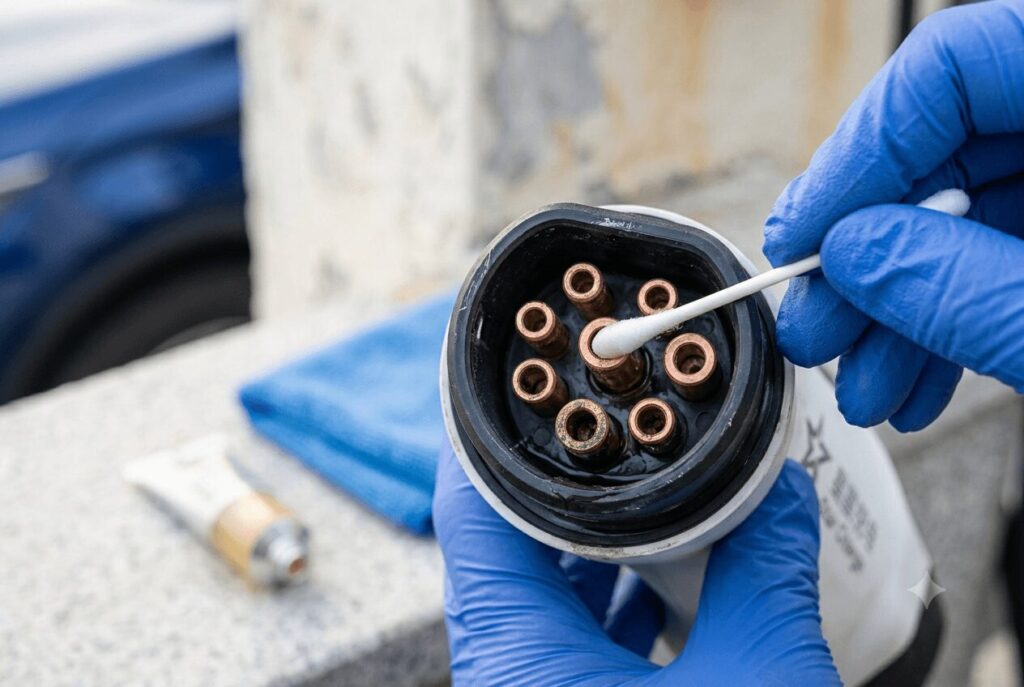
Procedure 1: Connector Contact Cleaning
Required materials:
- Isopropyl alcohol (IPA), minimum 99% purity (available at electronics suppliers, pharmacies) — ¥15-¥30 for 500ml
- Non-abrasive cotton swabs or lint-free wipes — not paper towels or standard cotton balls which leave fibres
- Dielectric grease (二极管润滑脂 or 电气接触润滑脂) — specifically formulated to protect electrical contacts while not interfering with conductivity — ¥20-¥50 for a small tube adequate for dozens of applications
- Torch or good lighting to clearly see contact surfaces
Procedure:
Step 1: Ensure the charger is powered off through its circuit breaker before any connector contact cleaning. Do not simply disconnect the vehicle — power down the dedicated EV charging circuit.
Step 2: Visually examine each contact pin in the GB/T connector under good lighting. Note any discolouration, powdery deposits (white = salt deposition, green/blue-green = copper oxide/salt combination, reddish = iron corrosion from connector body components), or visible roughness on contact surfaces.
Step 3: For Stage 1 deposition (white powdery residue, no surface discolouration): dampen a cotton swab with IPA and gently clean each contact pin with a rotating motion, using fresh swab sections for each pin. The IPA dissolves salt deposits without leaving residue.
Step 4: For Stage 2 deposition (surface discolouration developing): the IPA cleaning in Step 3 is still the first approach. If discolouration persists after IPA cleaning, very gentle cleaning with a clean pencil eraser (the white type, not the pink type that may leave abrasive residue) can remove surface oxide without damaging the contact surface for this stage of development. Do not use steel wool, metal polish, or abrasive pads — these remove protective plating along with the oxide.
Step 5: After cleaning, apply a very small amount of dielectric grease to each contact pin — less than a match-head size per pin. The grease creates a barrier that slows subsequent salt deposition while being thin enough not to interfere with electrical contact during charging.
Step 6: Power the circuit back on and confirm normal charging initiation.
Frequency in coastal Xiamen:
High salt exposure zone (within 500m of coastline): Monthly or after any significant salt spray event (following high wind from the sea direction)
Moderate salt exposure zone (500m-3km): Every 6-8 weeks
Lower salt exposure inland Xiamen: Quarterly, consistent with the general maintenance guide’s standard recommendation
Procedure 2: Mounting Hardware Assessment and Replacement
The replacement specification that Xiamen outdoor installations require:
Standard zinc-galvanised steel bolts are adequate for most Chinese outdoor electrical installations but are not adequate for Xiamen coastal outdoor installations. The replacement specification is:
Bolts: A4-316 stainless steel (316 grade contains molybdenum which provides superior chloride resistance versus the more common 304/A2 grade)
Washers: A4-316 stainless steel
Wall anchors: Nylon anchors (not metal expansion anchors which have metal components that corrode at the anchor body even when the exposed bolt is stainless)
The annual hardware inspection:
Remove the lowest bolt (most accessible) and examine both the bolt itself and the wall hole condition. Any rust development on the bolt, or any rust staining in the wall hole, warrants replacement of all bolts with A4-316 stainless.
A4-316 stainless steel M6 bolts (typical charger mounting bolt size): approximately ¥3-¥8 each — a trivial cost relative to the structural security they provide.
Procedure 3: Enclosure Seal Inspection and Maintenance
The seal inspection procedure:
With the charger powered off, shine a torch at an oblique angle across each enclosure seam and seal area. Degraded seals show as:
Cracks or splits perpendicular to the seal run direction (ozone cracking characteristic)
Gaps in the seal compression visible as lightlines under oblique illumination
Any white salt deposit on or near the seal indicating moisture is drawing salt through a compromised seal
Seal maintenance options:
For minor seal degradation not yet allowing ingress: A thin application of silicone sealant (中性硅酮密封胶, neutral-cure silicone only — never use acid-cure silicone near electrical equipment) over the affected seal sections can extend seal life.
For significant seal degradation: Contact the charger manufacturer for seal replacement — most quality charger manufacturers provide replacement seals as service parts. For manufacturers whose service parts are no longer available (the zombie pile scenario our dedicated guide addressed), professional assessment of whether continued outdoor coastal use is safe with degraded seals is appropriate.
Procedure 4: Cable Jacket Inspection and Protection
The UV crack inspection procedure:
With the charger powered off, gently flex the cable through its full range of motion while visually inspecting the outer jacket under good lighting. Fine perpendicular cracks (ozone cracking) are most visible during bending — the cracks open slightly under tension. Any visible cracking at this stage warrants replacement before the cracks propagate to the inner insulation layers.
UV protection for cable jacket:
Application of a UV-protective silicone spray (UV防护硅胶喷雾, available from automotive suppliers) to cable sections exposed to direct sunlight can slow UV degradation of the PVC jacket. Reapplication quarterly during sun-intensive seasons extends cable jacket life meaningfully.
Cable routing adjustment:
Where cable routing can be modified to reduce direct sun exposure — by routing the cable along a shaded wall section, through conduit that provides both mechanical protection and UV shielding, or by relocating the cable path even modestly to place it in shadow for most of the day — these routing adjustments provide ongoing protection that exceeds what periodic UV spray applications achieve.
The Equipment Selection for Xiamen Coastal Outdoor Installations
What Specification the Coastal Environment Requires Beyond Standard South China Guidance
The baseline specification (from our weatherproof charger guide for South China humid climate):
IP65 minimum — our standard South China humid climate recommendation
The Xiamen coastal enhancement requirements beyond that baseline:
Stainless steel or marine-grade connector materials:
Standard GB/T connector contacts use copper alloy contacts with standard electroplating. For Xiamen coastal outdoor installations, connectors with higher-grade plating — gold-plated contacts, nickel-silver alloy, or similar enhanced corrosion resistance — provide meaningfully extended service life in the salt-air environment.
Among the brands covered throughout this guide series, ABB’s Terra AC W7 with its premium connector specifications (discussed in our luxury EV charging guide) provides the most robust connector material specification for challenging coastal environments. Autel’s MaxiCharger’s connector specification is a strong second choice among accessible price-point options.
IP66 or IP67 rating for the highest salt exposure zones:
While IP65 is adequate for general South China humid climate installations (our weatherproof guide’s baseline for this region), the specific combination of salt aerosol plus monsoon rain plus potential direct sea spray in Xiamen’s closest-to-coastline installations warrants the step up to IP66 (dust-tight, protection against powerful water jets) or IP67 (dust-tight, protection against temporary immersion).
Ginlong Solis Smart (IP66) as covered in our maintenance and weatherproof guides is specifically recommended as the strongest available mainstream option for Xiamen’s most demanding outdoor coastal locations.
Polycarbonate or ABS enclosure preference over metal housings:
Metal enclosure chargers — while providing excellent mechanical robustness — introduce additional galvanic corrosion risk in the coastal environment. High-quality polycarbonate (PC) or ABS plastic enclosures, which are standard for most certified Chinese home EV chargers, avoid the metal-to-metal corrosion risk while providing adequate mechanical protection for normal installation conditions.
Marine-grade mounting hardware specified from installation:
As detailed in the mounting hardware procedure above, specifying A4-316 stainless steel mounting hardware from the initial installation (rather than the zinc-galvanised hardware that many installers would use by default) eliminates the need for the 12-24 month hardware replacement that standard hardware would require in Xiamen coastal conditions.
Request A4-316 stainless hardware specifically from the installation contractor — this needs to be explicitly requested, as the hardware upgrade is not typically included in standard installation quotes.
The Typhoon Preparation Protocol
Specific Steps for Xiamen EV Owners Before Typhoon Events
When Typhoon Orange or Red Warning is Issued for Xiamen:
Power down the dedicated EV charging circuit through its circuit breaker — do not leave the charger energised and unattended during typhoon conditions, even with IP-rated protection
If the charger’s cable can be secured against wind damage without creating a trip hazard, wrap and secure the cable to the charger body or to a secure mounting point
If the charger is in a location where debris could impact it during the typhoon (from tree branches, from neighbouring loose objects), assess whether temporary additional physical protection (a simple covering with a secured plastic sheet) is appropriate
After the typhoon has passed and winds have fully subsided:
Inspect the mounting hardware immediately for any movement or loosening from wind loading before restoring power
Inspect the charger for any debris impact damage before restoring power
Inspect connector condition — typhoon-driven rain may have deposited concentrated salt on connector surfaces that warrants immediate cleaning before the first post-typhoon charging session
Restore power and monitor the first post-typhoon charging session specifically for any fault codes or connector heating that might indicate damage sustained during the event
The Honest Assessment of Xiamen Coastal Charger Lifetime
Realistic Service Life Expectations in Coastal Conditions
Without appropriate maintenance (casual owner):
Connector showing significant degradation requiring replacement: 18-30 months in high salt zone, 30-48 months in moderate zone
Enclosure seal showing measurable degradation: 24-48 months
Mounting hardware showing significant rust in high salt zone: 12-24 months with standard hardware
With the maintenance programme this guide describes:
Connector remaining in good condition with regular cleaning and dielectric grease application: 5-8 years
Enclosure maintaining adequate IP protection with regular seal inspection and maintenance: 5-8 years
Mounting hardware (A4-316 stainless from initial installation): 10+ years without replacement
Charger total service life with appropriate Xiamen-adapted maintenance: approaching the standard 7-10 year service life expectation — significantly better than the 3-5 year degraded-function scenario that unmaintained coastal outdoor chargers commonly experience
The investment-outcome argument for the maintenance programme:
The maintenance time investment (approximately 30 minutes for monthly connector check, 2 hours for the comprehensive biannual inspection) plus the materials cost (IPA, dielectric grease, replacement hardware, UV spray — approximately ¥200-¥500 per year for all consumables) compared with the cost of replacing a charger and reinstalling every 3-5 years due to corrosion-accelerated degradation (¥3,000-¥8,000 replacement and reinstallation) produces an unambiguous case for the maintenance programme.
Internal Links — Further Reading on Clean Energy Bazaar
The rust dust and humidity maintaining your outdoor charger in coastal Xiamen guide is the coastal-climate-specific maintenance companion to the broader maintenance and weatherproof specification guides throughout this content cluster.
For the foundational weatherproof charger specification guide that established the IP rating baseline this Xiamen-specific guide extends, our weatherproof EV chargers 2026 IP ratings for humid southern China vs dusty northern China guide covers every Chinese climate zone specification. For the general maintenance guide that this coastal-specific guide extends with Xiamen-particular detail, our EV charger maintenance 2026 dust protection vs humidity resistance brand comparison guide covers every brand’s general maintenance characteristics. For the furnace city guide that covered the heat-acceleration of corrosion that Xiamen’s subtropical summers compound with salt exposure, our hot weather EV charger tips thermal management for furnace cities like Wuhan and Chongqing guide covers the heat-corrosion interaction. For the luxury EV charging guide that details the premium connector specifications (ABB, Autel) that perform best in Xiamen’s coastal outdoor conditions, our luxury EV charging 2026 Porsche Taycan BMW i5 Mercedes EQE best home solutions for China’s 1 percent guide covers premium hardware specifications. For the installation horror stories guide covering the consequences of neglected outdoor installation maintenance that Xiamen’s conditions accelerate, our installation horror stories what Chinese DIYers did wrong and how to fix it guide covers documented maintenance failure consequences. And for the fire safety guide contextualising the connector corrosion-to-fire progression documented in this guide, our fire safety and EV charging what Chinese homeowners need to know about indoor parking risks guide covers the complete fire safety framework.
Final Thoughts
The rust dust and humidity maintaining your outdoor charger in coastal Xiamen challenge is one of China’s most demanding residential EV charging maintenance environments — not because the equipment is inadequate for the climate in principle, but because the combination of salt-air corrosion, monsoon humidity, subtropical heat, and typhoon mechanical stress creates a compound environmental stress that exceeds what general South China humid climate maintenance guidance addresses.
The corrosion science is specific and important: salt aerosol creates an electrolytic surface film on metal components that drives electrochemical corrosion at rates far exceeding inland humidity corrosion. The connector contact degradation progresses through four documented stages from initial salt deposition through visible oxide development to active safety hazard if the specific connector cleaning procedure with dielectric grease protection isn’t applied regularly. The mounting hardware rusts on a 12-24 month timeline with standard zinc-galvanised hardware but lasts indefinitely with A4-316 stainless steel specified from installation. The IP65 seal that protects adequately for 7-10 years in inland installations degrades meaningfully within 3-5 years in Xiamen’s coastal UV and ozone environment.
The maintenance programme this guide provides — monthly connector inspection and cleaning in the high salt exposure zone, the pre-typhoon and post-monsoon comprehensive inspections, the specific material choices (IPA, dielectric grease, UV spray, stainless hardware) that cost less than ¥500 per year — is not burdensome. It is 30-60 minutes of attention per month applied consistently, plus two thorough seasonal inspections that each take 1-2 hours.
Against the alternative — charger degradation to the point of safety hazard within 3-5 years, replacement cost of ¥3,000-¥8,000 including reinstallation, and the period of unreliable charging that connector corrosion produces before replacement — the maintenance investment is clearly the economically and practically superior approach.
Xiamen’s coastal environment is demanding. Your outdoor EV charger can survive it and serve its full 7-10 year design life. But only if you treat it with the specific attention that living by the Taiwan Strait demands.