Delhi has taken one of the most aggressive steps yet to accelerate electric vehicle adoption in India. On June 30, 2026, the Delhi government notified the Delhi Electric Vehicle Policy 2026, which came into effect on July 1, 2026, and will remain in force until March 31, 2030. The policy goes far beyond purchase subsidies, mandating that every authorised EV dealership in the city establish at least one public charging station within six months of the guidelines being notified.
The operational guidelines, finalised by the Delhi transport department, lay down the framework for model approvals, incentive processing, grievance redressal, and the responsibilities of manufacturers, dealers, and government agencies. The policy plans to install 23,000 EV charging points across the city during the policy period, supported by a ₹15,000 crore investment over four years.
This guide on Delhi’s new EV policy 2026: mandatory charging stations at dealerships and new rules provides the complete, honest analysis. It covers the dealership charging mandate, the single-window clearance system, the registration deadlines, the incentive structure, the impact on dealers, and what this means for Delhi’s urban charging infrastructure.
The Dealership Charging Mandate: What Every Showroom Must Do
The Specific Requirements
Under the new policy, every Original Equipment Manufacturer (OEM) operating in Delhi is required to deploy at least one public EV charging station at each authorised dealership. The mandate includes specific minimum requirements for charging points.
Each dealership charging station must have a minimum of three charging points for two-wheelers and three-wheelers, and two charging points for four-wheelers. This ensures that charging facilities at dealerships can serve the full spectrum of electric vehicles, from scooters and rickshaws to passenger cars.
The requirement must be fulfilled within six months of the guidelines being notified. Failure to comply could result in deactivation of dealerships from the incentive processing portal until compliance is achieved. This is not a voluntary recommendation. It is a binding condition with direct consequences for dealership operations.
The Rationale Behind the Mandate
The dealership charging mandate serves multiple purposes. First, it expands public charging access at locations where EV buyers already visit, creating a natural touchpoint for charging infrastructure. Second, it ensures that dealerships are equipped to demonstrate and support the EVs they sell. Third, it distributes charging infrastructure across the city rather than concentrating it in a few dedicated charging hubs.
As Chief Minister Rekha Gupta explained, the government has shared the burden of increasing charging points with manufacturers, dealers, RWAs, and institutions. The dealership mandate is a key part of this distributed infrastructure strategy.
The Single-Window Clearance System: Faster Approvals for Charging Infrastructure
How the New System Works
One of the most significant provisions of the policy is the introduction of a single-window clearance system for charging infrastructure. This system is designed to help charging point operators and battery-swapping operators obtain approvals and electricity connections more quickly for public and semi-public charging stations.
Under the new framework, charging infrastructure developers will receive a dedicated digital platform for site onboarding, approvals, monitoring, and reporting. Delhi Transco Limited (DTL) will notify standard operating procedures covering technical standards, approval timelines, service benchmarks, and monitoring mechanisms.
The single-window system addresses one of the most persistent barriers to charging infrastructure deployment in Indian cities: procedural delays. By consolidating approvals into a single digital platform, the policy aims to significantly reduce the time required to establish new charging stations.
Delhi Transco Limited as Nodal Agency
Delhi Transco Limited has been designated as the nodal agency for planning, coordinating, and implementing public EV charging and battery-swapping infrastructure across the capital. DTL will aggregate demand, identify suitable locations, assess electricity load requirements, and undertake system-level planning for phased deployment.
This represents a shift from isolated, project-by-project charging infrastructure development to a coordinated, city-level planning approach. DTL will conduct system-level siting and grid-readiness assessments, and set operating standards for approvals, timelines, uptime, and service quality across the network.
A high-powered committee, headed by the Chief Secretary and comprising representatives of the transport, power, planning, environment, and finance departments, DTL, and DISCOMs, will oversee the development of charging infrastructure.
The Registration Deadlines: A Phased Transition to Electric
The Timeline for Phasing Out ICE Vehicles
The Delhi EV Policy 2026 includes phased registration deadlines that will fundamentally reshape the vehicle market in the capital.
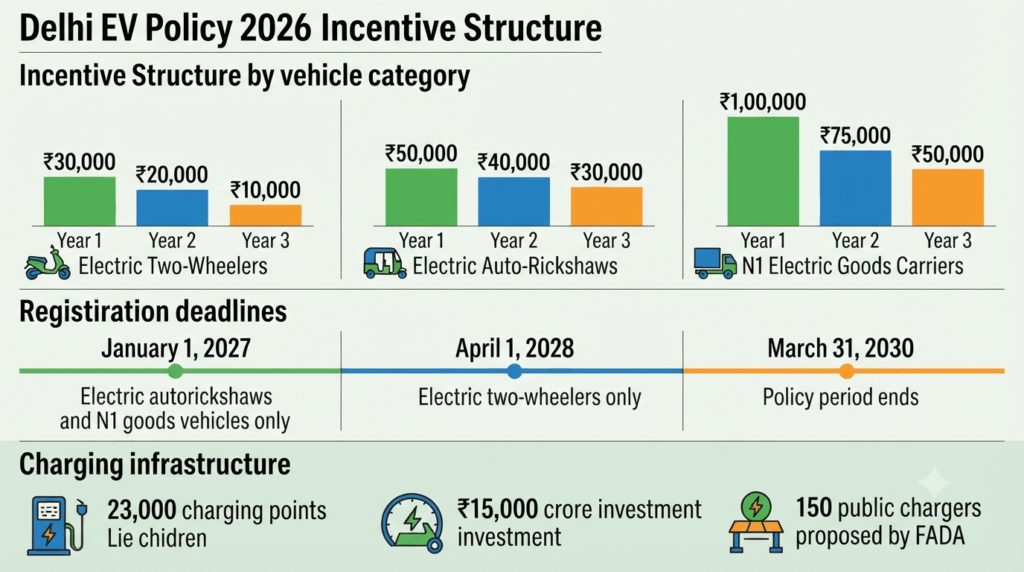
From January 1, 2027: Only electric autorickshaws (L5 category) and N1 category goods vehicles will be registered in Delhi. This applies to light commercial goods vehicles with a gross vehicle weight of up to 3.5 tonnes.
From April 1, 2028: Only electric two-wheelers will be eligible for new registration in the capital, effectively phasing out the registration of new petrol and CNG-powered two-wheelers. This has the largest retail impact because two-wheelers account for approximately 67 percent of Delhi’s registered vehicle stock.
The mandates apply to new registrations. They do not automatically remove existing petrol or CNG vehicles from Delhi’s roads. However, older vehicles will continue to be governed by the city’s separate vehicle-age and end-of-life regulations.
School Bus Fleet Electrification
Schools in Delhi must convert at least 10 percent of their total owned, leased, or hired bus fleets to electric vehicles by the end of the policy’s second year. The requirement rises to 20 percent by the end of the third year and 30 percent by March 31, 2030. All new intra-state buses procured by the Delhi administration will be electric.
The Incentive Structure: Front-Loaded to Encourage Early Adoption
Purchase Incentives for Electric Vehicles
The policy offers financial incentives designed to encourage early adoption before the compulsory registration deadlines take effect.
Electric two-wheelers priced at no more than ₹2.25 lakh ex-showroom qualify for an incentive of ₹10,000 per kWh in the first year, capped at ₹30,000. The benefit falls to ₹6,600 per kWh, capped at ₹20,000, in the second year. It drops further to ₹3,300 per kWh, capped at ₹10,000, in the third year.
Electric L5M auto-rickshaws qualify for ₹50,000 in the first year, ₹40,000 in the second year, and ₹30,000 in the third year.
N1 electric goods carriers with a gross vehicle weight above 1.75 tonnes qualify for ₹1 lakh in the first year, ₹75,000 in the second year, and ₹50,000 in the third year.
Tax Exemptions and Additional Benefits
Pure electric vehicles will continue to enjoy exemptions from road tax and registration fees. Electric cars priced up to ₹30 lakh are set to get a 100 percent waiver on road tax and registration fees until March 31, 2030.
Hybrid vehicles will not receive any subsidy under the new policy. The government has also clarified that there will be no cap on the number of EVs eligible for benefits, allowing buyers to claim incentives for multiple vehicles.
The Scrappage Incentive
Additional incentives will be offered to owners who scrap old vehicles while purchasing new electric ones. The policy includes a ₹500 crore allocation for scrappage incentives and over ₹3,000 crore for other purposes.
The Impact on Dealerships: Investment and Adaptation
What Dealers Need to Invest In
The Federation of Automobile Dealers Associations (FADA) has backed the Delhi EV Policy 2026, despite acknowledging that the transition will impose additional costs on dealerships and manufacturers.
FADA President C S Vigneshwar said dealerships would need to invest in charging equipment, workshop tools, and technician training as the capital moves away from internal-combustion vehicles. Some manufacturers will also have to expand their electric product ranges and production capacity before the registration restrictions take effect.
FADA has also offered to invest in Delhi’s EV ecosystem. The association has proposed setting up 150 public EV charging stations across the city and is willing to fund the infrastructure in partnership with the government. It has also proposed establishing vehicle scrappage centres in Delhi.
The Operational Burden on Dealers
FADA has emphasised that the operational burden of the transition will largely fall on dealer networks. As FADA president CS Vigneshwar put it: “Enablement always goes faster than enforcement”. The association has called for dealers to be included as active participants in the EV transition, given their role as the last-mile interface with customers.
FADA Delhi chairperson Shailender Luthra added: “The biggest burden of this transformation does not fall on OEMs alone; it falls on dealers”.
FADA has outlined three key priorities for Delhi’s EV transition: policy stability, infrastructure development, and employment generation.
The Rise in EV Enquiries
Despite the challenges, the launch of the Delhi EV Policy 2026 has sparked a rise in enquiries for electric cars and electric scooters. Dealerships have reported that enquiries have increased to 4-6 per day, and they expect the number to increase further once the policy is fully operational.
The Urban Charging Infrastructure Expansion: 23,000 Charging Points
The Scale of the Build-Out
Delhi plans to install 23,000 EV charging points across the city during the policy period. This represents a significant expansion from the existing public charging infrastructure.
To improve charging efficiency, DISCOMs will explore the use of Energy Storage Systems (ESS) at electric bus depots for better load management and grid reliability. They will also examine time-of-day tariffs and differential electricity pricing through the Delhi Electricity Regulatory Commission to reduce charging costs.
Community and Residential Charging
The policy places significant emphasis on community and residential charging. Resident Welfare Associations (RWAs), group housing societies, residential communities, and private entities are encouraged to facilitate community and private EV charging infrastructure within residential premises.
Charging infrastructure at suitable government-owned locations will also be developed to support the growing use of electric buses and trucks and provide reliable charging access for private fleet operators.
Battery Recycling and Management
The policy also addresses battery management and recycling. The Environment Department will ensure compliance with the Battery Waste Management Rules, 2022. The Delhi Pollution Control Committee (DPCC) will facilitate battery collection centres through a public-private partnership model with authorised recyclers.
OEMs will be required to periodically submit reports on battery traceability and compliance with Extended Producer Responsibility norms. The government also plans to promote a battery traceability system using unique battery identifiers to support refurbishment, second-life use, and environmentally sound recycling.
What This Means for Delhi’s EV Future
The Honest Assessment
The Delhi EV Policy 2026 represents one of the most comprehensive and aggressive electric vehicle policies in India. It goes beyond purchase subsidies to mandate charging infrastructure at dealerships, phase out new ICE vehicle registrations, and create a single-window clearance system for charging infrastructure development.
The dealership charging mandate is a smart approach to distributing infrastructure across the city. By requiring every dealership to install public charging stations, the policy ensures that charging access is available where EV buyers already go. The single-window clearance system addresses the procedural delays that have historically held back charging rollouts in Indian cities.
The registration deadlines are ambitious. Phasing out new petrol and CNG two-wheeler registrations by April 2028 is a bold move that will require significant preparation from manufacturers and dealers. The incentive structure is front-loaded to encourage early adoption, with generous benefits in the first year that decline over time.
The challenges are real. Dealerships will need to invest in charging equipment, workshop tools, and technician training. The grid will need upgrades to support 23,000 new charging points. The phase-out of ICE vehicle registrations will need to be carefully managed to ensure adequate supply of electric alternatives.
The honest verdict: Delhi’s EV Policy 2026 is a bold and comprehensive framework for accelerating electric mobility. It addresses the key barriers to EV adoption including charging infrastructure, upfront costs, and vehicle availability. The policy’s success will depend on effective implementation, adequate supply of electric vehicles, and the willingness of dealers and manufacturers to invest in the transition. For Delhi residents, the policy offers significant incentives to make the switch to electric. For the rest of India, it provides a template for how cities can accelerate the EV transition.
Internal Links: Further Reading on Clean Energy Bazaar
The Delhi’s new EV policy 2026: mandatory charging stations at dealerships and new rules guide connects to the EV market and infrastructure guides on cleanenergybazaar.com.
For the India EV charging network guide covering the 67,657 chargers installed nationwide, our India’s EV charging network expands to 67,657 chargers: what it means for EV adoption guide covers the national infrastructure landscape. For the battery swapping guide covering the Indofast Energy and GLIDA partnership, our battery swapping gains traction in India: Indofast Energy and GLIDA’s 100-station expansion guide covers the battery swapping ecosystem. For the India EV sales boom guide covering the record H1 2026 sales, our India’s EV sales boom: crossing 11% market share and 79% growth in H1 2026 guide covers the market growth that Delhi’s policy aims to accelerate. For the MG Hector Tomahawk EV and PHEV launch guide covering India’s first mainstream plug-in hybrid SUV, our MG Hector Tomahawk EV and PHEV launch: India’s first mainstream plug-in hybrid SUV guide covers the dual launch in detail.
Final Thoughts
Delhi’s new EV policy 2026: mandatory charging stations at dealerships and new rules — and the policy represents a bold and comprehensive framework for accelerating electric mobility in India’s capital.
The dealership charging mandate is a smart approach to distributing infrastructure. Every OEM must install at least one public charging station at each dealership, with three charging points for two- and three-wheelers and two for four-wheelers. The requirement must be fulfilled within six months, with non-compliance resulting in deactivation from the incentive portal.
The single-window clearance system addresses the procedural delays that have historically held back charging rollouts. Delhi Transco Limited will serve as the nodal agency for planning and coordinating the charging network, with a dedicated digital platform for approvals and monitoring.
The registration deadlines are ambitious. Electric autorickshaws and goods vehicles from January 2027. Electric two-wheelers only from April 2028. The incentive structure is front-loaded to encourage early adoption.
The honest verdict: Delhi’s EV Policy 2026 is one of the most comprehensive electric vehicle policies in India. It addresses charging infrastructure, upfront costs, and vehicle availability. For Delhi residents, the policy offers significant incentives to make the switch. For the rest of India, it provides a template for how cities can accelerate the EV transition.