Just twelve months ago, Europe’s electric vehicle market was stagnant. After years of steady growth, 2024 had delivered little more than a flatline — sales had stalled, policy uncertainty loomed, and the continent’s ambitious electrification targets seemed increasingly fragile.
What a difference a year makes.
On May 20, 2026, the International Energy Agency released its Global EV Outlook 2026, and the numbers for Europe told a story of a remarkable reversal. Electric car sales in Europe rose by more than 30% in 2025 to exceed 4 million vehicles. The electric car sales share in Europe reached 28% of total sales. Europe saw the strongest growth among major electric vehicle markets globally.
This guide on Europe’s EV sales surge 30% – how Germany, Spain, and Italy are leading the comeback provides the complete, honest breakdown — the IEA data that confirms Europe’s reversal, the country-by-country performance of Germany, Spain, and Italy, the policy drivers that triggered the surge, the energy crisis factor that accelerated it, and what this all means for European EV buyers and the continent’s automotive industry.
The Big Picture — Europe’s Remarkable Reversal
From Stagnation to the Fastest-Growing Major Market
The 2024 stagnation:
In 2024, European electric car sales had stagnated. Policy uncertainty, the phase-out of subsidies in key markets, and broader economic headwinds had combined to create a year of little growth. The momentum that had carried European EV adoption through the early 2020s appeared to be faltering.
The 2025 surge:
2025 changed everything. Europe experienced an upswing in sales following a step change in the EU CO2 standards. Electric car sales increased by more than 30% in Europe in 2025. Sales rose to more than 4 million after having stagnated in 2024.
Europe’s global position:
Europe saw the strongest growth among major electric vehicle markets. While China’s growth slowed slightly (partly due to a temporary halt to its trade-in scheme), and the United States remained stable at just under 10%, Europe surged ahead.
The production impact:
In the European Union, policy-driven growth in electric car sales resulted in production increasing 30% from 2024 to reach nearly 3.2 million in 2025. The European Union remained the world’s second-largest electric car producer and a net exporter of electric cars, with exports exceeding 1 million in 2025 — a 25% rise from the previous year.
Germany — The Engine of Europe’s EV Comeback
How Europe’s Largest Car Market Rebounded
The headline numbers:
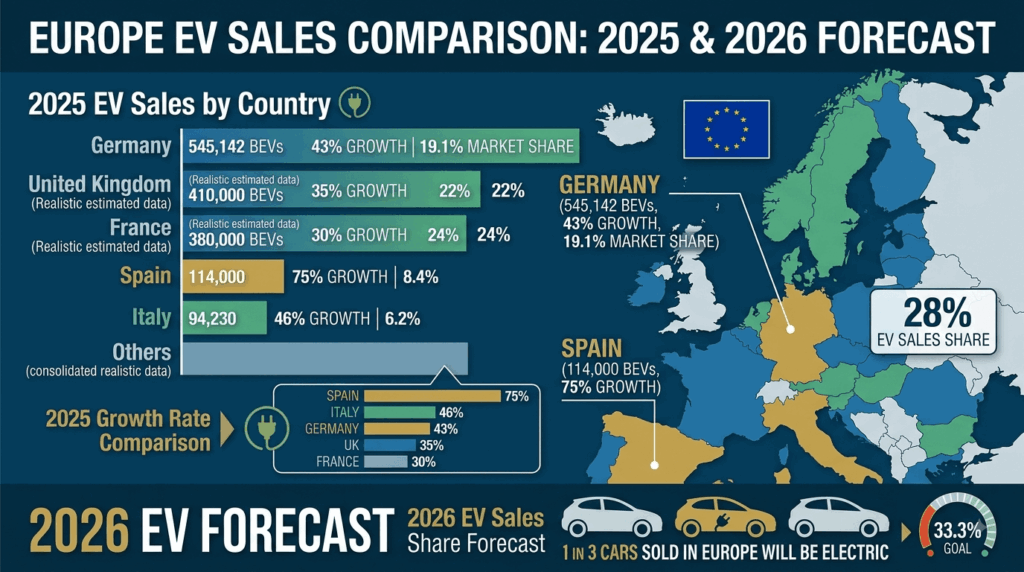
Germany, the largest market for electric cars in Europe, saw sales in 2025 rise by 50% according to IEA figures, reaching a record high of 850,000 vehicles. Approximately 30% of the cars sold in Germany in 2025 were electric vehicles.
The KBA data:
According to the German Federal Motor Transport Authority (KBA), 545,142 battery electric vehicles were newly registered in Germany in 2025 — a 43.2% increase compared to 2024. Pure electric vehicles achieved a market share of 19.1%. In other words, almost one in five new cars in Germany was a pure EV.
The recovery context:
The 2025 growth followed a difficult 2024. The German government’s unexpected termination of EV purchase subsidies had caused sales to plummet in 2024. As EY automotive expert Constantin Gall noted: “At first glance, these figures seem to indicate a boom in the electric vehicle market. But in reality, the strong growth in 2025 merely compensated for the sales decline in 2024”.
Market dynamics:
Hybrid vehicles accounted for nearly 40% of the German market in 2025, with about one-quarter of these being plug-in hybrids. Plug-in hybrid registrations grew 62.3% year-on-year. Meanwhile, petrol cars fell to 27.2% of the market, and diesel fell to 13.8%.
Brand performance:
Volkswagen maintained the highest market share among German manufacturers at 19.6%. BMW recorded the largest growth among German brands at nearly 9%. BYD recorded the strongest growth of any brand — over 700% — though its market share remained low at 0.8%. Tesla, by contrast, saw sales fall 48.4%.
Spain — The Surprise Performer
How Spain More Than Doubled Its Electrified Vehicle Sales
The headline numbers:
Spain presented strong growth in both battery electric vehicles and plug-in hybrids in 2025. Supported by expanding model availability, corporate fleet electrification, and gradual improvements in charging infrastructure, plug-in vehicles consolidated their position as a core pillar of the Spanish automotive market.
BEV performance:
Battery electric vehicles reached around 114,000 units in 2025, increasing by more than 75% year-on-year. For the first time, BEV passenger cars exceeded 100,000 units, reaching close to 9% market share. This represented a breakthrough for Spain’s EV market.
Total electrified vehicles:
Spain registered approximately 243,000 rechargeable vehicles (BEVs and PHEVs combined) in 2025, representing close to 19% of total vehicle registrations. Focusing on passenger cars, electrified vehicles surpassed 225,000 registrations, representing almost one in five new cars sold in Spain.
PHEV growth:
Plug-in hybrids recorded even faster growth than BEVs, with about 131,000 registrations — more than doubling year-on-year — and achieving a market share of around 9.5%.
Model leadership:
Tesla maintained its leadership in the Spanish BEV passenger car market in 2025. The Tesla Model 3 was the best-selling electric car, followed by the Tesla Model Y. Newer and more affordable models gained significant traction, notably the Kia EV3 and the Renault 5 E-Tech, highlighting growing consumer demand in the compact and small-car segments.
Charging infrastructure:
Spain closed 2025 with close to 50,000 operational public charging points, representing growth of around 35-40% compared to the previous year. However, a significant number of installed chargers remained non-operational due to administrative and grid-connection delays.
Italy — The Turning Point
From Lagging to Catching Up
The headline numbers:
Italy’s EV market in 2025 marked a turning point after a weak 2024. BEV registrations reached 94,230 units in 2025, representing growth of 46.1% compared with 2024 and accounting for 6.2% of the total car market.
December surge:
December 2025 was particularly strong, with BEVs exceeding 11% monthly market share, largely driven by the end-of-year effect of incentives and fleet registrations. PHEVs represented 6.4% of the total market, resulting in an estimated volume of just under 100,000 units. In December, combined EV and PHEV registrations reached 20.3%.
Market context:
Italy’s overall passenger car market declined by 2.1% year-on-year to 1,525,722 registrations. SUVs continued to dominate, accounting for nearly 58% of registrations. Hybrids remained the most popular powertrain, accounting for 44.1% of registrations (up from 40% in 2024). Petrol and diesel vehicles fell to 24.4% and 9.7% respectively.
Model leadership:
The most registered BEV models in Italy in 2025 were: Tesla Model 3 (7,116 units), Leapmotor T03 (6,242 units), Tesla Model Y (5,677 units), Dacia Spring (4,813 units), and BYD Dolphin Surf (4,563 units).
Charging infrastructure:
Italy counted over 70,000 public charging points nationwide by the end of 2025. Compared with September 2024, the number increased by roughly 16%. Regional disparities persisted, and ultra-fast charging coverage along motorways remained a key challenge.
BYD’s breakthrough:
Chinese manufacturer BYD, the world’s largest EV seller in 2025, multiplied its sales by seven in Italy to 23,621 units.
What Drove the Surge — The Four Factors Behind Europe’s Comeback
The Policy, Price, Energy, and Competition Drivers
1. The EU CO2 standards step change:
The single most important driver of Europe’s 2025 EV surge was the step change in the European Union’s CO2 standards for cars. The entry into force of stricter emission limits in 2025 prompted manufacturers to offer cheaper models.
The regulatory framework created a clear incentive for automakers to increase EV sales to meet fleet average CO2 targets. With substantial fines looming for non-compliance, manufacturers responded by accelerating EV production, offering more competitive pricing, and expanding model availability.
2. More affordable models:
The supply response to the CO2 standards was rapid. Manufacturers introduced a wider range of more affordable EV models in 2025. The share of electric models sold below the average price tag of their petrol equivalents rose above 30% in 2025. This price convergence made EVs accessible to a broader range of buyers.
3. The energy crisis and oil price shock:
The ongoing energy crisis resulting from the conflict in the Middle East has brought reliance on oil imports into sharp focus. The current high oil price environment is drawing consumer attention to the economic benefits of driving EVs.
Electric cars generally have lower running costs than internal combustion engine vehicles, mainly due to their higher efficiency. The recent rise in oil prices has further increased the cost savings associated with driving an EV. For example, based on average oil prices in April, the annual fuel cost savings associated with driving an EV in the European Union grew 35% compared to 2025 savings. For corporate fleets that travel long distances, the running cost savings can be several times larger than for the general consumer.
4. Increasing Chinese competition:
Chinese automakers supplied 60% of global electric car sales in 2025, while European and North American automakers were each responsible for about 15%. In Europe, sales of Chinese-made electric cars grew almost 50% from 2024.
The presence of competitive Chinese models at lower price points has put pressure on European manufacturers to improve their value proposition, accelerating the overall market.
The 2026 Outlook — What Comes Next
Europe Poised for Further Growth
The IEA forecast:
Europe is poised for the largest growth among major markets, with sales projected to increase by around 20% in 2026, such that one in three cars sold are electric. In the European Union, EV and plug-in hybrid sales are expected to rise about 20%, accounting for one in three cars sold.
The energy crisis effect:
Preliminary signs suggest EV sales are increasing in countries with supply concerns, or where fuel price increases have been particularly steep. The full implications of the current crisis will take time to register in the car market, due in part to the lag between vehicle orders and deliveries.
The outlook by country:
- Germany: The German automotive industry association (VDA) and the international manufacturers association (VDIK) predict sales will grow 2.0% to 2.5% to over 2.9 million vehicles — provided the government’s EV subsidy policy is implemented promptly.
- Spain: With plug-in vehicles approaching 20% of new passenger car registrations, Spain is entering a critical phase of its electric mobility transition. Continued progress will depend on policy stability, further reductions in vehicle prices, and tangible improvements in charging infrastructure.
- Italy: In the absence of new purchase incentives, plug-in market share may remain close to 2025 levels. However, further tightening of fleet emission rules, fiscal measures favouring company EVs, and continued charging infrastructure deployment could support gradual growth.
What This Means for Today’s EV Buyers
The Practical Implications of Europe’s EV Surge
More choice, better prices:
The surge in EV sales has been accompanied by a surge in model availability. The share of electric models sold below the price of their petrol equivalents rose above 30% in 2025. European buyers now have more choice at more competitive prices than ever before.
The running cost advantage:
The energy crisis has made the running cost advantage of EVs more compelling than ever. Annual fuel cost savings for EV drivers in the EU grew 35% compared to 2025 savings. For high-mileage drivers and corporate fleets, the savings are even more substantial.
The infrastructure expansion:
Europe’s charging infrastructure is expanding rapidly. Spain added 35-40% more public chargers in 2025. Italy now has over 70,000 public charging points. While gaps remain, the trend is clear.
Should you buy now?
The honest answer: yes. The EV market in Europe is more competitive, more affordable, and better supported by infrastructure than ever before. The 2025 surge was not a one-off — it was the beginning of a sustained acceleration. One in three new cars sold in Europe in 2026 is expected to be electric. Today’s buyers are not early adopters — they are part of the mainstream.
Internal Links — Further Reading on Clean Energy Bazaar
The Europe’s EV sales surge 30% – how Germany, Spain, and Italy are leading the comeback guide connects to the EV market and battery technology guides on cleanenergybazaar.com.
For the IEA Global EV Outlook 2026 summary covering the full global picture, our IEA Global EV Outlook 2026: 2025 sales hit 20M, capturing 25% of global car sales guide covers the flagship report in full. For the EU Omnibus automotive proposal guide covering the European regulatory framework for affordable EVs, our EU Omnibus proposal small affordable EV category guide covers the M1E category. For the Europe focus guide covering the European solid-state and lithium-sulfur developments, our Europe focus: Nissan Europe/Oxford/Gelion; Dongfeng’s planned mass production guide covers the battery technology race. For the solid-state vs. lithium-ion comparison guide covering the battery technology powering Europe’s EV surge, our solid-state vs. lithium-ion: safety, range, and cost compared guide covers the complete comparison.
Final Thoughts
Europe’s EV sales surge 30% – how Germany, Spain, and Italy are leading the comeback — and the data confirms that the reversal is real, substantial, and accelerating.
After a stagnant 2024, Europe rebounded with the strongest growth among major EV markets in 2025. Sales rose more than 30% to exceed 4 million vehicles, reaching 28% of total car sales. Germany led with 545,142 BEV registrations — 43% growth and a 19.1% market share. Spain saw BEV sales grow 75% to exceed 100,000 units for the first time. Italy rebounded with 46% BEV growth to 94,230 units.
The drivers are clear: stricter EU CO2 standards forced manufacturers to accelerate EV production and lower prices. The energy crisis made the running cost advantage of EVs more compelling than ever. The availability of more affordable models expanded the market. And increasing competition — including from Chinese manufacturers — put pressure on pricing.
The 2026 outlook is strong. Europe is poised for the largest growth among major markets, with sales projected to increase by around 20% in 2026, such that one in three cars sold are electric.
The honest verdict: Europe’s EV comeback is real, and it is only beginning. Today’s EV buyers have more choice, better prices, and stronger infrastructure support than ever before. The transition that seemed to be stalling in 2024 is now accelerating faster than almost anyone predicted.