The numbers are in, and they are staggering.
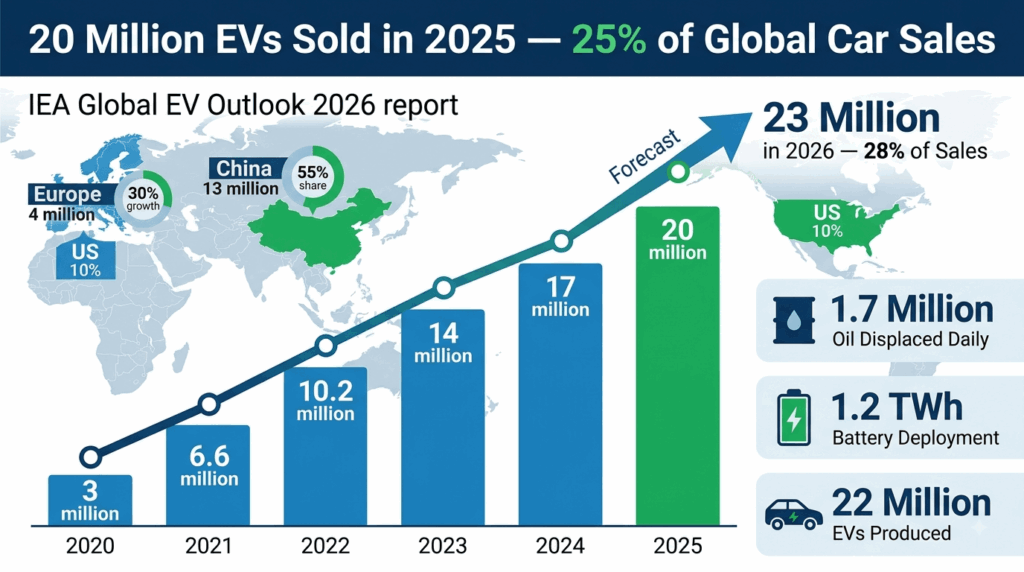
On May 20, 2026, the International Energy Agency released its flagship Global EV Outlook 2026 report — a 295-page assessment of electric mobility worldwide, subtitled “Growing Sales Amid an Energy Crisis”. The headline figure: global electric car sales topped 20 million in 2025, growing by 20% from 2024 and capturing one-quarter of all new cars sold worldwide.
This marks the fifth consecutive year in which annual electric car sales increased by about 3.5 million, a trend that began in 2021 after the Covid-19 pandemic. The global EV fleet now stands at nearly 80 million vehicles, with about 5% of the global car stock now electrified.
This guide on IEA Global EV Outlook 2026: 2025 sales hit 20M, capturing 25% of global car sales provides the complete, honest summary of the IEA’s flagship report — the regional breakdowns, the 2026 forecasts, the battery and supply chain implications, the oil displacement numbers, and what it all means for EV buyers and the global automotive industry.
The Big Picture — 20 Million and Rising
The Headline Numbers That Define the Report
2025 in review:
Global electric car sales in 2025 reached 20 million, representing a 20% increase over 2024. This was in line with expectations from the 2025 edition of the Global EV Outlook. The sales share of electric cars in the overall car market increased to 25%.
The five-year trend:
This marked the fifth consecutive year in which annual electric car sales increased by about 3.5 million, a trend that began in 2021 after the pandemic. The consistency of this growth pattern suggests a structural shift rather than a temporary spike.
The 2026 forecast:
The IEA projects global electric car sales will grow to 23 million in 2026, representing 28% of total car sales. In some estimates, this could reach nearly 30% of global car sales. The current high oil price environment — driven by the conflict in the Middle East — is drawing consumer attention to the economic benefits of driving EVs.
The 2035 outlook:
Under the IEA’s Current Policies Scenario, the global EV fleet (across all vehicle types except two/three-wheelers) will exceed 450 million by 2035 — more than five times the number at the end of 2025. EVs could reach 510 million by 2035 even without additional policy support.
The Regional Story — Three Major Markets, Three Different Trajectories
How China, Europe, and the US Performed in 2025
China — The Dominant Force:
China remains the world’s largest electric car market, accounting for six out of ten electric cars sold globally. More than 13 million electric cars were sold in China in 2025. Monthly electric car sales exceeded a 50% sales share in 11 out of 12 months of 2025 — up from only 5 months in 2024. This lifted the electric car sales share to almost 55%.
Growth in China slowed slightly, partly as a result of its trade-in scheme being temporarily halted. However, the country still accounted for more than half of the global increase in electric car sales in 2025. An estimated 44 million electric cars were on Chinese roads at the end of 2025, representing around 13% of the total car stock, up from 1 in 10 in 2024.
Europe — The Strongest Growth:
Europe experienced an upswing in sales following a step change in the EU CO2 standards. Electric car sales rose 30% to more than 4 million after having stagnated in 2024. The electric car sales share in Europe reached 28% of total sales.
This represents the strongest growth among major EV markets in 2025. The IEA estimates that in 2026, EV and plug-in hybrid sales in Europe are expected to rise about 20%, accounting for one in three cars sold.
United States — Stable but Stalled:
In the United States, the sales share of electric cars remained relatively stable at just below 10%. Several policy shifts, including the ending of EV tax credits, resulted in sales falling significantly in the last quarter of the year.
The IEA noted that this stability came despite policy headwinds. The end of tax credits coincided with a drop in sales at the end of the year. However, the report also notes that EVs are increasingly cost-competitive.
The Emerging Market Surge — The New Growth Engine
Where EV Adoption Is Accelerating Fastest
Southeast Asia — Sales More Than Doubled:
In Southeast Asia, annual sales more than doubled to reach a sales share of nearly 20%, led by Viet Nam, Indonesia and Thailand. This nearly 50% growth was mainly driven by emerging markets and developing economies, where sales rose around 80% to touch a record high.
Latin America — 75% Growth:
In Latin America, sales grew by 75%, led by Brazil and Mexico.
Global Reach:
More than 100 countries recorded electric car sales growth in 2025, and in one-third of these, they represented at least 10% of new car sales.
The China Connection:
Some later-entry markets have seen rapid increases in electric car sales, thanks to the economies of scale and cost-competitiveness of Chinese-made electric cars. For example, Nepal has witnessed one of the largest increases in electric car sales shares since 2020, as imports of electric cars made in China increased significantly. More than half of the 2 million electric car sales outside of the three major markets in 2025 took place in countries across Latin America, the Asia Pacific and the Middle East that have now reached an electric car sales share of more than 10%.
The 2026 Outlook — 23 Million and Nearly 30%
What the IEA Forecasts for the Current Year
The 23 million forecast:
The IEA projects global electric car sales will reach 23 million in 2026, representing 28% of total car sales. Some reports interpret this as nearly 30% of global car sales.
The energy crisis factor:
The current high oil price environment — resulting from the conflict in the Middle East — is drawing consumer attention to the economic benefits of driving EVs. Electric cars generally have lower running costs than internal combustion engine vehicles, mainly due to their higher efficiency. The recent rise in oil prices has further increased the cost savings associated with driving an EV.
Regional forecasts:
Preliminary signs suggest EV sales are increasing in countries with supply concerns, or where fuel price increases have been particularly steep. In Europe, EV and plug-in hybrid sales are expected to rise about 20% in 2026, accounting for one in three cars sold.
The Q1 2026 slowdown:
The IEA also noted that in the first quarter of 2026, global EV sales dipped 8% year-on-year following policy changes in China and the United States. However, the full implications of the current energy crisis will take time to register in the car market, due in part to the lag between vehicle orders and deliveries.
Manufacturing and Trade — Who Makes the EVs
The Production Landscape in 2025
Global production:
Nearly 22 million electric cars were produced globally in 2025 — up more than 25% compared to the previous year. Of those, about one-quarter were traded between major production and demand centres.
China’s manufacturing dominance:
China remains the world’s largest hub for manufacturing and trade of electric cars, capturing nearly 75% and 40% of the respective global totals. Primarily led by domestic carmakers, China’s 2025 production of 16 million electric cars outstripped domestic demand by 20%, pushing Chinese electric car exports to double to a record high of more than 2.5 million.
Electric models represented more than 35% of all Chinese car exports in 2025, up from about 20% the year before.
European production:
In the European Union, policy-driven growth in electric car sales resulted in production increasing 30% from 2024 to reach nearly 3.2 million in 2025. The European Union remained the world’s second-largest electric car producer. The region remained a net exporter of electric cars, with exports exceeding 1 million in 2025 — a 25% rise from the previous year.
Chinese automaker global share:
Chinese automakers supplied 60% of global electric car sales in 2025, while European and North American automakers were each responsible for about 15% of global sales.
Batteries — The Supply Chain Dimension
Battery Demand and Industry Trends
Battery deployment:
Electric vehicle battery deployment reached 1.2 TWh in 2025 — up nearly 30%. The IEA projects this could triple by 2030 depending on the policy scenario.
China’s battery dominance:
China also dominates the supply chain, accounting for more than 80% of global battery cell production in 2025. Chinese manufacturers produce roughly four in five of the battery cells that power electric vehicles and grid storage today.
Lithium prices:
Lithium prices more than doubled year-over-year in 2025, reflecting the surging demand for battery materials.
Battery recycling:
The report also includes analysis of battery recycling, reflecting the growing importance of circular supply chains for battery materials.
Oil Displacement — The Energy Security Impact
How EVs Are Reshaping Oil Demand
2025 oil displacement:
Electric vehicles displaced about 1.7 million barrels of oil per day in 2025, up from 0.4 million barrels per day in 2020. This is primarily in countries that have implemented fuel economy and CO2 standards, such as China and the European Union.
The 2030 projection:
Under the IEA’s Current Policies Scenario, global oil displacement from EVs could hit 5 million barrels per day by 2030, with China’s electrified fleet alone accounting for 2.7 million barrels per day of that.
The road transport context:
The road transport sector represents close to half of oil demand today. Policy responses to the current energy crisis stand to shape the global car market for years to come.
Historical parallels:
The IEA draws a parallel to the oil crisis of the 1970s, which prompted the introduction of fuel efficiency standards that resulted in close to a doubling of the fuel economy of conventional cars between 1975 and today. Similarly, during the Covid-19 pandemic, many countries introduced EV subsidies to boost uptake and support a broader economic recovery.
Policy and Scenarios — The IEA’s Three Pathways
Understanding the Report’s Forward-Looking Analysis
The Current Policies Scenario (CPS):
In the CPS, CO2 and fuel economy standards, especially for new light-duty vehicles, are the main driver of rising EV sales outside of China. In China and a few other emerging markets, the competitive economics of EVs already support continued adoption. EVs account for around 22% of all vehicles on the road (including two/three-wheelers) by 2035.
The Stated Policies Scenario (STEPS):
EV deployment in the STEPS follows a trajectory similar to the CPS, but with higher growth, especially in regions outside Europe and China. EVs across all vehicle types increase by around six times, without counting two- and three-wheelers. EVs account for over 25% of all vehicles on the road by 2035.
The Net Zero by 2050 Scenario (NZE):
The NZE Scenario sees a significantly faster expansion of the EV fleet by 2035, reaching close to 800 million vehicles (excluding two/three-wheelers). The corresponding share of EVs on the road reaches around 45%.
2035 EV stock by region:
The share of the global EV stock located in China declines from 70% in 2025 to over 55% by 2035 in the CPS and around 50% in the STEPS, as adoption accelerates in other markets.
What This Means for Today’s EV Buyers
The Practical Implications of the IEA Report
The momentum is real:
The IEA’s 2026 report confirms what the data has been suggesting for years: the EV transition is no longer a niche phenomenon. One in four new cars sold globally in 2025 was electric. In China, it was more than one in two. In Europe, it was more than one in four. The trend is not reversing — it is accelerating.
The 2026 outlook is strong:
The IEA projects 23 million EV sales in 2026 — nearly 30% of global car sales. Even with the Q1 2026 dip, the full-year forecast remains robust.
The cost advantage is growing:
The current energy crisis has made the running cost advantage of EVs more pronounced than ever. In the European Union, annual fuel cost savings associated with driving an EV grew 35% compared to 2025 savings. For corporate fleets that travel long distances, the running cost savings can be several times larger than for the general consumer.
Should you wait?
The honest answer: no. The IEA report confirms that EV adoption is accelerating, prices are becoming more competitive, and the charging infrastructure is expanding. Today’s EV buyers are not early adopters — they are part of the mainstream. The global fleet of EVs is expected to grow from nearly 80 million vehicles today to as many as 510 million by 2035. The technology is proven, and the economics are increasingly compelling.
Internal Links — Further Reading on Clean Energy Bazaar
The IEA Global EV Outlook 2026: 2025 sales hit 20M, capturing 25% of global car sales guide connects to the EV market and battery technology guides on cleanenergybazaar.com.
For the solid-state vs. lithium-ion comparison guide covering the battery technology that powers the EV growth documented in the IEA report, our solid-state vs. lithium-ion: safety, range, and cost compared guide covers the complete technology comparison. For the EU Omnibus automotive proposal guide covering the European policy framework driving the 30% sales growth documented in the IEA report, our EU Omnibus proposal small affordable EV category guide covers the European regulatory dimension. For the Europe focus guide covering the European solid-state and lithium-sulfur developments, our Europe focus: Nissan Europe/Oxford/Gelion; Dongfeng’s planned mass production guide covers the battery technology race. For the US focus guide covering the American EV market context, our US focus: Factorial Energy’s partnership with Stellantis; SwRI and SMU collaborative research guide covers the US solid-state landscape.
Final Thoughts
IEA Global EV Outlook 2026: 2025 sales hit 20M, capturing 25% of global car sales — and the numbers tell a story of a transition that is no longer coming. It is here.
The 20 million EVs sold in 2025 represent 25% of global car sales. China led with 13 million sales and a 55% sales share. Europe rebounded with 30% growth to 4 million sales. The US held steady at just under 10%. Emerging markets surged — Southeast Asia more than doubled, Latin America grew 75%.
The 2026 forecast is 23 million sales — nearly 30% of global car sales. The energy crisis is accelerating the shift, making the running cost advantage of EVs more compelling than ever. The global EV fleet is expected to grow from 80 million today to 510 million by 2035.
The honest verdict: the EV transition is real, it is accelerating, and it is global. Today’s EV buyers are not pioneers — they are participants in a mainstream market transformation. The technology is proven, the economics are increasingly compelling, and the momentum is undeniable.