Just twelve months ago, America’s electric vehicle market appeared unstoppable. Sales had surged to record highs, automakers had announced nearly $200 billion in EV manufacturing investments, and the federal government was backing the transition with generous tax credits and ambitious emissions targets.
Then came the policy reversal.
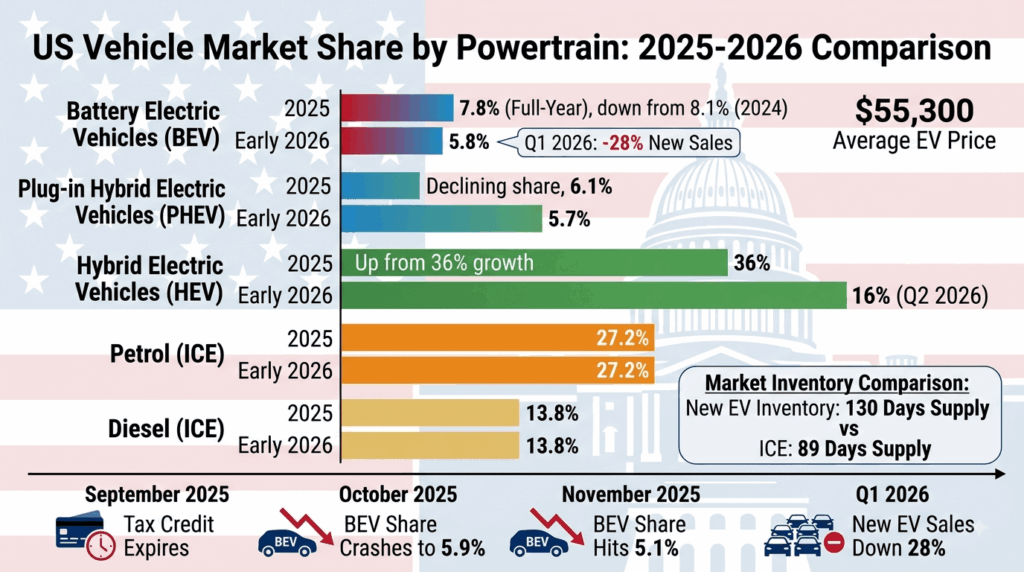
On September 30, 2025, the $7,500 federal EV tax credit expired. What followed was not a gradual cooling but a dramatic collapse. BEV sales represented just 5.9% of new-vehicle sales in October 2025, down from an all-time high of 11.3% in September 2025. In November, BEV market share plummeted further to 5.1%. The fourth quarter saw EV sales crash 45% year-over-year.
This guide on US EV sales slump 25% – policy uncertainty and the hybrid pivot provides the complete, honest analysis — the sales data that confirms the decline, the policy shifts that triggered it, the hybrid surge that filled the gap, the price and infrastructure barriers that remain, and what this all means for American EV buyers.
The Numbers — How Bad Was the 2025 Slump?
The First Annual Decline in a Decade
The full-year picture:
2025 marked the first year in at least a decade in which annual EV registrations in the United States declined. EV registrations slipped 0.4% to 1.3 million units. Some estimates put the decline at 2%, with approximately 1.282 million EVs sold compared to 1.301 million in 2024.
For the full year, EVs accounted for 7.8% of light vehicle registrations, down slightly from 8.1% in 2024. Meanwhile, total vehicle registrations rose 2.2% to 16.25 million units — Americans kept buying cars, but they increasingly chose ones with combustion engines.
The Q3 peak and Q4 collapse:
The story of 2025 was a tale of two halves. In the third quarter, EVs made up 10.5% of all new cars sold in America. Cox Automotive estimated EVs hit an all-time high of 11.6% of the new vehicle market in September.
Then the tax credit expired. Sales crashed by 50% in October. BEV sales in October 2025 totaled just under 75,000 units — a decline of 46.7% compared to September 2025 and down 23.8% year-over-year. In December, registrations plunged 48% year-over-year to just 75,427 vehicles. EVs’ share of the overall market tumbled from 9.9% in December 2024 to 5.3% in December 2025.
The 2026 continuation:
The decline did not end with 2025. New EV sales dropped 28% year-over-year in Q1 2026 to just 212,600 units. EV market share fell to an estimated 5.8% of total new vehicle sales. In the second quarter of 2026, battery electric vehicle sales were just 6% of new light-duty vehicles sold, down from 7% in the same period of 2025.
The 5.9% figure in context:
The 5.9% BEV market share in October 2025 — the figure that has become emblematic of the collapse — represents a more than 50% decline from the September peak in just one month. This was not a gradual erosion; it was a cliff.
The Policy Earthquake — What Actually Changed
The $7,500 Tax Credit Expiration
The legislative trigger:
The One Big Beautiful Bill Act, passed in 2025, eliminated the $7,500 federal EV tax credit for vehicles acquired after September 30, 2025. The Act also eliminated penalties for automakers that fail to meet fuel efficiency standards, making them less incentivized to sell EVs.
On the buyer’s side, the Act made buying and owning EVs more expensive by terminating tax credits for new and used vehicle purchases. It also proposed an annual $250 fee for EV owners to offset traditional taxes on gas that fund road and highway repairs.
The broader policy reversal:
The tax credit expiration was just one part of a comprehensive policy reversal. The Trump administration, as expected, reversed a whole suite of federal policies that promoted or encouraged EVs:
- California’s ability to require the sale of EVs was revoked
- Federal rules about emissions and fuel economy were rewritten
- Federal penalties for car companies that sell too many gas guzzlers were zeroed out
- The EPA finalized a rule overturning its endangerment finding, repealing federal limits on vehicle tailpipe emissions
- Funding for the National Electric Vehicle Infrastructure program was frozen for months
The impact on consumer behaviour:
The expiration of the EV tax credits in September pulled ahead many EV sales that would have occurred later. Buyers rushed to beat the deadline in the third quarter, then the market fell silent in the fourth. The tax credit cliff hit EV sales hard. Americans spent a record $31 billion on EVs in Q3 2025 — only for spending to collapse immediately after.
The “natural demand” question:
According to J.D. Power, average incentive spending per unit on BEVs totaled $13,161 in October 2025, up $2,047 compared to September 2025, as automakers tried to make up for the loss of the federal credit. The National Automobile Dealers Association noted: “It remains to be seen what the natural demand for BEVs will be in the absence of the credit, but we do expect it will take quite some time for BEV sales to reach the rate they were in the final months of the EV tax credits”.
The Hybrid Pivot — The Safe Middle Ground
Why Americans Are Rushing Back to Hybrids
The hybrid surge:
While EV sales collapsed, hybrids quietly became the safe middle ground. In the second quarter of 2025, hybrid-electric vehicle sales in the U.S. jumped about 36% year-over-year. For the full year, hybrid sales rose 36% while EV sales gained just 7%.
In the second quarter of 2026, hybrid electric vehicles reached a record 16% of light-duty vehicle sales. About 22% of light-duty vehicles sold in 2025 in the United States were hybrid, battery electric, or plug-in hybrid vehicles, up from 20% in 2024.
Why hybrids are winning:
The hybrid boom is being fueled by a simple reality: American buyers don’t want to compromise.
Range anxiety eliminated: Hybrids eliminate all charging anxiety while still slashing fuel consumption by 30-50 percent. For many buyers, they deliver “the EV experience without the EV headaches”.
Lower price premium: EVs still carry a premium — often $8,000 to $12,000 more than comparable gas or hybrid models. The average cost of an EV is $55,000-$59,000. Hybrid pricing has dropped considerably.
No charging infrastructure required: Hybrids do not have plugs, so they don’t directly affect grid-delivered electricity demand and were not eligible for any of the federal tax credits that expired.
Proven reliability: Hybrids have been on the road for over 25 years, and models like the Toyota Prius have proven nearly bulletproof. EVs, by comparison, are still fighting early-stage skepticism about software quality and charging infrastructure.
The manufacturer response:
Automakers responded to the hybrid surge by pushing hybrid variants into their most popular mainstream models, often at a modest upcharge of $1,500-$2,000. Ford’s hybrid sales hit a record in 2025, while its EV sales slumped by 14.1%. GM’s EV sales declined 43% in Q4, Ford’s plunged 52%.
The Price and Infrastructure Barriers
Why Mainstream Buyers Are Hesitating
The price gap:
Even with incentives, EV sticker prices have hovered above what mainstream buyers feel comfortable paying. According to the U.S. Energy Information Administration, in March 2025, the average transaction price for a pure electric vehicle was $59,200, while the average price for the new car market was $47,500 — a price gap of 25%, the largest since April 2023.
In February 2026, EV prices fell to an average transaction price of $55,300, narrowing the gap with gas cars to a record-low $6,500. But the gap remains significant for mainstream buyers.
The affordability paradox:
Globally, electric cars became more affordable in 2025 — except in the U.S.. Average EV battery prices declined by 8% due to relatively low raw material costs and widespread adoption of lithium iron phosphate technology. But in the U.S., a lack of supportive policy and subsidies, the unavailability of affordable Chinese models, and a preference for big cars have kept prices high.
Charging infrastructure:
Charging infrastructure in the U.S. is a patchwork slowly filling in. Early adopters are largely spoken for, and the next wave of customers worries about charging access and range anxiety. Public charging inconsistencies, unpredictable cold-weather range loss, and a lingering fear of long-distance inconvenience remain barriers.
The used EV bright spot:
While the new EV market struggles, the used side is booming. Used EV sales surged 12% in Q1 2026 to 93,500 units. Used EVs now average $34,821 — within just $1,300 of the average for used gas vehicles. That near-parity is unprecedented. The used EV-to-ICE price gap was over $10,000 as recently as early 2023. Used EVs are turning at nearly the same pace as gas cars on dealer lots — a sign of genuine consumer demand.
The Automaker Response — Cancellations and Rethinking
How the Industry Reacted
Investment pullbacks:
Since the policy reversal, at least $19.9 billion in planned manufacturing investments were canceled and automakers have begun rethinking their all-electric future.
Model cancellations:
The list of canceled or discontinued EVs is extensive:
- The all-electric Ram 1500 REV was canceled before a single one was built
- The all-electric Ford F-150 Lightning was discontinued
- The Volkswagen ID. Buzz is no longer available in the U.S.
- The GM Brightdrop van was discontinued
Both the Ram and Ford pickups will be replaced with extended-range electric vehicles, which come with both a big battery and a backup gas tank — effectively hybrids.
Tesla’s trouble:
Tesla, still the heavyweight champion of EV sales, saw its registrations drop 6.8% for the year to 570,418 vehicles. Its market share slipped 3.1% to 44.9%. December was painful but not catastrophic, with a 35% decline. Tesla sales dropped 7% in 2025 amid increasing competition and political controversy.
Ford’s decline:
Ford’s EV sales slumped by 14.1% in 2025, falling from nearly 98,000 units to 84,113. Ford endured an even steeper December slide of 61%.
The broader industry:
Rivian and Hyundai also saw declines, underscoring that this was not a one-brand problem. GM’s EV sales jumped 48% year-over-year to 169,887 — well behind Tesla’s 589,160 — but still a positive note.
The Global Context — America’s Isolation
The IEA’s Assessment
The IEA Global EV Outlook 2026:
According to the International Energy Agency’s Global EV Outlook 2026, released on May 20, 2026, global electric car sales exceeded 20 million in 2025, growing by 20% and capturing 25% of all new cars sold worldwide. Europe saw the strongest growth among major markets, with electric car sales rising by more than 30% to reach 28% of total sales. China’s EVs accounted for nearly 55% of all car sales.
The U.S. exception:
In the United States, electric car sales remained relatively stable at just under 10% of car sales for the year, though the end of EV tax credits coincided with a drop in sales at the end of the year. New EV sales in the U.S. during the last quarter of 2025 were 45% lower than the same period in 2024. The IEA estimated that by year’s end, 29% of all new cars sold globally will be electric — in the U.S., EVs accounted for only 5.8% of new car sales in the second quarter of 2026.
The lack of affordable options:
The U.S. is impaired by a lack of supportive policy and subsidies, the unavailability of affordable Chinese models, and a preference for big cars. Chinese brands, which are among the most affordable EVs in the world and lead sales in most global markets, attract 100% import duties in the U.S., making them unattractive to buyers. Affordable Chinese brands drove EV sales in Latin America, Southeast Asia, and Europe, making up to 85% of market share in some countries.
The 2026 outlook:
“In the absence of the tax credit, there is expected to be virtually no government financial support for the purchase of electric cars in 2026,” the IEA noted. The IEA projects U.S. EV sales will decline by 20% in 2026. Cox Automotive estimates that EVs will make up just 8% of all new car sales in 2026.
What This Means for Today’s EV Buyers
The Practical Implications
New EVs: Buyer’s market with caveats
The collapse in new EV sales has created a buyer’s market. New EV inventory has ballooned to 130 days’ supply — 46% higher than the 89 days’ supply for combustion vehicles. That glut is forcing automakers to pile on incentives. EV prices fell to an average transaction price of $55,300 in February 2026, narrowing the gap with gas cars to a record-low $6,500.
However, the $7,500 federal tax credit is gone. Buyers must rely on manufacturer incentives, state-level incentives (in some states), and lower dealer prices.
Used EVs: The best opportunity
The used EV market is where the real opportunity lies. Used EVs now average $34,821 — within just $1,300 of the average for used gas vehicles. Used EV days’ supply sits at 42 — just four days higher than the 38 days for combustion vehicles. The wave of EVs leased between 2023 and 2025 is now starting to hit dealer lots, creating a supply of affordable used EVs.
Hybrids: The safe choice
For buyers who want fuel efficiency without range anxiety or charging concerns, hybrids are an increasingly attractive option. They eliminate all charging anxiety while still slashing fuel consumption by 30-50 percent. With 16% market share and rising, hybrids have become the default choice for many American buyers.
Should you wait?
The honest answer: it depends on your priorities. If you want a new EV, the buyer’s market means good deals are available — but you’ll need to factor in the loss of the federal tax credit. If you’re open to used EVs, the pricing is more compelling than ever. If you want fuel efficiency without the charging commitment, hybrids are the rational choice. The policy uncertainty that caused the slump shows no sign of resolving in the short term.
Internal Links — Further Reading on Clean Energy Bazaar
The US EV sales slump 25% – policy uncertainty and the hybrid pivot guide connects to the EV market and battery technology guides on cleanenergybazaar.com.
For the IEA Global EV Outlook 2026 summary covering the full global picture, our IEA Global EV Outlook 2026: 2025 sales hit 20M, capturing 25% of global car sales guide covers the flagship report in full. For the Europe’s EV sales surge guide covering the contrasting European experience, our Europe’s EV sales surge 30% – how Germany, Spain, and Italy are leading the comeback guide covers the strongest-growing major market. For the US focus guide covering the American solid-state push, our US focus: Factorial Energy’s partnership with Stellantis; SwRI and SMU collaborative research guide covers the US solid-state landscape. For the solid-state vs. lithium-ion comparison guide covering the battery technology powering EVs, our solid-state vs. lithium-ion: safety, range, and cost compared guide covers the complete comparison.
Final Thoughts
US EV sales slump 25% – policy uncertainty and the hybrid pivot — and the data tells a story of a market that was artificially inflated by federal policy and then artificially deflated by its removal.
The $7,500 federal EV tax credit expiration on September 30, 2025, triggered a collapse that was as dramatic as it was predictable. BEV market share fell from an all-time high of 11.3% in September to just 5.9% in October — a more than 50% decline in one month. The fourth quarter saw EV sales crash 45% year-over-year. 2025 marked the first annual decline in EV registrations in at least a decade.
The policy reversal was comprehensive: not just the tax credit, but emissions rules, fuel economy standards, California’s waiver, and NEVI funding. The message to automakers and consumers was clear: the federal government was no longer supporting the EV transition.
The hybrid pivot was the result. Americans didn’t stop buying fuel-efficient vehicles — they just chose the ones that didn’t require charging infrastructure, didn’t carry a $8,000-$12,000 price premium, and didn’t come with range anxiety. Hybrids reached a record 16% of light-duty vehicle sales in Q2 2026.
The honest verdict: the US EV market is in a deep slump, and the policy uncertainty that caused it shows no sign of resolution. Today’s EV buyers face a market without federal support — but with lower prices, higher incentives, and a booming used EV market. Hybrids have become the default choice for mainstream buyers. The global EV transition continues to accelerate everywhere except America.