Here’s a situation playing out in apartment buildings across the UK, France, Germany, the Netherlands, Spain, and Italy every week in 2026.
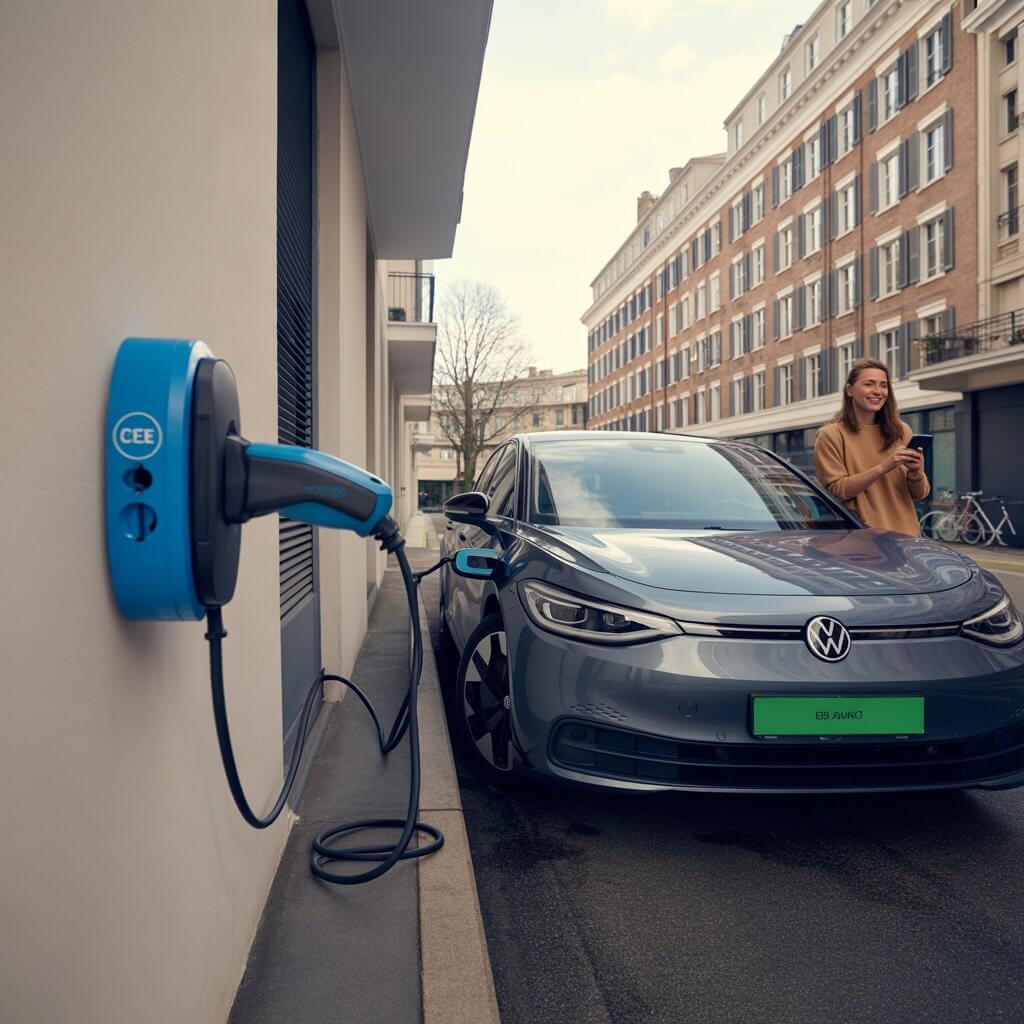
Someone buys a Renault 5 E-Tech Electric or a Volkswagen ID.3. They live in a flat. They have a designated parking space — or they don’t. They ask their building management about installing a home charger. Building management says it’s complicated, or it needs approval from all residents, or it will take months, or they simply say no.
The new EV owner sits in their car after a 32 km commute with 28% battery, wondering whether they made a mistake.
They didn’t make a mistake. They just need better information than most EV guides provide for their specific situation.
This guide on Europe apartment charging best solutions for Renault 5 or VW ID.3 owners is written specifically for compact EV owners in European apartment buildings — the people who chose an affordable, city-appropriate electric car and now need charging solutions that work in the real-world constraints of European flat living. Not the theoretical maximum — the practical reality.
The Renault 5 and VW ID.3 are particularly well-suited to apartment charging scenarios for reasons most guides don’t address — their smaller batteries mean faster charging from slower sources, their Type 2 connectors work with all European infrastructure, and their urban-focused design makes them ideal candidates for the charging strategies that actually work in flat buildings.
Why the Renault 5 and VW ID.3 Are Actually Ideal Apartment EVs
Before getting into solutions, understanding why these specific vehicles handle the apartment charging challenge better than larger EVs matters.
The Battery Size Advantage
Renault 5 Standard Range (40 kWh usable): At 7.2 kW home charging: Full charge from 20% takes approximately 3.5 hours At 3 kW (standard household socket): Full charge from 20% takes approximately 8.5 hours At 1.8 kW (13A UK plug): Full charge from 20% takes approximately 14 hours
VW ID.3 Pure (45 kWh usable): At 7.2 kW: Full charge from 20% takes approximately 4 hours At 3 kW: Full charge from 20% takes approximately 9.5 hours At 1.8 kW: Full charge from 20% takes approximately 16 hours
The apartment charging insight: A Renault 5 with a 40 kWh battery can be charged from 20% to 80% overnight on a standard household socket — extremely slowly (approximately 32 km of added range over 8 hours from a 1.8 kW socket) but functionally adequate for a driver covering 40-50 km daily who has 10-12 hours of overnight charging available.
Compare this to a BMW iX xDrive50 with a 105 kWh battery at the same 1.8 kW socket: the 20-80% charge takes approximately 42 hours. That’s genuinely impractical without a dedicated Level 2 charger.
The smaller batteries of compact EVs mean every charging solution — from a standard socket to a dedicated Level 2 installation — is more proportionally effective than for large-battery vehicles. This changes the apartment charging calculus fundamentally.
The Urban Range Profile
Renault 5 and ID.3 owners are disproportionately urban and suburban commuters. The typical Renault 5 owner in Paris, London, Amsterdam, or Berlin drives 30-60 km daily. The ID.3’s typical European owner drives a similar profile.
What this means for charging strategy:
- 30-60 km daily consumption = approximately 5-11 kWh drawn from the battery
- Replacing 5-11 kWh overnight from a 3 kW source takes 1.7-3.7 hours
- A standard household socket replaces 5-11 kWh in approximately 3-6 hours at 1.8 kW
- A dedicated 7.2 kW Level 2 charger replaces the same in 42-92 minutes
For a driver covering 40 km daily in a Renault 5, even a slow overnight charge from a standard socket replaces more than enough range. The charging challenge for compact urban EV owners is access to any overnight charging — not access to fast charging.
The European Apartment Charging Landscape — What’s Changed in 2026
Legal Rights — Stronger Than Most Apartment EV Owners Know
The most important piece of information for European apartment EV owners in 2026 is that legal frameworks have strengthened significantly across the EU and UK over the past two years — and most residents don’t know their rights.
EU Energy Performance of Buildings Directive (EPBD): The revised EPBD requires EU member states to ensure that residents of apartment buildings cannot be unreasonably blocked from installing EV charging infrastructure in their parking spaces. Member states are implementing this with varying speed and specificity, but the direction of travel is clear — the regulatory framework is moving consistently toward stronger individual resident rights.
France — Droit à la Prise (Right to Socket): In force since 2011 and strengthened since — French apartment residents cannot be refused permission to install EV charging in their designated parking space. The building syndic can impose reasonable conditions (specific cable routes, installer qualifications) but cannot refuse outright. Your right to charge in France is one of the most firmly established in Europe.
Germany — WEG Reform 2020: Condominium owners in Germany can demand permission to install EV charging as a “privileged construction measure.” The owners’ association cannot refuse — only the individual owner bears the costs. Renters in Germany have weaker rights but can negotiate with landlords.
Netherlands: Strong right to charge framework with government-funded support programmes for collective apartment building installations.
UK: The freeholder’s consent is required for electrical modifications in most UK flats under standard lease terms. However, UK legislation is moving toward stronger flat owner rights and the OZEV grant (£350) for eligible flat owners is a significant financial incentive that motivates cooperative building management.
Spain and Italy: Improving frameworks under EU EPBD implementation. In practice, building community approval is still often required, but the regulatory direction supports individual installation rights.
The practical implication for Renault 5 and ID.3 owners: Before accepting a building management “no,” research the specific legal framework in your country. In France, Germany, and the Netherlands, a simple refusal is not legally sustainable. In the UK, the grant incentive often motivates landlord cooperation that a request without financial benefit doesn’t achieve.
Scenario Analysis — The Five Apartment Situations Renault 5 and ID.3 Owners Face
The Europe apartment charging best solutions for Renault 5 or VW ID.3 owners question has different answers depending on five distinct apartment scenarios. Identify which one applies to you before reading the specific solutions.
Scenario A: Flat Owner With Designated Underground Parking Space
Who this is: You own your flat (leasehold or freehold), you have a designated parking space in an underground car park, and the building has some electrical infrastructure at the parking level.
The challenge: Getting permission to run a dedicated electrical circuit from your flat or from a new building supply to your parking space.
The opportunity: This is the most straightforward apartment charging scenario. Your legal rights are strongest here, the infrastructure path is most predictable, and the financial case is clearest.
→ See Solutions for Scenario A below
Scenario B: Flat Renter With Designated Parking Space
Who this is: You rent your flat, you have a designated parking space (either included in the tenancy or separately rented), and you want to install or request EV charging.
The challenge: As a renter, your ability to make permanent electrical modifications is more limited. You typically need landlord consent for any electrical work, and your investment in charging infrastructure doesn’t travel with you when you move.
The opportunity: Many landlords are increasingly cooperative with EV charging requests — particularly if you propose a solution that adds value to the property and doesn’t require them to bear cost. Portable charging solutions that use an existing outlet or negotiate a new outlet installation are the most accessible path.
→ See Solutions for Scenario B below
Scenario C: Flat Owner or Renter With Open-Air or Street Parking
Who this is: Your flat doesn’t come with a parking space — you use on-street parking, an open-air car park nearby, or occasionally a shared visitor space.
The challenge: Without a designated parking space adjacent to an electrical supply, private home charging installation is not straightforward. The charging solution depends on either the local authority’s on-street charging infrastructure or destination charging at nearby facilities.
The opportunity: Many European cities — particularly Amsterdam, London, Oslo, and Paris — have been aggressively expanding on-street residential charging. Your local authority may have a programme you don’t know about.
→ See Solutions for Scenario C below
Scenario D: Flat in a Building Currently Installing Shared EV Charging Infrastructure
Who this is: Your building management or owners’ association has agreed to install shared EV charging in the car park — you’re one of several residents who will benefit.
The challenge: Navigating the collective installation process, understanding your cost contribution, and ensuring the hardware chosen meets your specific needs.
The opportunity: Shared infrastructure is the most cost-effective and most scalable apartment charging solution. If your building is going through this process, understanding the right hardware choices for Renault 5 and ID.3 owners specifically can help you advocate for the right installation.
→ See Solutions for Scenario D below
Scenario E: No Parking Access at All
Who this is: You live in a flat in a dense city centre with no associated parking — you park on the street, in public car parks, or don’t own a car parking space.
The challenge: Home charging as conventionally defined is not possible. Your EV charging strategy is entirely dependent on public infrastructure.
The opportunity: For Renault 5 and ID.3 owners specifically, public charging dependency is more manageable than for large-battery EVs — the smaller battery means faster completion at public chargers and the urban driving patterns mean less total charging needed.
→ See Solutions for Scenario E below
Solutions for Scenario A — Flat Owner With Designated Parking
Step 1: Research Your Country’s Specific Right to Charge
Before approaching building management, understand your legal position:
France: You have the right to install. Send a formal request (lettre recommandée) to your building syndic citing the droit à la prise legislation. The syndic has 3 months to respond and cannot refuse without valid technical grounds.
Germany: As a Wohnungseigentümer (flat owner), request installation as a privileged measure under the 2020 WEG reform. The association cannot refuse — you bear the costs.
Netherlands: Contact your VvE (homeowners association) with a proposal. Government support programmes for collective installations may be relevant even if you’re proposing individual installation.
UK: Review your lease for electrical modification clauses. Contact your freeholder or managing agent in writing, citing the OZEV grant and government support for EV charging. Include the full proposal (hardware specification, installer credentials, installation route, how costs are allocated).
Spain: Contact your comunidad de propietarios (property community) in writing. Cite your right to install at personal cost under condominium law amendments.
Italy: Approach your condominium administrator (amministratore di condominio) with a written request and full installation specification.
Step 2: Prepare a Complete Proposal
Building management approves requests with clear proposals and rejects vague ones. Your proposal should include:
Technical specification:
- Charger hardware: specific model, IP rating, OZEV approval where applicable
- Installer credentials: OZEV-registered (UK), certified electrician, specific qualifications
- Cable route: exactly where the cable runs, what penetrations are required, how penetrations are sealed
- Electrical supply source: from your flat’s own consumer unit (preferred) or from a new building supply connection
- Metering: how your charging costs are separated from shared building costs
For a Renault 5 Standard Range or VW ID.3 Pure: A 7.2 kW single-phase charger on a 32A dedicated circuit is the correct specification. This is a standard residential installation — not a complex commercial project. Frame it as such.
Legal framework: One paragraph citing the applicable national right to charge legislation.
Cost responsibility: Explicitly state that you bear all installation costs and ongoing electricity costs.
Reversibility: Offer to restore the installation to original condition at your cost if you move or vacate.
Step 3: Choose the Right Hardware for an Apartment Installation
For Renault 5 Standard Range and VW ID.3 Pure owners (7.2 kW maximum AC rate):
UK Recommendation: Wallbox Pulsar Plus 7.4 kW (single-phase)
- OZEV approved (eligible for £350 grant)
- Compact form factor — important for tight underground car park spaces
- IP55 adequate for underground installation
- 2-year warranty
- Price: £649-£799
UK Budget Recommendation: Rolec WallPod EV Home
- OZEV approved — after £350 grant, unit cost drops to £99-£199
- Delivers the correct 7.2 kW for both vehicles
- 3-year warranty
- Price: £449-£549 (£99-£199 after OZEV grant)
European Recommendation: Easee One 7.4 kW (single-phase)
- Modular design with back plate separation simplifies installation in confined underground spaces
- 3-year warranty
- Dynamic load balancing — useful if other residents later add chargers on the same building supply
- Price: €499-€649
For VW ID.3 Pro Performance owners with three-phase supply and 11 kW capability: European Recommendation: Easee One Three-Phase or Wallbox Pulsar Plus Three-Phase
- Delivers the ID.3 Pro Performance’s full 11 kW AC capability
- Price: €499-€849 depending on variant
What to avoid for apartment installations:
- Chargers requiring significant panel work beyond the dedicated circuit
- Untethered charger sockets (tethered cables are more practical in underground car parks where carrying your own cable is inconvenient)
- Chargers without OZEV approval if in the UK (disqualifies you from the grant)
Step 4: Apply for All Applicable Incentives
UK flat owners:
- OZEV grant: £350 off through your OZEV-registered installer
- Total effective cost reduction: £350
France:
- ADVENIR programme: up to €960 for individual apartment installations
- TVA at 5.5% rather than 20% — applied automatically, saves approximately 14.5%
- Combined incentive can cover most or all installation cost
Netherlands:
- SEEH subsidy: 30% of purchase and installation costs up to €1,500
Germany:
- KfW subsidised financing — interest reduction on installation costs
Italy:
- Bonus Colonnine: 80% of purchase and installation costs up to €1,500
- For a €549 Easee One + €300 installation = €849 total, Bonus Colonnine covers €679 — leaving €170 net cost
Spain:
- MOVES III: up to €500 for qualifying installations
The Scenario A Cable Run Challenge
The most common practical obstacle in underground apartment parking is the cable run from the electrical supply to the parking space. In older European apartment buildings, this run can be:
Short (under 10 metres): From an existing electrical supply point in the car park to your space. Straightforward — typically €100-€200 in cable and conduit costs.
Medium (10-30 metres): From a building supply distribution point to your space through cable trays or conduit. Feasible — typically €200-€500 in cable and conduit.
Long (30+ metres) or from your flat: Running from your flat’s consumer unit down through stairwells or risers to the underground car park. More complex — typically €500-€1,500 in cable, conduit, and labour. Sometimes requires chasing cable channels through building fabric.
For Renault 5 and ID.3 owners specifically, the long cable run scenario is where the portable EVSE option becomes worth evaluating — see Scenario B solutions for the portable approach.
Solutions for Scenario B — Renters With Designated Parking
Renters have fewer rights than owners but more options than most assume.
Option 1: Negotiate a Commando Socket (UK) or CEE Socket (Europe)
Rather than requesting a full EV charger installation, negotiate with your landlord for a 32A commando socket (UK) or 32A CEE socket (Europe) at your parking space.
Why this approach works:
- A socket installation is simpler and cheaper than a full charger installation — less disruptive and less cost for the landlord
- A socket is genuinely useful for multiple purposes (power tools, event equipment) — easier to justify to a landlord than an EV-specific unit
- Once installed, the socket enables a portable Level 2 EVSE that delivers full 7.2 kW charging — identical speed to a hardwired charger
- The portable EVSE travels with you when you move
Cost for landlord: Typically £100-£250 (UK) or €100-€300 (Europe) for the socket installation Cost for you: The portable EVSE — £150-€650 depending on model Charging speed: Full 7.2 kW — identical to a hardwired charger for Renault 5 Standard Range and ID.3 Pure
The negotiation approach: Frame it as a property improvement that adds value — EV charging capability in a parking space increases property attractiveness to future tenants. Offer to pay for the socket installation yourself and leave it in place when you move.
Option 2: Portable EVSE With Existing Outlet
If your parking space has access to any standard household socket (13A UK, Schuko European):
Level of charging from standard socket:
- 13A UK socket (2.99 kW): Adds approximately 18-19 km of range per hour for Renault 5
- Schuko European socket (2.3 kW): Adds approximately 14-15 km of range per hour
For a Renault 5 owner covering 40 km daily: 40 km ÷ 18 km/hour = 2.2 hours of standard socket charging daily. If you have 10+ hours of overnight parking access, a standard socket covers your daily range replacement.
For a VW ID.3 owner covering 50 km daily: Similar calculation — approximately 2.7 hours of standard socket charging for daily range replacement.
What you need: A Mode 2 EVSE (portable charger with standard plug on one end and Type 2 on the other). Most EVs come with one in the box.
Cost: £0/€0 if you use the included Mode 2 cable. The limitation is that most included Mode 2 cables are rated for 10A rather than 13A — drawing 2.3 kW rather than 3 kW from a UK socket.
Best portable EVSEs for this approach:
- UK: Masterplug EVPOD2UK (£149-£199) — plugs into standard 13A UK socket AND 32A commando socket, future-proofing for upgraded socket installation
- Europe (Juice Booster 2, €499-€699): Works with Schuko, CEE 16A, CEE 32A, and Type 2 socket through included adapters — the most versatile portable EVSE for European renters
Option 3: Participate in Building-Wide Infrastructure Proposal
If multiple residents in your building have EVs (or are planning to), a collective proposal for shared charging infrastructure has significantly more chance of landlord or management company approval than an individual request.
Approach: Identify other EV-owning residents, form a group, and approach building management with a collective proposal for shared charging infrastructure funded partly by residents, partly through available grants.
Why building management responds better to collective proposals:
- Amortises cost across multiple residents
- Creates infrastructure that benefits the building as a whole
- Positions the landlord as proactive on EV readiness (increasingly relevant to property values)
- Can be funded through building capital reserves rather than pure landlord outlay
Hardware to propose: For a building with 4-8 Renault 5 and ID.3 owners wanting shared charging:
- 4-8 Easee One or Zaptec Go chargers with shared load management
- One Easee Equalizer or Zaptec Pro building management unit
- Individual billing through the network app — each resident pays for their own charging
Solutions for Scenario C — Street or Open-Air Parking
For Renault 5 and ID.3 owners without designated covered parking, the charging strategy depends entirely on public infrastructure.
Step 1: Map Your Local On-Street Charging
Several European cities have installed or are installing on-street EV charging specifically for residents without off-street parking:
London: The On-Street Residential ChargePoint Scheme (ORCS) has funded installation across many London boroughs. Check your council’s website for on-street charging maps. Some London boroughs have installed lamppost chargers (3.5-5.8 kW) directly on existing street lighting infrastructure — convenient for overnight charging from a nearby parking spot.
Amsterdam: The most extensive on-street residential EV charging network in Europe — over 3,500 public charging points across the city. Amsterdam’s charging points are disproportionately concentrated in residential areas for exactly this reason. Renault 5 and ID.3 owners in Amsterdam can typically find a charging point within 200 metres of their home.
Paris: Belib’ network provides on-street AC charging across Paris. The city has committed to significant expansion of residential on-street charging as part of its urban mobility plan.
Oslo: Near-universal on-street charging access reflects Norway’s world-leading EV adoption. Renault 5 and ID.3 owners in Oslo rarely struggle to find on-street charging.
Berlin, Hamburg, Munich: Growing on-street charging networks — less dense than Amsterdam or Oslo but expanding rapidly under EU AFIR requirements.
How to find on-street charging in your city:
- PlugShare app — shows all public charging points including on-street residential chargers, with real-time user check-in data
- Your local council or municipality website
- Your country’s official EV charging map (in the UK: zap-map.com)
Step 2: Build a Charging Routine Around Public Infrastructure
For Renault 5 and ID.3 owners in Scenario C, an effective charging routine typically combines:
Regular destination charging: Workplace, supermarket, shopping centre. Most Renault 5 and ID.3 owners have daily or weekly visits to locations with Type 2 AC charging. A 45-minute supermarket visit at a 7.2 kW charger adds approximately 45 km of range — replacing most or all of a typical day’s driving.
Weekly DC fast charging for buffer top-up: A 20-30 minute DC fast charging session at a CCS2 station adds 130-200 km to a Renault 5 or ID.3 — more than enough to cover a full week of daily commuting. Renault 5 Standard Range: 80 kW DC charges 10-80% in approximately 28 minutes. ID.3 Pure: 100 kW DC charges 10-80% in approximately 25 minutes.
On-street overnight charging where available: If your street has on-street AC chargers, regular overnight connection provides a reliable top-up option at lower per-kWh rates than DC fast charging.
The Renault 5 / ID.3 Scenario C annual charging cost:
Typical Strategy: 80% destination AC charging (£0.35-0.55/kWh) + 20% DC fast (£0.65-0.80/kWh) Annual kWh: 3,136 kWh (15,000 km, European typical) Average cost: approximately 3,136 × £0.45 = £1,411/year
Compare with home charging on Octopus Go: 3,594 kWh × £0.075 = £270/year
The annual cost difference between public charging dependency and home charging with Octopus Go: £1,141/year
This figure makes the business case for pursuing any viable home charging solution — even a relatively expensive or inconvenient one — compelling for Scenario C residents.
Step 3: Advocate for On-Street Charging in Your Area
If on-street charging doesn’t exist on your street, you can advocate for it:
UK: Contact your local councillor, citing the ORCS programme and requesting that your street be considered for on-street charger installation. The government funds up to 75% of installation costs through ORCS — councils bear minimal cost for participating.
Europe: Contact your local municipality’s transport or sustainability department. EU AFIR requirements are pushing municipalities to accelerate on-street charging installation — your request is swimming with the regulatory tide rather than against it.
Solutions for Scenario D — Building Installing Shared Infrastructure
If your building is going through a collective EV charging installation process, here’s what Renault 5 and ID.3 owners specifically should know about hardware choices.
The Right Specification for a Compact EV Building Installation
Many apartment building EV charging proposals default to 22 kW three-phase chargers because they sound more capable. For a building primarily housing Renault 5 Standard Range, ID.3 Pure, and similar compact EVs, 22 kW three-phase is unnecessary and more expensive.
Why 7.4 kW single-phase chargers are the right specification for compact EV apartment buildings:
- Renault 5 Standard Range: 7.2 kW maximum AC — a 22 kW charger delivers identical speed to a 7.4 kW charger
- VW ID.3 Pure: 7.2 kW maximum AC — same
- Citroën ë-C3, Peugeot e-208, Fiat Grande Panda Electric: all 7.2 kW maximum AC
- Only the ID.3 Pro Performance and Renault 5 Long Range (on three-phase supply) benefit from above 7.4 kW
A building where 90% of residents drive compact EVs accepting 7.2 kW maximum doesn’t need 22 kW infrastructure. Installing 7.4 kW single-phase chargers for a compact EV building:
- Costs less per charge point
- Requires less building electrical infrastructure upgrade
- Delivers identical charging speed to higher-rated chargers for the actual vehicles present
The hardware recommendations for a shared compact EV building installation:
Best shared installation charger for compact EV buildings: Easee One (7.4 kW single-phase, with Easee Equalizer for building load management)
The Easee One’s multi-unit dynamic load sharing is specifically designed for this scenario. When multiple residents charge simultaneously, the Easee Equalizer monitors the building’s total EV charging load and distributes available capacity proportionally — automatically increasing each session’s power when fewer cars are charging and reducing each session when more are active.
For a building with 10 parking spaces and 5 Renault 5 or ID.3 owners wanting to charge overnight:
- Available building EV charging supply: 60A (typical for a shared apartment building installation)
- 5 cars charging simultaneously: 12A each (2.76 kW each)
- All 5 cars replace 40 km of daily driving in approximately 6 hours at 2.76 kW
- Adequate for 10+ hours overnight
Billing for the shared installation: The Easee system and Zaptec system both provide individual resident billing — each resident is billed for their specific energy consumption through the charger app. Building management receives aggregate consumption data without needing to manage individual payments.
Installation cost for 5-10 Easee One chargers in a UK apartment building:
- Hardware (10 units × £549): £5,490
- Easee Equalizer building controller: £250
- Installation (per charger including cabling and commissioning): £300-£500
- Total installation (10 chargers): £3,000-£5,000
- Total project: £8,740-£10,740
- Per charging space: £874-£1,074
Available grants: UK Workplace Charging Scheme may apply for some apartment block configurations. OZEV grant applies to individual residential installations but not typically to shared infrastructure projects.
Solutions for Scenario E — No Parking Access
For Renault 5 and ID.3 owners in the most challenging situation — urban flats with no parking access whatsoever — the charging strategy is entirely public-infrastructure dependent.
The Honest Assessment
Can you own a Renault 5 or VW ID.3 without home charging? Yes — with the right driving pattern and local infrastructure.
Should you own a Renault 5 or VW ID.3 without home charging? Only if:
- Your daily driving is reliably under 60 km
- You have access to free or subsidised workplace charging that covers most of your weekly mileage
- You live in a city with good public charging density (Amsterdam, Oslo, London inner boroughs, Paris)
- You’re comfortable with weekly DC fast charging top-ups as a routine
The annual electricity cost penalty for Scenario E owners: As calculated in Scenario C: approximately £1,141/year more expensive than home charging with Octopus Go. Over five years: £5,705 more than a home charging setup.
If your public charging-dependent annual cost is £1,141 higher than a home charging alternative, and a home charging setup would cost £763 net (after OZEV grant in the UK), the financial case for pursuing any viable home charging solution is clear — even a relatively complicated one.
Maximising Public Charging Efficiency for Compact EV Owners
Prioritise AC destination charging over DC fast charging: AC destination charging at workplaces, supermarkets, and shopping centres is typically cheaper (£0.30-£0.55/kWh) than DC fast charging (£0.65-£0.85/kWh). Renault 5 Standard Range charges from 20-80% in approximately 3.5 hours at 7.2 kW AC — a typical work shift covers this comfortably.
Use DC fast charging for weekly buffer top-ups, not daily charging: The Renault 5’s 80 kW DC and ID.3 Pure’s 100 kW DC charging rates make weekly DC fast charging sessions efficient — 25-30 minutes replaces 150-180 km. One weekly DC session can supplement daily AC destination charging to provide adequate weekly range.
Join charging networks with the best per-kWh rates:
- UK: Pod Point (BP), Osprey, Osprey subscription, Gridserve memberships
- France: Engie E.V. Charge, TotalEnergies Charge, Lidl Charge
- Netherlands: FastNed, Allego subscription, Vattenfall InCharge
- Germany: EnBW mobility+, ARAL Pulse, Rewe Charging
Use PlugShare and Chargemap for real-time charger availability: Both apps show user check-in data that is more reliable than any operator’s own app for confirming a specific charger is currently working. Critical for daily charging planning.
The Portable EVSE Options — Best for Renault 5 and ID.3 Apartment Owners
Regardless of scenario, a portable Type 2 EVSE is the most versatile charging tool for European apartment EV owners. Here are the best options specifically for Renault 5 and ID.3 owners:
Juice Booster 2 — The Premium Portable Solution
Price: €499-€699 Max power: 22 kW (three-phase CEE 32A) / 7.4 kW (single-phase CEE 16A) / 2.3 kW (Schuko) Adapters included: Multiple European socket types IP Rating: IP67 Type 2 compatible: ✅ Works with both Renault 5 and ID.3
Why it’s the best portable for apartment owners: The Juice Booster 2’s multi-adapter system covers every socket type you’ll encounter across European apartment buildings, holiday destinations, and public locations. One device charges your Renault 5 or ID.3 at 2.3 kW from a Schuko at your parking level, 7.4 kW from a CEE 16A socket if your building installs one, and up to 22 kW from a CEE 32A industrial socket at a campsite or rural property.
For Renault 5 Standard Range owners (7.2 kW maximum AC): The 7.4 kW single-phase CEE 16A setting delivers full charging speed. For VW ID.3 Pro Performance owners (11 kW maximum AC): The single-phase setting delivers 7.4 kW — close to but not at maximum. Three-phase CEE 32A delivers maximum potential.
Best for: Apartment renters who charge at multiple locations, frequent travellers across Europe, owners without dedicated parking.
Keba KeContact P30 Portable — The Reliable Mid-Range
Price: €299-€449 Max power: 7.4 kW (single-phase CEE 16A) IP Rating: IP54 Cable length: 6 metres
Why it works for Renault 5 and ID.3 owners: At 7.4 kW it exactly matches the Renault 5 Standard Range and ID.3 Pure’s maximum AC acceptance rate. Keba’s Austrian engineering heritage produces reliable hardware at a mid-range price. The 6-metre cable is slightly more generous than most competitors.
Best for: Apartment owners with a confirmed CEE 16A socket at their parking space who want reliable single-location portable charging without the Juice Booster 2’s multi-adapter premium.
Masterplug EVPOD2UK — The UK Budget Portable
Price: £149-£199 Max power: 7.2 kW (32A commando) / 2.99 kW (13A UK plug) IP Rating: IP44 Type 2 compatible: ✅
Why it works for UK Renault 5 and ID.3 renters: The dual-plug design (13A standard plug AND 32A commando adapter) means this unit works from day one with a standard UK socket and upgrades to full Level 2 speed when a commando socket is installed. For UK renters who have negotiated a commando socket installation, the Masterplug EVPOD2UK delivers full 7.2 kW charging that permanently installed chargers provide at the lowest price point available.
Best for: UK renters who’ve negotiated (or are planning to negotiate) a 32A commando socket at their parking space.
The Grant and Incentive Summary — Apartment Edition
A quick reference for Renault 5 and ID.3 apartment owners across Europe:
| Country | Key Incentive | Amount | Applies To Apartments? | How to Claim |
|---|---|---|---|---|
| UK | OZEV EVHS | £350 | ✅ Flat owners only | Through OZEV-registered installer |
| France | ADVENIR | Up to €960 individual | ✅ Yes — apartment key market | Through approved installer |
| France | TVA reduction | 5.5% vs 20% | ✅ Automatic | Applied automatically |
| Netherlands | SEEH | 30%, up to €1,500 | ✅ Yes | Through RVO portal |
| Germany | KfW | Subsidised loan | ✅ Yes | Through KfW bank |
| Italy | Bonus Colonnine | 80%, up to €1,500 | ✅ Yes | Official portal (limited windows) |
| Spain | MOVES III | Up to €500 | ✅ Yes | Through regional energy agency |
| Norway | Enova | ~€260 | ✅ Housing associations | Enova portal |
The UK OZEV grant for flat owners — the most important caveat: The OZEV EVHS grant (£350) applies to flat owners only — not house-owning homeowners (who lost eligibility in April 2022) and not renters. If you own your flat, you are eligible. If you rent, you are not eligible for the grant directly, though your landlord may be eligible under some commercial charging schemes.
The Charging Time Reference — What Apartment Solutions Actually Deliver
For Renault 5 and ID.3 owners evaluating which apartment charging solution is adequate for their usage, here’s what each access level actually provides:
Renault 5 Standard Range (40 kWh usable, 40 km daily commute)
Daily charging need: approximately 8 kWh (40 km ÷ 5.5 km/kWh efficiency × 1.1 charging losses)
| Charging Access | Power | Time to Replace 8 kWh | Adequate for Daily Use? |
|---|---|---|---|
| Standard 13A UK socket | 2.3 kW | 3.7 hours | ✅ Yes (10hr overnight) |
| Schuko socket (European) | 2.3 kW | 3.7 hours | ✅ Yes |
| CEE 16A socket | 3.7 kW | 2.3 hours | ✅ Yes |
| 32A commando socket | 7.2 kW | 1.2 hours | ✅ Yes |
| Dedicated 7.4 kW charger | 7.2 kW | 1.2 hours | ✅ Yes |
| No overnight charging | 0 kW | — | ❌ Public charging dependent |
The Renault 5 revelation: Even a standard 13A UK socket replaces a 40 km daily commute in under 4 hours — any overnight charging access covers typical daily use.
VW ID.3 Pure (45 kWh usable, 50 km daily commute)
Daily charging need: approximately 10 kWh (50 km ÷ 5.5 km/kWh × 1.1)
| Charging Access | Power | Time to Replace 10 kWh | Adequate for Daily Use? |
|---|---|---|---|
| Standard 13A UK socket | 2.3 kW | 4.6 hours | ✅ Yes (10hr overnight) |
| Schuko socket (European) | 2.3 kW | 4.6 hours | ✅ Yes |
| CEE 16A socket | 3.7 kW | 2.9 hours | ✅ Yes |
| 32A commando socket | 7.2 kW | 1.5 hours | ✅ Yes |
| Dedicated 7.4 kW charger | 7.2 kW | 1.5 hours | ✅ Yes |
The ID.3 Pure’s daily commute replacement requires 4.6 hours from a standard socket — well within a 10-hour overnight parking window.
The combined insight: For typical Renault 5 and ID.3 owners covering 40-60 km daily, even the most basic socket access covers daily charging needs. The challenge is not charging speed — it’s charging access. Any solution that provides consistent overnight socket access to either vehicle’s Type 2 port is adequate.
Internal Links — Further Reading on Clean Energy Bazaar
Europe apartment charging best solutions for Renault 5 or VW ID.3 owners is the specific application of the broader apartment and compact EV charging guides across this site.
For the full European apartment charging legal framework and practical solutions guide, our apartment EV charging solutions 2026 US Europe guide covers every country’s rights and processes in detail. For the compact EV charging guide covering Renault 5, Skoda Enyaq, and similar vehicles across home and public scenarios, our charging guide Renault 5 Skoda Enyaq compact EVs Europe 2026 covers the full picture. For the portable vs hardwired comparison that determines the right hardware approach for renters specifically, our portable vs hardwired home EV chargers US Europe guide covers every scenario with honest cost comparisons. For the European grants that reduce the net cost of apartment charging installation, our EV home charging incentives Europe 2026 guide covers every country in one place. For the full European home charger comparison covering every charger recommended in this guide, our best Level 2 EV chargers UK Europe 2026 guide covers every major option. For the ROI calculation showing when apartment charging installation pays back, our EV home charger ROI calculator 2026 gives exact break-even timing. And for the charging time data showing how long each socket type takes to charge Renault 5 and ID.3 specifically, our EV charge time calculator 2026 covers both vehicles in detail.
Final Thoughts
Europe apartment charging best solutions for Renault 5 or VW ID.3 owners has a more optimistic answer than most apartment EV owners expect when they start researching.
The combination of compact battery sizes (meaning even slow charging covers daily needs), strengthening European legal rights (meaning building management refusals are increasingly challengeable), and improving public infrastructure (meaning non-home charging is increasingly viable) means Renault 5 and ID.3 owners in European apartments have more viable charging paths than owners of larger EVs in the same situations.
The honest summary by scenario:
Scenario A (flat owner, designated parking): Use your legal rights. Research the national framework, prepare a complete proposal, choose OZEV-approved hardware in the UK or grant-eligible hardware in Europe, apply for incentives before installation begins. Net cost after incentives is often under €200-£200.
Scenario B (renter, designated parking): Negotiate a 32A commando or CEE socket rather than a full charger installation. Use a portable EVSE that travels with you. The Masterplug EVPOD2UK (UK) or Juice Booster 2 (Europe) covers daily charging needs from any socket access.
Scenario C (street or open-air parking): Build a charging routine around destination AC charging at work, shops, and leisure destinations, supplemented by weekly DC fast charging top-ups. Calculate whether the public charging cost premium justifies pursuing a home charging solution through other means.
Scenario D (building installing shared infrastructure): Advocate for 7.4 kW single-phase chargers rather than unnecessary 22 kW infrastructure — it’s cheaper and equally effective for compact EVs. Easee One or Zaptec Go with multi-unit load balancing is the right hardware choice.
Scenario E (no parking access): Public charging dependency is viable for low-mileage compact EV owners in well-served cities. Quantify the annual cost penalty versus home charging alternatives and pursue any viable path to reduce it.
The Renault 5 and VW ID.3 were designed for European urban living. The charging solutions described in this guide are designed for the same reality.