Here’s the conversation that happens in EV owner communities every single week.
Someone posts that they just bought an EV and lives in an apartment. They want to install a home charger. Their condo board or building management said no. They’re asking what to do next.
The replies are a mix of “check your state laws,” “you have a right to charge,” “just use public charging,” and “move somewhere with a garage.” None of them give a complete, actionable answer.
This guide does.
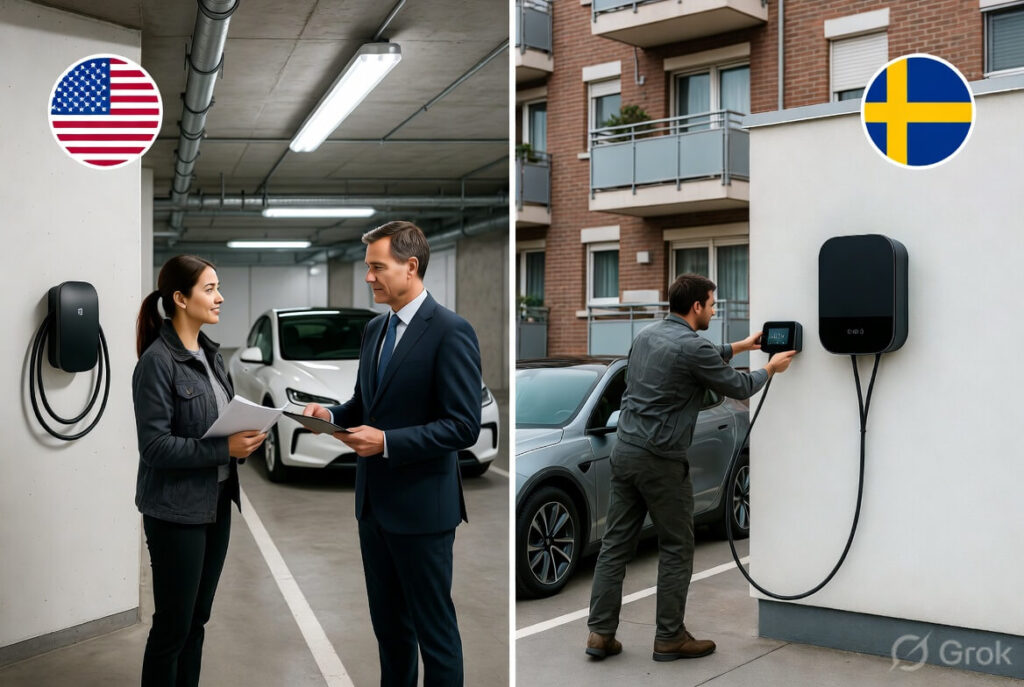
Apartment EV charging solutions 2026 US Europe is the most under-served topic in the entire EV charging space. It affects a significant and growing share of EV owners — roughly 30% of US households live in multi-unit dwellings, and in European cities the percentage is considerably higher. Yet almost every home EV charger guide assumes you own a house with a garage and a dedicated parking space.
The reality for apartment and condo dwellers is messier, more legally complex, and more varied by location than any generic guide acknowledges. This one doesn’t pretend otherwise.
Why Apartment EV Charging Is Harder Than It Should Be in 2026
The core problem is that installing an EV charger in an apartment or condo building involves three parties whose interests don’t automatically align:
You — who wants reliable, convenient home charging and is legally entitled to it in a growing number of jurisdictions.
Your building management or condo association — who may have legitimate concerns about electrical infrastructure capacity, liability, installation quality, and cost allocation between residents.
Your electricity supplier and local grid operator — who may need to approve additional electrical load on the building’s supply and meter the charging separately from your domestic consumption.
Getting these three parties to a workable outcome requires understanding the legal framework in your jurisdiction, the practical constraints of your building’s electrical infrastructure, and the specific solutions that have worked for other apartment EV owners in similar situations.
Let’s cover each geography in turn.
US Apartment and Condo EV Charging — The Legal Landscape in 2026
The Right to Charge — Which US States Have It
The most important piece of information for US apartment EV owners is this: a growing number of states have enacted “right to charge” legislation that limits or prohibits condo associations and landlords from unreasonably denying EV charging installation requests.
As of 2026, the following states have meaningful right to charge protections for EV owners in multi-unit dwellings:
California: The most comprehensive right to charge law in the US. Condo associations cannot unreasonably deny an EV charging installation request. They can impose reasonable conditions — specific installer requirements, insurance requirements, metering requirements — but they cannot simply say no. The law applies to both owner-occupied condos and rental properties.
Florida: Condo associations and homeowner associations cannot prohibit EV charging installations in designated parking spaces. Reasonable rules about aesthetics, installer qualifications, and metering are permitted. The law was strengthened in 2023 and covers both condos and HOAs.
New York: Right to charge laws apply to condo owners in their designated parking spaces. New York City has additional requirements for new building construction to include EV-ready parking.
Colorado, Virginia, Oregon, Washington, Hawaii, Maryland, Connecticut, New Jersey: All have varying degrees of right to charge protection. The specific terms differ — some apply only to owners, some also to renters, some require the association to help facilitate installation rather than just permit it.
Texas, Illinois, Ohio, and most other states: No statewide right to charge legislation as of 2026. You are at the mercy of your condo association’s governing documents and goodwill — with no legal recourse if they simply refuse.
What right to charge laws actually do and don’t do:
Right to charge laws prevent unreasonable refusal. They do not force the building to pay for installation, provide dedicated electrical supply, or guarantee your preferred charging solution. They give you legal standing to push back against a blanket no — they don’t give you a blank cheque to install whatever you want regardless of building constraints.
How to Navigate a US Condo Association EV Charging Request
If you’re in a right to charge state, this is the approach that works:
Step 1: Read your condo association’s governing documents. Look for any existing EV charging policy, electrical modification policy, or parking space modification policy. Some associations already have an EV charging process — following it is faster than fighting for one.
Step 2: Submit a formal written request. Make your request in writing to the board. Include: the specific charging unit you want to install, the licensed electrician you plan to use, your plan for metering (to separate your EV charging costs from the building’s shared electrical bill), and your insurance coverage details.
Step 3: Address the board’s likely objections proactively. The most common condo board objections to EV charging are:
- Electrical capacity concerns — address by providing an electrician’s assessment of the building’s panel capacity
- Cost allocation concerns — address by proposing a submetered circuit that bills your charging directly to your unit
- Safety and liability concerns — address by specifying only OZEV-approved or UL-listed hardware and licensed installation
- Aesthetics concerns — address by specifying a flush-mounted hardwired unit that matches the parking structure’s aesthetics
Step 4: If refused unreasonably in a right to charge state: Send a formal letter citing the specific right to charge statute in your state. Note that their refusal appears to violate the statute and request a written explanation of the specific reasonable grounds for denial. Most condo boards back down at this stage — they don’t want the legal exposure of an unjustified refusal.
Step 5: If refused in a non-right to charge state: Your options are political (working to change the association’s policy through the normal governance process), practical (using the solutions below that don’t require installation approval), or ultimate (moving to a building that accommodates EV charging, which is an increasingly significant factor in property values).
Practical US Apartment EV Charging Solutions That Don’t Require Full Installation Approval
Solution 1: Portable Level 2 EVSE with NEMA 14-50 outlet If your parking space has access to a standard 240V outlet — common in underground parking garages — a portable Level 2 EVSE using a NEMA 14-50 plug may require only outlet installation approval rather than a full charger installation. The distinction matters because outlet installation is simpler, cheaper, and easier to approve than a permanently mounted charging unit. Once the outlet is installed, the portable EVSE plugs in and delivers Level 2 speed (7.2-9.6 kW) without a permanent wall-mounted fixture.
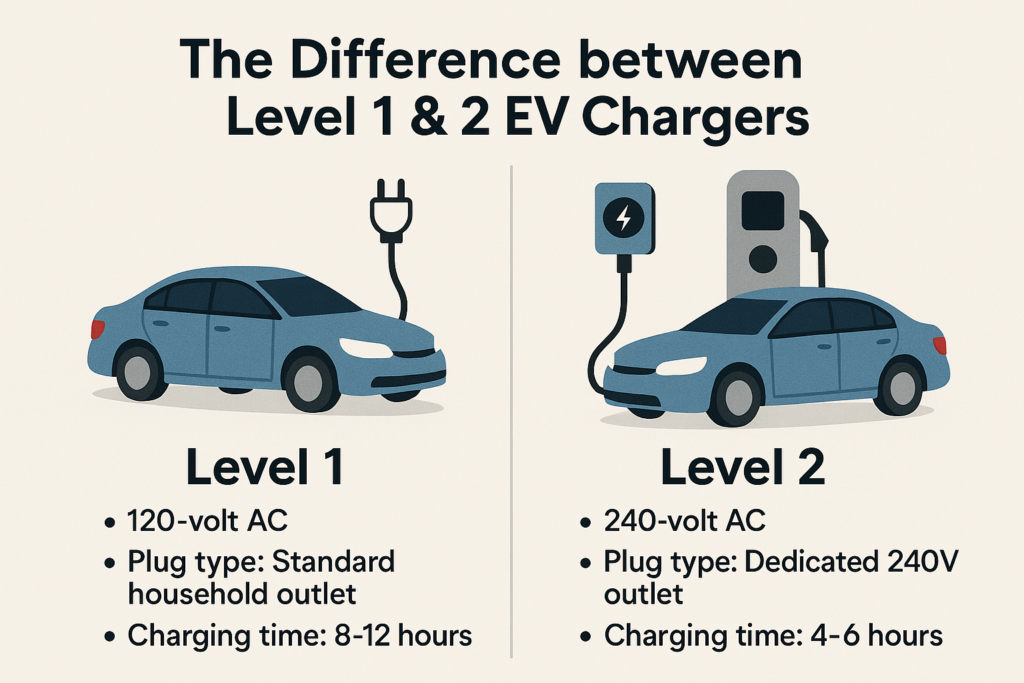
Solution 2: Cord reel or cable management system Some apartment buildings approve a simple cord reel system — a weatherproof extension cord management unit mounted at your parking space that allows you to run a charging cable from a nearby outlet to your car without a dedicated charger installation. This is a workaround rather than a solution — it uses standard 120V outlets and delivers Level 1 speed — but it’s often the path of least resistance in buildings with resistant management.
Solution 3: Shared charging infrastructure proposal Rather than requesting individual charging for your unit, propose a shared charging infrastructure project for the entire building. This approach often gets more traction with condo boards because it distributes the cost and benefit across multiple residents, can be funded through the association’s capital improvement budget, and positions the board as proactively adding amenity value to the building rather than accommodating one resident’s individual request.
Companies like ChargePoint, Blink, and Volta offer apartment building charging programs that include hardware, installation, network management, and individual billing — making the shared infrastructure approach much more turnkey than it was even three years ago.
Solution 4: DCFC public charging plus home Level 1 For lower-mileage drivers in apartments near a reliable DC fast charging station, the combination of weekly DC fast charging at a nearby station and nightly Level 1 charging from a standard 120V outlet in your parking space can cover most charging needs without any special installation. This isn’t ideal — it requires planning and a nearby fast charger — but it’s a legitimate strategy for urban apartment dwellers who drive less than 60 km daily.
European Flat and Apartment EV Charging — The Legal Landscape in 2026
European apartment EV charging law is in many ways ahead of the US — but the practical implementation challenges are at least as complex.
EU-Wide Right to Charge Legislation
The EU Energy Performance of Buildings Directive (EPBD) — significantly strengthened in 2023 and now being implemented by member states — includes provisions that require:
- New residential buildings to have EV charging points or pre-wiring for every parking space
- Existing residential buildings with more than 10 parking spaces to install at least one EV charging point and pre-wiring for 20% of spaces when undergoing major renovation
- Member states to remove regulatory barriers to the installation of EV charging points in existing multi-unit buildings
The “remove regulatory barriers” provision is the most practically relevant for current apartment owners. EU member states are required to ensure that neither building owners nor condominium associations can unreasonably block EV charging installation in individual parking spaces. The specific implementation varies by country.
UK Right to Charge for Flats
The UK’s approach to apartment EV charging changed significantly in 2022 with the introduction of the Electric Vehicle (Smart Charge Points) Regulations, and further in 2023 with updates to the Electric Vehicle Homecharge Scheme.
What UK flat owners can currently claim: The OZEV grant (£350) is available for flat owners installing a home charger — subject to the charger meeting smart charging requirements and installation being by an OZEV-registered electrician. The grant applies to the unit and installation costs.
The flat permission challenge: In England and Wales, installing electrical infrastructure in a flat that affects shared building systems (the electrical supply, common areas, or building fabric) requires landlord or freeholder consent under the terms of most leases. Unlike some EU countries, the UK does not yet have a blanket right to charge that overrides lease terms.
However, the Leasehold Reform Act and ongoing legislative developments are moving toward stronger right to charge protections for UK flat owners. As of 2026, flat owners in England and Wales should:
- Check their lease for any electrical modification or parking space modification clauses
- Submit a formal written request to their freeholder or managing agent, citing the government’s EV charging encouragement and the OZEV grant availability
- Propose a solution that doesn’t affect building fabric — such as a supply from their own flat’s circuit to their parking space, rather than a new connection to the building’s shared supply
Scotland: The Tenements (Scotland) Act provides different rules that can be more favourable to individual flat owners seeking to install EV charging.
Germany — Wohnungseigentumsgesetz (WEG) Reform
Germany’s Wohnungseigentumsgesetz (condominium ownership law) was reformed in 2020 specifically to address EV charging and other accessibility and sustainability improvements. The reformed WEG gives individual flat owners the right to demand permission for EV charger installation as a “privileged construction measure” — the owners’ association cannot refuse permission, only require the requesting owner to bear the costs.
This is one of the strongest right to charge frameworks in Europe. German flat owners can:
- Demand permission for EV charger installation in their assigned parking space
- Cannot be refused by the owners’ association
- Must bear the installation costs themselves
- Must use a qualified electrician
- Must not damage communal property
In practice, the main practical challenge in Germany is the building’s electrical infrastructure capacity — many older German apartment buildings have limited supply capacity that needs to be upgraded to accommodate EV charging loads across multiple residents.
Netherlands, Belgium, Scandinavia
These countries have among the most progressive EV charging frameworks in Europe, consistent with their overall EV adoption rates.
Netherlands: The Dutch government has been proactive in requiring apartment buildings to facilitate EV charging. New buildings must include EV-ready parking. Existing buildings receive government support for shared charging infrastructure installation. Individual residents have strong rights to request EV charging installation in their designated parking spaces.
Belgium: The Belgian government’s EV charging incentive scheme includes provisions for apartment buildings. The Flemish, Walloon, and Brussels regional governments each have slightly different approaches but all include support for apartment building charging infrastructure.
Scandinavia (Norway, Sweden, Denmark, Finland): Among the most developed apartment EV charging frameworks anywhere. Norway in particular — where EV adoption is the highest in the world on a per capita basis — has well-established apartment charging infrastructure across most residential buildings. Individual right to charge is effectively universal and shared charging infrastructure in apartment buildings is commonplace rather than exceptional.
France — The Right to Socket (Droit à la Prise)
France has had a “droit à la prise” (right to socket) since 2011 — one of the earliest right to charge frameworks in Europe. Under this law:
- Residents of apartment buildings cannot be refused permission to install an EV charging point in their parking space
- The building syndic (management body) can require specific technical and aesthetic conditions but cannot refuse outright
- The installation costs are borne by the requesting resident
- The syndic has 3 months to respond to an installation request
In practice, French apartment EV charging has been limited by the practicalities of older building electrical infrastructure. The French government’s collective installation programme — which allows syndicates to install shared charging infrastructure with subsidies — has helped accelerate deployment in apartment buildings across France.
Italy, Spain, Portugal
These Southern European countries have implemented the EPBD provisions with varying speed and comprehensiveness.
Italy: Right to install EV charging in apartment parking spaces exists through condominium law reform, but implementation is patchy. Building administrator (amministratore di condominio) approval is still required in practice, and the process can be slow.
Spain: The technical building code requires EV charging pre-installation in new buildings. Existing buildings are covered by condominium law amendments that generally permit installation with community notification rather than approval, but enforcement varies by community.
Portugal: Strong national EV charging policy includes apartment building provisions. The Portuguese government has been proactive in funding shared apartment charging infrastructure.
The Practical Solutions — Apartment EV Charging That Actually Works in 2026
Regardless of your jurisdiction, these are the solutions that apartment and flat EV owners are actually using successfully in 2026:
Solution 1: Individual Dedicated Circuit to Parking Space
The gold standard for apartment EV charging. A dedicated electrical circuit runs from your flat’s consumer unit (distribution board) to your designated parking space, with a home EV charger installed at the parking space end.
Why it works: The circuit runs from your own electrical supply — you pay for it through your existing electricity bill, no shared metering complications, no shared infrastructure cost allocation.
Challenges: Requires permission for the cable route through building fabric (walls, ceiling voids, risers). In older buildings, the cable run from flat to parking space can be long and expensive — £500-£2,000 for cabling alone depending on distance.
Best hardware for this solution:
- UK/Europe: Wallbox Pulsar Plus (compact, OZEV-eligible), Myenergi Zappi (if you have solar)
- US: ChargePoint Home Flex (NEMA 14-50 option for flexibility), Emporia Pro (solar integration)
Solution 2: Shared Charging Infrastructure with Individual Billing
A single electrical connection from the building’s supply feeds multiple charging points in the parking area. Each charging point is separately metered and bills directly to the resident who uses it — either through a smart charging network (ChargePoint, Zaptec, Easee) or through individual sub-meters.
Why it works: Spreads the installation cost across multiple residents. Building management is more likely to approve shared infrastructure than multiple individual installations. Smart charging networks handle billing automatically.
Who facilitates this:
- US: ChargePoint, Blink, Volta, EV Connect all have specific apartment building programs
- UK: Pod Point, Osprey, Zaptec all offer residential block charging solutions
- Europe: Easee, Zaptec, and Charge Amps all have multi-unit residential products
Cost reality: Shared infrastructure installation for a 10-space apartment car park typically costs £5,000-£15,000 (UK) or $8,000-$20,000 (US) for hardware and installation — spread across the building capital budget or split between participating residents.
Solution 3: Load-Managed Cluster Charging
A more sophisticated version of shared infrastructure that uses dynamic load management to share a single electrical supply connection between multiple chargers. Instead of each charger having its own dedicated supply capacity, a load management system allocates available power dynamically between active charging sessions.
Why it works: Requires less total electrical capacity than individual dedicated circuits for each space. A building that can supply 80A total for EV charging can support 10 chargers that each deliver 8A simultaneously, or 4 chargers at 20A each when fewer cars are charging — the load manager handles the allocation automatically.
Best hardware for this:
- Easee, Zaptec, and ABB all offer load-managed cluster systems specifically designed for apartment buildings
Solution 4: Portable Level 2 EVSE With Dedicated Outlet
As covered in the US section — a portable Level 2 charger plugged into a dedicated 240V/230V outlet at your parking space. Requires outlet installation approval rather than charger installation approval. Delivers full Level 2 speed (7.2-9.6 kW). Can be taken with you when you move.
Best hardware for this:
- US: Lectron 240V portable EVSE ($189-$229), Grizzl-E Duo ($299-$349)
- UK/Europe: Juice Booster 2 (€499-€699, works with multiple socket types), Masterplug EVPOD2UK (£149-£199)
For a deeper look at portable vs hardwired options and when each makes sense, our portable vs hardwired home EV chargers US Europe guide covers every scenario including apartment-specific considerations.
The Costs — What Apartment EV Charging Actually Costs in 2026
Most guides quote charger unit prices without the full picture. Here’s the honest cost breakdown for apartment EV charging:
Individual Installation Costs
US Apartment (individual circuit to parking space):
- Charger unit: $229-$699
- Electrical cable run (per 10 metres): $50-$150
- Total cable run (typical 20-50 metre apartment-to-parking): $100-$750
- Licensed electrician installation: $200-$600
- Permit and inspection fees: $50-$200
- Total realistic range: $579-$2,249
- Federal tax credit (30%, up to $1,000): reduces total by $174-$300
- Net cost after credit: $279-$1,949
UK Flat (individual circuit to parking space):
- Charger unit: £300-£900
- Electrical cable run: £200-£1,500 depending on distance
- OZEV-registered installation: £150-£500
- Total realistic range: £650-£2,900
- OZEV grant: -£350
- Net cost after grant: £300-£2,550
European Apartment (individual circuit to parking space):
- Charger unit: €300-€900
- Electrical cable run: €200-€1,500
- Licensed electrician installation: €150-€500
- Government subsidy (varies by country): €200-€1,000
- Net cost after subsidy: €150-€1,900
Shared Infrastructure Costs (per space)
When a building installs shared charging infrastructure across multiple spaces, the per-space cost typically drops significantly:
US: $800-$2,000 per space for a 10-20 space shared installation (hardware, installation, network setup)
UK: £600-£1,500 per space including installation and OZEV grant
Europe: €500-€1,200 per space including installation and applicable national subsidy
The Management Conversation — How to Get Your Building on Board
The management conversation is where most apartment EV charging projects succeed or fail — not in the technical installation. Here’s what actually works:
Lead with building value, not your personal need. A condo board that hears “I need an EV charger” is thinking about your problem. A condo board that hears “EV charging is now a top-five amenity requirement in apartment searches and buildings with charging command 5-8% higher resale values” is thinking about the building’s value. The second conversation is more likely to produce a yes.
Come with a complete proposal, not a request. Show up to the board meeting with a specific charger, a specific installer quote, a specific metering solution, and a specific insurance and liability arrangement. Boards that receive vague “I want to install an EV charger” requests stall indefinitely. Boards that receive complete proposals with all questions pre-answered move faster.
Find your allies. If other residents have EVs or are planning to buy one, coordinate. A proposal for shared infrastructure from five residents is fundamentally more compelling to a board than an individual request. It also distributes the advocacy effort and the cost.
Cite the legal framework. In right to charge jurisdictions, cite the law. Not aggressively — matter-of-factly. “I wanted to let the board know that [state] law gives residents the right to install EV charging in their designated parking spaces, subject to reasonable conditions. I’d like to work with the board to find a solution that meets the building’s requirements.”
Propose a pilot. Some boards are more comfortable approving a pilot programme for one or two charging spaces than a full building-wide rollout. A successful pilot becomes the template for broader rollout and removes the board’s uncertainty about how it will work in practice.
Subsidies and Grants Available for Apartment EV Charging in 2026
US Federal Tax Credit
The Alternative Fuel Vehicle Refueling Property Credit covers 30% of home EV charger purchase and installation costs up to $1,000 credit for residential installations. Applies to apartment owners installing individual charging in their designated parking space. Does not apply to rental tenants who don’t own the property.
UK OZEV Grant
The £350 Electric Vehicle Homecharge Scheme grant is available for flat owners (not renters) installing OZEV-approved smart chargers. The grant applies to the unit cost and installation cost combined. Requires an OZEV-registered installer. For apartment building shared infrastructure, a separate Workplace Charging Scheme may apply.
EU National Subsidies
France: ADVENIR programme provides subsidies for collective charging infrastructure in apartment buildings — up to €50 per kW of installed charging capacity for collective installations.
Germany: KfW bank offers subsidised loans and grants for EV charging infrastructure in residential buildings.
Netherlands: SEEH subsidy scheme covers 30% of home charging installation costs up to €1,500 including for apartment installations.
Norway: Enova provides grants for apartment building charging infrastructure — typically 20-25% of installation costs.
Belgium: Regional subsidy schemes in Flanders, Wallonia, and Brussels each provide varying levels of support for apartment EV charging installation.
Internal Links — Further Reading on Clean Energy Bazaar
Apartment EV charging solutions 2026 US Europe is where most apartment-dwelling EV owners start their research. Here’s where to go next.
For the portable charger solutions that work best in apartment settings, our portable vs hardwired home EV chargers US Europe guide covers every scenario with honest cost comparisons. For the best home charger hardware options once you have approval, our best home EV chargers 2026 US comparison and best Level 2 EV chargers UK Europe 2026 guide cover all the leading options honestly. For understanding every spec on a charger listing before you propose one to your building management, our guide to understanding EV charger specs 2026 translates everything into plain language. Before buying any charger, our EV charger warranty comparison covers what warranty terms actually mean. And if you’re comparing smart charger options for a shared building installation, our smart EV chargers 2026 features worth the cost guide breaks down which features deliver real value in multi-unit settings.
Final Thoughts
Apartment EV charging solutions 2026 US Europe is solvable — but it requires more effort, more knowledge, and more negotiation than charging in a house with a garage. The legal frameworks are strengthening in most jurisdictions. The technology solutions — portable EVSEs, shared infrastructure, load-managed cluster systems — are better and more accessible than they were even two years ago. And the financial case for buildings to enable EV charging is stronger than ever as EV adoption continues to accelerate.
The apartment and condo EV owners who succeed are the ones who come prepared — with knowledge of their legal rights, a complete proposal rather than a vague request, and a solution that addresses the building management’s concerns rather than simply asserting their own needs.
Know your rights. Build your proposal. Find your allies. The yes is more achievable in 2026 than it’s ever been.