The European automotive market has crossed a threshold that few industry analysts anticipated a decade ago. Chinese manufacturers are no longer marginal players testing the waters. They are now significant competitors, and the data from 2026 confirms that their gains are accelerating rather than plateauing.
According to the European Automobile Manufacturers’ Association, Chinese brands accounted for 11.9% of new car registrations across the EU, UK, and EFTA in the first eight months of 2026, up from 6.7% in the same period of 2025 . That is a near doubling of market share in a single year. In May 2026, Chinese manufacturers outsold Japanese brands in Europe for the first time, a symbolic reversal that would have seemed implausible just a few years ago .
This is Chinese EV brands charge into Europe: BYD and Geely gain ground, and the numbers behind it reveal a structural shift in the competitive landscape.
The Headline Numbers: From 6.7% to 11.9%
The aggregate figures tell the story of a rapid, broad-based expansion.
In the January-to-August period of 2026, Chinese brands registered approximately 725,000 vehicles across the EU, capturing a 9.6% market share, up by roughly two-thirds from the same period a year earlier . By September, the share across the broader EU, UK, and EFTA region had reached 11.9% .
The growth is not concentrated in a single brand. Five major Chinese groups—Geely, BYD, SAIC, Chery, and Leapmotor—collectively sold over 619,000 cars in Europe in the first five months of 2026, according to JATO data . In May alone, Chinese brands captured a record 10.7% of the European market, up from 5.9% a year earlier .
The composition of the Chinese advance has shifted. While battery electric vehicles remain the foundation, Chinese manufacturers have increasingly pivoted toward hybrids and plug-in hybrids, segments that sit outside the EU’s countervailing duties on Chinese-made BEVs. In the first five months of 2026, hybrids accounted for 37.8% of the EU market, BEVs for 20%, and PHEVs for 9.7% . Chinese brands have moved aggressively into the hybrid space, where tariffs do not apply.
BYD: Overtaking Ford and Closing on Tesla
BYD has emerged as the most prominent Chinese manufacturer in Europe, and its 2026 performance has been remarkable.
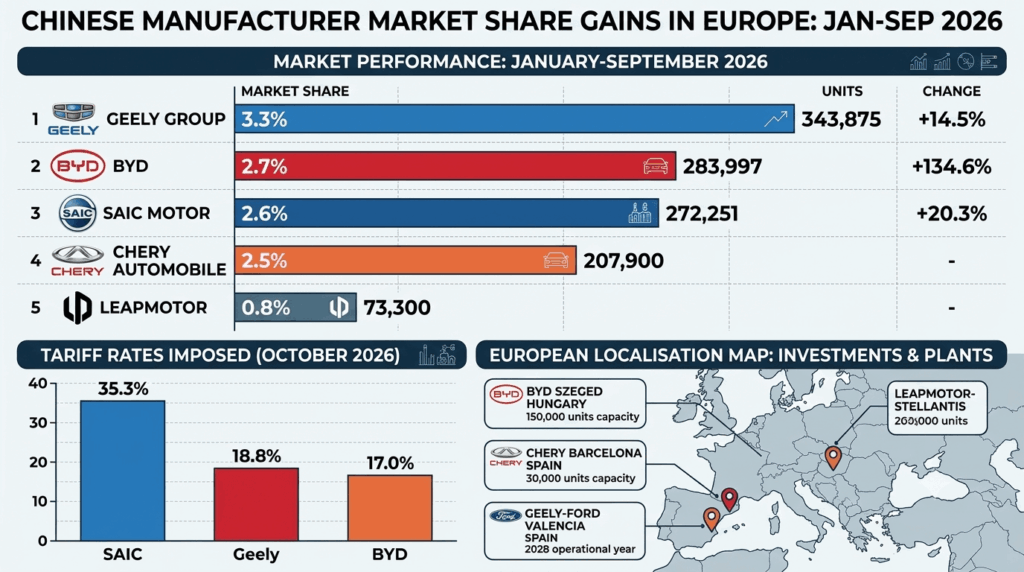
Between January and September 2026, BYD registered 283,997 cars across the EU, UK, and EFTA, a 134.6% increase year-on-year . That figure allowed BYD to overtake Ford, which registered 277,269 vehicles in the same period . BYD’s market share rose to 2.7% from 1.2% a year earlier .
In the EU alone, BYD’s registrations climbed 154.4% to 206,002 units in the first nine months, with its market share expanding to 2.4% from 1.0% . That placed BYD ahead of Tesla in cumulative registrations for the January-to-September period, even as Tesla recorded strong growth of its own .
The model strategy has been broad rather than narrow. BYD has deployed more than ten models across Europe, with the Dolphin Surf and Seal each exceeding 5,000 quarterly sales in the first quarter of 2026 . In the first quarter, BYD’s European BEV sales reached 25,074 units, a 75.13% increase, lifting its BEV market share to 5.4% and placing it among the top five BEV brands in Europe for the first time .
BYD is not relying on imports alone. Its Szeged plant in Hungary is scheduled to begin passenger vehicle assembly in the fourth quarter of 2026, with an initial production target of 150,000 vehicles annually, scaling toward 300,000 units . The company has said it aims to produce all of its EVs for Europe locally by 2028 .
Geely Group: The Volume Leader Through Established Brands
While BYD captures headlines with its rapid growth, Geely Group has become the largest Chinese carmaker in Europe by volume, largely through brands that European consumers already know.
Geely Group, which includes Volvo, Polestar, Lotus, Lynk & Co, Zeekr, Smart, and the Geely brand itself, registered 343,875 vehicles in the first nine months of 2026, a 14.5% increase . Its market share reached 3.3%, up from 3.0% . In the January-to-August period, Geely accounted for 3.1% of total European registrations, making it the biggest Chinese group on the continent .
The strength of Geely’s position lies in its portfolio of established European brands. Volvo and Polestar provide recognition and dealer networks that newer Chinese entrants lack. The Geely brand itself is expanding, entering seven European markets in just 45 days in 2026, with its EX5 and EX5 EM-i models now available in more than 20 countries.
Geely is also investing in local production. In July 2026, it announced plans to build two electric SUVs at a Ford plant in Spain under a joint venture 66%-owned by Ford and 34% by Geely, with the first vehicles expected in 2028 .
Chery and Leapmotor: The Fastest Risers
The most dramatic growth rates among Chinese manufacturers have come from Chery and Leapmotor, albeit from smaller bases.
Chery Automobile, which operates through the Chery, Omoda, Jaecoo, and Jetour brands, saw its European market share rise from 0.7% to 2.5% in the first nine months of 2026, a gain of 1.8 percentage points . In May 2026, Chery’s registrations grew 244.1% year-on-year . The company has a 40% stake in a joint venture with Spanish carmaker EBRO to manufacture vehicles at a former Nissan plant in Barcelona, with production expected to begin at the end of 2026 or early 2027 .
Leapmotor, which partners with Stellantis, saw its market share rise from 0.2% to 0.8% . In the first quarter of 2026, Leapmotor’s European BEV sales reached 18,246 units, an 846.37% increase, lifting its BEV market share to 4% . The T03 city car was the volume driver, with 12,550 units sold in the quarter, entering the top four best-selling BEV models in Europe .
SAIC and MG: The Incumbent Under Pressure
SAIC Motor, which owns the MG brand, remains a significant player, but its position is under pressure.
SAIC registered 272,251 vehicles in the first nine months of 2026, a 20.3% increase, with its market share rising to 2.6% from 2.3% . But MG’s BEV sales in Europe declined 7.08% in the first quarter of 2026 to 8,376 units, and the brand that once led Chinese EV sales in Europe has been overtaken by BYD and Leapmotor .
The reason is partly structural. MG faces the highest EU countervailing duty of any Chinese manufacturer at 35.3%, making its imported vehicles more expensive than those from BYD (17.0%) and Geely (18.8%) . SAIC has responded by shifting its sales mix toward leasing and fleet channels, but the competitive pressure is evident .
The Tariff Response and the Localisation Pivot
The European Union’s countervailing duties, imposed in October 2024, were designed to slow the advance of Chinese EVs. They have not succeeded in reversing it. Instead, they have accelerated a pivot toward local production.
Chinese manufacturers are now advancing operations across 26 European production sites, according to industry tallies . These include BYD’s Szeged plant in Hungary, Chery’s Barcelona joint venture with EBRO, Geely’s planned Ford joint venture in Spain, and Leapmotor’s production plans with Stellantis. The strategy is straightforward: assembling vehicles inside the EU removes the combined 27% duty penalty on imported electric cars .
The localisation push extends to the battery supply chain. Seven Chinese battery suppliers now hold a combined 67.8% of the European battery market share, up from 41.0% in 2023 . The industrial footprint is deepening, not retreating.
What This Means for the European Market
The Chinese advance has several implications that extend beyond market share numbers.
For European manufacturers, the pressure is intensifying. Geely Group’s registration volume in the first nine months of 2026 exceeded Ford’s, and BYD has now overtaken Ford as well . The competitive threat is no longer confined to the affordable end of the market. Chinese brands are moving into hybrids, SUVs, and premium segments.
For consumers, the expansion has brought more choice and lower prices. The availability of Chinese models has pressured established manufacturers to improve their value propositions. But the long-term effect on prices will depend on whether Chinese manufacturers can maintain their cost advantage as they localise production in higher-cost European environments.
For policymakers, the tariff strategy has produced mixed results. It has slowed the import of Chinese BEVs but has not stopped the growth of Chinese brands, which have pivoted to hybrids and local production. The European Commission has acknowledged the need for a more comprehensive approach, including local content requirements and battery production incentives.
The Chinese EV brands charge into Europe, and BYD and Geely are leading the way. The data from 2026 confirms that this is not a temporary surge. It is a structural shift in the European automotive market, and it is accelerating.