The electric vehicle industry has spent a decade telling drivers that charging will eventually be as fast as refuelling. BYD has now built the technology, the vehicles, and the infrastructure to make that claim real.
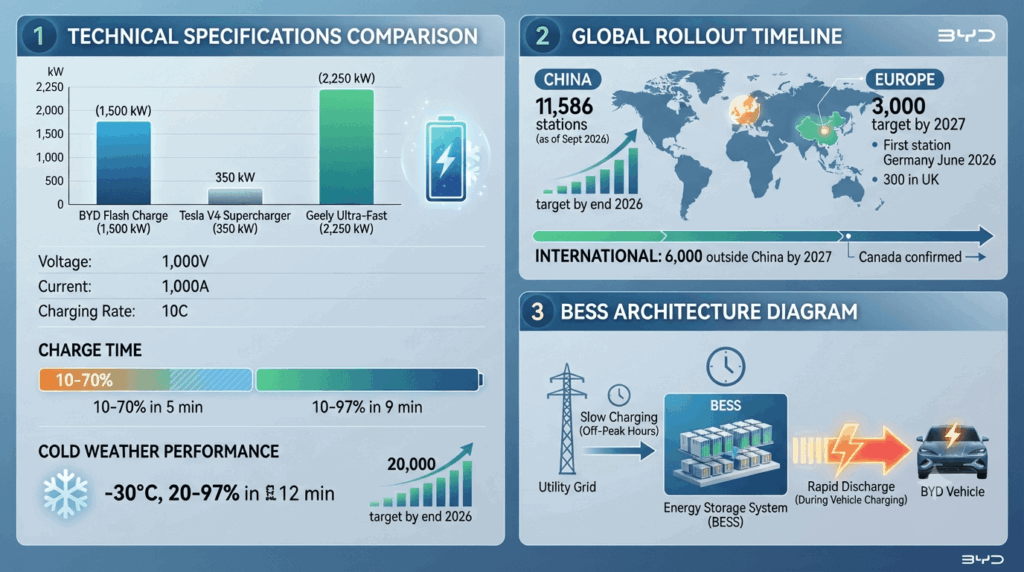
In March 2026, BYD unveiled its second-generation Blade Battery and FLASH Charging system. The specifications were not incremental improvements. They were a categorical shift. A compatible vehicle can charge from 10% to 70% in five minutes and from 10% to 97% in nine minutes. A single connector delivers up to 1,500 kW. And the system performs in conditions that would cripple conventional charging, with 20% to 97% taking just twelve minutes at minus 30°C.
This is BYD’s five-minute flash charging: how it works and where it’s coming.
The Technology: 1,500 kW and the Super e-Platform
The foundation of FLASH Charging is BYD’s Super e-Platform, a 1,000-volt architecture that enables charging currents of up to 1,000 amps and a peak charging power of 1 megawatt. The system uses silicon carbide semiconductors to handle the high-voltage environment efficiently, reducing energy losses during power conversion.
The charging rate reaches 10C, meaning the battery can be charged at ten times its capacity in current terms. That is the highest charging rate of any mass-produced traction battery in the world. In practical terms, a 100 kWh battery pack can accept 1,000 kW of charging power at peak.
The connector itself is designed for the task. BYD’s flash charging stations feature T-shaped overhead gantries that emulate petrol station layouts, allowing vehicles to charge from either side. The stations use the CCS2 standard outside China, making them compatible with non-BYD vehicles, though the maximum power output is only achievable by BYD and Denza models equipped with the appropriate battery technology.
The critical enabler is the second-generation Blade Battery. The original Blade Battery used lithium iron phosphate chemistry in a structural design where cells acted as load-bearing elements. The second generation retains the LFP foundation but blends it with lithium manganese iron phosphate to raise energy density by approximately 5%. More importantly, it reduces internal resistance, which is the key to accepting high charging currents without excessive heat generation.
The Performance: Five Minutes to 70%, Nine to 97%
The headline figures are straightforward. From 10% to 70% state of charge takes five minutes. That is the equivalent of adding approximately 400 kilometres of CLTC range. From 10% to 97%, essentially a full charge, takes nine minutes. For context, Tesla’s V4 Supercharger, the most powerful charger in widespread deployment, delivers up to 350 kW. BYD’s system delivers more than four times that power.
The cold-weather performance is the specification that changes the practical calculus for millions of drivers. At minus 30°C, charging from 20% to 97% takes twelve minutes. That is only three minutes longer than the same charge at normal temperatures. Conventional lithium-ion batteries suffer dramatically reduced charging rates in extreme cold, often requiring battery pre-conditioning that consumes energy and adds time. BYD’s system eliminates that penalty almost entirely.
The first production vehicles to use the technology are the Han L sedan and Tang L SUV. The Han L can achieve 400 kilometres of range in five minutes of charging. During live demonstrations, the megawatt flash charger reached 1 MW charging power in ten seconds while charging a Han L. The Denza Z9GT, BYD’s premium shooting brake, is the first European model to feature the technology, with deliveries expected through the Denza brand.
The Infrastructure: 11,586 Stations and Counting
BYD is not waiting for other companies to build the charging network. It is building its own.
As of September 2026, BYD had constructed 11,586 flash charging stations in China, covering 341 cities. The company’s target is 20,000 stations by the end of 2026. Of those, 2,000 are designated as highway stations, and that target was completed three months ahead of schedule. The highway stations cover nearly one-third of China’s highway service areas, with an average spacing of just over 100 kilometres.
The network is open to electric vehicles from other brands. Actual charging power depends on each vehicle’s capabilities, and not all models can achieve the charging speeds advertised by BYD. Owners of other brands account for nearly one-third of users. The flash charging network had delivered a cumulative 210 million kWh of electricity and served more than 1.83 million users as of August 2026.
The international rollout is underway. BYD activated its first commercial Flash charging station in Germany in June 2026 and is preparing a rollout of 3,000 ultra-fast charging points across Europe by the end of 2026 or 2027. In the United Kingdom, BYD plans to install around 300 1,500 kW Flash chargers before the end of 2027, with coverage potentially leaving a charging point every 50 kilometres on main corridors. The company is investing nearly €2 billion in the European network.
Beyond Europe, BYD plans 6,000 flash charging stations outside China by 2027, including the 3,000 in Europe. The company has confirmed plans to bring its megawatt Flash Charging network to Canada, marking the first confirmed deployment in North America. Denza, BYD’s premium brand, plans to deploy 350 Flash Charging stations across the Iberian Peninsula, with 300 in Spain and 50 in Portugal, before the end of 2027.
The Grid Solution: Battery Energy Storage Systems
Delivering 1,500 kW to a single vehicle requires more power than most grid connections can provide. A station with multiple chargers would require grid infrastructure that simply does not exist in most locations.
BYD’s solution is to pair the chargers with ultra-fast-discharge battery energy storage systems. The BESS acts as both an energy reservoir and a power amplifier. When no vehicle is charging, the storage system recharges slowly from the existing grid connection. When a vehicle plugs in, the storage system discharges rapidly to deliver the high charging power. This approach avoids the need for costly grid upgrades and allows flash charging stations to be deployed in locations where a direct high-power connection would be impractical.
The BESS system is not an afterthought. It is a core component of the flash charging architecture. BYD’s plug-and-play solution treats the chargers as a “station within a station”, using their own energy storage systems to provide the extremely high charging power for short periods. The energy storage systems are charged on-site by the existing electrical infrastructure when no electric vehicle is charging.
This architecture has a second benefit. By charging the BESS during off-peak hours and discharging during peak demand, the system can reduce energy costs. In the United Kingdom, BYD has hinted that it might aim for charging rates close to 50 pence per kWh, relying on stationary batteries installed at the sites to charge during off-peak hours and reduce energy costs.
The Competitive Context: A New Stage in the Charging War
BYD’s flash charging technology represents a significant escalation in the global competition over charging infrastructure.
Tesla operates more than 20,000 charging points in Europe and over 80,000 globally. Its V4 Supercharger delivers up to 350 kW. BYD’s system delivers more than four times that power. The gap is not incremental. It is generational.
Chinese competitors are responding. Geely unveiled its Geely Smart Charging technology and fifth-generation chargers in September 2026, with a peak output of 2,250 kW, compared with BYD’s maximum of 1,500 kW per connector. The competition over charging speeds is intensifying, and BYD’s early lead in deployment is being tested.
The more important competition may be over business models. BYD’s approach of vertical integration, where the company manufactures the vehicles, the batteries, the chargers, and the energy storage systems, gives it control over the entire charging experience. Tesla has followed a similar model with its Supercharger network. Traditional automakers have generally relied on third-party charging networks, ceding control over a critical part of the customer experience.
What It Means for Drivers
For drivers in China, the network is already operational. More than 11,500 stations are running, and the highway network provides coverage on major routes with an average spacing of just over 100 kilometres. For drivers in Europe, the rollout is underway but will take time to reach meaningful coverage. The first German station is operational, and the United Kingdom will see approximately 300 chargers by the end of 2027.
The practical benefit is straightforward. A five-minute charge that adds 400 kilometres of range makes long-distance electric travel functionally equivalent to petrol travel. The driver stops, plugs in, uses the restroom, buys a coffee, and returns to a vehicle that is ready to continue. The charging time is no longer the constraint.
The cold-weather performance extends that benefit to regions where EV adoption has been slowest. A vehicle that charges from 20% to 97% in twelve minutes at minus 30°C is a vehicle that works in Scandinavia, Canada, and the northern United States without compromise.
The limitations are equally clear. The maximum charging speed is only achievable by BYD and Denza models equipped with the second-generation Blade Battery. Other vehicles can use the network but will charge at their own maximum rates. The network is expanding rapidly but does not yet match the geographic coverage of established charging operators in Europe and North America. And the cost of charging at flash stations has not been fully disclosed, though BYD’s use of BESS suggests it is targeting competitive pricing.
BYD’s five-minute flash charging is not a laboratory demonstration or a future promise. It is a commercial technology, deployed in production vehicles, supported by a rapidly expanding charging network. The company has built the vehicles, the batteries, the chargers, and the energy storage systems. The only question remaining is how quickly the rest of the world gets access to it.