The solid-state battery race has a distinct geographic character. In Asia, the commercialisation clock is ticking loudly. In Europe, the research engines are firing.
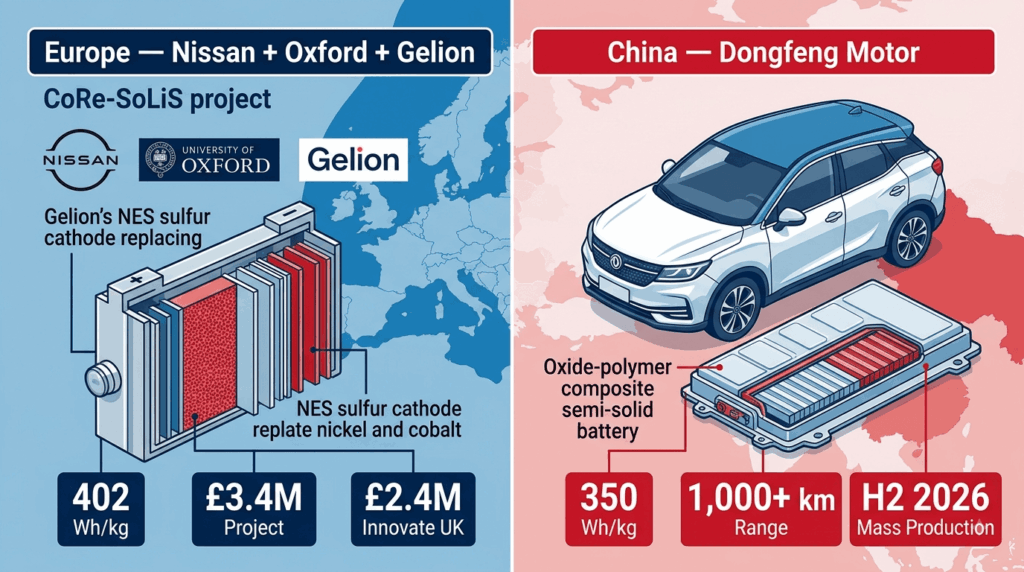
On one side of the world, Dongfeng Motor Corporation has announced it will begin mass-producing and installing its self-developed next-generation solid-state batteries in vehicles during the second half of 2026. The battery boasts an energy density of 350 Wh/kg, a range exceeding 1,000 kilometres on a full charge, and a pack that is 30% lighter than conventional lithium-ion batteries.
On the other side, a distinctly European collaboration is taking shape: Nissan Technical Centre Europe, the University of Oxford, and Anglo-Australian battery innovator Gelion have launched a three-year, £3.4 million project to develop solid-state lithium-sulfur batteries that replace expensive nickel and cobalt with abundant, ultra-low-cost sulfur.
This guide on Europe focus: Nissan Europe/Oxford/Gelion; Dongfeng’s planned mass production (H2 2026) provides the complete, honest analysis — what the CoRe-SoLiS project actually involves, how Gelion’s NES technology claims to overcome lithium-sulfur’s historical limitations, what Dongfeng’s mass production announcement means for the global solid-state race, and the honest assessment of whether Europe can compete with China’s march to commercialisation.
Part One: The European Collaboration — Nissan, Oxford, and Gelion
The CoRe-SoLiS Project — What It Actually Is
The announcement:
In June 2026, Australian-founded battery innovator Gelion announced a three-year collaboration with Nissan Technical Centre Europe and the University of Oxford to advance solid-state lithium-sulfur battery development. The project, known as CoRe-SoLiS (Cost-effective, Resilient Solid-state Li-S), began in June 2026.
The funding:
The total project cost is £3.4 million, with £2.4 million in combined grant funding from Innovate UK under the Battery Innovation Concept Development Round 1 competition. This includes an award of £1.6 million to Gelion’s UK subsidiary. Approximately two-thirds of the budget is covered by public funding.
The partners and their roles:
Gelion brings its Nano-Encapsulated Sulfur (NES™) cathode active material — a proprietary technology that encapsulates sulfur at the nanoscale to address the historical performance limitations of sulfur-based battery chemistry. Gelion’s NES technology is already used in its high-performance liquid electrolyte lithium-sulfur batteries, achieving an energy density of 402 watt-hours per kilogram.
Nissan Technical Centre Europe contributes extensive experience in automotive-grade solid-state battery development, ensuring the project aligns with real-world performance, safety and manufacturability requirements. The project aligns with Nissan’s major investment in its Sunderland manufacturing hub through the EV36Zero programme, ensuring the UK remains at the heart of Nissan’s European electrification strategy.
The University of Oxford, a global leader in solid-state battery science, provides advanced anode materials and cell-level expertise to de-risk integration.
The project goal:
The initiative focuses on integrating Gelion’s NES cathode into next-generation solid-state cells. The aim is to build and deliver a high-power, high-energy and long-duration solid-state lithium-sulfur battery pack specifically focused on meeting the key performance indicators of automotive solid-state battery applications, informed by Nissan’s performance, safety and manufacturability requirements.
The NES Technology — Why Lithium-Sulfur Is Different This Time
The fundamental challenge lithium-sulfur has always faced:
Sulfur-based batteries have historically faced technical limitations that have restricted commercial adoption, namely power and cycle-life issues caused by the formation of polysulfides. During charging and discharging, the sulfur cathode forms soluble intermediate compounds — lithium polysulfides — that dissolve into the electrolyte, migrate to the anode, and cause rapid capacity fade and short cycle life.
What NES does differently:
Gelion’s NES technology overcomes these challenges, unlocking performance levels previously considered unachievable for sulfur cathodes. By encapsulating sulfur at the nanoscale, the technology physically contains the polysulfides and prevents their migration, enabling sulfur to function as a high-performance cathode material while maintaining the benefits of low cost and broad availability.
The key advantages:
Gelion’s NES technology offers:
- Reduced reliance on critical minerals
- Lower material and manufacturing costs
- Compatibility with existing global production lines
- Suitability for high-power and fast-charge applications
- Alignment with emerging anode technologies such as lithium metal and hard carbon
The Longspur Capital “Cheaper Than China” thesis:
A recent Longspur Capital research report provides additional context on the potential impact of Gelion’s sulfur cathode technology. The report outlines how NES addresses the long-standing polysulfide shuttle issue and notes that Gelion’s cathode delivers energy density comparable to high-performance NMC chemistries while also offering competitive power delivery, charging speed, cycle life and low-temperature performance.
The report argues that Gelion has “successfully developed a battery cathode material platform that delivers the benefits of high-performance lithium ion but that could be produced in the West more cheaply than China today” — potentially neutralising the cost advantage Chinese manufacturers currently hold through scale and supply chain integration.
Nissan’s Broader Solid-State Strategy
The Yokohama pilot line:
Nissan inaugurated an all-solid-state battery production line at its Yokohama facility in Japan in January 2025. The pilot line, covering approximately 10,000 square metres, is aimed at further promoting development and innovative manufacturing technologies for the batteries.
The 2028 target:
Nissan has successfully stacked up to 23 battery cells into a single solid-state battery pack prototype, sufficient for real-world vehicle application while also meeting key charge and discharge performance requirements. Within the same size constraints, these solid-state batteries can deliver roughly double the energy density of conventional lithium-ion batteries, potentially cutting charging times by nearly two-thirds.
Nissan plans to introduce its first EVs powered by in-house solid-state batteries by fiscal 2028. While detailed specifications remain undisclosed, these batteries could potentially double driving range compared to traditional lithium-ion systems, translating to a WLTP range exceeding 620 miles.
The LiCAP partnership:
Nissan has partnered with US-based LiCAP Technologies to scale up production. LiCAP’s Activated Dry Electrode technology eliminates the need for drying and solvent recovery, helping reduce manufacturing costs and improve efficiency.
The CoRe-SoLiS role:
The CoRe-SoLiS project is designed to inform Nissan’s 2028 solid-state EV timeline. Gelion CEO John Wood commented: “This endorsement of our technology’s commercial potential in solid-state cells for automotive applications highlights the platform nature of NES™. The two primary opportunities to push battery performance boundaries (independently) are solid-state and sulfur cathode material. This project combines both”.
Part Two: Dongfeng’s Planned Mass Production — The Chinese Front
The Announcement
What Dongfeng has announced:
In June 2026, Dongfeng Motor Corporation confirmed that its self-developed next-generation solid-state batteries will begin mass production and installation in vehicles during the second half of 2026. The official target month is September 2026.
The automaker established a dedicated team back in 2018 to focus on an oxide-polymer composite approach, continuously refining formulations and processes. Today, Dongfeng has achieved full mastery of core technologies, spanning from electrode materials and solid electrolytes to complete battery pack integration.
The technology:
Dongfeng’s solid-state battery is an oxide-polymer composite semi-solid battery, 100% self-developed with fully domestic intellectual property. Key specifications include:
- Energy density: 350 Wh/kg
- Range: Exceeding 1,000 kilometres on a full charge
- Weight: 30% lighter than conventional lithium-ion batteries
- Cold-weather performance: Retains over 74% of its charge at -30°C
- Heat tolerance: Withstands temperatures up to 170°C, far surpassing national testing standards
The vehicle application:
The battery will be installed in the Dongfeng Yipai eπ007, with CLTC range exceeding 1,000 kilometres. The company has a clear timeline: September 2026 for mass production, September 2026 for vehicle installation.
The Development Journey
From research to production:
Dongfeng’s solid-state battery development has followed a methodical path:
2018: Dedicated team established focusing on oxide-polymer composite approach
2019: First-generation solid-state battery system completed
2021: Secured China’s first certification for a solid-state battery passenger vehicle, with a fleet of 50 demonstration cars logging over 3.2 million kilometres of safe driving
2025: Solid-state battery laboratory and 0.2 GWh pilot line went into operation, establishing a complete R&D and production chain spanning from laboratory to trial and pilot lines
2026: Mass production begins in H2
The manufacturing capability:
Dongfeng’s solid-state battery pilot workshop is now running a fully automated production line, encompassing more than 20 processes ranging from material feeding and coating to baking and welding.
To tackle mass-production hurdles — such as wider electrode gaps and higher internal resistance caused by the hardness of solid electrolytes — the team drew on real-world driving scenarios. By optimising internal battery contact surfaces to minimise energy loss, and leveraging proprietary technologies like directional pressure relief, thermal-electrical separation, and novel materials, the group has systematically overcome these obstacles.
The Industrial Ecosystem
The Hubei Solid-State Battery Industry Technology Innovation Consortium:
In May 2026, Dongfeng Motor led the formation of the Hubei Solid-State Battery Industry Technology Innovation Consortium, joining forces with 18 enterprises and universities — including Wuhan University and Huazhong University of Science and Technology — to accelerate technological iteration and industrial application.
The 2027 roadmap:
The research team is currently developing fast-charging solid-state batteries and higher energy density technologies, aiming to equip vehicles with next-generation high-specific-energy batteries by 2027.
Europe vs. China — The Solid-State Race Compared
The Commercialisation Gap
| Dimension | Europe (Nissan/Oxford/Gelion) | China (Dongfeng) |
|---|---|---|
| Technology | Solid-state lithium-sulfur (all-solid-state target) | Oxide-polymer composite semi-solid |
| Energy density | 402 Wh/kg (cell-level lab) | 350 Wh/kg (production) |
| Stage | Research collaboration, R&D | Mass production (H2 2026) |
| Timeline to market | 2028 (Nissan solid-state EV) | September 2026 |
| Funding | £3.4M total, £2.4M public | Corporate R&D, industrial consortium |
| Key advantage | Cost (sulfur replaces nickel/cobalt) | Speed to market, scale |
The honest assessment:
The gap is stark and widening. Dongfeng will have solid-state (semi-solid) batteries in production vehicles in September 2026. Nissan’s first solid-state EV is targeted for 2028. Europe is still in the research phase; China is in the production phase.
The semi-solid vs. all-solid-state distinction:
It is important to acknowledge the distinction: Dongfeng’s battery is a semi-solid battery (oxide-polymer composite), not a true all-solid-state battery. The CoRe-SoLiS project is targeting true all-solid-state lithium-sulfur.
Semi-solid batteries are an improvement based on the existing liquid lithium-ion battery system. All-solid-state batteries represent a disruptive innovation in materials, processes, and performance. The gap between semi-solid and all-solid-state is significant.
The European scepticism:
Commenting on the CoRe-SoLiS announcement, industry observer William Tahil noted: “How much did the University of Oxford already put into Oxis? Try again I suppose” — a reference to OXIS Energy, a previous UK lithium-sulfur battery company that entered administration in 2021 after failing to commercialise its technology.
The comparison is worth taking seriously: lithium-sulfur has been promising to deliver the cost breakthrough for decades, and multiple companies have failed to make the technology work at automotive scale.
What This Means for Today’s EV Buyers
The Practical Purchasing Guidance
Should you wait for solid-state before buying an EV?
The honest answer: no. Dongfeng’s mass production announcement is significant, but it is for the Chinese market. European buyers waiting for solid-state EVs from Nissan are waiting until 2028 at the earliest.
The realistic timeline:
- Dongfeng (China): Semi-solid batteries in production vehicles — September 2026
- Nissan (Global): First all-solid-state EV — 2028
- CoRe-SoLiS project: R&D 2026-2029, commercial prototype target FY2027
- European solid-state EVs reaching consumers: 2028-2030 (realistic estimate)
The wait-for-better-technology calculation:
At $1,500-$2,500/year in fuel cost savings versus a comparable gasoline vehicle, waiting three additional years for solid-state costs approximately $4,500-$7,500 in foregone savings — a cost that would need to be recovered through solid-state technology advantages that, at the vehicle price premiums solid-state batteries will initially command, may not materialise.
The appropriate response:
- Buy current EVs with confidence: Lithium-ion technology is proven, available now, and delivers substantial cost savings over gasoline vehicles
- Monitor solid-state development: The CoRe-SoLiS project’s milestones and Dongfeng’s production ramp will provide genuine signal about commercialisation timelines
- Plan for the long term: For buyers considering their next vehicle after the next one, solid-state is relevant to consider
Internal Links — Further Reading on Clean Energy Bazaar
The Europe focus: Nissan Europe/Oxford/Gelion; Dongfeng’s planned mass production (H2 2026) guide connects to the battery technology and EV market guides on cleanenergybazaar.com.
For the Nissan + Oxford + Gelion lithium-sulfur partnership guide covering the CoRe-SoLiS project in detail, our Nissan + Oxford + Gelion partnership – can lithium-sulfur break the cost barrier? guide covers the technology and funding breakdown. For the solid-state vs. lithium-ion comparison guide covering the broader technology landscape, our solid-state vs. lithium-ion: safety, range, and cost compared guide covers the complete comparison. For the US focus guide covering the American solid-state push, our US focus: Factorial Energy’s partnership with Stellantis; SwRI and SMU collaborative research guide covers the US solid-state landscape. For the upcoming EV charger trends guide covering battery technology developments, our upcoming EV charger trends 2026-2027 V2G solid-state batteries guide covers the global battery innovation landscape.
Final Thoughts
Europe focus: Nissan Europe/Oxford/Gelion; Dongfeng’s planned mass production (H2 2026) — and the honest assessment is that the two fronts could not be more different in their stage of development.
Dongfeng is in production. September 2026. Semi-solid batteries with 350 Wh/kg energy density, 1,000+ kilometre range, and a pack 30% lighter than conventional lithium-ion. The company has logged over 3.2 million kilometres of safe driving across 50 demonstration vehicles. The pilot line is fully automated. The supply chain is being built. The industrial consortium is in place.
Europe is in research. The CoRe-SoLiS project is a three-year, £3.4 million concept development programme. The technology — solid-state lithium-sulfur — is promising, with 402 Wh/kg demonstrated at cell level. The partnership is credible: Gelion’s NES technology, Nissan’s automotive expertise, Oxford’s fundamental science. The UK government backing is meaningful.
But the gap is real. Dongfeng’s battery is in production vehicles in three months. Nissan’s first solid-state EV is targeted for 2028. Europe’s lithium-sulfur technology is still in the laboratory, aiming for a commercial prototype in FY2027.
The honest verdict: China is winning the solid-state commercialisation race. Europe’s approach is more ambitious — true all-solid-state lithium-sulfur versus semi-solid — but ambition does not equal speed. The CoRe-SoLiS project is a credible attempt to develop a genuinely cost-competitive, supply-chain-resilient battery technology. But it is years behind Dongfeng’s production timeline.
Today’s EV buyers should purchase current lithium-ion vehicles with confidence while monitoring solid-state development for their next purchase decision. Solid-state is coming — but in Europe, it is coming later than in China.