Guangzhou’s residential landscape is defined by its high-rise towers — not the modest five or six storey buildings that characterise residential architecture in many Chinese provincial cities, but genuine high-rise towers of 30, 40, even 50 storeys concentrated in Tianhe, Haizhu, Liwan, and the extended Guangzhou metropolis that has absorbed Foshan, Dongguan, and other Pearl River Delta cities into an effectively continuous urban fabric. These towers, many built during the rapid urbanisation of the 1990s and 2000s, were designed for a city where almost nobody owned a private car and where the concept of home EV charging was decades in the future.
The specific Guangzhou high-rise challenge is therefore not simply the generic Chinese apartment EV charging problem covered in our comprehensive flywire safety guide — it is a specific amplification of that problem created by the combination of building height, underground parking depth, and the Pearl River Delta’s humidity and heat that together make the flywire charging arrangements some Guangzhou residents attempt particularly dangerous and the formal installation process particularly complex.
This guide on the flywire fix legal safe options for high-rise owners in Guangzhou addresses the specific Guangzhou situation with the specificity it deserves — the particular regulatory provisions that apply in Guangzhou, the specific infrastructure characteristics of Guangzhou’s high-rise residential stock, the Guangzhou-specific climate considerations that affect equipment choices, and the realistic ranked options for Guangzhou high-rise EV owners who want to charge legally and safely without resorting to the dangerous flywire arrangements that have caused fires in Guangzhou residential compounds and that Guangzhou’s fire safety authorities have specifically targeted for elimination.
Why Guangzhou’s High-Rise Context Is Specifically Challenging
The Compound Factors That Make Guangzhou Different
Factor 1: Building height and cable run distance
Guangzhou’s residential towers create cable run distances from distribution infrastructure to parking spaces that frequently exceed what is manageable through standard residential electrical installation:
For a Guangzhou high-rise where the distribution board serving the underground car park is located on the B1 or B2 level and the nearest apartment is on the 15th floor, the cable distance from an apartment’s electrical supply to the parking space is genuinely enormous — 50-80 metres or more even before accounting for any horizontal distance within the car park itself.
This distance makes the most dangerous form of flywire charging — running a cable from a high-floor apartment down to a basement parking space — both physically impractical and safety-catastrophic when attempted. The resistance of a 60-metre cable of inadequate specification, carrying sustained EV charging current, creates the cable heating failure mode documented in our flywire safety guide and our Pinduoduo scams guide at its most severe.
Factor 2: Pearl River Delta climate — heat, humidity, and the specific Guangzhou combination
As covered in our weatherproof charger guide’s South China section, Guangzhou experiences South China’s full monsoon and heat combination:
Summer temperatures: 32-36°C regularly from May through October
Humidity: 75-85% relative humidity during the monsoon period (April through September), rarely dropping below 65% even in drier months
Annual rainfall: approximately 1,700mm, concentrated in the monsoon season but with year-round elevated humidity
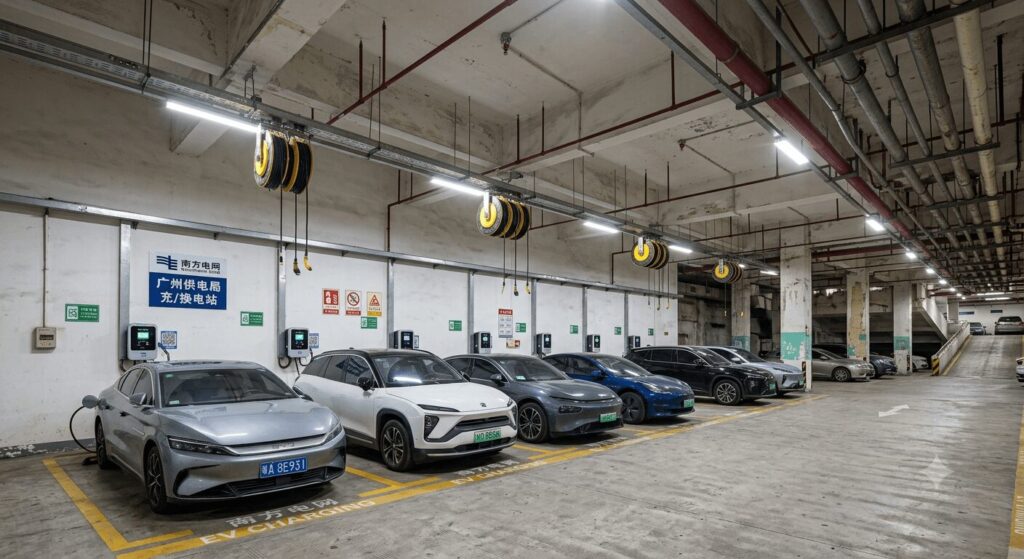
For EV charging equipment in Guangzhou’s underground car parks, this climate creates specific challenges:
Underground car parks in Guangzhou that draw air from surface-level ventilation shafts experience direct humidity import during the monsoon season — the hot, humid surface air that enters for ventilation carries moisture that condenses on cooler concrete and metal surfaces, including electrical equipment
The humidity-temperature combination that our furnace city guide identified as particularly aggressive for connector corrosion applies in Guangzhou with the additional monsoon intensity that can temporarily exceed even Wuhan’s documented corrosion rates during the April-June pre-monsoon and the July-September active monsoon periods
Factor 3: Older housing stock with limited infrastructure
Guangzhou’s high-rise housing boom of the 1990s and early 2000s produced a very large housing stock that predates any consideration of EV charging requirements. These buildings’ electrical distribution infrastructure was sized for the appliance loads expected at the time — modest by modern standards — and many buildings’ car park distribution infrastructure has limited or no headroom for EV charging circuit additions.
Factor 4: Guangzhou’s specific 物业 landscape
Guangzhou’s residential compounds span from premium developments with professional 物业 management companies to older compounds managed by basic building committees with limited technical knowledge and limited engagement with regulatory requirements. The quality and responsiveness of 物业 management varies enormously across Guangzhou’s diverse housing stock in ways that affect the realistic feasibility of each legal charging option.
The Guangzhou-Specific Regulatory Framework
What Guangzhou Law Actually Provides for EV Charging Rights
The national framework applied to Guangzhou:
As covered in our apartment permission legal loopholes guide, Chinese national regulatory framework establishes that 物业 management companies should not unreasonably obstruct EV charging installation for residents with designated parking. This national framework applies in Guangzhou as in every Chinese city.
Guangzhou’s specific municipal provisions:
Guangzhou has developed specific municipal guidance on residential EV charging that supplements national framework with Guangzhou-specific implementation detail:
The Guangzhou 20-working-day provision:
Guangzhou’s municipal implementation of residential EV charging guidance establishes processing timelines for 物业 applications — though Guangzhou’s specific timeline provisions and their enforcement mechanism differ somewhat from Shanghai’s more explicitly legislated deemed-approval mechanism. Guangzhou’s approach has generally been more guidance-based than regulation-based in the residential EV charging context, relying on the Guangzhou Municipal Housing and Urban-Rural Development Bureau (广州市住房和城乡建设局) to encourage rather than mandate 物业 compliance.
The Guangzhou fire safety overlay:
Guangzhou’s fire safety bureau (广州市消防救援局) has issued specific guidance on EV charging in high-rise residential buildings that is more detailed and more prescriptive than in many other Chinese cities — driven by Guangzhou’s documented EV charging fire incidents and by the specific fire safety challenges of high-rise residential buildings where evacuation complexity makes fire prevention particularly important.
This guidance specifically addresses:
Prohibited charging configurations in high-rise buildings — including explicit prohibition of flywire charging from upper floors to basement parking, citing both fire risk and fire escape obstruction
Required separation between EV charging positions and non-EV vehicle parking where the building’s car park design allows — a provision that affects where within the underground car park EV charging can be installed
Required fire suppression provisions in EV charging designated areas of car parks — provisions that affect the capital cost of any formal EV charging installation in Guangzhou’s older residential buildings
The Southern Grid (南方电网) Guangdong connection process:
As distinguished from SGCC that serves most of China, Guangdong including Guangzhou is served by Southern Grid (南方电网). The dedicated circuit installation process in our professional installation costs and SGCC vs private networks guides applies with Southern Grid’s specific procedures and pricing rather than SGCC’s — broadly similar in structure but with Guangdong-specific pricing and processing timelines.
Southern Grid Guangdong’s specific EV charging connection process has, in the Pearl River Delta context, generally been well-refined due to Guangdong’s high EV adoption volume — Southern Grid’s Guangdong operations have processed more individual residential EV charging connections than any other provincial grid operation and have developed relatively efficient processes for standard residential connection requests.
Option 1: The Standard Dedicated Circuit Installation — Pursuing What Many Guangzhou Owners Assume Is Unavailable
Why This Is the Correct First Option Even For Guangzhou High-Rises
The common Guangzhou high-rise assumption that this option refutes:
Many Guangzhou high-rise EV owners assume, without specifically investigating, that the formal dedicated circuit installation is unavailable in their specific building because:
- The building “doesn’t have the infrastructure”
- The 物业 said no without any specific technical explanation
- Neighbours have tried and failed
- The building is “too old” for EV charging
These assumptions are often wrong, and this option should be specifically investigated before concluding it is unavailable.
The specific investigation required for Guangzhou high-rises:
Step 1: Request a Southern Grid assessment engineer visit
As covered in our SGCC vs private networks guide (adapted for Southern Grid), the engineering assessment is the definitive answer to what is possible in a specific building. Rather than accepting a 物业 claim about infrastructure limitations, a Southern Grid assessment engineer inspects the actual distribution board, measures available capacity, and determines the specific cost and feasibility of a dedicated circuit to your parking space.
In Guangzhou specifically, request this assessment simultaneously with your 物业 application — the parallel application approach covered in our apartment permissions guide is particularly valuable in Guangzhou where 物业 processing can be slow and where the Southern Grid assessment creates institutional momentum that a solo 物业 application doesn’t.
Step 2: Understand the infrastructure reality for your specific building
Guangzhou’s high-rise housing stock is not uniform. Buildings vary enormously in their existing electrical infrastructure:
Better-positioned buildings: Post-2005 Guangzhou high-rises with designed car park electrical infrastructure, buildings that have undergone recent electrical upgrades, buildings whose developer provided for EV charging in the original design (increasingly common for developments built since 2015)
More challenging buildings: Pre-2000 Guangzhou high-rises with car park distribution boards sized for minimal lighting and access control loads, buildings where the distribution board has no spare circuit positions, buildings where the cable route from distribution board to specific parking positions passes through structural elements that limit cable installation options
The honest outcome of this investigation:
A meaningful proportion of Guangzhou high-rise residents who investigate specifically will find that a standard dedicated circuit installation is feasible, possibly at higher cost than simpler single-level buildings due to longer cable runs and potentially more complex Southern Grid assessment. A smaller proportion will find that genuine infrastructure limitations make individual dedicated circuits technically infeasible without collective infrastructure investment.
The Guangzhou-specific cost range:
Dedicated circuit installation costs in Guangzhou follow the professional installation costs guide’s framework but with Guangzhou-specific variables:
Southern Grid connection fee (Guangdong rates): ¥150-¥3,000+ depending on cable run distance
Private electrician (meter to charger, Guangzhou labour rates): ¥800-¥2,500
Charger hardware (IP65 specified for Guangzhou climate): ¥1,299-¥2,500
Gross total: ¥2,249-¥8,000
Guangzhou installation subsidies (covered below): potentially ¥1,500-¥3,000 reduction
Net total: approximately ¥749-¥6,500
Option 2: Collective Charging Infrastructure — The Structural Solution for Guangzhou High-Rises
Why This Option Is Particularly Appropriate for Guangzhou’s Older Stock
The specific Guangzhou high-rise case for collective infrastructure:
As covered in our flywire charging safety guide’s collective infrastructure section, the structural solution for buildings where individual dedicated circuits are infeasible due to distribution board capacity constraints is collective charging infrastructure — a single project that upgrades the electrical supply at the car park level and installs managed charging points serving multiple residents.
For Guangzhou’s oldest and most infrastructure-limited high-rises, this is often not just the best option but the only viable option that delivers genuine home-level charging convenience.
What collective infrastructure looks like in a Guangzhou high-rise car park:
A typical collective infrastructure project for a 40-storey Guangzhou residential tower with 120 units and 80 underground parking spaces might include:
New supply cable from the building’s main distribution room to the B1/B2 car park level, sized for the aggregate EV charging load (typically 150-300 kW for a full building deployment, sized conservatively for initial phase)
A dedicated EV charging distribution board at the car park level with smart load management capability
20-30 smart charging points (7 kW AC, IP65 rated for Guangzhou’s humidity) with individual user metering and app-controlled scheduling
OCPP-based management platform handling load distribution across all points, TOU scheduling for all users, and per-user billing
The financial structure options:
Model A: 物业-initiated, owner-funded
The 物业 management company initiates and manages the collective project, with resident owners contributing proportional capital (typically ¥3,000-¥8,000 per participating owner) to fund the infrastructure. Ongoing electricity costs are metered per user through the management platform.
Model B: Third-party operator
A charging network operator (TELD, StarCharge, or a Guangdong-specific operator) funds and installs the infrastructure in exchange for operating the charging service under a revenue-sharing arrangement — the operator recovers its capital through per-session charging fees over a multi-year operating period.
This model requires zero upfront capital from individual residents but results in ongoing per-session fees above the pure TOU electricity cost.
Model C: Guangzhou government-supported collective project
Guangzhou has specific government support programmes for collective EV charging infrastructure in older residential compounds — the 老旧小区 improvement programmes that have run across multiple Chinese cities include EV charging infrastructure as an eligible improvement category, with municipal co-funding that can cover a significant proportion of project capital costs.
Initiating collective infrastructure in a Guangzhou high-rise:
The initiation process for a Guangzhou high-rise collective charging project requires:
Surveying fellow residents through the compound’s WeChat group or in-person canvassing to identify the number of EV owners and the number interested in participating in a collective solution
Presenting a collective petition to the 物业 management company requesting initiation of a collective charging infrastructure project — framing this as a safety improvement (eliminating dangerous flywire arrangements that may already exist in the building) as well as a facility upgrade
Engaging directly with Guangzhou’s housing improvement office (广州市住房保障办公室) or the relevant district-level improvement programme office to explore whether the building qualifies for government co-funding of the collective infrastructure
Option 3: The Guangzhou Community Property Charging Model
A Specifically Guangzhou-Prevalent Alternative
What the community property charging model is:
Guangzhou, and the Pearl River Delta more broadly, has developed a specific EV charging model that doesn’t appear prominently in guides focused on Beijing or Shanghai: the community property charging model where the 物业 management company itself operates EV charging as a property service, charging residents per session through a property management app or card rather than through a charging network app.
Why this model is more prevalent in Guangzhou than other cities:
Guangzhou’s relatively more entrepreneurial 物业 management culture — reflecting the broader Pearl River Delta commercial orientation — has produced more 物业 companies willing to invest in charging infrastructure as a value-added service and revenue source rather than viewing charging as a regulatory compliance burden.
Southern Grid Guangdong’s proactive engagement with property management companies — providing charging infrastructure design guidance and expedited connection for compliant collective installations — has facilitated 物业-operated charging in ways that make this model more accessible in Guangzhou than in some other cities.
The practical operation for residents:
Under this model, residents:
Do not own individual charger hardware or dedicated circuits
Access charging through 物业-operated charging points in the car park
Pay per session through the property management payment system
Enjoy installation-free charging access without navigating the full dedicated circuit process
The financial comparison:
物业-operated charging service fees in Guangzhou typically range from ¥0.85-¥1.10/kWh total (electricity plus service charge), compared to the ¥0.32-¥0.55/kWh that TOU-optimised dedicated circuit home charging achieves at Guangzhou’s valley rates.
Over a typical year of 4,000 kWh EV consumption, the cost difference:
物业-operated charging: 4,000 × ¥0.95 = ¥3,800/year
Dedicated circuit TOU charging: 4,000 × ¥0.45 average = ¥1,800/year
Annual cost premium of 物业-operated charging over dedicated circuit: ¥2,000/year
The honest value assessment:
For Guangzhou high-rise residents in buildings where individual dedicated circuits are genuinely unavailable and where collective infrastructure has not yet been installed, 物业-operated charging at a ¥2,000/year premium over the ideal is still meaningfully cheaper than public DC fast charging and immeasurably safer than flywire charging. This is a viable bridge solution while pursuing the collective infrastructure option.
For residents in buildings where individual dedicated circuits are available, the ¥2,000/year premium is not justified — the dedicated circuit option pays back its installation cost within 1-3 years through the electricity cost saving.
Option 4: Portable EVSE With Authorised Access Point
The Lowest-Capital Legitimate Option for Guangzhou High-Rises
The legitimate portable EVSE option adapted for Guangzhou:
As covered in our flywire safety guide’s certified extension solution and our DIY charging guide’s portable EVSE coverage, a properly specified portable EVSE connected to an authorised socket access point — with 物业 knowledge and agreement — represents a legitimate alternative to both flywire and formal dedicated circuit installation for specific Guangzhou situations.
The specific Guangzhou application:
For Guangzhou high-rise residents whose parking space is close enough (genuinely, not dangerously) to an authorised socket access point — a 物业 office socket, a car park maintenance socket, or a designated common area socket that 物业 has agreed to allow for EV charging access — the certified portable EVSE approach provides:
Legitimate charging access without the full dedicated circuit installation process
Lower capital cost (¥800-¥1,500 for a quality certified EVSE versus ¥2,249-¥8,000 for full installation)
No structural modification to shared infrastructure
Immediate availability (no Southern Grid application waiting period)
The critical distinctions from flywire charging:
As emphasised in our flywire guide, this is legitimate only when:
The cable length is genuinely short — the available socket is within 10-15 metres of the vehicle, not 50 metres up a building exterior
The EVSE is properly rated — purpose-built EV portable EVSE (BESEN, Pilot-EV, or equivalent), not a standard domestic extension cord
RCCB protection is included in the EVSE
物业 is aware and has agreed to the specific arrangement (ideally in writing)
The cable routing does not pass through fire escape routes, stairwells, or corridors
The Guangzhou climate adaptation:
For Guangzhou’s humidity conditions, any outdoor or semi-outdoor portable EVSE use requires IP55-minimum equipment — the IP55 portable EVSE options available in China’s market provide adequate humidity protection for Guangzhou’s monsoon season outdoor exposure. IP44 equipment, which might be adequate in drier northern Chinese climates, is not adequate for Guangzhou’s seasonal conditions.
Option 5: Nearby Monthly Subscription Charging
The No-Infrastructure Bridge for the Most Difficult Situations
When this is the appropriate option:
For Guangzhou high-rise residents in the specific circumstances where:
Individual dedicated circuits are technically infeasible (confirmed by Southern Grid assessment, not assumed)
Collective infrastructure is being pursued but not yet implemented (12-24 month timeline for typical collective project)
物业-operated charging is not available in the specific building
Authorised socket access is not feasible for the specific parking space location
…the monthly subscription at a nearby public charging facility provides safe, legal charging access without any of the risks of flywire, at a defined cost that allows realistic financial planning during the period while more permanent solutions are pursued.
Guangzhou’s specific charging access context:
Guangzhou has, as one of China’s highest-EV-adoption cities, developed a dense public charging network through StarCharge, TELD, Southern Grid’s public network, and various other operators. Monthly subscription options are available at multiple commercial and public charging locations across Guangzhou’s residential districts.
The practical subscription economics for Guangzhou:
Monthly unlimited AC charging subscription: ¥150-¥300/month typical in Guangzhou commercial areas
Annual cost: ¥1,800-¥3,600/year
Compare to dedicated circuit TOU charging: ¥1,800/year (at Guangzhou valley rates)
The monthly subscription costs 0-100% more than dedicated circuit TOU charging annually — a premium that is genuinely worth paying as a bridge solution while permanent options are implemented, rather than resorting to the dangerous and illegal flywire alternative.
The Guangzhou Subsidy Landscape
Available Financial Support for Legal Charging Solutions
Guangzhou municipal subsidies for residential EV charging:
Guangzhou has maintained a residential EV charging installation subsidy programme that provides financial support for both individual dedicated circuit installations and collective charging infrastructure projects:
Individual installation subsidy:
Guangzhou municipal subsidy for certified residential charger installation: typically ¥1,000-¥2,000 per installation point for qualifying applications
Tianhe and Haizhu district supplements: selected districts have provided additional ¥300-¥500 per point supplements in specific programme rounds
Collective infrastructure subsidy:
For buildings qualifying under Guangzhou’s 老旧小区 (older residential compound) improvement programmes, collective EV charging infrastructure may qualify for subsidy covering 30-50% of project capital costs — a significant financial contribution that materially improves the economics of collective projects in older Guangzhou high-rises.
Demand response programme access:
As covered in our local rebates guide, OCPP-compliant chargers installed in Guangzhou can participate in Southern Grid’s demand response programmes — generating ¥200-¥600/year in additional income from grid services, which improves the financial case for legitimate installation versus flywire arrangements that have no such income potential.
The subsidy-adjusted financial case:
For a standard Guangzhou high-rise dedicated circuit installation at the midpoint of the ¥2,249-¥8,000 gross range:
Gross cost: approximately ¥5,000
Municipal subsidy: ¥1,500
District supplement: ¥400
Net cost: ¥3,100
At the TOU saving of ¥2,000/year versus 物业-operated charging, payback: 1.6 years
At the saving of ¥2,000/year versus monthly subscription, payback: 1.6 years
This payback calculation makes legitimate installation clearly superior to sustained use of subscription or 物业-operated alternatives on pure financial grounds for residents who can access the dedicated circuit option.
The Escalation Path for 物业 Resistance in Guangzhou
Guangzhou-Specific Escalation Resources
When Guangzhou 物业 refuses without substantiated grounds:
As covered in our apartment permissions legal loopholes guide, the escalation path from written formal application through 12345 complaint to housing authority formal complaint applies in Guangzhou with specific local contacts:
Guangzhou 12345 complaint:
The 12345 Government Service Hotline routes Guangzhou EV charging complaints to the Guangzhou Municipal Housing and Urban-Rural Development Bureau (广州市住房和城乡建设局), which has housing management oversight authority over Guangzhou’s 物业 companies.
Guangzhou Housing Authority (广州市住建局):
The Guangzhou Municipal Housing and Urban-Rural Construction Bureau’s 物业 management oversight function handles formal complaints about 物业 non-compliance with regulatory requirements including EV charging installation processing obligations.
The Guangzhou-specific escalation advantage:
Guangzhou’s Pearl River Delta commercial culture means that 物业 management companies in Guangzhou are often more responsive to formal complaint escalation than in some other cities — the reputational and commercial consequences of formal regulatory attention on their 物业 management licence create meaningful incentives for compliance that complement the regulatory enforcement mechanisms.
Internal Links — Further Reading on Clean Energy Bazaar
The flywire fix legal safe options for high-rise owners in Guangzhou guide connects directly to the flywire safety, apartment permissions, and weather protection guidance throughout this content cluster.
For the foundational flywire safety guide that establishes why these alternatives are necessary, our China apartment flywire charging is it safe legal solutions for lower ground parking guide covers the complete safety and legal framework. For the apartment permissions guide covering the legal rights and escalation mechanisms referenced throughout this guide, our how to get permission to install a charger in a Chinese apartment the legal loopholes guide covers every regulatory pathway. For the weatherproof charger guide covering the IP65 specification required for Guangzhou’s monsoon conditions, our weatherproof EV chargers 2026 IP ratings for humid southern China vs dusty northern China guide covers every South China climate specification. For the SGCC vs private networks guide covering the Southern Grid connection process specific to Guangdong, our State Grid SGCC vs private networks who offers the best home connection rate guide covers the connection cost and process framework. For the local rebates guide covering Guangzhou’s specific subsidy programmes referenced in the financial analysis, our local utility rebates for EV charging 2026 Shenzhen Shanghai Beijing guide covers every available programme. And for the fire safety guide covering the indoor parking fire risks that make flywire alternatives so urgent in Guangzhou’s high-rise context, our fire safety and EV charging what Chinese homeowners need to know about indoor parking risks guide covers the complete fire safety framework.
Final Thoughts
The flywire fix legal safe options for high-rise owners in Guangzhou situation is, at its core, a solvable problem for the overwhelming majority of Guangzhou high-rise EV owners — not easily, not immediately in every case, and not without engaging the regulatory and community processes this guide has detailed, but solvable.
The Guangzhou-specific factors that make the problem feel harder than the generic apartment charging challenge — building height, monsoon humidity, older infrastructure, variable 物业 quality — are real, but they change the implementation path rather than eliminating the viable legal options. The five options this guide has detailed, from the standard dedicated circuit installation through collective infrastructure to portable EVSE with authorised access to monthly subscription as a bridge, cover the full range of Guangzhou high-rise situations from the most straightforward to the most genuinely constrained.
The priority hierarchy is clear:
First, investigate whether a standard dedicated circuit is feasible — not assume it isn’t. The Southern Grid assessment visit is free. The result may be more favourable than feared, and if infrastructure limitations are genuine, the assessment produces documented evidence that supports collective infrastructure applications.
Second, if individual installation is infeasible, pursue collective infrastructure through the 物业, government improvement programme, or third-party operator channels. This is the permanent structural solution for Guangzhou’s most infrastructure-limited high-rises.
Third, use 物业-operated charging or monthly subscription as a legitimate bridge during the period while permanent solutions are implemented — accepting the modest cost premium as the price of safety and legal compliance rather than resorting to flywire arrangements.
What this guide has specifically not recommended, and what remains the correct advice regardless of how difficult the Guangzhou high-rise situation becomes: flywire charging is not an acceptable option. Not at any building height. Not for any cable specification. Not with any 物业 informal tolerance. The fire risk to the vehicle, the parking space, and the building above is not a matter of probability management but of risk elimination. In Guangzhou’s high-rise context, where fire in an underground car park creates smoke and egress challenges that put many hundreds of residents at risk, this is not theoretical — it is why Guangzhou’s fire safety bureau has specifically targeted these arrangements for elimination.
The legal options exist. They work. Use them.