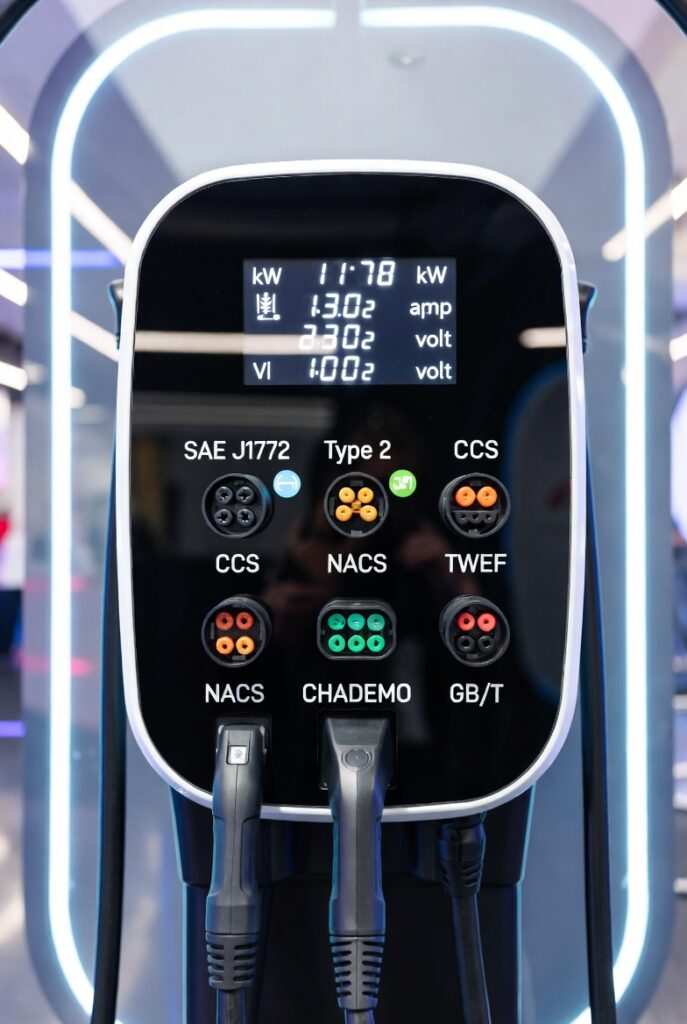
There is a specific frustration that surfaces in Chinese EV owner communities with increasing frequency as the charger market matures and as sophisticated buyers develop the tools to investigate what they have actually purchased: the discovery that a charger bought for ¥1,499 from a brand with professional marketing, a premium-feeling website, and glossy product photography is physically identical — same housing tooling, same internal components, same firmware — to a charger sold under a different brand name for ¥389 on Pinduoduo.
This is the OEM rebranding phenomenon, and it is more widespread in China’s EV charging market than most buyers realise. The Chinese manufacturing ecosystem’s strength — an extraordinary concentration of electronics manufacturing capability in Guangdong, Jiangsu, and Zhejiang provinces — simultaneously enables genuine innovation at scale and creates the infrastructure for companies to take the output of established manufacturing lines, attach different brand names and price points, and sell the product as a premium original design.
This guide on rebranded chargers how to tell if your premium charger is just a cheap OEM unit provides the complete detection toolkit — what OEM rebranding actually means in China’s EV charger market, why it matters for buyers beyond the obvious price transparency issue, the specific physical and documentary tells that distinguish genuine original designs from rebranded OEM units, the database resources that allow you to trace a product’s actual manufacturing origin, and the honest assessment of when OEM sourcing is acceptable and when it represents genuine product misrepresentation.
Understanding OEM in China’s EV Charger Market
What OEM Rebranding Actually Is and Isn’t
The legitimate end of the OEM spectrum:
Original Equipment Manufacturing (OEM) is a standard and largely legitimate practice across virtually all manufacturing sectors — Apple’s iPhone components are manufactured by multiple OEM suppliers, Volkswagen and Toyota share platform architecture, and most consumer electronics brands source components or complete products from specialist manufacturers rather than manufacturing everything in-house.
In China’s EV charger market, legitimate OEM relationships take several forms:
A brand designs a product and specifies its requirements in detail, then contracts a manufacturer to produce it to those specifications — the brand adds genuine value through design, engineering specification, brand management, and distribution.
A brand licenses a manufacturer’s reference design and adapts it for specific market requirements — adding local language firmware, market-specific connectivity, or performance adjustments while using the manufacturer’s core hardware architecture.
An EV manufacturer (BYD, NIO, Xpeng) partners with a charging equipment specialist to produce branded chargers for their customers — the vehicle brand adds customer relationship and distribution value while the charging specialist contributes the core product expertise.
The problematic end of the OEM spectrum:
The rebranding that creates the consumer harm this guide addresses is different from legitimate OEM in specific, identifiable ways:
A brand purchases a standard, unmodified product from a manufacturer at volume pricing, applies its own branding with no engineering modification, and sells at a price point that implies original design capability the brand doesn’t have.
A brand markets a standard OEM product using specifications borrowed from a more capable product — listing the OEM manufacturer’s best-case specifications while the specific configured product doesn’t achieve those specifications in practice.
A brand creates marketing collateral that implies proprietary technology (“our AI energy optimisation algorithm,” “exclusive thermal management system”) when the product is an unmodified standard OEM unit with the same firmware as the ¥389 version.
Why this matters beyond price:
The most obvious harm of OEM rebranding is paying more than a product is worth. But the specific harms in the EV charger context go beyond price:
Safety engineering representation: Premium pricing implies premium safety engineering — buyers who pay ¥1,499 for an “advanced safety” charger reasonably expect superior safety engineering to the ¥389 alternative. If both are identical OEM products from the same manufacturing line, neither buyer’s safety expectations are fully accurate, but the premium buyer’s expectations are specifically misleading.
Warranty and support backing: Premium brands typically imply premium support — professional customer service, efficient warranty claims, technical assistance. If the “premium brand” is actually a small rebranding operation without genuine service infrastructure, the support expectations implied by premium pricing are not met.
Certification validity: As covered in our fake certification detection guide, OEM certification complexity creates specific risks — the OEM manufacturer may hold 3C certification for their base product, but the rebranding entity may not hold independent certification for their specifically-named product variant, creating a certification gap that the consumer cannot easily detect.
The Chinese OEM Manufacturing Ecosystem — Why Rebranding Is So Prevalent
The Structural Conditions That Enable Widespread OEM Rebranding
China’s electronics manufacturing concentration:
As noted in our great shakeout guide’s discussion of manufacturing economics, China’s electronics manufacturing is extraordinarily concentrated in specific industrial clusters where manufacturing capability, component supply chains, and engineering talent combine to produce world-class manufacturing output at competitive cost.
In the EV charger specifically, several major OEM manufacturers operate in Guangdong and Zhejiang provinces that produce standard reference designs — complete, certified, functional EV charger products — available for purchase by any brand that wants to sell them under their own name. These OEM manufacturers are not hiding their business model; they actively market their OEM services to international and domestic brands through trade shows, Alibaba’s B2B platform, and direct sales relationships.
The Alibaba 1688 transparency that reveals the ecosystem:
Alibaba’s 1688 platform (the Chinese domestic B2B wholesale channel, as distinct from Alibaba’s international platform) lists the OEM manufacturers whose products populate much of China’s branded EV charger market. A search on 1688 for 充电桩OEM代工 (EV charger OEM manufacturing) reveals dozens of manufacturers offering complete charger products — same models that appear under various brand names in the consumer market — at wholesale prices that make the retail pricing of some “premium” brands difficult to justify on manufacturing cost grounds.
The pricing differential that reveals rebranding:
If a specific OEM manufacturer’s 1688 wholesale listing shows a product at ¥280 per unit at minimum order quantities of 50 units, and a brand is selling what appears to be the identical product at ¥1,299 retail, the ¥1,019 retail-to-wholesale spread either represents:
Legitimate value addition: genuine engineering modification, certification costs, warehousing, marketing, distribution, customer service infrastructure, and reasonable margin — possible for established brands with genuine operational infrastructure
Or pure margin extraction through rebranding: the ¥1,019 spread is captured primarily as margin by a “brand” that has added no meaningful value beyond label printing and marketing materials
Distinguishing these two scenarios requires the investigation techniques this guide provides.
The Physical Detection Methods — What to Look For
Examining the Hardware for OEM Tell-Tale Signs
Physical tell 1: Housing tooling identification marks
EV charger housings are injection-moulded plastic components manufactured in dedicated tooling sets. Tooling is expensive — a complete housing tooling set for a complex product like an EV charger costs ¥200,000-¥800,000 — and is typically not reproduced by rebranding companies who are simply purchasing completed units.
Where tooling marks appear:
Parting lines (the seams where mould halves meet) are in specific positions determined by the tooling design. Gate marks (where plastic was injected) appear at specific locations. Draft angles (the slight angle of moulded surfaces to allow release from the mould) are identical across all units from the same tooling.
The practical implication: If two chargers from different brands have parting lines in exactly the same positions, gate marks in exactly the same locations, and draft angles that produce identical surface geometry — they came from the same tooling, meaning they came from the same manufacturer. This is the most definitive physical evidence of shared manufacturing origin.
How to use this for detection:
Compare your charger’s housing geometry to other products through:
- Online product images of other brands’ chargers
- Direct physical comparison if you or someone you know owns a different brand’s charger
- Product comparison videos on Chinese EV owner platforms (知乎, 小红书, Bilibili)
Identical housing geometry from different “brands” confirms OEM shared manufacturing origin.
Physical tell 2: PCB manufacturer stamps and component dating codes
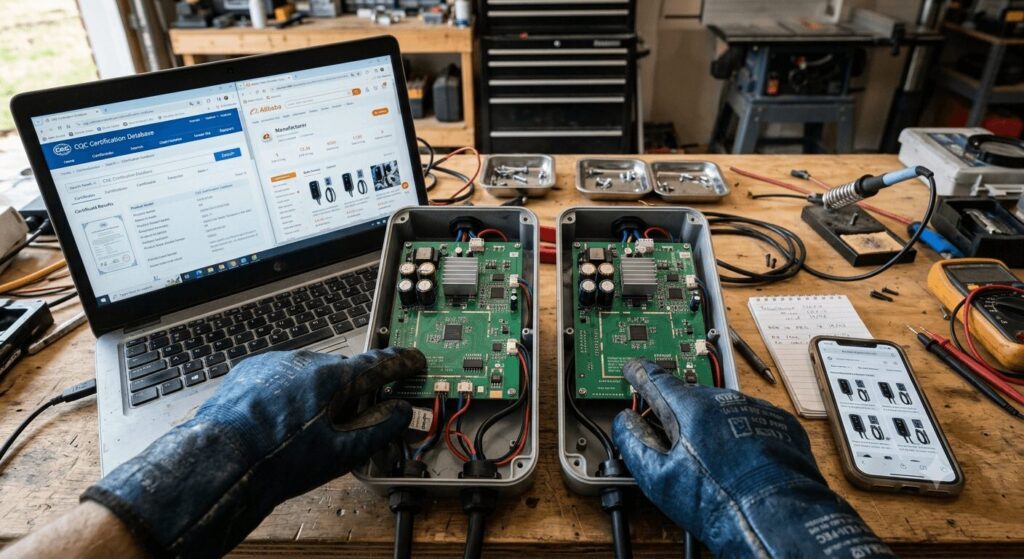
Electronic components and PCBs carry manufacturer codes and date codes that are visible upon opening the charger — something that voids warranty and should only be done if you have specific reasons to investigate, but which the Chinese EV owner community has documented extensively for various charger models.
What the community investigation has revealed:
Chinese EV owner investigative communities on 知乎 and relevant forums have documented numerous cases where premium-branded chargers opened for internal inspection reveal:
- PCBs stamped with OEM manufacturer names that appear in 1688 listings
- Component date codes indicating production periods inconsistent with the brand’s claims about when they “designed” the product
- Identical PCBA layouts to products from completely different brands
- Firmware version strings that contain the OEM manufacturer’s internal product code rather than the reselling brand’s code
Physical tell 3: Connector and cable manufacturing marks
GB/T connectors and charging cables carry manufacturer marks — typically moulded into the connector body or printed on the cable jacket — that identify the actual component manufacturer. A brand that claims to manufacture its own premium connectors but whose connector body carries a third-party component manufacturer’s mark demonstrates a specific gap between marketing claims and product reality.
How to check: Examine the cable jacket printing carefully — the manufacturer name, certification marks, and technical specifications are typically printed along the cable’s length. The connector body typically has a small moulded manufacturer identifier on the body itself or on the strain relief boot.
Physical tell 4: Regulatory label content consistency
As covered in our 3C certification guide’s discussion of rating label requirements, the rating label must contain the legal manufacturer name. For an OEM-rebranded product, this creates a specific dilemma:
If the rating label shows the OEM manufacturer’s company name rather than the selling brand’s company name: the product may be appropriately certified under the OEM manufacturer’s certification, but the selling brand is transparent about using OEM manufacturing — the certification is valid even if the marketing doesn’t emphasise the OEM origin.
If the rating label shows the selling brand’s company name: the selling brand has gone through the process of obtaining certification in its own name — which requires either independent testing of their specific product configuration or a legitimately structured re-brand arrangement under the OEM manufacturer’s umbrella certification. This is possible and legitimate but means the selling brand has invested in actual certification process, suggesting some genuine operational infrastructure beyond pure label printing.
If the rating label shows neither name clearly, or contains inconsistencies between the label and the marketing materials: this is a red flag for the Pattern 4 fake certification scenario covered in our Pinduoduo scams guide — a label that exists to create visual certification appearances without genuine certification backing.
The Documentary Investigation Methods
Database and Company Registry Investigation
Investigation method 1: National Enterprise Credit Information Publicity System verification
As referenced in our Pinduoduo scams guide, the National Enterprise Credit Information Publicity System (国家企业信用信息公示系统) maintains public records of all registered Chinese companies. For any EV charger brand being evaluated:
Search the brand’s company name (the legal entity name, not the brand name if different) in this system.
Examine: company registration date, registered capital, business scope (does it include EV charging equipment manufacturing?), registered address (is it a real office/factory address or a mail forwarding address?), and any recorded penalties or violations.
A brand claiming to manufacture premium EV chargers since 2018 but registered as a company in 2023 with ¥100,000 registered capital at a serviced office address is almost certainly a rebranding operation rather than a genuine manufacturer.
Investigation method 2: CQC certification database cross-reference
As covered in our CQC database verification guide, each 3C certification record specifies the certified manufacturer and the specific product covered. For investigating OEM rebranding:
Find the brand’s certification (or the OEM manufacturer’s certification, if identifiable from the rating label)
Check whether the certification is in the selling brand’s name or the OEM manufacturer’s name
If in the OEM manufacturer’s name: confirm the selling brand is explicitly listed as an authorised seller under the OEM manufacturer’s certification umbrella — legitimate structure but confirms OEM origin
If multiple different brands’ products share the same certification number: this specifically confirms OEM rebranding — the same certification covers products from different “brands” because they are actually the same product
Investigation method 3: Patent and utility model database search
China’s State Intellectual Property Office (SIPO/CNIPA) maintains a public patent and utility model database. A brand that genuinely designed an original product will typically hold design patents or utility model registrations for the product’s distinctive design elements.
Searching CNIPA’s database (cnipa.gov.cn) for patents and utility models registered to the selling brand:
No registered patents or utility models: consistent with a rebranding operation that hasn’t created any original designs
Design patents registered: suggests the brand has at least developed original aesthetic designs, even if internal components are OEM sourced
Utility model patents covering functional innovations: suggests genuine engineering capability and original development, not pure rebranding
Investigation method 4: Alibaba 1688 reverse search
This is the most direct OEM detection method for buyers willing to invest 20-30 minutes of investigation:
1688.com is Alibaba’s domestic B2B wholesale platform where OEM manufacturers sell to resellers. Product images on 1688 listings often show the exact same physical product that appears under different brand names on retail platforms.
The investigation process:
Take a distinctive product photograph from the “premium” brand’s retail listing
Conduct a reverse image search (百度图片 supports reverse image search; Google Lens works with VPN)
Compare results to 1688 wholesale listings
If the 1688 wholesale search reveals a factory listing showing the identical product at ¥280-¥350 wholesale pricing, you have found the OEM manufacturer and confirmed the rebranding relationship.
This investigation is time-consuming but definitively answers the OEM origin question for specific products.
The Firmware Investigation — Software as a Brand Authenticity Indicator
What Firmware Tells You About Engineering Investment
Why firmware is a meaningful brand authenticity indicator:
Developing proprietary firmware for an EV charger — the software that controls charging sessions, manages TOU scheduling, implements OCPP communication, handles fault detection, and provides app connectivity — requires genuine engineering investment: embedded software engineers, months of development time, testing infrastructure, and ongoing maintenance.
A brand that has invested in genuine firmware development has made a specific engineering commitment that pure rebranding operations avoid by using the OEM manufacturer’s firmware unchanged.
How firmware authenticity manifests:
Proprietary firmware typically produces app experiences with:
- The brand’s own app name, branding, and user interface design
- Features developed for the specific brand’s market positioning
- Technical support channels integrated into the app
- Firmware version strings that contain the brand’s own product codes
OEM firmware typically produces:
- Generic or OEM-manufacturer-branded app experiences (sometimes using the OEM manufacturer’s app with the logo changed)
- Identical feature sets across multiple brands using the same OEM platform
- Firmware version strings containing OEM manufacturer internal codes
- App reviews mentioning that the app feels similar to or identical to other brand apps
The OCPP backend investigation:
OCPP-compliant chargers connect to a cloud backend for session management and demand response. The OCPP server address — accessible in the charger’s OCPP configuration settings — reveals whether the brand operates its own OCPP infrastructure or relies on a shared OEM platform.
A brand operating its own OCPP infrastructure has:
- A company-specific domain in the OCPP server address (e.g., charging.brandname.com)
- Server infrastructure that responds with the brand’s own identifiers
A brand using shared OEM OCPP infrastructure shows:
- A generic or OEM manufacturer domain in the OCPP server address
- Server responses that may reveal the OEM platform being used
This investigation requires accessing the charger’s technical settings — typically available through the installer menu or through the brand’s technical support — and is most relevant for commercial or prosumer buyers who want to confirm genuine OCPP infrastructure independence.
The Honest Assessment — When Does OEM Rebranding Matter and When Doesn’t It?
The Nuanced Framework That Prevents Both Overconcern and Underconcern
When OEM rebranding is not a meaningful concern:
If the OEM manufacturer’s product is genuinely certified (CQC database confirms valid certification in the OEM manufacturer’s name), if the specific product configuration being sold is explicitly covered by that certification, and if the selling brand is transparent about the product’s OEM origin — then the OEM rebranding is a distribution arrangement rather than a fraud.
Many legitimate business models use OEM manufacturing. The question is not “is this OEM manufactured?” but “does the brand represent the product accurately, provide genuine value beyond label printing, and back the product with real warranty and service infrastructure?”
A brand that purchases certified OEM products, specifies meaningful adaptations for their market, provides genuine customer service, enforces the warranty from a real operational entity, and prices at a margin that reflects real operational costs rather than pure label-printing arbitrage — this brand is adding genuine value even if it doesn’t manufacture its own housing tooling.
When OEM rebranding is a meaningful concern:
Scenario A: Premium pricing without value addition
If a brand is charging ¥1,200 more than the equivalent OEM product available on 1688 without providing meaningful engineering, customer service, or certification advantages — the premium is pure margin extraction from buyers who don’t know the OEM origin.
Scenario B: Specification misrepresentation
If a brand markets the OEM product using specifications it doesn’t achieve in practice — claiming 50,000 connect-disconnect cycle connector rating when the OEM connector is rated for 10,000, claiming -40°C cold weather operation when the OEM product’s actual tested performance is -20°C — the rebranding has crossed into material misrepresentation.
Scenario C: Certification gap
If the OEM manufacturer’s certification doesn’t cover the specific product variant being sold under the rebranded name — because the brand has modified the configuration in ways that take it outside the certified scope — and the brand hasn’t obtained independent certification for their specific configuration, the certification claim is false regardless of the underlying product quality.
Scenario D: No genuine service infrastructure
If the brand’s “customer service” is a WhatsApp number that doesn’t respond, a WeChat account that replies once every two weeks, and a “warranty” that is practically unenforceable because the brand entity has no real operational presence — the premium implied service value doesn’t exist.
The Specific Brands to Investigate — Community Knowledge Sources
Where Chinese EV Owners Are Sharing OEM Investigation Results
The Chinese online communities doing this work:
Chinese EV owner communities have developed a substantial body of OEM investigation results through collaborative investigation:
知乎 (Zhihu): The most technically sophisticated Chinese social knowledge platform has multiple long-form investigation posts documenting specific OEM relationships in the EV charger market. Searching 知乎 for [charger brand name] + OEM or [品牌名] + 代工 often surfaces community investigation results.
小红书 (Xiaohongshu/RedNote): Product investigation and comparison posts on Xiaohongshu have documented specific OEM relationships in approachable visual format, often including comparison photos and investigation methodology.
Bilibili: Video investigations of EV charger teardowns and comparisons are documented on Bilibili, with some content creators having built substantial followings specifically through EV charger investigation content.
The limitations of community knowledge:
Community investigation is valuable but not authoritative — specific claims require verification rather than blind acceptance. Community posts sometimes contain errors, may be influenced by brand relationships not disclosed by the poster, and may become outdated as manufacturers change their products and sourcing.
Use community investigation as a starting point for your own verification rather than as a substitute for the documentary investigation methods above.
The Buying Decision Framework — What to Actually Do
Applying the Detection Knowledge to Purchase Decisions
Pre-purchase investigation sequence:
Step 1: Verify the brand exists as a legitimate registered company through the National Enterprise Credit Information System. Confirm the registration date, capital, and business scope are consistent with a genuine manufacturer or legitimate reseller.
Step 2: Confirm 3C certification in the CQC database. Note whether the certification is in the brand’s own name or an OEM manufacturer’s name. If in the OEM manufacturer’s name, determine whether the brand is explicitly listed as an authorised partner under that certification.
Step 3: Assess the price-to-value relationship. Research the 1688 wholesale market for similar specification products. If the retail price implies a manufacturing cost above the 1688 wholesale market for similar products, the premium requires justification through genuine value addition.
Step 4: Test the customer service reality before purchase. Contact the brand’s customer service through their published channels with a pre-purchase technical question. Response time, depth of technical knowledge, and channel responsiveness reveal genuine service infrastructure versus marketing facade.
Step 5: Research community investigation results for the specific brand on 知乎, 小红书, or Bilibili. Prioritise posts that include documentary evidence (photos, database screenshots) over opinion-only posts.
The honest threshold for acceptance:
A brand sourcing OEM products is acceptable if:
- The certification is valid and covers the specific product sold
- The price premium over OEM wholesale cost is justified by genuine value (verified customer service, real warranty infrastructure, meaningful engineering adaptations)
- The marketing claims are accurate to the product’s actual capabilities
- The brand entity is a genuine operational company with accountability
A brand sourcing OEM products is unacceptable if:
- The certification gap exists (not covered under any valid certification)
- The price premium is pure margin extraction with no genuine value addition
- Marketing claims exceed actual product capabilities
- The brand entity is a non-accountable shell
Internal Links — Further Reading on Clean Energy Bazaar
The rebranded chargers how to tell if your premium charger is just a cheap OEM unit guide is the product authenticity companion to the certification, safety, and brand survival guides throughout this content cluster.
For the fake certification detection guide covering the CQC database verification process central to OEM investigation, our spotting fake 3C logos how Chinese buyers can verify certification on Taobao JD chargers guide covers the complete certification verification process. For the Pinduoduo scams guide covering the dangerous end of the cheap OEM rebranding spectrum, our Lader scams why cheap chargers on Pinduoduo are burning out guide covers the safety failure modes from the most problematic OEM products. For the zombie pile crisis guide covering the brand survival risk that extends OEM concerns into long-term product support, our zombie pile crisis 2026 how to avoid dead chargers from liquidated Chinese brands guide covers the complete brand survival framework. For the warranty comparison guide covering the service infrastructure that distinguishes legitimate brands from rebranding operations, our EV charger warranty comparison 2026 best coverage from local brands vs US importers guide covers every warranty structure. For the great shakeout guide contextualising OEM rebranding within the broader market consolidation driving these practices, our great shakeout why 80 percent of Chinese EV charger manufacturers face elimination in 2026 guide covers the complete industry analysis. And for the August 2026 compliance guide covering the certification framework that OEM rebranding sometimes violates, our China’s 3C deadline August 2026 is your current EV charger now illegal the 20 point checklist guide covers every compliance consideration.
Final Thoughts
The rebranded chargers how to tell if your premium charger is just a cheap OEM unit question is one where honest engagement requires resisting two equally unhelpful extremes: the reflexive rejection of all OEM manufacturing as inherently fraudulent, and the naïve acceptance of all brand marketing as an accurate description of original design capability.
OEM manufacturing is a legitimate and widespread practice. The question is not whether a charger is OEM-manufactured — most chargers are, to some degree — but whether the brand and pricing accurately represent the value being delivered. A brand that sources excellent OEM products from certified manufacturers, adapts them meaningfully for their market, provides genuine warranty service from a real operational entity, and prices reasonably relative to the value delivered is a legitimate market participant even if it doesn’t operate its own injection moulding presses and PCB assembly lines.
The problematic rebranding is specifically the case where none of these value-justifying elements are present — where the brand name is a label-printing exercise, the marketing claims are fabricated, the certification is borrowed from an OEM manufacturer without the specific product variant being properly covered, the customer service doesn’t exist in any meaningful operational sense, and the premium pricing is pure arbitrage on buyer ignorance.
The detection methods this guide provides — physical housing comparison, rating label investigation, CQC database research, company registry verification, 1688 wholesale market research, firmware investigation, and community knowledge synthesis — give Chinese EV owners the tools to make this distinction themselves rather than relying on marketing claims.
The appropriate conclusion from this investigation for any specific product is not a binary “fake or real” but a graded assessment of whether the brand has delivered genuine value commensurate with the premium it has charged. That assessment requires the deliberate investigation this guide has equipped you to conduct.
Investigate before you buy. Verify before you use. The ¥800 difference between the OEM product and the rebranded premium might be worth paying — for genuine warranty infrastructure, genuine technical support, and genuine certification coverage. Or it might not be. The investigation tells you which. This guide gives you the tools to investigate.