Here is the technical misunderstanding that affects more BYD Seal and Han EV owners than any other home charging question.
They read that their BYD Seal has 800V battery architecture. They read that 800V systems charge faster. They wonder whether their 7 kW home charger is somehow incompatible with their 800V vehicle — or whether they need to buy a special “800V compatible” home charger to unlock the system’s capability.
The answer to this question is the foundation of every useful home charger recommendation for BYD Seal and Han EV owners in 2026 — and it is more nuanced than most product listings and even most Chinese EV forums acknowledge.
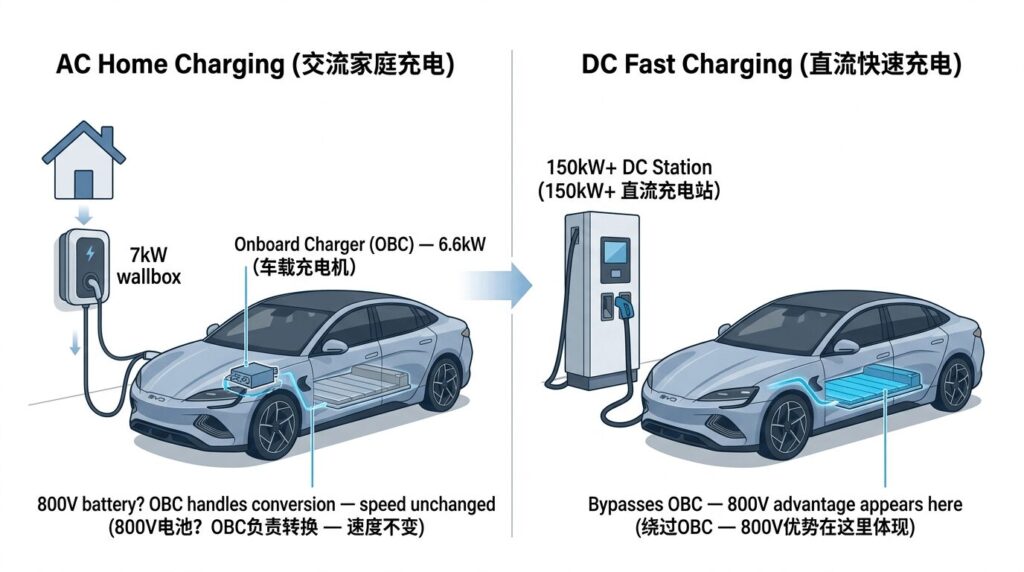
Here is the honest answer: 800V battery architecture has no effect whatsoever on AC home charging speed or compatibility. A BYD Seal with 800V architecture charges from a 7 kW home charger at exactly the same speed as a BYD Dolphin with 400V architecture — because AC home charging uses the vehicle’s onboard AC-to-DC converter, which processes incoming AC regardless of battery pack voltage. The 800V architecture advantage only appears at DC fast charging stations specifically designed for 800V output.
This clarification is critical because it prevents BYD Seal and Han owners from:
- Overpaying for a “800V compatible” home charger that doesn’t exist as a meaningful product category
- Believing they need expensive three-phase 11 kW charging when most Chinese residential buildings cannot provide it anyway
- Missing the genuinely important home charging considerations for BYD Seal and Han vehicles — which are about Blade Battery optimisation, DiLink integration, and smart scheduling, not voltage architecture
This guide on the best home chargers for BYD Seal and Han owners 2026 compatibility with 800V systems covers the complete picture honestly — the 800V architecture explanation that clarifies what actually matters, the specific home charging specifications for BYD Seal and Han variants, the charger recommendations that deliver genuine value for BYD owners, and the financial calculations that make the buying decision clear.
Understanding BYD Seal and Han EV — The Technical Foundation
Before recommending specific chargers, establishing the correct technical understanding of BYD Seal and Han charging architecture prevents every purchasing mistake this guide exists to prevent.
BYD Seal — The Vehicle Range
BYD Seal Standard Range (海豹 标准版):
- Battery: 60.48 kWh (usable)
- Architecture: 400V
- AC charging: 6.6 kW maximum (single-phase, 32A, 220V)
- DC fast charging: 100 kW maximum
- CLTC range: 550 km
BYD Seal Long Range RWD (海豹 长续航后驱版):
- Battery: 82.56 kWh (usable)
- Architecture: 800V
- AC charging: 6.6 kW maximum (single-phase, 32A, 220V)
- DC fast charging: 150 kW maximum
- CLTC range: 700 km
BYD Seal Performance AWD (海豹 四驱性能版):
- Battery: 82.56 kWh (usable)
- Architecture: 800V
- AC charging: 6.6 kW maximum (single-phase, 32A, 220V)
- DC fast charging: 150 kW maximum
- CLTC range: 650 km
The critical observation: All BYD Seal variants — 400V Standard Range and 800V Long Range/Performance — have the same maximum AC charging rate: 6.6 kW. The 800V architecture in the Long Range and Performance variants does not change the AC home charging speed. Both charge at 6.6 kW from a standard 7 kW home charger.
BYD Han EV — The Vehicle Range
BYD Han EV Standard Range (汉 EV 标准续航版):
- Battery: 64.8 kWh (usable)
- Architecture: 400V
- AC charging: 6.6 kW maximum
- DC fast charging: 80 kW maximum
- CLTC range: 506 km
BYD Han EV Long Range (汉 EV 长续航版):
- Battery: 76.9 kWh (usable)
- Architecture: 400V
- AC charging: 6.6 kW maximum
- DC fast charging: 120 kW maximum
- CLTC range: 605 km
BYD Han EV Premium Long Range (汉 EV 旗舰版):
- Battery: 85.4 kWh (usable)
- Architecture: 400V (note: Han EV uses 400V architecture — Han DM-p uses different architecture)
- AC charging: 6.6 kW maximum
- DC fast charging: 120 kW maximum
- CLTC range: 700 km
Important note on BYD Han variants: The standard BYD Han EV uses 400V architecture across all variants in the 2024-2026 model range. Only the BYD Han DM-p (the plug-in hybrid performance version) uses different powertrain architecture. All BYD Han EV (pure electric) variants have identical AC charging rates.
The 800V Architecture Home Charging Reality — Explained in Full Detail
This section provides the complete technical explanation of why 800V architecture is irrelevant to home charging — so BYD Seal owners can confidently understand their vehicle rather than simply taking the conclusion on faith.
AC home charging uses the onboard charger (OBC): When you plug your BYD Seal into a 7 kW home charger, the electricity flows from the grid, through the charger cable, into the vehicle’s charging inlet (GB/T AC port), and to the vehicle’s Onboard Battery Charger (OBC). The OBC is an AC-to-DC converter inside the vehicle.
The OBC’s job is to convert incoming AC electricity (from the grid, at 220V AC, 32A maximum) into DC electricity at the voltage required to charge the battery pack. For the BYD Seal Long Range’s 800V battery pack, the OBC converts 220V AC into approximately 700-900V DC — the voltage required to charge the 800V battery.
The OBC rating — not the battery voltage — determines home charging speed: The BYD Seal’s OBC is rated for 6.6 kW of AC input regardless of whether the battery pack is 400V or 800V. The OBC handles the voltage conversion — the home charger only needs to supply AC electricity at the appropriate current (32A at 220V = 7 kW).
Why you cannot buy an “800V compatible” home AC charger that charges faster: An AC home charger delivers AC electricity to the OBC. The OBC converts it to DC. The maximum AC delivery rate is 6.6 kW regardless of what DC voltage the OBC outputs to the battery. No home AC charger can bypass the OBC and deliver DC directly to the battery — that would require a DC fast charger, not an AC home charger.
Where 800V matters: When a BYD Seal Long Range connects to a DC fast charger — particularly a high-power 250 kW+ DC station or an 800V-native fast charging station — the vehicle can accept DC electricity directly at up to 150 kW because the fast charger bypasses the OBC and delivers pre-converted DC. The 800V architecture allows this at 150 kW where a 400V battery would be limited to approximately 100 kW at the same current.
The practical summary:
- Home charger selection for BYD Seal: 7 kW for all variants, regardless of architecture
- DC fast charger selection: Use 150 kW+ stations for BYD Seal Long Range/Performance for full speed benefit
- “800V compatible home charger”: Not a meaningful product category — all AC home chargers are compatible with all BYD Seal variants
What Actually Matters for BYD Seal and Han Home Charging
Having established what doesn’t matter (800V compatibility), the genuinely important home charging considerations for BYD Seal and Han owners are:
Factor 1: Blade Battery Optimisation
BYD’s proprietary Blade Battery technology — used in both the BYD Seal and BYD Han EV — has specific charging characteristics that differ from conventional cylindrical or pouch cell batteries:
Blade Battery structure: The Blade Battery uses LFP (Lithium Iron Phosphate) cell chemistry in an elongated prismatic form factor. LFP chemistry has a flatter voltage curve than NMC (Nickel Manganese Cobalt) chemistry — meaning the battery’s voltage changes less during charging, requiring more accurate charge completion detection to avoid overcharging.
Optimal charging for Blade Battery longevity: BYD’s engineering guidance for Blade Battery longevity recommends:
- Regular charging target: 80% SOC for daily use
- Charge rate at high SOC: Taper charging beginning at approximately 75% SOC to protect cell longevity
- Temperature range for optimal charging: 15°C-35°C
- Avoidance of sustained 100% SOC: Minimise time at full charge when not needed for range
How the BYD Smart Charger implements this: The BYD-branded home charger communicates with the Blade Battery management system through DiLink — the BYD vehicle’s connected car platform. This communication allows the charger to implement BYD’s recommended charging parameters:
- Departure-time charging that targets 80% completion and tapers the final 5% more gradually
- Temperature-adaptive charging rate (reducing charge rate when battery is below 10°C or above 40°C)
- Cell balance monitoring — detecting if individual cell groups require balance charging before the standard schedule
Can a third-party charger do this? Standard GB/T communication protocol allows basic communication between any certified charger and the BYD vehicle — the charger and vehicle handshake establishes current limits and basic state information. But the deeper Blade Battery-specific parameters — cell temperature distribution, individual group balance state, BYD’s proprietary taper charging curves — are accessible only through DiLink.
The honest assessment of Blade Battery optimisation value: For BYD Han EV owners using the car primarily for daily commuting with regular charging to 80% — the Blade Battery optimisation from the BYD-branded charger delivers marginal but real long-term battery health benefit. For BYD Seal Long Range owners who regularly charge to 80-100% and make frequent DC fast charging stops — the home charger’s slow AC charging is the recovery phase where Blade Battery optimisation most matters.
Over a 10-year ownership horizon with daily charging, the accumulated battery health difference between BYD-optimised home charging and generic GB/T charging is estimated at 1-3% additional capacity retention. On an 82.56 kWh battery, 1-3% is approximately 0.8-2.5 kWh — translating to approximately 4-12 km of retained range at year 10.
This is real but modest — worth considering as one factor among several, not the decisive purchasing criterion.
Factor 2: DiLink Integration
BYD’s DiLink connected car platform is the ecosystem through which the BYD Smart Charger delivers its integrated user experience:
What DiLink integration provides:
Dashboard display: Charging status, remaining time, and estimated completion appear on the BYD vehicle’s infotainment screen — no need to open the BYD app separately.
Departure time integration: Setting a departure time in the DiLink system updates both the vehicle’s pre-conditioning schedule and the charger’s TOU scheduling simultaneously.
Charging history in vehicle: Session data (energy consumed, cost at TOU rates, charging efficiency) accessible through the vehicle’s infotainment menu — relevant for owners who review charging data in the car rather than through a phone app.
Smart stop: The vehicle communicates target SOC to the charger through DiLink — the charger stops precisely at the target SOC rather than relying on the vehicle’s internal cut-off.
The DiLink advantage for BYD Seal owners specifically: The BYD Seal’s vehicle software — particularly the 2024-2026 OTA updates — has progressively enhanced the DiLink charging integration. Newer BYD Seal owners have access to more sophisticated departure-time charging that accounts for journey planning, battery pre-conditioning for cold weather departure, and automatic schedule adjustment for unusual departure times detected from the navigation history.
Third-party charger compatibility with DiLink: Third-party chargers using standard GB/T communication can initiate and stop charging when commanded by the vehicle — so the BYD app can still control charging via the vehicle’s own intelligence. But the bidirectional data richness of the BYD Smart Charger’s DiLink integration (real-time display in infotainment, seamless schedule coordination) is not replicated.
Factor 3: TOU Scheduling — The Dominant Financial Factor
Regardless of which charger is chosen, TOU scheduling is the single most financially impactful home charging feature for BYD Seal and Han owners.
Annual TOU saving for BYD Seal Long Range owner (Shanghai, 20,000 km/year):
Vehicle efficiency: approximately 14.5 kWh/100km (CLTC) → real-world approximately 17 kWh/100km Annual consumption: 20,000 km × 17 kWh/100km ÷ 100 = 3,400 kWh With charging efficiency (90%): 3,400 ÷ 0.90 = 3,778 kWh from charger
Without TOU (blended rates): 3,778 × ¥0.75 = ¥2,833/year With TOU valley rate (¥0.34): 3,778 × ¥0.34 = ¥1,285/year Annual TOU saving: ¥1,548/year
Annual TOU saving for BYD Han EV Long Range owner (Shanghai, 20,000 km/year):
Vehicle efficiency: approximately 15.5 kWh/100km (CLTC) → real-world approximately 18 kWh/100km Annual consumption: 20,000 × 18 ÷ 100 = 3,600 kWh With charging efficiency: 3,600 ÷ 0.90 = 4,000 kWh
Without TOU: 4,000 × ¥0.75 = ¥3,000/year With TOU: 4,000 × ¥0.34 = ¥1,360/year Annual TOU saving: ¥1,640/year
Every charger in this guide supports TOU scheduling. The choice of charger does not change the TOU saving available — but the reliability and convenience of TOU implementation varies between products.
Factor 4: Home Charging Time — Does It Matter for Your Daily Schedule?
BYD Seal Long Range (82.56 kWh, 6.6 kW maximum AC) overnight charging:
| Starting SOC | Target SOC | Energy Needed | At 6.6 kW | Completion Time (start 11pm) |
|---|---|---|---|---|
| 20% | 80% | 49.5 kWh | 7.5 hours | 6:30am ✅ |
| 30% | 80% | 41.3 kWh | 6.3 hours | 5:18am ✅ |
| 10% | 80% | 59.6 kWh | 9.0 hours | 8:00am ⚠️ |
| 10% | 100% | 74.3 kWh | 11.2 hours | 10:12am ❌ |
BYD Han EV Long Range (76.9 kWh, 6.6 kW maximum AC):
| Starting SOC | Target SOC | Energy Needed | At 6.6 kW | Completion Time (start 11pm) |
|---|---|---|---|---|
| 20% | 80% | 46.1 kWh | 7.0 hours | 6:00am ✅ |
| 30% | 80% | 38.5 kWh | 5.8 hours | 4:48am ✅ |
| 10% | 80% | 53.8 kWh | 8.2 hours | 7:12am ✅ |
| 10% | 100% | 69.2 kWh | 10.5 hours | 9:30am ⚠️ |
The charging time insight for BYD Seal and Han owners: For BYD Seal Long Range owners who arrive home occasionally with low battery (10-15% SOC) and need to depart early (6-7am), the 6.6 kW charging rate creates a specific timing constraint. Arriving at 10% and needing 80% by 7am departure requires:
- 49.5 kWh (10-80%) ÷ 6.6 kW = 7.5 hours
- Starting at 11pm (valley rate start): completes at 6:30am — barely adequate for 7am departure
Practical recommendation for early-departure BYD Seal owners: Plug in as early as possible after arriving home — even at peak electricity rates for the first 1-2 hours before the valley rate starts at 11pm. The total electricity cost difference between charging 1 hour at peak rate versus waiting for valley rate is approximately ¥0.53 × 6.6 kW × 1 hour = ¥3.50 — worth paying for the schedule flexibility.
Configure your smart charger’s minimum SOC override — most smart chargers allow setting a minimum SOC threshold (e.g., 30%) below which charging starts immediately regardless of schedule. This prevents the low-battery, early-departure timing problem automatically.
The Charger Recommendations for BYD Seal and Han Owners
Recommendation 1: BYD Smart Charger (官方推荐 — The Manufacturer’s Choice)
Price: ¥800-¥1,600 (at BYD dealership, with potential promotional pricing) Power: 7 kW single-phase (32A, 220V) IP Rating: IP55 Temperature: -20°C to +50°C Warranty: 3 years DiLink: ✅ Full integration Blade Battery: ✅ Cell-level optimisation TOU Scheduling: ✅ Via BYD app
The honest case for the BYD Smart Charger:
For BYD Seal Long Range and Performance owners who use their vehicle heavily — 25,000-40,000 km/year, frequent DC fast charging, extended ownership horizon of 7-10 years — the Blade Battery optimisation from the BYD Smart Charger is the most compelling single reason to choose the manufacturer’s option. At this usage intensity, the accumulated battery health difference between BYD-optimised AC charging and generic GB/T charging becomes more meaningful.
For BYD Han EV owners who value the DiLink infotainment integration — seeing charging status on the car’s screen, departure-time coordination through the vehicle rather than through a charger app — the BYD Smart Charger delivers a seamless ecosystem experience that third-party chargers cannot replicate.
Promotional pricing consideration: BYD frequently includes the home charger at discounted or zero cost as part of vehicle purchase promotions. If your BYD dealer offers the home charging bundle at below ¥2,500 total (charger + standard installation), accepting the bundle is financially rational regardless of the charger’s standalone comparison to alternatives.
Who should choose the BYD Smart Charger:
- High-mileage BYD Seal owners (25,000+ km/year) prioritising Blade Battery longevity
- BYD Han EV owners who want DiLink infotainment integration as a daily-use feature
- Buyers who receive the BYD bundle at promotional pricing (below ¥2,500 total)
- Owners who prefer single-brand service experience (charger issues resolved through the BYD dealer network)
Who should NOT choose the BYD Smart Charger over alternatives:
- Owners with outdoor parking in South China or northern China cold regions — IP55 is adequate but not optimal for these conditions (Autel’s IP65 is better for outdoor exposure)
- Owners in Harbin or Changchun — -20°C minimum is inadequate for sustained outdoor use in these cities
- Owners who primarily use Xiaomi Mi Home or Huawei HarmonyOS — third-party chargers provide better smart home ecosystem integration
Recommendation 2: StarCharge S Series Smart Charger (最佳性价比)
Price: ¥899-¥1,499 Power: 7 kW / 11 kW IP Rating: IP54 Temperature: -20°C to +55°C Warranty: 3 years DiLink: ❌ No vehicle-level integration Blade Battery: Standard GB/T only TOU Scheduling: ✅ Reliable, app-based Xiaomi Integration: ✅
The honest case for StarCharge:
For BYD Seal and Han owners in covered underground parking who want maximum TOU saving reliability at minimum cost, the StarCharge S Series delivers exactly the functionality that produces ¥1,548-¥1,640/year in annual electricity savings — identical to more expensive alternatives.
The TOU scheduling implementation in StarCharge’s app is among the most reliable in the Chinese market — consistently reviewed positively for scheduling accuracy and schedule-keeping through connectivity interruptions. For the dominant financial function of a smart home EV charger, StarCharge executes as well as any competitor.
The Xiaomi Mi Home integration is the genuine differentiator over the BYD Smart Charger for owners who are active Xiaomi smart home users. If you manage your home through Mi Home automations and want EV charging integrated into those automations — charging triggered by “arriving home” scenes, 小爱同学 voice commands, unified energy monitoring — the StarCharge S Series delivers this in ways the BYD Smart Charger doesn’t.
The cost comparison: StarCharge S Series at ¥999 versus BYD Smart Charger at ¥1,200: ¥201 saving on hardware. Over 5 years, both deliver identical TOU savings. StarCharge’s lower price provides a marginally faster payback with no functional difference in daily charging performance.
Who should choose StarCharge for BYD Seal/Han:
- Budget-conscious BYD owners in covered underground parking
- Xiaomi Mi Home users wanting smart home integration
- Owners who received their BYD bundle pricing above ¥3,000 total and are evaluating alternatives
- High-mileage drivers for whom TOU reliability (StarCharge’s proven strength) matters more than Blade Battery optimisation
Recommendation 3: Autel MaxiCharger AC (室外和北方首选)
Price: ¥1,299-¥2,499 Power: 7 kW / 11 kW IP Rating: IP65 Temperature: -30°C to +55°C Warranty: 3 years DiLink: ❌ No vehicle-level integration Blade Battery: Standard GB/T only TOU Scheduling: ✅ App-based Solar Integration: ✅ OCPP: 1.6 ✅
The honest case for Autel:
For BYD Seal and Han owners with outdoor parking, semi-outdoor parking in humid South China climates, or in northern China cities approaching or exceeding -20°C winter conditions — Autel is the only mainstream consumer charger that provides the correct specification for these environments.
IP65 for outdoor South China exposure — the monsoon season and typhoon conditions that challenge IP54 and IP55 units are handled without risk by IP65. As calculated in our weatherproof charger guide, a BYD Seal owner who installs an IP54 charger outdoors in Guangdong and replaces it after moisture failure twice over 5 years pays ¥2,498 more than buying IP65 at the start.
-30°C for BYD Seal owners in Beijing outdoor parking, Harbin, Changchun, or any northern Chinese location where -20°C conditions occur regularly. A BYD Seal Long Range with an 82.56 kWh battery in Harbin needs reliable overnight charging in -25°C conditions — the Autel delivers this; the StarCharge S1 at -20°C minimum does not.
For BYD Seal owners with villa rooftop solar installations — the Autel’s solar integration capability (compatible with Sungrow, Growatt, and other major Chinese solar brands through the Autel Charge app) provides solar divert functionality that neither the BYD Smart Charger nor StarCharge offers.
OCPP future-proofing: For BYD Seal owners planning 7-10 year ownership who want to participate in smart grid demand response programmes as they develop in China — Beijing, Shenzhen, and Shanghai are all deploying residential demand response programmes that will reward OCPP-compliant charger owners — Autel’s OCPP 1.6 compliance positions the charger for these programmes.
Who should choose Autel for BYD Seal/Han:
- Any outdoor or semi-outdoor parking installation in any Chinese city
- South China (Guangdong, Fujian, Hainan) all installations except deep underground parking
- Northern China: Beijing outdoor, Harbin, Changchun, Shenyang, Hohhot, all outdoor and semi-outdoor
- Solar panel owners wanting solar integration
- 7-10 year ownership planners wanting OCPP future-proofing
Recommendation 4: Xiaomi EV Charger Basic (小米SU7以外的小米生态用户)
Note: This recommendation is specifically for BYD Seal and Han owners who are simultaneously Xiaomi Mi Home power users or BYD owners who have recently also purchased a Xiaomi SU7 as a second household vehicle.
Price: ¥1,099-¥1,399 Power: 7 kW IP Rating: IP55 Temperature: -20°C to +55°C Warranty: 3 years TOU Scheduling: ✅ Excellent (HyperOS, voice control) Mi Home Integration: ✅ Best in market
The Xiaomi EV Charger’s HyperOS/Mi Home integration and dual-band WiFi make it the best smart home-integrated charger at the ¥1,099-¥1,399 price tier. For households where a BYD Seal or Han EV shares a garage with a Xiaomi SU7, the Xiaomi charger serves both vehicles — one charging cable, one app.
Who should choose Xiaomi for BYD Seal/Han:
- Xiaomi Mi Home users who want unified smart home charging management
- Dual-vehicle households with BYD + Xiaomi SU7
- Dense urban environments where dual-band WiFi connectivity advantage matters
Recommendation 5: CATL Ningle Home Charger (CATL电池车型专属)
Note for BYD Seal/Han: This recommendation requires clarification. BYD manufactures its own Blade Battery — CATL does not supply batteries to BYD. The CATL Ningle’s cell-level optimisation is specifically designed for CATL-supplied batteries (NIO, Xpeng, Zeekr).
For BYD Seal and Han owners: the CATL Ningle is NOT the relevant choice. The BYD Smart Charger with DiLink integration provides the equivalent Blade Battery optimisation that the CATL Ningle provides for CATL-battery vehicles.
This clarification prevents a purchasing mistake that some BYD owners have made — buying a CATL Ningle for cell-level optimisation that doesn’t apply to BYD’s proprietary Blade Battery.
The 800V DC Fast Charging Guide for BYD Seal Owners
While this guide focuses on home AC charging, BYD Seal Long Range and Performance owners have questions about maximising the 800V architecture’s DC fast charging benefit. This section addresses those questions concisely.
DC Fast Charging Maximisation for BYD Seal Long Range
The BYD Seal Long Range accepts up to 150 kW DC fast charging. To receive this speed:
Compatible stations (150 kW+):
- State Grid premium DC fast charging hubs (250 kW stations at major motorway locations)
- TELD 150 kW+ stations (available at commercial locations in tier-1 cities)
- BYD Diamond Level charging hubs (BYD’s own premium charging locations — 250 kW+ capability)
- StarCharge 150 kW dual-gun stations (output shared, full 150 kW available when single gun active)
Standard 50-120 kW stations: BYD Seal Long Range at a 120 kW station charges at 120 kW — limited by the station, not the vehicle. The 800V architecture advantage only appears at stations delivering 150 kW+.
DC charging time (BYD Seal Long Range, 10-80%):
- At 150 kW: 49.5 kWh ÷ 150 kW = 19.8 minutes (approximately 20 minutes)
- At 120 kW: 49.5 kWh ÷ 120 kW = 24.75 minutes (approximately 25 minutes)
- At 50 kW: 49.5 kWh ÷ 50 kW = 59.4 minutes (approximately 1 hour)
Home Charging vs DC Fast Charging Cost Comparison
| Charging Method | Rate | Cost per 100km (BYD Seal LR) |
|---|---|---|
| Home TOU valley rate (¥0.34) | 17 kWh/100km | ¥5.78/100km |
| State Grid DC fast (¥1.40/kWh) | 17 kWh/100km | ¥23.80/100km |
| TELD premium DC (¥2.00/kWh) | 17 kWh/100km | ¥34.00/100km |
| Petrol equivalent (Honda CR-V, ¥8/L, 8L/100km) | — | ¥64.00/100km |
The cost hierarchy: Home TOU charging is 4× cheaper than State Grid DC fast charging and 11× cheaper than petrol. This is why home charging setup is the most financially impactful decision in BYD Seal and Han EV ownership — not the DC fast charging speed optimisation that 800V architecture delivers.
The Complete Specification Comparison for BYD Seal and Han Owners
| Charger | Price | IP | Temp | BYD Blade | DiLink | TOU | Best Scenario |
|---|---|---|---|---|---|---|---|
| BYD Smart | ¥800-1,600 | IP55 | -20°C | ✅ Yes | ✅ Yes | ✅ | High-mileage, DiLink users |
| StarCharge S1 | ¥899-1,099 | IP54 | -20°C | Standard | ❌ | ✅ | Covered parking, value |
| StarCharge S Pro | ¥1,199-1,499 | IP54 | -20°C | Standard | ❌ | ✅ Full | Xiaomi/Tmall users |
| Autel MaxiCharger | ¥1,299-2,499 | IP65 | -30°C | Standard | ❌ | ✅ | Outdoor, north China |
| Xiaomi Basic | ¥1,099-1,399 | IP55 | -20°C | Standard | ❌ | ✅ Mi | Mi Home users |
| CATL Ningle | ¥1,200-1,800 | IP55 | -20°C | ❌ N/A | ❌ | ✅ | NIO/Xpeng — not BYD |
The Decision Framework for BYD Seal and Han Owners
Question 1: Where is your parking space?
| Parking Type | Recommendation |
|---|---|
| Covered underground, major city | StarCharge S1 (best value) or BYD Smart (DiLink) |
| Covered but humid (Chengdu basin) | Autel MaxiCharger (IP65) |
| Outdoor, South China | Autel MaxiCharger (IP65) — required |
| Outdoor, North China (-20°C+) | Autel MaxiCharger (IP65, -30°C) — required |
| Outdoor, Harbin/Changchun | Autel MaxiCharger — only viable option |
Question 2: Do you actively use BYD DiLink and value infotainment integration?
| DiLink Use | Recommendation |
|---|---|
| Yes — want charging on car screen | BYD Smart Charger |
| No — use BYD app on phone only | StarCharge S1 or Autel |
Question 3: What is your annual mileage and ownership horizon?
| Profile | Blade Battery Value | Recommendation |
|---|---|---|
| Under 15,000 km/year, 5-year plan | Marginal | StarCharge S1 (value) |
| 15,000-25,000 km/year, 7-year plan | Moderate | BYD Smart Charger |
| Over 25,000 km/year, 10-year plan | Meaningful | BYD Smart Charger |
Question 4: Do you use Xiaomi Mi Home or have solar panels?
| Smart Home / Solar | Recommendation |
|---|---|
| Xiaomi Mi Home active user | Xiaomi Basic or StarCharge S Pro |
| Solar panels (Sungrow/Growatt) | Autel MaxiCharger or Sungrow/Growatt charger |
| No specific ecosystem | StarCharge S1 or BYD Smart |
The 5-Year True Cost of Ownership Comparison
For a BYD Seal Long Range owner in Shanghai, 20,000 km/year:
| Charger | Hardware | Install | 5yr Electricity (TOU) | 5yr Maintenance | 5yr Total |
|---|---|---|---|---|---|
| BYD Smart (bundle ¥2,500) | ¥1,200 | ¥1,300 | ¥6,425 | ¥150 | ¥9,075 |
| StarCharge S1 | ¥999 | ¥1,700 | ¥6,425 | ¥150 | ¥9,274 |
| Autel MaxiCharger | ¥1,499 | ¥1,700 | ¥6,425 | ¥100 | ¥9,724 |
| Xiaomi Basic | ¥1,249 | ¥1,700 | ¥6,425 | ¥150 | ¥9,524 |
The dominant finding: Electricity cost (¥6,425 over 5 years at valley rates) is the single largest component — larger than all hardware and installation costs combined. The difference between the cheapest and most expensive charger in this comparison over 5 years is ¥649 — less than one month of TOU electricity savings.
BYD bundle pricing changes the calculation: If BYD offers the home charging bundle at ¥2,500 total (charger + installation), the BYD Smart Charger becomes the lowest 5-year total cost option at ¥8,925 — ¥349 less than the StarCharge independent purchase.
This is why confirming BYD bundle pricing at delivery is important — the financial case for the BYD bundle depends entirely on the bundle price at that specific point in time.
Internal Links — Further Reading on Clean Energy Bazaar
The best home chargers for BYD Seal and Han owners 2026 compatibility with 800V systems guide is the vehicle-specific charging recommendation within the Chinese market content cluster.
For the complete EV charger specs guide explaining why 800V architecture does not affect AC home charging, our understanding EV charger specs 2026 kW amps 800V architecture and the new GB standards guide covers every technical specification. For the manufacturer bundle comparison covering the BYD Smart Charger programme versus NIO and Xpeng alternatives, our BYD vs NIO vs Xpeng which EV maker sells the best home charging bundle in 2026 guide covers every programme dimension. For the full seven-charger comparison covering StarCharge, Autel, TELD, NIO, BYD, Sungrow, and Schneider, our best home EV chargers 2026 top 7 comparison for Chinese homeowners Star Charge Autel guide covers the complete market. For the weatherproof charger guide covering which IP rating is correct for different Chinese installation environments, our weatherproof EV chargers 2026 IP ratings for humid southern China vs dusty northern China guide covers every climate zone. For the financial rebates available on home charger installation for BYD owners in Shanghai, Beijing, and Shenzhen, our local utility rebates for EV charging 2026 Shenzhen Shanghai Beijing guide covers every available subsidy. For the Chinese market charging speed guide explaining DC fast charging optimisation for the BYD Seal’s 800V architecture, our EV charging guide 2026 slow vs fast vs ultra-fast differences in the Chinese market covers the full DC charging picture.
Final Thoughts
The best home chargers for BYD Seal and Han owners 2026 compatibility with 800V systems analysis produces clear verdicts once the 800V architecture confusion is resolved.
The most important thing BYD Seal and Han owners need to understand about home charging: 800V architecture is irrelevant to home AC charging. Every BYD Seal and Han variant — Standard Range 400V, Long Range 800V, Performance 800V — charges at 6.6 kW from a 7 kW home charger. Buy a certified 7 kW home charger that matches your installation environment and smart home preferences. Do not pay a premium for a feature that doesn’t exist.
The verdicts:
BYD Smart Charger (¥800-¥1,600 / bundle ¥2,500): The correct choice for high-mileage BYD Seal Long Range owners (25,000+ km/year) who value Blade Battery optimisation over a 10-year ownership horizon, and for Han EV owners who actively use DiLink for daily charging management. At promotional bundle pricing, the correct choice for almost all BYD owners.
StarCharge S1 (¥899-¥1,099): The correct choice for covered underground parking installations where IP54 is adequate, for Xiaomi Mi Home users, and for budget-conscious buyers for whom the BYD Smart Charger’s premium is not justified by their specific usage pattern.
Autel MaxiCharger (¥1,299-¥2,499): The correct choice for any outdoor installation, South China exposure, northern China cold, or solar integration requirements. The specification leader for environmental resilience among mainstream Chinese home EV chargers.
The universal recommendation regardless of charger choice: Configure TOU valley rate scheduling on the day of installation. The ¥1,548-¥1,640/year electricity saving from valley rate charging for BYD Seal and Han owners is available through every charger in this guide — and it pays back the entire installation cost within 18 months. That is the most important home charging decision any BYD owner makes.