Here is the home charging question that NIO, Xpeng, and Li Auto owners ask differently from every other EV brand’s owners — and that requires genuinely different answers.
A BYD Han EV owner’s home charging question is simple: which 7 kW charger should I buy? The answer varies by installation environment and smart home preferences but the fundamental setup — one home charger, one vehicle, overnight AC charging — is straightforward.
NIO, Xpeng, and Li Auto owners face a more complex home charging question because each brand has a distinctive energy architecture that changes the role of home charging in daily ownership:
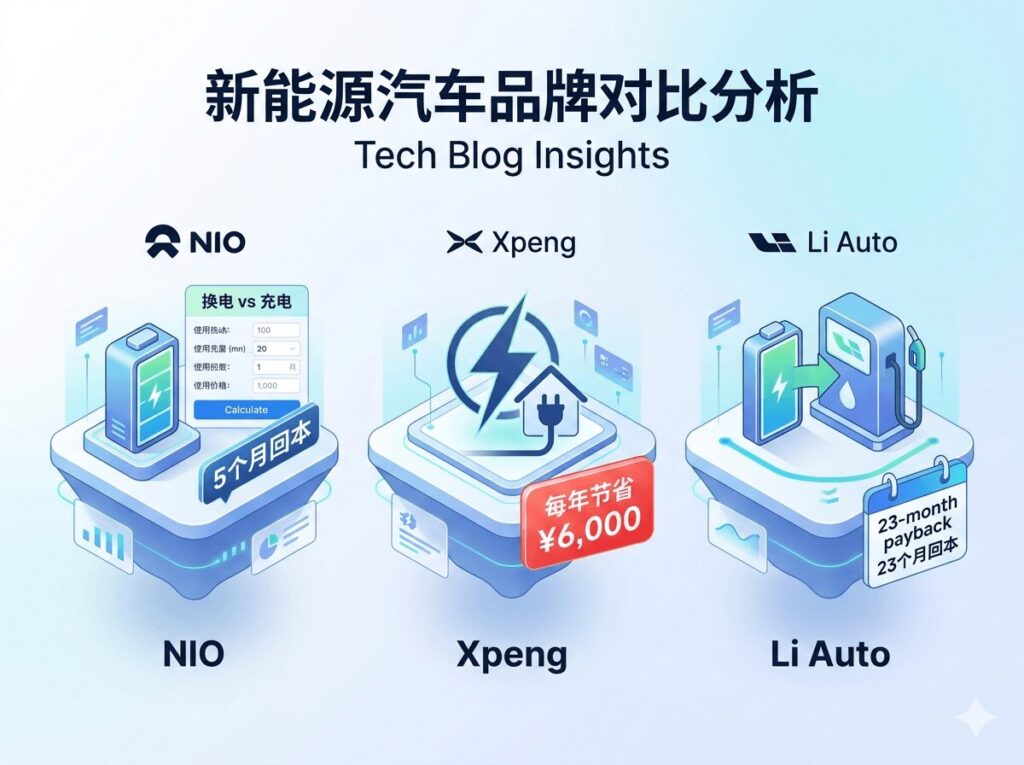
NIO owners have battery swap capability. Their vehicle can be fully replenished in 3-5 minutes at a swap station. Home charging is available but optional for most daily scenarios — which completely changes the financial and practical calculation for home charger specification and investment.
Xpeng owners have access to the S4 supercharging network with up to 480 kW DC capability. The G9 Ultra can charge 10-80% in approximately 11 minutes. For owners near S4 stations, home charging’s role as the primary energy source changes relative to owners without nearby supercharger access.
Li Auto owners drive Extended Range Electric Vehicles (EREVs) — vehicles with petrol generators that charge the battery on the go. The EREV architecture means Li Auto owners essentially never have range anxiety and can always reach a home charger without worrying about battery depletion. But the specific home charging strategy for EREV vehicles — how much electric-only driving to maximise, how to minimise petrol consumption, how to use the home charger within the EREV architecture — is genuinely different from pure BEV home charging.
This guide on the best EV charger for NIO Xpeng and Li Auto home solutions for battery swap vs charging addresses each brand’s specific home charging reality honestly — covering the battery swap vs charging calculation for NIO owners, the supercharger vs home charging balance for Xpeng owners, and the EREV-specific home charging strategy for Li Auto owners. Then it recommends specific chargers for each scenario.
Part 1: NIO — Battery Swap vs Home Charging
Understanding NIO’s Energy Architecture
NIO’s approach to EV energy replenishment is fundamentally different from every other car manufacturer in China. Understanding this architecture is prerequisite to making any home charging decision.
NIO Power — the complete ecosystem:
NIO operates four energy replenishment mechanisms:
- Battery swap (换电): Robotic battery replacement in 3-5 minutes at NIO Power Swap Stations
- NIO Power Charger (蔚来超充): NIO’s own DC fast charging network
- Home charging (家充): The NIO Home Charger installed at the owner’s residence
- Access to third-party networks: NIO’s app integrates with TELD, StarCharge, and other public networks
The existence of battery swap — a complete energy solution in 3-5 minutes available at 2,300+ stations across China — fundamentally changes the role of home charging for NIO owners compared to owners of vehicles without swap capability.
The Battery Swap vs Home Charging Decision
For NIO owners, the first question is not “which home charger should I buy” — it is “how much do I actually need home charging?”
The NIO owner daily energy profile:
Scenario A — Short daily commute (under 80 km), near swap station:
NIO ET5 with 75 kWh battery:
- Daily consumption: approximately 13-15 kWh (80 km at 16-18 kWh/100km real-world)
- Battery depletion from 100%: drops to approximately 80% after 80 km daily drive
- Without home charging: battery decreases 20% per day, requires swap or charge approximately every 4-5 days
At this usage level, a NIO owner could potentially operate without home charging — using swap stations for energy replenishment every 4-5 days. Each swap costs approximately ¥25-¥35 for BaaS subscribers.
Cost comparison:
- Swap-only energy: ¥30 × 72 swaps/year (if used every 5 days) = ¥2,160/year
- Home TOU charging (same 80 km/day, 29,200 km/year): 4,672 kWh × ¥0.34 = ¥1,589/year
- Annual saving from home charging: ¥571/year
Home charging installation cost (NIO programme, basic): ¥0-¥1,500 Payback: 0-2.6 years
Scenario B — Long daily commute (over 150 km):
At 150 km daily consumption: approximately 26 kWh/day Battery depletion from 100%: approximately 35% per day Without home charging: requires swap every 1.5-2 days
Cost comparison:
- Swap-only energy: ¥30 × 195 swaps/year = ¥5,850/year
- Home TOU charging (same usage): 10,530 kWh × ¥0.34 = ¥3,580/year (but a single charge cycle won’t cover the full day — need DC fast charging supplement)
- Combined home + supplement: approximately ¥4,000-¥4,500/year
- Annual saving from home charging setup: ¥1,350-¥1,850/year
For high-mileage NIO owners, home charging is more financially important than for low-mileage owners — the annual saving from home TOU charging versus swap-only is proportionally larger.
The honest battery swap vs home charging conclusion for NIO owners:
Home charging is worth installing for virtually all NIO owners who have access to a designated parking space — the NIO programme makes the hardware and installation cost low (potentially zero), and the ongoing electricity savings versus swap-only energy justify the setup. But the degree of financial urgency differs:
- Low-mileage NIO owners (under 15,000 km/year): Home charging saves ¥400-¥700/year over swap-only. NIO programme at zero cost makes this worthwhile but not urgent.
- High-mileage NIO owners (over 25,000 km/year): Home charging saves ¥1,500-¥2,500/year. High priority.
- NIO owners without designated parking space: Swap-only operation is entirely viable and financially acceptable — swap stations are specifically designed for this use case.
NIO Home Charger — The Technical Specifications
NIO ET5:
- Battery options: 75 kWh / 100 kWh / 150 kWh
- AC charging: 11 kW maximum (three-phase) / 6.6 kW (single-phase)
- DC fast charging: 126 kW maximum
NIO ET7:
- Battery options: 75 kWh / 100 kWh / 150 kWh
- AC charging: 11 kW maximum (three-phase) / 6.6 kW (single-phase)
- DC fast charging: 126 kW maximum
NIO ES6 / ES8 / EC6:
- Varies by model and year — typically 6.6 kW or 11 kW AC maximum
The three-phase AC charging capability (11 kW): Unlike most BYD models, NIO ET5 and ET7 can accept 11 kW AC charging from a three-phase supply. For NIO owners with three-phase parking space supply — available in some commercial buildings, newer premium residential developments, and villa compounds — an 11 kW charger delivers:
- ET5 (75 kWh, 10-80%): 49.5 kWh ÷ 11 kW = 4.5 hours (vs 7.5 hours at 6.6 kW)
- ET7 (100 kWh, 10-80%): 66 kWh ÷ 11 kW = 6 hours (vs 9.1 hours at 6.6 kW)
For NIO owners with three-phase supply, specifying an 11 kW charger is worthwhile — the 3-hour charging time reduction for the ET5 is meaningful for late arrivals needing early departures.
For most NIO apartment owners with single-phase supply: 7 kW is the correct home charger specification. The 11 kW capability of the vehicle is unused on single-phase residential supply — this is the same situation as the BYD Seal 800V architecture home charging equivalence discussed in our previous guide.
NIO Home Charging Time Reference
| Vehicle | Battery | SOC Range | At 6.6 kW | At 11 kW (3-phase) |
|---|---|---|---|---|
| NIO ET5 | 75 kWh | 20-80% | 6.8 hours | 4.1 hours |
| NIO ET5 | 100 kWh | 20-80% | 9.1 hours | 5.5 hours |
| NIO ET5 | 150 kWh | 20-80% | 13.6 hours | 8.2 hours |
| NIO ET7 | 75 kWh | 20-80% | 6.8 hours | 4.1 hours |
| NIO ET7 | 100 kWh | 20-80% | 9.1 hours | 5.5 hours |
The NIO ET5 150 kWh battery home charging reality: The 150 kWh semi-solid-state battery — NIO’s flagship range-extension option — requires 13.6 hours for a 20-80% home charge at 6.6 kW. This is a tight fit for owners who arrive home late (10pm+) and depart early (7am). At 11 kW three-phase, the 8.2 hours is more manageable.
For NIO ET5 150 kWh owners: three-phase home charging is particularly valuable — the 5.4-hour time saving matters for regular overnight charging cycles.
NIO-Specific Charger Recommendations
Primary recommendation: NIO Home Charger (via NIO Power programme)
As covered extensively in our BYD vs NIO vs Xpeng manufacturer bundle guide, the NIO Power home charging programme is the most compelling manufacturer bundle in the Chinese EV charging market — particularly when available at zero or near-zero cost for qualifying new vehicle buyers.
What makes NIO’s programme uniquely valuable for NIO owners:
The Power Specialist service: NIO assigns a dedicated Power Specialist who manages the entire installation process — 物业 navigation, utility meter application, installation by NIO-certified engineers, and ongoing support. This service level is unmatched by any competing manufacturer programme and is particularly valuable for NIO owners in older residential compounds where 物业 navigation is complex.
The NIO Power ecosystem integration: The NIO Home Charger’s integration with the NIO app provides the most comprehensive energy management dashboard of any EV brand in China:
- Real-time home charging status
- Swap station availability in real time
- Combined home + public + swap energy cost tracking
- Battery health monitoring across charging methods
- Intelligent scheduling that accounts for planned long journeys requiring swap stops
The 150 kWh battery-specific integration: For NIO ET5 owners with the 150 kWh battery who need three-phase home charging, the NIO Home Charger’s 11 kW three-phase variant (where supply available) delivers the full 11 kW benefit with NIO app ecosystem integration. No third-party charger provides the same combination of 11 kW delivery and NIO app coordination.
If NIO programme is not available at promotional pricing (standard pricing ¥1,500+):
Alternative 1: StarCharge S Series Smart 7 kW (¥899-¥1,499) For covered underground parking installations, StarCharge delivers equivalent TOU savings with reliable scheduling at lower hardware cost than NIO’s standard pricing. Loses NIO app ecosystem integration but maintains full TOU financial benefit.
Alternative 2: Autel MaxiCharger (¥1,299-¥2,499) — for outdoor, northern China, or solar IP65 and -30°C specifications for NIO owners in challenging installation environments. NIO ET5 owners in Harbin outdoor parking cannot use StarCharge S1’s -20°C specification — Autel is the only appropriate mainstream option.
Alternative 3: CATL Ningle Home Charger (¥1,200-¥1,800) — for NIO’s CATL-battery vehicles NIO vehicles use CATL batteries (not BYD Blade Battery). The CATL Ningle’s cell-level optimisation is therefore applicable to NIO vehicles in a way that it is not applicable to BYD vehicles. For NIO ET5 and ET7 owners who prioritise battery health optimisation over ecosystem integration, the CATL Ningle delivers cell-level charging parameter management that generic GB/T chargers cannot.
CATL Ningle vs NIO Home Charger — the honest comparison for NIO owners:
| Feature | NIO Home Charger | CATL Ningle |
|---|---|---|
| NIO app integration | ✅ Full | ❌ None |
| Cell-level optimisation | ❌ Standard GB/T | ✅ CATL-specific |
| Battery health monitoring | ✅ Via NIO app | ✅ Via Ningle app |
| Installation support | ✅ NIO Power | Standard |
| Price | ¥0-¥1,500 | ¥1,200-¥1,800 |
Verdict: NIO Home Charger wins on ecosystem integration and installation support. CATL Ningle wins on cell-level battery optimisation. For most NIO owners, the ecosystem integration value of the NIO Home Charger — combined with the potentially zero-cost NIO programme — makes it the correct choice. For NIO ET5 150 kWh owners planning 10-year ownership who are willing to forego NIO app integration for battery health optimisation, CATL Ningle is a legitimate alternative.
NIO Home Charging Setup Summary
| Scenario | Recommended Charger | Why |
|---|---|---|
| NIO programme at ¥0-¥1,000 | NIO Home Charger | Unbeatable value + ecosystem |
| Three-phase available (ET5/ET7) | NIO Home Charger 11 kW | Full AC speed + NIO integration |
| Outdoor South China | Autel MaxiCharger (IP65) | IP65 required |
| Northern China outdoor | Autel MaxiCharger (-30°C) | Temperature required |
| CATL battery health priority | CATL Ningle | Cell-level optimisation |
| Budget, covered parking | StarCharge S1 | TOU savings at minimum cost |
Part 2: Xpeng — Supercharger Network vs Home Charging Balance
Understanding Xpeng’s Energy Architecture
Xpeng’s energy strategy differs from NIO in that it is charging-only (no battery swap) but features China’s most advanced proprietary DC fast charging network — the S4 Supercharger — delivering up to 480 kW for compatible Xpeng vehicles.
Xpeng S4 Supercharger network (2026):
- Station count: 1,200+ S4 stations across China (major cities, motorway corridors)
- Maximum power: 480 kW (Xpeng G9 Ultra compatible)
- Charging time (Xpeng G9 Ultra, 10-80%): approximately 11 minutes
The S4 supercharger vs home charging decision:
For Xpeng G9 and G6 owners living within 5-10 minutes of an S4 station, the supercharger’s 11-minute charge time creates a specific question: is home charging still worth setting up, or is the S4 station effectively a faster and equally convenient alternative?
The honest analysis:
Cost comparison (Xpeng G9 Ultra, 25,000 km/year, Shanghai):
S4 supercharger cost: approximately ¥1.80-¥2.20/kWh (Xpeng S4 pricing) Annual energy at 17 kWh/100km: 4,250 kWh Annual S4 cost: 4,250 × ¥2.00 = ¥8,500/year
Home TOU cost: 4,250 × ¥0.34 = ¥1,445/year
Annual saving from home charging over S4-only: ¥7,055/year
Even for Xpeng owners living adjacent to an S4 station, home charging at TOU rates saves approximately ¥7,000/year over S4-only operation. This is the largest annual saving differential of any brand in this guide — because Xpeng’s premium S4 pricing (¥2.00/kWh) is approximately 6× the Shanghai TOU valley rate (¥0.34/kWh).
The conclusion for Xpeng owners: S4 supercharging is a supremely convenient range replenishment method — but it is a premium-priced method. For daily charging economics, home TOU charging is far superior. The optimal Xpeng ownership strategy is home TOU charging for daily energy needs and S4 supercharging for long-distance travel, time-critical top-ups, and emergency range replenishment.
Xpeng Vehicle Home Charging Specifications
Xpeng G9 (Ultra and standard):
- Battery: 78 kWh or 98 kWh (depending on variant)
- AC charging: 11 kW maximum (three-phase)
- DC fast charging: 300 kW (G9 standard) / 480 kW (G9 Ultra on S4)
- CLTC range: 520-702 km
Xpeng G6:
- Battery: 87.5 kWh (Long Range) / 66 kWh (Standard Range)
- AC charging: 11 kW maximum
- DC fast charging: 270 kW maximum
- CLTC range: 570-755 km
Xpeng P7:
- Battery: 70.8 kWh (standard) / 80.9 kWh (long range)
- AC charging: 6.6 kW maximum
- DC fast charging: 100 kW maximum
- CLTC range: 480-562 km
The Xpeng G9/G6 three-phase AC consideration: Both the G9 and G6 accept 11 kW AC charging (three-phase). For Xpeng owners with three-phase supply availability:
| Vehicle | Battery | At 6.6 kW (20-80%) | At 11 kW (20-80%) | Time saving |
|---|---|---|---|---|
| G9 (98 kWh) | 98 kWh | 8.9 hours | 5.3 hours | 3.6 hours |
| G9 (78 kWh) | 78 kWh | 7.1 hours | 4.3 hours | 2.8 hours |
| G6 Long Range | 87.5 kWh | 8.0 hours | 4.8 hours | 3.2 hours |
For Xpeng G9 and G6 owners with three-phase supply, the 11 kW charger’s 3-4 hour time saving is meaningful — particularly for owners who combine occasional S4 supercharging with home overnight charging and may arrive home with lower battery after a longer journey.
Xpeng P7 owners: The P7’s 6.6 kW AC maximum means three-phase offers no benefit over single-phase — 7 kW single-phase charging is the correct specification.
The XNGP Integration Value for Xpeng Home Charging
Xpeng’s home charger integration with XNGP (Xpeng’s intelligent driving system) creates specific value for Xpeng owners who regularly use XNGP for long highway journeys:
How XNGP integration works with home charging:
When the Xpeng app’s XNGP journey planner schedules a long journey including S4 supercharger stops, the system can:
- Calculate whether current home battery state allows the journey to begin directly
- Recommend specific home charging before departure to optimise S4 stop efficiency
- Pre-condition the battery to optimal temperature for S4 ultra-fast charging
This coordination — home charging as preparation for S4 ultra-fast charging sessions — is the most sophisticated use case for Xpeng home charger integration.
Battery pre-conditioning for S4 charging: The Xpeng app, through the home charger, can pre-condition the battery to 25-35°C before departure on a planned S4 charging journey. A battery pre-conditioned to optimal temperature accepts S4’s 480 kW charge rate for longer before thermal limiting reduces the rate — maximising the ultra-fast charging speed benefit.
This pre-conditioning function is unique to the Xpeng home charger integration — third-party chargers can initiate charging but cannot communicate the specific pre-conditioning target temperature required for S4 optimisation.
Xpeng-Specific Charger Recommendations
Primary recommendation: Xpeng Home Charger (via Xpeng programme)
For Xpeng G9 and G6 owners with three-phase supply: The Xpeng Home Charger’s 11 kW three-phase variant delivers full AC speed benefit combined with XNGP integration and S4 pre-conditioning capability. No third-party charger provides the S4 pre-conditioning integration.
For Xpeng G9 and G6 owners with single-phase supply: Xpeng’s 7 kW single-phase home charger provides XNGP integration and S4 pre-conditioning at single-phase speeds. The XNGP-specific features justify the Xpeng programme pricing for G9 and G6 owners who regularly use XNGP.
For Xpeng P7 owners: The P7’s 6.6 kW AC maximum and simpler DC charging profile means XNGP integration is less critical for home charging decisions. At standard Xpeng programme pricing, the value case is weaker — StarCharge S1 at ¥899 delivers equivalent TOU savings at lower cost.
If Xpeng programme pricing exceeds ¥3,000 total (charger + installation):
Alternative 1: StarCharge S Series (¥899-¥1,499) For G9/G6 owners who don’t regularly use XNGP, or for P7 owners where XNGP integration adds minimal home charging value, StarCharge S Series delivers full TOU savings at lower cost.
Alternative 2: Autel MaxiCharger (¥1,299-¥2,499) For outdoor parking, South China exposure, or northern China cold conditions — same reasoning as for NIO and BYD owners. IP65 and -30°C specifications matter regardless of vehicle brand.
Alternative 3: CATL Ningle (¥1,200-¥1,800) Xpeng vehicles use CATL batteries. The CATL Ningle’s cell-level optimisation is applicable to Xpeng vehicles — and for G9 Ultra owners who push their battery through frequent S4 ultra-fast charging sessions, the cell-level home charging recovery optimisation has more value than for less heavily used vehicles.
The S4-home charging interaction argument for CATL Ningle: A Xpeng G9 Ultra owner who regularly uses S4 480 kW charging — exposing the battery to extremely high charge rates repeatedly — has greater need for health-optimised AC recovery charging at home than a driver who only uses 50-120 kW public DC charging. The CATL Ningle’s battery health recovery mode — which implements conservative AC charging parameters after high-rate DC sessions — addresses this specific use case.
Xpeng Home Charging Setup Summary
| Scenario | Recommended | Why |
|---|---|---|
| G9/G6 with three-phase + XNGP use | Xpeng 11 kW + programme | Full AC speed + XNGP integration |
| G9/G6 single-phase + XNGP use | Xpeng 7 kW + programme | XNGP + S4 pre-conditioning |
| P7 or non-XNGP user | StarCharge S1 | TOU savings at minimum cost |
| Frequent S4 user, battery health focus | CATL Ningle | Cell-level recovery charging |
| Outdoor/South China/North China | Autel MaxiCharger | IP65/-30°C requirement |
Part 3: Li Auto — EREV Home Charging Strategy
Understanding Li Auto’s EREV Architecture
Li Auto’s Extended Range Electric Vehicle (EREV) architecture is fundamentally different from both BYD’s pure BEV and NIO’s swap-capable BEV — and it creates the most genuinely distinctive home charging strategy of any major Chinese EV brand.
How Li Auto’s EREV works:
Li Auto vehicles (L9, L8, L7, L6, MEGA) use a series hybrid architecture where:
- A battery pack provides electric-only driving range (typically 150-215 km CLTC)
- A petrol engine acts as an on-board generator — not driving the wheels directly but generating electricity to charge the battery and power the motors
- The combined electric + generator range extends to 1,100-1,300+ km on a full tank + full battery
This architecture creates a specific home charging dynamic:
Li Auto owners never face range anxiety — the petrol generator provides unlimited range extension. But the financial and environmental case for electric-only driving (and therefore home charging) is compelling:
- Electric driving cost (home TOU): approximately ¥0.06/km
- Petrol-extended driving cost: approximately ¥0.40-0.50/km
An Li Auto owner who maximises electric-only driving through daily home charging saves approximately ¥0.34-0.44/km versus petrol-only operation — approximately ¥3,400-¥4,400/year for 10,000 km of electric-only driving.
The Li Auto EREV home charging priority:
Unlike BYD or NIO owners where the home charger supports the vehicle’s primary energy source, the Li Auto home charger specifically supports the fuel-substitution benefit — converting petrol consumption to cheaper, cleaner electricity.
For Li Auto owners, home charging setup is specifically about:
- Maximising the electric-only driving fraction of total annual mileage
- Minimising the petrol consumption triggered when the battery depletes below its minimum reserve threshold
- Configuring the charging schedule to align with typical daily driving patterns
Li Auto Vehicle Home Charging Specifications
Li Auto L9:
- Electric battery: 42.8 kWh (usable)
- Electric range: 215 km CLTC
- AC charging: 6.6 kW maximum
- DC fast charging: 100 kW maximum
- Total range: 1,315 km (full tank + full battery)
Li Auto L8:
- Electric battery: 42.8 kWh (usable)
- Electric range: 215 km CLTC
- AC charging: 6.6 kW maximum
- DC fast charging: 100 kW maximum
Li Auto L7:
- Electric battery: 42.8 kWh (usable)
- Electric range: 215 km CLTC
- AC charging: 6.6 kW maximum
Li Auto L6:
- Electric battery: 36.6 kWh (usable)
- Electric range: 180 km CLTC
- AC charging: 6.6 kW maximum
Li Auto MEGA (Pure BEV):
- Battery: 100 kWh
- AC charging: 11 kW maximum
- DC fast charging: 520 kW maximum
- Note: MEGA is Li Auto’s pure BEV flagship — home charging strategy is same as other pure BEVs, not EREV
Li Auto EREV home charging simplicity: Every Li Auto EREV model has the same 6.6 kW maximum AC charging rate. There is no three-phase variant, no 11 kW option, no architecture complexity. A 7 kW single-phase home charger is the correct specification for all Li Auto L-series and older EREV models.
Li Auto EREV Charging Time Reference
| Vehicle | Battery (usable) | From 0% | 20-80% | Overnight (8hr, 11pm-7am) |
|---|---|---|---|---|
| L9 / L8 / L7 | 42.8 kWh | 6.5 hours | 3.9 hours | +37.2 kWh → +186 km |
| L6 | 36.6 kWh | 5.5 hours | 3.3 hours | +37.2 kWh → +186 km (full) |
The Li Auto EREV overnight charging insight: The 42.8 kWh battery charges from 20% to 80% in 3.9 hours — well within a standard TOU valley window of 11pm-7am (8 hours). Even an owner who arrives home at midnight with 20% battery will have 80%+ by 3:54am — well before any reasonable departure time.
The 42.8 kWh battery is straightforward to manage with home charging — the relatively small battery size means overnight charging from any realistic arrival SOC is comfortably completed within the valley rate window.
The EREV-Specific Home Charging Strategy
The maximum electric driving calculation:
For an Li Auto L9 owner in Shanghai driving 30,000 km/year:
Total annual driving: 30,000 km
Scenario A: No home charging
- Most driving powered by petrol generator
- Electric-only driving: approximately 30% (using initial battery charge and occasional DC fast charging)
- Annual petrol consumption: approximately 200-250 litres
- Annual energy cost: ¥1,600 (petrol) + ¥500 (occasional fast charging) = ¥2,100/year
Scenario B: Daily home TOU charging
- Electric-only driving: approximately 70-80% of annual mileage (15,000-20,000 km electric-only per year, based on average daily drive under 200 km electric range)
- Annual electricity consumed: 15,000 km × 18 kWh/100km ÷ 100 = 2,700 kWh
- Annual TOU electricity cost: 2,700 × ¥0.34 = ¥918/year
- Annual petrol consumption: approximately 50-80 litres (long journeys only)
- Annual petrol cost: approximately ¥400-¥640
- Total annual energy: ¥1,318-¥1,558/year
Annual saving from daily home charging: ¥542-¥782/year
Over 5 years: ¥2,710-¥3,910 in additional savings from home charging versus EREV-without-home-charging
Home charger payback (StarCharge S1 + installation: ¥2,699): 3.4-4.9 years
The honest Li Auto home charging financial case: The payback period for Li Auto EREV home charging (3-5 years) is longer than for pure BEV home charging (18-24 months) — because the EREV’s petrol backup means total energy cost without home charging is already lower than it would be for a pure BEV relying entirely on public charging.
But over a 5-10 year ownership period, the saving is real and meaningful. The breakeven decision is clear for owners planning 5+ year ownership.
Additionally: The environmental case for Li Auto EREV home charging — maximising electric operation and minimising petrol consumption — is independent of the financial calculation and personally valuable to many Li Auto owners who chose the EREV specifically to reduce emissions.
The EREV vs Pure BEV Home Charging Priority Comparison
| Factor | Pure BEV (BYD Han) | NIO (swap available) | Li Auto EREV |
|---|---|---|---|
| Annual saving without home charging | ¥3,000+ over public DC | ¥2,160+ over swap | ¥2,100 (petrol substitute) |
| Annual TOU saving from home charging | ¥1,640/year | ¥1,640/year | ¥918/year |
| Payback (StarCharge) | 16-18 months | 16-20 months | 36-60 months |
| Urgency of home charging setup | High | Moderate-High | Moderate |
Li Auto MEGA (Pure BEV) — Different Strategy
The Li Auto MEGA is Li Auto’s pure BEV flagship — fundamentally different from the EREV L-series in home charging strategy:
- 100 kWh battery + 520 kW DC fast charging
- 11 kW AC maximum (three-phase)
- Home charging strategy: same as other large-battery pure BEVs
For Li Auto MEGA owners: three-phase supply and 11 kW home charger maximises overnight charging speed — identical recommendation to Xpeng G9 and NIO ET7 three-phase scenarios.
Li Auto-Specific Charger Recommendations
For Li Auto L-Series (EREV) — General Recommendation: StarCharge S Series Smart (¥899-¥1,499)
Reasoning:
- All L-series EREV models accept 6.6 kW maximum AC — 7 kW single-phase is the correct specification
- TOU scheduling captures the electric driving cost advantage — the primary financial justification for Li Auto home charging
- The EREV’s petrol backup means installation urgency is lower and cost sensitivity is higher relative to pure BEV owners — StarCharge’s value position is well-matched
- Li Auto does not have the same Blade Battery integration or CATL cell-optimisation arguments that NIO and BYD have — standard GB/T charging with reliable TOU scheduling is all that is functionally needed
For Li Auto EREV owners with Xiaomi smart home: Xiaomi EV Charger Basic (¥1,099-¥1,399) Mi Home integration adds convenience value and the Li Auto vehicle can be managed alongside other smart home devices.
For Li Auto EREV outdoor/South China/North China: Autel MaxiCharger (¥1,299-¥2,499) Same environmental specification reasoning as for all other brands — IP65 and -30°C requirements apply regardless of EREV vs BEV architecture.
For Li Auto MEGA (pure BEV, three-phase available): NIO Home Charger 11 kW or Autel MaxiCharger 11 kW three-phase The MEGA’s 11 kW AC capability and pure BEV architecture makes the three-phase charger recommendation appropriate — same as Xpeng G9 three-phase scenario.
The Li Auto EREV charger decision summary:
The relatively modest annual financial saving from Li Auto EREV home charging (¥542-¥782/year) means there is less financial urgency to invest in a premium charger. The StarCharge S1 at ¥899 delivers the TOU scheduling that captures the available saving at minimum hardware cost. The ¥400-¥1,600 premium of the Autel MaxiCharger over the StarCharge S1 is harder to justify purely on financial grounds for EREV owners — justified only when installation environment genuinely requires IP65 or -30°C specification.
Li Auto Home Charging Setup Summary
| Scenario | Recommended | Why |
|---|---|---|
| L-series EREV, covered parking | StarCharge S1 | TOU saving at minimum cost |
| L-series, Xiaomi Mi Home | Xiaomi Basic | Smart home integration |
| L-series, outdoor/South China | Autel MaxiCharger | IP65 requirement |
| L-series, northern China outdoor | Autel MaxiCharger (-30°C) | Temperature requirement |
| Li Auto MEGA (pure BEV) | 11 kW three-phase charger | Full AC speed benefit |
The Three-Brand Comparison — Every Dimension Side by Side
The Battery Swap Consideration
| Brand | Swap Available? | Impact on Home Charging |
|---|---|---|
| NIO | ✅ Yes — 2,300+ stations | Reduces urgency for owners near stations; changes cost calculation vs pure DC charging |
| Xpeng | ❌ No | Home charging is primary energy source — high urgency |
| Li Auto | ❌ No (EREV) | Petrol generator backup reduces urgency vs pure BEV |
The Annual Financial Saving from Home TOU Charging
| Brand | Vehicle | Annual kWh | Annual TOU Cost | Without Home TOU | Annual Saving |
|---|---|---|---|---|---|
| NIO | ET5 75 kWh (15,000 km) | 2,618 kWh | ¥890/yr | ¥1,964/yr (swap) | ¥1,074/yr |
| Xpeng | G9 Ultra (20,000 km) | 3,778 kWh | ¥1,285/yr | ¥7,556/yr (S4) | ¥6,271/yr |
| Li Auto | L9 EREV (30,000 km electric) | 2,700 kWh | ¥918/yr | ¥2,100/yr (petrol) | ¥1,182/yr |
The Xpeng finding is dramatic: Xpeng G9 owners who rely on S4 supercharging for daily energy spend ¥7,556/year on electricity versus ¥1,285/year for home TOU charging. This ¥6,271/year saving makes home charging installation for Xpeng G9 owners the single most financially urgent home charging decision in this entire guide — larger than BYD Han, larger than NIO, much larger than Li Auto EREV.
The Payback Period Comparison
| Brand | Charger | Installation | Annual Saving | Payback |
|---|---|---|---|---|
| NIO (zero programme) | ¥0 | ¥500 | ¥1,074/yr | 5.6 months |
| NIO (standard pricing) | ¥999 | ¥1,700 | ¥1,074/yr | 25 months |
| Xpeng G9 (S4 daily) | ¥999 | ¥1,700 | ¥6,271/yr | 5 months |
| Xpeng G9 (mix of home + S4) | ¥999 | ¥1,700 | ¥3,000/yr | 9 months |
| Li Auto L9 EREV | ¥999 | ¥1,700 | ¥1,182/yr | 23 months |
The Vehicle-Specific Smart Feature Value
| Feature | NIO Value | Xpeng Value | Li Auto Value |
|---|---|---|---|
| CATL cell optimisation | ✅ High (CATL cells) | ✅ High (CATL cells) | ✅ Moderate (CATL cells) |
| Brand app integration | ✅ Best in class (NIO) | ✅ XNGP integration | ✅ Good |
| Battery swap coordination | ✅ Unique to NIO | ❌ | ❌ |
| S4 pre-conditioning | ❌ | ✅ G9/G6 specific | ❌ |
| EREV mode management | ❌ | ❌ | ✅ Li Auto specific |
The Universal Charger Decision — Applicable to All Three Brands
Covered Underground Parking, Moderate Climate
All three brands: StarCharge S1 (¥899-¥1,099) — the value benchmark for standard installation.
NIO owners: Consider NIO Home Charger via NIO programme first (potentially zero cost). Xpeng owners: Consider Xpeng charger if XNGP use is regular — S4 pre-conditioning value. Li Auto owners: StarCharge S1 is the default — minimal brand-specific feature value from premium alternatives.
Outdoor or Semi-Outdoor Parking, Any Climate
All three brands: Autel MaxiCharger (IP65, -30°C, ¥1,299-¥2,499) — the only mainstream consumer charger appropriate for any outdoor installation in any Chinese city.
No brand-specific arguments change the IP65 and temperature specification requirements of outdoor installation.
Northern China Outdoor (Harbin, Changchun, Shenyang)
All three brands: Autel MaxiCharger (-30°C, IP65) — the temperature specification is non-negotiable regardless of vehicle brand.
Solar Panel Installation
All three brands: Growatt EV Charger (for Growatt solar), Sungrow EV Charger (for Sungrow solar), or Autel MaxiCharger (for third-party solar integration).
No brand-specific features of NIO, Xpeng, or Li Auto manufacturer chargers include solar integration.
CATL Cell Optimisation Priority (NIO or Xpeng)
CATL Ningle (¥1,200-¥1,800) — applicable to NIO and Xpeng vehicles (both use CATL batteries). Most valuable for:
- NIO ET5 owners with 100 kWh or 150 kWh batteries planning 10-year ownership
- Xpeng G9 Ultra owners who frequently use S4 480 kW fast charging (high thermal stress battery recovery)
The Complete Charger Recommendation Matrix
| Owner Profile | First Choice | Second Choice | When to Choose Second |
|---|---|---|---|
| NIO ET5/ET7, NIO programme | NIO Home Charger | CATL Ningle | When programme not available + battery health priority |
| NIO, covered parking, budget | StarCharge S1 | NIO Home Charger | When NIO standard pricing exceeds ¥3,000 |
| NIO ET5 150kWh, 3-phase | NIO Home 11kW | Autel 11kW | When NIO programme not available |
| NIO, outdoor South China | Autel MaxiCharger | — | Required regardless |
| Xpeng G9/G6, XNGP user | Xpeng Home Charger | CATL Ningle | When no XNGP use or programme too expensive |
| Xpeng G9/G6, 3-phase | Xpeng 11kW | Autel 11kW | When Xpeng programme too expensive |
| Xpeng P7, no XNGP | StarCharge S1 | Xiaomi Basic | For Xiaomi users |
| Xpeng G9 Ultra, S4 frequent | CATL Ningle | Xpeng Charger | When battery health > ecosystem |
| Li Auto L-series, covered | StarCharge S1 | Xiaomi Basic | For Xiaomi users |
| Li Auto L-series, outdoor | Autel MaxiCharger | — | Required |
| Li Auto MEGA (pure BEV) | 11kW three-phase | Autel 11kW | Either appropriate |
Internal Links — Further Reading on Clean Energy Bazaar
The best EV charger for NIO Xpeng and Li Auto home solutions for battery swap vs charging is the vehicle-specific complement to the BYD Seal and Han guide in the Chinese market content cluster.
For the BYD Seal and Han equivalent guide covering Blade Battery optimisation and 800V architecture, our best home chargers for BYD Seal and Han owners 2026 compatibility with 800V systems guide covers every BYD specification. For the manufacturer bundle comparison covering NIO, BYD, and Xpeng programmes in detail, our BYD vs NIO vs Xpeng which EV maker sells the best home charging bundle in 2026 guide covers every programme. For the full seven-charger product comparison including StarCharge, Autel, CATL, and Growatt, our best home EV chargers 2026 top 7 comparison for Chinese homeowners Star Charge Autel guide covers the complete market. For the smart charger comparison covering Huawei and Xiaomi platforms relevant to NIO and Xpeng smart home users, our best smart EV chargers China 2026 Huawei Digital Power vs Xiaomi vs local innovators guide covers the smart platform market. For the weatherproof specification guide determining whether Autel’s IP65 is required for your specific installation, our weatherproof EV chargers 2026 IP ratings for humid southern China vs dusty northern China guide covers every regional climate. And for the rebates guide covering installation subsidies available for NIO, Xpeng, and Li Auto owners in Shanghai, Beijing, and Shenzhen, our local utility rebates for EV charging 2026 Shenzhen Shanghai Beijing guide covers every available subsidy.
Final Thoughts
The best EV charger for NIO Xpeng and Li Auto home solutions for battery swap vs charging analysis produces brand-specific conclusions that reflect the genuinely different energy architectures of these three brands.
NIO owners: The NIO Power programme at zero or near-zero cost is the most compelling home charging deal in the Chinese EV market. Accept it if available. The NIO Home Charger’s ecosystem integration — battery swap coordination, unified NIO Power dashboard, proactive 物业 support — is the most comprehensive brand home charging experience available. For NIO owners who miss the programme pricing, StarCharge S1 captures the same TOU savings at minimum cost. CATL Ningle is the cell-level alternative for long-term battery health-focused owners.
Xpeng owners: Home charging setup is the most financially urgent of the three brands — the gap between S4 premium pricing (¥2.00/kWh) and home TOU valley rates (¥0.34/kWh) creates a ¥6,000+/year saving from home charging for G9 owners who currently rely on S4 for daily energy. Install home charging immediately. Xpeng’s programme with XNGP and S4 pre-conditioning integration is worth the premium for regular XNGP users. CATL Ningle is the battery health alternative for owners who push their G9 Ultra through frequent S4 480 kW sessions. P7 owners without XNGP use should buy StarCharge S1.
Li Auto owners: EREV architecture means home charging setup is financially worthwhile but not urgent — the petrol generator provides backup that pure BEV owners don’t have. The annual saving from home TOU charging (¥542-¥782/year) has a longer payback than pure BEV alternatives. StarCharge S1 is the correct value choice for standard installation. Autel MaxiCharger is required for outdoor installation. Li Auto MEGA owners (pure BEV) should treat home charging with the same urgency as any other large-battery pure BEV.
The universal conclusions across all three brands: configure TOU scheduling on installation day, verify GB/T certification before purchase, and match IP rating to your specific installation environment. The brand-specific features — NIO ecosystem, Xpeng XNGP, CATL cell optimisation — are meaningful refinements on top of these fundamentals. But the fundamentals must come first.