Here is the situation that catches out more EV owners than any other single technical detail about driving electric in China.
Someone moves to Shanghai with a European-spec Volkswagen ID.4. Type 2 and CCS2 connectors. They search for a charging station near their apartment. They find one. They arrive. The connector doesn’t fit.
Or a Chinese national returns from three years in California with a Tesla Model Y in NACS configuration and ships it to Shenzhen. They try to use the Tesla Supercharger near their home. The connector fits the station but not the car — because Chinese Superchargers are GB/T, not NACS.
Or a British expat buys a BYD Han EV in Beijing because it’s significantly cheaper than importing a European-spec vehicle. GB/T connectors throughout. They plan a trip to Hong Kong and beyond, wondering what happens to their charging capability across the border.
These situations — genuinely common in 2026 as international EV brands expand in China, Chinese EV brands expand internationally, and expat populations in major Chinese cities grow — all trace back to the same fundamental confusion: which connector plug does your vehicle have, which connector plug does the charging infrastructure use, and what adapters if any bridge the gap.
This guide on GB/T vs NACS vs CCS which EV charger plug do you actually need in China in 2026 answers every variation of that question. Precisely. Honestly. With specific adapter recommendations where adapters work and honest statements about where they don’t.
Why the Connector Question Is More Complex in China Than Anywhere Else
Before comparing the specific connectors, understanding why China’s connector landscape is more complex than Europe or the US frames every specific answer that follows.
China Has Its Own Mandatory Standards
China does not use the international EV charging connector standards that Europe and North America use. China’s national standards organisation (GB — Guobiao, 国家标准) mandated its own connector specifications rather than adopting IEC Type 2 (Europe) or SAE J1772/NACS (North America).
This was a deliberate policy decision — part of China’s broader industrial strategy to develop domestic technology standards for strategic industries. The result is that:
Every EV sold in China for the domestic market uses GB/T connectors — regardless of brand. Chinese-spec Tesla, Chinese-spec BMW, Chinese-spec Volkswagen, and every Chinese brand (BYD, NIO, Xpeng, Li Auto, Huawei Aito) all use GB/T connectors in China.
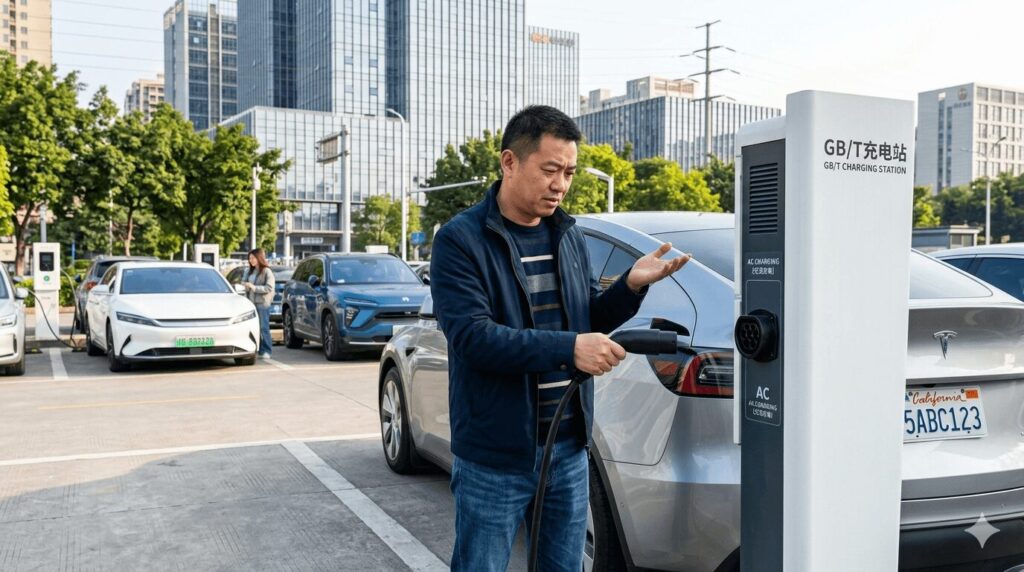
Every public charging station in China uses GB/T — State Grid, TELD, StarCharge, and all other network operators.
This creates a clean, unified domestic ecosystem — but a clear incompatibility with international vehicles using Type 2, CCS2, or NACS connectors.
China Has Multiple Emerging Standards
The situation is further complicated by China being in active transition:
ChaoJi is China’s next-generation ultra-fast connector — replacing GB/T DC for high-power applications. Compatible with GB/T through adapters but requiring new hardware for native use.
GB/T AC and GB/T DC are technically separate standards despite sharing the GB/T family name — different physical connectors, different power capabilities.
NACS is expanding globally from its North American origin — some Chinese consumers who travel internationally or follow global EV news ask about NACS even though it has no current presence in Chinese charging infrastructure.
CCS (Combined Charging System) — both CCS1 (US) and CCS2 (Europe) — is used by international EV brands globally but not in the Chinese domestic market.
Understanding where each of these sits in the Chinese context is the core of this guide.
The Four Connector Standards You Need to Understand for China
Connector 1: GB/T AC (交流充电接口)
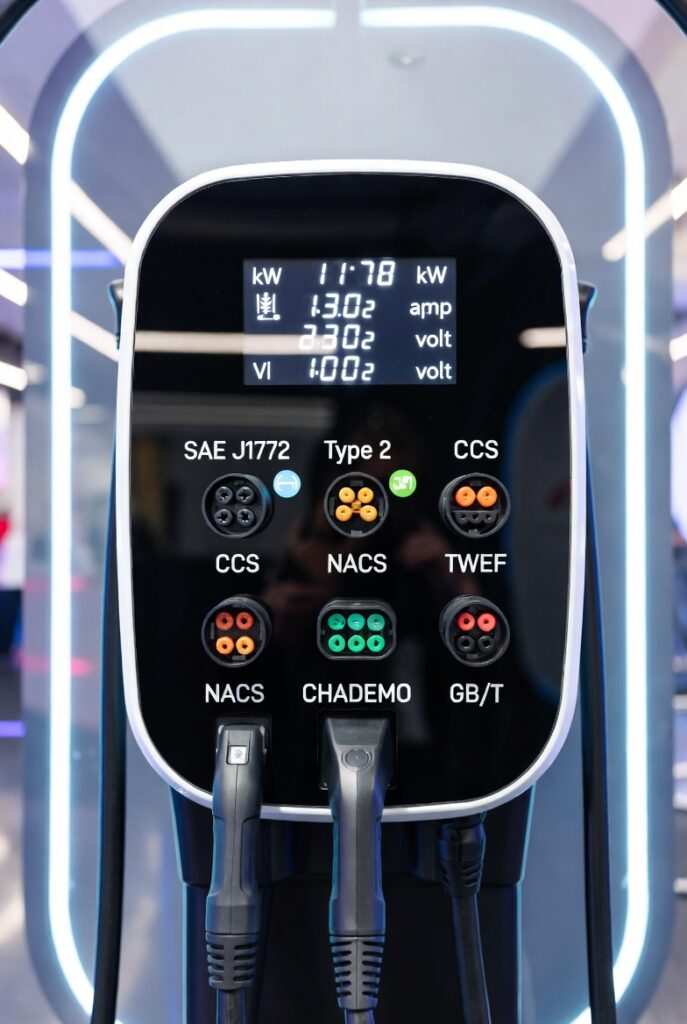
Standard: GB/T 20234.2-2015 Type: AC charging only Physical description: Seven-pin connector with a distinctive rounded rectangular housing. Roughly comparable in size to European Type 2. Not physically interchangeable with Type 2 despite superficial similarity in function. Power capability: Up to 7 kW single-phase (32A at 220V) or up to 22 kW three-phase (32A per phase at 380V) Voltage: 220V single-phase or 380V three-phase Communication: CP (Control Pilot) signal for EVSE-vehicle handshake
Where you encounter GB/T AC:
- Residential home charging units (桩) in Chinese apartment building car parks
- AC public charging stations in commercial buildings, shopping centres, car parks
- Workplace charging installations
- Hotel destination charging
Who uses it: Every EV sold in China for the domestic market. No exceptions.
Physical compatibility with international connectors: None — GB/T AC does not physically fit into a Type 2, J1772, or NACS socket without an adapter.
The daily relevance: For Chinese domestic EV owners, GB/T AC is the connector they use every day at home and at slow public charging locations. It is the baseline — the connector around which daily EV ownership in China is organised.
Connector 2: GB/T DC (直流充电接口)
Standard: GB/T 20234.3-2015 Type: DC fast charging only Physical description: Nine-pin connector, larger than the AC version, typically housed in a separate inlet port from the GB/T AC connector. Chinese EVs typically have two charging ports — one for GB/T AC and one for GB/T DC — or a combined inlet design. Power capability: Up to 250 kW at current standard stations; up to 480 kW at premium stations; ChaoJi extension pathway toward 900 kW Voltage: 200V-1000V DC Communication: CAN bus communication protocol between charger and vehicle BMS
Where you encounter GB/T DC:
- DC fast charging stations at motorway service areas
- Urban fast charging hubs
- Shopping centre fast charging bays
- Brand-specific fast charging networks (operated by TELD, StarCharge, State Grid and others)
Who uses it: Every EV sold in China for the domestic market with DC fast charging capability. No exceptions.
Physical compatibility with international connectors: None — GB/T DC does not fit CCS2, CCS1, or any other international DC connector without an adapter. The communication protocol also differs.
The daily relevance: GB/T DC is the connector used for all fast and ultra-fast public charging in China. For motorway driving and rapid top-ups, this is the connector that matters.
Connector 3: NACS (North American Charging Standard / SAE J3400)
Standard: SAE J3400 (formerly Tesla proprietary, standardised 2023) Type: Combined AC and DC — a single connector handles both Level 2 AC and DC fast charging Physical description: Compact, slim two-pin connector significantly smaller than CCS or GB/T. Designed by Tesla, now adopted as the North American standard. Power capability:
- AC Level 2: up to 11.5 kW (48A at 240V)
- DC fast: up to 1,000V, currently up to 350 kW in commercial deployment (V4 Supercharger)
Where you encounter NACS:
- Tesla Supercharger network (US and Canada) — V3 and V4 Superchargers
- US public charging infrastructure transitioning from J1772 to NACS
- Home charging in North America for Tesla and NACS-compatible vehicles
- NOT in mainland China — NACS is a North American standard with no current Chinese deployment
Who uses NACS in the context of China:
- North American-spec EVs shipped to China (rare, typically for diplomatic or expat use)
- Chinese consumers researching global EV standards
- Chinese buyers who have lived in North America and are familiar with Tesla’s US charging experience
NACS in China — the honest answer: NACS does not exist in Chinese public charging infrastructure. Tesla Superchargers in China use GB/T — not NACS. If you have a North American-spec NACS vehicle in China, you cannot use any Chinese public charging infrastructure with your native NACS connector. You need an adapter.
The NACS-to-GB/T AC adapter: NACS to GB/T AC adapters exist for AC charging. A North American NACS vehicle can use Chinese GB/T AC public charging stations at Level 2 speeds with a quality certified adapter. Maximum speed is limited by the lower of the vehicle’s AC acceptance rate (typically 11.5 kW for NACS) and the GB/T AC station’s output (typically 7 kW).
The NACS-to-GB/T DC adapter: This is where the complexity becomes significant. Cross-standard DC fast charging adapters between NACS and GB/T DC require complex power electronics and communication protocol translation. Consumer-grade NACS-to-GB/T DC adapters are not widely available for reliable high-power use. In practice, NACS vehicles in China are limited to AC charging speeds via adapter — DC fast charging from Chinese infrastructure is not practically accessible for NACS vehicles without significant engineering solutions.
Connector 4: CCS — CCS1 (North America) and CCS2 (Europe)
Standard: SAE J1772 + DC pins (CCS1) or IEC 62196-2 Type 2 + DC pins (CCS2) Type: Combined AC and DC — the J1772 or Type 2 AC portion handles Level 2 AC; the additional DC pins handle fast charging Physical description:
- CCS1: J1772 upper section with two large DC pins added below
- CCS2: Type 2 upper section with two large DC pins added below Power capability:
- CCS1: Up to 350 kW DC, J1772 AC (up to 19.2 kW)
- CCS2: Up to 350 kW DC (Ionity), Type 2 AC (up to 22 kW)
Where you encounter CCS:
- CCS1: US and Canadian DC fast charging infrastructure (Electrify America, EVgo, older ChargePoint DC)
- CCS2: European DC fast charging (Ionity, Allego, FastNed, national networks)
- NOT in mainland China — CCS is not used in Chinese charging infrastructure
Who uses CCS in the context of China:
- European-spec EVs brought to China (expats with European-market vehicles)
- US-spec EVs older than 2025 model year in China
- Chinese consumers researching international EV standards for vehicles purchased abroad
CCS2-to-GB/T AC adapter: A CCS2 vehicle (European-spec VW ID.4, European-spec BMW iX, etc.) in China can use Chinese GB/T AC charging stations with a CCS2-to-GB/T AC adapter. The physical and electrical connection is achievable — the adapter translates the Type 2 upper portion of the CCS2 vehicle’s inlet to the GB/T AC connector format.
CCS2-to-GB/T DC adapter: Same situation as NACS-to-GB/T DC — cross-standard DC fast charging adapters between CCS2 and GB/T DC are not commercially available for reliable consumer use. A European-spec vehicle in China is practically limited to AC charging speeds via adapter.
This is the most critical information for European expats in China: Your European CCS2 vehicle can charge in China — but only at AC speeds (up to 7 kW with GB/T AC adapter). DC fast charging is not practically available for European-spec vehicles in China.
The Complete Compatibility Matrix
This is the definitive reference for which vehicle connects to which infrastructure in China in 2026:
Chinese Charging Infrastructure × Vehicle Connector
| Vehicle Connector | GB/T AC Station | GB/T DC Station | ChaoJi Station | Notes |
|---|---|---|---|---|
| GB/T AC + DC (Chinese domestic) | ✅ Native | ✅ Native | ✅ With adapter | Full access to all Chinese infrastructure |
| NACS (North American) | ⚠️ Adapter (AC only) | ❌ Not practical | ❌ No | AC charging via adapter only |
| CCS1 (US market) | ⚠️ Adapter (AC only) | ❌ Not practical | ❌ No | AC charging via adapter only |
| CCS2 (European) | ⚠️ Adapter (AC only) | ❌ Not practical | ❌ No | AC charging via adapter only |
| J1772 (older US) | ⚠️ Adapter (AC only) | ❌ Not applicable | ❌ No | AC only, limited speed |
| Type 2 (European AC) | ⚠️ Adapter (AC only) | ❌ Not applicable | ❌ No | AC only via adapter |
| ChaoJi | ✅ With adapter | ✅ With adapter | ✅ Native | Forward-compatible with GB/T |
Chinese EV (GB/T) × International Infrastructure
| Infrastructure | GB/T Vehicle Access | Speed Available | Adapter Needed |
|---|---|---|---|
| European Type 2 AC | ⚠️ With adapter | Up to 7 kW | GB/T AC to Type 2 |
| European CCS2 DC | ❌ Not practical | N/A | No reliable adapter |
| US J1772 AC | ⚠️ With adapter | Up to 7 kW | GB/T AC to J1772 |
| US NACS (Supercharger) | ❌ Not compatible | N/A | No reliable adapter |
| US CCS1 DC | ❌ Not practical | N/A | No reliable adapter |
| Hong Kong Type 2/CCS2 | ⚠️ AC with adapter | Up to 7 kW | GB/T to Type 2 |
| Taiwan Type 2/CCS2 | ⚠️ AC with adapter | Up to 7 kW | GB/T to Type 2 |
The Seven Specific Scenarios — Which Plug You Actually Need
Scenario 1: Chinese National, Chinese-Spec EV, Living in China
Your connector: GB/T AC + GB/T DC What you need: Nothing additional — GB/T is universal for all Chinese charging infrastructure Home charging: 7 kW GB/T AC home unit Public charging: Full access to State Grid, TELD, StarCharge, NIO swap (if NIO), Xpeng S4 (if Xpeng), all DC fast charging Answer: You have exactly the right connector for China. No adapters needed. No compatibility concerns.
Scenario 2: European Expat in China, European-Spec EV (CCS2)
Your connector: Type 2 AC + CCS2 DC Your challenge: Neither Type 2 nor CCS2 is directly compatible with Chinese GB/T infrastructure
AC charging solution: Purchase a CCS2 to GB/T AC adapter (Type 2 male to GB/T female — sometimes listed as “Type 2 to GB/T adapter”). This allows your vehicle to use Chinese GB/T AC charging stations at up to 7 kW.
Recommended adapters for European-spec vehicles in China:
- Setec GB/T AC Adapter (Type 2 to GB/T): The most widely used in the expat community. Certified, rated for 32A. Price: approximately ¥300-¥600.
- Ratio GB/T AC Adapter: Chinese brand, well-reviewed among expat EV owners in Shanghai and Beijing. Price: approximately ¥250-¥500.
DC fast charging: No practical solution. Your European-spec vehicle cannot use Chinese DC fast charging infrastructure. Plan your life around AC charging at home and at commercial locations.
The practical charging strategy for European expats: Install a GB/T AC home charging unit in your apartment parking space. This is the primary daily charging solution. The 7 kW AC adapter is your backup for public AC charging when away from home. For longer drives within China, plan routes around the distance your battery covers on a full charge — avoid depending on DC fast charging that isn’t accessible.
Is this workable? For daily urban driving — yes. Most European expats in Shanghai, Beijing, or Shenzhen drive under 60 km daily. Home charging at 7 kW via adapter overnight covers this comfortably. The limitation is long-distance driving — without DC fast charging access, long motorway drives in China require either careful planning around your full battery range or consideration of a Chinese-spec vehicle instead.
Should you import your European-spec EV to China? Honestly — for stays over 12 months, buying a Chinese-spec EV in China is more practical than importing a European-spec vehicle. The charging infrastructure compatibility, vehicle service network, and resale value all favour Chinese-spec vehicles for long-term China residence. The one advantage of keeping your European-spec vehicle is being able to use it when you return to Europe without adapter complexity.
Scenario 3: North American Expat in China, NACS Vehicle
Your connector: NACS (combined AC/DC) Your challenge: NACS is absent from Chinese charging infrastructure — including Tesla’s Chinese Supercharger network, which uses GB/T
AC charging solution: NACS to GB/T AC adapter. This allows your NACS vehicle to use Chinese GB/T AC stations at Level 2 speeds. The adapter translates the NACS connector’s AC pins to GB/T AC format.
Important note for Tesla owners: Your North American Tesla (NACS) cannot use Chinese Tesla Superchargers without an adapter. Chinese Superchargers are GB/T — designed for the Chinese-spec Tesla that uses GB/T connectors. The NACS connector on your North American Tesla does not fit a Chinese Supercharger cable. You need a NACS to GB/T DC adapter for Supercharger access — and this adapter is not Tesla-supplied for North American vehicles in China.
The most practical solution for NACS owners in China: Contact Tesla China (if you have a Tesla) — Tesla has occasionally provided GB/T adapters for North American owners in China through service channels. This is not a standard programme but worth enquiring about directly.
For non-Tesla NACS vehicles, a quality NACS to GB/T AC adapter handles daily charging at home and at public AC stations. DC fast charging remains the limitation.
DC fast charging: Same limitation as CCS2 — no practical consumer adapter solution for NACS to GB/T DC fast charging.
The practical charging strategy for North American expats: Install a dedicated home charging circuit and a Level 2 EVSE compatible with your NACS vehicle (using your existing home charging equipment shipped from North America or a NACS home charger if available). For Chinese public infrastructure access, the GB/T AC adapter covers slow public charging. Plan life around home charging as primary source.
Scenario 4: Chinese National Studying or Working Abroad, Buying an EV in UK/Europe
Your situation: You are in the UK or Europe and buying an EV for use while abroad. Eventually you may return to China.
Your connector (UK/European-spec purchase): Type 2 AC + CCS2 DC Chinese infrastructure compatibility: Type 2 to GB/T AC adapter allows Chinese home and slow public charging. DC fast charging in China not available.
The buying decision for China returnability: If you plan to return to China with the vehicle:
- UK/European-spec vehicle can be used in China for daily charging via adapter but is significantly limited for fast charging
- Selling the UK/European-spec vehicle before returning to China and buying a Chinese-spec vehicle in China is more practical for long-term China residence
- Some Chinese nationals keep UK/European-spec vehicles for use during visits to the UK/Europe and use local transport or rental cars in China
The MG4 and BYD Atto 3 specific note: MG4 and BYD Atto 3 sold in the UK and Europe are European-spec with Type 2/CCS2 connectors — these are NOT the same as the Chinese-market versions of the same models (which use GB/T). If you buy an MG4 in the UK for use in Europe and then want to charge it in China, you have the European-spec connector challenge.
Scenario 5: Chinese National Planning to Drive from China to Europe (or Vice Versa)
The realistic overland EV route: The overland route from China to Europe passes through Central Asia — Kazakhstan, Russia, and into Eastern Europe. This is not a practical EV route in 2026 for most consumers. DC fast charging infrastructure across Central Asian countries is minimal to non-existent.
The practical reality: Driving your Chinese-spec EV from China to Europe overland is currently impractical for charging infrastructure reasons before it’s impractical for other logistical reasons. This is not a scenario that requires connector compatibility planning in 2026.
Flying between China and Europe/US with an EV: You don’t fly the car — you buy or rent locally, or ship the vehicle and manage the connector compatibility challenge as per Scenarios 2-4.
Scenario 6: Hong Kong — The Specific Border Case
Hong Kong represents the most commonly encountered cross-border EV charging scenario for mainland Chinese EV owners — and it has a specific connector complexity worth understanding.
Hong Kong’s charging infrastructure: Hong Kong uses European-standard Type 2 and CCS2 connectors — NOT GB/T. This is a legacy of Hong Kong’s pre-2020 EV infrastructure development which followed international standards rather than mainland Chinese standards.
For mainland Chinese GB/T vehicles driving to Hong Kong:
- AC charging in Hong Kong: GB/T to Type 2 adapter allows your mainland Chinese EV to use Hong Kong’s Type 2 AC stations
- DC fast charging in Hong Kong: Not practically available for GB/T vehicles without a reliable CCS2-to-GB/T DC adapter
This is a genuine practical limitation: A mainland Chinese EV owner driving to Hong Kong (increasingly common as restrictions have eased) can access Hong Kong’s AC Type 2 infrastructure at slow charging speeds via adapter. For rapid charging in Hong Kong, options are limited to the few GB/T DC stations that some Hong Kong operators have installed specifically to serve mainland Chinese visitors.
Recommended adapter for Hong Kong visits: A quality GB/T AC to Type 2 adapter is the practical solution. Brands: Setec, Ratio, and several other Chinese EV accessory brands offer certified versions. Verify the adapter is rated for your vehicle’s maximum AC charging current before purchase.
The Taiwan situation: Taiwan, like Hong Kong, uses Type 2 and CCS2. A mainland Chinese GB/T vehicle visiting Taiwan has the same adapter requirements as Hong Kong.
Scenario 7: International Brand EV in China — Chinese-Spec vs International-Spec
This scenario is the most commonly misunderstood — because the same EV model sold in different markets has different connectors.
Tesla example:
- Tesla Model Y sold in China (manufactured at Gigafactory Shanghai): GB/T connectors — full access to all Chinese infrastructure including Tesla Superchargers in China
- Tesla Model Y sold in the US (manufactured at Gigafactory Texas or Fremont): NACS connectors — limited access to Chinese infrastructure, requires adapter
- Tesla Model Y sold in Europe: CCS2 connectors — limited access to Chinese infrastructure, requires adapter
BMW example:
- BMW iX sold in China (manufactured at BMW Brilliance, Shenyang): GB/T connectors
- BMW iX sold in Europe: CCS2 connectors
Volkswagen ID.4 example:
- VW ID.4 sold in China (manufactured at SAIC-Volkswagen or FAW-Volkswagen): GB/T connectors
- VW ID.4 sold in Europe: CCS2 connectors
The lesson: The brand name on the car doesn’t tell you which connector it has — the market it was sold in does. Always verify the specific market variant’s connector standard before assuming compatibility.
Adapter Guide — What Works, What Doesn’t, and What to Buy
This section provides specific guidance on which adapters are available, which work reliably, and which are limited or non-functional in the China EV charging context.
Adapters That Work Reliably
GB/T AC (female) to Type 2 (male): Allows GB/T AC vehicle to use European Type 2 AC stations.
Use case: Chinese domestic EV owner visiting Hong Kong or Taiwan, or Chinese EV owner in Europe.
Reliability: High — AC charging at low power levels (up to 7 kW single-phase) is technically straightforward to adapt. Communication protocol translation at AC levels is manageable.
Recommended products:
- Setec EVSE GB/T to Type 2 adapter: ¥300-¥600 / approximately €40-€80
- Besen GB/T to Type 2 adapter: well-reviewed for reliability at up to 32A
Type 2 (male) to GB/T AC (female): Allows European-spec Type 2/CCS2 vehicle to use Chinese GB/T AC stations.
Use case: European expat in China needing to use Chinese public AC charging stations.
Reliability: High for AC charging — same reasoning as above.
Recommended products:
- Setec Type 2 to GB/T adapter: widely used by expat community
- Various Chinese EV accessory brands — verify certification (GB/T 20234.2 compliance marking)
GB/T AC (female) to J1772 (male): Allows GB/T AC vehicle to use US J1772 AC stations.
Use case: Chinese-spec EV temporarily in the US (diplomatic or expat use).
Reliability: Adequate for AC charging. Limited to J1772 Level 2 speeds.
NACS to GB/T AC: Allows North American NACS vehicle to use Chinese GB/T AC stations.
Use case: North American expat in China with NACS vehicle.
Reliability: Adequate for AC charging — NACS AC pins to GB/T AC translation works at low power levels.
Adapters That Are Limited or Unreliable
Any GB/T DC to CCS2 adapter: DC fast charging cross-standard adapters between GB/T DC and CCS2 require both physical connector translation AND communication protocol translation between GB/T’s CAN bus protocol and CCS2’s PLC-based communication. Consumer-grade adapters claiming this capability are unreliable at high power levels and present genuine safety risks.
Verdict: Do not use untested GB/T DC to CCS2 adapters for high-power DC fast charging. The risk of incomplete charge, communication failure, or hardware damage is not worth the convenience.
CCS2 to GB/T DC adapter: Same problem in reverse — European-spec vehicle attempting to use Chinese DC fast charging via adapter.
Verdict: No reliable consumer solution. Accept the AC-only limitation for European-spec vehicles in China.
NACS to GB/T DC adapter: Same problem — power electronics and protocol complexity make reliable high-power DC cross-standard adapters impractical for current consumer use.
Verdict: Same as above. AC-only charging is the practical limit for NACS vehicles in China.
The Chinese EV Brands Going Global — What Connector They Use Abroad
This section specifically serves Chinese users who follow their domestic EV brands internationally and want to understand how BYD, NIO, Xpeng, and others configure their vehicles for non-Chinese markets.
BYD in Europe
BYD Atto 3 (European spec): Type 2 AC + CCS2 DC — NOT GB/T BYD Seal (European spec): Type 2 AC + CCS2 DC BYD Han (European spec, where available): Type 2 AC + CCS2 DC BYD Dolphin (European spec): Type 2 AC + CCS2 DC
The key point: BYD vehicles sold in Europe are reconfigured for European connectors. They are not the same as Chinese-spec BYD vehicles. A BYD Atto 3 bought in the UK charges from a Type 2 home charger exactly like any other European EV.
MG in Europe
MG4 (European spec): Type 2 AC + CCS2 DC MG5 (European spec): Type 2 AC + CCS2 DC
Same principle — European-spec MG vehicles use European connectors.
NIO in Europe
NIO ET5 (European spec): Type 2 AC + CCS2 DC NIO ET7 (European spec): Type 2 AC + CCS2 DC NIO battery swap in Europe: NIO is building swap stations in Norway, Germany, and other European markets. European NIO swap stations use a European-spec battery swap system — compatible with European NIO vehicles but NOT with Chinese-spec NIO vehicles.
Xpeng in Europe
Xpeng G9 (European spec): Type 2 AC + CCS2 DC Xpeng P7 (European spec): Type 2 AC + CCS2 DC
The Pattern
Every major Chinese EV brand selling in Europe or the US configures vehicles with the local connector standard rather than GB/T. This is mandatory — Chinese-spec GB/T connectors would make the vehicles unusable on European infrastructure.
ChaoJi — The Future Connector and What It Means for You
ChaoJi deserves specific attention in the GB/T vs NACS vs CCS which EV charger plug do you actually need in China in 2026 comparison because it changes the long-term Chinese connector landscape.
What ChaoJi Is
ChaoJi (超级充电接口) is China’s next-generation combined AC/DC charging connector:
- Single connector for both AC and DC charging (like NACS in North America)
- DC capability up to 900 kW
- AC capability up to 22 kW
- Communication: PLC (Power Line Communication) — the same protocol used by CCS2 in Europe
- Backward compatibility: ChaoJi connectors can charge existing GB/T vehicles through adapter mode built into the ChaoJi standard
ChaoJi vs CCS2 — An Interesting Technical Convergence
ChaoJi and CCS2 use the same communication protocol (PLC/ISO 15118) even though they use different physical connectors. This technical commonality has created discussion in the international EV standards community about potential future interoperability — but as of 2026, the physical connector incompatibility means ChaoJi and CCS2 remain separate standards requiring adapters for cross-compatibility.
Does ChaoJi Change Your Connector Decision in 2026?
For Chinese domestic EV owners: If you’re buying a new premium Chinese EV in 2026-2027 that includes ChaoJi capability, you are buying into the future Chinese standard. Your existing GB/T infrastructure access is maintained through adapters built into the ChaoJi standard. No action required beyond ensuring your home charging setup handles GB/T AC (which it does if it’s a current installation).
For international expats in China: ChaoJi doesn’t change your situation in 2026 — you still face the same GB/T vs international connector incompatibility. ChaoJi’s international compatibility trajectory is not yet established.
For Chinese national EV buyers abroad: ChaoJi will eventually create pressure for international adapter solutions — its PLC commonality with CCS2 may facilitate future bidirectional adapter development. But this is a 2028-2030 prospect, not a 2026 reality.
The Practical Connector Decision Guide
For each reader scenario, here is the single most important connector decision:
If You Drive in China Daily (Chinese Resident)
Buy a Chinese-spec EV with GB/T. This is the only rational choice for long-term China residence. Full access to all Chinese charging infrastructure, no adapter complexity, full DC fast charging access, full home charging access.
If you already have an international-spec EV in China: Get the appropriate AC adapter (Type 2 to GB/T, or NACS to GB/T AC), install a home charging unit compatible with your vehicle’s connector, accept the DC fast charging limitation for long-distance driving, and plan accordingly.
If You Drive in Europe Daily (Chinese Expat Abroad)
Buy a European-spec EV with Type 2/CCS2. If you’re in the UK or EU for more than 12 months, a locally-spec’d vehicle eliminates all charging compatibility problems. European-spec BYD, MG, NIO, and Xpeng vehicles are available and fully compatible with European infrastructure.
If you want to keep a Chinese-spec EV abroad: Get a GB/T to Type 2 adapter for AC charging. Accept that DC fast charging on European CCS2 infrastructure is not practically available. For short stays this is manageable — for long-term residence it’s a significant limitation.
If You Regularly Travel Between China and Europe
Two vehicles or one vehicle with a significant limitation:
The honest answer is that no single vehicle with a single connector standard works natively in both China and Europe. Your options:
- Chinese-spec vehicle in China + European-spec vehicle in Europe — optimal charging access in both markets, requires two vehicles
- One vehicle with adapters in both markets — reduced to AC charging in whichever market the vehicle wasn’t designed for
- Chinese-spec vehicle with GB/T to Type 2 adapter in Europe — adequate for daily commuting in Europe on AC charging, limited for long-distance European motorway driving without CCS2 DC access
If You Are Buying an EV Specifically for Hong Kong
Buy a Hong Kong-spec vehicle with Type 2/CCS2 — or a mainland Chinese-spec vehicle with GB/T adapter.
Hong Kong’s charging infrastructure uses Type 2/CCS2 for established stations and an increasing number of GB/T stations specifically for mainland Chinese visitors. A Hong Kong-registered vehicle bought locally will have Type 2/CCS2. A mainland vehicle visiting Hong Kong needs the GB/T to Type 2 adapter.
The Adapter Buying Guide — What to Look for and What to Avoid
If you need adapters for cross-market EV charging involving China, these specific criteria prevent the most common adapter mistakes:
Certification Requirements
For adapters used in China: Ensure the adapter carries GB/T 20234 compliance marking — this confirms the adapter meets Chinese electrical safety and performance standards for EV charging. Uncertified adapters sold cheaply online may not handle sustained high-current charging safely.
For adapters used in Europe: The adapter should carry CE marking (European Conformity) and ideally IEC 62196 compliance confirmation. UK-specific: UKCA marking post-Brexit.
Current Rating
Match the adapter’s current rating to your vehicle’s maximum AC charging rate:
- 7 kW vehicle (32A): adapter rated 32A minimum
- 11 kW vehicle (48A): adapter rated 48A minimum
An adapter rated for 16A (3.7 kW) will limit your vehicle’s AC charging speed even if the vehicle and station support higher rates.
Cable Length
Many adapters are designed as short-length conversion pieces (under 30 cm) rather than full cable assemblies. Ensure the adapter length, combined with your charging cable’s length, reaches comfortably from the station to your vehicle’s charging port.
Brands to Consider for China Market Adapters
Setec (深圳市赛特新能源): The most widely referenced brand in the expat EV owner community in China for Type 2 to GB/T adapters. Well-reviewed for reliability at sustained charging currents.
Besen (比深): Strong reputation for EV charging accessories including cross-standard adapters. Certified products available.
Ratio: Chinese brand with good expat community reviews for AC adapter reliability.
What to avoid: Unbranded or uncertified adapters from unknown sellers on Taobao or AliExpress at very low prices (under ¥100). The price-quality relationship for EV charging adapters is significant — a failing adapter at 32A is a safety hazard.
Internal Links — Further Reading on Clean Energy Bazaar
The GB/T vs NACS vs CCS which EV charger plug do you actually need in China in 2026 guide sits within our growing Chinese market content alongside the broader connector guides across this site.
For the complete Chinese market charging speed guide covering slow vs fast vs ultra-fast in depth, our EV charging guide 2026 slow vs fast vs ultra-fast differences in the Chinese market covers the full charging landscape. For understanding how European connector standards (Type 2 and CCS2) compare to each other — relevant for expats moving between European and Chinese markets, our J1772 vs Type 2 EV charger connectors definitive guide covers the European and US connector picture in depth. For the NACS vs Type 2 future-proofing comparison that explains why NACS is North American-only and has no Chinese deployment, our NACS vs Type 2 future-proof EV chargers US Europe 2026 guide covers the full international connector landscape. For understanding EV charger specifications — the kW, kWh, and amperage numbers that appear in Chinese and international charging guides, our EV charger specs 2026 guide translates everything into plain language. And for the upcoming bidirectional and ultra-fast trends including ChaoJi that will shape the Chinese connector landscape, our upcoming EV charger trends 2026-2027 V2G bidirectional guide covers the global technology direction.
Final Thoughts
The GB/T vs NACS vs CCS which EV charger plug do you actually need in China in 2026 question has answers that are clearer than the complexity of the connector landscape might suggest.
The definitive answers by situation:
Living in China full-time: You need GB/T. Buy a Chinese-spec vehicle. No other connector works natively in China. GB/T gives you full access to all Chinese charging infrastructure at all speeds including DC fast charging.
European expat in China with European-spec EV: You have CCS2. You need a Type 2 to GB/T AC adapter for Chinese public AC charging. You cannot practically DC fast charge in China. Install a home charging unit compatible with your CCS2 vehicle for primary daily charging.
North American expat in China with NACS EV: You have NACS. You need a NACS to GB/T AC adapter. Same DC fast charging limitation as European-spec vehicles. Home charging is your primary solution.
Chinese national in Europe with Chinese-spec EV: You have GB/T. You need a GB/T to Type 2 adapter for European AC charging. European DC fast charging via CCS2 is not practically available. Plan around AC home charging as primary source.
Chinese expat buying an EV in Europe: Buy the European-spec version of any EV — BYD Atto 3, MG4, NIO ET5, Xpeng G9 all come in European Type 2/CCS2 specification. These are fully compatible with European infrastructure and have no compatibility complications in the EU and UK.
Driving between mainland China and Hong Kong: You need the GB/T to Type 2 AC adapter for Hong Kong’s Type 2 infrastructure. Hong Kong is progressively adding GB/T DC stations for mainland visitors but don’t depend on them.
The connector you actually need is determined by where you drive, not by what you might find interesting to own. China uses GB/T. Europe uses Type 2/CCS2. North America uses NACS. Each is the right connector for its own market — and the adapter complexity is the unavoidable cost of operating across market boundaries.
Know your market. Know your connector. Know your adapter requirements for the markets you cross. Then charge accordingly.