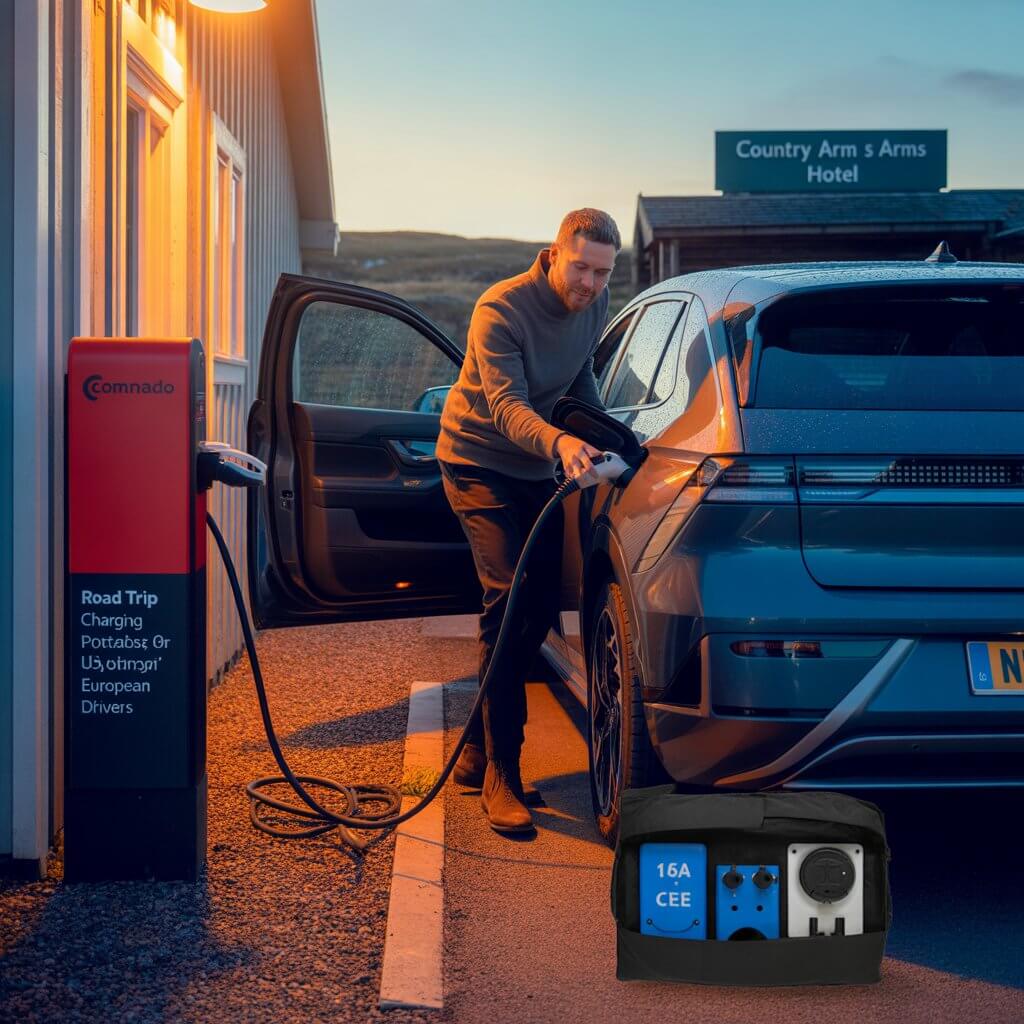
Here’s the conversation that happens in the car park of a rural Scottish hotel at 11pm on a Tuesday in August.
A family arrives with a Hyundai Ioniq 5. They have 18% battery. The hotel doesn’t have an EV charger. The nearest public fast charger is 23 miles away. They have the car’s included Mode 2 cable — the one that plugs into a standard socket. The hotel has standard sockets.
They plug in. The Mode 2 cable draws 2.3 kW from the standard socket. Over 8 hours overnight, they gain approximately 43 km of range. Enough to reach the fast charger in the morning, but only just, and only if they don’t take the scenic route they planned.
This situation is entirely preventable. Not by staying near motorway services — but by carrying the right road trip charging kit 2026 portable options for US and European drivers in the boot of the car.
The difference between that 11pm car park anxiety and a relaxed overnight charge isn’t always a dedicated charger at the hotel. It’s sometimes a 32A commando adapter that turns the hotel’s workshop socket into a 7.4 kW charging connection. Or knowing which app shows the nearest working public charger at that exact moment. Or having a CCS2-to-Type-2 adapter that makes a destination charger compatible when the car’s native port doesn’t fit.
This guide builds the complete road trip charging kit for both US and European drivers — every portable EVSE worth carrying, every adapter genuinely worth packing, every app that actually helps on the road, and the kit combinations that match different vehicle types, trip profiles, and budgets.
Why a Road Trip Charging Kit Is Different From a Home Charging Setup
Before building the kit, understanding what makes road trip charging different from home charging shapes the right decisions.
The Charging Environment Is Unpredictable
At home, you know your charger, your socket, your electrical supply. On a road trip you encounter:
- Hotel car parks with standard sockets, commando sockets, or purpose-built EV chargers — or nothing at all
- Airbnb properties with whatever electrical infrastructure the host has installed
- Rural charging deserts where the nearest fast charger may be 40-80 miles away
- Campsite hook-up points with 16A or 32A CEE sockets (Europe) or 30A/50A NEMA outlets (US)
- Friends and family homes with standard sockets and occasional 240V outlets in garages
- Workplace car parks with 7.2 kW Type 2 chargers or 120V outlets depending on how progressive the employer is
A road trip charging kit needs to work across all of these environments — not just the ideal ones.
Speed Matters Differently on the Road
At home, charging overnight at 7.2 kW is perfectly adequate — you sleep through it. On a road trip, an unplanned overnight stop where you need 150 km of range by 8am and you’re plugging into a 2.3 kW socket at 10pm adds genuine stress.
A kit that includes an adapter unlocking 7.4 kW from a campsite or hotel socket turns a 12-hour slow-charge situation into a 3.5-hour situation — the difference between waking up ready to drive and waking up to a 32% battery you didn’t want.
The Weight and Space Trade-Off Is Real
Unlike a permanently installed home charger, your road trip kit has to live in the boot of your car. Every adapter and cable adds weight and takes space. The kit discipline question — what’s actually worth carrying versus what’s optimistic edge-case preparation — is one of the most practical questions this guide answers.
The Connector Landscape Is Still Complex
Despite NACS consolidation in the US and Type 2 standardisation in Europe, the 2026 road trip environment still has connector complexity:
US road trip: NACS vehicles encounter legacy J1772 destination chargers everywhere. J1772 vehicles encounter NACS-only Supercharger stations. Rural states have older CHAdeMO DC chargers at some locations. Your kit needs to bridge these gaps.
European road trip: Type 2 is universal for AC but some older destination chargers in rural areas have proprietary connectors or non-functioning Type 2 units. Cross-border travel creates different network compatibilities. Some older AC chargers in France, Italy, and Spain use 3-pin connectors that require adapters.
Building the Kit — What Every EV Road Tripper Needs
The road trip charging kit 2026 portable options for US and European drivers has four layers. Not every driver needs every layer — we’ll identify which layers apply to which driver profiles.
Layer 1 — Foundation (everyone needs this): The essential items no road tripper should leave home without, regardless of vehicle or trip type.
Layer 2 — Destination Charging (most drivers benefit): Items that unlock faster overnight charging at hotels, Airbnbs, family homes, and campsites.
Layer 3 — Emergency and Backup (worth having for longer or rural trips): Items that prevent genuine range emergencies and provide backup when primary charging options fail.
Layer 4 — Cross-Country and International (specific scenarios): Items for US cross-country trips or European multi-country driving where connector and network complexity increases.
Layer 1 — Foundation Items (Every Driver, Every Trip)
Item 1: Your Vehicle’s Included Mode 2 EVSE
What it is: The portable charging cable included with every new EV — one end is Type 2 (or NACS in the US), the other end is a standard household plug (13A UK, Schuko European, standard 120V US).
Power delivery: 1.8-3 kW depending on socket and cable rating
Why it’s in Layer 1: You already have it. It costs nothing additional. And despite being the slowest charging option, it’s the universal fallback that works literally anywhere there’s a standard socket. For adding range overnight at a family member’s house, a hotel room’s exterior socket, or any location where you have 8-10 hours of charging time, this cable covers your needs adequately.
The Renault 5 and compact EV specific note: As established in our apartment charging guide, a Mode 2 cable replaces a typical day’s driving (40-60 km) for a compact EV owner in under 4-5 hours from a standard socket. For compact EV road trippers, the included Mode 2 cable is proportionally more useful than for drivers of large-battery vehicles.
What to check: Is your included cable rated for 10A (2.3 kW) or 13A (3 kW) from a standard socket? Many included cables are 10A rated. A 13A rated third-party Mode 2 cable draws more power from the same socket — worth the £20-€25 upgrade.
Space: Minimal — all EVs have a designated cable storage compartment.
Item 2: The PlugShare App (US) or Chargemap App (Europe)
What it is: Real-time EV charging station location and status apps powered by user check-ins and network integrations.
Cost: Free (both apps)
Why it’s in Layer 1: A charging network’s own app tells you where their chargers are. PlugShare and Chargemap tell you which chargers are actually working right now, based on user check-ins in the past hour. The difference is critical when you arrive at a charging location with 8% battery.
PlugShare (US and worldwide): Shows all charging networks in one map. Filter by connector type, power level, and user rating. User check-ins (“Working great — just charged here”) and reviews (“Out of order since March”) are the most valuable feature. Available offline for cached maps.
Chargemap (Europe): The European equivalent — particularly strong in France, Belgium, Germany, the Netherlands, and Southern Europe. Shows real-time availability, pricing, and user reviews. Chargemap Pass allows payment across multiple European networks from one account.
Download both before you leave: Even if you’re a primarily US driver, Chargemap is essential for European trips. Even if you’re a primarily European driver, PlugShare covers US trips if you ever cross the Atlantic with your EV.
Space: Zero — apps.
Item 3: Network Memberships and Apps Pre-Installed
What it is: Accounts pre-registered with the major charging networks relevant to your trip route.
Cost: Free to register (per-kWh charging costs apply)
Why it’s in Layer 1: The single most stressful charging scenario on a road trip is arriving at a fast charger with low battery and discovering you need to create an account, verify your email, and add payment details before you can start charging. A 5-minute process becomes a 15-minute ordeal with 6% battery and a 4-year-old asking when lunch is.
US drivers — pre-register with:
- Tesla app (all NACS vehicles now use Supercharger network)
- Electrify America app (or use the car’s touchscreen)
- ChargePoint app
- EVgo app
- Blink app (for rural areas)
- Your specific utility’s network app if applicable
European drivers — pre-register with:
- Ionity app (or ABRP integration)
- Allego / Fastned app
- IONITY is available via various roaming apps — check your car manufacturer’s app for integrated Ionity billing
- Chargemap Pass (covers multiple networks across Europe from one card)
- Your country’s dominant network: Pod Point / BP Pulse (UK), Recharge (Scandinavia), EnBW (Germany), Total Energies (France), Iberdrola (Spain), Enel X (Italy)
The Chargemap Pass advantage for European road trippers: Rather than managing accounts with 8-10 different European networks, a Chargemap Pass card provides access to 400,000+ charging points across Europe from one account. For multi-country European road trips, this is the most practical payment solution available.
Space: Zero — apps and a single payment card.
Item 4: A Physical Backup Payment Method
What it is: A contactless bank card or credit card that works with pay-as-you-go charging stations.
Cost: Zero
Why it’s in Layer 1: Some charging stations — particularly older UK and European stations — require contactless card payment at the station rather than app payment. If your phone battery is dead, your data connection is unavailable, or the station’s app integration is broken, a physical contactless card is your fallback.
The specific scenario: Rural France, rural Italy, rural Spain still have older charging stations that accept credit card payment directly — no app, no account, just tap. Ensuring you have a card that works internationally and contactlessly covers this scenario.
Space: Zero — already in your wallet.
Layer 2 — Destination Charging Upgrades (Most Drivers Benefit)
Item 5: 32A Commando Adapter (UK) or CEE 32A Adapter (Europe)
What it is: An adapter that converts a 32A industrial socket (commando in the UK, CEE 32A red socket in Europe) to Type 2 (or NACS with US adapter), allowing Level 2 charging speeds from campsite hook-ups, hotel workshop sockets, and industrial premises.
Power delivery: Up to 7.4 kW (32A × 230V × efficiency)
Why it’s the most valuable Layer 2 item:
32A industrial sockets are far more common at road trip destinations than dedicated EV chargers:
- UK campsites almost universally have 16A commando (EHU) hook-ups and many have 32A workshop sockets
- European campsites have CEE 16A (blue) hook-ups and often CEE 32A (red) workshop or service sockets
- Hotels often have workshop or maintenance sockets accessible to guests on request
- Farm stays, rural Airbnbs, and countryside accommodation often have agricultural or workshop 32A sockets
- Some motorhome service points have 32A sockets designed for motorhome hook-up that EV owners can also use
A 32A commando or CEE adapter turns a 7-hour slow charge from the Mode 2 cable into a 1.5-2 hour Level 2 charge for a Renault 5, or a 3-4 hour charge for a VW ID.4 with 77 kWh battery.
UK specific products:
Besen Type 2 to 32A Commando Adapter (£45-£65): The most commonly carried UK road trip adapter. Converts a 32A commando socket to a Type 2 EVSE connection. Works with any Type 2 vehicle. Cable length typically 5 metres. Must be used with a charging cable that has a Type 2 connector on the car end — some EVs require the car’s own Type 2 cable.
Important compatibility note: UK 32A commando adapters connect to a Type 2 socket on the cable side — meaning you need either your car’s own Type 2 cable or a separate Type 2 cable. Some EVs have untethered (socket) connections on the car side requiring a Type 2-to-Type-2 cable.
European specific products:
Juice Booster 2 with CEE 32A adapter (€499-€699): The Juice Booster 2 with its CEE 32A red adapter included is the premium solution. It’s both a standalone EVSE and an adapter system — one device covers CEE 16A (7.4 kW single-phase), CEE 32A (7.4 kW or up to 22 kW three-phase), Schuko (2.3 kW), and other European socket types.
KEBA KeContact Portable with CEE adapters (€299-€449): A dedicated portable EVSE with CEE adapter compatibility. Less versatile than the Juice Booster 2 but more affordable for owners who specifically need single-phase charging.
Budget CEE 32A to Type 2 adapter (€30-€60): For owners who already have a suitable portable EVSE and just need the adapter. The socket-type adapter (not a full EVSE) is the lightest and cheapest option.
Space: Varies — Juice Booster 2 with adapters is the size of a medium camera bag. Standalone adapters are fist-sized.
Weight: Juice Booster 2 approximately 1.8 kg. Standalone adapter approximately 300-500g.
Item 6: 16A Commando / CEE 16A Adapter (Campsite Use)
What it is: Adapter converting a standard 16A EHU (electric hook-up) campsite socket to Type 2. The slower version of Item 5 — delivers 3.7 kW rather than 7.4 kW.
Power delivery: 3.7 kW (16A × 230V)
Why it’s worth carrying separately from the 32A adapter:
UK and European campsites almost universally have 16A EHU hook-up points — the blue CEE 16A sockets designed for campervans and motorhomes. These are available at virtually every touring pitch in the UK and Europe, often included in the pitch fee.
At 3.7 kW, a 16A campsite hook-up charges:
- Renault 5 Standard Range (40 kWh) from 20-80%: approximately 6.5 hours
- VW ID.3 Pure (45 kWh) from 20-80%: approximately 7.5 hours
- Hyundai Ioniq 5 Long Range (77 kWh) from 20-80%: approximately 13 hours
Overnight campsite charging from a 16A EHU adequately covers compact EV owners’ daily range replacement. For larger battery vehicles, a 16A hook-up provides partial charging — meaningful but not complete.
UK product: Besen Type 2 to 16A Commando Adapter (£35-£50): Specifically for UK blue 16A commando sockets. Many UK campsites have these as standard hook-up sockets. One of the most consistently useful adapters for UK road trip campers.
European product: CEE 16A to Type 2 EVSE cable (€25-€45): A simple conversion cable from the blue CEE 16A socket to Type 2 EVSE connection. Many EV drivers in Europe carry this as a camping standard.
Space: Fist-sized. Worth it for any camping or glamping element of a road trip.
Item 7: NEMA 14-50 Adapter (US Road Trippers)
What it is: For US NACS or J1772 vehicle owners, an adapter connecting to a NEMA 14-50 socket (the standard 240V outlet used by electric dryers and ranges) and converting to your vehicle’s connector.
Power delivery: Up to 9.6 kW (40A × 240V)
Why it’s the US equivalent of the European 32A commando adapter:
NEMA 14-50 sockets are ubiquitous in North America:
- RV parks and campgrounds universally have NEMA 14-50 or NEMA TT-30 hook-up stations
- Airbnb hosts increasingly install NEMA 14-50 outlets in garages or driveways as EV amenities
- Rural hotels sometimes have NEMA 14-50 in workshop or laundry areas accessible to guests on request
- Friends and family homes often have 240V outlets in garages (dryer outlet, workshop outlet)
- Some Walmart, Cracker Barrel, and retail parking areas have NEMA 14-50 installations
For NACS vehicles: The Tesla Mobile Connector with the NEMA 14-50 adapter is the standard solution — delivers 32A (7.7 kW) from any NEMA 14-50 socket. Tesla includes the Mobile Connector and 120V adapter; the NEMA 14-50 adapter is sold separately for approximately $35.
For J1772 vehicles: Any portable J1772 EVSE with a NEMA 14-50 plug — the JuiceBox 40, Lectron 240V, or Grizzl-E Duo. Most of these are NEMA 14-50 plug equipped as standard.
Space: The Tesla Mobile Connector + NEMA 14-50 adapter is a small bag that fits in any glove compartment. Worth carrying on every US road trip with a NACS vehicle.
Layer 3 — Emergency and Rural Backup
Item 8: Extension Cord — Outdoor Rated, Correct Gauge
What it is: A heavy-duty outdoor extension cord for reaching a socket from a parking position further than your Mode 2 cable reaches.
Power delivery: Passes through whatever the socket delivers — maintain cable gauge rating
Why emergency situations justify carrying one:
The hotel socket is around the corner from where you’re parked. The campsite EHU is 15 metres from the most convenient pitch. The Airbnb’s outdoor socket is 12 metres from the driveway. Your Mode 2 cable is 4.5 metres.
In these scenarios — genuinely common on road trips — a rated outdoor extension cord is the difference between no charge and an adequate overnight top-up.
Critical safety requirements:
- Use only fully unwound — coiled extension cords overheat under sustained EV charging load
- Minimum 2.5mm² conductor for UK/European 13A-16A use
- Minimum 12 AWG for US 20A use
- Maximum 10 metres for standard charging — longer runs cause excessive voltage drop and reduced charging speed
- Outdoor rated (IP44 minimum) — road trips involve wet conditions
UK/Europe recommendation: 2.5mm² outdoor extension cord, 10 metres maximum, rated for 13A/3kW continuous use. Brennenstuhl and Masterplug make appropriate UK models (£25-£45).
US recommendation: 12 AWG outdoor extension cord, 25 feet maximum, 20A rated. Southwire and Husky make appropriate US models ($25-$45).
What to avoid: Domestic indoor extension cords from your house. The thinner wire gauges (typically 0.75mm² or 1.5mm²) are not rated for sustained high-current EV charging draw and present a fire risk.
Space: 10-metre cord rolls to approximately 30cm diameter. Store in a carrier bag in the boot.
Item 9: NACS to J1772 Adapter (US NACS Vehicles)
What it is: Adapter allowing a NACS vehicle to use J1772 charging stations — the dominant legacy public Level 2 network in North America.
Power delivery: Full Level 2 speed (up to 11.5 kW depending on station)
Why every US NACS vehicle road tripper should carry one:
Despite NACS’s rapid adoption as the standard for new US vehicles, the installed base of J1772 Level 2 destination chargers is enormous — hotels, shopping centres, parking garages, workplaces, and destination sites installed J1772 infrastructure over the past decade. That infrastructure isn’t being replaced immediately — it will serve J1772 and NACS vehicles with adapters for years.
On a US road trip, particularly away from major metropolitan areas, J1772 Level 2 destination chargers are significantly more common than NACS Level 2 stations. Carrying the NACS-to-J1772 adapter ensures access to this entire existing network.
For Tesla owners: Tesla includes a NACS-to-J1772 adapter with some vehicles and sells it separately for approximately $25. Essential for any road trip.
For non-Tesla NACS vehicles (Ford, GM, Rivian): Manufacturers provide adapters or sell them through their accessories programmes. Check your manufacturer’s accessories catalogue.
Space: Adapter is fist-sized. Fits in a glove compartment alongside your regular charging cable.
Item 10: J1772 to NACS Adapter (US J1772 Vehicles)
What it is: Adapter allowing older J1772 vehicles to use NACS charging infrastructure where it’s available.
Power delivery: Passes through Level 2 speeds where compatible
Why J1772 vehicle owners benefit from carrying one:
As Supercharger stations open to non-Tesla vehicles, NACS charging infrastructure is increasingly accessible to J1772 vehicle owners who carry the appropriate adapter. The Supercharger network’s reliability and coverage makes Supercharger access via adapter a meaningful road trip benefit.
Tesla’s Magic Dock: In the US, Tesla has installed J1772 adapters at many Supercharger locations — the Magic Dock allows J1772 vehicles to plug in directly without a personal adapter. However, not all Supercharger locations have Magic Dock, and relying on it being available is risky planning.
Third-party J1772 to NACS adapters: Several brands offer J1772-to-NACS adapters for approximately $50-$150. Quality varies significantly — stick to established brands with explicit vehicle compatibility confirmation.
Space: Adapter is fist-sized.
Layer 4 — Cross-Country US and European International Trips
Item 11: Route Planning — ABRP (A Better Route Planner)
What it is: A route planning application specifically designed for EV road trips, calculating charging stops based on your vehicle’s specific charging curve, real-time weather conditions, and charging station availability.
Cost: Free (Plus subscription at approximately $3-4/month adds live traffic and station availability data)
Why it’s in Layer 4 but important enough to mention:
Standard navigation apps (Google Maps, Apple Maps) now include EV charging stop suggestions, but ABRP’s charging curve data is significantly more accurate. For a Hyundai Ioniq 5 on a 500-mile US road trip in winter, the difference between ABRP’s 25% arrival SOC estimate and a standard app’s 35% estimate is the difference between arriving at the charger with comfortable margin and arriving with anxiety.
ABRP includes:
- Real-time state of charge at each charging stop
- Charging time at each stop (based on your vehicle’s actual charging curve)
- Alternative routes if a charging station is out of service
- Cold weather efficiency adjustments
Supported vehicles: Virtually every EV sold in the US and Europe — including Renault 5, VW ID.3, Tesla Model Y/3, Hyundai Ioniq 5/6, Ford F-150 Lightning, Rivian R1T/R1S, BMW iX, VW ID.4, and more.
Download before departure: ABRP is useful with data connection. Download your route for offline reference before you leave, particularly for rural areas with poor signal.
Item 12: CCS2 to CHAdeMO Awareness (European Rural Trips)
What it is: Awareness (not necessarily an adapter) that some rural European fast charging locations still have only CHAdeMO DC connectors — incompatible with CCS2 vehicles (which is virtually all European EVs sold since 2018).
Why this is in Layer 4:
In rural France, Spain, Italy, Portugal, and parts of Eastern Europe, older CHAdeMO fast chargers from networks installed 8-10 years ago remain operational. These are incompatible with modern CCS2 vehicles.
The action: Use ABRP or Chargemap to filter out CHAdeMO-only stations when planning your route in rural Europe. Plan charging stops around confirmed CCS2 locations. This is a planning issue rather than a kit issue — but it catches out enough European road trippers to be worth explicit mention.
For Nissan Leaf owners (CHAdeMO): This is the reverse situation — your CHAdeMO port is incompatible with CCS2 fast chargers, which are the dominant European fast charging infrastructure. A CCS2-to-CHAdeMO adapter does not exist in a commercially viable form. Nissan Leaf owners planning European long-distance road trips in 2026 need to plan routes around the diminishing CHAdeMO network — a genuine constraint.
Item 13: Cross-Border Data Plan or Offline Maps
What it is: A mobile data plan that works across all countries on your European itinerary, or offline maps downloaded for all regions.
Cost: EU roaming is free within EU member states for UK residents post-Brexit this has changed — UK SIM cards now have limited free EU roaming. European SIMs with EU-wide data are typically €15-€30/month.
Why it matters for the charging kit:
Every charging-related app — PlugShare, Chargemap, ABRP, network apps — requires data connection for real-time information. An international road trip through France, Spain, and Portugal where your data plan runs out halfway through leaves you navigating without real-time charging data in countries where you don’t know the charging network landscape.
UK drivers specifically: Confirm your UK mobile plan’s EU roaming allowance before departure. Many UK plans include limited free EU roaming (typically 12-25 GB) but some cap speeds or charge beyond a certain amount. A separate EU data SIM or e-SIM for the trip is worth considering for multi-week European road trips.
Offline option: PlugShare allows downloading charging station maps for offline use. Download the regions you’ll be driving through before departure — the station locations are available offline even without data, though real-time status isn’t.
The Complete Kit by Driver Profile
Rather than carrying everything in this guide (which would fill your boot), here are the specific kit combinations for different driver profiles:
Profile 1: UK Driver, Compact EV (Renault 5, VW ID.3, MG4), Summer UK Road Trip
Essential (Layer 1):
- Mode 2 cable (already have it)
- PlugShare app
- Pre-registered charging network accounts (Pod Point, BP Pulse, Osprey)
- Contactless bank card
Recommended additions (Layer 2):
- 32A commando adapter (Type 2 to 32A commando): £45-£65
- 16A EHU adapter (for campsite use): £35-£50
Optional (Layer 3):
- 10-metre outdoor extension cord: £25-£35
Total kit cost: £105-£150 additional items Total kit weight: Under 2 kg Total kit space: Small carrier bag
Profile 2: European Driver, Family EV (VW ID.4, Hyundai Ioniq 5, BMW iX), Multi-Country Europe Trip
Essential (Layer 1):
- Mode 2 cable (already have it)
- Chargemap app + Chargemap Pass card
- ABRP subscription (Plus, £3-4/month)
- Pre-registered network accounts (Ionity, Allego, FastNed, country-specific networks)
- Contactless card + EU data SIM
Recommended additions (Layer 2 + 4):
- Juice Booster 2 with CEE adapters (32A, 16A, Schuko): €499-€699
- Offline maps downloaded for all countries
Optional (Layer 3):
- 10-metre outdoor extension cord (2.5mm²): €25-€35
Total kit cost: €524-€734 additional items Total kit weight: Under 3 kg Total kit space: Medium carry bag
Profile 3: US Driver, NACS Vehicle (Tesla Model Y, Ford Mach-E, GM Ultium), West Coast to East Coast
Essential (Layer 1):
- NACS charging cable (car’s cable)
- PlugShare app
- Tesla app (Supercharger access)
- Electrify America, ChargePoint, EVgo accounts pre-registered
- Contactless payment card
Recommended additions (Layer 2 + 3):
- Tesla Mobile Connector + NEMA 14-50 adapter: $35-$70
- NACS to J1772 adapter: $25-$50
- 25-foot 12 AWG outdoor extension cord: $25-$45
Optional (Layer 4):
- ABRP Plus subscription: $3-4/month
Total kit cost: $85-$165 additional items Total kit weight: Under 2 kg Total kit space: Small bag, glove compartment
Profile 4: US Driver, J1772 Vehicle (Chevrolet Bolt, older Hyundai), Rural Southwest Road Trip
Essential (Layer 1):
- J1772 charging cable (car’s cable or portable EVSE)
- PlugShare app
- ChargePoint, EVgo, Blink accounts pre-registered
- Contactless payment card
Recommended additions (Layer 2 + 3):
- Lectron 240V J1772 EVSE with NEMA 14-50 plug ($189-$229): Level 2 from RV parks
- J1772 to NACS adapter ($50-$100): Supercharger access
- NEMA TT-30 to NEMA 14-50 adapter ($15-$25): RV park 30A hook-up
- 25-foot 12 AWG outdoor extension cord ($25-$45)
Optional (Layer 4):
- ABRP Plus ($3-4/month)
Total kit cost: $279-$399 additional items Total kit weight: Under 2.5 kg
Profile 5: UK Driver, Larger EV (BMW iX, Porsche Taycan), Scottish Highlands or Rural Wales
Essential (Layer 1):
- Type 2 charging cable (car’s cable or portable)
- PlugShare + Zap-Map apps
- All major UK network accounts (Pod Point, BP Pulse, Osprey, Osprey subscription, GeniePoint)
- Contactless card
Recommended additions (Layer 2 + 3):
- 32A commando adapter: £45-£65
- 16A commando EHU adapter: £35-£50
- Juice Booster 2 (full version with UK commando adapters): £550-£700
- 10-metre outdoor extension cord: £25-£35
Note for BMW iX and Taycan owners: The larger battery (77-105 kWh usable) means overnight charging from a 16A EHU (3.7 kW) delivers only 29 kWh — approximately 35-40% of a full charge. A 32A commando delivering 7.4 kW over 8 hours delivers 59 kWh — approximately 56-76% of usable capacity. Planning charging stops rather than relying on destination charging is more important for large-battery vehicles in rural areas.
Total kit cost: £655-£850 additional items Total kit weight: Under 3 kg
The Campsite Charging Strategy — A Specific Deep Dive
Campsite charging deserves specific attention because it’s the most common scenario where the right portable kit transforms the road trip experience.
UK Campsite Charging
The majority of UK touring pitches include a 16A EHU (electric hook-up) — the blue commando socket at each pitch. This delivers:
- 3.7 kW continuous
- Renault 5 Standard Range: 20-80% in approximately 6.5 hours overnight ✅
- VW ID.3 Pro Performance: 20-80% in approximately 9 hours overnight ✅ (tight but feasible)
- Tesla Model Y Long Range: 20-80% in approximately 12.5 hours overnight ❌ (insufficient for most scenarios)
The practical campsite kit for UK drivers:
For Renault 5 and similar compact EVs: 16A commando adapter (£35-£50) does the job. Overnight charging from the EHU pitch hook-up fully replaces a day’s driving. This is the most cost-effective and space-efficient campsite charging solution.
For Tesla Model Y Long Range and similar large-battery EVs: The 16A EHU provides 29-30 kWh overnight — helpful but not a full charge. Supplement with a DC fast charge every 2-3 days on the road.
The 32A upgrade: Some UK campsites have 32A workshop or service sockets accessible to guests on request. A 32A commando adapter in your kit turns a conversation with the site manager into a potential 7.4 kW overnight charge — worth asking about at check-in.
European Campsite Charging
Continental European campsites universally have the blue CEE 16A (MENNEKES) sockets at touring pitches — the same 3.7 kW delivery as UK 16A EHU.
In addition, many European campsites — particularly German, Dutch, and Scandinavian sites — have evolved to offer dedicated EV charging points at an increasing number of pitches. The Campsite Finder and ADAC apps (Germany) filter for EV-friendly campsites with dedicated charging.
The specific European campsite scenario: The Juice Booster 2 with CEE 16A adapter is the standard European campsite charging solution. One device, one bag, every European campsite socket covered.
Hotel Charging Strategy — What to Actually Ask For
Hotels are the most variable charging scenario on any road trip. What you ask for and how you ask makes a significant difference.
At Check-In — The Five-Minute Conversation That Can Transform Charging
Rather than asking “do you have an EV charger?” (which yields a yes/no answer), ask:
“I’m charging an electric car — do you have any of these accessible?”
Then show on your phone (or simply ask about):
- A 32A three-pin commando socket (UK) or CEE 32A red socket (Europe) in the maintenance area, car park, or workshop
- A NEMA 14-50 outlet in the utility room, laundry area, or parking area (US)
- Any external socket near the car park
Many hotels that have no dedicated EV charger have maintenance, laundry, or workshop sockets that guests can use with a polite request. The worst answer is no. The best answer is being shown to a 32A socket that charges your car overnight faster than anything you expected to find.
The right framing: “I just need to plug something in for overnight — I have my own cable and adapter, I won’t need any help, and I’m happy to pay for the electricity if there’s a way to do that.” Removing the burden from hotel staff dramatically increases the success rate of this conversation.
The Budget Kit vs Premium Kit — What’s Actually Worth the Money
For drivers making the road trip charging kit 2026 portable options for US and European drivers purchase decisions on a budget, here’s the honest value ranking:
Most Worth the Money (Buy These First)
UK drivers:
- 32A commando adapter (£45-£65) — unlocks 7.4 kW from campsites and hotels
- 16A EHU adapter (£35-£50) — covers campsite pitch hook-ups
- PlugShare app (free) — essential real-time station status
European drivers:
- Juice Booster 2 with adapters (€499-€699) — the single most versatile portable EVSE available, covers every European socket type
- Chargemap Pass (free card, pay per use) — multi-network access from one card
- ABRP Plus (€3-4/month) — accurate route planning with charging curve data
US drivers:
- NACS to J1772 adapter (Tesla: $35, others: $25-$50) — unlocks J1772 destination network
- Tesla Mobile Connector + NEMA 14-50 adapter ($70) — 9.6 kW from RV parks, garages
- PlugShare app (free) — real-time station status
Least Worth the Money for Most Drivers
Unnecessary for most:
- CCS1-to-NACS adapters (complex, expensive, limited compatibility)
- High-amperage portable EVSEs if you have a 16A campsite socket adapter (speed mismatch)
- Solar-panel powered portable chargers (charging rates are impractically slow for EV batteries)
The One Thing That Matters More Than Any Physical Kit Item
This guide covers the physical kit thoroughly. But the most important road trip charging preparation is not a cable or an adapter — it’s route planning that accounts for charging.
Plan your charging stops before departure. Use ABRP to model your specific vehicle’s range at expected speeds, temperature, and load. Identify two charging options at each planned stop (primary and backup). Know the arrival SOC at each stop. Know what you’ll do if the primary charger is unavailable.
A driver with a mediocre kit and excellent planning has better road trip experiences than a driver with the perfect kit and no planning. The kit items in this guide are insurance — they handle the unexpected. Solid pre-departure planning handles the expected.
Internal Links — Further Reading on Clean Energy Bazaar
The road trip charging kit 2026 portable options for US and European drivers is the travel companion to the broader home and public charging guides across this site.
For the portable vs hardwired comparison that establishes when portable EVSEs are better than hardwired installations, our portable vs hardwired home EV chargers US Europe guide covers every scenario. For the charging time data that helps you calculate how long each kit item will charge your specific vehicle, our EV charge time calculator 2026 covers every major model. For the apartment charging solutions that share much of the portable charging infrastructure with road trip scenarios, our Europe apartment charging best solutions for Renault 5 or VW ID.3 owners covers the full picture. For the connector standard comparison that explains why US drivers need NACS-to-J1772 adapters, our NACS vs Type 2 future-proof EV chargers US Europe 2026 guide covers every compatibility scenario. For the complete visual comparison of all 15 major home and portable chargers, our visual side-by-side 15 top EV chargers 2026 US and Europe compared covers every specification. And for the full US public charging network comparison that informs which network accounts to pre-register with, our best home EV chargers 2026 US guide covers the landscape.
Final Thoughts
The road trip charging kit 2026 portable options for US and European drivers isn’t a single product — it’s a layered set of items that transform your EV from a vehicle that needs specific infrastructure to charge into a vehicle that can charge from almost any electrical source you encounter on the road.
The minimum viable road trip kit for most drivers is simpler and cheaper than this guide might suggest:
UK compact EV drivers (Renault 5, ID.3, MG4): 32A commando adapter (£45-£65) + 16A EHU adapter (£35-£50) + PlugShare. Total: under £120.
European multi-country drivers: Juice Booster 2 with adapters (€499-€699) + Chargemap Pass + ABRP. Total: €499-€699.
US NACS drivers: NACS-to-J1772 adapter ($25-$50) + Mobile Connector NEMA 14-50 adapter ($35) + PlugShare + pre-registered network accounts. Total: under $100.
The upgrades beyond these foundations — extension cords, additional adapters, premium EVSE units — add genuine value for specific scenarios (rural Scotland, multi-country Europe, remote US Southwest) but aren’t necessary for most road trips.
Know your kit. Know your route. Know your charging options before you need them. The Scottish hotel car park at 11pm with 18% battery is a stress that pre-departure planning and the right adapter in your boot turns into a relaxed overnight charge and a full battery at breakfast.