Here’s a question that new EV owners ask constantly and rarely get a straight answer to.
“How long will it take to charge my car?”
The manufacturer’s website gives a number that assumes a specific charger power level, a specific starting state of charge, and optimal temperature conditions — none of which are always true in real life. The charging station display shows a time estimate that changes every five minutes. The forum thread has twelve different answers from owners with different charger setups and different driving conditions. And nobody has written down the actual charging time for your specific car on your specific charger in plain language.
This guide on the EV charge time calculator 2026 how long to full for your model in US and Europe does exactly that. It gives you real charging times — not theoretical maximums from a controlled test environment, but honest estimates based on actual vehicle specifications, real-world charging efficiency losses, and the specific charger setup you’re likely to have at home or encounter at a public station.
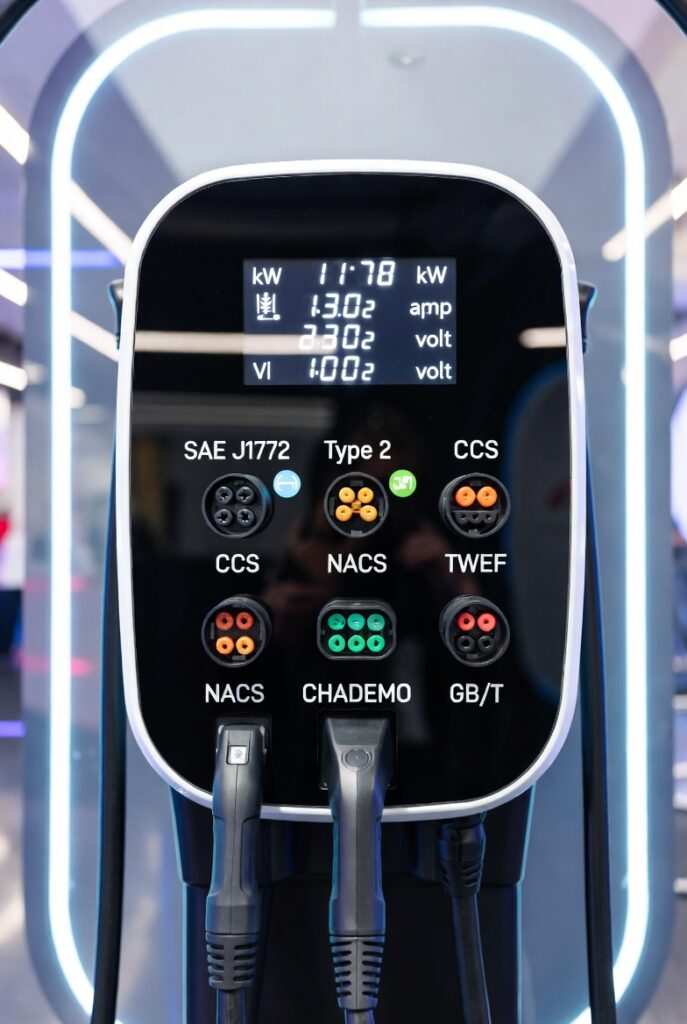
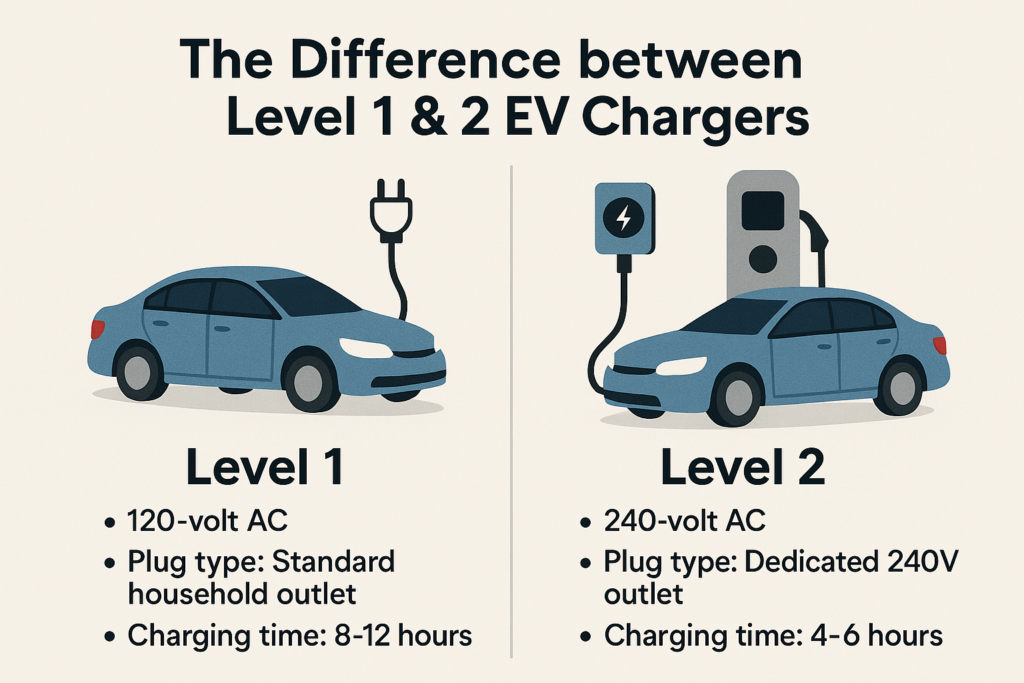
We cover every major EV sold in the US and European markets in 2026. We calculate charging times for Level 1, Level 2 (7.2 kW, 11 kW, 22 kW), and DC fast charging (50 kW, 100 kW, 150 kW, 250 kW+). We explain why the number on your dashboard often differs from any calculation. And we give you the personal calculator framework to work out your own specific charging time for any combination of car, charger, and starting charge level.
Why EV Charging Times Are Confusing — The Variables Nobody Explains
Before getting into specific models, understanding why charging time calculations are complicated makes the numbers more useful and the exceptions less surprising.
Variable 1: Onboard Charger Capacity vs Station Power
Your EV has an onboard charger — a piece of hardware that converts AC electricity from the grid into DC electricity for the battery. This onboard charger has a maximum input rate that caps how fast AC charging can happen, regardless of how powerful the charging station is.
A charging station rated at 22 kW three-phase AC doesn’t charge a Renault 5 Standard Range faster than 7.2 kW — because the Renault 5 Standard Range’s onboard charger accepts only 7.2 kW. The extra 14.8 kW of station capacity sits unused.
This is why charging time calculations require knowing your car’s maximum AC charging rate — not the station’s rated power. The lower of the two determines actual charging speed.
For DC fast charging, the same principle applies but at higher power levels — your car’s maximum DC input rate is the ceiling, regardless of what the fast charger offers. A Tesla Model 3 RWD at a 250 kW Supercharger charges at the Model 3 RWD’s maximum DC rate of approximately 80-95 kW, not 250 kW.
Variable 2: Battery State of Charge and Charging Curve
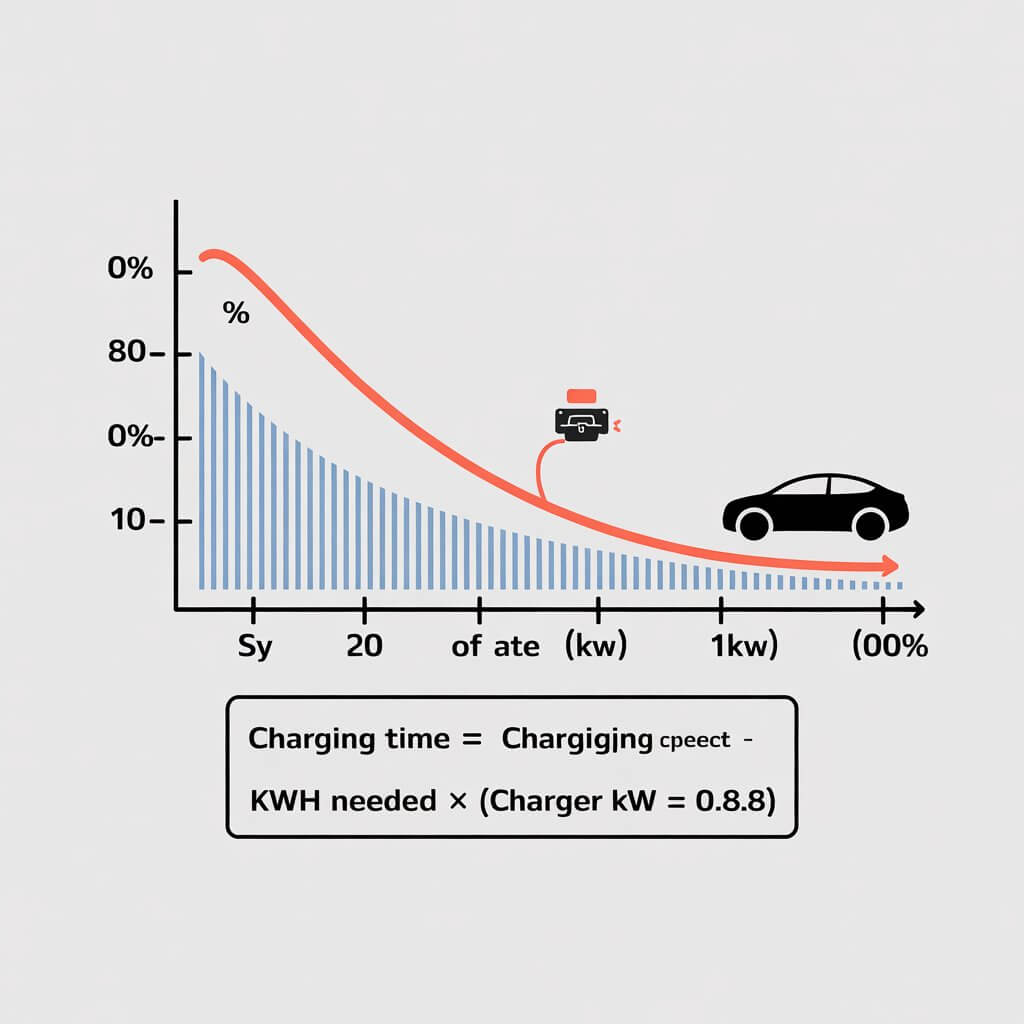
EV batteries don’t charge at a constant rate from 0% to 100%. They charge fastest from approximately 10% to 80% State of Charge (SOC) and significantly slower from 80% to 100%.
This is the charging curve — a deliberate design choice that protects battery longevity by reducing charging stress at high SOC levels. The result is that:
- Charging from 10% to 80% is roughly 3-4x faster per kWh than charging from 80% to 100%
- The “time to full” calculation changes dramatically depending on your starting SOC
- The 20-80% time (quoted in manufacturer specs) is a much better daily planning metric than 0-100% time
Practical implication: If you’re calculating charging time for daily use, calculate 20-80% time — not 0-100%. You’ll rarely charge from completely empty and you’ll rarely need to charge to completely full.
Variable 3: Battery Temperature
Cold batteries charge slower than warm ones. Below approximately 10°C, most EV battery management systems reduce charging rate to protect the cells. Below 0°C, charging speed reduction can be significant — sometimes 30-50% slower than at optimal temperature.
This is why winter charging in Minnesota, Norway, or Scotland takes longer than summer charging — and why manufacturer charging time specs (typically quoted at 20-25°C) don’t match cold weather experience.
Practical implication: Add 20-30% to calculated charging times for charging below 5°C. Many modern EVs have battery pre-conditioning that warms the battery before you arrive at a DC fast charger — use it when available.
Variable 4: Charging Efficiency Losses
Not every kWh drawn from the charger ends up stored in the battery. The AC-to-DC conversion in the onboard charger, cable resistance losses, and battery management overhead mean typically 10-15% of drawn power is lost.
A 7.4 kW charger drawing 7.4 kW from the grid delivers approximately 6.3-6.7 kWh to the battery per hour of charging. This efficiency factor is why real charging times are slightly longer than pure power-divided-by-battery-size calculations suggest.
Our calculations use a 12% efficiency loss factor — consistent with real-world measurements from independent EV testing organisations.
Variable 5: Battery Capacity vs Usable Capacity
EV battery specifications quote gross capacity (total physical cell capacity) and usable capacity (the portion the BMS allows you to access). Usable capacity is always less than gross — typically 90-95% of gross capacity.
Examples:
- Tesla Model Y Long Range: 82 kWh gross, approximately 75-78 kWh usable
- Volkswagen ID.4 Pro Performance: 77 kWh gross, approximately 72-74 kWh usable
- Hyundai Ioniq 5 Long Range: 84 kWh gross, approximately 77-79 kWh usable
Charging time calculations should use usable capacity — because the battery stops accepting charge (or significantly slows) when it approaches the usable maximum, which is below gross capacity.
The Charging Time Formula — How to Calculate It Yourself
The core formula is simple:
Charging time (hours) = (Target kWh to add ÷ Charger power in kW) ÷ Charging efficiency
Or more practically:
Charging time (hours) = kWh to add ÷ (Charger kW × 0.88)
Where:
- kWh to add = Usable battery capacity × (Target SOC% – Starting SOC%) ÷ 100
- Charger kW = The lower of your car’s maximum AC charging rate or the station’s rated power
- 0.88 = Accounts for 12% charging efficiency losses
Example Calculation
Tesla Model Y Long Range (78 kWh usable), charging from 20% to 80% on a 48A (11.5 kW) home charger:
kWh to add = 78 × (80-20) ÷ 100 = 78 × 0.60 = 46.8 kWh
Charging time = 46.8 ÷ (11.5 × 0.88) = 46.8 ÷ 10.12 = 4.62 hours (approximately 4 hours 37 minutes)
Why Real Times May Differ
The formula gives a good estimate but real charging times can vary because:
- The charging curve isn’t perfectly linear (especially 80-100% where it slows significantly)
- Battery temperature affects acceptance rate
- Some EVs reduce AC charging speed periodically for thermal management
- Charger output may be slightly below rated power under load
Our model-specific tables below use the formula adjusted for known charging curve characteristics of each vehicle — giving more accurate estimates than the pure formula for the 80-100% range.
The Charging Time Reference Tables — US and European Models
How to Read These Tables
Each table shows:
- 20-80%: The most relevant daily charging metric
- 0-100%: Full charge from empty (rare in practice but useful for planning)
- Times shown for each relevant charging scenario
Temperature assumed: 20°C / 68°F (add 20-30% for below 5°C / 41°F)
US Market — Major EV Models 2026
Tesla Model Y
Variants and Battery Specs:
- RWD: approximately 57-60 kWh usable, 7.2 kW max AC, ~95 kW max DC
- Long Range: approximately 75-78 kWh usable, 11.5 kW max AC, ~250 kW max DC
- Performance: approximately 75-78 kWh usable, 11.5 kW max AC, ~250 kW max DC
Charging Times — Model Y RWD:
| Charger Type | Power | 20-80% | 0-100% |
|---|---|---|---|
| Level 1 (120V, 12A) | 1.4 kW | 22 hours | 47 hours |
| Level 1 (120V, 16A) | 1.9 kW | 16.5 hours | 35 hours |
| Level 2 (32A, 240V) | 7.2 kW | 4.5 hours | 9.5 hours |
| Level 2 (40A, 240V) | 7.2 kW* | 4.5 hours | 9.5 hours |
| Tesla Supercharger V2 | ~75 kW | 35 mins | 1hr 10 mins |
| Tesla Supercharger V3 | ~95 kW | 28 mins | 55 mins |
*Car’s 7.2 kW ceiling limits speed regardless of higher charger rating
Charging Times — Model Y Long Range / Performance:
| Charger Type | Power | 20-80% | 0-100% |
|---|---|---|---|
| Level 1 (120V, 12A) | 1.4 kW | 37 hours | 64 hours |
| Level 2 (32A, 240V) | 7.2 kW | 7 hours | 13 hours |
| Level 2 (48A, 240V) | 11.5 kW | 4 hours 37 mins | 8 hours 30 mins |
| Tesla Supercharger V3 | ~250 kW | 22 mins | 55 mins |
| Other NACS 250kW | ~250 kW | 22 mins | 55 mins |
The Model Y overnight charging insight: A Model Y Long Range on a 48A home charger, charging from 20% to 80% (the ideal daily charge), completes in approximately 4 hours 37 minutes. Plugging in at 11:30pm on Octopus Go equivalent finishes before 4:30am — well within the cheap rate window. For the RWD on a 32A charger, 20-80% completes in 4.5 hours — equally manageable overnight.
Tesla Model 3
Variants and Battery Specs:
- RWD: approximately 57-60 kWh usable, 7.2 kW max AC, ~80-95 kW max DC
- Long Range: approximately 75-78 kWh usable, 11.5 kW max AC, ~250 kW max DC
- Performance: approximately 75-78 kWh usable, 11.5 kW max AC, ~250 kW max DC
Charging Times — Model 3 (identical to Model Y for equivalent variants)
The Model 3 and Model Y share the same battery architecture and charging specifications — charging times are essentially identical for equivalent variants. Refer to Model Y tables above.
Chevrolet Bolt EV and EUV
Battery Specs:
- Bolt EV/EUV: 65 kWh usable, 7.2 kW max AC (J1772), 55 kW max DC (CCS1)
Charging Times:
| Charger Type | Power | 20-80% | 0-100% |
|---|---|---|---|
| Level 1 (120V, 12A) | 1.4 kW | 25 hours | 52 hours |
| Level 2 (32A, 240V) | 7.2 kW | 5 hours | 10.5 hours |
| Level 2 (48A, 240V) | 7.2 kW* | 5 hours | 10.5 hours |
| DC Fast (CCS1, 55 kW) | 55 kW | 57 mins | 1hr 55 mins |
| DC Fast (CCS1, 50 kW) | 50 kW | 63 mins | 2hrs 5 mins |
*Bolt caps at 7.2 kW AC regardless of charger rating — 48A charger provides no benefit over 32A
The Bolt insight: The Chevrolet Bolt’s 55 kW DC charging ceiling is the most limiting specification among mainstream US EVs in 2026. At a 150 kW or 350 kW DC fast charger, the Bolt charges at 55 kW — the same speed as at a much cheaper 50 kW unit. Prioritise reliable 50 kW CCS1 stations for Bolt owners rather than high-power premium stations.
Ford F-150 Lightning
Battery Specs:
- Standard Range: approximately 90 kWh usable, 19.2 kW max AC (NACS, 80A), ~130 kW max DC
- Extended Range: approximately 123 kWh usable, 19.2 kW max AC (NACS, 80A), ~130 kW max DC
Charging Times — Standard Range:
| Charger Type | Power | 20-80% | 0-100% |
|---|---|---|---|
| Level 1 (120V, 16A) | 1.9 kW | 25 hours | 54 hours |
| Level 2 (48A, 240V) | 11.5 kW | 5 hours 20 mins | 10 hours |
| Level 2 (80A, 240V) | 19.2 kW | 3 hours 10 mins | 6 hours |
| DC Fast (CCS1/NACS, 130 kW) | 130 kW | 40 mins | 1hr 25 mins |
Charging Times — Extended Range:
| Charger Type | Power | 20-80% | 0-100% |
|---|---|---|---|
| Level 2 (80A, 240V) | 19.2 kW | 4 hours 20 mins | 8 hours |
| Level 2 (48A, 240V) | 11.5 kW | 7 hours 15 mins | 13 hours 30 mins |
| DC Fast (130 kW) | 130 kW | 56 mins | 1hr 55 mins |
The F-150 Lightning insight: The Lightning’s 19.2 kW AC charging rate is the highest of any mainstream production vehicle in the US market. At a dedicated 80A home charger, the Extended Range battery charges 20-80% in under 4.5 hours — impressive for a 123 kWh battery. However, most home installations only support 48A (11.5 kW), which significantly extends charging time for the Extended Range variant. The 80A charger installation (100A dedicated circuit) is worth the investment specifically for F-150 Lightning Extended Range owners.
Rivian R1T and R1S
Battery Specs:
- Standard (135 kWh): approximately 121 kWh usable, 11.5 kW max AC (NACS), ~200 kW max DC
- Max Pack (180 kWh): approximately 149 kWh usable, 11.5 kW max AC, ~200 kW max DC
Charging Times — Standard Pack:
| Charger Type | Power | 20-80% | 0-100% |
|---|---|---|---|
| Level 1 (120V) | 1.4 kW | 58 hours | 97 hours |
| Level 2 (48A) | 11.5 kW | 7 hours 10 mins | 13 hours |
| DC Fast (200 kW) | 200 kW | 25 mins | 55 mins |
The Rivian insight: The Rivian’s enormous battery means Level 1 charging is genuinely impractical for daily use — 58 hours for 20-80% is more than two days. A 48A Level 2 home charger is the minimum viable home setup for a Rivian owner. At 7 hours 10 minutes for 20-80%, plugging in when you arrive home at 6pm delivers a full usable charge by 1:10am.
Hyundai Ioniq 5 (US Spec)
Battery Specs:
- Standard Range: approximately 53 kWh usable, 7.2 kW max AC (J1772), ~185 kW max DC
- Long Range RWD/AWD: approximately 74 kWh usable, 11 kW max AC (J1772), ~235 kW max DC
Charging Times — Long Range:
| Charger Type | Power | 20-80% | 0-100% |
|---|---|---|---|
| Level 1 (120V) | 1.4 kW | 36 hours | 60 hours |
| Level 2 (32A) | 7.2 kW | 7 hours | 12 hours |
| Level 2 (48A) | 11 kW | 4 hours 35 mins | 8 hours |
| DC Fast (CCS1, 235 kW) | 235 kW | 17 mins | 42 mins |
The Ioniq 5 DC fast charging insight: The Ioniq 5 Long Range’s 235 kW DC charging capability (on compatible 800V infrastructure) makes it one of the fastest-charging mainstream EVs available. At an Electrify America 350 kW station, 10-80% completes in approximately 18 minutes. This world-class DC charging speed partially compensates for the car’s relatively modest 11 kW AC ceiling — fast charging on the road is excellent, home charging is adequate.
Volkswagen ID.4 (US Spec)
Battery Specs:
- All US ID.4 variants: approximately 77 kWh usable, 7.2 kW max AC (J1772), 135 kW max DC (CCS1)
Charging Times:
| Charger Type | Power | 20-80% | 0-100% |
|---|---|---|---|
| Level 1 (120V) | 1.4 kW | 37 hours | 62 hours |
| Level 2 (32A) | 7.2 kW | 7 hours | 12.5 hours |
| Level 2 (48A) | 7.2 kW* | 7 hours | 12.5 hours |
| DC Fast (CCS1, 135 kW) | 135 kW | 32 mins | 1hr 5 mins |
*US ID.4 accepts maximum 7.2 kW AC — 48A charger provides no additional speed
Ford Mustang Mach-E (2025+, NACS)
Battery Specs:
- Standard Range: approximately 68 kWh usable, 11.5 kW max AC (NACS), ~115 kW max DC
- Extended Range: approximately 88 kWh usable, 11.5 kW max AC (NACS), ~150 kW max DC
Charging Times — Extended Range:
| Charger Type | Power | 20-80% | 0-100% |
|---|---|---|---|
| Level 2 (48A) | 11.5 kW | 4 hours 10 mins | 9.5 hours |
| DC Fast (150 kW) | 150 kW | 38 mins | 1hr 15 mins |
Lucid Air
Battery Specs:
- Pure: approximately 84 kWh usable, 19.2 kW max AC (NACS, 80A), ~200 kW max DC
- Grand Touring: approximately 112 kWh usable, 19.2 kW max AC, ~300 kW max DC
- Dream Edition: approximately 118 kWh usable, 19.2 kW max AC, ~350 kW max DC
Charging Times — Grand Touring:
| Charger Type | Power | 20-80% | 0-100% |
|---|---|---|---|
| Level 2 (48A) | 11.5 kW | 6 hours 35 mins | 12 hours |
| Level 2 (80A) | 19.2 kW | 3 hours 57 mins | 7 hours 15 mins |
| DC Fast (300 kW) | 300 kW | 22 mins | 50 mins |
The Lucid Air insight: The Lucid Air’s 19.2 kW AC charging capability is genuinely transformative at an 80A home installation — less than 4 hours for 20-80% on a 112 kWh battery. At a standard 48A home charger (the most common home setup), charging takes 6.5 hours — still manageable overnight but the 80A installation unlocks the car’s full home charging potential.
European and UK Market — Major EV Models 2026
Volkswagen ID.4 and ID.3 (European Spec)
ID.4 Variants:
- Pure/Pure Performance: approximately 52 kWh usable, 7.2 kW max AC (Type 2), 135 kW max DC (CCS2)
- Pro/Pro Performance: approximately 72-74 kWh usable, 7.2 kW or 11 kW max AC (Type 2), 135 kW max DC
ID.4 Pro Performance Charging Times (74 kWh usable, 11 kW AC):
| Charger Type | Power | 20-80% | 0-100% |
|---|---|---|---|
| Mode 2 (13A UK socket) | 3 kW | 16 hours | 28 hours |
| Level 2 single-phase (32A) | 7.4 kW | 6 hours 50 mins | 11 hours 45 mins |
| Level 2 three-phase (11 kW) | 11 kW | 4 hours 35 mins | 7 hours 55 mins |
| Level 2 public AC (22 kW) | 11 kW* | 4 hours 35 mins | 7 hours 55 mins |
| DC Fast (CCS2, 50 kW) | 50 kW | 52 mins | 1hr 45 mins |
| DC Fast (CCS2, 135 kW) | 135 kW | 28 mins | 58 mins |
*ID.4 Pro Performance caps at 11 kW regardless of 22 kW station rating
ID.3 Pro Performance Charging Times (77 kWh usable, 11 kW AC): Essentially identical to ID.4 Pro Performance — same battery size and charging specifications.
The VW European insight: The difference between single-phase (7.4 kW) and three-phase (11 kW) charging at home is approximately 2 hours 15 minutes on the 20-80% cycle for the large-battery variants. For owners with three-phase supply and the 11 kW onboard charger, the three-phase installation is worth pursuing — particularly for those with tighter overnight charging windows.
Renault 5 E-Tech Electric
Variants:
- Standard Range (40 kWh): approximately 37 kWh usable, 7.2 kW max AC, 80 kW max DC
- Long Range (52 kWh): approximately 48 kWh usable, 11 kW max AC (three-phase), 100 kW max DC
Standard Range Charging Times:
| Charger Type | Power | 20-80% | 0-100% |
|---|---|---|---|
| Mode 2 (13A UK) | 3 kW | 8 hours 20 mins | 14 hours |
| Level 2 single-phase (32A) | 7.2 kW | 3 hours 28 mins | 5 hours 55 mins |
| DC Fast (CCS2, 80 kW) | 80 kW | 18 mins | 35 mins |
| DC Fast (CCS2, 50 kW) | 50 kW | 28 mins | 52 mins |
Long Range Charging Times:
| Charger Type | Power | 20-80% | 0-100% |
|---|---|---|---|
| Mode 2 (13A UK) | 3 kW | 11 hours | 18.5 hours |
| Level 2 single-phase (32A) | 7.2 kW | 4 hours 33 mins | 7 hours 48 mins |
| Level 2 three-phase (11 kW) | 11 kW | 2 hours 59 mins | 5 hours 7 mins |
| DC Fast (100 kW) | 100 kW | 17 mins | 30 mins |
The Renault 5 insight: The compact battery sizes make the Renault 5 one of the fastest home-charging EVs available — the Standard Range 20-80% completes in under 3.5 hours on a standard 7.2 kW home charger. For most Renault 5 owners who commute 60 km or less daily, plugging in when they arrive home completes charging well before midnight regardless of setup.
Skoda Enyaq (60, 85, RS)
Variants:
- Enyaq 60: approximately 58 kWh usable, 7.2 kW max AC (Type 2), 135 kW max DC
- Enyaq 85/RS: approximately 77-79 kWh usable, 11 kW max AC (Type 2), 135-175 kW max DC
Enyaq 85 Charging Times (79 kWh usable, 11 kW AC):
| Charger Type | Power | 20-80% | 0-100% |
|---|---|---|---|
| Mode 2 (13A UK) | 3 kW | 17 hours 45 mins | 30.5 hours |
| Level 2 single-phase (32A) | 7.4 kW | 7 hours 15 mins | 12.5 hours |
| Level 2 three-phase (11 kW) | 11 kW | 4 hours 53 mins | 8 hours 25 mins |
| DC Fast (CCS2, 135 kW) | 135 kW | 27 mins | 57 mins |
| DC Fast (Enyaq RS, 175 kW) | 175 kW | 20 mins | 43 mins |
The Enyaq overnight charging insight: An Enyaq 85 owner with single-phase supply (UK) needs 7 hours 15 minutes for 20-80%. Plugging in at 10pm completes charging by 5:15am — just within the Octopus Go cheap rate window (11:30pm-5:30am) if you’re using a scheduled charger. For tighter schedules, three-phase supply brings this to under 5 hours — a significant practical improvement.
Hyundai Ioniq 5 (European Spec)
Battery Specs:
- Standard Range: approximately 58 kWh usable, 11 kW max AC (Type 2), 185 kW max DC
- Long Range: approximately 74-77 kWh usable, 11 kW max AC (Type 2), 235 kW max DC
Long Range Charging Times:
| Charger Type | Power | 20-80% | 0-100% |
|---|---|---|---|
| Mode 2 (13A UK) | 3 kW | 17.5 hours | 29.5 hours |
| Level 2 single-phase (32A) | 7.4 kW | 7 hours 5 mins | 12 hours |
| Level 2 three-phase (11 kW) | 11 kW | 4 hours 46 mins | 8 hours 10 mins |
| DC Fast (CCS2, 235 kW) | 235 kW | 15 mins | 37 mins |
The Ioniq 5 European DC insight: The 235 kW DC charging rate on 800V-compatible stations makes the European Ioniq 5 Long Range one of the fastest-charging EVs available in Europe — 15 minutes for 20-80% at an Ionity 350 kW station is genuinely impressive. The trade-off is a relatively modest 11 kW AC ceiling — excellent DC charging, adequate home charging.
BMW iX
Variants:
- xDrive40: approximately 69 kWh usable, 11 kW max AC, 195 kW max DC
- xDrive50: approximately 105 kWh usable, 11 kW max AC, 200 kW max DC
- M60: approximately 105 kWh usable, 11 kW max AC, 195 kW max DC
xDrive50 Charging Times (105 kWh usable, 11 kW AC):
| Charger Type | Power | 20-80% | 0-100% |
|---|---|---|---|
| Mode 2 (13A UK) | 3 kW | 24 hours | 40.5 hours |
| Level 2 single-phase (32A) | 7.4 kW | 9 hours 40 mins | 16.5 hours |
| Level 2 three-phase (11 kW) | 11 kW | 6 hours 30 mins | 11 hours |
| DC Fast (CCS2, 200 kW) | 200 kW | 28 mins | 54 mins |
The BMW iX overnight charging warning: The iX xDrive50’s 105 kWh battery combined with a 7.4 kW single-phase UK supply creates a genuine overnight charging challenge. At 9 hours 40 minutes for 20-80%, a driver arriving home at 10pm with 20% SOC needs until 7:40am for a full 80% charge — tight for early morning departures. For iX xDrive50 owners with single-phase supply, three-phase upgrade or scheduling carefully managed departure times is important.
For UK iX owners on Octopus Go: The 5.5-hour cheap rate window (11:30pm-5:30am) allows approximately 7.4 kW × 5.5 × 0.88 = 35.7 kWh of charging on the cheap rate. For an iX xDrive50 starting at 20% (needing 62 kWh to reach 80%), the Octopus Go window covers approximately 57% of the needed charge. Start the charge before the cheap window begins or use a charger with departure-time scheduling to maximise cheap rate use.
Porsche Taycan (European Spec)
Variants:
- Taycan (standard): approximately 72 kWh usable, 11 kW max AC (standard) or 22 kW (optional upgrade)
- Taycan Turbo S: approximately 93 kWh usable, 11 kW or 22 kW max AC, 270 kW max DC
Taycan Turbo S Charging Times:
| Charger Type | Power | 20-80% | 0-100% |
|---|---|---|---|
| Level 2 single-phase (32A) | 7.4 kW | 8 hours 35 mins | 14 hours 45 mins |
| Level 2 three-phase (11 kW) | 11 kW | 5 hours 47 mins | 9 hours 55 mins |
| Level 2 three-phase (22 kW — with upgrade) | 22 kW | 2 hours 54 mins | 4 hours 58 mins |
| DC Fast (CCS2, 270 kW) | 270 kW | 18 mins | 43 mins |
The Taycan 22 kW upgrade insight: The optional 22 kW onboard charger upgrade for the Taycan transforms home charging. On three-phase supply, 20-80% drops from nearly 6 hours to under 3 hours. For Taycan Turbo S owners with three-phase supply, the 22 kW upgrade is the most impactful home charging investment available.
Lucid Air (European Spec)
Battery Specs:
- Grand Touring: approximately 112 kWh usable, 22 kW max AC (Type 2 three-phase), 300 kW max DC
Charging Times:
| Charger Type | Power | 20-80% | 0-100% |
|---|---|---|---|
| Level 2 single-phase (32A) | 7.4 kW | 10 hours 17 mins | 17 hours 40 mins |
| Level 2 three-phase (11 kW) | 11 kW | 6 hours 55 mins | 11 hours 55 mins |
| Level 2 three-phase (22 kW) | 22 kW | 3 hours 28 mins | 5 hours 57 mins |
| DC Fast (300 kW) | 300 kW | 13 mins | 33 mins |
The Lucid Air European insight: Same conclusion as US market — the 22 kW AC capability is genuinely valuable if you have three-phase supply. Three-phase 22 kW AC charging delivers 20-80% in 3.5 hours for the 112 kWh battery. Without three-phase, the single-phase 7.4 kW scenario requires over 10 hours for the same charge — making overnight charging tight even with a full 8-hour window.
MG4 Electric (European)
Variants:
- Standard (51 kWh): approximately 47 kWh usable, 7.2 kW max AC, 117 kW max DC
- Long Range (64 kWh): approximately 58 kWh usable, 11 kW max AC, 140 kW max DC
Long Range Charging Times:
| Charger Type | Power | 20-80% | 0-100% |
|---|---|---|---|
| Mode 2 (13A UK) | 3 kW | 13 hours | 22.5 hours |
| Level 2 single-phase (32A) | 7.4 kW | 5 hours 20 mins | 9 hours 10 mins |
| Level 2 three-phase (11 kW) | 11 kW | 3 hours 35 mins | 6 hours 10 mins |
| DC Fast (CCS2, 140 kW) | 140 kW | 16 mins | 28 mins |
Citroën ë-C3 (European)
Battery Specs:
- 44 kWh: approximately 41 kWh usable, 7.2 kW max AC (Type 2), 100 kW max DC
Charging Times:
| Charger Type | Power | 20-80% | 0-100% |
|---|---|---|---|
| Mode 2 (13A UK) | 3 kW | 9 hours 15 mins | 15.7 hours |
| Level 2 single-phase (32A) | 7.2 kW | 3 hours 52 mins | 6 hours 37 mins |
| DC Fast (CCS2, 100 kW) | 100 kW | 16 mins | 26 mins |
Peugeot e-208 (European)
Battery Specs:
- 51 kWh: approximately 47 kWh usable, 7.2 kW max AC, 100 kW max DC
Charging Times:
| Charger Type | Power | 20-80% | 0-100% |
|---|---|---|---|
| Mode 2 (13A UK) | 3 kW | 10.5 hours | 18 hours |
| Level 2 single-phase (32A) | 7.2 kW | 4 hours 25 mins | 7 hours 35 mins |
| DC Fast (CCS2, 100 kW) | 100 kW | 17 mins | 30 mins |
Your Personal EV Charge Time Calculator
Use this framework to calculate charging time for any combination not covered in the tables above:
Step 1: Find Your Usable Battery Capacity
Check your owner’s manual or the manufacturer’s website for “usable battery capacity” or “net battery capacity.” If only gross capacity is listed, multiply by 0.92 as an estimate.
Step 2: Determine Your Starting and Target SOC
For daily driving planning: 20% starting, 80% target For trip planning: Actual current SOC to target
kWh to add = Usable capacity × (Target% – Start%) ÷ 100
Step 3: Determine Your Effective Charging Power
Your effective charging power is the LOWER of: a) Your car’s maximum AC charging rate b) Your charger’s rated output
For DC fast charging: The LOWER of your car’s maximum DC rate and the station’s rated output.
Step 4: Apply the Charging Efficiency Factor
For home AC charging: Multiply effective power by 0.88 For DC fast charging: Multiply by 0.92 (slightly more efficient at DC)
Adjusted power = Effective charging power × efficiency factor
Step 5: Calculate Charging Time
Charging time (hours) = kWh to add ÷ Adjusted power
Step 6: Adjust for Conditions
- Below 5°C / 41°F: Multiply result by 1.25 (25% longer)
- 80-100% SOC range: Multiply result by 1.5 (significantly slower due to taper)
- First 5% SOC (near empty): Multiply by 1.3 (BMS cautious at very low SOC)
The Quick Reference Chart — Charging Time by Power Level and kWh
| kWh to Add | 3 kW | 7.4 kW | 11 kW | 22 kW | 50 kW | 100 kW | 150 kW | 250 kW |
|---|---|---|---|---|---|---|---|---|
| 10 kWh | 3h 47m | 1h 32m | 1h 2m | 31m | 13m | 7m | 4m | 3m |
| 20 kWh | 7h 35m | 3h 5m | 2h 4m | 1h 2m | 27m | 13m | 9m | 5m |
| 30 kWh | 11h 23m | 4h 37m | 3h 6m | 1h 33m | 40m | 20m | 13m | 8m |
| 40 kWh | 15h 10m | 6h 10m | 4h 9m | 2h 4m | 54m | 27m | 18m | 11m |
| 50 kWh | 18h 58m | 7h 42m | 5h 11m | 2h 36m | 67m | 34m | 22m | 13m |
| 60 kWh | 22h 45m | 9h 14m | 6h 13m | 3h 7m | 1h 21m | 40m | 27m | 16m |
| 70 kWh | 26h 33m | 10h 47m | 7h 15m | 3h 38m | 1h 35m | 47m | 31m | 19m |
| 80 kWh | 30h 20m | 12h 19m | 8h 18m | 4h 9m | 1h 49m | 54m | 36m | 22m |
*Times include 12% efficiency factor for AC, 8% for DC. Does not include 80-100% taper or temperature adjustments.
Common Charging Time Questions — Answered Honestly
“Why does my dashboard show a different time than your calculation?”
Your dashboard’s charging time estimate accounts for your specific current battery temperature, the real-time charging curve (which slows as you approach 100%), and any dynamic adjustments the BMS is making. It’s more accurate than any formula for your specific moment — but it changes constantly as conditions change. Use the tables for planning, your dashboard for real-time status.
“My car charged faster/slower than your table shows — why?”
Several real factors cause variation from calculated times:
- Battery temperature (cold = slower, warm = faster up to a point)
- Battery pre-conditioning (some cars warm the battery before charging — speeds up DC charging significantly)
- Grid voltage variation (rural supplies at 210V charge slower than urban supplies at 235V)
- Charger output variation (a 7.4 kW charger under load may deliver 6.8-7.2 kW in practice)
- Battery degradation (older batteries may not accept maximum charging rates)
“What’s the fastest way to charge my car for a long trip?”
Use DC fast charging on the road — not home Level 2. Charge to 80% at DC fast chargers rather than 100% — the 20-80% segment is 3-4x faster per kWh than 80-100%. For DC charging stops, 20 minutes at 80% SOC adds more range than 40 minutes at 90% SOC. Plan multiple shorter DC charging sessions rather than one very long one.
“Can I charge to 100% every day?”
Technically yes, but most manufacturers recommend keeping daily charging to 80% for battery longevity. Regular charges to 100% cause slightly faster battery degradation over years of use. Reserve 100% charges for days when you genuinely need the full range. Most EVs let you set a default charging limit — set it to 80% for daily use.
“How does cold weather actually affect charging time?”
At 0°C, expect approximately 20-25% longer charging times than at 20°C. At -10°C, expect 30-40% longer. Some EVs handle cold better than others — vehicles with active battery thermal management (most modern EVs) warm the battery during charging, which partially compensates. Vehicles without active thermal management are more severely affected by cold.
Internal Links — Further Reading on Clean Energy Bazaar
The EV charge time calculator 2026 how long to full for your model in US and Europe is the practical planning companion to the home charger buying guides across this site.
For the home charger that delivers the fastest practical home charging for your vehicle, our interactive EV charger selector tool US NACS J1772 or Europe Type 2 edition narrows down the right charger in seven questions. For the full US home charger comparison, our best home EV chargers 2026 US guide covers ten options. For UK and European options, our best Level 2 EV chargers UK Europe 2026 guide covers every major option. For the ROI on buying a faster home charger — whether the upgrade pays back financially, our EV home charger ROI calculator 2026 gives exact payback periods. For the load balancing solutions that enable faster charging on limited panels, our load balancing EV chargers 2026 guide covers every scenario. And for understanding every charging spec mentioned in these tables, our EV charger specs 2026 guide translates everything into plain language.
Final Thoughts
The EV charge time calculator 2026 how long to full for your model in US and Europe exists because the question “how long will it take to charge?” deserves a specific, honest answer — not a range from “a few minutes” to “overnight” that helps nobody plan their day.
The three most important charging time insights from this guide:
Insight 1: Your car’s maximum AC acceptance rate matters more than your charger’s rated power. A Chevrolet Bolt at a 48A charger charges at 7.2 kW — identical to a 32A charger. Knowing your car’s ceiling prevents overspending on charger capacity that delivers no additional speed.
Insight 2: Plan for 20-80%, not 0-100%. The 0-100% time is a theoretical maximum that almost never applies in daily use. The 20-80% time is what you’ll experience every day. It’s typically 40-50% shorter than 0-100% and a far more useful planning metric.
Insight 3: DC fast charging and home charging serve different purposes. Home Level 2 charging covers daily top-ups efficiently. DC fast charging covers road trips. Optimising one for the other’s job is the wrong approach — a 48A home charger and a DC fast charger network subscription is the right combination, not the most expensive home charger possible.
Calculate your specific scenario. Plan your charging around real times rather than manufacturer marketing figures. And plug in earlier than you think you need to — the electricity is cheap overnight and the car being full in the morning is always better than the anxiety of checking the percentage at 5am.