Here is the situation that is generating unnecessary anxiety, unnecessary expenditure, and unnecessarily replaced hardware across Chinese EV owner communities in 2026.
A Chinese EV owner purchased a BYD Han EV in 2023 and had a StarCharge S1 installed at the same time. In early 2026, they upgrade their vehicle — purchasing a BYD Seal Long Range with 800V architecture. Someone in an online forum tells them their 2023 StarCharge “isn’t compatible with 800V cars” and they need to upgrade their charger. They spend ¥2,699 on a new charger and installation. Their annual electricity bill from home TOU charging: identical to what it was the day before.
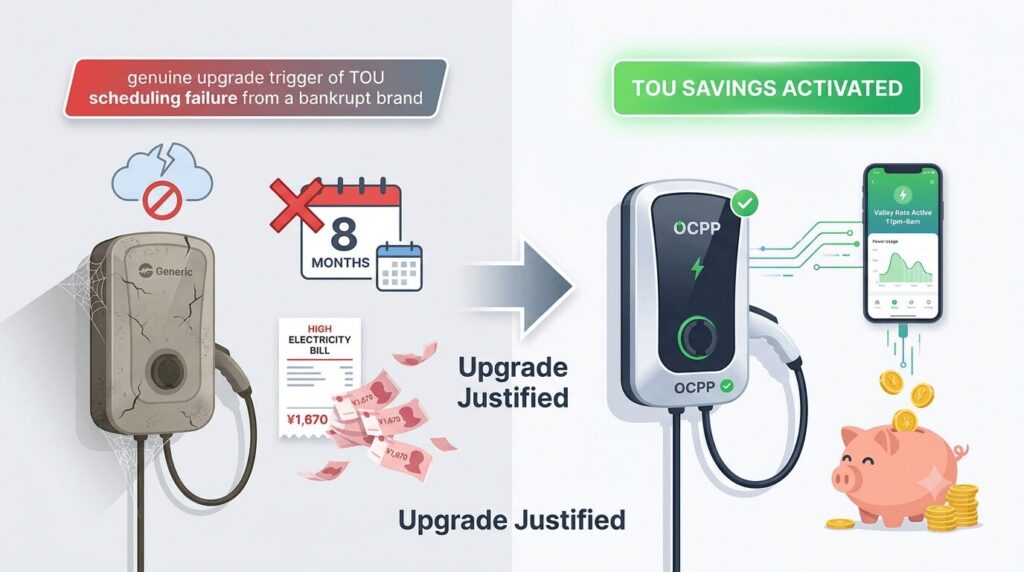
At the same time, a different Chinese EV owner also purchased a home charger in 2023 — a budget unit from a manufacturer that ceased operations in 2024. Their charger’s TOU scheduling has been non-functional for eight months. They’re charging at full evening rates every night, spending approximately ¥1,670 more per year than necessary. They’ve been meaning to investigate but assumed the scheduling issue would resolve itself, or that fixing it would require expensive technical support.
Both owners need different advice. The first owner needs to be told, clearly and authoritatively, that their upgrade was entirely unnecessary and wasted ¥2,699. The second owner needs to understand that continuing to delay their upgrade is costing them substantially more annually than a replacement would cost.
This guide on when to upgrade your EV charger signs your 2023 charger isn’t ready for 2026’s 800V cars provides the honest, evidence-based assessment of when a home EV charger upgrade is genuinely justified, when it absolutely is not (regardless of what the marketing materials or forum advice suggests), and how to make this decision correctly for your specific situation.
The Foundation — What Has and Hasn’t Changed Since 2023
What Has Genuinely Changed in China’s Home EV Charging Landscape Since 2023
Understanding which changes are substantive versus cosmetic prevents unnecessary spending on real-but-irrelevant improvements.
Change 1: 800V vehicle architecture proliferation
As covered exhaustively in our dedicated 800V architecture guide, the proportion of new Chinese EVs using 800V battery architecture has increased significantly since 2023. Vehicles that were niche in 2023 — BYD Seal Long Range, Zeekr 001 Performance, Xpeng G9 Ultra — have been joined by additional 800V models across multiple manufacturers.
The home charging implication of this change: Zero.
As that entire dedicated guide establishes with complete technical clarity, 800V battery architecture has no effect whatsoever on AC home charging. Every Chinese home charger manufactured in 2023, 2022, 2019, or any other year, charges every 800V vehicle at exactly the same speed as any 400V vehicle. This is not an opinion or an approximation — it is the fundamental electrochemistry of AC home charging through the vehicle’s onboard charger, explained in complete technical detail in our dedicated guide on this subject.
Change 2: OCPP 2.0 deployment expansion
OCPP 2.0, as covered in our connectivity and technology trends guides, has expanded from a premium-only specification toward increasing availability in mid-range products since 2023. For owners who purchased 2023 chargers with OCPP 1.6, this represents a genuine technical advancement — but as those guides established, OCPP 1.6 remains entirely adequate for all currently available Chinese residential demand response programmes, with OCPP 2.0’s additional capabilities primarily relevant for future V2G programmes not yet commercially deployed at residential scale.
The home charging implication: Modest and genuinely future-oriented, not urgently current.
Change 3: Manufacturer failures and zombie pile risk
As covered in our zombie pile crisis guide, the 2024-2025 period saw meaningful consolidation in China’s EV charger manufacturer market, with several smaller brands ceasing operations. This represents a genuine change that affects some 2023 charger owners directly.
The home charging implication: Significant for affected owners, zero for owners of products from surviving manufacturers.
Change 4: App ecosystem improvements
Smart charger apps have improved meaningfully across most major brands since 2023, with enhanced TOU scheduling interfaces, better energy reporting, and more sophisticated ecosystem integration. However, most of these improvements have been delivered to existing hardware through OTA software updates rather than requiring hardware replacement.
The home charging implication: Generally zero hardware implication; existing hardware has often received the same improvements through updates.
Change 5: V2G pilot programme expansion
As covered in our technology trends guide, V2G pilot programmes have expanded meaningfully across Chinese cities since 2023, with more owners now able to earn demand response income. However, as that guide established, standard chargers without bidirectional hardware cannot participate in V2G regardless of vintage — and bidirectional hardware remains premium-priced with long payback periods at current V2G income levels.
The home charging implication: Relevant specifically for owners who specifically want V2G, which represents a minority case requiring explicit cost-benefit analysis rather than a general upgrade recommendation.
The Genuine Upgrade Triggers — When Replacement Is Actually Justified
Genuine Upgrade Trigger 1: Your Manufacturer Has Failed and TOU Scheduling Is Broken
This is the most financially significant genuine upgrade trigger, and the most commonly underestimated by affected owners.
As covered in our zombie pile crisis guide and our error code troubleshooting guide, when a home charger manufacturer ceases operations, cloud-dependent TOU scheduling typically fails — meaning the charger continues delivering electricity to the vehicle but can no longer execute the scheduled overnight charging that captures the valley rate savings covered throughout our TOU savings guide.
The annual financial cost of ignoring this:
As established in our TOU savings guide, the annual saving from valley rate versus non-TOU charging for a typical Shanghai EV owner driving 20,000 km/year is approximately ¥1,670. An owner whose 2023 charger’s TOU scheduling stopped working eight months ago has already foregone approximately ¥1,113 in unnecessary electricity cost.
The replacement payback calculation:
New StarCharge S1: ¥999
New installation (if existing charger is simply replaced with no circuit changes): ¥500-¥700 (substantially lower than a full new installation since the dedicated circuit, meter, and most hardware already exists)
Total replacement cost: approximately ¥1,500-¥1,700
At ¥1,670/year in recovered TOU savings, payback period: approximately 11 months.
Over 5 years: ¥8,350 in TOU savings – ¥1,600 replacement cost = ¥6,750 net benefit.
This is a clear, financially unambiguous case for immediate replacement — not eventually, but now.
How to confirm this is your situation:
If your charger’s app has been unresponsive for an extended period, if TOU scheduling commands you’ve configured don’t appear to be executing (verifiable by checking your dedicated EV meter’s consumption timing pattern — is the vast majority of consumption occurring in the 11pm-8am valley window, or is it distributed throughout the day?), and if the manufacturer shows the warning signs covered in our zombie pile guide (no recent app updates, unresponsive customer service, declining online presence), this trigger applies to you.
The car timer interim solution while arranging replacement:
As covered throughout our TOU savings guide, your vehicle’s built-in charging timer captures identical TOU savings to the charger’s app-based scheduling. Configure this immediately — today, before you’ve arranged any charger replacement — to stop the financial bleeding while you arrange a proper hardware replacement at a planned rather than emergency pace.
Genuine Upgrade Trigger 2: Your Charger Is Showing Hardware Safety Deterioration
As covered in our maintenance guide and error code troubleshooting guide, there are specific observable signs that distinguish cosmetic or performance-related wear from genuine hardware safety concerns.
The safety-relevant signs warranting replacement consideration:
Recurring ground fault error codes (as covered in our troubleshooting guide) that persist despite confirmed absence of moisture and confirmed solid connector engagement — suggesting developing insulation or RCCB hardware degradation rather than environmental causes.
Visible physical damage to the cable jacket exposing inner conductors, particularly relevant for northern Chinese installations where the cold-weather cable brittleness mechanism covered in our winter guide may have caused physical cable damage over repeated cold-season thermal cycling.
Connector contact pins showing significant corrosion that has progressed beyond surface discolouration to actual contact surface degradation, particularly relevant for South China and furnace city installations where the accelerated corrosion mechanism covered in our maintenance and furnace city guides may have produced this outcome faster than typical in milder climates.
Charger enclosure showing visible physical compromise — cracking, deformation, or any damage that visibly compromises the IP-rated seal integrity that the weatherproof charger guide established as the primary protective function of the enclosure design.
Important calibration: The maintenance guide’s inspection schedule exists specifically to catch these early, when the issue can sometimes be addressed through targeted maintenance rather than full replacement. A charger showing any of these signs warrants professional inspection before automatically assuming replacement — the safety-relevant finding might be as addressable as a cable replacement or connector cleaning rather than requiring full unit replacement.
Genuine Upgrade Trigger 3: Your Charging Speed Is Genuinely Inadequate for Your Current Vehicle
This is a genuine trigger for a specific, identifiable subset of Chinese EV owners — those who have changed vehicles since their 2023 charger installation, and whose new vehicle has significantly different AC charging requirements that their existing charger cannot meet.
The cases where this is genuine:
If you purchased a new vehicle with 11 kW three-phase AC maximum (NIO ET7, Xpeng G9, Zeekr 001, Xiaomi SU7 Max, Porsche Taycan, BMW i5, Mercedes EQE) but your 2023 installation was a 7 kW single-phase charger, and you also have three-phase supply available at your parking space, upgrading to an 11 kW three-phase charger genuinely reduces charge time by 35-40% for your new vehicle — a real and meaningful improvement.
The cases where this is not genuine:
If you purchased a vehicle with a higher battery capacity but the same 6.6 kW AC maximum as your previous vehicle — virtually all BYD models, Xpeng P7, Li Auto EREV, Xiaomi SU7 Standard/Pro — your 2023 7 kW charger delivers exactly the vehicle’s maximum AC acceptance rate, making charging speed the same regardless of charger upgrade.
The charge time calculator test:
Before concluding this trigger applies to you, use the charge time calculator from our dedicated guide to calculate your specific vehicle’s 20-80% charge time at your current charger’s output. If the result comfortably fits within the overnight TOU valley window (9 hours in Shanghai, 8 hours in Beijing), charging speed does not justify an upgrade — the current setup is functionally adequate regardless of any other comparison.
If the result doesn’t fit the valley window — specifically if your vehicle is in the category of large-battery 11 kW AC vehicles where the charge time calculator showed valley window failure at 7 kW (as covered in our dedicated calculator guide) — then three-phase installation upgrade is genuinely justified on functional grounds, not just convenience.
Genuine Upgrade Trigger 4: Your Installation Lacks RCCB Protection
This trigger applies to a specific subset of older installations where the RCCB ground fault protection that this guide series has consistently identified as a non-negotiable safety requirement was not properly included.
As covered in our DIY charging guide and our 3C certification guide, RCCB protection within the EV charging circuit is a fundamental safety requirement — its absence is not a minor technical detail but a genuine safety gap that the sustained charging current and connector handling involved in daily EV charging specifically makes meaningful.
How to check:
The licensed electrician who installed your 2023 charger should have documented what protection devices were installed. If you’re uncertain, a qualified electrician can inspect your dedicated EV charging circuit and confirm whether appropriate ground fault protection is present.
If it isn’t present: This justifies either adding standalone RCCB protection to the existing circuit (potentially without replacing the charger itself, if the charger is otherwise serviceable) or using the opportunity to also replace an otherwise marginal charger unit simultaneously.
Genuine Upgrade Trigger 5: Your Demand Response Programme Requires OCPP That Your Charger Lacks
This trigger applies specifically to Chinese EV owners in Beijing, Shanghai, Shenzhen, or other cities where demand response programmes are actively operating and generating real income, who own 2023 chargers without OCPP compliance.
As covered in our local rebates guide, demand response programme income for OCPP-compliant chargers in active pilot cities currently ranges from approximately ¥200-¥800 per year — real but not transformative at the lower end, more compelling at the higher end, but in either case requiring OCPP compliance in the charger hardware.
The upgrade cost-benefit calculation for this specific trigger:
OCPP-capable replacement charger premium over standard: approximately ¥300-¥600
Annual demand response income: ¥200-¥800
Payback: 0.4-3 years depending on specific city programme income level
For owners in Beijing (highest demand response income documented): Strong financial case, payback under 1 year at upper income estimates.
For owners in less active demand response cities: Weaker case; may be better to monitor programme expansion before upgrading specifically for this reason.
The Non-Genuine Upgrade Triggers — When You Should Definitely Not Upgrade
Non-Genuine Trigger 1: “My New Car Is 800V So I Need An 800V-Compatible Charger”
This is the single most common unjustified upgrade driver in 2026, and it has already cost many Chinese EV owners ¥2,699+ unnecessarily.
As established in our entire dedicated 800V architecture guide, this premise is technically false. No home AC charger compatibility requirement changes when a vehicle uses 800V battery architecture. Every GB/T-certified home charger manufactured in 2023 or any other year is fully compatible with every 800V vehicle sold in China’s domestic market. There is no “800V-ready” home AC charger distinction that provides any functional benefit.
What to do when someone tells you this upgrade is necessary: Refer them to our dedicated 800V architecture guide and ask them specifically which technical aspect of their claim they believe our guide’s explanation of OBC-mediated AC charging has wrong. In our experience, this specific technical challenge is not met with a substantive counterargument.
Non-Genuine Trigger 2: “My Charger Is Three Years Old So It Should Be Replaced”
Age alone is not a meaningful upgrade trigger for EV charger hardware.
Unlike some categories of technology hardware where software ecosystem obsolescence makes older hardware genuinely outdated regardless of continued physical function — smartphones being the clearest example — EV charger hardware’s core function (delivering AC electricity to a vehicle’s OBC at controlled current) is not subject to functional obsolescence through the technology advances currently occurring in the Chinese EV market.
The relevant test is functional performance, not calendar age:
Is TOU scheduling executing correctly? Is the hardware showing the safety-relevant deterioration signs covered in our genuine upgrade triggers? Is the charger brand still supported? Is the charging speed genuinely inadequate for your current vehicle? If all four answers are “no / no / yes / no,” your three-year-old charger is not in need of replacement regardless of its age.
Non-Genuine Trigger 3: “A Newer Model Has Better App Features”
App features in EV charging smart chargers have improved since 2023, but the vast majority of these improvements have been delivered through software updates to existing hardware rather than requiring hardware replacement.
Before concluding that a new charger’s superior features justify replacement, confirm:
- Whether your existing charger’s app has been updated to its current version, as the feature improvement you’re noticing in a newer product may already be available on your existing hardware through an update you haven’t applied
- Whether the specific feature improvement you’ve identified actually changes your annual electricity cost, your annual charging reliability, or a genuine safety characteristic — or whether it represents a convenience improvement (marginally better UI, slightly more detailed energy reporting) that doesn’t justify the ¥2,699+ replacement cost
The decision test: If the specific feature you’re seeking translates to either meaningful electricity cost savings beyond your current setup, meaningful safety improvement, or meaningful reliability improvement, consider the upgrade. If it translates to “slightly nicer app experience,” don’t.
Non-Genuine Trigger 4: “My Charger Doesn’t Have OCPP So I Might Miss Out on Future Features”
OCPP future-proofing anxiety is legitimate as a consideration but rarely justifies immediate replacement of a functioning non-OCPP charger.
As covered in our technology trends guide, V2G and advanced smart grid features requiring OCPP 2.0 are not yet commercially deployed at residential scale in China. As covered in our demand response and local rebates guides, OCPP 1.6 is sufficient for all currently active Chinese residential demand response programmes.
The appropriate response to this concern:
Monitor programme developments in your specific city. If demand response income opportunities in your city expand to the point where OCPP upgrade payback becomes clearly positive, that becomes Genuine Trigger 5 above, and upgrade at that point — not preemptively based on speculative future programme features that may or may not materialise on your timeline.
Non-Genuine Trigger 5: “Someone Online Said I Need To Upgrade”
The Chinese EV owner online community, while generally valuable and generally well-intentioned, contains a meaningful proportion of technically inaccurate information about home EV charging, often driven by the same 800V confusion, future-proofing anxiety, or well-meaning but technically incorrect “helpfulness” documented throughout this guide.
The decision framework for evaluating online upgrade advice:
Does the specific upgrade recommendation come with a specific, articulable technical justification beyond “800V” or “it’s old” or “newer is better”? Can you verify the technical claim against the relevant guides throughout this content cluster? Does the recommended upgrade change your annual electricity cost, your safety situation, or your genuine functional charging capability in any specific, measurable way?
If the answer to any of these questions requires accepting an unverifiable technical claim on faith rather than on the basis of the clearly-explained technical reasoning throughout this guide series, the appropriate response is scepticism rather than expenditure.
The Upgrade Decision Framework — The Five-Question Test
Apply these five questions to your specific situation to determine whether an upgrade is genuinely justified:
Question 1: Is TOU scheduling currently executing correctly, confirmed by checking your dedicated meter’s actual consumption pattern rather than just assuming the app is working?
If no: This is Genuine Trigger 1. Replace the charger. Configure car timer TOU immediately as an interim measure. Prioritise based on annual electricity cost loss rate.
Question 2: Is your charger showing the specific safety-relevant deterioration signs covered in the maintenance guide and genuine upgrade triggers above?
If yes: Have a qualified electrician assess whether the specific issue requires full unit replacement or targeted maintenance/component replacement.
Question 3: Does your current vehicle have a higher AC maximum than your current charger can deliver, AND do you have the appropriate supply type (three-phase) to deliver that higher rate?
If both are true: Calculate charge time with the calculator from our dedicated guide. If this reveals valley window failure for your specific vehicle, Genuine Trigger 3 applies.
Question 4: Is your charger from a manufacturer that has demonstrably ceased operations, per the zombie pile crisis guide’s framework?
If yes: Assess whether basic charging function (without cloud features) still works. If cloud-dependent features are the only non-functional element, configure car timer TOU as an interim solution and plan an upgrade within 6-12 months.
Question 5: Are you in an active demand response city, does your charger lack OCPP compliance, and does the annual demand response income in your specific city make upgrade payback under 2 years?
If yes to all three: This is Genuine Trigger 5. Upgrade specifically to an OCPP-compliant charger such as Autel MaxiCharger or Ginlong Solis as covered throughout this guide series.
If all five answers are no, don’t, no, no, no: Your 2023 charger does not need upgrading. Invest the ¥2,699+ in something else.
The Replacement Hardware Guidance — When You Do Upgrade
For Owners Replacing a Failed-Manufacturer’s Charger (Genuine Trigger 1)
Replacement priority: Brand survival confidence above all other considerations.
This owner has already experienced the consequence of choosing a brand with insufficient survival longevity. The replacement decision should weight the brand survival framework from our zombie pile guide most heavily, prioritising Tier 1 brands (Huawei, Xiaomi) or Tier 2 brands with demonstrated track record (StarCharge, Autel) over any product with survival uncertainty, even if the uncertain product offers superior specification on paper.
Recommended replacements: StarCharge S1 (value, proven track record), Autel MaxiCharger (IP65, OCPP for future demand response), Xiaomi EV Charger (for Xiaomi ecosystem users), or Huawei FusionCharge (maximum survival confidence, maximum AI optimisation).
For Owners Upgrading for Speed (Genuine Trigger 3)
Replacement priority: Three-phase capability and 11 kW output confirmation.
The specific upgrade required here is not simply “any newer charger” but specifically an 11 kW three-phase-capable charger, and the supply infrastructure must support this rating. Confirm three-phase supply availability at your parking space before purchasing, and confirm the specific vehicle’s 11 kW AC acceptance (not all vehicles marketed as premium actually accept 11 kW — verify against this guide series’ vehicle-specific content).
Recommended replacements: Autel MaxiCharger 11 kW three-phase (best all-around specification), Ginlong Solis Smart 11 kW (IP66, OCPP 2.0 for maximum future-proofing), or the appropriate manufacturer-branded unit if your vehicle’s specific ecosystem integration (Xpeng XNGP pre-conditioning, NIO Power coordination) provides genuine value in your specific usage pattern.
For Owners Upgrading for OCPP (Genuine Trigger 5)
Replacement priority: Confirmed OCPP 1.6 minimum, OCPP 2.0 preferred for Shenzhen and Shanghai long-term ownership.
Recommended replacements: Autel MaxiCharger (OCPP 1.6, most accessible price point for this specification), Ginlong Solis Smart (OCPP 2.0 for maximum programme future-proofing), or Huawei FusionCharge (OCPP plus AI optimisation for maximum combined demand response and smart charging value).
The Cost-Benefit Summary — When the Numbers Justify Upgrading
| Upgrade Scenario | Upgrade Cost | Annual Benefit | Payback Period | 5-Year Net |
|---|---|---|---|---|
| TOU scheduling failure (Trigger 1) | ¥1,500-1,700 | ¥1,670/yr TOU | ~11 months | ¥6,650 |
| Safety deterioration (Trigger 2) | ¥1,500-2,500 | Non-financial (safety) | N/A (safety priority) | Safety value |
| Speed (11kW, 3-phase) (Trigger 3) | ¥2,200-3,500 | Convenience, valve window fit | 2-4 years (convenience) | Variable |
| RCCB missing (Trigger 4) | ¥500-1,500 | Non-financial (safety) | N/A (safety priority) | Safety value |
| OCPP (Beijing demand response) (Trigger 5) | ¥400-800 premium | ¥550/yr DR income | ~1 year | ¥2,350 |
| 800V “compatibility” (FALSE trigger) | ¥2,699+ | ¥0 (no benefit) | Never | -¥2,699 |
| App features only (FALSE trigger) | ¥2,699+ | ¥0-50/yr (marginal) | 54+ years | -¥2,449 |
Internal Links — Further Reading on Clean Energy Bazaar
The when to upgrade your EV charger signs your 2023 charger isn’t ready for 2026’s 800V cars guide is the upgrade decision companion to both the buying guidance and the ongoing care guidance covered throughout this content cluster.
For the complete 800V architecture explanation that definitively establishes why this is never a genuine upgrade trigger, our 800V vs 400V architecture should Chinese EV owners buy an 800V ready charger in 2026 guide covers the full technical explanation. For the zombie pile crisis guide establishing the framework for identifying whether your 2023 charger’s manufacturer has failed, our zombie pile crisis 2026 how to avoid dead chargers from liquidated Chinese brands guide covers every warning sign. For the TOU savings guide confirming the annual financial cost of non-functional scheduling that drives the strongest upgrade case, our time-of-use EV charging savings smart chargers that exploit cheaper night rates in China guide covers every tariff. For the charge time calculator establishing whether your current charger’s speed is genuinely inadequate for your specific vehicle, our EV charge time calculator 2026 how long to full for your Chinese EV BYD to NIO guide covers every major model. For the maintenance guide covering the specific deterioration signs that distinguish cosmetic wear from safety-relevant upgrade triggers, our EV charger maintenance 2026 dust protection vs humidity resistance brand comparison guide covers every brand’s specific maintenance indicators. And for the local rebates guide confirming demand response income levels that determine whether OCPP upgrade payback is justified in your specific city, our local utility rebates for EV charging 2026 Shenzhen Shanghai Beijing guide covers every available programme.
Final Thoughts
The when to upgrade your EV charger signs your 2023 charger isn’t ready for 2026’s 800V cars question has a genuinely straightforward honest answer for the vast majority of Chinese EV owners reading it: your 2023 charger is almost certainly ready for 2026’s 800V cars, because “ready for 800V cars” means “has a GB/T connector and delivers AC electricity,” which your 2023 charger has done continuously since the day it was installed.
The specific situations where a genuine upgrade is justified — TOU scheduling failure from manufacturer cessation, safety-relevant hardware deterioration, genuine charging speed inadequacy for an 11 kW vehicle with available three-phase supply, absent RCCB protection, or OCPP demand response income in an active pilot city — are real, and for owners in these situations, this guide’s honest recommendation is unambiguous: upgrade promptly, using the specific replacement criteria and product guidance this guide has provided, because the financial or safety benefit is clear and positive.
But for the substantial majority of owners whose 2023 charger is physically intact, whose manufacturer remains operational, whose TOU scheduling executes correctly, whose vehicle’s AC maximum is met by a 7 kW single-phase charger, and who live in a city where OCPP upgrade payback isn’t yet compelling — the answer is equally unambiguous: keep the charger you have, do the seasonal maintenance the maintenance guide recommends, configure the car timer TOU as a backup to the charger’s scheduling as a free hedge against any future connectivity issues, and redirect the ¥2,699 you would have spent on an unnecessary upgrade toward literally any other use.
The best upgrade is the one that genuinely improves your charging situation. The second-best upgrade is no upgrade at all. The worst upgrade is the one that costs ¥2,699 and changes your annual electricity bill by exactly zero yuan.