The US electric vehicle market has split into two opposing realities. On one side, new EV sales are contracting sharply after the expiration of federal purchase incentives. On the other, the used EV market is setting records, drawing buyers who want electric driving without the subsidy-dependent price tag of a new model.
The numbers are striking. In September 2026, used EV sales rose 21.2% year-on-year to an estimated 47,862 units, lifting used EVs to 3.3% of all used-vehicle sales, the highest share on record . In the same month, new EV sales fell 40.7% . The demand for electric cars did not disappear when the credits vanished. It moved to the secondhand lot.
This is the used EV market heats up: are they the best investment after federal credits vanished, and the answer requires looking past the headline sales figures to the price trends, the supply wave, and the risks that remain.
The Price Story: Near Parity With Gas Cars
The single most important development in the used EV market is the collapse of the price premium over conventional vehicles.
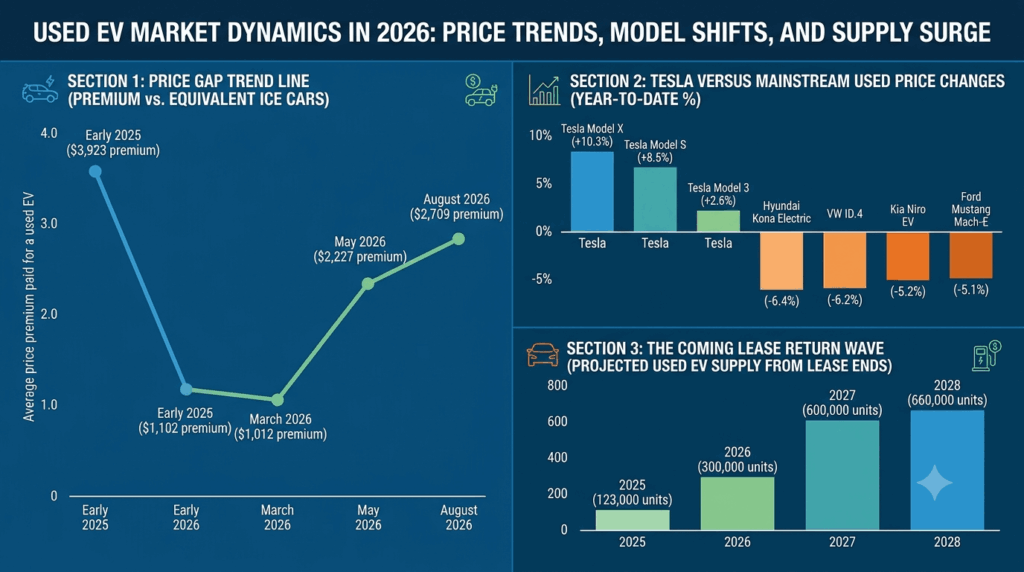
In early 2026, the average used EV transaction price fell to $34,653, just $1,102 above the $33,551 average for a used gasoline car . A year earlier, that premium was $3,923 . The gap has shrunk by nearly three-quarters in twelve months.
The sub-$25,000 segment has become the fastest-appreciating part of the market. At the end of 2025, roughly 40% of US used EVs sold for under $25,000 . By March 2026, that figure had risen to 44% . The Nissan Leaf, one of the most accessible models, trades at roughly $12,000 .
The reason is partly mechanical and partly psychological. The $4,000 federal used EV credit, which was available on vehicles priced at $25,000 or less, expired on September 30, 2025 . When the credit disappeared, the artificial ceiling it created on eligible vehicles disappeared with it. Buyers who previously could not access the credit, because of income limits or vehicle price caps, entered the market at the exact moment that lease returns began flooding dealer lots with late-model inventory .
The Supply Wave: 300,000 Lease Returns
The supply side of the used EV boom is not a mystery. It is the predictable consequence of a leasing surge that peaked in 2022 and 2023.
When the Inflation Reduction Act’s leasing loophole allowed the $7,500 federal credit to apply to leased EVs regardless of domestic sourcing requirements, leasing exploded. Nearly half of all franchise EV sales in 2023 were leases . Those leases are now maturing.
Cox Automotive projects that approximately 300,000 two- and three-year-old EVs will come off lease in 2026, up from just 123,000 in 2025. That number rises to 600,000 in 2027 and nearly 660,000 in 2028 . These are predominantly 2022–2023 model-year vehicles, typically low-mileage, often still covered by factory warranty, and many still protected by the federally mandated eight-year, 100,000-mile battery warranty .
The brand mix is shifting. In mid-2025, about half of EV lease maturities were Teslas. Through 2026 and 2027, that mix is diversifying toward mainstream OEM brands, which changes the pricing and demand dynamics considerably . A used Hyundai Ioniq 5 or Kia EV6 entering the market at a competitive price is a different proposition from a used Tesla, which retains stronger brand pricing power.
The Divergence: Tesla Versus Everyone Else
The used EV market is not a monolith. The pricing trends within it reveal a two-tier structure.
Since the federal credits expired, used Tesla prices have risen 4.3%, while nearly every other used EV has dropped an average of 3.6%, according to iSeeCars data . The Hyundai Kona Electric fell 6.4%, the Volkswagen ID.4 dropped 6.2%, the Kia Niro EV declined 5.2%, and the Ford Mustang Mach-E lost 5.1% . Every Tesla model went the other direction, with the Model X surging 10.3% .
The divergence matters for buyers. A used Tesla commands a premium that reflects brand strength and Supercharger access. A used mainstream EV offers a steeper discount but may carry more residual value risk. The question of whether a used EV is a “good investment” depends heavily on which used EV you are considering.
Are They a Good Investment? The Honest Assessment
The word “investment” is doing a lot of work in this question. A vehicle is a depreciating asset, not an appreciating one. The relevant question is whether a used EV offers better value relative to the alternatives than it did before the credits vanished.
The case for yes:
The price gap to gas cars has narrowed to near-parity. The supply of late-model, low-mileage vehicles is increasing. The operating cost advantage of electric driving remains substantial, particularly with gasoline prices above $4 per gallon in many markets. And the removal of the federal credit has exposed a segment of genuine, unsubsidized demand that is growing rather than contracting .
The case for caution:
The depreciation risk has not disappeared. It has shifted. The institutions that are profiting from the used EV boom are the distributors and retailers who turn inventory quickly, not the manufacturers or lenders who hold residual value risk . Ford wrote off $19.5 billion from its EV business and ended production of the all-electric F-150 Lightning. When a used EV’s market price falls below the residual a manufacturer assumed on its lease book, the gap is a realized loss .
For a buyer, that means the vehicle you purchase today may be worth less than you expect in three years, particularly if you buy a non-Tesla model in a segment where supply is increasing rapidly. The value transfer that makes used EVs affordable is a transfer from the original owner and financier to the second buyer. The second buyer captures the benefit, but they also inherit the risk that the depreciation continues.
What to Watch Before You Buy
The battery warranty. Most used EVs from the 2022–2023 lease wave still carry the original eight-year, 100,000-mile battery warranty . That is a meaningful protection against the single most expensive component failure. Verify the warranty transferability and the remaining coverage before purchase.
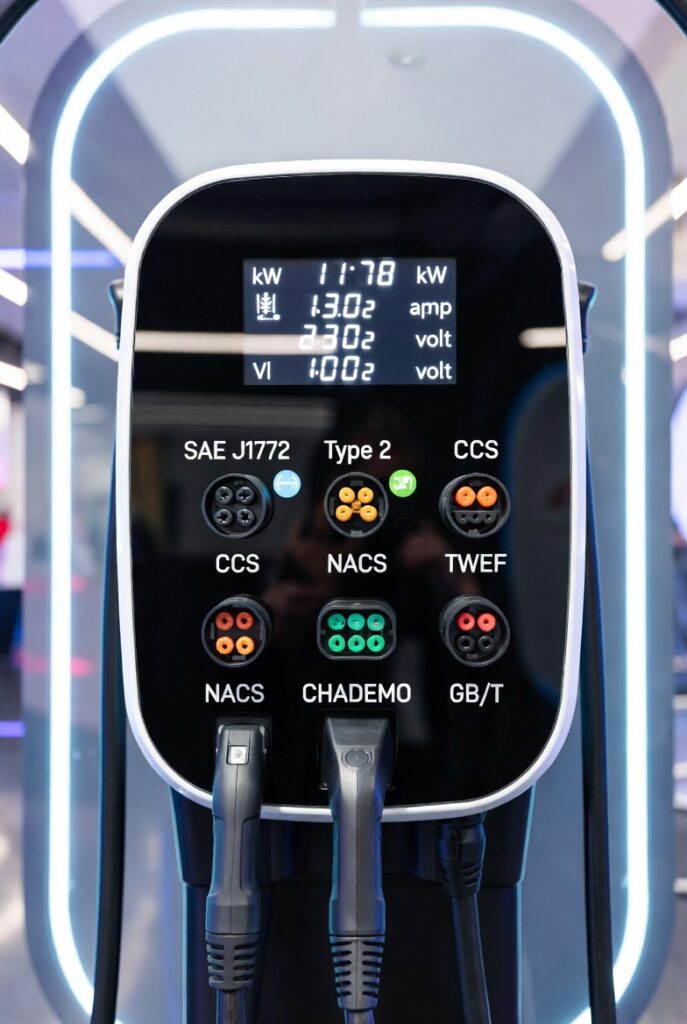
The charging standard. A used EV from 2022 or 2023 likely has a CCS port, not the NACS standard that Tesla and a growing number of charging networks are adopting. An adapter is available and increasingly reliable, but it is an additional cost and a minor inconvenience .
The model’s residual trajectory. A used Tesla has held value better than a used mainstream EV. If you are buying a non-Tesla, factor in the possibility that resale values will continue to soften as the lease return wave grows through 2027 and 2028 .
The regional market. Used EV demand is highly regional. High-adoption markets in the Northeast, California, and the Pacific Northwest see tighter supply and stronger pricing. In the South and rural markets, vehicles sit longer and margins erode faster . Buying in a strong EV market and shipping, or buying in a weak market and accepting a narrower resale pool, are both viable strategies depending on your circumstances.
The Verdict
The used EV market is not a bubble. It is a correction. The federal credits inflated new EV prices and constrained used EV supply. Their removal, combined with the lease return wave, has created a market where electric vehicles are finally competing with gasoline cars on upfront price as well as running costs.
For buyers who want electric driving without the new-car premium, the used market is the best opportunity it has ever been. The price gap is narrow, the supply is increasing, and the vehicles are often still under warranty. The risk of further depreciation is real, but it is the same risk that every vehicle buyer faces.
The used EV market heats up: are they the best investment after federal credits vanished? The honest answer is that they are not an investment in the financial sense. But they are the most compelling value proposition in the US automotive market right now, and the buyers who recognize that are already driving the record sales figures.