Here is the conversation that reveals how differently home EV charging works across China’s geography.
A Beijing buyer in Chaoyang district asks online for home charger recommendations. They get 20 replies — StarCharge S1, Autel MaxiCharger, Xiaomi EV Charger, discussions about 物业 approval timelines, advice on 12345 complaints for resistant 物业, TOU pricing from State Grid, Octopus-equivalent valley rate scheduling. The conversation assumes urban high-rise infrastructure, dense public charging networks as backup, experienced 物业 companies who have processed dozens of EV charging applications.
Three days later, a buyer in a village outside Chengdu asks the same question. They get five replies — all of them tentative, all of them defaulting to “just ask your village committee,” none of them addressing the specific challenges of rural electrical infrastructure: single-phase 220V supply that may be shared between multiple households, no dedicated parking, no 物业 process to navigate because there is no 物业, variable grid voltage that makes sustained 32A charging unreliable, and public charging infrastructure that may be a 40-minute drive away.
Three days after that, a buyer in a mid-sized Chengdu villa compound asks. They get the most useful responses — because the Chengdu villa charging scenario combines elements of both: better electrical infrastructure than most Beijing high-rises (three-phase supply commonly available), more flexibility than rural China, but different climate conditions from Beijing, different 物业 dynamics from a luxury compound versus a standard apartment building, and a different solar installation opportunity that villa ownership provides.
This guide on tier 1 vs tier 2 city charging solutions for Beijing high-rises vs Chengdu villas vs rural villages addresses all three scenarios honestly — the specific electrical infrastructure characteristics, the specific 物业 and regulatory environment, the specific charger recommendations, and the specific financial calculations that apply to each of China’s distinct EV charging geographies.
Why Location Determines Every Home Charging Decision in China
Before covering specific scenarios, understanding why Chinese EV charging decisions are more location-dependent than in any other major EV market establishes the framework.
China’s Electrical Infrastructure Diversity
China’s electrical grid serves 1.4 billion people across 9.6 million square kilometres of geography ranging from dense coastal megalopolises to high-altitude Tibetan plateau villages to Mongolian steppe communities. The resulting electrical infrastructure diversity is extraordinary:
Tier-1 city high-rise (Beijing, Shanghai, Shenzhen, Guangzhou):
- 220V single-phase residential supply standard
- Dedicated metering infrastructure in place or easily added
- Grid voltage stability: excellent (within ±5% of nominal voltage)
- Peak demand management: sophisticated
- Maximum available residential load: 40-60A per apartment circuit
Tier-2 city mixed residential (Chengdu, Wuhan, Hangzhou, Nanjing, Xi’an):
- Mix of single-phase and three-phase supply depending on building age and type
- Villa compounds increasingly have three-phase supply as standard
- Grid voltage stability: good in urban areas, variable in suburban fringe
- Significant variation between premium and standard residential development
Tier-3 and tier-4 cities:
- Standard residential supply: single-phase 220V
- Older infrastructure in established residential areas
- New development zones may have modern electrical infrastructure
- Public charging infrastructure: limited but growing
Rural villages and township areas:
- Single-phase 220V supply — often shared transformer serving multiple households
- Grid voltage stability: variable — rural distribution lines experience higher voltage fluctuation than urban supply
- Maximum available load: may be constrained by shared transformer capacity
- Agricultural electrical usage creates peak demand patterns different from urban areas
- Public charging: typically 30-60+ km to nearest DC fast charging
China’s Regulatory Environment Diversity
The 物业 process — the central regulatory challenge for most Chinese EV charging installations — applies entirely differently across China’s geographic tiers:
Tier-1 city high-rise: Established 物业 companies with documented EV charging approval procedures. Local government policies with clear timelines and escalation mechanisms. Competition between 物业 companies in premium developments creating incentive to facilitate resident requests.
Tier-2 city villa compound: Often developer-managed 物业 with less bureaucratic resistance than large urban compounds. Physical space and infrastructure flexibility that high-rise parking cannot provide. Less standardised approval processes — more relationship-dependent.
Rural and township residential: Often no formal 物业 at all — EV charging permission depends on village committee (村委会) cooperation, township government policies, and individual property ownership arrangements. The formal 物业 approval framework in most Chinese EV charging guides simply does not apply.
China’s Climate Diversity
As covered in our weatherproof EV charger guide, China’s climate diversity creates dramatically different charger specification requirements:
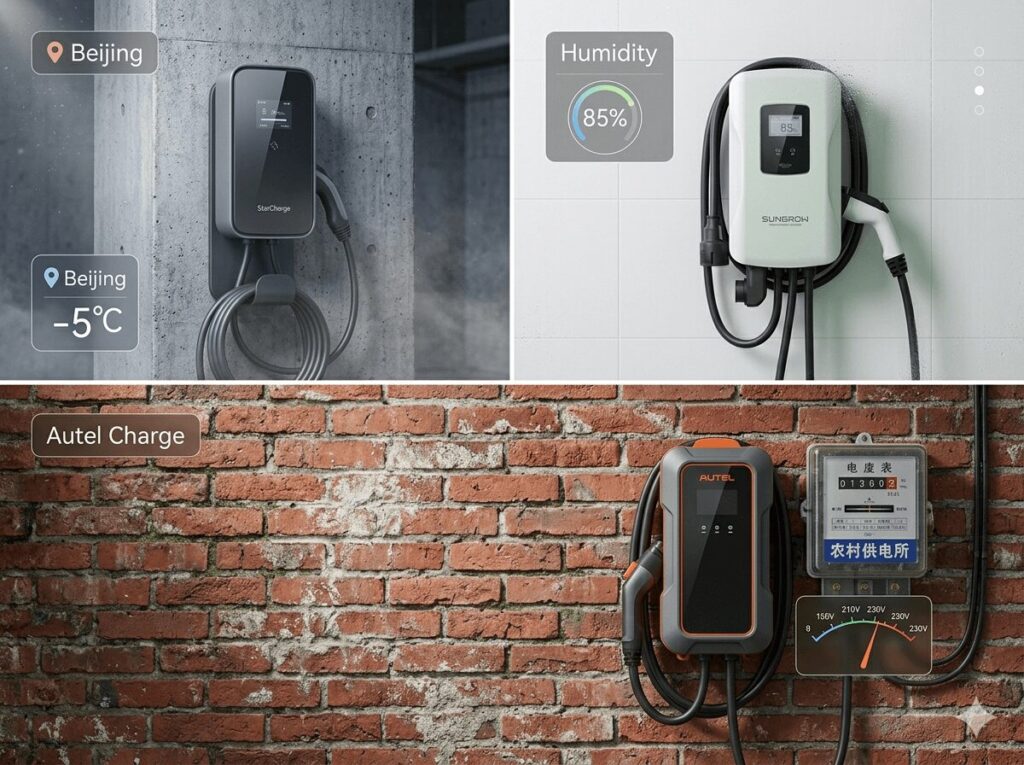
- Beijing high-rise: -20°C winter capable, dust-storm IP65 preferred for outdoor/semi-outdoor
- Chengdu villa: -5°C minimum, very high humidity — IP65 essential for any outdoor exposure
- Rural Sichuan: similar to Chengdu urban
- Rural Northeast: -35°C+ possible — the most demanding cold weather specification in China
Scenario 1: Beijing High-Rise — The Urban Apartment Challenge
The Beijing High-Rise Charging Context
Beijing represents China’s most established and policy-supported urban EV charging environment. The combination of national capital status, ambitious local government EV adoption targets, and a dense public charging network creates the best-supported urban EV charging ecosystem in China outside of Shenzhen.
The typical Beijing high-rise parking situation:
Standard Beijing residential compound: 10-30 storey residential towers with underground or semi-underground car parking. Parking spaces either purchased, long-term leased, or assigned. Electrical supply to parking spaces: single-phase 220V, typically 32A capacity. Dedicated EV charging meter: required by 物业 as standard condition of installation approval.
What makes Beijing high-rise charging specifically challenging:
Challenge 1: Underground parking WiFi signal quality Beijing’s underground car parks — particularly older developments — can have poor WiFi signal penetration from the residential unit’s WiFi router. A smart charger installed 50 metres underground from the nearest WiFi access point may have intermittent connectivity — disrupting TOU scheduling reliability.
Solution: Specify dual-band WiFi charger (Xiaomi, Autel) and install a WiFi extender at the B2 or B3 level near the charging installation. Alternatively, specify the Autel MaxiCharger’s optional 4G connectivity for guaranteed connectivity independence from building WiFi infrastructure.
Challenge 2: 物业 approval competitiveness among multiple EV-owning residents In a 300-unit Beijing residential building, 30-50 EV owners may be simultaneously pursuing charger installation. The building’s distribution board has finite capacity — not all 50 can charge at 32A simultaneously. This creates a first-mover advantage — later applicants may face rejection based on capacity grounds that were valid for their application but not for earlier applicants.
Solution: Submit the installation application at earliest opportunity — immediately upon EV delivery, or even before delivery if possible. Reference the Beijing Green Charging Support Programme subsidy in your application — the subsidy application deadline creates a legitimate urgency argument for timely processing.
Challenge 3: -20°C winter conditions Beijing’s average January low of -15°C with extreme events to -20°C means standard -20°C minimum chargers operate at their rated limit during coldest conditions. For outdoor and semi-outdoor Beijing parking, this is a meaningful specification constraint.
Solution: Autel MaxiCharger (-30°C) for outdoor or semi-outdoor installation. StarCharge S1 (-20°C) is technically adequate for covered underground parking where ambient temperature is moderated by building mass — typically -5°C to -10°C even in the coldest Beijing winters.
Challenge 4: Spring dust storms (March-May) Beijing’s annual dust storm season deposits loess particles through underground car park ventilation systems. IP54’s dust-protected (not dust-tight) rating allows gradual dust accumulation inside the charger enclosure over multiple dust storm seasons.
Solution: IP65 charger for any above-ground or ventilated installation position in Beijing. Even in underground car parks, IP65 provides better long-term dust protection than IP54.
Beijing High-Rise Electrical Supply Reality
The 32A dedicated circuit: Beijing residential EV charging installations use a dedicated 32A circuit from the underground car park distribution board to the parking space. This circuit has its own meter and its own circuit breaker.
The single-phase reality: Despite Beijing’s extensive modern infrastructure, residential EV charging in apartment compounds is almost universally single-phase 220V. Three-phase supply to individual apartment parking spaces is available only in the most premium luxury developments. Standard Beijing high-rise owners: plan for 7 kW maximum AC home charging.
Load balancing in Beijing high-rise context: For Beijing apartment owners with dedicated EV charging circuits — the standard installation — load balancing between EV charging and household appliances is handled by separate circuit design. The EV charging circuit does not share a breaker with household circuits.
However, the building distribution board serving multiple EV charging circuits may have capacity constraints as EV adoption increases. This is managed at the building infrastructure level (物业 and the utility jointly) rather than by individual charger load management.
Beijing High-Rise Public Charging Context
Beijing’s public charging infrastructure is among the densest in China:
- Over 150,000 public charging points in Beijing (2026)
- Motorway corridor: fully covered by State Grid DC fast charging
- Urban density: major shopping areas, office parks, residential compounds all have significant AC charging presence
- App integration: 京电 app and 国网北京 app provide comprehensive charging navigation
The public charging backstop for Beijing high-rise owners: Beijing’s dense public network means high-rise owners who cannot install home charging are not stranded — they have viable public charging access throughout the city. But the cost differential (¥1.40/kWh at State Grid DC vs ¥0.30/kWh at home TOU valley) makes home installation financially urgent for any Beijing EV owner who can achieve it.
Beijing High-Rise Charger Recommendations
For covered underground parking (most common):
Primary: StarCharge S1 Smart (¥899-¥1,099) The most appropriate choice for standard Beijing underground parking:
- IP54 adequate for underground covered parking (not fully dust-tight but acceptable in ventilated underground environment where dust storms are moderated)
- -20°C adequate for underground parking where ambient temperature moderated by building mass
- Best 物业 approval recognition — most commonly installed brand in Beijing residential compounds
- Beijing Green Charging Support Programme subsidy: ¥1,000-¥2,000 with demand response registration
- 3-year warranty
- Xiaomi Mi Home integration for large portion of Beijing’s tech-forward EV buying population
Premium alternative: Autel MaxiCharger (¥1,299-¥2,499) For Beijing owners who want IP65 dust-tight protection against cumulative spring dust storm ingress even in underground parking. Justified for:
- Semi-outdoor or ventilated parking above B1 level
- Owners planning 8-10 year installation lifetime (dust accumulation prevention has more value over longer ownership)
- Owners seeking OCPP future-proofing for Beijing’s developing demand response programmes
For outdoor or semi-outdoor Beijing parking:
Required: Autel MaxiCharger (IP65, -30°C) Outdoor Beijing installation requires IP65 for dust-tight protection and -30°C for extreme cold weather margin. No other mainstream consumer charger meets both requirements.
Beijing TOU and Financial Analysis
Beijing TOU valley rate: ¥0.30/kWh (23:00-7:00)
Annual charging cost for typical Beijing EV owner (BYD Han EV, 20,000 km/year):
- At TOU: 4,073 kWh × ¥0.30 = ¥1,222/year
- Without TOU: 4,073 kWh × ¥0.72 = ¥2,933/year
- Annual TOU saving: ¥1,711/year
Beijing installation subsidy (full claim): Municipal: ¥2,000 (with demand response registration) District: ¥500-¥800 Vehicle purchase charging component: ¥1,000-¥2,000 Total installation support: ¥3,500-¥4,800
5-year net benefit: Installation subsidies + 5-year TOU savings – installation cost: ¥4,150 (average subsidies) + ¥8,555 (5-year TOU) – ¥2,699 (StarCharge S1 + standard install) = ¥10,006 net benefit over 5 years
Scenario 2: Chengdu Villa — The Southwest China Opportunity
The Chengdu Villa Charging Context
Chengdu represents a fundamentally different EV charging opportunity from Beijing high-rise. The Sichuan basin’s rapid economic development, affordable land values (relative to coastal tier-1 cities), and lifestyle preferences have produced a large villa-dwelling professional and business owner population — many of whom are early EV adopters.
The Chengdu villa owner’s home charging situation differs from the Beijing high-rise owner in several important and mostly advantageous ways:
The typical Chengdu villa parking situation: Private enclosed garage or covered parking within a villa compound. Often direct access from the home rather than a shared car park. Electrical supply: frequently three-phase 380V available at the property — villa electrical supply is typically designed for higher load including air conditioning, pool equipment, and home automation.
What makes Chengdu villa charging specifically advantageous:
Advantage 1: Three-phase supply commonly available The single most significant charging advantage for Chengdu villa owners over Beijing high-rise owners. Three-phase supply enables 11 kW AC charging for any vehicle capable of accepting it (NIO ET5, Xpeng G9, Zeekr 001, Porsche Taycan, BMW i5, Mercedes EQE, Xiaomi SU7 Max).
At 11 kW versus 7 kW for a NIO ET5 75 kWh:
- Three-phase 11 kW (20-80%): 4.1 hours
- Single-phase 7 kW (20-80%): 6.8 hours 2.7-hour advantage for Chengdu villa owners with three-phase supply.
Advantage 2: Private garage with flexible installation No shared car park, no 物业 approval process involving distribution board capacity assessment. The Chengdu villa owner’s installation is on their own private electrical supply — the installation permissions are simpler, the cable routing is more flexible, and the installation quality can be higher.
Advantage 3: Solar installation opportunity Villa rooftop ownership — unlike apartment owners who cannot access the building roof — enables rooftop solar installation. Chengdu averages approximately 1,100-1,200 hours of sunshine annually — lower than coastal China but sufficient for meaningful solar generation with appropriate system sizing.
Solar EV charging synergy for Chengdu villa: A 5 kWp rooftop solar system in Chengdu generates approximately 5,500 kWh annually. Home consumption (including EV charging) may be approximately 8,000-10,000 kWh annually. Solar surplus available for EV charging: approximately 1,500-2,000 kWh (depending on household consumption pattern and EV usage).
At Chengdu’s valley rate (¥0.25/kWh) and typical feed-in tariff (¥0.35/kWh), the financial case for solar divert is: Solar divert saving: 1,500 kWh × (¥0.55 standard rate – ¥0.35 feed-in) = ¥300/year This is modest — Chengdu’s low electricity rates reduce the solar divert financial case relative to coastal cities.
More significant: solar reduces grid import at standard rates during daytime hours — particularly relevant for Chengdu villa owners who work from home and use EV charging during daytime solar generation periods.
Advantage 4: 物业 relationship flexibility Villa compound 物业 tends to be smaller scale, developer-operated, and more responsive to individual owner requests than the large institutional 物业 companies managing Beijing high-rise developments. The relationship-based approach that characterises business culture in Sichuan can navigate 物业 approval more efficiently than formal regulatory escalation.
What makes Chengdu villa charging specifically challenging:
Challenge 1: Persistent high humidity — China’s most challenging sustained humidity environment Chengdu and Chongqing occupy the Sichuan basin, which traps moisture from Tibetan plateau weather systems and summer monsoonal flow. Annual average relative humidity: 82-85% — among the highest sustained values of any major Chinese metropolitan area.
This humidity creates specific risks for EV charger hardware:
- Condensation inside insufficiently sealed enclosures during daily temperature cycling
- Accelerated connector contact corrosion
- Cable jacket degradation faster than less humid environments
Solution: IP65 is the minimum appropriate specification for any Chengdu villa installation — even in a covered private garage. The persistent high humidity penetrates IP54’s dust-protected (not dust-tight) seals over time in ways that Beijing’s drier climate does not.
Challenge 2: Frequent overcast conditions affecting solar performance Chengdu is famous for its overcast skies — described in Chinese culture as “天无三日晴” (the sky never has three consecutive clear days). Solar generation in Chengdu is approximately 40% lower per installed kWp than in Beijing or coastal Guangdong.
This affects the solar divert financial case and should moderate expectations for solar-EV charging synergy in Chengdu villa installations.
Challenge 3: Summer heat and humidity combined Chengdu summer temperatures (July-August peak: 35-38°C) combined with 80%+ humidity create challenging conditions for charger thermal management. Charger enclosures in south-facing or poorly ventilated garage positions can reach 45-50°C in Chengdu summer — approaching the upper operating temperature limit of some consumer chargers.
Solution: Specify chargers with 55°C+ upper operating temperature (Autel, Sungrow, Ginlong Solis) rather than those limited to 50°C. Avoid south-facing charger mounting where afternoon sun exposure would add radiant heat load.
Chengdu Villa Electrical Supply and Installation
Three-phase confirmation: Before purchasing any charger for a Chengdu villa installation, confirm three-phase supply availability at the garage:
- Count the conductors entering the property’s main electrical panel
- A three-phase supply has three live conductors (L1, L2, L3) plus neutral plus earth
- Confirm the panel’s main breaker is three-phase
For three-phase Chengdu villa: Install 11 kW three-phase charger for vehicles with 11 kW AC maximum (NIO, Xpeng G9, Zeekr, SU7 Max, Taycan, i5, EQE). Install 7 kW single-phase charger for vehicles with 6.6 kW AC maximum (BYD models, Li Auto EREV, Xiaomi SU7 Standard, Xpeng P7).
For single-phase Chengdu villa (some older villa compounds): 7 kW home charger is the correct specification. Three-phase upgrade investigation is worthwhile if the property has three-phase main supply but single-phase circuit run to the garage.
Chengdu Villa Charger Recommendations
Primary recommendation: Sungrow EV Charger (IP65, 5-year warranty with Sungrow solar)
For Chengdu villa owners with existing or planned Sungrow solar installations, the Sungrow EV Charger delivers native solar ecosystem integration alongside:
- IP65 protection for Chengdu’s persistent high humidity
- iSolarCloud platform unified solar + EV energy management
- 5-year warranty (with Sungrow inverter)
- -25°C operating temperature (adequate for Chengdu’s mild winters)
The Chengdu villa solar integration financial case: At Chengdu’s standard rate (approximately ¥0.55/kWh peak) versus valley rate (¥0.25/kWh): Solar divert saving: 1,500 kWh × (¥0.55 – ¥0.28 feed-in) = ¥405/year TOU saving: 3,600 kWh × (¥0.55 avg – ¥0.25 valley) × % charged at peak = approximately ¥1,440/year Combined annual saving: ¥1,845/year
For Chengdu villa without solar:
Autel MaxiCharger 11 kW three-phase (IP65, -30°C)
- IP65 for persistent Chengdu humidity
- 11 kW three-phase for full AC speed benefit
- -30°C specification is excessive for Chengdu winters (-5°C minimum) but provides hardware longevity in the heat-humidity cycling environment
- OCPP 1.6 for future smart grid programme participation
For Chengdu villa with Huawei smart home ecosystem:
Huawei Digital Power FusionCharge (IP65, 3-5yr warranty) Villa ownership combined with Huawei’s full energy management ecosystem delivers the most sophisticated charging intelligence available — AI scheduling, solar coordination (if Huawei solar installed), HarmonyOS home integration.
Chengdu TOU and Financial Analysis
Chengdu TOU valley rate: ¥0.25/kWh (derived from Sichuan hydropower abundance)
Annual charging cost (NIO ET5 75 kWh, 20,000 km/year):
- At TOU: 3,600 kWh × ¥0.25 = ¥900/year
- Without TOU: 3,600 kWh × ¥0.60 = ¥2,160/year
- Annual TOU saving: ¥1,260/year
Note: Chengdu’s low valley rate (¥0.25/kWh) makes it one of the cheapest cities in China for EV home charging — even though the annual TOU saving (¥1,260/year) is lower than Beijing (¥1,711/year) because the absolute differential between peak and valley rates is smaller.
Villa installation cost: Three-phase charger + three-phase circuit installation in private villa garage: ¥3,500-¥6,000 total
Chengdu installation subsidy: Sichuan provincial + Chengdu city: ¥500-¥1,000 installation support Net installation cost after subsidy: ¥2,500-¥5,000
5-year net benefit: Subsidies + 5yr TOU savings – net installation: ¥750 (average subsidies) + ¥6,300 (5-year TOU) – ¥3,750 (average installation) = ¥3,300 net benefit over 5 years
Scenario 3: Rural Villages and Township Areas — The Overlooked EV Charging Frontier
The Rural China Charging Context
Rural China EV adoption is the most rapidly growing and least well-documented segment of the Chinese EV market. The combination of government rural vehicle subsidies (农村新能源汽车推广计划), lower vehicle purchase costs for entry-level Chinese EVs, and the petrol cost savings that particularly benefit rural families with significant driving needs has driven EV adoption into townships, county seats, and rural villages at a pace that charging infrastructure has not kept pace with.
Who are rural Chinese EV owners?
The rural Chinese EV owner profile is genuinely diverse:
- Township government officials and professionals driving mid-range EVs (BYD Qin Plus DM-i, BYD Song Pro)
- Village small business owners using EVs for local commerce (BYD Shark, commercial vehicles)
- Agricultural households using Wuling Mini EV and similar micro-EVs for local transport
- County-seat professionals who live in town but own land in surrounding villages
- Rural construction contractors using EVs for job-site transport within limited local range
What makes rural China charging fundamentally different:
Difference 1: No 物业 framework — completely different permission structure
Rural Chinese residential property is not managed by 物业 companies. The formal application and approval process described in all urban Chinese EV charging guides does not apply.
Instead, rural EV charging installation involves:
For village residents (自建房 — self-built rural housing): Land and housing are typically individually owned or family-owned under rural land use rights. Electrical supply connects directly to the household from the rural grid. There is no intermediate 物业 — the owner of the house controls what electrical work is done on their own property, subject to safety regulations and utility meter approval.
This means a rural village EV owner can install a home charger on their own property without any 物业 approval process — the significant bureaucratic friction of urban EV charging simply does not exist. The permission structure is: get a licensed electrician, apply to the rural electricity supply bureau (农村供电所) for a dedicated meter if needed, and install.
For township apartment housing (乡镇公寓/单位房): Some township residents live in work unit housing (单位房) or simple township apartment buildings. These have building management — often the work unit or township government — rather than a formal 物业 company. The approval process is typically simpler than urban 物业 but exists.
Difference 2: Grid voltage stability challenges
Rural electrical distribution in China operates on longer distribution lines from fewer transformation points than urban infrastructure. This creates:
Voltage fluctuation: Rural supply voltage may fluctuate between 190V-240V rather than the 215V-225V of stable urban supply. During agricultural peak demand periods (irrigation pumping, processing equipment), rural voltage may drop significantly.
The EV charger voltage tolerance requirement: Standard Chinese EV chargers are designed for 220V ±10% = 198V-242V operation. At the lower end of rural voltage fluctuation (190V), a charger at 220V design point may operate at its lower voltage limit — potentially triggering under-voltage protection and stopping charging.
Solution: Specify chargers with wider voltage tolerance (180V-264V input range) rather than standard 220V ±10% design. Some chargers — including Autel MaxiCharger variants — offer wider input voltage tolerance suitable for rural grid applications.
Difference 3: Transformer capacity constraints
Rural distribution transformers serve clusters of households. In villages where EV adoption is increasing, multiple households simultaneously charging at 32A may exceed the local transformer’s capacity — causing voltage depression and protection trips.
The rural EV charging capacity problem: A typical rural distribution transformer serves 50-100 households at 100-200 kVA capacity. If 10-15 households each attempt 32A charging simultaneously, the combined load (10 × 32A × 220V = 70.4 kW) approaches or exceeds the transformer’s capacity.
Solution at household level: Configure chargers for 16A maximum (3.5 kW) rather than 32A — halving the transformer impact. At 16A, 10 simultaneous chargers draw 35 kW — more manageable.
Solution at community level: Rural electricity cooperatives (农村电力合作社) and township governments are increasingly applying for transformer capacity upgrades specifically to support EV charging. The State Grid’s rural EV charging infrastructure support programme provides subsidy for this upgrade.
Difference 4: No nearby public charging backup
In major cities, failed home charging produces the inconvenience of using public charging at higher cost. In rural areas, failed home charging may mean 40-60 km of driving to the nearest DC fast charging station.
This makes home charging reliability — including voltage-tolerance, cold weather specification, and hardware quality — more critical in rural areas where public charging backup is genuinely distant rather than a 5-minute detour.
Difference 5: Extended-range and PHEV vehicles dominate
Rural Chinese EV adoption strongly favours Extended Range Electric Vehicles (ERVs) and PHEVs — Li Auto EREV, BYD DM-i series, Huawei AITO EREV. The petrol range extender eliminates the range anxiety that makes long distances between public charging stations problematic.
This changes the home charging priority: rural EREV owners use home charging to maximise electric-only driving and minimise petrol consumption — the same calculation as for Li Auto owners in urban areas but with more kilometres between charging opportunities.
Rural China Sub-Scenarios
Sub-Scenario 3A: Northern Rural Village (Harbin/Shenyang Prefecture Rural Area)
The most challenging rural charging scenario in China.
Climate: -30°C to -40°C possible winter temperatures. Snowfall. Ice coating on outdoor equipment. Infrastructure: Single-phase 220V, often with voltage fluctuation. No 物业. Public charging: 30-80 km to nearest DC fast charging in many rural Northeast areas. Primary vehicle types: BYD DM-i PHEVs, Li Auto EREV (petrol backup critical for range in cold).
Charging challenges:
- Charger hardware must survive -40°C ambient storage temperature (not just -30°C operating)
- Cable jacket must flex at -35°C without cracking
- Battery pre-conditioning critical — cold-soak battery cannot accept charge effectively until warmed
- Indoor installation (heated space if possible) dramatically reduces specification requirements
The heated indoor installation priority for Northern rural: If the rural household has any form of heated indoor space connected to the main electrical supply — a heated equipment room, animal housing, or simple insulated garage — installing the charger in this space is the highest-priority hardware decision. A standard 7 kW charger at -5°C in a heated space performs infinitely better than a -30°C-rated charger at -38°C in exposed outdoor conditions.
If outdoor installation is unavoidable:
Required specification:
- Operating temperature: -30°C minimum (only Autel MaxiCharger in mainstream consumer market)
- Cable cold-rated to -40°C (custom specification — may require commercial charger rather than consumer product)
- IP65 minimum
- Wide voltage input tolerance (180V-264V) for rural grid fluctuation
Charger recommendation: Autel MaxiCharger (IP65, -30°C) — the only mainstream consumer charger with appropriate specification for northern rural outdoor installation. For truly extreme (-38°C+) conditions, commercial-grade chargers with extended temperature ratings may be more appropriate than consumer products.
For Northern rural PHEV/EREV owners specifically: Li Auto L9 and BYD DM-i owners in northern rural areas: the petrol range extender eliminates charging urgency that pure BEV owners face. Home charging at 2.2-3.5 kW from a standard socket — using the car’s built-in timer for TOU scheduling — is adequate for the electric driving fraction in most scenarios. Full 7 kW installation investment can be deferred in favour of simple socket charging if resources are constrained.
Sub-Scenario 3B: Yangtze Valley Rural (Hubei/Hunan/Anhui Rural County Seat)
A middle-ground rural scenario with more manageable challenges.
Climate: -5°C to -15°C winter minimum. Seasonal humidity (plum rain season). Occasional frost. Infrastructure: Single-phase 220V. Some rural areas upgrading to higher capacity. No 物业 in village settings. Public charging: 20-40 km to nearest county seat with DC fast charging. Primary vehicle types: Mixed — BYD models, Wuling Mini EV in rural villages, mid-range EVs at county level.
The county seat distinction: County seats (县城) in central China are distinct from village-level communities. County seats have:
- More organised property management in apartment housing
- Better electrical infrastructure (sometimes including three-phase)
- Closer proximity to public charging (often within the county seat itself)
- More formal approval processes approaching township-level
For county seat apartment residents: Similar approach to tier-3 city urban — standard 7 kW installation with 物业-equivalent approval from building management. StarCharge S1 or TELD entry charger is appropriate.
For village residents with self-built housing: Simple installation process — direct application to rural electricity supply bureau (农村供电所) for dedicated meter. StarCharge S1 or ChargeWay basic charger installed in covered outdoor position. IP55 minimum for plum rain season moisture.
Charger recommendation for Yangtze Valley rural:
- Village self-built housing: StarCharge S1 (IP54) for covered installation, Autel Basic (IP65) for any outdoor exposure
- County seat apartment: Standard urban installation approach with StarCharge S1
Sub-Scenario 3C: Southwest Rural (Yunnan/Guizhou Rural Township)
The most topographically diverse rural charging scenario.
Climate: Yunnan: mild year-round (+5°C to +25°C typical) but variable altitude effects. Guizhou: high humidity, frequent rainfall. Infrastructure: Highly variable — major county seats have modern infrastructure; remote mountain communities have basic single-phase supply with significant voltage fluctuation. Public charging: Very limited in remote areas; county seats have basic charging.
The Yunnan altitude consideration: At altitudes above 2,000 metres (common in rural Yunnan), air density is lower — affecting convective cooling of charger electronics. Some chargers derate their output at high altitude to prevent thermal issues from reduced convective cooling.
Specification consideration for high-altitude Yunnan: Verify that the chosen charger’s specification includes altitude rating. Most consumer chargers specify operation to 2,000m altitude. For rural Yunnan installations above 2,000m, confirm altitude specification with the manufacturer.
Charger recommendation for Southwest rural:
- Yunnan low-altitude: Standard installation — StarCharge S1 or ChargeWay basic depending on whether TOU scheduling is available
- Yunnan high-altitude (above 2,000m): Verify altitude rating — Autel MaxiCharger (rated to higher altitudes in commercial variants)
- Guizhou high-humidity rural: Autel MaxiCharger (IP65) for any outdoor exposure
The Rural China Electricity Meter Application — Different from Urban Process
Urban residents apply for dedicated EV charging meters through the State Grid’s standard urban service channels. Rural residents apply through different channels:
Rural electricity supply bureau (农村供电所): Each rural township area is served by a rural supply bureau — a branch of State Grid or Southern Grid specifically managing rural distribution. For rural EV charging meter applications:
- Visit the local 农村供电所 office in person
- Provide: identity documents, property rights documentation (土地使用证 or 房产证), vehicle registration
- Request: dedicated EV charging meter installation (专用充电电表)
- The supply bureau assesses transformer capacity for the additional load
- If capacity is available: meter installation scheduled, typically 2-6 weeks
- If capacity is constrained: the bureau may recommend a limited current connection (typically 16A rather than 32A) or advise on timeline for transformer upgrade
Rural charging cost realities: Rural residential electricity rates are often the same as urban residential rates under national tariff harmonisation — but TOU pricing availability varies by province and rural area. Some rural supply bureaus have implemented TOU pricing; others still operate flat-rate billing for rural residential consumers.
Check TOU availability before installation: Before investing in a smart charger specifically for TOU scheduling, confirm with the local supply bureau whether TOU pricing is available for rural residential accounts in your specific area. If not available, a basic non-smart charger at lower cost serves the daily charging function equally well — use the car’s built-in timer for schedule management.
Rural China Government Support Programmes
The Rural New Energy Vehicle Support Programme (农村新能源汽车推广): China’s national programme specifically supporting EV adoption in rural areas includes a charging infrastructure component — subsidies for rural residential charging installation that may not be widely publicised through urban channels.
Application: Contact the county-level development and reform bureau (发改委) or new energy management office (新能源办) for rural charging installation support.
State Grid Rural EV Charging Service: State Grid has established a rural EV charging service initiative — providing technical consultation, installation coordination, and in some cases subsidised charging equipment for rural residents. Contact the local 农村供电所 for details specific to your area.
The Three-Scenario Comparison — Every Dimension
Electrical Infrastructure Comparison
| Dimension | Beijing High-Rise | Chengdu Villa | Rural Village |
|---|---|---|---|
| Typical supply | Single-phase 220V | Three-phase 380V | Single-phase 220V |
| Max home AC speed | 7 kW | 11 kW (if 3-phase) | 7 kW (if stable) |
| Voltage stability | Excellent | Good | Variable |
| Permission structure | 物业 formal process | Villa 物业 (simpler) | Village committee / none |
| Meter application | State Grid urban | State Grid urban | 农村供电所 |
| Timeline expectation | 4-12 weeks | 3-8 weeks | 2-8 weeks |
Public Charging Infrastructure Backup
| City/Area | Public DC Fast | Density | Backup reliability |
|---|---|---|---|
| Beijing | 150,000+ points | High | Excellent |
| Chengdu | 50,000+ points | Good | Good |
| Rural Northeast | < 1 per 50km | Very low | Poor — plan accordingly |
| Rural Yangtze | 1 per 20-40km | Low | Limited |
| Rural Southwest | 1 per 30-60km | Very low | Poor |
Financial Support Availability
| Location | Installation Subsidy | TOU Pricing | Annual TOU Saving |
|---|---|---|---|
| Beijing | ¥3,500-4,800 | ✅ Available | ¥1,711/yr |
| Chengdu | ¥500-1,000 | ✅ Available | ¥1,260/yr |
| Rural county seat | ¥200-500 | ✅ Likely | ¥800-1,400/yr |
| Rural village | ¥0-500 | ⚠️ Check locally | Variable |
Charger Specification by Scenario
| Scenario | Minimum IP | Minimum Temp | Power | Smart Features |
|---|---|---|---|---|
| Beijing underground | IP54 | -20°C | 7 kW | TOU essential |
| Beijing outdoor | IP65 | -30°C | 7 kW | TOU + DR |
| Chengdu villa garage | IP65 | -20°C | 11 kW if 3-phase | TOU + solar |
| Chengdu outdoor | IP65 | -20°C | 11 kW | TOU + solar |
| Rural county (covered) | IP54 | Climate-specific | 7 kW | TOU if available |
| Rural North outdoor | IP65 | -30°C | 7 kW | Basic timer |
| Rural South/SW outdoor | IP65 | -20°C | 7 kW | TOU if available |
The Decision Framework — Which Scenario Are You In?
Question 1: Urban High-Rise or Villa/Private Property?
Urban high-rise: → Single-phase standard. Focus on 物业 approval process, Beijing/city-specific subsidy capture, TOU scheduling reliability.
Villa or private property: → Investigate three-phase supply first. Focus on IP65 for climate (Chengdu humidity, northern cold), solar integration opportunity, installation freedom.
Rural self-built: → Simpler permission process, rural supply bureau meter application, voltage tolerance and hardware reliability priorities.
Question 2: What Climate Zone?
Northern China (Beijing, northeast provinces, Inner Mongolia): → -30°C temperature specification for outdoor. Spring dust storm IP65 preference.
Yangtze Basin and southwest (Chengdu, Wuhan, Chongqing): → IP65 essential for high humidity. Upper temperature rating for summer heat.
South China (Guangdong, Fujian, Hainan): → IP65-66 for monsoon. Minimal cold weather concern.
Rural north: → -30°C minimum outdoor. Indoor installation highest priority.
Question 3: What Is Your Public Charging Backup Distance?
Under 10 km: High-density urban — home charging is financial optimisation 10-30 km: Mid-density — home charging is important convenience 30+ km: Rural/township — home charging is operational necessity
Question 4: Is TOU Pricing Available?
Tier-1 and most tier-2 cities: Yes — smart charger essential Some rural areas: Check locally — may not be available If not available: Non-smart charger at lower cost plus car’s built-in timer
Internal Links — Further Reading on Clean Energy Bazaar
The tier 1 vs tier 2 city charging solutions for Beijing high-rises vs Chengdu villas vs rural villages guide is the geographic context companion to every product recommendation guide in the Chinese market content cluster.
For the apartment EV charging rights guide covering the 物业 approval process relevant to Beijing high-rise owners, our apartment EV charging solutions 2026 China HOA rules property manager permissions and fixed parking rights guide covers every regulatory step. For the weatherproof charger specification guide determining IP rating requirements for each geographic scenario, our weatherproof EV chargers 2026 IP ratings for humid southern China vs dusty northern China guide covers every climate zone. For the rebates guide covering the installation subsidies available in Beijing, Chengdu, and other cities, our local utility rebates for EV charging 2026 Shenzhen Shanghai Beijing guide covers major city programmes. For the budget charger options relevant to rural and township installations where cost sensitivity is highest, our best budget EV chargers under ¥2,000 2026 Chinese options that actually work guide covers affordable certified options. For the portable vs hardwired comparison relevant to rural owners evaluating socket versus dedicated charger installation, our portable vs hardwired home EV chargers best options for Chinese apartment dwellers guide covers every scenario. And for the safety certification guide ensuring all chargers — whether installed in Beijing high-rises or rural Yunnan villages — meet basic safety requirements, our 3C certification and EV chargers 2026 why buying non-certified chargers is dangerous in China guide covers every safety requirement.
Final Thoughts
The tier 1 vs tier 2 city charging solutions for Beijing high-rises vs Chengdu villas vs rural villages analysis reveals that China’s EV charging landscape is not a single market with a single set of answers — it is three genuinely different markets with different infrastructure, different regulations, different climate challenges, and different financial calculations.
The Beijing high-rise summary: The best-supported urban EV charging environment in China — generous installation subsidies, dense public charging backup, established 物业 procedures, and TOU valley rates of ¥0.30/kWh that deliver ¥1,711/year in annual savings. The primary challenges are 物业 approval friction, spring dust storm specification requirements, and winter cold weather performance for outdoor positions. StarCharge S1 for covered underground installation. Autel MaxiCharger for outdoor positions.
The Chengdu villa summary: The most technically advantageous home charging scenario of the three — three-phase supply commonly available, private installation flexibility, solar opportunity, and hydropower-driven electricity rates that produce some of China’s cheapest EV charging. The primary challenges are persistent high humidity requiring IP65 for all installations and overcast conditions limiting solar generation. Sungrow EV Charger for solar-equipped villas. Autel MaxiCharger 11 kW three-phase for non-solar installations.
The rural village summary: The most rapidly developing and most underserved segment of Chinese EV charging. Simpler permission structure (no 物业) but more challenging infrastructure (voltage fluctuation, transformer capacity, distant public charging). Hardware reliability is more critical than smart features. Indoor installation prioritised wherever possible. Autel MaxiCharger for northern rural outdoor. ChargeWay or StarCharge S1 for temperate rural covered installation. Rural supply bureau engagement for meter applications.
The universal conclusions across all three scenarios:
TOU scheduling — whether through a smart charger’s app or through the car’s built-in timer — is available in most Chinese residential scenarios and delivers meaningful annual savings. Pursue it in every location.
Hardware certification (3C/CQC) is non-negotiable in every scenario — Beijing high-rise, Chengdu villa, or rural Yunnan. The risks of non-certified chargers are identical across geographies.
Installation quality matters more in rural scenarios where public charging backup is distant — the reliability of a properly installed certified charger is more critical when the alternative is a 50 km round trip.
The right charger for your EV depends on where you live as much as on which vehicle you drive. This guide gives you the location-specific framework. The earlier guides give you the vehicle-specific recommendations. Together they cover every combination of Chinese EV ownership geography and vehicle choice.