Electric vans had a regulatory problem that had nothing to do with their performance. A diesel van and an electric van with the same payload, the same dimensions, and the same use case could be treated as completely different classes of vehicle, simply because the electric van’s battery pushed its gross weight over a threshold that the diesel van stayed under.
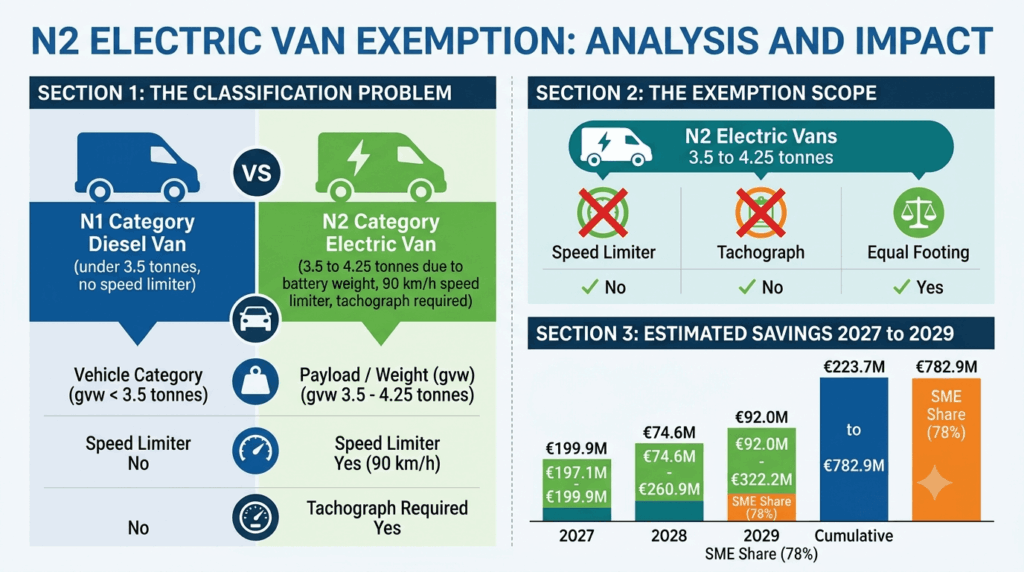
That threshold is 3.5 tonnes. Below it, a van is category N1, subject to the same rules as a passenger car. Above it, a van is category N2, subject to the same rules as a heavy truck. For decades, the line worked because diesel vans with comparable payloads stayed below it. Electric vans, which carry 300 to 500 kilograms of additional battery weight, often do not.
The EU’s N2 van rule: why electric vans were being penalised for battery weight is the story of how a well-intentioned safety regulation created an unintended penalty for the cleanest vehicles on the road, and how the European Commission moved to correct it.
The Regulatory Mechanism: Directive 92/6/EEC
The rule that created the problem is Council Directive 92/6/EEC. Article 3(1) of that directive requires that vehicles of categories N2 and N3 may be used on the road only if equipped with a speed limitation device set so that their speed cannot exceed 90 kilometres per hour.
The logic behind the original rule was sound. Heavy goods vehicles and buses have powerful engines that enable them to climb slopes. On level roads, that same power enables them to be driven at excessive speeds that are not compatible with the specifications of other vehicle components such as brakes and tyres. Directive 2002/85/EC extended the scope of the rule to all N2, N3, M2 and M3 vehicles.
The problem is the classification threshold. Category N2 covers goods vehicles with a maximum mass exceeding 3.5 tonnes but not exceeding 12 tonnes. When an electric van’s battery pushes its gross vehicle weight above 3.5 tonnes, it enters N2 territory. A diesel van with essentially the same payload and use case remains in N1 and faces no speed limiter requirement.
The Commission’s impact assessment was explicit about the consequence. The inclusion of such a device in these e-vans means that diesel vans can drive at higher speeds. The cleaner vehicle is artificially constrained while the fossil fuel alternative is not.
The Parallel Tachograph Problem
The speed limiter was not the only penalty. A parallel problem existed with tachograph requirements.
Electric vans with a maximum permissible mass exceeding 3.5 tonnes and not exceeding 4.25 tonnes must have a tachograph installed unless they are not used for commercial road transport. The tachograph records driving times and rest periods, imposing administrative obligations on operators that diesel vans below 3.5 tonnes do not face.
For SMEs, the burden was compounded. They had to organise and record their drivers’ working times according to the rules on driving times and rest periods. The Commission noted that this additional burden hampered the uptake of electric vans compared to similar combustion engine vans, which could result in increased difficulty for manufacturers to reach CO2 performance targets for vans.
The impact assessment summarised the competitive distortion: electric vans suffer from a competitive disadvantage vis-à-vis combustion engine vans, rendering them less attractive to customers, many of whom are SMEs.
The Exemption: Two Parallel Amendments
On 16 December 2025, the European Commission presented a proposal to amend Directive 92/6/EEC to exempt certain N2 category electric vehicles from the requirement to install and use a speed limitation device.
The exemption applies to vehicles of category N2 propelled by electricity with a maximum technically permissible laden mass exceeding 3.5 tonnes but not exceeding 4.25 tonnes. The amended text would read that Member States shall take the necessary measures to ensure that motor vehicles of categories N2 and N3, except those vehicles of category N2 propelled exclusively by means of electricity and with a maximum permissible mass between 3.5 and 4.25 tonnes, may be used on the road only if equipped with a speed limitation device.
A parallel amendment to Regulation (EU) 2019/2144 adds a new paragraph stating that vehicles of category N2 propelled by electricity, with a maximum technically permissible laden mass between 3.5 and 4.25 tonnes, shall not be required to be equipped with speed limitation devices in accordance with UN Regulation No 89.
The proposal also addresses the tachograph problem. It would allow Member States to exempt e-vans with gross vehicle weights between 3.5 tonnes and 4.25 tonnes engaged exclusively in domestic transport from the obligation to install smart tachographs.
The objective, as the Commission framed it, is to put electric N2 vans on an equal footing with their fossil fuel equivalent, N1 diesel vans.
The Cost Savings: €782.9 Million from 2027 to 2029
The economic case for the exemption was quantified in the Commission’s impact assessment.
The total savings of the measure lie between €223.7 million (lower-bound estimate) and €782.9 million (upper-bound estimate) from 2027 to 2029. Of these savings, 78% are attributable to SMEs and 22% to large companies.
The annual breakdown shows how the savings accumulate:
| Year | Lower-Bound Estimate | Higher-Bound Estimate |
|---|---|---|
| 2027 | €57.1 million | €199.9 million |
| 2028 | €74.6 million | €260.9 million |
| 2029 | €92.0 million | €322.2 million |
| Cumulative | €223.7 million (€174.5M SMEs) | €782.9 million (€610.7M SMEs) |
Source: European Commission Impact Assessment, Table 3
The Commission noted that eliminating the requirement would contribute to decreasing the total cost of ownership of these vehicles, which are used by many SMEs, in particular tradesmen, that need vans with this payload. Removing the speed limitation device also removes an adjustment cost that would likely benefit customers.
The tachograph exemption adds further savings. Stakeholders from OEMs, trade associations, and fleet operators noted that eliminating tachographs in e-vans would save time and costs. Drivers would no longer need to comply with reporting obligations related to driving times and rest, and fleet operators would no longer need to keep records of their drivers’ activities and organise work to meet rest requirements.
The Road Safety Debate
The exemption was not without opposition. Seven type-approval authorities raised concerns that removing speed-limiting devices would impact negatively on safety. Their argument was straightforward: speed limiters were introduced for heavy-duty vehicles to ensure road safety and environmental protection, and removing them from any category of vehicle could increase risk.
The Commission’s response was that the level of safety of e-vans with gross vehicle weights between 3.5 tonnes and 4.25 tonnes is expected to remain robust due to comprehensive standards such as cab impact and electric safety tests. Furthermore, the widespread deployment of advanced driver assistance systems in these vehicles today contributes to their enhanced safety performance, providing equivalency compared to their fossil-fuel counterparts with similar use case and payload.
The European Economic and Social Committee adopted its opinion on the proposal on 18 March 2026 with 205 votes in favour, 1 against, and 3 abstentions. The Committee underlined that regulatory simplification should not come at the expense of established road safety standards or the protection of drivers and vulnerable road users, including cyclists and pedestrians.
However, it also recognised that certain regulatory obstacles can unintentionally hinder the use of light electric commercial vehicles and slow the transition to zero-emission mobility. The EESC called on the Commission to keep the exemption conditional for the time being, with conditionality linked to an evaluation after a certain period of time. It recommended that the exemption apply only to vehicles that are 100% electric, not hybrid.
The Legislative Process
The proposal was presented by the European Commission on 16 December 2025. In the European Parliament, the Committee on Transport and Tourism is responsible for the file. Merja Kyllönen was appointed Rapporteur on 28 April 2026.
The rapporteur published her draft report on 11 May 2026, proposing to take over the Commission’s proposal. In total, 12 amendments to the proposal were tabled by MEPs in the TRAN committee. Discussions have also begun in the Council of the EU.
The second Presidency compromise text was circulated on 17 March 2026. The legislative process is expected to conclude in 2026, with the exemption applying from the date specified in the final text. The Commission’s impact assessment covers the period 2027 to 2029, suggesting that the exemption is expected to be operational by 2027.
The Broader Context: Electric Van Market Growth
The exemption comes at a time of strong growth in Europe’s electric van market.
Electrically chargeable vans recorded 41.6% growth in the first half of 2026, increasing their market share from 9.5% in H1 2025 to 13.2%. In the first quarter of 2026, electrically chargeable vans grew by 42%, capturing 12% market share, up from 8.7% in the first quarter of 2025.
The Kia PV5 has emerged as a significant player. In the first half of 2026, the PV5 accounted for over one-third of Europe’s small electric van market, with 13,116 units sold and a 37% share of the C-segment electric van market.
The exemption is part of a broader regulatory simplification effort. The Commission describes the Automotive Omnibus as aiming to remove regulatory barriers that disproportionately affect electric vehicles, particularly in the light commercial and small passenger car segments. Alongside the speed limiter and tachograph exemptions, the package includes the M1E category for small affordable electric cars and measures to reduce Euro 7 emission testing costs.
What This Means for Fleet Operators
For the SMEs that dominate Europe’s light commercial vehicle market, the exemption removes a cost disadvantage that made electric vans less competitive than their diesel equivalents.
A tradesperson comparing a diesel van and an electric van with the same payload and dimensions no longer faces a situation where the electric option carries an extra cost for a speed limiter that the diesel does not need. A delivery company operating a fleet of vans in the 3.5 to 4.25 tonne range no longer faces tachograph compliance obligations that its diesel-using competitors avoid.
The savings are real but modest on a per-vehicle basis. The Commission’s estimates suggest cumulative savings of €223.7 million to €782.9 million over three years, with 78% accruing to SMEs. Spread across the thousands of vehicles that will benefit, the per-vehicle saving is measured in hundreds of euros, not thousands.
But the regulatory burden was never just about the direct cost of the speed limiter or the tachograph. It was about the administrative complexity, the driver training requirements, the record-keeping obligations, and the psychological barrier of operating a vehicle classified as a truck rather than a van. Removing that burden makes electric vans a more straightforward choice for the businesses that buy them.
The EU’s N2 van rule was a regulatory anomaly that penalised electric vans for the weight of their batteries. The exemption corrects that anomaly. For European fleet operators, it removes a barrier that should never have existed.