The EV charging standards landscape in 2026 has achieved something close to regional resolution — NACS dominates North America, CCS2 holds Europe with NACS making inroads, and GB/T governs China’s domestic market. But this regional resolution is not the end of the standards story. It is the prelude to a more consequential competition: which standard, or which combination of standards, will define the ultra-high-power charging infrastructure of the 2028-2035 era, when 500 kW+ charging becomes mainstream, when EV charging times genuinely approach petrol refuelling convenience, and when the global installed charging infrastructure base reaches a scale that makes cross-standard incompatibility genuinely costly for international vehicle manufacturers.
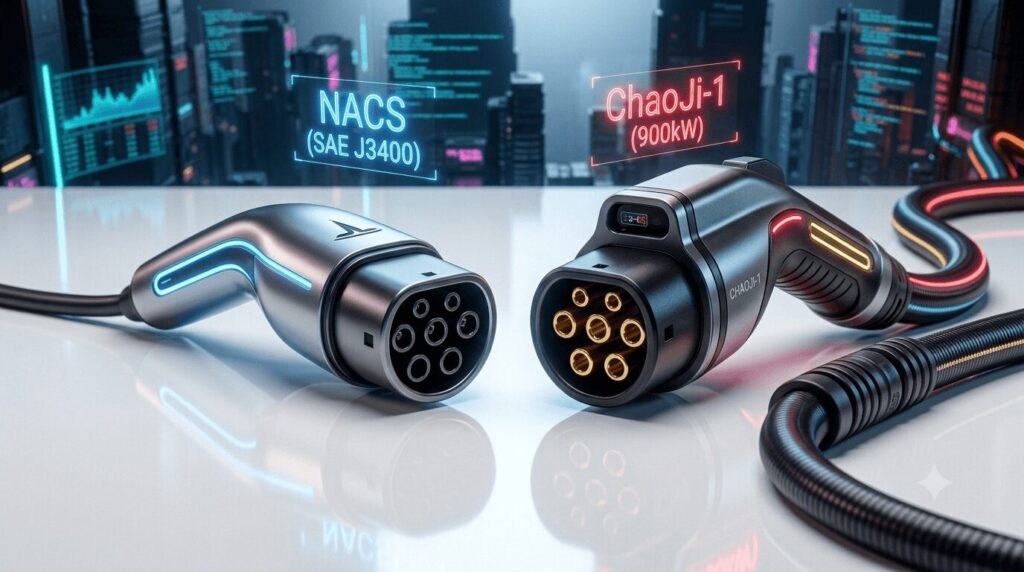
In this forward-looking competition, two standards have the technical specifications, the institutional backing, and the market momentum to be genuine contenders for global influence: Tesla’s NACS (now SAE J3400), which has consolidated North American EV charging with remarkable speed and is showing genuine traction in European and global markets; and China’s ChaoJi (超级充, also designated ChaoJi-1 for its first-generation specification), which targets 900 kW maximum power, has been designed with explicit global standardisation aspirations, and benefits from the world’s largest EV market’s regulatory and commercial backing.
This guide on Tesla’s NACS vs China’s ChaoJi ChaoJi-1 the future super-standard battle provides the complete honest analysis — the technical comparison across every relevant specification dimension, the market position and momentum of each standard, the specific scenarios where each has genuine global expansion potential and where each faces structural barriers, and the honest assessment of whether this battle resolves into a single global standard, continued regional fragmentation, or something in between.
The Technical Foundation — What Each Standard Actually Offers
NACS (SAE J3400) Technical Specification
Physical design:
NACS’s defining physical characteristic is its compactness — a single small oval connector handling both AC and DC charging through the same inlet. This design philosophy reflects Tesla’s original engineering priority: user convenience and vehicle aesthetic integration over maximum power delivery capability.
Physical connector dimensions: Approximately 75mm × 35mm (significantly smaller than CCS2 or CHAdeMO)
Pin count: 3 active pins (2 DC power, 1 combined pilot/communication) plus integrated ground
Single inlet for both AC and DC: the most distinctive user experience advantage over CCS-family connectors
Electrical specifications:
AC charging: Up to 19.2 kW (240V single-phase @ 80A, North American standard)
DC charging (current deployed): Up to 350 kW
DC charging (SAE J3400 specification limit): Up to 900V and 500A = 450 kW maximum in current standard specification
Future specification extensions: SAE J3400 committee has indicated the specification can accommodate higher power through cable and connector upgrades without changing the basic connector geometry
Communication protocol:
AC communication: Control pilot (CP) signal — identical in principle to J1772 AC charging protocol
DC communication: PLC (Power Line Communication) over the pilot conductor — a single-wire implementation that communicates charging parameters between vehicle and charger
The key NACS technical strength:
Compactness and single-connector simplicity produce the best user experience among all current competing standards — one connector, one inlet, handles everything from 1.4 kW AC charging to 350 kW+ DC fast charging.
The key NACS technical limitation for future ultra-high-power:
The physics of the current NACS connector geometry impose limits on thermal management at very high current — the compact connector design that provides user experience advantages creates thermal challenges at 500 kW+ that require cable cooling solutions not yet standardised within SAE J3400.
ChaoJi (ChaoJi-1) Technical Specification
Physical design:
ChaoJi’s physical design prioritises power delivery and safety at ultra-high power levels rather than connector compactness — a different engineering priority from NACS that reflects its design objective of 900 kW capability.
Liquid-cooled cable: Standard for high-power operation, allowing higher current delivery at manageable cable temperature
Connector geometry: Larger than NACS but smaller than CHAdeMO, with a specific pin arrangement optimised for high-current DC delivery
Single inlet for both AC and DC: ChaoJi matches NACS’s single-inlet user experience advantage, unlike CCS2’s dual-inlet design
Electrical specifications:
AC charging: Up to 22 kW (three-phase, consistent with Chinese and European grid infrastructure)
DC charging (ChaoJi-1 specification): Up to 900 kW (1,500V × 600A)
The 900 kW specification is ChaoJi’s headline technical achievement and its most significant specification advantage over currently-deployed NACS
Communication protocol:
DC communication: CAN bus — the same protocol used in GB/T 20234.3 and CHAdeMO, providing technical continuity with existing Chinese charging infrastructure communication architecture
The backward compatibility provision:
ChaoJi’s most strategically significant technical design decision: the specification includes explicit backward compatibility with existing GB/T 20234.3 DC charging infrastructure through an adapter provision. A ChaoJi vehicle can charge from a standard GB/T 20234.3 DC charger using an adapter — without this adapter requiring complex active electronics because the CAN bus communication protocol is shared between the standards.
This backward compatibility provision means the entire existing Chinese DC fast charging network (tens of millions of charging points) becomes accessible to ChaoJi vehicles from day one of ChaoJi deployment, through simple passive adapters. This is a fundamentally different launch position from any previous new charging standard’s introduction.
The key ChaoJi technical strength:
900 kW maximum specification represents a genuine ultra-high-power capability that exceeds current NACS specification limits, combined with backward compatibility that provides immediate infrastructure access at launch and liquid-cooled cable technology that handles the thermal management requirements at very high power.
The key ChaoJi technical limitation:
Larger physical connector than NACS creates a slightly less elegant user experience. The liquid cooling requirement for high-power operation adds cable complexity that NACS at current power levels doesn’t require.
The Direct Technical Comparison
| Specification | NACS (SAE J3400) | ChaoJi-1 |
|---|---|---|
| Maximum DC voltage | 900V | 1,500V |
| Maximum DC current | 500A | 600A |
| Maximum DC power (specification) | 450 kW | 900 kW |
| Maximum DC power (deployed 2026) | 350 kW | Pilot only |
| AC charging maximum | 19.2 kW (North America) | 22 kW (three-phase) |
| Communication (DC) | PLC | CAN bus |
| Single inlet (AC+DC) | Yes | Yes |
| Liquid-cooled cable (standard) | Optional/upgrade | Standard at high power |
| Backward compatibility | Via adapter to CCS1/J1772 | Via adapter to GB/T 20234.3 |
| Physical connector size | Compact (best-in-class) | Medium (larger than NACS) |
| Standards body | SAE International | CAE/SAC (China) |
| Primary deployment market | North America, expanding global | China, pilot only outside China |
The honest technical verdict:
ChaoJi-1 has superior specification headroom — 900 kW versus 450 kW for current NACS specification, with a voltage architecture (1,500V) that provides more headroom for future expansion. NACS has superior user experience in the compact connector and deployment maturity in current infrastructure.
For the 2026 present moment, NACS has far more real-world deployed capability and real-world user experience data. For the 2030-2035 future where 500-900 kW charging becomes mainstream for the highest-range vehicles, ChaoJi’s specification advantage becomes more relevant — if ChaoJi achieves the deployment scale to create network effects.
The Market Position — Where Each Standard Actually Stands
NACS Market Position in 2026
North America — complete consolidation:
As covered in our NACS vs GB/T guide, NACS has achieved effective North American market consolidation with remarkable speed:
- All major US EV manufacturers have committed to or completed NACS adoption (Ford, GM, Rivian, Stellantis, Honda, BMW USA, Hyundai/Kia)
- Tesla’s Supercharger network — the most extensive and highest-rated fast charging network in North America — operates on NACS
- Major third-party charging networks (Electrify America, EVgo, ChargePoint) have deployed NACS connectors alongside CCS1 in upgrades
- SAE J3400 standardisation provides the institutional framework for continued deployment
European expansion — contested:
NACS has made initial inroads in Europe — Tesla maintains NACS (or CCS2 with adapter) European Supercharger deployment, and some European manufacturers have indicated consideration of NACS adoption. However, Europe’s regulatory framework (the Alternative Fuels Infrastructure Regulation, AFIR) specifies CCS2 as the mandatory standard for publicly-funded charging infrastructure, creating a regulatory barrier to NACS adoption that mirrors China’s GB/T regulatory mandate.
Global emerging market position:
Multiple emerging market countries in Southeast Asia, Latin America, and Middle East are making initial charging infrastructure investment decisions — and the NACS vs CCS2 vs GB/T competition for these markets is genuinely open, as no regulatory mandate has yet established a preferred standard in most of these markets.
ChaoJi Market Position in 2026
China — pre-deployment stage:
ChaoJi is at a significantly earlier deployment stage than NACS in its home market. As of mid-2026:
Pilot deployments: A small number of ChaoJi charging points exist at pilot locations in China — primarily at major charging network operators’ flagship sites and at locations associated with the specific Chinese automotive OEMs developing ChaoJi-compatible vehicle models.
No ChaoJi vehicles in mass production: The vehicles that will create vehicle-side demand for ChaoJi infrastructure are in development at multiple Chinese OEMs but have not yet entered mass production. NACS’s North American success was vehicle-led (Tesla Supercharger network drew other manufacturers to adopt NACS); ChaoJi’s Chinese success will require both vehicle and infrastructure deployment to occur in coordination.
Timeline to meaningful deployment: Most realistic assessments project 2027-2028 as the period when ChaoJi vehicles enter significant production volume and the infrastructure buildout accelerates from pilot to commercial deployment.
International — essentially zero:
ChaoJi’s international footprint outside China as of mid-2026 is effectively zero in terms of deployed commercial infrastructure. The ChaoJi-CHAdeMO adapter specification creates technical interoperability with Japanese CHAdeMO infrastructure, but deployed ChaoJi charging points outside China are limited to demonstration projects at industry events and research facilities.
The Five Competitive Dimensions
Dimension 1: Deployment Velocity
NACS advantage — significant and growing:
NACS’s deployment velocity in North America has been the fastest standards transition in EV charging history — driven by the Tesla Supercharger network’s existing scale and by the speed with which automotive manufacturers committed to NACS adoption after Ford’s announcement in May 2023 triggered a cascade of commitments.
ChaoJi’s deployment velocity in China — when it begins — will have the advantage of China’s infrastructure buildout capability (China has demonstrated the fastest EV charging infrastructure deployment globally) but starts from a much lower base in 2026.
The velocity gap that matters for global competition:
NACS is building compounding network effects while ChaoJi remains in pre-commercial deployment. Every additional NACS charging point installed, every additional non-Tesla vehicle manufacturer that commits to NACS, and every additional year of NACS infrastructure accumulation makes it harder for ChaoJi to establish global presence in markets where NACS is already entrenched.
The window for ChaoJi to establish meaningful global presence beyond China is narrowing with each year that NACS infrastructure matures in non-Chinese markets.
Dimension 2: Institutional and Political Backing
ChaoJi advantage — in China:
Within China, ChaoJi has the most comprehensive institutional backing available to any standard: MIIT policy alignment, SAC standards authority, State Grid’s deployment commitment, and the support of China’s domestic automotive industry. This backing is determinative for China’s domestic market — ChaoJi’s Chinese deployment is a question of timing, not of whether.
NACS advantage — international institutions:
SAE International’s standardisation of NACS as J3400 gives NACS the imprimatur of an established, respected international standards body with decades of automotive industry credibility. SAE’s involvement in NACS standardisation has been specifically important for persuading non-Tesla manufacturers to adopt NACS — the transition from “Tesla’s proprietary connector” to “SAE J3400” transformed the political dynamics of manufacturer adoption decisions.
ChaoJi’s standardisation through Chinese bodies (CAE, SAC) does not carry the same international credibility with non-Chinese automotive manufacturers — creating a political barrier to ChaoJi adoption outside China that NACS does not face in the same way.
Dimension 3: Vehicle Manufacturer Alignment
NACS advantage — decisive in North America and growing internationally:
The vehicle manufacturer commitments to NACS represent the most significant commercial validation of any EV charging standard to date. When Ford and GM simultaneously announced NACS adoption in 2023, they committed the two largest US domestic automakers to a standard — creating vehicle-side demand that made NACS infrastructure investment commercially obvious for charging network operators who needed to serve any major US automaker’s customers.
ChaoJi — dependent on Chinese manufacturer deployments:
ChaoJi’s vehicle-side support comes from Chinese automotive manufacturers whose China-market vehicles will eventually include ChaoJi inlets alongside GB/T backward-compatible adapters. BYD, NIO, Xpeng, and other Chinese OEMs are expected to introduce ChaoJi-capable vehicles as the standard’s commercial deployment approaches — but the specific vehicle model commitments and production timelines remain less publicly documented than the NACS adoption cascade that occurred in North America.
For international vehicle manufacturers (European and Japanese brands) to adopt ChaoJi — which would be necessary for ChaoJi to have genuine global relevance beyond China — the institutional and political barriers discussed above would need to be overcome.
Dimension 4: Infrastructure Investment Dynamics
The chicken-and-egg problem each standard faces differently:
NACS infrastructure investment in North America was substantially de-risked by the Tesla Supercharger network’s existing scale — investors in NACS-compatible charging infrastructure were investing alongside an established network, not betting on a standard with uncertain adoption.
ChaoJi infrastructure investment in China will be supported by the combination of regulatory direction and State Grid’s deployment role — the institutional investment commitment that China’s government-backed grid company provides means ChaoJi infrastructure will be built whether or not the chicken-and-egg private investment dynamics would have produced it.
In international markets beyond North America and China, both standards face genuine chicken-and-egg dynamics — no Supercharger network to de-risk NACS, no State Grid to commit to ChaoJi. International market infrastructure investment will follow vehicle adoption, which will follow manufacturer commitments, which will follow the outcome of the standards competition.
Dimension 5: User Experience and Ergonomics
NACS advantage — clear and consistent:
NACS’s compact connector and single-inlet design have received consistently positive user experience feedback from the North American EV owner community. The smaller, lighter connector that handles everything from home AC charging to 350 kW+ DC fast charging creates a genuinely superior interaction experience compared to the larger, heavier connectors of CCS2 and earlier CHAdeMO.
ChaoJi — adequate but not outstanding:
ChaoJi’s connector is not as compact as NACS, and its liquid-cooled cable (necessary for high-power operation) adds weight compared to passive-cooled cables used at lower power levels. The user experience is functional and adequate but does not match NACS’s ergonomic advantage.
However, this user experience comparison requires the caveat that at the power levels where ChaoJi’s specifications differentiate it (500-900 kW), liquid-cooled cable is a thermal necessity — not an unnecessary weight addition. At these power levels, NACS would also require cable cooling, potentially equalising the ergonomic comparison in future ultra-high-power scenarios.
The Scenarios for Resolution
Scenario 1: Continued Regional Fragmentation (Most Likely Near-Term)
The base case for 2026-2030:
NACS continues consolidating North America and making selective inroads in Europe and global emerging markets. ChaoJi deploys in China as the domestic next-generation standard. The two standards occupy different regional markets with limited direct competition, and cross-border vehicle compatibility is addressed through adapters rather than standard convergence.
Supporting factors:
Regulatory mandates in both major markets (NACS de facto through vehicle manufacturer commitment in North America, GB/T/ChaoJi through regulatory mandate in China) create structural barriers to the other standard’s entry. The economic case for regulatory change in either direction is weak — neither China nor North America has a strong incentive to abandon its domestic standard for the other’s.
Practical implication:
International vehicle manufacturers continue producing market-specific variants (NACS for North America, GB/T/ChaoJi for China, CCS2 for Europe) — the same localisation they currently perform for other market-specific requirements. Cross-border travel in EVs remains constrained but manageable through adapters.
Scenario 2: ChaoJi Global Breakthrough (Low Probability Near-Term, Higher Long-Term)
The conditions required:
ChaoJi’s 900 kW specification and backward GB/T compatibility would provide genuine technical advantages at the ultra-high-power tier (500-900 kW) that becomes mainstream from approximately 2028-2032. If Chinese vehicle manufacturers achieve significant global market presence (particularly in Europe and Southeast Asia) with ChaoJi-equipped vehicles, infrastructure investment to serve these vehicles would follow.
The specific catalyst scenario:
Chinese EVs with ChaoJi inlets achieve 15-20% European market share by 2028-2030. European charging infrastructure investors, needing to serve ChaoJi vehicles, begin deploying ChaoJi alongside CCS2. The installed ChaoJi base in Europe reaches the scale where other vehicle manufacturers consider ChaoJi adoption for European market vehicles — beginning a European adoption cascade analogous to North America’s NACS cascade.
Why this scenario is possible but not probable near-term:
European tariff policy on Chinese EVs (the same policy context as US tariffs discussed in our NACS vs GB/T guide) significantly constrains the Chinese vehicle market share in Europe that would be needed to catalyse this scenario. Without a critical mass of ChaoJi vehicles in European markets, ChaoJi infrastructure investment in Europe has no commercial rationale.
Scenario 3: NACS Global Dominance (Possible in Western Markets)
The conditions required:
NACS completes European adoption — European vehicle manufacturers commit to NACS, displacing CCS2 as they displaced CHAdeMO. NACS SAE J3400 becomes the clear global standard for all markets outside China. Chinese EV exports to Western markets use NACS connectors for their export variants.
The specific catalyst scenario:
Volkswagen Group — Europe’s largest automotive manufacturer — announces NACS adoption for its European market vehicles, triggering the same cascade that Ford and GM triggered in North America. European regulatory framework adapts to permit NACS alongside CCS2.
Current status of this scenario:
Some European manufacturers have indicated interest in or exploration of NACS adoption. The SAE J3400 standard’s international credibility makes NACS a legitimate option for European regulatory consideration. However, AFIR’s CCS2 mandate and the existing CCS2 infrastructure investment create significant inertia that slows but does not prevent this scenario from developing.
Scenario 4: Technical Convergence — A New Global Ultra-Fast Standard
The most optimistic scenario for global interoperability:
NACS, ChaoJi, and CCS2 stakeholders negotiate a genuine global ultra-fast charging standard at IEC (International Electrotechnical Commission) or ISO level that incorporates the technical strengths of each — ChaoJi’s high-power specification, NACS’s user experience, CCS2’s established European regulatory framework — into a single connector that all parties adopt for the ultra-high-power tier.
Why this scenario is appealing but historically unprecedented:
There is no historical precedent for three competing regional standards successfully converging into a single global standard once network effects have established regional entrenched positions. The political, institutional, and commercial interests aligned behind each standard in its home region have consistently proven more powerful than the efficiency arguments for global convergence.
The narrow window where convergence might have happened:
Before 2023 — when NACS achieved North American consolidation, before massive infrastructure investment locked in regional standards — a global standards process initiated at IEC level might have had a realistic chance of producing convergence. After 2023, the invested interests on each standard are sufficiently large that convergence requires overcoming the sunk cost of existing infrastructure in each market.
What This Means for Chinese EV Owners and Industry Participants
For Chinese EV Owners in China
The practical 2026 reality:
For Chinese EV owners using Chinese-market vehicles in China, the NACS vs ChaoJi battle is currently irrelevant to daily charging experience. GB/T remains the operative standard for all home and public charging, and ChaoJi deployment is still in early pilot stage.
The transition that will eventually matter:
When ChaoJi deployment begins at scale — projected 2027-2028 for early commercial locations, with broader rollout through 2030 — Chinese EV owners will face the same backward-compatibility-through-adapter situation that any standards transition creates. ChaoJi’s specific design decision to maintain GB/T backward compatibility through adapters is specifically intended to make this transition smooth rather than disruptive.
For owners purchasing chargers today: The OCPP 2.0 compliant chargers recommended throughout this guide series for demand response and future V2G participation will remain relevant regardless of ChaoJi deployment timeline. The home charger’s AC function (GB/T 20234.2) is not affected by the DC fast charging standard competition — AC home charging will remain GB/T-based throughout any ChaoJi DC transition.
For Chinese Industry Participants — Export Strategy Implications
The export market connector decision:
Chinese EV manufacturers targeting North American export markets must specify NACS for those variants — as established in our NACS vs GB/T guide, this is a product engineering requirement for North American market access.
Chinese charging equipment manufacturers targeting North American export — Autel and similar companies with established North American commercial presence — must offer NACS connector products for that market, which several already do.
The European market connector uncertainty:
European market export strategy for both vehicles and charging equipment involves more uncertainty — CCS2 is currently the regulatory-mandated standard, but NACS adoption by European manufacturers could change this over the 2026-2030 period. A cautious export strategy for European markets includes CCS2 capability as the baseline, with NACS capability as an option to add if European regulatory framework evolves.
The Southeast Asian and emerging market opportunity:
Markets that have not yet made definitive charging standard commitments — many Southeast Asian, Middle Eastern, and Latin American countries — represent the genuine battleground where NACS, CCS2, and ChaoJi compete for infrastructure investment decisions. Chinese companies with ChaoJi-compatible products and Chinese government relationships in these markets have specific opportunities to shape emerging market standard adoption that don’t exist in North America or Europe.
The Honest Verdict — Who Wins the Future Super-Standard Battle
The Differentiated Assessment
In North America: NACS has won. The consolidation is effectively complete. ChaoJi has no credible path to North American deployment at commercial scale given the market structure, regulatory environment, and installed base realities.
In China: ChaoJi will win. The same structural factors that make NACS’s Chinese entry impossible make ChaoJi’s Chinese dominance certain. The question is deployment timeline, not outcome.
In Europe: CCS2 holds, with NACS making incremental inroads. ChaoJi has a long-shot path to European relevance through Chinese vehicle export market share growth that current tariff policy is actively constraining.
In global emerging markets: Genuinely contested. This is the real battleground where the standards competition remains open and where the next several years’ infrastructure investment decisions will be consequential. Chinese government relationships, Chinese infrastructure financing capabilities, and ChaoJi’s technical specifications create a genuine competitive position for ChaoJi in markets where the playing field hasn’t been defined by prior investment.
The overall honest assessment:
Neither NACS nor ChaoJi wins a single global market. Regional fragmentation is the most probable sustained outcome, with adapter solutions managing cross-border compatibility as they do today between CCS2, CHAdeMO, and GB/T. The specific scenarios where either standard achieves meaningful global expansion beyond its home region are real possibilities but require specific conditions — Chinese EV export success for ChaoJi, European manufacturer NACS adoption for NACS — that are possible but not certain.
The “future super-standard battle” framing implies a binary winner. The likely reality is a stable multi-standard world where vehicle manufacturers produce market-specific variants, adapters address cross-border compatibility, and the genuine technical competition between NACS and ChaoJi plays out in global emerging markets rather than in either’s established home territory.
Internal Links — Further Reading on Clean Energy Bazaar
The Tesla’s NACS vs China’s ChaoJi ChaoJi-1 the future super-standard battle guide is the forward-looking standards companion to the connector and technology guides throughout this content cluster.
For the CHAdeMO 3.0 vs GB/T guide that covers CHAdeMO’s role in the ChaoJi technical collaboration and its declining market position, our CHAdeMO 3.0 vs GB/T why Japan’s standard is losing in the Chinese market guide covers the complete CHAdeMO analysis. For the NACS invasion guide that covers NACS’s current China market relationship and compatibility questions, our NACS invasion are US Tesla chargers compatible with Chinese GB/T standards in 2026 guide covers the North American standards comparison. For the foundational connector standards guide that establishes the complete GB/T framework within which ChaoJi is developing, our GB/T vs NACS vs CCS which EV charger plug do you need in China 2026 guide covers every connector standard in detail. For the technology trends guide that contextualises ChaoJi alongside V2G and other emerging technologies in the broader EV technology landscape, our upcoming EV charger trends 2026-2027 V2G solid-state batteries and what to buy now in China guide covers every emerging technology. For the grid capacity guide that contextualises the infrastructure scale that ultra-fast charging standards must operate within, our target 20 million units can China’s grid handle the EV load in 2026 guide covers China’s grid infrastructure reality. And for the commercial DC fast charger guide covering the current commercial deployment standards that ChaoJi and NACS will eventually complement or replace, our how to choose commercial DC fast chargers for your Chinese gas station conversion guide covers every current commercial specification.
Final Thoughts
The Tesla’s NACS vs China’s ChaoJi ChaoJi-1 the future super-standard battle analysis is genuinely fascinating because it is one of the few technology standards competitions where both competitors have legitimate technical credentials, massive institutional backing, and plausible pathways to significant global influence — yet are simultaneously unlikely to displace each other in their respective home markets.
NACS is the better connector for the present: more compact, better user experience, with the most extensive deployed fast charging network on earth in North America and the most impressive adoption cascade in EV charging standards history. ChaoJi is the better specification for the future: higher maximum power, more headroom for the ultra-high-power charging tier that will define the 2030-2035 EV experience, with backward compatibility engineering that NACS’s connector geometry couldn’t replicate.
The battle’s outcome is not a single winner — it is a multi-standard world where the genuine competition plays out in the markets that haven’t yet chosen. Southeast Asia, Middle East, Latin America, and Africa will see genuine NACS vs ChaoJi competition over the next several years, and the outcomes in these markets will determine whether ChaoJi achieves the global relevance that China’s EV industry ambitions envision or remains a China-plus-Japan-adjacent standard while NACS becomes the Western world’s de facto global standard.
For Chinese EV owners: this competition is more about China’s global EV industry influence than about your daily charging experience. Your home charger is GB/T. Your next home charger might be GB/T or ChaoJi-compatible. NACS doesn’t enter your home charging equation regardless of how the global standards battle resolves.
For Chinese industry participants with global ambitions: the standards competition is one dimension of a broader global EV industry competition where China’s manufacturing scale, technical capability, and government support are genuine competitive assets — and where ChaoJi’s global adoption is part of the same strategic agenda as Chinese EV export success and Chinese charging equipment export growth.
The future super-standard battle is real, consequential, and genuinely undecided in the markets that matter most for its resolution. That is not a failure of analysis — it is an accurate description of a competition that is currently being decided.