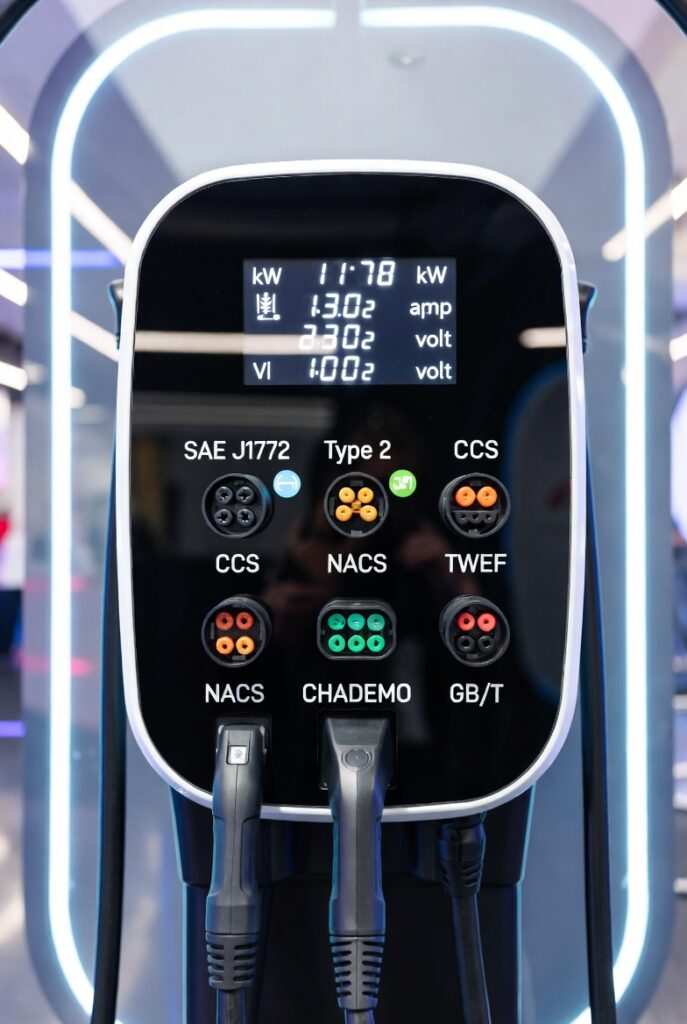
The global EV charging standards landscape in 2026 has resolved into a clearer picture than it presented in 2020 — when CHAdeMO, CCS, GB/T, and Tesla’s proprietary connector were all legitimate contenders for various market segments across different geographies. Four years of EV adoption acceleration, infrastructure investment consolidation, and automotive market evolution have produced a picture where the regional winners are substantially determined, and where CHAdeMO’s position — once a genuine major player in the global DC fast charging standards landscape — has been decisively weakened in every market except Japan itself.
Nowhere is CHAdeMO’s decline more pronounced, more commercially significant, and more structurally irreversible than in the Chinese market — the world’s largest EV market, the market that CHAdeMO once had genuine ambitions to penetrate through its technical cooperation relationship with China’s GB/T standard development, and the market where that ambition has most clearly not materialised into meaningful market presence.
This guide on CHAdeMO 3.0 vs GB/T why Japan’s standard is losing in the Chinese market provides the complete honest analysis — what CHAdeMO 3.0 technically offers and where its specifications genuinely advance on earlier generations, why these technical advances have not translated into Chinese market recovery, the specific structural forces that have made GB/T’s dominance in China essentially permanent, what CHAdeMO’s decline means for the ChaoJi collaboration that was supposed to bridge the Japanese and Chinese standards, and the practical implications for Chinese EV owners and industry participants navigating the standards landscape.
CHAdeMO — A Brief History of a Standard That Should Have Won
The Origins and Early Dominance
CHAdeMO’s founding and initial success:
CHAdeMO (CHArge de MOve, チャデモ) was established in 2010 through an association of Japanese manufacturers — Toyota, Nissan, Mitsubishi, Fuji Heavy Industries (Subaru), and Tokyo Electric Power Company — as a collaborative industry standard for DC fast charging. It was, at the time, the only functioning DC fast charging standard with meaningful market deployment: the Nissan Leaf, which became the world’s best-selling EV of its era, used CHAdeMO, bringing the standard into global prominence through one vehicle’s commercial success.
CHAdeMO’s technical characteristics (original specification):
DC voltage: 50-500V DC
Maximum current: 120A
Maximum power: Initially 50 kW, subsequently expanded
Communication: CAN bus (Controller Area Network, the same protocol used in GB/T 20234.3)
Physical connector: Large, distinct circular connector with specific locking mechanism
The early competitive position:
By 2013-2015, CHAdeMO had established the largest installed DC fast charging network globally, with particular strength in Japan, Europe, and the United States. Nissan’s Leaf adoption and the standard’s head start in infrastructure deployment created genuine network effects that appeared to position CHAdeMO for long-term global dominance.
Where CHAdeMO’s Dominance Began to Erode
The European CCS challenge:
As covered in our NACS vs GB/T guide’s discussion of global standards fragmentation, European automotive manufacturers — BMW, Volkswagen Group, Daimler, Ford Europe — backed the Combined Charging System (CCS2) standard for European DC fast charging, which combined the existing IEC 62196 Type 2 AC connector with additional DC pins in a single inlet. CCS2 adoption by the dominant European automotive manufacturers gave it market support that CHAdeMO could not overcome in Europe despite its infrastructure head start.
The Chinese market divergence:
As China developed its own domestic EV market from approximately 2010 onward, the decision to develop and mandate GB/T 20234 as China’s domestic standard — rather than adopting CHAdeMO or any international standard — reflected both industrial policy objectives (building domestic standards capability) and the technical assessment that GB/T’s design would better serve China’s specific electrical infrastructure and fleet composition.
The Tesla proprietary threat:
Tesla’s proprietary connector — subsequently standardised as NACS in North America — created a third competitive force in North American and increasingly European markets that further fragmented the market CHAdeMO had hoped to capture.
The market share trajectory:
By 2020, CHAdeMO’s global DC fast charging infrastructure share had begun declining in absolute as well as relative terms as CCS installations outpaced CHAdeMO in Europe and North America, and as GB/T infrastructure in China grew without CHAdeMO participation. By 2024-2025, major charging network operators in Europe and North America had begun phasing out CHAdeMO connectors at stations being upgraded — a definitive sign that the standard had crossed into terminal decline in those markets.
CHAdeMO 3.0 — What the Latest Generation Actually Offers
The Technical Specification Advance
CHAdeMO 3.0 represents a genuine technical advance over earlier generations:
The CHAdeMO association, recognising that CHAdeMO 1.0 and 2.0’s maximum power specifications had fallen behind the 350 kW+ capability of modern CCS2 installations and the projected requirements of next-generation EVs, developed CHAdeMO 3.0 as a high-power successor:
CHAdeMO 3.0 specifications:
Maximum voltage: 1,000V DC
Maximum current: 600A
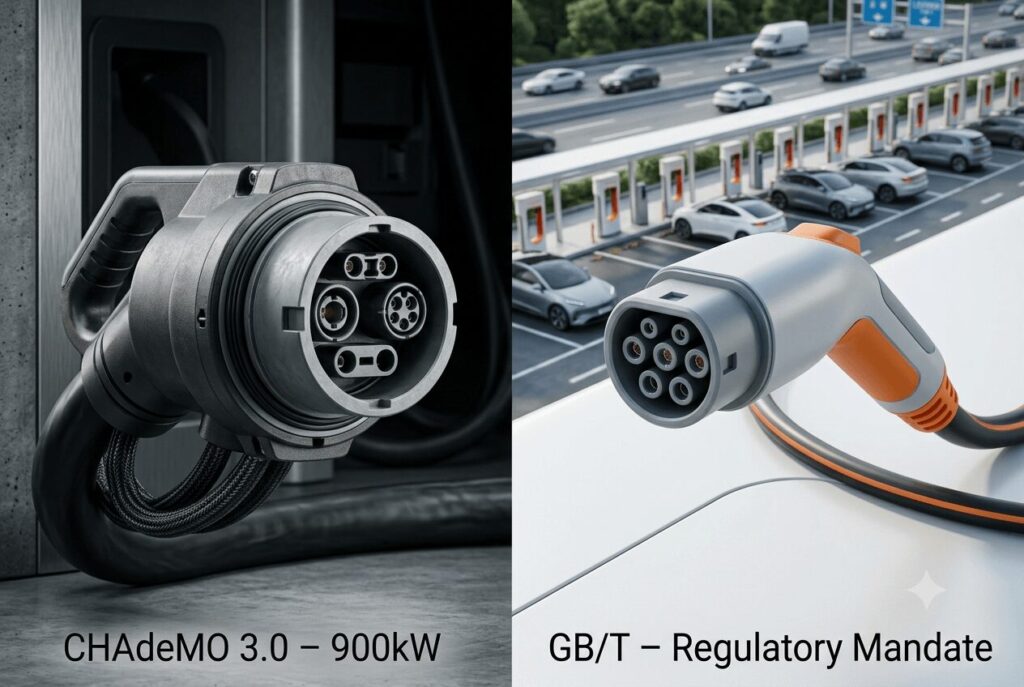
Maximum power: 900 kW
Communication: CAN bus (retained from earlier CHAdeMO generations)
Physical connector: Significantly redesigned from CHAdeMO 2.0, using liquid cooling in the cable to handle high-current delivery at manageable cable temperature
The 900 kW specification is genuinely impressive:
At 900 kW maximum charging power, CHAdeMO 3.0 technically exceeds current deployed CCS2 (typically 350 kW maximum deployed), current NACS deployments (350 kW maximum deployed), and even most current GB/T 20234.3 deployments (250 kW typical, with premium installations reaching 480 kW+).
The 900 kW specification positions CHAdeMO 3.0 alongside China’s ChaoJi standard (also targeting 900 kW) as a genuinely ultra-high-power next-generation charging specification.
The communication protocol retention:
CHAdeMO 3.0 retains CAN bus communication from earlier CHAdeMO versions — this is the specific technical decision that creates both backward compatibility benefits (CAN bus is already established in EV charging infrastructure) and the technical foundation for the CHAdeMO-ChaoJi collaboration.
The ChaoJi Collaboration — Why It Matters
The CHAdeMO-JARI-ChaoJi technical connection:
ChaoJi, China’s next-generation ultra-fast charging standard developed by CAE (China Automotive Engineering Society) in collaboration with Japan Automotive Research Institute (JARI, which has been involved in CHAdeMO development), represents a specific technical convergence between CHAdeMO 3.0 and the Chinese next-generation standard:
Both target 900 kW maximum power
Both use CAN bus communication (compatible underlying protocol)
ChaoJi was explicitly designed with physical adapter backward compatibility with existing GB/T 20234.3 infrastructure
The CHAdeMO and ChaoJi connectors are designed with physical similarity that allows converter adapters between them
The ChaoJi-CHAdeMO adapter specification:
A ChaoJi-to-CHAdeMO adapter, specified within the standard, is intended to allow:
- ChaoJi vehicles to charge at CHAdeMO stations (through adapter)
- CHAdeMO vehicles to charge at ChaoJi stations (through adapter)
Why this technical collaboration hasn’t translated to Chinese market CHAdeMO presence:
The ChaoJi-CHAdeMO technical alignment addresses the technical incompatibility between the standards but does not address the commercial and structural reasons why CHAdeMO has no meaningful Chinese market presence — reasons that are commercial and regulatory rather than purely technical, as this guide addresses below.
The Structural Reasons for CHAdeMO’s Chinese Market Decline
Reason 1: GB/T’s Regulatory Mandated Position
The regulatory foundation that makes GB/T’s dominance structural rather than competitive:
China’s Ministry of Industry and Information Technology (MIIT) requires that all EVs sold in China’s domestic market include GB/T-compatible charging interfaces. This regulatory requirement — not consumer preference, not network effects, not price competition — is the primary reason every EV sold in China uses GB/T connectors.
A Japanese automaker that wanted to sell CHAdeMO-equipped vehicles in China would need either a regulatory exemption (practically unavailable) or to equip the vehicle with both CHAdeMO and GB/T connectors (adding cost and complexity). In practice, all Japanese automakers selling in China — including Nissan (which uses CHAdeMO in Japan) — equip their China-market vehicles with GB/T connectors.
The permanent nature of this regulatory advantage:
Unlike market-driven standards competitions where an incumbent can be displaced by a technically superior alternative with sufficient commercial support, a regulatory mandate creates a structural barrier to entry that technical superiority cannot overcome without regulatory change. There is no credible scenario in which China’s regulatory bodies would mandate a transition from GB/T to CHAdeMO or any other foreign standard — the regulatory, industrial policy, and commercial interests are entirely aligned behind GB/T and its successor ChaoJi.
Reason 2: Installed Infrastructure Network Effects
The scale of GB/T DC fast charging infrastructure in China:
China’s public DC fast charging network, predominantly GB/T 20234.3, has grown to include millions of individual charging points across the country as of 2026. This infrastructure represents:
- Hundreds of billions of yuan of installed capital
- Years of operational history
- Integration with national charging network management platforms
- Compatibility with every Chinese-market EV sold
The network effect value of this infrastructure is enormous and self-reinforcing: the larger the GB/T network, the less reason any infrastructure investor has to install CHAdeMO alternatives.
CHAdeMO’s China installed base:
CHAdeMO has an extremely limited installed base in China — primarily a small number of Japanese automaker-operated or promoted charging points in cities with significant Japanese business communities, and a handful of locations specifically targeting Japanese tourists or diplomatic community EVs. This is not a competitive installed base by any meaningful measure.
Reason 3: Domestic Vehicle Fleet Composition
The vehicle-side network effect:
As covered throughout this guide series’ vehicle-specific content, China’s EV fleet is dominated by domestic Chinese manufacturers whose vehicles universally use GB/T. The three largest EV manufacturers in China’s domestic market — BYD, SAIC (MG, Wuling), and Geely (Zeekr, Lynk & Co) — collectively represent the overwhelming majority of Chinese EV sales and produce exclusively GB/T vehicles.
Japanese automakers — Toyota, Nissan, Honda — who might in other markets advocate for CHAdeMO have adapted their China-market EV strategies to GB/T compliance because the alternative (selling CHAdeMO vehicles in China without charging infrastructure) is commercially non-viable.
The absence of a Japanese EV market position in China:
A crucial supporting factor for CHAdeMO’s failure in China is that Japanese automakers have significantly underperformed in China’s EV transition relative to their traditional combustion vehicle market positions. Toyota, which dominated Japanese and Chinese hybrid markets, has been slower to develop compelling BEV products for the Chinese market. Nissan, which pioneered EV adoption globally with the Leaf, has lost market share in China to domestic manufacturers.
Without a meaningful Japanese EV vehicle market position in China, CHAdeMO has no vehicle-side advocates that could create demand for CHAdeMO charging infrastructure — a chicken-and-egg dynamic that has resolved firmly in favour of GB/T because that’s where both the vehicles and the infrastructure are concentrated.
Reason 4: The Chinese Industrial Policy Alignment
China’s industrial policy framework and charging standards:
China’s approach to EV charging standards is part of a broader industrial policy framework that views technical standards as strategic assets rather than simply technical specifications. GB/T development is managed by the Standardization Administration of China (SAC) through its technical committees, with MIIT and NDRC providing policy alignment.
The development of ChaoJi as China’s next-generation standard — rather than adopting CHAdeMO 3.0 which technically addresses similar requirements — reflects China’s policy preference for developing domestic standards capability even when foreign standards offer comparable technical specifications. The CHAdeMO-ChaoJi technical collaboration is welcomed as a technical exchange that informs ChaoJi’s development, but does not translate into CHAdeMO adoption.
The intellectual property dimension:
Standards carry intellectual property rights — the patents, testing requirements, and certification processes associated with a standard create ongoing royalty flows and control mechanisms for the standards body. China’s preference for domestic standards development reflects the IP dimension: ChaoJi’s IP is controlled by Chinese institutions, while CHAdeMO’s IP is controlled by Japanese institutions. For a market of China’s scale, this is not a trivial consideration.
Reason 5: The Scale Economics That Reinforce GB/T’s Dominance
The manufacturing economics of scale:
China produces more EVs and more EV charging equipment than any other country. The manufacturing scale that Chinese EV and charging equipment manufacturers have achieved for GB/T components — connectors, inlet hardware, power electronics calibrated for GB/T specifications — creates cost advantages over alternative standards that compound as volume increases.
A Chinese charging equipment manufacturer producing GB/T charging points at millions of units annually achieves component costs that a CHAdeMO manufacturer producing at tens of thousands of units cannot match. This manufacturing economics advantage reinforces GB/T’s position through pure cost competitiveness in any price-sensitive market decision.
The Japanese EV Charging Market Comparison — Why CHAdeMO Survives at Home
Why CHAdeMO Remains Viable in Japan Despite Chinese Decline
The specific Japanese market factors that sustain CHAdeMO:
Japan’s domestic EV charging market is meaningfully different from China’s in ways that explain why CHAdeMO retains viability in Japan without this sustaining any Chinese market position:
Japanese regulatory framework:
Japan has not mandated a single DC fast charging standard in the way China has mandated GB/T. The Japanese market accommodates both CHAdeMO and CCS2 infrastructure, with CHAdeMO having the larger Japanese installed base from its early deployment advantage.
Japanese automaker vehicle positions:
Nissan’s Leaf (CHAdeMO in Japan), Mitsubishi Outlander PHEV (CHAdeMO in Japan), and other Japanese CHAdeMO vehicles represent a meaningful proportion of Japan’s EV fleet — providing the vehicle-side demand that justifies continued CHAdeMO infrastructure investment in Japan in a way that has no equivalent in China.
The Toyota factor:
Toyota’s investment in CHAdeMO infrastructure and its involvement in CHAdeMO standard development means Japan’s largest automaker supports CHAdeMO’s domestic position in a way that has no parallel in China, where no major automaker has CHAdeMO alignment.
CHAdeMO 3.0 Japan deployment:
CHAdeMO 3.0 / ChaoJi-compatible ultra-high-power charging infrastructure is being piloted in Japan specifically to validate the technology for Japanese market deployment — creating a domestic development programme that supports CHAdeMO 3.0’s technical advancement without depending on Chinese market adoption.
The ChaoJi Question — Collaboration Without Convergence
What the CHAdeMO-ChaoJi Relationship Actually Is in 2026
The collaborative development that some observers misread as convergence:
Some industry observers have interpreted the CHAdeMO-ChaoJi technical collaboration as a step toward standards convergence — toward a single China-Japan standard that would give CHAdeMO renewed Chinese market relevance. This interpretation misunderstands the nature of the collaboration and overstates its commercial implications.
What the collaboration actually is:
Technical information exchange at the engineering level between Chinese and Japanese standards development bodies — producing a situation where ChaoJi and CHAdeMO 3.0 share technical characteristics (900 kW target, CAN bus communication, liquid-cooled cable) and where physical adapters between them are specified.
What the collaboration is not:
- Joint deployment of infrastructure in China using CHAdeMO connectors
- Chinese regulatory recognition of CHAdeMO as an acceptable domestic charging standard
- Automotive manufacturer commitment to deploy CHAdeMO vehicles in China
- Chinese charging network operator commitment to install CHAdeMO charging points
The adapter specification’s practical limitation:
The CHAdeMO-ChaoJi adapter specification addresses technical interoperability — a vehicle with a ChaoJi inlet could theoretically use a CHAdeMO charging station with an adapter, and vice versa. But this technical interoperability is only commercially relevant if there are both ChaoJi vehicles and CHAdeMO infrastructure (or CHAdeMO vehicles and ChaoJi infrastructure) in proximity to create genuine adapter demand.
In China: ChaoJi infrastructure will be deployed where ChaoJi vehicles are sold. CHAdeMO vehicles are not sold in meaningful numbers in China. The adapter standard is technically useful but commercially inert in the Chinese market context.
In Japan: CHAdeMO infrastructure exists. If ChaoJi vehicles are sold in Japan (through Chinese vehicle exports or Japanese manufacturer adoption), the ChaoJi-to-CHAdeMO adapter would enable Chinese-standard vehicles to use Japanese infrastructure — a specific cross-border use case that has genuine application but limited volume.
The Current State of CHAdeMO in China’s Charging Network
What CHAdeMO Infrastructure Actually Exists in China
The honest inventory:
CHAdeMO DC fast charging points in China are so limited as to be practically negligible in the context of China’s overall charging infrastructure. Unlike GB/T 20234.3 DC fast charging, which is available at virtually every significant charging hub in every Chinese city, CHAdeMO points are concentrated in:
A small number of Chinese locations specifically serving Japanese diplomatic and business community vehicles
Some import vehicle dealerships that installed CHAdeMO specifically for early-generation Japanese import EV test drives
A handful of locations in cities with high Japanese tourist or business presence (Shanghai Pudong business district, certain Beijing diplomatic areas)
The practical reality for Chinese EV owners:
A Chinese EV owner with a GB/T vehicle has zero practical need to be aware of CHAdeMO infrastructure — there is no scenario in normal Chinese EV ownership where CHAdeMO charging access would be relevant. CHAdeMO does not appear in the standard Chinese charging network apps (国家电网, 特来电, 星星充电) as a meaningful infrastructure category because there is essentially no CHAdeMO infrastructure in China to display.
The Commercial Implications for Chinese Industry Participants
For Chinese Charging Equipment Manufacturers
The export market CHAdeMO question:
Chinese charging equipment manufacturers who are pursuing export strategies — particularly to Japan and markets where CHAdeMO remains a consideration — face a specific product development question: should they develop CHAdeMO or CHAdeMO 3.0 compatible products for export markets?
The honest commercial assessment:
For Japanese market export: CHAdeMO compatibility is commercially relevant and potentially valuable — Japan remains a CHAdeMO market, and Chinese manufacturers who can offer CHAdeMO-compatible products at competitive prices have a genuine market opportunity in Japan’s charging infrastructure buildout.
For European market export: CHAdeMO compatibility is increasingly irrelevant — European charging infrastructure investment has definitively shifted to CCS2 and NACS in some segments, with CHAdeMO being phased out of European network upgrades.
For Southeast Asian export markets: Variable — some Southeast Asian markets have significant Japanese vehicle fleet presence that creates CHAdeMO demand, while others are developing from scratch with GB/T or CCS2 as the dominant standard.
For Chinese EV Manufacturers Targeting Japanese Export
The specific Japanese market connector question:
Chinese EV manufacturers who want to sell vehicles in Japan must consider CHAdeMO compatibility alongside CCS2 compatibility for access to Japan’s charging infrastructure.
As of 2026, Japanese market EV infrastructure includes both CHAdeMO and CCS2 — a dual-standard environment that requires Chinese export vehicles for Japan to either include both connectors or an adapter solution.
The commercial priority:
Given Japan’s relatively small market size compared to China’s domestic market and the complexity of Japanese vehicle safety and emissions certification requirements (beyond just connector compatibility), Japan is currently a secondary export market for most Chinese EV manufacturers relative to Europe and Southeast Asia. The CHAdeMO connector question for Japan export is real but not the primary strategic consideration for most Chinese manufacturers’ export programmes.
The Technical Comparison Table
| Specification | CHAdeMO 1.0 | CHAdeMO 2.0 | CHAdeMO 3.0 | GB/T 20234.3 (current) | ChaoJi |
|---|---|---|---|---|---|
| Maximum power | 50 kW | 400 kW | 900 kW | 250-480 kW | 900 kW |
| Maximum voltage | 500V | 1,000V | 1,000V | 750-1,000V | 1,500V |
| Maximum current | 125A | 400A | 600A | 250-480A | 600A |
| Communication | CAN bus | CAN bus | CAN bus | CAN bus | CAN bus |
| Cable cooling | Passive | Liquid (high power) | Liquid | Passive/liquid | Liquid |
| China market status | Negligible | Negligible | Negligible | Dominant | Emerging |
| Japan market status | Large installed base | Limited new deployment | Pilot | Negligible | Emerging |
The table’s story:
CHAdeMO 3.0’s technical specifications genuinely advance on earlier generations and match ChaoJi in key parameters. But technical specifications determine market outcomes only when other factors — regulatory mandates, vehicle fleet composition, installed infrastructure, industrial policy — are approximately equal. In China, these other factors are overwhelmingly aligned behind GB/T and ChaoJi, making CHAdeMO 3.0’s technical merits irrelevant to Chinese market outcomes.
The Forward Outlook — Where This Resolves
The 2026-2030 Trajectory for CHAdeMO in China
What would need to happen for CHAdeMO to recover Chinese market position:
- Chinese regulatory authorities would need to recognise CHAdeMO as an acceptable domestic charging standard — which would require either a significant change in industrial policy orientation or a specific bilateral agreement with Japan that has no current policy foundation
- Major Japanese automakers would need to develop compelling GB/T-exempt EV products for China with sufficient market success to create vehicle-side demand for CHAdeMO infrastructure — which contradicts the market trends of the past five years
- Chinese charging infrastructure investors would need to choose CHAdeMO over GB/T for new installations — which contradicts both regulatory requirements and economic incentives
None of these conditions are approaching reality as of 2026. CHAdeMO’s Chinese market trajectory is decline to irrelevance, not recovery.
The ChaoJi development timeline:
ChaoJi’s deployment in China is expected to accelerate through 2027-2030 as vehicles with ChaoJi inlets are introduced to the market and infrastructure is deployed at premium commercial locations first (highway services, flagship commercial districts) before broader rollout. This deployment will further cement China’s domestic standards dominance — but will happen under Chinese standards (ChaoJi) rather than the CHAdeMO-ChaoJi convergence that some have hoped for.
The CHAdeMO Japan survival outlook:
CHAdeMO will likely remain the primary DC fast charging standard in Japan for existing infrastructure through at least 2030, with CHAdeMO 3.0 deployment happening selectively at premium locations. Whether Japan ultimately converges on a global standard (CCS2 or ChaoJi) for new infrastructure investment from 2030 onward remains genuinely uncertain and beyond this guide’s reliable assessment horizon.
Internal Links — Further Reading on Clean Energy Bazaar
The CHAdeMO 3.0 vs GB/T why Japan’s standard is losing in the Chinese market guide is the standards competition companion to the connector and technology guides throughout this content cluster.
For the NACS invasion guide that covers the other major international standard’s relationship with China’s GB/T market, our NACS invasion are US Tesla chargers compatible with Chinese GB/T standards in 2026 guide covers the North American standards comparison. For the GB/T vs NACS vs CCS foundational guide that established the complete connector standards framework this guide builds upon, our GB/T vs NACS vs CCS which EV charger plug do you need in China 2026 guide covers every connector standard in detail. For the technology trends guide covering ChaoJi’s development as China’s next-generation standard that parallels CHAdeMO 3.0’s technical ambitions, our upcoming EV charger trends 2026-2027 V2G solid-state batteries and what to buy now in China guide covers every emerging standard. For the understanding EV charger specs guide covering the technical specifications including 800V architecture that interact with connector standard considerations, our understanding EV charger specs 2026 kW amps 800V architecture new GB standards guide covers every technical specification. For the great shakeout guide that contextualises the consolidation in standards within the broader market consolidation affecting Chinese EV charging, our great shakeout why 80 percent of Chinese EV charger manufacturers face elimination in 2026 guide covers the complete industry analysis. And for the commercial DC fast charger guide covering the commercial infrastructure that operates under GB/T standards rather than CHAdeMO, our how to choose commercial DC fast chargers for your Chinese gas station conversion guide covers every commercial specification.
Final Thoughts
The CHAdeMO 3.0 vs GB/T why Japan’s standard is losing in the Chinese market analysis produces a conclusion that is important to state clearly because it contradicts the occasional optimistic commentary about CHAdeMO-ChaoJi convergence creating renewed Japanese standard relevance in China: CHAdeMO’s Chinese market position is not “losing” — it has effectively already lost. The question of whether CHAdeMO 3.0’s technical advances can recover any Chinese market position is answered by examining the structural forces arrayed against such recovery, which are regulatory, commercial, industrial policy, and manufacturing economics simultaneously — a combination that technical specification improvement cannot overcome.
CHAdeMO 3.0 is a technically impressive specification. Its 900 kW maximum power, liquid-cooled cable, and CAN bus communication foundation genuinely advance the standard beyond its earlier generations. The CHAdeMO-ChaoJi collaboration creates genuine technical alignment between the Japanese and Chinese next-generation standards. These are real technical achievements.
But they are achievements happening outside China’s domestic market, for deployment outside China’s domestic market, and with no credible pathway to Chinese domestic market adoption. China’s regulatory mandate, its installed GB/T infrastructure network, its domestic vehicle fleet composition, its industrial policy orientation, and its manufacturing scale economics all point in the same direction: GB/T for the current generation, ChaoJi for the next generation, and no CHAdeMO role in China’s domestic charging ecosystem.
For Chinese EV owners: CHAdeMO is irrelevant to your charging decisions.
For Chinese industry participants: CHAdeMO matters only as context for export market product planning in Japan and selective Southeast Asian markets.
For anyone hoping that CHAdeMO 3.0’s technical excellence will translate to Chinese market recovery: the technical question was never the deciding one.