Here is the cost conversation that catches most Chinese EV buyers unprepared.
They have researched charger hardware extensively. They know the StarCharge S1 costs ¥899-¥1,099. They know the Autel MaxiCharger costs ¥1,299-¥2,499. They have a charger chosen, a parking space confirmed, 物业 approval underway.
Then the installation quote arrives.
The electrician coordinated through their EV manufacturer’s programme quotes ¥3,800 for installation — on top of a ¥1,500 charger. The State Grid representative who came for the meter assessment mentioned a service fee that wasn’t specified in advance. A second quote from an independent electrician comes in at ¥1,900. A third quote from a company recommended in a WeChat group is ¥1,200 but has no written contract. The range between the highest and lowest quote is ¥2,600 — more than the cost of the charger itself.
This is not unusual. Chinese home EV charger installation costs vary more than almost any other tradesperson service — because the work varies enormously in complexity, because the State Grid’s involvement creates a specific cost layer that private electricians do not, because some installers include components that others exclude, and because an uninformed buyer in a market with high price dispersion always pays more than they need to.
This guide on professional EV charger installation costs 2026 what State Grid chargers vs private companies charge covers every cost component with specific numbers, explains what drives the variation between quotes, identifies which costs are unavoidable and which are negotiable, and gives Chinese EV owners the framework to assess any installation quote accurately.
The Two-Party Installation Structure — Why Chinese EV Charger Installation Is Always Two Jobs
The most fundamental thing to understand about Chinese home EV charger installation cost structure is that it almost always involves two separate parties doing two separate jobs — with two separate cost components.
Party 1: The State Grid (国家电网 or 南方电网)
The electricity supply bureau — State Grid in most of China, Southern Grid (南方电网) in Guangdong, Guangxi, Yunnan, Guizhou, and Hainan — is responsible for:
The dedicated electricity meter installation: Every Chinese home EV charging installation requires a separate dedicated electricity meter for the EV charging circuit — separate from the apartment’s household electricity meter. This meter is installed by the utility company, not by a private electrician.
What the utility does:
- Assesses the existing electrical supply capacity at the property and parking location
- Runs or supervises the supply cable from the building’s main distribution infrastructure to the new meter location
- Installs the dedicated meter (电表)
- Connects the meter to the distribution board
- Issues the installation certificate
What the utility charges: The State Grid and Southern Grid meter installation is theoretically provided at standardised costs — but the specific charges vary based on:
- Distance from main distribution board to meter location
- Whether new supply cable is required
- Regional pricing policies
- Whether connection fees apply
Typical State Grid/Southern Grid installation costs:
| Component | Typical Cost | Notes |
|---|---|---|
| Meter hardware | ¥0-¥200 | Often provided at cost or free |
| Meter installation labour | ¥0-¥300 | Standardised labour |
| New supply cable (per metre) | ¥15-¥35/m | If new cable required |
| Connection fee (接入费) | ¥0-¥1,000 | Varies by region and capacity |
| State Grid total range | ¥0-¥2,500 | Wide variation by scenario |
The State Grid 0-cost scenario: In residential compounds where the infrastructure from main supply to parking space distribution boards already exists, and the new EV charging circuit merely requires a new circuit breaker and meter from an existing board, the State Grid’s costs may be minimal or zero — limited to the meter hardware and brief installation labour.
The State Grid high-cost scenario: In older residential compounds where new supply infrastructure must be run from the main building transformer to the car park, State Grid costs can reach ¥2,000-¥2,500 — predominantly for the supply cable material and installation.
Party 2: The Private Electrician (持证电工)
The private electrician — specifically a licensed electrician (持证电工) with the appropriate qualifications — is responsible for:
The charging circuit installation: Everything from the dedicated meter to the charger mounting point:
- Pulling cable from the meter through the car park to the parking space
- Installing circuit breaker and protection devices
- Mounting the charger unit on the wall
- Wiring the charger to the circuit
- Testing and commissioning
What the private electrician charges: This is where cost variation is greatest — because private installation cost depends on cable distance, routing complexity, local labour rates, and the installer’s business model.
Typical private electrician installation costs:
| Component | Typical Range | Notes |
|---|---|---|
| Mobilisation / call-out | ¥200-¥500 | Fixed regardless of distance |
| Labour (per hour) | ¥150-¥300/hour | 2-4 hours typical |
| Cable material (per metre) | ¥8-¥25/m | Depends on gauge and rating |
| Conduit/trunking (per metre) | ¥5-¥20/m | For surface-mounted runs |
| Circuit breaker | ¥50-¥200 | Depends on rating and quality |
| Wall fixings and cable management | ¥50-¥200 | Variable |
| Private electrician total | ¥800-¥4,000 | For standard residential |
The Installation Cost Components Explained
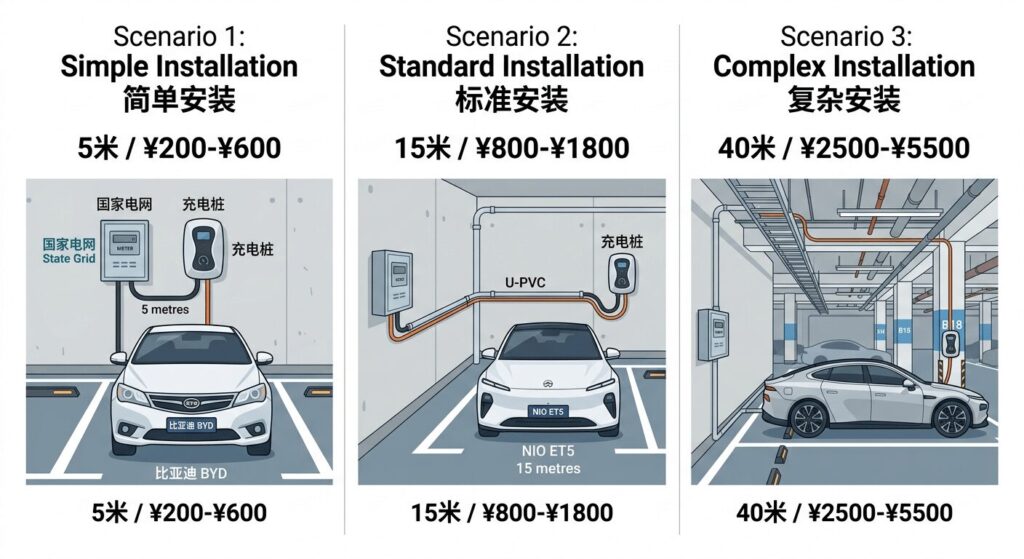
Component 1: Cable Distance and Routing
The single most important cost driver in Chinese home EV charger installation is the distance between the dedicated meter location and the parking space, and the complexity of the cable route between them.
Simple installation (under 5 metres from meter to charger): The dedicated meter is installed at or very close to the parking space. Cable run from meter to charger mounting point is minimal.
- Cable material: ¥40-¥125 (5m × ¥8-¥25/m)
- Installation labour: 1-1.5 hours
- Additional cost for cable component: ¥40-¥125
Standard installation (5-20 metres): The most common scenario — meter at distribution board, cable running 5-20 metres through car park infrastructure to parking space.
- Cable material: ¥80-¥500 (10m typical × ¥8-¥25/m)
- Conduit/trunking: ¥50-¥200 (10m typical)
- Installation labour: 2-3 hours
- Additional cost for cable component: ¥130-¥700
Complex installation (20-50 metres): Cable must traverse significant distance through car park, potentially through walls, around structural elements, using cable trays.
- Cable material: ¥240-¥1,250 (30-50m × ¥8-¥25/m)
- Conduit/trunking: ¥150-¥1,000
- Installation labour: 3-6 hours
- Additional cost for cable component: ¥390-¥2,250
The cable specification requirement: Chinese electrical standards require minimum 6mm² copper cable for 32A EV charging circuits at distances up to approximately 30 metres. For longer runs or higher quality installations:
- 6mm² copper (standard): ¥15-¥20/metre
- 10mm² copper (premium, long runs): ¥25-¥40/metre
An installer who quotes ¥8-¥10/metre is using undersized cable (typically 4mm² or 2.5mm²). This is a red flag — undersized cable creates resistance heating over a long run at 32A continuous load.
Component 2: Circuit Protection Devices
Minimum protection required:
- 40A circuit breaker (保护开关): ¥50-¥150
- RCCB/RCD protection: ¥80-¥300 (Type A/AC minimum; Type B recommended)
The Type A vs Type B RCD distinction: As established in our safety guide, Type B RCDs detect both AC and DC fault currents — the correct specification for EV charging circuits. Type A/AC RCDs detect only AC fault currents — potentially missing DC leakage from EV onboard chargers.
Cost difference:
- Type A/AC RCCB: ¥80-¥150
- Type B RCD: ¥180-¥500
Installers who use Type A to reduce costs are cutting a meaningful corner. The additional ¥100-¥350 for Type B is worthwhile — specify it explicitly in your quotation request.
Component 3: Wall Mounting and Charger Connection
Charger mounting:
- Wall anchor installation: ¥30-¥80
- Level mounting (for aesthetics): included in quality installation, skipped in budget installation
- Cable entry gland (IP protection seal): ¥20-¥60
Charger wiring and commissioning:
- Terminal connection and wiring: ¥100-¥200 labour
- Testing and commissioning: ¥100-¥200 (confirming earth, polarity, RCD function)
- App setup (for smart charger): ¥0-¥100
Component 4: 物业 Coordination and Application Assistance
Some installation companies include 物业 coordination as part of their service — preparing documents, submitting applications, following up with 物业 on behalf of the owner. Others provide the charger and installation only, leaving 物业 navigation entirely to the owner.
If 物业 coordination is included:
- Typical additional charge: ¥200-¥800
- Value: significant for owners who find 物业 navigation difficult or time-consuming
The NIO programme’s 物业 coordination value: As established in our NIO home charging programme analysis, NIO’s Power Specialist service includes proactive 物业 coordination — a service that has genuine value beyond the charger and installation hardware. For NIO owners, this coordination service alone partially justifies the manufacturer programme.
The State Grid Installation Process and Costs — Detailed
The Meter Application Process
Step 1: Application to State Grid
After obtaining 物业 approval, the owner applies to the local State Grid service hall (国网营业厅) or through the 国家电网 app:
- Submit identity documents
- Submit property rights documentation
- Submit 物业 approval letter
- Submit proposed charger specification
Step 2: State Grid Site Assessment (免费)
State Grid dispatches an assessment engineer — this service is free. The engineer assesses:
- Available supply capacity at the relevant distribution board
- Proposed meter installation location
- Cable route requirements from distribution board to meter
This assessment is the key cost-determining step. The engineer’s report determines whether:
- Simple meter installation is possible (lowest cost)
- New supply cable is required (medium cost)
- Infrastructure upgrades are required before installation can proceed (highest cost)
Step 3: Cost Quotation
State Grid provides a formal cost quotation based on the site assessment. This is issued before work begins — the owner accepts or raises concerns before proceeding.
What legitimate State Grid quotations include:
Scenario A: Simple meter installation only Building supply to distribution board already exists. Meter installation at distribution board location. Private electrician handles circuit from meter to charger.
- State Grid cost: ¥0-¥500 (meter hardware + minimal labour)
- This scenario is becoming more common as urban residential compound electrical infrastructure improves
Scenario B: Meter + supply cable to car park New metered supply cable must be run from the building’s main distribution point to the car park’s secondary distribution.
- State Grid cost: ¥500-¥2,000 (supply cable material + installation)
Scenario C: Infrastructure upgrade required Car park electrical capacity is insufficient and requires transformer upgrade or new distribution board before individual meters can be added.
- This is a building-level infrastructure issue — typically beyond the individual owner’s installation scope. See collective charging infrastructure section.
State Grid Fee Schedule — What’s Standard vs What’s Excessive
Standard (acceptable) State Grid charges:
- Meter hardware: ¥0-¥200
- Connection capacity fee (接入容量费): ¥0-¥500 for standard 7 kW residential
- Supply infrastructure cable: ¥15-¥35/metre for new runs
- Total: ¥0-¥2,500 for typical residential installation
Excessive or questionable charges:
“Design fee” (设计费): Some State Grid representatives quote a design fee of ¥500-¥1,500 for simple residential EV charging installations. A straightforward residential EV charging meter installation does not require paid design services — question this charge specifically.
Arbitrary “commissioning fee” (调试费): If a commissioning fee is quoted separately from installation, ask specifically what it covers. Meter commissioning is typically included in installation labour. A separate ¥500-¥1,000 “commissioning fee” for a residential meter is excessive.
“Priority processing fee” (加急费): Some State Grid representatives — or middlemen claiming to represent State Grid — suggest that a cash payment can accelerate processing. This is not an official State Grid fee and may constitute a solicitation of improper payments. If suggested, request a formal written quotation including this fee before paying anything.
How to challenge excessive State Grid charges:
State Grid’s residential EV charging installation fees are subject to regulatory oversight. Excessive charges can be challenged through:
- National Energy Administration (国家能源局) complaints — 12398 hotline
- State Grid’s customer service: 95598
- Provincial electricity regulatory body
Private Electrician Costs — The Market Reality by City
Installation labour and material costs vary significantly across Chinese cities. Understanding city-specific market rates prevents overpaying and helps assess whether a quote is reasonable.
Beijing (北京)
Labour rate: ¥200-¥350/hour (licensed electrician) Typical simple installation (under 10m cable run): ¥1,200-¥2,200 Typical standard installation (10-20m): ¥1,800-¥3,500 Complex installation (20-50m): ¥3,000-¥6,000
Beijing-specific factors:
- Beijing’s licensed electrician market is mature — many installers experienced with EV charging
- Strong competition among installation companies reduces prices versus the northeast and northwest
- Beijing Green Charging Programme approved installers may charge premium rates — compare with independent quotes
Beijing quote reference table:
| Cable distance | Materials | Labour | Total private |
|---|---|---|---|
| Under 5m | ¥200-¥400 | ¥500-¥800 | ¥700-¥1,200 |
| 5-15m | ¥400-¥700 | ¥700-¥1,200 | ¥1,100-¥1,900 |
| 15-30m | ¥600-¥1,200 | ¥1,000-¥1,800 | ¥1,600-¥3,000 |
| 30-50m | ¥900-¥2,000 | ¥1,500-¥2,500 | ¥2,400-¥4,500 |
Shanghai (上海)
Labour rate: ¥220-¥380/hour Typical simple installation: ¥1,100-¥2,000 Typical standard installation: ¥1,700-¥3,200 Complex installation: ¥2,800-¥5,500
Shanghai-specific factors:
- Most competitive electrician market in China — multiple established EV charging installation companies
- Shanghai installation subsidy (¥1,500-¥2,100) applies to approved installations — use approved installers to qualify
- Underground car park cable runs in Shanghai’s newer high-rise developments often require complex routing through structured cable management systems
Shanghai quote reference table:
| Cable distance | Materials | Labour | Total private |
|---|---|---|---|
| Under 5m | ¥200-¥350 | ¥450-¥750 | ¥650-¥1,100 |
| 5-15m | ¥350-¥650 | ¥650-¥1,100 | ¥1,000-¥1,750 |
| 15-30m | ¥550-¥1,100 | ¥950-¥1,700 | ¥1,500-¥2,800 |
| 30-50m | ¥800-¥1,800 | ¥1,400-¥2,200 | ¥2,200-¥4,000 |
Shenzhen and Guangzhou (深圳 / 广州)
Labour rate: ¥180-¥320/hour (lower than Beijing/Shanghai, larger installer market) Typical simple installation: ¥900-¥1,800 Typical standard installation: ¥1,500-¥2,800 Complex installation: ¥2,500-¥4,500
Southern China-specific factors:
- Southern Grid (南方电网) rather than State Grid — slightly different meter installation process but similar costs
- High EV adoption in Shenzhen creates competitive electrician market with multiple specialised EV charging installers
- Shenzhen’s notification-only framework for owned parking spaces reduces 物业 coordination time and cost
Chengdu (成都)
Labour rate: ¥150-¥280/hour Typical simple installation: ¥800-¥1,600 Typical standard installation: ¥1,200-¥2,400 Complex installation: ¥2,000-¥4,000
Chengdu-specific factors:
- Lower labour rates than coastal tier-1 cities
- Villa installations with private garages are simpler and lower cost than underground apartment car park installations
- Three-phase supply more commonly available — three-phase installation costs approximately ¥300-¥800 more than single-phase for the additional cable and protection hardware
Tier-2 and Tier-3 Cities (General)
Labour rate: ¥120-¥250/hour Typical simple installation: ¥700-¥1,400 Typical standard installation: ¥1,000-¥2,000 Complex installation: ¥1,800-¥3,500
Tier-2/3 considerations:
- Lower labour rates but potentially less experienced EV-specific installation companies
- May require selecting from a smaller pool of qualified installers
- Brand-specific installation programmes (StarCharge, TELD) have better tier-2 coverage than many independent premium brands
The Manufacturer Programme vs Independent Quote — The Cost Comparison
What Manufacturer Programmes Include and Their Cost Premium
As established in our BYD vs NIO vs Xpeng manufacturer bundle guide, EV manufacturer home charging programmes bundle charger hardware with installation. The cost transparency varies significantly between programmes.
NIO Home Charging Programme:
- Charger hardware: ¥0-¥1,500 (subsidised)
- Standard installation (up to 10m): ¥0-¥500 (included in promotion)
- Extended installation (10-30m): ¥500-¥2,000 (surcharge)
- Total typical cost: ¥0-¥2,500
NIO’s competitive advantage: The NIO programme is the most cost-competitive manufacturer programme in the market when promotional pricing applies. Power Specialist service adds genuine 物业 navigation value.
BYD Home Charging Bundle:
- Charger hardware: ¥800-¥1,600
- Standard installation: ¥800-¥1,800
- Total: ¥1,600-¥3,400
- Compared to independent (StarCharge S1 + standard installation): ¥2,699
- BYD premium over independent: ¥0-¥700 — modest at standard pricing
Xpeng Home Charging Bundle:
- Charger hardware: ¥900-¥1,500
- Standard installation: ¥1,000-¥2,000
- Total: ¥1,900-¥3,500
- Xpeng premium over independent: ¥200-¥800
Premium manufacturer programmes (Porsche, BMW, Mercedes):
- Charger hardware: ¥2,500-¥5,000
- Installation: ¥1,500-¥3,000
- Total: ¥4,000-¥8,000
- Independent equivalent (ABB Terra + standard installation): ¥5,200-¥6,700
- Luxury brand premium: ¥0-¥1,300 — modest given service level
Independent Installer Cost Comparison
StarCharge S1 (7 kW smart, standard installation):
- Charger: ¥999
- State Grid meter: ¥0-¥800
- Private electrician (standard 10-15m run): ¥1,200-¥1,800
- Total: ¥2,199-¥3,597
- Median: approximately ¥2,900
Autel MaxiCharger (IP65, standard installation):
- Charger: ¥1,499
- State Grid meter: ¥0-¥800
- Private electrician (standard 10-15m run): ¥1,200-¥1,800
- Total: ¥2,699-¥4,097
- Median: approximately ¥3,400
ABB Terra AC W7 (premium, standard installation):
- Charger: ¥3,500
- State Grid meter: ¥0-¥800
- Private electrician (premium installation, Type B RCD, 10-15m run): ¥1,800-¥3,000
- Total: ¥5,300-¥7,300
- Median: approximately ¥6,300
The Quote Assessment Framework — How to Evaluate Any Installation Quote
When you receive an installation quote for a Chinese home EV charger, use this framework to assess whether it is accurate, complete, and fair.
Step 1: Confirm What Is and Isn’t Included
Every legitimate installation quote should explicitly state:
Included:
- Charger hardware (model, price)
- Cable specification (cross-section, length assumed)
- Conduit/trunking specification
- Circuit breaker specification (rating)
- RCD/RCCB specification (Type A or Type B)
- Labour (hours estimated)
- State Grid coordination or exclusion
Explicitly excluded:
- State Grid meter installation costs (if not included)
- Extended cable runs beyond quoted length
- 物业 application support (if not included)
A quote that doesn’t specify these components is not a complete quote — it is a low number designed to win the business, with additional charges to follow.
Step 2: Check Cable Specification for the Distance
Take the quoted cable distance (or measure it yourself) and apply the cable cost reference:
Reference check:
- Quoted cable distance: X metres
- Minimum cable cost at ¥15/m for 6mm²: X × ¥15
- If quoted cable cost is significantly below this: undersized cable is likely
Example check: Quote says “20m cable run, materials ¥200.” At 20m, minimum materials at ¥15/m = ¥300. The ¥200 quote implies either shorter cable than stated, smaller cross-section than required, or excluded conduit costs. Ask specifically.
Step 3: Verify RCD Protection Specification
Ask specifically: “Is Type B RCD protection included?” If the answer is “we use standard protection” or if the installer doesn’t know the distinction, the installation is using Type A/AC protection — technically adequate but below optimal specification.
For the additional ¥100-¥350 of a Type B RCD, specify it explicitly. Reputable installers will accommodate this without significant cost argument.
Step 4: Confirm State Grid Scope
Ask: “Does this quote include State Grid meter installation costs, or is that separate?” The answer determines the true all-in installation cost.
If State Grid costs are separate, ask for their estimated range based on the installer’s experience with the specific building type and location.
Step 5: Request Written Contract
Any installation of ¥2,000+ should have a written contract specifying:
- All hardware to be installed with specifications
- Labour scope and timeline
- Payment terms (deposit and final payment)
- Warranty on installation workmanship (minimum 1 year)
- What happens if additional costs arise (e.g., cable run longer than estimated)
An installer who resists providing a written contract should not be trusted with the installation.
The Price Red Flags — Quotes That Should Concern You
Red Flag 1: Quote Under ¥800 (Private Electrician Only)
An installation quote under ¥800 for a hardwired home EV charger from a private electrician is almost certainly cutting corners on:
- Cable specification (undersized)
- Protection devices (Type A instead of Type B, or missing RCCB entirely)
- Testing and commissioning (skipped)
- Documentation (no installation certificate)
Why this matters: An under-spec installation may work for months before the undersized cable creates a heat accumulation problem. No installation certificate means no insurance claim if a fire occurs.
Red Flag 2: Quote That Doesn’t Mention the State Grid Meter
If a private electrician quotes a “complete installation including everything” without mentioning the State Grid meter, either:
- The meter costs are genuinely included (clarify exactly how)
- The meter application hasn’t been considered — the installer will discover this partway through the project and charge additionally
- The installer is planning to illegally tap into existing infrastructure without a dedicated meter
Ask directly: “Does your quote include the State Grid dedicated meter installation?”
Red Flag 3: Cash-Only Payment With No Receipt
Legitimate installation businesses accept WeChat Pay, Alipay, or bank transfer and provide receipts. Cash-only installers are operating outside formal business registration — their “warranty” on installation workmanship is unenforceable.
The rebate implication: Shanghai, Beijing, and Shenzhen installation rebate applications require valid invoices (发票). An installer who provides no receipt means your installation is not eligible for available rebates. In Shanghai, this costs you ¥1,500-¥2,100 in foregone subsidies — more than any cash discount the installer might offer.
Red Flag 4: Installation Completed Without 物业 Sign-Off
An electrician who proposes to complete the installation without obtaining 物业 approval first is creating legal exposure for the property owner. If 物业 subsequently discovers an unapproved installation, they can require removal at the owner’s expense.
Legitimate installers require proof of 物业 approval before beginning installation work.
Red Flag 5: No Mention of Electrical Installation Certificate (竣工验收证明)
A properly completed installation produces an electrical installation certificate (竣工验收证明 or 电气安装合格证). This certificate:
- Confirms the installation was completed by a licensed electrician
- Is required for insurance validity
- Is required for some installation rebate applications
- Provides documentation for property resale
An installer who doesn’t mention the certificate as part of their service is either planning not to issue one (installing without proper documentation) or is unaware of the requirement (inexperienced).
Getting and Comparing Multiple Quotes — The Practical Process
Where to Find Qualified EV Charger Installers in China
Channel 1: Charger manufacturer’s installer network
All major charger brands maintain networks of approved installers who are trained on their specific products. Advantages: brand accountability, standardised installation quality, rebate programme eligibility. Potential disadvantage: may charge above market rates.
- StarCharge: 星星充电安装服务 platform — covers tier-1 through tier-3 cities
- Autel: Autel Charge authorised installer network
- TELD: 特来电安装服务
- State Grid EV charging partners: Listed on 国网充电桩 app
Channel 2: EV manufacturer service centres
For brand-specific chargers (BYD, NIO, Xpeng, BMW, Mercedes, Porsche): the manufacturer’s service centre network. Highest accountability but typically the highest price for independent comparison.
Channel 3: 美团 and 58同城 (local service platforms)
Both major Chinese local service platforms have EV charging installation categories. Advantages: reviews, price transparency, platform accountability. Disadvantages: quality varies; some listers are unlicensed.
What to check on 美团/58同城:
- Verify installer holds a valid electrician license (持证电工)
- Minimum 10 reviews with EV charging-specific mentions
- Business registration (不是个人) — registered company rather than individual
Channel 4: Peer recommendation in owner communities
WeChat owner groups for your specific vehicle brand (BYD owners group, NIO community) and local groups for your compound often have recommendations for specific installers with track records in your specific building type.
The value of compound-specific recommendations: An electrician who has installed 10-15 chargers in your specific compound already knows the cable routes, has a working relationship with your 物业, and understands the building’s electrical infrastructure. This local knowledge can reduce both cost (efficient routing) and timeline (fewer 物业 surprises).
The Three-Quote Process
Quote 1: Manufacturer programme or approved installer This establishes the benchmark for a fully accountable, brand-sanctioned installation. Typically the highest price but includes the most comprehensive service.
Quote 2: Independent electrician with EV experience From a licensed electrician with documented EV charging installation experience. Should be 20-35% below the manufacturer programme.
Quote 3: Peer-recommended local installer From someone recommended specifically for your building or compound. May be lowest price; assess against quality and documentation requirements.
Evaluating the three quotes: Compare on: total all-in cost (including State Grid), cable specification, protection device specification, documentation provided, payment terms, and workmanship warranty.
The lowest quote is not automatically the right choice — the cheapest cable specification and missing documentation can cost more than the saving.
The Complete Cost Reference Table
All-In Installation Cost Ranges by Scenario
| Scenario | State Grid | Private Installer | Total Range | Median |
|---|---|---|---|---|
| Shanghai simple (under 5m, existing infra) | ¥0-¥300 | ¥650-¥1,100 | ¥650-¥1,400 | ¥1,000 |
| Shanghai standard (5-15m) | ¥200-¥600 | ¥1,000-¥1,750 | ¥1,200-¥2,350 | ¥1,750 |
| Shanghai complex (15-30m) | ¥400-¥1,000 | ¥1,500-¥2,800 | ¥1,900-¥3,800 | ¥2,850 |
| Beijing standard (5-15m) | ¥200-¥700 | ¥1,100-¥1,900 | ¥1,300-¥2,600 | ¥1,950 |
| Beijing complex (15-30m) | ¥400-¥1,200 | ¥1,600-¥3,000 | ¥2,000-¥4,200 | ¥3,100 |
| Shenzhen standard (5-15m) | ¥200-¥500 | ¥900-¥1,600 | ¥1,100-¥2,100 | ¥1,600 |
| Chengdu villa (private garage, 10m) | ¥100-¥400 | ¥700-¥1,400 | ¥800-¥1,800 | ¥1,300 |
| Tier-2 city standard | ¥200-¥600 | ¥800-¥1,600 | ¥1,000-¥2,200 | ¥1,600 |
After Subsidy Net Costs
Applying available government installation subsidies transforms the net cost picture significantly:
| City | Gross Installation | Available Subsidy | Net Cost |
|---|---|---|---|
| Shanghai (standard) | ¥1,750 median | ¥1,500-¥2,100 | ¥0-¥750 |
| Beijing (standard, DRP) | ¥1,950 median | ¥2,000-¥4,800 | ¥0 (often zero net) |
| Shenzhen (standard) | ¥1,600 median | ¥1,500-¥2,800 | ¥0-¥300 |
| Chengdu villa | ¥1,300 median | ¥500-¥1,000 | ¥300-¥800 |
| Tier-2 city | ¥1,600 median | ¥500-¥1,500 | ¥100-¥1,100 |
The Beijing finding is remarkable: For Beijing EV owners who qualify for the full municipal + district + vehicle purchase charging component (¥3,500-¥4,800 in subsidies), the installation cost is effectively zero — the subsidy exceeds the median installation cost. This transforms the home charger decision from a capital investment question to purely a hardware selection question.
Installation Timeline — What to Expect and How to Accelerate It
Typical Timeline Components
| Stage | Minimum | Typical | With Complications |
|---|---|---|---|
| 物业 application to approval | 2 weeks | 4-8 weeks | 8-16 weeks |
| State Grid application to assessment | 3-5 days | 1-2 weeks | 2-4 weeks |
| State Grid assessment to meter installation | 1-3 weeks | 2-6 weeks | 4-10 weeks |
| Electrician scheduling to installation | 3-7 days | 1-2 weeks | 2-4 weeks |
| Total typical timeline | 5 weeks | 2-3 months | 4-6 months |
Acceleration Strategies
Parallel processing: Submit the State Grid meter application simultaneously with the 物业 application — as soon as you have submitted the 物业 application, you can begin the State Grid process. The State Grid assessment can often proceed before 物业 approval is formally received, with the final installation conditional on 物业 sign-off.
Manufacturer programme selection for timeline certainty: NIO’s Power Specialist service includes active 物业 coordination that has demonstrated faster approval timelines than owner-managed applications. If timeline certainty is important, the NIO programme’s managed process is a genuine advantage.
Pre-selecting electrician: Have your electrician identified and booked for a provisional installation date before 物业 approval arrives. An electrician who is available on short notice when approval comes through reduces waiting time versus starting the electrician search after approval.
Shanghai and Shenzhen advantage: Both cities have committed processing timelines (20 days in Shanghai, 15 in Shenzhen) that allow owners to plan installation scheduling with reasonable certainty about approval timing.
Internal Links — Further Reading on Clean Energy Bazaar
The professional EV charger installation costs 2026 what State Grid chargers vs private companies charge guide is the cost transparency companion to every charger selection guide in the Chinese market content cluster.
For the charger buying guide covering which hardware to specify for the installation, our find the right EV charger for your home China edition guide covers the complete pre-purchase decision. For the rebates guide covering installation subsidies that offset the costs detailed here, our local utility rebates for EV charging 2026 Shenzhen Shanghai Beijing guide covers every available subsidy. For the manufacturer bundle comparison assessing whether BYD, NIO, and Xpeng programme costs are competitive with independent installation, our BYD vs NIO vs Xpeng which EV maker sells the best home charging bundle in 2026 guide covers every programme. For the 物业 rights guide covering the approval process that precedes every professional installation, our apartment EV charging solutions 2026 China HOA rules property manager permissions and fixed parking rights guide covers every regulatory step. For the DIY plug-and-play options that avoid professional installation costs entirely for 220V socket solutions, our DIY EV charger installation 2026 easiest plug and play models for Chinese apartments 220V guide covers every self-install option. And for the 3C certification guide ensuring the hardware specified for professional installation is genuinely certified, our 3C certification and EV chargers 2026 why buying non-certified chargers is dangerous in China guide covers every safety requirement.
Final Thoughts
The professional EV charger installation costs 2026 what State Grid chargers vs private companies charge analysis produces clear guidance for Chinese EV owners navigating what is often the most confusing and opaque cost component of home EV charging setup.
The key findings:
Installation cost variation is real and large. The range between a simple installation in a well-equipped Chengdu villa and a complex installation in a Beijing high-rise with long cable runs spans ¥650-¥6,000+ — more than the hardware cost in most cases. Understanding which scenario you are in is the single most important preparation before soliciting quotes.
State Grid costs are separate and variable. A quote from a private electrician that doesn’t address State Grid meter installation costs is incomplete. The State Grid component adds ¥0-¥2,500 to total installation cost depending on infrastructure status at your building.
Subsidies transform the net cost calculation. In Beijing, Shanghai, and Shenzhen, government installation subsidies ranging from ¥1,500-¥4,800 can reduce net installation cost to near zero. Claiming these subsidies requires approved installers and valid invoices — requirements that make the cheapest cash-only quote often the most expensive after subsidy is considered.
Three quotes are the minimum. The manufacturer programme establishes the high benchmark. An independent licensed electrician with EV experience establishes the market benchmark. A peer-recommended compound-specific installer may offer the lowest legitimate cost. The correct choice balances price, documentation quality, workmanship warranty, and subsidy eligibility.
The cable specification is the most important quality indicator. Minimum 6mm² copper for 32A circuits at standard distances. Any quote implying cable material costs below ¥15/metre for a 32A circuit is using undersized cable.
Type B RCD is worth specifying explicitly. The ¥100-¥350 premium over Type A/AC RCD is the most cost-effective quality upgrade available in any installation quote.
The right installation is not the cheapest installation. It is the installation that delivers safe, reliable, documented, subsidy-eligible charging at a fair market price for your specific building and distance scenario.