Public EV charging in America has long been a source of frustration. Broken chargers, slow speeds, confusing payment systems, and unreliable networks have made the experience of road-tripping in an EV something closer to a gamble than a convenience. Studies have shown that industry-average public DC fast charger uptime has historically been below 80% — meaning one in five charging sessions could end in disappointment.
The federal government has finally set a new standard.
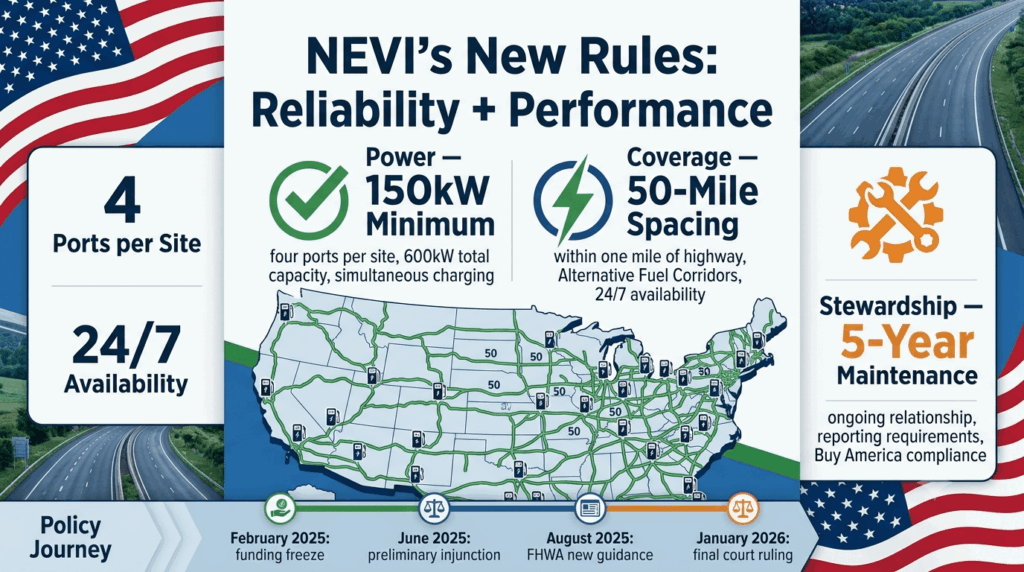
On August 11, 2025, the Federal Highway Administration released new guidance for the National Electric Vehicle Infrastructure (NEVI) Formula Program, which had been paused since January 2025. The core technical requirements remained unchanged — and they are demanding. Every NEVI-funded charging port must maintain an average annual uptime greater than 97%. Every port must deliver at least 150 kW of power simultaneously. Stations must be available 24/7 year-round and maintained for five years from the initial date of operation.
This guide on NEVI’s new rules: 97% uptime + 150kW – the US raises the bar for public chargers provides the complete, honest analysis — the exact technical requirements that define NEVI compliance, the policy and legal battles that nearly derailed the program, what these standards mean for charging networks and EV drivers, and the honest assessment of whether America can actually deliver on this ambitious vision.
The New Rules — What the NEVI Standards Actually Require
The Technical Specifications That Define Compliance
The $5 billion program:
The NEVI Formula Program is a cornerstone of the Bipartisan Infrastructure Law, allocating nearly $5 billion over five years to create a coast-to-coast EV charging network. The program is administered by states, with funding directed to designated Alternative Fuel Corridors — primarily interstate highways — to build a national network of EV charging infrastructure.
The 97% uptime standard:
Each NEVI-funded charging port must have an average annual uptime greater than 97%. A charging port is considered “up” when its hardware and software are both online and available for use, or in use.
The math is unforgiving. At 97% uptime, a charger is allowed approximately 263 hours — or just under 11 days — of downtime per year. This must be calculated on a monthly basis for the previous twelve months. Exclusions include scheduled maintenance, vandalism, and natural disasters, but the burden of proof lies with the operator.
The 150 kW power requirement:
Each NEVI-funded site must have at least four network-connected DC fast charging ports, with each port capable of simultaneously delivering at least 150 kW. This means a minimum site power capability of 600 kW.
The 150 kW standard is a significant step up from the 50 kW chargers that have been the industry norm in many locations. It means a typical EV can charge from empty to 80% in approximately 30 minutes — making highway travel genuinely practical.
The spacing requirements:
Charging stations along Alternative Fuel Corridors must be spaced at a maximum distance of 50 miles apart and within one mile of the highway. This creates a national network where EV drivers can reliably find fast charging on major routes.
The five-year maintenance commitment:
NEVI-funded sites must be maintained for five years from the initial date of operation. This is not a “build and forget” program — it requires an ongoing relationship with maintenance, uptime reporting, and other obligations that extend for at least five years beyond construction.
The customer protection requirements:
The NEVI minimum standards place the customer at the centre of their requirements. Stations must provide contactless payment methods accepting major credit and debit cards, as well as payment through either an automated toll-free phone number or SMS. Pricing must be displayed prior to initiating a charging transaction. Customers must have a mechanism to report issues with charging stations.
The Buy America requirement:
NEVI projects require hardware that meets strict federal requirements, including Buy America compliance. Chargers must be manufactured in the United States to be eligible for federal funding. The federal government has recently proposed modifying guidance to require charging stations be built with 100% American-made components, up from the previous 55% domestic content requirement.
The Policy Rollercoaster — How NEVI Nearly Died and Came Back
The Funding Freeze, the Court Battle, and the August 2025 Revival
The January 2025 freeze:
In February 2025, the Federal Highway Administration issued a letter from Associate Administrator Emily Biondi that froze all new EV-charging funding obligations and effectively rescinded previously approved state infrastructure plans. States were told to pause the NEVI program while the administration rescinded guidance and re-reviewed state plans.
The freeze put billions of dollars in limbo. NEVI had been creating a minimum network of national chargers along major corridors, with 40% targeted to underserved locations that the market refused to touch, required 97% uptime, and mandated good-paying jobs. All of that was suddenly at risk.
The legal challenge:
A coalition of states, led by Washington, sued the Department of Transportation. On January 23, 2026, U.S. District Judge Tana Lin of the Western District of Washington issued a final ruling holding that the Department of Transportation and the FHWA had acted unlawfully when they froze NEVI funding.
Judge Lin held that the action violated the Administrative Procedure Act because the agency failed to follow the statutory procedures for withholding funds. Under the Infrastructure Act, agencies must provide states with at least 90 days to address concerns with their plans and a subsequent 60-day notice period before withholding funds — procedures that were not followed.
The ruling barred the federal government from withdrawing or withholding NEVI funding for any reason not explicitly set forth in the Infrastructure Act or without following proper procedural requirements. States that previously had approved plans could now proceed with implementation.
The August 2025 revival:
On August 11, 2025, the FHWA released new guidance for the NEVI Program. States had thirty days to draft and submit new State Plans outlining their approach to deploying apportioned NEVI funds.
The core requirements remained unchanged: 97% uptime, 150 kW minimum, four ports per site, 24/7 availability. But the new guidance introduced significant changes in how states could deploy the funds.
The new flexibility:
The August 2025 guidance lifted the rigid 50-mile rule. Moving forward, if a state could provide a justification that its designated Alternative Fuel Corridors were built out and the FHWA agreed, the state could be deemed “Fully Built Out”. After achieving this status, states could use NEVI funds with greater discretion, as long as funds were spent on EV charging infrastructure on public roads or other publicly accessible locations.
The guidance also shifted attention squarely towards American retailers — convenience stores, grocers, gas station owners, and other retail owners positioned along the US highway network. FHWA now explicitly “encourages the selection of charging locations where the charging station operator is also the site host (i.e., property owner)”. This created a major opening for fuel retailers, truck stops, and other landowners to play a more direct role in the NEVI buildout.
What the New Rules Mean for Charging Networks
The Industry Reality of 97% Uptime
The challenge of reliability:
The 97% uptime requirement is not a suggestion — it is a condition of funding. To qualify for or retain NEVI funding, sites must guarantee 97% uptime. Crucially, this uptime must be verifiable. Federal guidance requires granular error reporting to prove why a station went down.
This is a significant challenge for an industry where public DC fast charger uptime has historically been below 80%. The gap between where the industry is and where NEVI requires it to be is substantial.
The “up” debate:
Not all uptime is created equal. As one industry observer noted: “NEVI uptime = ‘is the charger’s software reporting itself as online.’ ‘Up.’ A 150kW charger throttled to 25kW? Still ‘up'”. The definition of “up” — hardware and software both online and available for use — does not necessarily guarantee that a charger is delivering its rated power.
This has led to calls for more sophisticated reliability metrics. Some in the industry argue that “First-Time Charge Success Rate” is a better measure of actual customer experience than simple uptime. A charger that is “up” but delivers 25 kW instead of 150 kW is not delivering the experience that drivers expect.
The compliance burden:
Federal NEVI funding requires a 97% uptime guarantee — but most government agencies have no systematic process to track EVSE failures, dispatch technicians, or document compliance. This creates a gap between the requirement and the capability to enforce it.
For charging network operators, the stakes are high. Operators failing to hit 97%+ uptime — and prove it — will be outpaced and replaced. The market has shifted from “deployment” to “utilization.” The new risk isn’t just regulatory fines; it is “Zombie Infrastructure” — assets that are physically functional but digitally obsolete because they cannot verify 97% uptime.
The hardware response:
Hardware manufacturers are responding to the NEVI challenge. Tritium, for example, manufactures all its chargers in the United States, delivering 150kW minimum simultaneous charging, 97% uptime, CCS connectivity, and Buy America compliance. Lincoln Electric’s Velion DC fast charger is engineered to exceed 97% uptime with an output of up to 1000V/150A and 500V/300A.
The success stories:
Some operators are already exceeding the NEVI requirement. Electric Era’s patented and battery-backed solution delivers more than 98% uptime per port. The company has an 85% win rate across NEVI and state grant proposals and has helped partners secure over $25 million in NEVI funds.
What the New Rules Mean for EV Drivers
The Experience That NEVI Is Designed to Deliver
No more broken chargers:
The 97% uptime requirement is designed to eliminate the experience that has frustrated EV drivers for years: arriving at a charging station only to find that the charger is broken, offline, or throttled.
At 97% uptime, a charger is unavailable for only about 11 days per year. For a driver on a road trip, the odds of encountering a broken charger drop dramatically.
No more slow charging:
The 150 kW minimum means that highway charging will be genuinely fast. A typical EV can charge from empty to 80% in approximately 30 minutes. This makes long-distance travel practical in a way that 50 kW chargers never could.
No more payment confusion:
NEVI requires contactless payment, transparent pricing, and accessible payment methods. Drivers will no longer need to download a specific app, create an account, or navigate confusing payment systems. They can simply tap their credit card and charge.
The 50-mile network:
With stations spaced every 50 miles along major corridors and within one mile of the highway, range anxiety on major routes should become a thing of the past. According to NREL analysis, if corridors reach NEVI compliance, 94% of U.S. counties could achieve 75%+ consecutive long-distance coverage.
The rural challenge:
The NEVI buildout is particularly important for rural America, where the market has failed to provide charging infrastructure. The funding freeze hit hardest in these areas, delaying bids, missing transformers, and leaving gaps in the network. The program’s revival has restored the prospect of reliable charging in underserved communities.
The Challenges That Remain
The Honest Assessment of What Could Go Wrong
The definition problem:
As noted above, the definition of “up” remains a concern. A charger that is “up” but delivers reduced power is technically compliant but practically useless. The industry needs more sophisticated reliability metrics that measure actual charging performance, not just online status.
The enforcement gap:
Most government agencies have no systematic process to track EVSE failures, dispatch technicians, or document compliance. Without effective enforcement, the 97% requirement risks becoming a paper standard rather than a real one.
The cost burden:
A standard four-charger hub (150kW each) costs roughly $1 million or more. The 20% match requirement means that site hosts must contribute significant capital. For smaller operators, this can be a substantial barrier.
The grid constraints:
Many projects stall due to grid constraints. Deploying 600 kW of charging capacity requires significant electrical infrastructure upgrades that can be expensive and time-consuming. Battery-backed solutions like Electric Era’s can help bypass these constraints, but they add cost.
The legislative threat:
Some in Congress have proposed eliminating the NEVI program entirely. The Highway Funding Flexibility Act of 2025 would effectively eliminate the NEVI Formula Program and require states to use unobligated funds only for certain non-electric vehicle related projects. While the court ruling has restored funding for now, the political threat remains.
What This Means for Today’s EV Buyers
The Practical Implications
Better charging is coming:
The NEVI standards are not optional for federally funded chargers. As the network builds out, drivers can expect more reliable, faster, and easier-to-use charging along major highways.
But it will take time:
The program has faced significant delays. The funding freeze, the court battle, and the August 2025 restart have pushed timelines back. States had thirty days to submit new plans after August 11. Actual deployment will take months or years.
The charger desert is shrinking:
The 50-mile spacing requirement means that even rural areas will eventually have reliable fast charging. For drivers in underserved communities, this is a significant improvement.
Tesla drivers are not the primary beneficiaries:
NEVI requires CCS connectors. While some stations may add NACS compatibility in the future, the program is primarily designed to support non-Tesla EVs. Tesla’s Supercharger network expands with private capital, but NEVI is the equalizer that pushes multi-brand charging forward.
Internal Links — Further Reading on Clean Energy Bazaar
The NEVI’s new rules: 97% uptime + 150kW – the US raises the bar for public chargers guide connects to the EV infrastructure and policy guides on cleanenergybazaar.com.
For the US EV sales slump guide covering the broader policy context, our US EV sales slump 25% – policy uncertainty and the hybrid pivot guide covers the market conditions that NEVI is designed to address. For the IEA Global EV Outlook 2026 summary covering the global EV transition, our IEA Global EV Outlook 2026: 2025 sales hit 20M, capturing 25% of global car sales guide covers the flagship report in full. For the nation-by-nation BEV penetration ranking covering where the US stands globally, our nation-by-nation BEV penetration ranking: Norway at 97.9%, Denmark at 80%, US at 5.9% guide covers the global EV adoption landscape. For the upcoming EV charger trends guide covering the broader charging technology landscape, our upcoming EV charger trends 2026-2027 V2G solid-state batteries guide covers the global charging innovation landscape.
Final Thoughts
NEVI’s new rules: 97% uptime + 150kW – the US raises the bar for public chargers — and for the first time, America has a federal standard that demands EV charging infrastructure that is actually reliable, actually fast, and actually usable.
The 97% uptime requirement is ambitious. Industry-average uptime has historically been below 80%. The gap between where the industry is and where NEVI requires it to be is substantial. But the requirement creates a powerful incentive for improvement. Operators that cannot meet the standard will be replaced by those that can.
The 150 kW minimum is transformative. It means highway charging will be genuinely fast — 30 minutes for an 80% charge. The days of 50 kW chargers that take an hour or more are ending.
The customer protections — contactless payment, transparent pricing, accessible interfaces — address the user experience failures that have made public charging frustrating for too many drivers.
The policy battle that nearly killed NEVI demonstrates how fragile this progress remains. The funding freeze, the court battle, and the August 2025 restart have all delayed the buildout. And the legislative threat to the program has not disappeared.
The honest verdict: NEVI represents the most significant federal investment in EV charging infrastructure in American history. The standards it sets are ambitious but necessary. The challenges are real — enforcement, cost, grid constraints, political uncertainty. But for EV drivers, the promise is clear: a national network of reliable, fast, and easy-to-use public charging. The bar has been raised. Now the industry must meet it.