The global transition to electric vehicles is not happening at the same speed everywhere. In some countries, the transition is virtually complete. In others, it has barely begun. And in a few, it is going backwards.
The gap between the world’s EV leaders and laggards has never been wider. At one extreme, Norway has effectively eliminated petrol and diesel cars from its new car market — 97.9% of new cars sold were electric. At the other extreme, the United States — the world’s second-largest auto market and home to Tesla — saw its BEV market share collapse to just 5.9% in October 2025 after the federal tax credit expired.
This guide on nation-by-nation BEV penetration ranking: Norway at 97.9%, Denmark at 80%, US at 5.9% provides the complete, honest analysis — the IEA and national data that reveals the global EV pecking order, the policy decisions that explain the extremes, and what these numbers mean for the future of electric mobility.
The Global Picture — One in Four Cars Now Electric
The IEA’s 2026 Assessment
The headline numbers:
According to the International Energy Agency’s Global EV Outlook 2026, electric car sales topped 20 million globally in 2025, growing by 20% from 2024. One in four new cars sold worldwide was electric. The sales share of electric cars in the overall car market increased to 25%. This marked the fifth consecutive year in which annual electric car sales increased by about 3.5 million.
The BEV share shift:
A significant development in 2025 was the resurgence of battery electric vehicles. The share of battery electric cars in total electric car sales increased to 65%, reversing the trend seen in the two years prior.
The regional story:
Market developments varied dramatically across regions. China maintained its position as the world’s largest electric car market, accounting for six out of ten electric cars sold globally. Europe experienced an upswing in sales following a step change in the EU CO₂ standards, with sales rising 30% to more than 4 million. In the United States, the sales share of electric cars remained relatively stable at just below 10% for the full year, though the end of EV tax credits resulted in sales falling significantly in the last quarter.
The emerging market surge:
More than 100 countries recorded electric car sales growth in 2025, and in one-third of these, they represented at least 10% of new car sales. In Southeast Asia, annual sales more than doubled to reach a sales share of nearly 20%. In Latin America, sales grew by 75%.
The Leaders — Countries Where EV Adoption Has Reached Critical Mass
Norway — The Global Benchmark (97.9%)
The numbers:
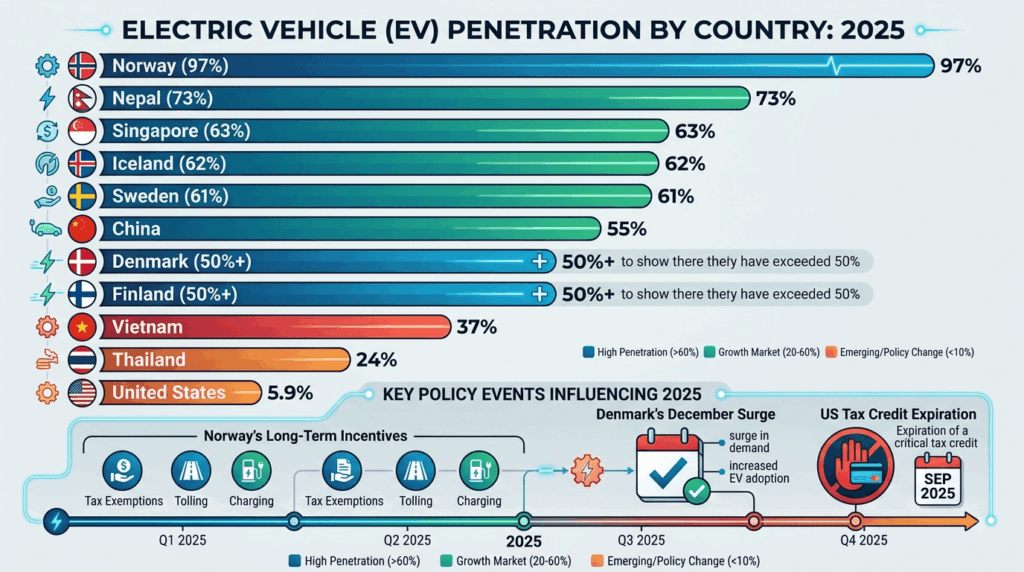
Norway remains the global leader in EV adoption. According to the Norwegian Road Federation (OFV), 95.9% of all new cars registered in Norway in 2025 were electric, up from 88.9% in 2024. In December 2025 alone, the share reached 97.6%. Other sources estimate the full-year figure at 97%.
What drove it:
Norway’s success has been driven by a consistent, long-term policy framework spanning more than three decades. The country has used tax exemptions, reduced tolls, free parking, and access to bus lanes to incentivise EV adoption. Crucially, these policies have been sustained across multiple governments — creating the policy certainty that EV buyers and automakers need.
The result:
Norway has effectively eliminated petrol and diesel cars from its new car market. The transition is essentially complete.
Tesla’s dominance:
Tesla was the best-selling brand in Norway for the fifth consecutive year. However, Chinese-made cars are also gaining market share.
Denmark — The December Surge (80.95%)
The numbers:
Denmark’s EV market accelerated dramatically in 2025. In December 2025, BEVs represented 80.95% of all passenger car registrations, with an additional 2.27% being plug-in hybrids, for a total EV market share of 83.2%.
The full-year picture:
For the full year of 2025, Denmark’s EV market share reached 68.5%. The first half of 2025 was even more remarkable for private car buyers: 81.8% of new private cars registered in Denmark were BEVs.
The momentum:
December 2025 set a new record with 14,955 newly registered electric cars. This represents the highest BEV share ever recorded in Denmark.
The policy driver:
Denmark’s surge has been driven by a combination of tax incentives, growing model availability, and improving charging infrastructure. The country is now one of Europe’s EV leaders, trailing only Norway in penetration.
Nepal — The Emerging Market Surprise (73%)
The numbers:
Nepal ranks second globally in EV penetration, with EVs estimated to account for 73% of new car sales in 2025. This represents a striking shift from just 8% in 2019.
What drove it:
Nepal’s rapid transition has been driven by the cost-competitiveness of Chinese-made electric cars. As imports of Chinese EVs increased significantly, they became the most affordable option for Nepali buyers. The country has witnessed one of the largest increases in electric car sales shares since 2020.
The lesson:
Nepal demonstrates that EV adoption is not limited to wealthy countries. When affordable EVs become available, even emerging markets can transition rapidly.
Other Nordic Leaders
Sweden:
Sweden is estimated to reach 61% EV sales share in 2025.
Iceland:
Iceland ranks near the top, with EV share estimated at 62%.
Finland and Denmark:
Both exceed 50% EV sales share.
The Middle Tier — Countries Making Steady Progress
China — The Volume Leader (53-55%)
The numbers:
China’s EV sales share reached almost 55% in 2025. More than 13 million electric cars were sold in China. Monthly electric car sales exceeded a 50% sales share in 11 out of 12 months of 2025.
The context:
China is the world’s largest EV market by volume and one of the fastest-growing in terms of market share. An estimated 44 million electric cars were on Chinese roads at the end of 2025.
The slowdown:
Growth in China slowed slightly in 2025, partly as a result of its trade-in scheme being temporarily halted. However, the country still accounted for more than half of the global increase in electric car sales.
Vietnam — The Southeast Asian Standout (37%)
The numbers:
Vietnam achieved an EV sales share of 37% in 2025, surpassing Europe’s 27% by 10 percentage points.
The context:
Vietnam is the largest EV market in Southeast Asia. The country has already announced plans to expand or extend EV tax incentives as part of its response to the current energy crisis.
Thailand (24%), Türkiye (18%), Indonesia (16%), Colombia (11%)
These countries all jumped ahead of the United States in EV penetration. Thailand reached nearly one-quarter EV share, while Indonesia rose to 15%.
The United Kingdom
The UK registered nearly half a million new battery EVs in 2025, with EV share estimated at around 23%.
Singapore (63%)
Singapore achieved an EV share of 63% in 2025, reflecting the city-state’s aggressive EV policies and limited car market.
The Laggards — Countries Where EV Adoption Is Stalled or Reversing
The United States — The Collapse (5.9%)
The numbers:
In the United States, BEV market share fell from an all-time high of 11.3% in September 2025 to just 5.9% in October 2025. In November, it dropped further to 5.1%. For the full year, EVs accounted for approximately 7.8% of light vehicle registrations, down from 8.1% in 2024.
The trigger:
The $7,500 federal EV tax credit expired on September 30, 2025, under the One Big Beautiful Bill Act. The Act also eliminated penalties for automakers that fail to meet fuel efficiency standards.
The impact:
The expiration pulled ahead many EV sales that would have occurred later, creating a Q3 rush followed by a Q4 collapse. Americans spent a record $31 billion on EVs in Q3 2025 — only for spending to collapse immediately after. In December 2025, EV registrations plunged 48% year-over-year.
The global isolation:
The IEA noted that the United States remained just below 10% EV share in 2025, despite being one of the world’s largest auto markets. While global EV sales hit 25% of new cars, the US fell to 5.9% in the critical post-tax-credit period. The US is impaired by a lack of supportive policy and subsidies, the unavailability of affordable Chinese models, and a preference for big cars.
Canada (9%)
Canada trails slightly behind the United States at approximately 9% EV share. Recently, the Canadian government agreed to remove its 100% blocking tariff on Chinese EVs, which could accelerate adoption.
The Ranking — Where Every Country Stands
The Top 10 by EV Penetration (2025)
The full global picture:
Other countries with significant EV shares include: Belgium (~41%), Thailand (24%), Türkiye (18%), Indonesia (16%), Colombia (11%), and the United Kingdom (~23%).
The Policy Lesson — What Explains the Extremes
Why Norway Succeeded
Consistent long-term policy: Norway’s EV policies have been sustained across multiple governments for more than 30 years. This created the policy certainty that EV buyers and automakers need.
Comprehensive incentives: Tax exemptions, reduced tolls, free parking, and access to bus lanes made EVs the rational economic choice for Norwegian buyers.
No manufacturing protectionism: Norway did not protect domestic automakers. It opened its market to the best EVs from around the world.
Why Denmark Surged
Tax incentives: Denmark’s tax system heavily favours EVs over ICE vehicles.
December rush: The December surge suggests buyers were responding to upcoming policy changes, creating a similar but smaller version of the US pre-tax-credit rush.
Why the US Collapsed
Policy uncertainty: The US EV market was built on a policy foundation (the $7,500 tax credit) that was suddenly removed. The market that was artificially inflated was artificially deflated.
No affordable options: Chinese brands, which are among the most affordable EVs in the world, attract 100% import duties in the US, making them unattractive to buyers.
Preference for big cars: US buyers prefer larger vehicles, which are more expensive to electrify and harder to make affordable.
What the Rest of the World Can Learn
Policy matters more than wealth: Norway is wealthy, but Nepal is not. The common thread is policy that makes EVs the rational choice.
Affordable EVs unlock mass adoption: Nepal, Vietnam, and Southeast Asia are adopting EVs rapidly because Chinese-made EVs are affordable.
Consistency creates markets: The countries with the highest EV penetration have sustained policies across decades, not flip-flopped every election cycle.
What This Means for Today’s EV Buyers
The Practical Implications
If you live in Norway or Denmark: The transition is essentially complete. Your next car will almost certainly be electric. The charging infrastructure is widespread, and the policy support is entrenched.
If you live in the US: You are operating in a market that is an outlier. The policy uncertainty that caused the collapse shows no sign of resolution. However, this has created a buyer’s market. New EV inventory has ballooned to 130 days’ supply, forcing automakers to pile on incentives. Used EVs now average $34,821 — within just $1,300 of used gas vehicles.
If you live in an emerging market: EV adoption is accelerating rapidly, driven by affordable Chinese imports. The gap between your market and the global leaders is closing faster than almost anyone predicted.
Internal Links — Further Reading on Clean Energy Bazaar
The nation-by-nation BEV penetration ranking: Norway at 97.9%, Denmark at 80%, US at 5.9% guide connects to the EV market and policy guides on cleanenergybazaar.com.
For the IEA Global EV Outlook 2026 summary covering the full global picture, our IEA Global EV Outlook 2026: 2025 sales hit 20M, capturing 25% of global car sales guide covers the flagship report in full. For the US EV sales slump guide covering the American collapse, our US EV sales slump 25% – policy uncertainty and the hybrid pivot guide covers the complete analysis. For the Europe’s EV sales surge guide covering the European comeback, our Europe’s EV sales surge 30% – how Germany, Spain, and Italy are leading the comeback guide covers the country-level performance. For the global EV sales comparison guide covering the three major markets, our US (-25%), Europe (+36%), China (-9%) guide covers the regional divergence.
Final Thoughts
Nation-by-nation BEV penetration ranking: Norway at 97.9%, Denmark at 80%, US at 5.9% — and the gap between the leaders and laggards tells a story about policy, affordability, and political will.
Norway has shown what is possible with consistent, long-term policy. The country has effectively eliminated petrol and diesel cars from its new car market. Denmark has surged to 80% in December, demonstrating that rapid acceleration is possible when the policy framework is right. Nepal has shown that EV adoption is not limited to wealthy countries — affordable Chinese EVs have transformed the market.
The United States, by contrast, has shown what happens when policy support is withdrawn. The $7,500 tax credit expiration triggered a collapse that was as dramatic as it was predictable. BEV market share fell from 11.3% to 5.9% in one month. The country that invented the modern EV market is now an international laggard.
The honest verdict: EV adoption is a policy choice. Countries that choose to sustain EV incentives, open their markets to affordable imports, and build charging infrastructure will transition rapidly. Countries that flip-flop on policy, protect domestic automakers from competition, and allow uncertainty to prevail will fall behind. The global EV transition is accelerating — but it is not happening at the same speed everywhere.