Here’s the conversation that happens among new luxury EV owners more often than it should.
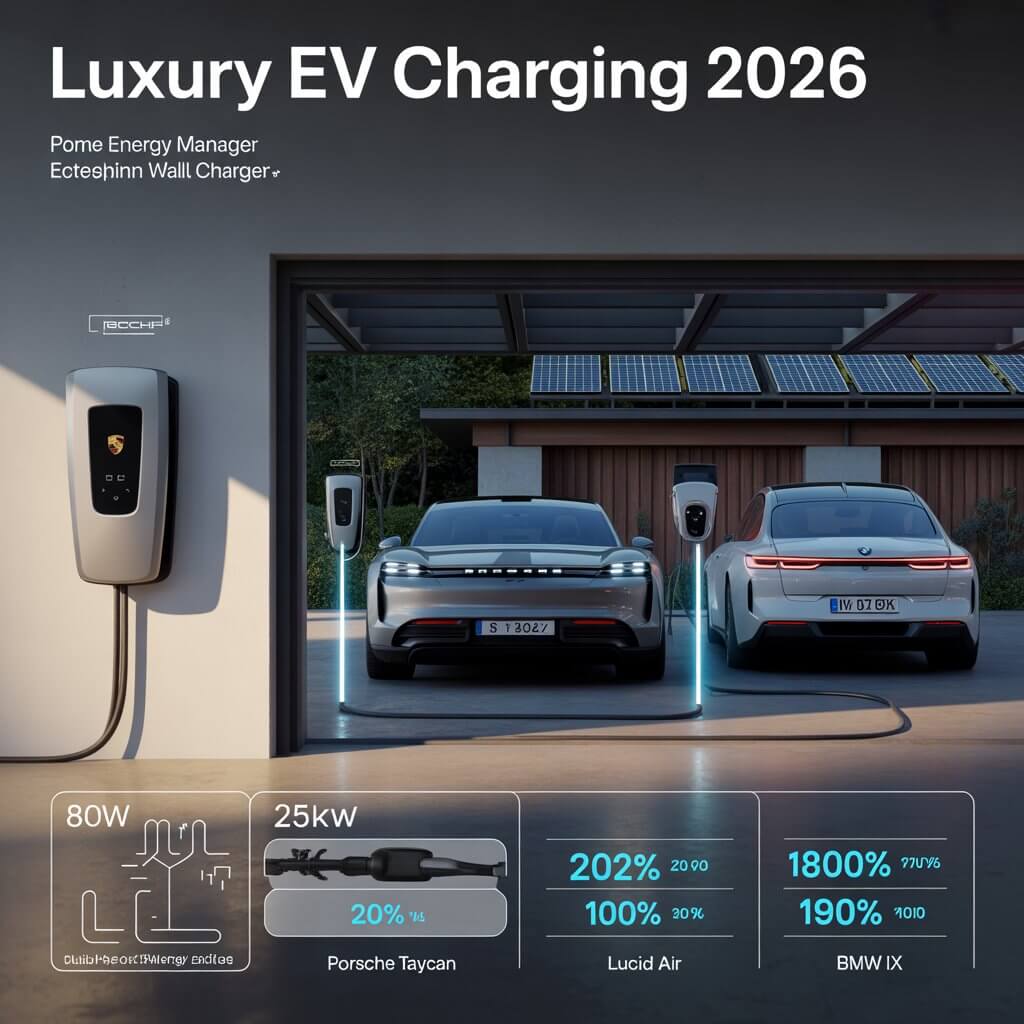
Someone takes delivery of a Porsche Taycan. Or a Lucid Air. Or a BMW iX. They’ve spent £80,000 to £150,000 on the vehicle. They get home, look at their garage, and realise they have no idea which home charger to buy.
The Porsche dealer suggested the Porsche Home Energy Manager — naturally. The BMW dealer mentioned the BMW Wallbox — naturally. The Lucid delivery team handed over a ChargePoint setup guide. None of these suggestions were wrong. But none of them explained why — or whether a premium charger from the manufacturer is genuinely better than a well-specified third-party alternative at a fraction of the cost.
This guide on luxury EV charging 2026 Porsche Taycan Lucid Air BMW iX gives you the honest answer. What these three vehicles actually need from a home charger. Why 800V battery architecture changes the home charging conversation in ways most guides don’t explain. What the manufacturer-branded chargers deliver that third-party alternatives don’t. And where the £2,000-£3,000 manufacturer charging solution is genuinely worth the premium — versus where a £700-£800 Wallbox Pulsar Plus delivers an identical charging experience at a fraction of the cost.
Why Luxury EV Home Charging Is Different From Mainstream EV Charging
The luxury EV charging 2026 Porsche Taycan Lucid Air BMW iX question involves several technical characteristics that don’t apply to compact or mainstream EVs — and understanding them changes which home charger is genuinely worth buying.
800V Battery Architecture — What It Means for Home Charging
The Porsche Taycan and Lucid Air both use 800V battery architecture — a significantly higher internal battery voltage than the 400V architecture used by most mainstream EVs.
800V architecture enables extraordinarily fast DC public charging — the Taycan at up to 270 kW and the Lucid Air at up to 350 kW (the fastest charging production EV currently available). These speeds are irrelevant for home charging, where AC is the charging method.
Here’s the counterintuitive reality: 800V battery architecture offers no advantage over 400V architecture for home AC charging. The AC charging process involves the car’s onboard charger converting AC to DC before it reaches the battery — the battery voltage doesn’t affect this conversion. A Taycan’s 800V battery charges from an AC charger at the same effective rate as a 400V battery accepting the same AC input.
What 800V architecture does affect at home is the onboard AC charger specification — which leads to the next point.
Maximum AC Charging Rates — Where Luxury EVs Genuinely Differ
This is where luxury EVs create a genuinely different home charger decision:
Porsche Taycan:
- Maximum AC charging rate: 11 kW (European, three-phase) OR 9.6 kW (US, 40A, 240V) — standard
- With optional AC charging upgrade: 22 kW (European, three-phase) — this is one of the highest AC charging rates available on any production vehicle
Lucid Air:
- Maximum AC charging rate: 19.2 kW (US, 80A, 240V) — the highest AC charging rate of any production EV sold in the US
- European: 22 kW (three-phase) on higher variants
BMW iX:
- Maximum AC charging rate: 11 kW (European, three-phase, standard)
- US: 9.6 kW (40A, 240V) — same as most premium EVs in the US
These maximum AC rates create fundamentally different home charger requirements. A mainstream EV accepting 7.2 kW is well served by any standard 7.4 kW single-phase charger. A Lucid Air accepting 19.2 kW on a dedicated 80A circuit needs specialised high-power Level 2 hardware that most home charger guides don’t cover.
Large Battery Sizes — Why Overnight Charging Matters More
Porsche Taycan: 79.2-105 kWh battery (depending on variant) Lucid Air: 88-118 kWh battery (depending on variant — the Dream Edition has the largest battery of any production EV) BMW iX: 76.6-111.5 kWh battery
These battery sizes change the overnight charging time calculation significantly:
At 11 kW, a BMW iX xDrive50 with a 111.5 kWh battery takes approximately 11 hours to charge from 20% — meaning you need to plug in by 8pm for a 7am departure. At 19.2 kW, a Lucid Air charges the same 111 kWh battery from 20% in approximately 6.5 hours — plug in at midnight, full by 6:30am.
For luxury EV owners with demanding schedules, large batteries, and predictable departure times, the charging rate advantage of higher-power AC hardware is more practically significant than for compact EV owners.
Porsche Taycan — Home Charging Specifications and What They Mean
Taycan Charging Specifications
European Taycan (standard onboard charger):
- Maximum AC charging rate: 11 kW (three-phase, 16A per phase, 400V)
- Maximum DC fast charging rate: 270 kW (CCS2) — one of the highest DC charging rates available
- Connector: Type 2 (AC), CCS2 (DC)
- Battery: 79.2 kWh (Taycan), 105 kWh (Taycan Turbo S)
- Full charge at 11 kW: approximately 8-9 hours (79.2 kWh), 10-11 hours (105 kWh)
European Taycan with optional 22 kW AC upgrade:
- Maximum AC charging rate: 22 kW (three-phase, 32A per phase, 400V)
- Full charge at 22 kW: approximately 4.5 hours (79.2 kWh), 5.5 hours (105 kWh)
- This upgrade is worth paying for if you have three-phase residential supply
US Taycan:
- Maximum AC charging rate: 9.6 kW (40A, 240V) — standard
- Maximum DC fast charging rate: 270 kW (CCS1 with NACS adapter capability in 2026)
- Connector: J1772/NACS (AC), CCS1 (DC)
- Full charge at 9.6 kW: approximately 9-11 hours depending on battery size
The Porsche Home Energy Manager — Is It Worth It?
Porsche offers the Porsche Home Energy Manager (HEM) as the manufacturer’s recommended home charging solution. It’s not just a charger — it’s an integrated energy management system that connects to your solar installation, battery storage, and grid supply to optimise when and at what rate the Taycan charges.
Price: £2,500-£3,500 (UK); approximately $3,000-$4,000 (US, when available)
What it does that a standard charger doesn’t:
- Monitors your home’s total energy consumption and dynamically adjusts Taycan charging to prevent overloading your supply
- Integrates with rooftop solar to prioritise surplus solar for charging
- Integrates with battery storage systems to charge the Taycan from stored solar energy
- Provides detailed charging analytics through the Porsche Connect app
- Enables scheduled charging based on electricity tariff pricing
Is it worth £2,500-£3,500?
For Taycan owners with rooftop solar and battery storage — yes, potentially. The HEM’s integration across solar generation, battery storage, and EV charging is more sophisticated than most standalone chargers can achieve. If you have a 10+ kWp solar system, battery storage, and a Taycan Turbo S with a 105 kWh battery, the HEM’s optimisation can deliver meaningful annual savings on charging costs.
For Taycan owners without solar or battery storage — probably not. The core charging functionality (11 kW or 22 kW AC delivery, scheduled charging, energy monitoring) can be matched by a Wallbox Commander 2 at £800-£1,000 or a Myenergi Zappi at £699-£849 for solar users, at a fraction of the HEM’s cost.
The honest answer: the Porsche Home Energy Manager is the right choice for Taycan owners with a sophisticated home energy setup (solar + storage + smart grid tariff). For everyone else, it’s a premium product that’s more about brand coherence than charging performance.
Lucid Air — Home Charging Specifications and What They Mean
Lucid Air Charging Specifications
US Lucid Air (all variants):
- Maximum AC charging rate: 19.2 kW (80A, 240V) — the highest of any production EV in the US
- Maximum DC fast charging rate: 300-350 kW (CCS1/NACS adapter)
- Connector: J1772/NACS (AC), CCS1 (DC)
- Battery: 88 kWh (Pure), 118 kWh (Grand Touring, Dream Edition)
- Full charge at 19.2 kW: approximately 6.5 hours (118 kWh from 20%)
- Full charge at 11.5 kW (48A — most home charger maximum): approximately 11 hours (118 kWh from 20%)
European Lucid Air:
- Maximum AC charging rate: 22 kW (three-phase)
- Full charge at 22 kW: approximately 6 hours (118 kWh from 20%)
The 19.2 kW Lucid Air Problem — And Why It Changes Everything
The Lucid Air’s 19.2 kW maximum AC charging rate is the specification that makes home charger selection genuinely different for Lucid owners compared to any other luxury EV.
To deliver 19.2 kW at 240V, you need 80A of continuous current. This means:
- A dedicated 100A circuit breaker (the NEC requires the breaker to be rated at 125% of the continuous load)
- 4 AWG or larger copper wiring from your panel to the charger
- A home electrical panel capable of supporting a 100A dedicated circuit — which typically requires a 200A main panel
- A charger specifically rated for 80A continuous output
Most home EV chargers — including the Tesla Wall Connector (48A maximum) and the ChargePoint Home Flex (48A maximum) — cannot deliver 19.2 kW. They cap at 11.5 kW (48A). If you plug a Lucid Air into a standard 48A charger, it charges at 11.5 kW — perfectly functional but significantly slower than the car’s maximum AC capability.
The question is whether the difference between 11.5 kW and 19.2 kW matters for your specific usage pattern.
For Most Lucid Air Owners — 48A Is Sufficient
For a Lucid Air Grand Touring with the 118 kWh battery:
- At 11.5 kW (48A): 20% to full takes approximately 11 hours — plug in at 8pm, full by 7am
- At 19.2 kW (80A): 20% to full takes approximately 6.5 hours — plug in at midnight, full by 6:30am
If you consistently arrive home with more than 20% remaining, your overnight charging window is even shorter. A Lucid Air at 50% (59 kWh to add) takes 5 hours at 11.5 kW — plug in at 2am, full by 7am. The 19.2 kW charger covers the same charge in 3 hours.
The practical verdict: For Lucid Air owners who arrive home with 30%+ most nights and depart after 7am, a standard 48A charger delivers a full battery every morning with the right overnight schedule. For owners who arrive home very late, depart very early, or regularly arrive home with low charge, the 80A charger’s speed advantage is genuinely valuable.
Chargers That Deliver 80A for the Lucid Air
Lucid Connected Home Charging Station (branded):
- 80A delivery, 19.2 kW
- Designed specifically for Lucid Air
- Integrated Lucid app monitoring
- Price: approximately $1,200-$1,500
ClipperCreek HCS-80 (third party):
- 80A delivery, 19.2 kW
- J1772 connector
- Minimal smart features — no app, no scheduling
- Price: approximately $600-$700
- Best for: Lucid owners who want maximum charging speed without smart feature premium
Siemens VersiCharge 80A (third party):
- 80A delivery, 19.2 kW
- Basic smart features
- Price: approximately $700-$900
Important installation note: An 80A EV charger installation requires a 100A dedicated circuit — significantly more electrical work than a standard 48A installation. Expect installation costs of $500-$1,200 in the US depending on panel capacity, cable run length, and local labour rates. Always have an electrician assess your panel before ordering an 80A charger.
For Lucid Air Owners in Europe
European Lucid Air owners with three-phase supply can charge at 22 kW — requiring a three-phase charger. The Wallbox Commander 2 (22 kW, approximately €1,000-€1,200) or ABB Terra AC W22 are the most appropriate hardware options.
BMW iX — Home Charging Specifications and What They Mean
BMW iX Charging Specifications
European BMW iX (all variants):
- Maximum AC charging rate: 11 kW (three-phase, 16A per phase, 400V) — standard on all iX variants
- Maximum DC fast charging rate: 195 kW (iX xDrive40), 200 kW (iX xDrive50), 195 kW (iX M60)
- Connector: Type 2 (AC), CCS2 (DC)
- Battery: 76.6 kWh (xDrive40), 111.5 kWh (xDrive50, M60)
- Full charge at 11 kW: approximately 7.5 hours (76.6 kWh), 10.5-11 hours (111.5 kWh)
US BMW iX:
- Maximum AC charging rate: 9.6 kW (40A, 240V)
- Maximum DC fast charging rate: 195-200 kW
- Connector: J1772/NACS adapter (AC), CCS1 (DC)
- Full charge at 9.6 kW: approximately 9 hours (76.6 kWh), 13 hours (111.5 kWh)
The BMW Wallbox — Worth It or Brand Loyalty Tax?
BMW offers the BMW Wallbox (manufactured by Webasto) as their recommended home charger. It’s available in Europe at approximately £800-£1,200 depending on variant and market.
What the BMW Wallbox delivers:
- 11 kW three-phase (European) or 9.6 kW (US)
- BMW Connected Drive integration — charging schedule managed through the BMW app
- Energy monitoring and session history
- OCPP 1.6 compliance
- 3-year warranty
Is the BMW Wallbox worth its premium over alternatives?
The BMW Connected Drive integration is the genuine differentiator. For iX owners who manage their vehicle through the BMW app — checking charge status, setting departure times, viewing charging history — having the home charger integrated into the same app experience reduces friction in a way that matters daily.
For European iX xDrive50 owners with 111.5 kWh batteries needing 10.5-11 hours at 11 kW, the overnight charging window is tight. Departure-time scheduling integrated with the BMW app — where the car handles the pre-conditioning, range display, and charging schedule in one place — is genuinely useful when the window is constrained.
Where third-party chargers match or beat the BMW Wallbox:
- Wallbox Pulsar Plus (European): same 11 kW delivery, better bidirectional roadmap, similar price
- Myenergi Zappi (UK/European): better solar integration, lower price, 3-year warranty
- Hypervolt Home 3 Pro (UK): better UK smart tariff integration, comparable price
The honest verdict: The BMW Wallbox is a solid charger that earns its recommendation for iX owners who prioritise BMW Connected Drive integration. For owners who don’t actively use the BMW app for charging management — or who have solar panels that make the Zappi’s solar divert more valuable — third-party alternatives deliver equal or better performance at equal or lower cost.
US Luxury EV Home Charger Comparison
For Porsche Taycan US Owners (9.6 kW Maximum AC)
The US Taycan’s 9.6 kW (40A) maximum AC rate means a standard 40A charger is the right hardware match. The $595 Tesla Universal Wall Connector’s 48A exceeds the Taycan’s 40A ceiling — the car charges at 40A regardless.
Best options for US Taycan owners:
Porsche Home Energy Manager (US): If available in your market and you have solar + storage, the full integration justifies consideration. Without solar/storage, it’s overpriced for the charging task.
ChargePoint Home Flex (set to 40A): $699, adjustable to exactly match the Taycan’s 40A maximum. OCPP compliance. ChargePoint network integration. The most versatile US option for a vehicle likely to be replaced by a future Taycan with different specifications.
Emporia Pro (NACS, with NACS-to-J1772 adapter): $399 with solar integration. For US Taycan owners with rooftop solar, the Emporia Pro’s solar divert at $399 delivers more financial value than the ChargePoint Home Flex at $699 — the adapter adds minor complexity but the solar savings justify it.
Grizzl-E Smart (40A): $329, set to 40A, smart features, IP67 weather resistance. For US Taycan owners in cold climates who want reliable outdoor charging without overpaying.
For Lucid Air US Owners (19.2 kW Maximum AC)
As covered above, the Lucid Air’s 80A capability requires specialist hardware:
Lucid Connected Home Charging Station: $1,200-$1,500. Native Lucid app integration. Best for owners who want manufacturer-matched hardware and use the Lucid app actively.
ClipperCreek HCS-80: $600-$700. No smart features, full 80A delivery. Best for owners who want maximum charging speed at minimum hardware cost and don’t need scheduling or monitoring.
Standard 48A charger (any): If your usage pattern doesn’t require 80A speed — arriving home with 30%+ regularly, departing after 7am — a standard ChargePoint Home Flex or Emporia Pro at 48A charges your Lucid Air effectively and at significantly lower total installation cost.
For BMW iX US Owners (9.6 kW Maximum AC)
The US iX’s 9.6 kW (40A) maximum makes the selection similar to the US Taycan:
BMW Wallbox (US): If BMW Connected Drive integration matters to you, the BMW Wallbox is the right choice. If it doesn’t, a third-party charger delivers identical charging performance.
ChargePoint Home Flex (set to 40A): Best third-party option for iX owners who want flexibility and the largest US service network.
Emporia Pro (J1772): Best for US iX owners with solar panels — the solar divert savings justify the choice over the BMW Wallbox for solar households.
European Luxury EV Home Charger Comparison
For European Porsche Taycan Owners
With standard 11 kW onboard charger: The Taycan charges at 11 kW maximum AC — same as many mainstream European EVs. Standard European home charger recommendations apply:
- Wallbox Commander 2 (22 kW capable): Delivers 11 kW to the standard Taycan, 22 kW to the optionally upgraded 22 kW Taycan. Best future-proofing option.
- Myenergi Zappi (7.4 kW single-phase or 22 kW three-phase): Best for solar-owning Taycan owners. Eco+ mode saves £250-£400 annually for UK solar households.
- Porsche Home Energy Manager: Justified for Taycan owners with solar + battery storage who want the full Porsche ecosystem integration.
With optional 22 kW onboard charger upgrade: The 22 kW Taycan is one of the rare European vehicles that genuinely benefits from a 22 kW three-phase home charger. A 105 kWh battery at 22 kW charges from 20% in approximately 5.5 hours versus 11+ hours at 11 kW.
Best hardware for 22 kW Taycan:
- Wallbox Commander 2: 22 kW, OCPP, bidirectional capable. €1,000-€1,200.
- ABB Terra AC W22: 22 kW, OCPP 2.0.1, industrial reliability. €900-€1,200.
- Schneider Electric EVlink 22 kW: Commercial-grade reliability at reasonable cost. €700-€900.
For European BMW iX Owners
Standard recommendation: The BMW iX’s universal 11 kW AC rate across European variants makes it one of the more straightforward luxury EVs to match with a home charger.
- Best overall: Wallbox Pulsar Plus (11 kW three-phase) — mature app, bidirectional readiness, wide installer network
- Best for solar: Myenergi Zappi (7.4 kW single or 22 kW three-phase) — Eco+ mode is the right choice for iX solar owners
- Best for UK smart tariff users: Hypervolt Home 3 Pro — departure-time scheduling particularly useful for iX xDrive50 owners with 111.5 kWh batteries needing 10.5+ hour charging windows
- BMW Wallbox: Right choice if BMW Connected Drive integration is actively valuable in your daily routine
For European Lucid Air Owners
Lucid Air Grand Touring / Dream Edition with 22 kW AC capability: The 22 kW European Lucid Air is one of the highest AC charging rate vehicles in the market. A 22 kW home charger halves the overnight charging time compared to 11 kW — genuinely significant for the largest 118 kWh battery variants.
Best hardware:
- Wallbox Commander 2 (22 kW): Best overall — OCPP, bidirectional capability, mature app. €1,000-€1,200.
- ABB Terra AC W22: Best for reliability — OCPP 2.0.1, remote diagnostics, 5-year extended warranty option. €900-€1,200.
- Schneider Electric EVlink 22 kW: Most cost-effective 22 kW option with solid brand reliability. €700-€900.
The Manufacturer Charger vs Third-Party Charger Question — Answered Honestly
This is the core question for luxury EV owners and it deserves a direct answer rather than a diplomatic “it depends.”
Buy the manufacturer charger if:
- You actively use your vehicle’s companion app for charging management and want everything in one place
- You have rooftop solar and battery storage and the manufacturer’s energy management system (like Porsche’s HEM) provides whole-home integration that standalone third-party chargers don’t match
- Your vehicle has a non-standard charging specification (like the Lucid Air’s 80A) and the manufacturer’s charger is specifically engineered for it
- Brand coherence matters to you — for some luxury EV owners, having Porsche hardware on the wall of a Porsche garage is part of the ownership experience
Buy a third-party charger if:
- Your primary interest is maximising the financial value of home charging — solar divert, smart tariff optimisation, lowest total cost
- Your vehicle’s AC charging rate (11 kW for most European luxury EVs, 9.6 kW for most US) is matched by standard premium home chargers at significantly lower cost than the manufacturer alternative
- You have or anticipate having a different EV brand in future — a Wallbox or Myenergi charger works with any Type 2 or J1772 vehicle regardless of brand
- You want better smart features than the manufacturer charger provides — specifically solar integration, bidirectional readiness, or dynamic tariff API
The honest summary: for most luxury EV owners, a premium third-party charger delivers identical charging performance to the manufacturer alternative at meaningfully lower cost. The manufacturer charger earns its premium in specific scenarios — app integration, high-power Lucid Air charging, whole-home energy management for Taycan owners — that don’t apply to the majority of buyers.
The 22 kW Opportunity — Who Actually Benefits
Among European luxury EV owners, 22 kW home charging is available to:
- Porsche Taycan owners who paid for the optional 22 kW onboard charger upgrade AND have three-phase residential supply
- Lucid Air owners in Europe with three-phase residential supply
- Some BMW iX variants — the standard iX tops at 11 kW but check your specific variant
For owners who qualify, 22 kW home charging is genuinely transformative for large-battery vehicles. A 105 kWh Taycan Turbo S at 22 kW charges from 20% in 5.5 hours. At 11 kW the same charge takes 11+ hours. For owners with demanding schedules, late arrivals, and early departures, 22 kW makes the difference between arriving with enough charge and not.
For owners who don’t qualify — UK homeowners on single-phase supply (most of the UK), European homeowners who haven’t confirmed three-phase availability — the 22 kW option isn’t accessible regardless of car specification. Check your supply type before considering any 22 kW hardware.
Installation Reality for Luxury EV Charging — What It Actually Costs
Luxury EV owners typically have higher home installation budgets than compact EV buyers — but the installation requirements for high-power luxury EV charging are genuinely more demanding and more expensive than standard Level 2 installations.
UK Installation Costs
Standard 11 kW three-phase hardwired installation:
- Charger unit: £700-£1,200
- Electrical assessment and installation: £300-£600
- Three-phase supply upgrade (if not already installed): £1,500-£3,000
- Total without supply upgrade: £1,000-£1,800
- Total with supply upgrade: £2,500-£4,800
22 kW three-phase installation (Taycan with upgrade or Lucid Air):
- Charger unit: £800-£1,400
- Installation: £400-£800 (more complex than 11 kW)
- Total: £1,200-£2,200
US Installation Costs
Standard 40A installation (Taycan, iX):
- Charger unit: $400-$800
- Installation: $200-$600
- Total: $600-$1,400
80A installation (Lucid Air at full speed):
- Charger unit: $600-$1,500
- Installation: $500-$1,200 (significantly more complex)
- Panel upgrade if required: $1,500-$4,000
- Total without panel upgrade: $1,100-$2,700
- Total with panel upgrade: $2,600-$6,700
The federal Alternative Fuel Vehicle Refueling Property Credit covers 30% of purchase and installation costs up to $1,000 — apply this to your total cost calculation for US installations.
Smart Features That Matter Most for Luxury EV Owners
Luxury EV owners have different smart feature priorities from compact EV owners — higher electricity costs (due to larger batteries), more sophisticated home energy setups, and in many cases existing solar installations make certain features more financially significant.
Features Worth Prioritising for Luxury EV Owners
Whole-home energy management integration. For Taycan owners with Porsche’s HEM, iX owners with BMW Connected Drive, or any luxury EV owner with rooftop solar and battery storage, integration across all home energy assets is more valuable than for a standalone charger. The Myenergi ecosystem (Zappi + Eddi + Libbi) and the Porsche HEM both offer this — at very different price points.
22 kW three-phase capability. For qualifying Taycan and Lucid Air owners, 22 kW hardware future-proofs the installation in a way that 11 kW hardware doesn’t.
OCPP 2.0.1 compliance. As smart grid utility programmes develop in the UK and Europe, OCPP 2.0.1 enables participation in demand response schemes that OCPP 1.6 chargers can’t access. ABB Terra AC W22 is the most accessible premium charger with OCPP 2.0.1 currently.
Bidirectional charging readiness. V2H technology is moving toward mainstream adoption for luxury EVs faster than for compact EVs — Porsche, BMW, and Lucid all have V2H capability on their development roadmaps. A charger with credible bidirectional hardware readiness (Wallbox Commander 2, Wallbox Pulsar Plus) is a better long-term investment than one without.
Departure-time scheduling with large batteries. For iX xDrive50 owners needing 10.5+ hour charging windows and Taycan Turbo S owners needing 11+ hours at 11 kW, departure-time scheduling that works backward from a specified departure to optimise off-peak charging is more valuable than a simple time-window scheduler. Hypervolt Home 3 Pro (UK) handles this particularly well.
Head to Head — Luxury EV Charging 2026 Porsche Taycan Lucid Air BMW iX
| Vehicle | Market | Max AC Rate | Recommended Charger | Price Range | Why |
|---|---|---|---|---|---|
| Taycan (standard) | Europe | 11 kW | Wallbox Commander 2 | €800-€1,200 | 11kW delivery, bidirectional |
| Taycan (22kW upgrade) | Europe | 22 kW | ABB Terra AC W22 | €900-€1,200 | Full 22kW, OCPP 2.0.1 |
| Taycan + solar | UK/Europe | 11/22 kW | Myenergi Zappi | £699-£849 | Solar divert pays for itself |
| Taycan (standard) | US | 9.6 kW | ChargePoint Home Flex | $699 | 40A, OCPP, network integration |
| Taycan + solar | US | 9.6 kW | Emporia Pro | $399 | Solar divert, load management |
| Lucid Air | US | 19.2 kW | Lucid CHCS or ClipperCreek 80A | $600-$1,500 | Full 80A delivery |
| Lucid Air (48A sufficient) | US | 19.2 kW | ChargePoint Home Flex | $699 | Standard 48A, flexibility |
| Lucid Air | Europe | 22 kW | Wallbox Commander 2 | €1,000-€1,200 | Full 22kW, bidirectional |
| BMW iX | Europe | 11 kW | BMW Wallbox or Wallbox Pulsar Plus | £800-£1,200 | 11kW, app integration |
| BMW iX + solar | UK/Europe | 11 kW | Myenergi Zappi | £699-£849 | Solar divert |
| BMW iX | US | 9.6 kW | BMW Wallbox or ChargePoint Home Flex | $699-$1,000 | 40A, brand integration |
Internal Links — Further Reading on Clean Energy Bazaar
The luxury EV charging 2026 Porsche Taycan Lucid Air BMW iX guide sits within a broader set of resources covering every dimension of premium home EV charging.
For the full European smart charger comparison covering the Wallbox, Myenergi Zappi, and Andersen that luxury EV owners most commonly consider, our Wallbox vs Myenergi Zappi vs Andersen smart charger Europe 2026 comparison covers every relevant difference in depth. For the full UK and European home charger market, our best Level 2 EV chargers UK Europe 2026 guide covers every major option. For the US market, our best home EV chargers 2026 US comparison covers ten options honestly. For smart feature value assessment — which features pay for themselves and at what timescale — our smart EV chargers 2026 features worth the cost guide gives specific payback timelines. For understanding every spec in this guide in plain language, our EV charger specs 2026 guide is the reference. And before any purchase, our EV charger warranty comparison tells you what warranty terms actually mean.
Final Thoughts
The luxury EV charging 2026 Porsche Taycan Lucid Air BMW iX question has clearer answers than most guides admit — because once you know your car’s actual maximum AC charging rate and your home’s supply type, the charger selection is more constrained than the overwhelming number of options suggests.
For most European luxury EV owners (Taycan standard, BMW iX), the 11 kW three-phase home charger is the right specification — and within that specification, the Wallbox Commander 2, Myenergi Zappi (for solar owners), and Hypervolt Home 3 Pro (for UK smart tariff users) are the three serious options depending on your priorities.
For Lucid Air owners in the US, the 80A vs 48A charger decision is the genuine choice that changes based on your arrival time, departure time, and battery state on typical days.
For Porsche HEM consideration, the honest filter is: do you have rooftop solar AND battery storage AND an active interest in whole-home energy management? If yes, the HEM earns consideration. If not, a Myenergi Zappi or Wallbox Commander 2 delivers equivalent charging at a fraction of the cost.
The luxury EV ownership experience deserves a home charging setup that matches the vehicle’s capability. That doesn’t always mean the manufacturer’s charger. It means the charger that matches your specific installation, your energy setup, and your daily charging pattern — at the price those requirements actually justify.