The electric vehicle industry has a materials problem. Nickel is expensive. Cobalt is expensive and ethically compromised. Both are geographically concentrated and subject to supply chain shocks. The cathode chemistries that power the majority of today’s EVs, whether NMC or NCA, depend on these metals.
Sulfur is the tenth most abundant element on Earth. Its raw material cost is approximately $0.02 per gram. It is available everywhere. It has no supply chain constraints. And it can, in theory, store more energy per kilogram than any conventional lithium-ion cathode.
The problem has always been making it work.
On June 2, 2026, Gelion plc announced a three-year collaborative project with Nissan Technical Centre Europe and the University of Oxford to develop solid-state lithium-sulfur batteries for electric vehicles. The project, titled CoRe-SoLiS (Cost-effective, Resilient Solid-state Li-S), carries a total cost of £3.4 million, with £2.4 million in grant funding from Innovate UK under the Battery Innovation Concept Development Round 1 competition. Gelion’s UK subsidiary has been awarded £1.6 million of that total.1
This is lithium-sulfur batteries: the £3.4 million bet to replace nickel and cobalt.
What the CoRe-SoLiS Project Actually Involves
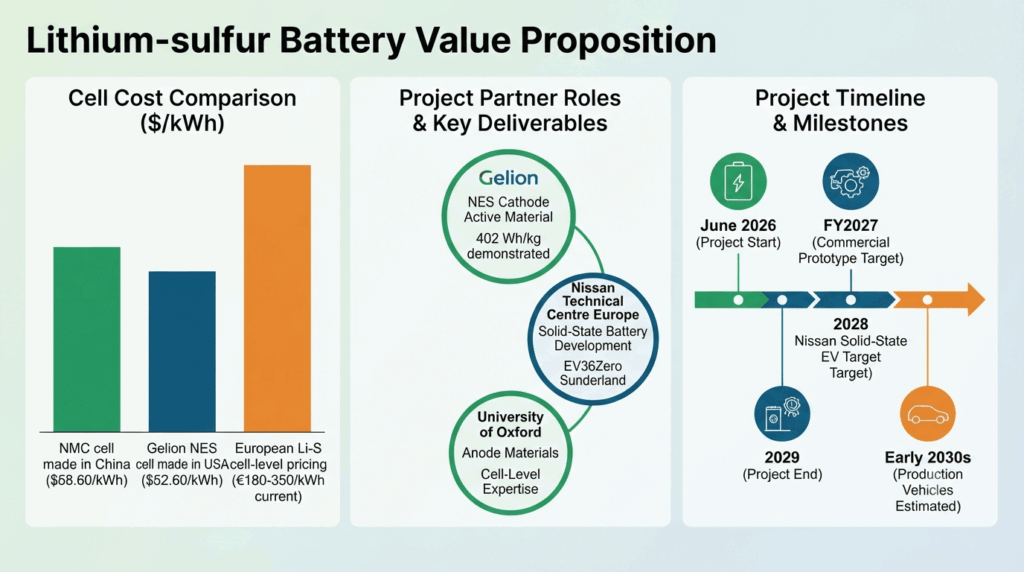
The project brings together three partners with complementary capabilities. Gelion provides its Nano-Encapsulated Sulfur (NES) cathode active material. Nissan Technical Centre Europe contributes its solid-state battery development capabilities and automotive engineering expertise. The University of Oxford, a global leader in solid-state battery science, provides advanced anode materials and cell-level expertise to de-risk integration.2
The goal is specific: build and deliver a high-power, high-energy, long-duration solid-state lithium-sulfur battery pack that meets the key performance indicators of automotive solid-state battery applications. The project is informed by Nissan’s performance, safety, and manufacturability requirements.3
The project commenced in June 2026 and runs for three years. Results will inform future scale-up, manufacturing, and commercialisation efforts for solid-state batteries, with the potential to expand collaboration across the automotive and energy storage sectors.4
Gelion’s NES Technology: Why This Is Different
Lithium-sulfur batteries have been researched for decades. The fundamental challenge has always been the same: during charging and discharging, sulfur forms intermediate compounds called polysulfides that dissolve into the electrolyte, migrate to the anode, and cause rapid capacity fade and short cycle life.5
Gelion’s NES technology addresses this through nano-encapsulation. By coating sulfur particles at the nanoscale, the technology physically contains the polysulfides and prevents their migration. Gelion claims this overcomes the historical limitations, “unlocking performance levels previously considered unachievable for sulfur cathodes.”6
The NES cathode is made from sulfur that is abundantly available and free from supply chain constraints. It is designed to be a drop-in solution that can be integrated into existing global manufacturing lines.7
Gelion has already demonstrated the technology’s potential in liquid-electrolyte systems. Its GEN 3 lithium-sulfur battery achieved 402 Wh/kg energy density in a 12 Ah cell, more than 60% higher than a typical lithium-ion battery.8 That performance was achieved with a semi-solid-state architecture. The CoRe-SoLiS project aims to take that cathode technology and integrate it into a true solid-state cell.
Adrien Amigues, President of Gelion UK and Europe and Project Lead for CoRe-SoLiS, framed the opportunity: “Our technology is particularly well-suited to solid-state batteries due to the exceptional physical properties of NES, its unique potential to substitute NMC and be used as a drop-in solution into existing and future solid-state battery production lines.”9
The Cost Argument: Can Lithium-Sulfur Undercut China?
The most compelling part of the lithium-sulfur proposition is economic. Sulfur is dramatically cheaper than cobalt or nickel. A 2026 academic review noted that sulfur’s raw material cost is approximately $0.02 per gram, and that Li-S cells do not require costly and environmentally challenging rare metals such as cobalt, nickel, and manganese.10
The Longspur Capital research report published in June 2026 made a more specific claim. Longspur calculated that using Gelion’s NES material, a battery cell could be produced in the United States for $52.60 per kilowatt-hour, below the $58.60 per kilowatt-hour cost of a conventional nickel manganese cobalt cell made in China.11
The report, titled “Cheaper Than China,” argued that Gelion has “successfully developed a battery cathode material platform that delivers the benefits of high-performance lithium ion but that could be produced in the West more cheaply than China today, levelling the playing field in this strategically important area.”
That claim is significant. The cost advantage that Chinese battery manufacturers currently hold is not solely due to scale or cheap labour. It is also due to supply chain integration and access to low-cost materials. If lithium-sulfur can undercut NMC on cost in the United States, the competitive dynamics of the global battery industry change.
The European Union’s own price data provides a reality check. Cell-level pricing for lithium-sulfur batteries in the EU ranged from €180 to €350 per kWh in 2026, significantly higher than mainstream lithium-ion at €80 to €140 per kWh.12 The gap reflects the immaturity of the supply chain and the absence of manufacturing scale. The question is how quickly that gap closes.
The Manufacturing Advantage: Drop-In Compatibility
One of the most commercially significant aspects of Gelion’s approach is its compatibility with existing manufacturing infrastructure. The NES cathode is designed to be a drop-in solution that can be integrated into existing global production lines.13
This is not a universal characteristic of solid-state technologies. Sulfide-based solid electrolytes, for example, require entirely new manufacturing environments with ultra-low humidity and specialised handling equipment. The capital investment required to build those facilities is substantial.
Gelion’s NES technology, by contrast, is designed to work within the existing lithium-ion manufacturing ecosystem. It replaces the cathode material without requiring a complete overhaul of the production process. That compatibility dramatically reduces the capital investment required to scale production and accelerates the path to commercialisation.
The strategic implication is clear. If lithium-sulfur cathodes can be produced on existing lines, the barrier to entry for Western battery manufacturers is lower. The competitive advantage of Chinese manufacturers, built on decades of supply chain development and manufacturing scale, is partially neutralised.
The Solid-State Synergy
The CoRe-SoLiS project is not just about lithium-sulfur. It is about combining lithium-sulfur with solid-state electrolytes. The partners believe these technologies complement and extend each other.14
Solid-state electrolytes eliminate the flammable liquid electrolyte used in conventional lithium-ion cells, improving safety. They also provide a more stable environment for the sulfur cathode, potentially further reducing polysulfide dissolution. The combination of a solid electrolyte and a nano-encapsulated sulfur cathode addresses the two primary failure modes of lithium-sulfur chemistry.
John Wood, CEO of Gelion, explained the logic: “The two primary opportunities to push battery performance boundaries (independently) are solid-state and sulfur cathode material. This project combines both, and we are excited by the way the core technologies have the potential to complement and extend each other.”15
The solid-state architecture also enables the use of lithium-metal anodes, which store approximately ten times more lithium per unit volume than graphite. That is the pathway to the energy densities that solid-state batteries have long promised.
The Challenges: What Could Go Wrong
The honest assessment requires acknowledging that lithium-sulfur has failed to commercialise for decades. Multiple companies have attempted to bring the technology to market and failed. OXIS Energy, a UK lithium-sulfur battery company, entered administration in 2021 after failing to commercialise its technology. One industry observer, commenting on the CoRe-SoLiS announcement, noted: “How much did the University of Oxford already put into Oxis? Try again I suppose.”16
The polysulfide problem is real and well-documented. A 2026 review in the journal Advanced Materials noted that practical deployment of lithium-sulfur batteries remains hindered by polysulfide shuttling, sluggish sulfur redox kinetics, severe volume expansion, and limited cycle life.17
Cycle life remains the most significant challenge. Automotive qualification typically requires 1,000 to 2,000 cycles at 80% capacity retention. Recent research has made progress: a strain-coordination strategy published in Nature Communications in June 2026 demonstrated 4,500 cycles at 1C and 140,000 cycles at 15C in an all-solid-state lithium-sulfur cell.18 But these are laboratory results, not production validation.
Manufacturing scale is another barrier. Global lithium-sulfur production remains negligible compared to lithium-ion. Even with Gelion’s partnerships and the CoRe-SoLiS project, the path from laboratory to gigawatt-hour production is measured in years.
Gelion is not relying solely on the Nissan project. The company has signed a £2 million funded development agreement with Mitsui Kinzoku of Japan to accelerate commercial development of the NES cathode, with Mitsui Kinzoku paying in milestone-linked staged payments and securing an option to negotiate manufacturing and distribution rights in certain Asian territories.19 Gelion also has collaborations with TDK, QinetiQ, and the Max Planck Institute.20 These partnerships spread the development risk and broaden the potential commercialisation pathways.
The Timeline: When Could Lithium-Sulfur Reach Production?
The CoRe-SoLiS project runs from June 2026 to June 2029. Gelion has stated that results will inform future scale-up and commercialisation efforts.21
Gelion’s own commercial prototype target is FY2027. A prototype would demonstrate that the technology can be manufactured at scale and integrated into production-ready battery packs.
Nissan’s broader solid-state strategy targets a 2028 launch for its first all-solid-state EV. The CoRe-SoLiS project is designed to inform that timeline, though it is not the sole source of Nissan’s solid-state technology. Nissan has been developing solid-state batteries independently and through other partnerships.
The realistic production timeline, accounting for the project duration, manufacturing scale-up, and automotive qualification, is early 2030s for lithium-sulfur EVs reaching consumers. That is consistent with the broader solid-state commercialisation timeline. Lithium-sulfur is a second-generation solid-state solution, arriving after the first wave of solid-state batteries that use conventional NMC or high-nickel cathodes.
What This Bet Actually Means
The £3.4 million CoRe-SoLiS project is not a guarantee of success. It is a bet. The bet is that sulfur, the tenth most abundant element on Earth, can replace nickel and cobalt in electric vehicle batteries. The bet is that nano-encapsulation can solve the polysulfide problem that has defeated previous attempts. The bet is that solid-state electrolytes and sulfur cathodes can work together to deliver the performance, safety, and cost that the EV industry needs.
The partners are credible. Gelion has demonstrated 402 Wh/kg in liquid-electrolyte lithium-sulfur cells. Nissan has been developing solid-state batteries for years and has a production line in Yokohama. Oxford University is a global leader in solid-state battery science. Innovate UK has provided £2.4 million in grant funding, a signal of government confidence in the technology’s strategic importance.
The economics are compelling. If Longspur Capital’s calculation is correct, a lithium-sulfur cell produced in the United States could undercut a Chinese NMC cell on cost. If that holds at scale, the competitive dynamics of the global battery industry change fundamentally.
The timeline is long. Production vehicles are unlikely before the early 2030s. The project that starts in 2026 will not deliver commercial products in this decade.
The bet is worth making. The alternative is continued dependence on nickel and cobalt, continued vulnerability to supply chain shocks, and continued acceptance that the cheapest batteries will always come from China. Sulfur offers a different path. The £3.4 million project is a step down that path. Whether it leads anywhere will be determined by the engineering, not the ambition.