On 25 February 2024, a fire in an underground car park in Changsha, Hunan province, destroyed 72 vehicles and injured multiple people. The fire originated from an EV charging in the underground facility. On 19 April 2024, a similar incident in Guangzhou’s Haizhu district caused significant property damage when an EV battery entered thermal runaway while charging in an underground car park. These incidents — and dozens of similar though less publicised events throughout 2023-2025 — have moved Chinese fire safety authorities, property management companies, and the residents who park their EVs underground every night from theoretical concern to concrete policy and practical action.
This is not a guide designed to frighten Chinese EV owners out of charging at home. Home EV charging — done correctly, with certified equipment, properly installed, in adequately ventilated spaces, following the habits this guide establishes — is safe. The tens of millions of Chinese EV owners who charge at home nightly without incident are evidence of this.
This guide on fire safety and EV charging what Chinese homeowners need to know about indoor parking risks exists because “safe when done correctly” requires understanding what “correctly” specifically means in the context of underground and covered indoor parking, where the consequences of anything going wrong are meaningfully more severe than they would be in open-air parking. The specific combination of confined space, limited ventilation, shared infrastructure, and concentrated vehicle density that characterises Chinese residential underground car parks creates a fire risk environment genuinely distinct from other EV charging contexts — and one that deserves the specific, honest treatment this guide provides.
Understanding EV Battery Fire — What Actually Causes It and Why It Matters for Indoor Parking
Thermal Runaway — The Specific Mechanism Behind EV Charging Fires
What thermal runaway is:
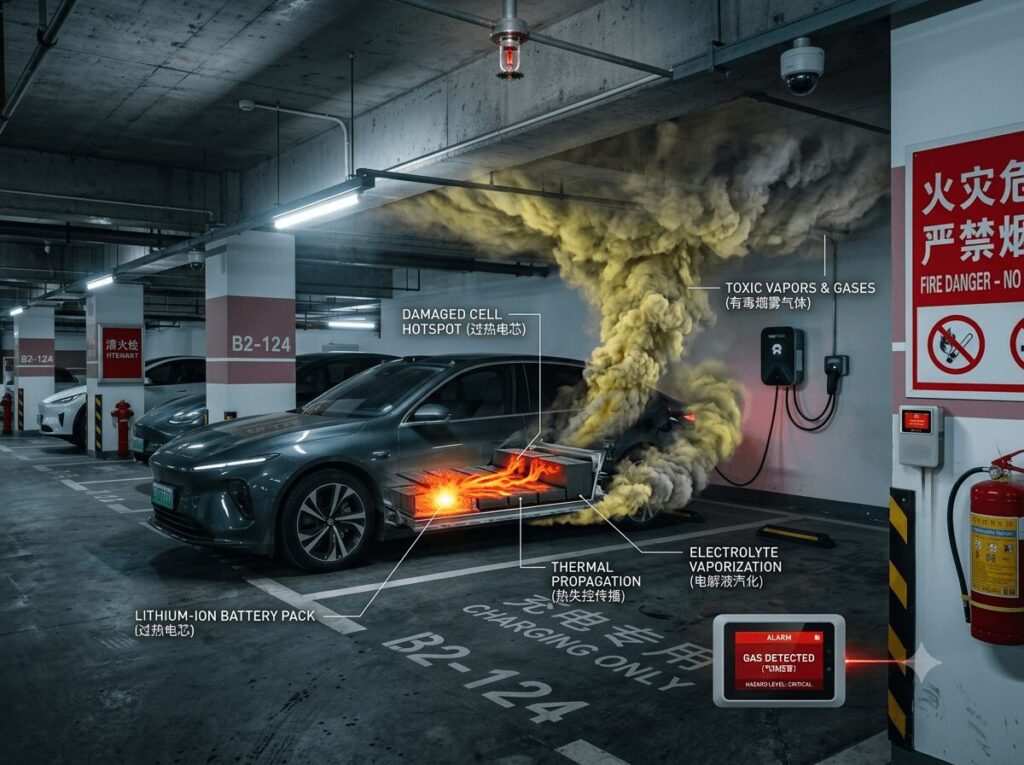
Thermal runaway is the specific failure mode responsible for the most severe EV battery fire incidents. It describes a self-reinforcing chain reaction within a lithium-ion battery cell where:
- An initiating event — internal short circuit from cell damage, external short circuit from charging equipment fault, overcharging beyond the battery’s safe maximum voltage, manufacturing defect, or sustained extreme thermal stress — causes localised heating within one or more cells
- This localised heating causes further chemical breakdown of cell materials (particularly the electrolyte), releasing additional heat and flammable gases
- The released heat triggers the same breakdown in adjacent cells, creating a propagating chain reaction
- The released flammable gases, if ignited, produce the fire that external observers see
Why this matters specifically for underground parking:
The thermal runaway process, once initiated, releases toxic and flammable gases including hydrogen fluoride, carbon monoxide, methane, and other combustion products, before any visible fire begins. In open-air outdoor environments, these gases disperse rapidly. In underground car parks with limited air exchange, they can accumulate to dangerous concentrations before ignition, producing an explosive combustion event rather than a progressive fire when ignition eventually occurs.
Additionally, EV battery fires, once fully established, burn at extremely high temperatures (800°C-1000°C+), resist standard suppression approaches, and can reignite hours after apparent extinguishment due to the ongoing chemical reactions within damaged cells. These characteristics make fire suppression in the confined spaces of underground car parks significantly more challenging and dangerous for fire services than surface-level vehicle fires.
What Initiates Thermal Runaway — The Specific Charging-Related Causes
Charging-related thermal runaway causes relevant to home EV owners:
Charging equipment fault: Malfunctioning charging equipment that delivers voltage or current beyond the battery’s rated safe limits — specifically relevant to uncertified equipment whose protection circuitry may not function as claimed, as covered extensively in our 3C certification and fake certification detection guides.
RCCB failure allowing sustained fault current: As covered in our troubleshooting guide, a malfunctioning RCCB that fails to trip when a ground fault occurs can allow sustained fault current that generates heat at the fault location, potentially initiating thermal runaway in the vehicle’s charging system.
Mechanical damage to battery during preceding driving: Impact damage to the battery pack from road debris, kerb strikes, or minor collisions can create internal cell damage that isn’t immediately apparent but produces an internal short circuit under the stress of subsequent charging — which is why fire safety guidance consistently recommends having a vehicle inspected before resuming charging if it has experienced any impact to the underbody.
Manufacturing defect in specific cell batches: This is a known and documented cause of EV battery fire incidents globally — manufacturing defects that produce internal short circuits that may take months or years to manifest, sometimes doing so during charging when the battery is at its highest voltage and therefore its highest stress state.
The Underground Parking-Specific Risk Factors
Why Underground Parking Amplifies EV Charging Fire Risk
The ventilation constraint:
Chinese residential underground car parks are ventilated, but their ventilation is designed for vehicle exhaust removal and general air quality management — not for the rapid dispersal of the flammable and toxic gases that thermal runaway releases in quantities that can be substantial (a full EV battery in thermal runaway can release hundreds of litres of flammable gas before ignition).
Standard underground car park ventilation rates in Chinese residential buildings, typically designed to meet GB50067 (Code for Design of Garage Buildings) ventilation requirements, may be insufficient to prevent dangerous gas accumulation during a thermal runaway event before automatic fire detection systems respond.
The fire suppression access constraint:
Underground car parks limit fire service access — the primary access points are ramps and stairwells, the same paths through which vehicle exhaust and fire gases travel upward when ventilation is compromised. The confined geometry limits the approaches fire services can use for suppression, prolongs their response time compared to surface incidents, and creates smoke and gas accumulation that makes interior access hazardous.
The thermal mass and heat retention:
The concrete structure of underground car parks retains heat more effectively than open-air environments, potentially allowing temperatures to reach levels that propagate thermal runaway to adjacent vehicles faster than would occur outdoors.
The adjacent vehicle density:
Underground residential car parks in Chinese cities often have vehicle spacing that meets the minimum requirements of GB50067 but leaves limited clearance between adjacent vehicles — meaningful when an EV battery fire produces the extreme heat documented in such incidents, which can ignite adjacent conventional (petrol) vehicles whose fuel represents a significant secondary fire hazard.
The Chinese Regulatory Response — What Has Changed
National and Local Regulations Addressing EV Indoor Parking Fire Risk
The national framework:
China’s fire safety authorities — the Ministry of Emergency Management (应急管理部) and the National Fire and Rescue Administration (消防救援局) — have progressively issued guidance on EV parking and charging fire safety as the scale of EV adoption has made this an increasingly significant national safety consideration.
Key regulatory developments relevant to residential underground EV charging:
Thermal runaway detection requirements: Updated guidance has emphasised the need for underground car parks used for EV storage and charging to have fire detection systems sensitive to the gases released during early-stage thermal runaway — moving beyond traditional smoke or heat detectors toward more sophisticated gas detection capable of identifying hydrogen and hydrocarbon releases before flaming ignition occurs.
Charging equipment certification enforcement: The August 2026 certification deadline context covered in our dedicated compliance guide reflects broader fire safety-driven regulatory tightening specifically motivated by the fire incident record, recognising that uncertified charging equipment’s uncertain RCCB and overvoltage protection represents a specific thermal runaway initiation risk.
物业 obligations: Several Chinese cities have issued specific guidance establishing 物业 obligations regarding EV charging safety in their managed compounds — including requirements to use only certified charging equipment, to maintain separation between charging vehicles and non-EV vehicles where possible, and to report any EV charging-related safety incidents to fire authorities.
Local government specific regulations:
Several major Chinese cities have moved beyond national guidance to establish local regulations with specific requirements:
Shanghai has issued specific requirements for underground car park EV charging area design, including minimum ventilation rates for areas where EV charging occurs, specific requirements for charging equipment certification, and requirements for automatic fire suppression system provisions in car park areas with high EV charging density.
Shenzhen’s fire safety guidance has specifically addressed the gas detection recommendation as a near-mandatory requirement for new underground car park developments and has established retrofit requirements for existing car parks in certain building categories.
Beijing’s guidance has emphasised the compound-level management of EV charging, including requirements for 物业 companies to maintain records of certified charging installations and to conduct periodic safety inspections.
The Practical Fire Safety Habits for Chinese EV Owners Charging Indoors
Habit 1: Never Leave Charging Completely Unmonitored When Battery Is in Poor Condition
The specific high-risk charging scenario:
As covered in our winter charging guide, a battery that has experienced sustained cold exposure, deep discharge, or any impact event represents a higher thermal runaway initiation risk during subsequent charging than a battery in normal condition. Charging such a battery overnight in underground parking without any monitoring represents the combination of elevated risk and delayed detection that produces the most severe outcomes.
The practical mitigation:
Smart charger app notifications — available on all major smart charger brands covered throughout this guide series — can be configured to alert the owner’s phone if charging stops unexpectedly, if charging current shows unusual patterns, or if the session completes. These notifications provide early warning of potential problems without requiring the owner to physically check the vehicle.
Additionally, most modern Chinese EV apps provide real-time battery condition monitoring that can show if the battery’s internal temperature is behaving unusually during charging — worth a brief check before going to sleep on any night when the vehicle has experienced an unusual condition during the day.
Habit 2: Target 80% SOC, Not 100%, for Routine Overnight Charging
The fire safety basis for this recommendation, beyond the battery longevity reasons covered throughout this guide series:
As covered in our charge time calculator guide’s discussion of SOC management for battery longevity, charging to 80% rather than 100% is recommended for routine daily use because lithium-ion cells are at their highest chemical stress at maximum SOC — including their highest thermal runaway initiation susceptibility. A battery held at 100% SOC is chemically more reactive than the same battery at 80% SOC, meaning the temperature threshold for initiating thermal runaway is somewhat lower at maximum SOC.
For underground parking specifically:
This provides a specific, quantifiable risk reduction for the overnight charging period when the vehicle is unoccupied in the underground environment and any thermal runaway event would develop for an extended period before detection and response. The recommendation to charge to 80% rather than 100% for routine use has both battery longevity and fire safety justification — the latter being particularly relevant for underground charging contexts.
Habit 3: Verify RCCB Function Regularly
Why RCCB verification matters for fire safety specifically:
The RCCB (Residual Current Circuit Breaker) is the primary protection against the ground fault current that can cause sustained heating in charging cables and connectors — one of the specific charging equipment fault mechanisms identified above as a thermal runaway initiation pathway. A malfunctioning RCCB that fails to trip when a ground fault occurs allows this heating to continue unchecked.
The verification process:
As covered in our troubleshooting guide, the RCCB test button should be pressed periodically — quarterly is a reasonable schedule — while the charger is powered (but with the vehicle disconnected from the connector end) to confirm the RCCB trips correctly. An RCCB that fails to trip when its test button is pressed has failed and represents an active fire safety concern requiring replacement before the charger is used again.
Habit 4: Never Charge Immediately After a Suspected Impact Event
The specific scenario:
If your vehicle has experienced any impact to its underbody, floor, or rear (where battery packs typically extend) — including minor incidents that might not seem significant, such as driving over road debris, a moderately severe pothole impact, or a minor parking collision — fire safety guidance consistently recommends having the battery inspected by an authorised service centre before resuming charging, particularly charging in enclosed spaces overnight.
The practical challenge:
This habit conflicts with the convenience of overnight charging and the fact that most minor impacts produce no immediately observable vehicle behaviour change that would alert the driver. The practical implementation requires deliberate attention to any impact event during the day and a deliberate decision to defer overnight charging until the vehicle can be inspected — not an easy habit to maintain but one that addresses a genuine documented risk pathway.
Habit 5: Know Your Underground Car Park’s Fire Safety Infrastructure
Why this matters:
As covered earlier in this guide, underground car parks vary meaningfully in their fire safety provisions — both in the design quality of their fixed systems (suppression, detection, ventilation) and in how recently those systems have been inspected and maintained. This variation directly affects how quickly an EV charging fire would be detected and how effectively it would be suppressed.
The specific information to gather:
Ask your 物业 specifically:
- When was the underground car park’s fire suppression system (typically wet pipe sprinkler for residential car parks in China) last inspected and certified?
- Does the car park have CO or gas detection in addition to smoke/heat detection?
- What is the emergency contact procedure if a charging event causes any concern during overnight hours?
- Has the 物业 received any guidance from local fire authorities regarding EV charging in the car park?
This isn’t intended to create anxiety but to arm owners with specific information that helps calibrate appropriate precautions.
Habit 6: Choose a Charging Position With Maximum Ventilation Where Possible
The practical application:
If your parking space location isn’t fixed (or if you have flexibility in which of adjacent spaces to use for charging versus non-charging storage of a second vehicle), choosing the position with the best proximity to the car park’s ventilation air supply points — typically near the entrance ramp where fresh air enters from the surface — provides better gas dispersal in the event of any early-stage thermal runaway, before dangerous concentration accumulates.
The Charging Equipment Choices That Specifically Reduce Fire Risk
Prioritise Certified Equipment for Underground Parking Above All Other Contexts
The asymmetry between outdoor and indoor uncertified charger risk:
As covered in our fake certification detection guide, our 3C certification guide, and our August 2026 compliance guide, uncertified EV charging equipment represents a meaningful risk in any context. But the specific risk profile in underground parking — where any fire initiation produces a more severe, more dangerous outcome than outdoor equivalents — makes the certification requirement specifically non-negotiable for this context.
An uncertified charger in outdoor or open-carport parking creates a genuine risk but one with more natural containment. The same uncertified charger in underground parking creates the same initiation risk with substantially worse consequences if that risk materialises. The case for using certified equipment in underground parking is correspondingly stronger than the already-strong case that applies in any context.
The RCCB Type B Specification Is Specifically Relevant for Underground Charging
As covered in our professional installation costs guide, the distinction between Type A/AC and Type B RCD protection devices is specifically meaningful for the fire safety context of underground EV charging.
Type B RCDs detect both AC and DC fault currents — the full range of fault types that EV onboard charging systems can produce. Type A/AC RCDs detect only AC fault currents — potentially missing DC leakage from certain fault modes in EV charging systems.
For underground parking specifically, where the consequences of an undetected ground fault developing into a heating event are more severe than in other contexts, specifying Type B protection in the dedicated EV charging circuit is a meaningful, quantifiable fire safety improvement over the minimum technically-acceptable Type A/AC specification.
Smart Monitoring Capability Is Not a Luxury Feature for Underground Charging
The specific value of remote monitoring for underground parking:
As covered throughout our smart charger comparison and connectivity guides, smart charger app notifications and remote monitoring are primarily discussed in terms of their financial value (TOU scheduling optimisation) and convenience value. For underground charging specifically, the safety value of remote monitoring deserves equal emphasis:
A smart charger that stops charging due to any fault and immediately notifies the owner’s phone provides detection of any charging anomaly within minutes of occurrence, regardless of the time of night, allowing the owner to assess whether investigation is warranted — potentially detecting a developing problem before it has reached fire-initiating severity.
A basic non-smart charger that stops charging for any reason provides no notification, potentially allowing a developing fault condition to sit unobserved through an entire overnight period.
For underground parking specifically, the recommendation to use a smart charger isn’t primarily about TOU savings — it’s about the monitoring capability that can provide the earliest possible detection of any charging anomaly.
The 物业 and Building Management Perspective
What Chinese Residential 物业 Are Doing About EV Charging Fire Risk
The 物业 response pattern that has emerged since 2023:
Following the documented fire incidents and the regulatory guidance that followed them, Chinese residential compound 物业 management companies have taken a range of responses to EV charging fire risk in their underground car parks, varying significantly by company quality, building age, and local regulatory environment:
More proactive 物业 responses (larger, more professional operators):
Implementing formal certification verification as part of the charging installation approval process — requiring owners to demonstrate 3C certification of their specific charger model before approval, connected to the August 2026 deadline framework.
Installing automatic gas detection systems (hydrogen and hydrocarbon sensors) in areas of higher EV charging density, supplementing the standard smoke and heat detection.
Designating specific areas of the underground car park for EV charging, with those areas having better ventilation, gas detection, and in some cases dedicated suppression provisions.
Establishing specific protocols for what to do if an EV exhibits any unusual charging behaviour (excessive heat, unusual sounds from the battery area, unusual smells).
Less proactive 物业 responses (smaller operators, older buildings):
Continuing to process charging installation applications without specific certification verification beyond cursory review.
Relying entirely on existing smoke/heat detection without gas detection supplementation.
No specific EV charging-related safety protocols beyond the general fire safety procedures that apply to the building.
What this means for residents:
The quality of your 物业’s EV charging fire safety response varies significantly and is worth understanding specifically — both because it directly affects the actual safety of your charging environment and because owners who understand their 物业’s specific provisions can make informed decisions about what additional personal precautions are warranted to supplement whatever the building-level provisions include.
The Emergency Response — What to Do If Something Goes Wrong
If You Observe Any Unusual Charging Behaviour
Swelling, unusual heat, smell, or sounds from the vehicle during charging:
These are specific early-warning indicators that warrant immediate action:
- Disconnect the charging connector from the vehicle immediately (do not disconnect at the wall/charger end first — the connector end gives you more immediate control of the vehicle-side connection)
- Move away from the vehicle to at least 20 metres
- Call your compound’s 物业 emergency number and inform them of the situation
- Call emergency services (119 for fire) immediately — do not wait for visible smoke or fire
- Alert any people in the immediate area to evacuate the car park level
- Do not attempt to enter a vehicle whose battery may be in early-stage thermal runaway
If You See Smoke or Fire From a Vehicle in the Car Park
The specific underground fire response:
- Activate the car park’s manual fire alarm pull station if one is immediately accessible
- Call 119 immediately, specifying “electric vehicle fire in underground car park” — this information affects how fire services respond, as they need to bring appropriate suppression materials for lithium battery fires
- Evacuate through the nearest stairwell (not the vehicle ramp, which may become smoke-filled) and close fire doors behind you
- Do not attempt to move your own vehicle if it requires passing close to the burning vehicle
- Do not attempt to suppress an EV battery fire with standard portable fire extinguishers — these may temporarily suppress surface flames while failing to address the ongoing internal reaction
Internal Links — Further Reading on Clean Energy Bazaar
The fire safety and EV charging what Chinese homeowners need to know about indoor parking risks guide is the safety foundation companion to every installation and equipment guide in this content cluster.
For the 3C certification guide establishing why uncertified equipment specifically increases fire initiation risk, our 3C certification and EV chargers 2026 why buying non-certified chargers is dangerous in China guide covers every safety requirement. For the flywire charging safety guide that addresses another significant fire risk factor in underground parking specifically, our China apartment flywire charging is it safe legal solutions for lower ground parking guide covers every safety and legal consideration. For the fake certification detection guide that helps confirm certified equipment for underground use, our spotting fake 3C logos how Chinese buyers can verify certification on Taobao JD chargers guide covers the complete verification process. For the professional installation costs guide covering the Type B RCD specification specifically relevant to underground parking fire safety, our professional EV charger installation costs 2026 what State Grid chargers vs private companies charge guide covers every installation requirement. For the troubleshooting guide covering RCCB function verification relevant to fire prevention, our troubleshooting home EV chargers common error codes for GB/T standards guide covers every common fault category. And for the smart charger guide covering the monitoring capability that provides critical early warning for underground charging, our best smart EV chargers China 2026 Huawei Digital Power vs Xiaomi vs local innovators guide covers every smart monitoring platform.
Final Thoughts
The fire safety and EV charging what Chinese homeowners need to know about indoor parking risks assessment produces a genuinely balanced conclusion: indoor EV charging in Chinese residential underground car parks is safe for the overwhelming majority of owners the overwhelming majority of the time, provided it is done with certified equipment, professionally installed, with adequate protection devices, following the habits this guide has detailed. The documented fire incidents that motivated this guide’s existence represent a small proportion of the total overnight charging events that occur across China’s tens of millions of home EV chargers — but a proportion that is not negligible and whose consequences in underground environments are severe enough to warrant the specific attention this guide has given them.
The specific actions that meaningfully reduce indoor EV charging fire risk are neither burdensome nor expensive:
Use certified equipment — confirmed through the database verification process covered in our dedicated verification guide. Use Type B RCD protection in the dedicated circuit — a ¥100-¥350 component upgrade over Type A. Configure smart charger monitoring notifications — a free setting adjustment in any smart charger app. Target 80% SOC for routine charging — a scheduling configuration that also extends battery longevity. Verify RCCB function quarterly — a 30-second test with the button that’s there specifically for this purpose. Know your car park’s fire infrastructure and 物业 emergency contact — a ten-minute information-gathering exercise. Defer overnight charging after any underbody impact event — a deliberate decision on specific occasions.
None of these is technically complex. Together, they address the specific initiation pathways and detection gaps that the documented fire incident record has identified as the genuine risk factors for this specific context.
The goal of this guide, and of this entire content cluster, has been to make home EV charging in China as safe, as financially optimal, and as practically effective as it can be for every owner in every circumstance. Fire safety for indoor parking is the dimension of that goal where the stakes are highest and the specific knowledge requirements are most distinct from the broader charging guidance. This guide provides that specific knowledge. Apply it.