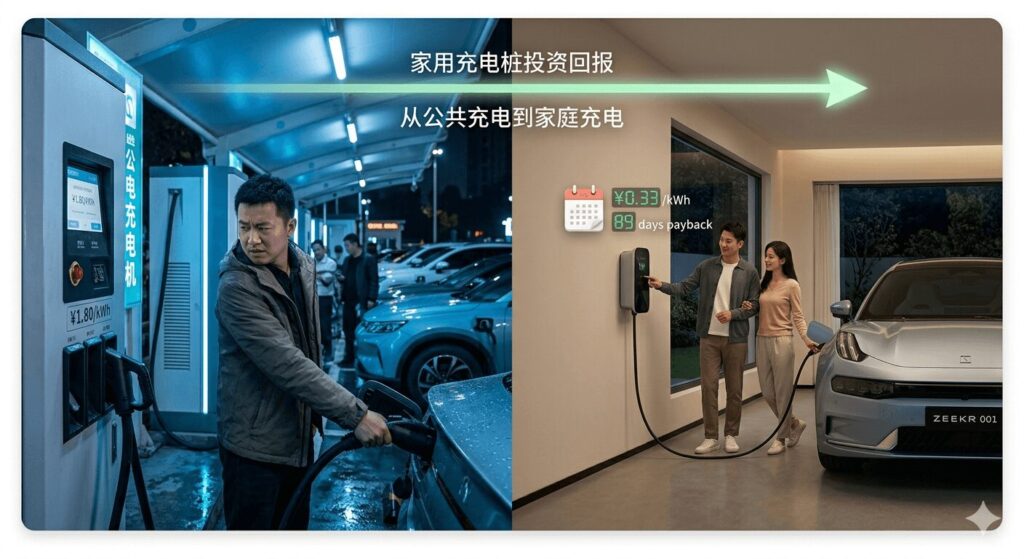
Here is the question that every rational Chinese EV buyer should ask before spending ¥3,000-¥8,000 on home charger hardware and installation.
Not “which charger is best?” Not “what features do I need?” But the most financially fundamental question: when does this investment pay for itself, and what is the total return over the ownership period?
The answer depends on variables that differ between every owner — which city they live in, how much they currently drive, how they currently charge, what rebates they qualify for, and what charger and installation combination they choose. A Shanghai owner driving 25,000 km/year who currently relies on public DC fast charging has a dramatically different ROI calculation from a Chengdu villa owner driving 12,000 km/year who charges from a standard socket.
This guide on the EV home charger ROI calculator 2026 when it pays off with local rebates included does the complete ROI calculation for every major Chinese EV owner scenario — with the most common city subsidies applied, the realistic electricity rate differentials used, and the honest total cost of ownership numbers that transform the “which charger should I buy” question into “here is exactly when your investment returns your money.”
The ROI Framework — What We Are Actually Calculating
Return on Investment Defined
ROI for a home EV charger is not merely whether the charger “pays off” in some abstract sense — it is the specific financial return on a specific investment over a specific ownership period.
The complete ROI calculation:
Total Investment: Charger hardware + installation cost − applicable government subsidies + any ongoing costs (app subscriptions, data plans)
Annual Financial Return: Annual electricity cost savings (home TOU versus current charging method) + annual demand response income (if applicable)
Payback Period: Total net investment ÷ annual financial return = years to break even
5-Year Net Return: (Annual return × 5) − Total net investment = total profit or loss over 5 years
10-Year Net Return: (Annual return × 10) − Total net investment = total profit or loss over 10 years
The Three Cost Comparisons That Drive ROI
The annual financial return depends on what you are currently paying for electricity versus what you will pay with home TOU charging. There are three distinct comparison scenarios:
Comparison 1: Home TOU charging vs public DC fast charging (highest saving) Chinese EV owners who currently have no home charging and rely entirely on public DC fast charging at ¥1.20-¥2.50/kWh are the owners for whom home charger ROI is most compelling.
Comparison 2: Home TOU charging vs standard socket charging without TOU (moderate saving) EV owners who already have some home socket access but aren’t on TOU pricing — paying full residential rate for EV electricity.
Comparison 3: Home TOU charging vs standard socket charging WITH car timer TOU (lowest saving) EV owners who have already captured TOU savings using their car’s built-in timer and a standard socket. The home charger investment in this case is primarily about charging speed and convenience rather than electricity cost reduction.
The Cost Input Reference — What Each Component Actually Costs
Before building ROI scenarios, establishing accurate cost inputs prevents the calculations from being misleading.
Hardware Costs
| Charger | Price Range | Representative Price Used |
|---|---|---|
| ChargeWay CW-J7032 (basic 7 kW) | ¥580-¥780 | ¥680 |
| StarCharge S1 (smart 7 kW) | ¥899-¥1,099 | ¥999 |
| Autel MaxiCharger (IP65, OCPP) | ¥1,299-¥2,499 | ¥1,699 |
| Xiaomi EV Charger (Mi Home) | ¥1,099-¥1,999 | ¥1,399 |
| Huawei FusionCharge (AI) | ¥1,800-¥4,500 | ¥2,800 |
| NIO Home Charger (standard pricing) | ¥800-¥1,500 | ¥1,150 |
| BYD Smart Charger (bundle pricing) | ¥800-¥1,600 | ¥1,200 |
Installation Costs
| Scenario | Installation Range | Representative Used |
|---|---|---|
| Simple (under 5m, existing infrastructure) | ¥650-¥1,400 | ¥1,050 |
| Standard (5-15m cable run) | ¥1,200-¥2,350 | ¥1,750 |
| Complex (15-30m cable run) | ¥1,900-¥3,800 | ¥2,850 |
| Villa private garage (simple) | ¥800-¥1,800 | ¥1,300 |
Government Installation Subsidies
| City | Subsidy Range | Representative Used |
|---|---|---|
| Shanghai | ¥1,500-¥2,100 | ¥1,800 |
| Beijing (standard) | ¥1,000-¥2,000 | ¥1,500 |
| Beijing (with demand response registration) | ¥2,000-¥4,800 | ¥2,800 |
| Shenzhen | ¥1,000-¥2,800 | ¥2,000 |
| Guangzhou | ¥800-¥2,500 | ¥1,500 |
| Chengdu | ¥500-¥1,000 | ¥750 |
| Wuhan | ¥500-¥1,300 | ¥900 |
| Hangzhou | ¥500-¥1,500 | ¥1,000 |
| Tier-2 general | ¥200-¥1,000 | ¥600 |
| Rural/township | ¥0-¥500 | ¥250 |
Annual Demand Response Income
For owners who register for demand response programmes in pilot cities with OCPP-compliant chargers:
| City | Annual Income Range | Representative Used |
|---|---|---|
| Shanghai | ¥100-¥500 | ¥300 |
| Beijing | ¥300-¥800 | ¥550 |
| Shenzhen | ¥150-¥600 | ¥375 |
| Other pilot cities | ¥100-¥400 | ¥250 |
ROI Scenario Calculator — 12 Detailed Calculations
Scenario 1: Shanghai, BYD Han EV, Currently Public DC Only
Owner profile:
- City: Shanghai
- Vehicle: BYD Han EV Long Range (76.9 kWh, 18 kWh/100km)
- Annual mileage: 20,000 km
- Current charging: 100% public DC fast charging at ¥1.80/kWh average
- Parking: Covered underground with designated space
Current annual charging cost: 20,000 km ÷ 100 × 18 kWh × 1.12 efficiency × ¥1.80 = ¥7,257/year
With home TOU (StarCharge S1, ¥0.34/kWh valley): 4,074 kWh × ¥0.34 = ¥1,385/year
Annual saving: ¥5,872/year
Investment calculation:
| Component | Cost |
|---|---|
| StarCharge S1 | ¥999 |
| Standard installation | ¥1,750 |
| Gross investment | ¥2,749 |
| Shanghai subsidy | -¥1,800 |
| Net investment | ¥949 |
ROI Calculation:
| Metric | Result |
|---|---|
| Net investment | ¥949 |
| Annual return | ¥5,872 |
| Payback period | 0.16 years (59 days) |
| 1-year net return | ¥4,923 |
| 5-year net return | ¥28,411 |
| 10-year net return | ¥57,771 |
This is the most compelling home charger ROI in China in 2026. An owner switching from 100% public DC charging to home TOU charging in Shanghai recovers the net installation investment in under two months. Over 10 years, the investment returns ¥57,771 — 60× the net investment.
Scenario 2: Beijing, NIO ET5 75kWh, Currently Public DC and Swap Mix
Owner profile:
- City: Beijing
- Vehicle: NIO ET5 (75 kWh standard battery)
- Annual mileage: 22,000 km
- Current charging: 50% public DC (¥1.50/kWh), 50% swap (¥30/swap average)
- Parking: Underground with designated space
Current annual charging cost:
Annual kWh: 22,000 ÷ 100 × 17 × 1.12 = 4,193 kWh total 50% from public DC: 2,097 kWh × ¥1.50 = ¥3,145 50% from swap: 110 km average range per swap = 22,000 km × 0.5 ÷ 110 × ¥30 = ¥3,000 Current total: ¥6,145/year
With home TOU (NIO Home Charger via NIO programme, ¥0.30/kWh Beijing valley): 4,193 kWh × ¥0.30 = ¥1,258/year Annual saving: ¥4,887/year
Investment calculation:
| Component | Cost |
|---|---|
| NIO Home Charger | ¥1,150 |
| Standard installation | ¥1,750 |
| Gross investment | ¥2,900 |
| Beijing subsidy (standard) | -¥1,500 |
| Demand response registration bonus | -¥200 |
| Net investment | ¥1,200 |
Annual return with demand response: Electricity saving: ¥4,887 Demand response income (Beijing, OCPP): ¥550 Total annual return: ¥5,437
ROI Calculation:
| Metric | Result |
|---|---|
| Net investment | ¥1,200 |
| Annual return | ¥5,437 |
| Payback period | 0.22 years (81 days) |
| 5-year net return | ¥25,985 |
| 10-year net return | ¥53,170 |
Scenario 3: Shenzhen, Zeekr 001 Performance, Currently Public Fast Charging
Owner profile:
- City: Shenzhen
- Vehicle: Zeekr 001 Performance AWD (100 kWh, 20 kWh/100km)
- Annual mileage: 25,000 km
- Current charging: 80% public fast charging at ¥1.80/kWh, 20% standard socket
- Parking: Villa garage with three-phase supply available
Current annual charging cost: Annual kWh: 25,000 ÷ 100 × 20 × 1.12 = 5,600 kWh 80% public (¥1.80): 4,480 kWh × ¥1.80 = ¥8,064 20% standard socket (¥0.67 flat): 1,120 kWh × ¥0.67 = ¥750 Current total: ¥8,814/year
With home TOU 11 kW three-phase (Autel MaxiCharger, ¥0.33/kWh Shenzhen valley): 5,600 kWh × ¥0.33 = ¥1,848/year Annual saving: ¥6,966/year
Investment calculation:
| Component | Cost |
|---|---|
| Autel MaxiCharger 11 kW three-phase | ¥2,199 |
| Villa garage installation (three-phase) | ¥1,600 |
| Gross investment | ¥3,799 |
| Shenzhen subsidy (smart 11 kW) | -¥2,000 |
| Net investment | ¥1,799 |
Annual return with demand response: Electricity saving: ¥6,966 Demand response income (Shenzhen, OCPP 1.6): ¥375 Total annual return: ¥7,341
ROI Calculation:
| Metric | Result |
|---|---|
| Net investment | ¥1,799 |
| Annual return | ¥7,341 |
| Payback period | 0.25 years (89 days) |
| 5-year net return | ¥34,906 |
| 10-year net return | ¥71,611 |
The villa three-phase advantage: Shenzhen villa owners with three-phase supply get full 11 kW charging for the Zeekr 001’s AC capability — no extra charging time premium over single-phase. The three-phase installation cost (¥1,600) versus single-phase (¥1,300) adds ¥300 to gross investment — recovered in approximately 2 weeks through electricity savings.
Scenario 4: Chengdu, Li Auto L9 EREV, Currently Standard Socket Without TOU
Owner profile:
- City: Chengdu
- Vehicle: Li Auto L9 EREV (42.8 kWh usable electric battery)
- Annual electric driving: 15,000 km (remainder petrol)
- Current charging: Standard socket, no TOU scheduling
- Parking: Villa garage, single-phase supply
Current annual electric charging cost: 15,000 km ÷ 100 × 16 kWh × 1.12 = 2,688 kWh At blended rates (immediate charging): 2,688 × ¥0.60 = ¥1,613/year
With home TOU (Sungrow EV Charger with Growatt solar, ¥0.25/kWh Chengdu valley): 2,688 kWh × ¥0.25 = ¥672/year Annual saving: ¥941/year
Note: Li Auto EREV home charging ROI is lower than pure BEV scenarios because electric driving is partial. The petrol engine covers remaining driving.
Investment calculation (smart charger with solar integration for villa):
| Component | Cost |
|---|---|
| Sungrow EV Charger 7 kW | ¥1,800 |
| Villa installation | ¥1,300 |
| Gross investment | ¥3,100 |
| Chengdu subsidy | -¥750 |
| Net investment | ¥2,350 |
ROI Calculation:
| Metric | Result |
|---|---|
| Net investment | ¥2,350 |
| Annual return | ¥941 |
| Payback period | 2.5 years |
| 5-year net return | ¥1,355 |
| 10-year net return | ¥7,060 |
The EREV ROI context: 2.5-year payback is significantly longer than pure BEV scenarios — but still financially justified over a 5-10 year ownership horizon. The villa installation provides solar divert capability that becomes more valuable over time as the solar system generates more measurable surplus EV charging opportunity.
Scenario 5: Hangzhou, Xiaomi SU7 Max, Car Timer TOU Currently
Owner profile:
- City: Hangzhou
- Vehicle: Xiaomi SU7 Max (101 kWh, 19 kWh/100km)
- Annual mileage: 18,000 km
- Current charging: Standard socket + car built-in timer at valley rate (¥0.28/kWh)
- Parking: Apartment underground, 20m cable run needed
Current annual charging cost (already on TOU via car timer): 18,000 ÷ 100 × 19 × 1.12 = 3,828 kWh At valley rate ¥0.28: ¥1,072/year
With home 7 kW smart charger (Xiaomi EV Charger, same TOU rate): 3,828 kWh × ¥0.28 = ¥1,072/year — identical electricity cost
Annual electricity saving from smart charger: ¥0
In this scenario, the owner has already captured TOU savings through the car timer. The home charger investment is justified by:
- Charging speed: 7 kW vs approximately 3.3 kW from standard socket
- Convenience: No car timer configuration, Mi Home integration
- Hardware safety: Dedicated circuit vs standard socket sustained use
The charging speed value for SU7 Max: At 3.3 kW standard socket: SU7 Max (101 kWh), 20-80% = 18.4 hours — exceeds valley window. At 7 kW home charger: 20-80% = 8.7 hours — fits within valley window.
For the SU7 Max, the speed difference is functionally significant. The home charger is necessary for adequate overnight charging, not just for TOU savings.
Investment calculation:
| Component | Cost |
|---|---|
| Xiaomi EV Charger 7 kW | ¥1,399 |
| Standard installation (20m) | ¥2,100 |
| Gross investment | ¥3,499 |
| Hangzhou subsidy | -¥1,000 |
| Net investment | ¥2,499 |
ROI Calculation (speed and convenience value, not electricity saving):
| Metric | Result |
|---|---|
| Net investment | ¥2,499 |
| Direct electricity saving | ¥0/year |
| Annual convenience value | ¥500-¥1,000 (subjective) |
| Payback (convenience-based) | 2.5-5 years |
The honest ROI for car-timer-TOU owners: The financial case is primarily about charging speed adequacy (necessary for large-battery EVs) rather than electricity savings. The investment is justified by functional necessity for SU7 Max and similar large-battery vehicles that cannot complete overnight charging from a standard socket.
Scenario 6: Wuhan, BYD Seal Long Range, Currently No Home Charging (Renting)
Owner profile:
- City: Wuhan
- Vehicle: BYD Seal Long Range (82.56 kWh, 18 kWh/100km)
- Annual mileage: 20,000 km
- Current charging: Monthly subscription at nearby public car park, unlimited AC (¥150/month)
- Parking: No dedicated space — uses landlord partnership arrangement
Current annual charging cost: Monthly subscription: ¥150 × 12 = ¥1,800/year
With home equivalent (landlord partnership, 32A commando socket, BESEN portable EVSE, ¥0.31/kWh Wuhan valley):
Hardware: BESEN BP-3307 smart 32A portable (¥720) + 32A socket installation on landlord’s space (¥1,200 joint cost, owner pays ¥600) Annual electricity: 4,074 kWh × ¥0.31 = ¥1,263/year Annual saving vs subscription: ¥1,800 – ¥1,263 = ¥537/year
Investment calculation:
| Component | Cost |
|---|---|
| BESEN BP-3307 portable | ¥720 |
| 32A socket installation (owner share) | ¥600 |
| Gross investment | ¥1,320 |
| Wuhan subsidy (N/A for renter) | ¥0 |
| Net investment | ¥1,320 |
ROI Calculation:
| Metric | Result |
|---|---|
| Net investment | ¥1,320 |
| Annual return | ¥537 |
| Payback period | 2.5 years |
| 5-year net return | ¥1,365 |
| 10-year net return | ¥4,050 |
The renter ROI insight: Even in the constrained renter scenario with partial subsidy access, the portable 32A socket solution pays back in 2.5 years. The portable EVSE goes with the owner when they move — extending its value beyond a single installation.
Scenario 7: Rural Sichuan Township, BYD DM-i PHEV, Grid Only
Owner profile:
- City: Rural township, Sichuan province
- Vehicle: BYD Song Plus DM-i (18.3 kWh electric battery)
- Annual electric driving: 10,000 km
- Current charging: Standard socket, no TOU (flat rate, TOU not available at rural supply bureau)
- Parking: Self-built house with yard, single-phase supply
Current annual electric charging cost: 10,000 ÷ 100 × 15 kWh × 1.12 = 1,680 kWh At flat rate ¥0.52/kWh: ¥874/year
With home basic 7 kW charger + car timer (no smart features needed, TOU unavailable): 1,680 kWh × ¥0.52 = ¥874/year — no TOU saving available
The rural case for home charger without TOU: Primary benefit is charging speed (7 kW vs 2.2 kW from standard socket) and safety (dedicated circuit vs sustained standard socket use), not electricity cost.
Investment calculation:
| Component | Cost |
|---|---|
| ChargeWay CW-J7032 basic 7 kW | ¥680 |
| Rural extension installation | ¥1,000 |
| Gross investment | ¥1,680 |
| Rural subsidy (if available) | -¥250 |
| Net investment | ¥1,430 |
Annual return: Electricity cost saving: ¥0 (no TOU available) Safety value (prevented socket degradation): Non-quantifiable Speed value: 7 kW charges PHEV battery overnight instead of 4+ hours at 2.2 kW
ROI in financial terms: Weak without TOU. This is a safety and convenience investment, not a financial one. Justified for drivers concerned about standard socket safety — not financially urgent for PHEV owners with petrol backup who don’t need fast charging.
Recommendation for rural PHEV owners without TOU: If TOU pricing becomes available through the rural supply bureau (check annually), the charger’s car timer captures ¥400-¥600/year in electricity savings — payback in approximately 2 years from that point.
Scenario 8: Shanghai, Porsche Taycan 4S, ABB Premium Charger
Owner profile:
- City: Shanghai
- Vehicle: Porsche Taycan 4S China-spec (79.2 kWh, 22 kWh/100km)
- Annual mileage: 15,000 km
- Current charging: Public DC and employer workplace (50% each)
- Parking: Villa garage, three-phase supply
Current annual charging cost: 15,000 ÷ 100 × 22 × 1.12 = 3,696 kWh 50% public DC (¥1.80): 1,848 × ¥1.80 = ¥3,326 50% employer (free): ¥0 Current total: ¥3,326/year
With ABB Terra AC W7 home TOU (¥0.34 Shanghai valley): 3,696 kWh × ¥0.34 = ¥1,257/year Annual saving: ¥2,069/year
Investment calculation (premium):
| Component | Cost |
|---|---|
| ABB Terra AC W7 11 kW (5yr warranty) | ¥4,500 |
| Premium villa installation (three-phase, 10m) | ¥2,000 |
| Gross investment | ¥6,500 |
| Shanghai subsidy | -¥1,800 |
| Net investment | ¥4,700 |
ROI Calculation:
| Metric | Result |
|---|---|
| Net investment | ¥4,700 |
| Annual return | ¥2,069 |
| Payback period | 2.3 years |
| 5-year net return | ¥5,645 |
| 10-year net return | ¥16,190 |
The luxury EV premium charger ROI: Despite the ¥4,700 net investment — significantly higher than budget alternatives — the 2.3-year payback is financially sound for a Taycan owner with 10-15 year vehicle ownership plans. The 5-year extended warranty eliminates unexpected repair costs for a hardware investment that will run daily for a decade.
Scenario 9: Beijing, NIO ET5 150kWh, Huawei Ecosystem + Solar Villa
Owner profile:
- City: Beijing
- Vehicle: NIO ET5 with 150 kWh semi-solid-state battery
- Annual mileage: 30,000 km
- Current charging: 60% public fast charging (¥1.50/kWh), 40% NIO swap (¥32/swap)
- Parking: Villa with Huawei solar (5 kWp), three-phase supply
Current annual charging cost: 30,000 ÷ 100 × 17 × 1.12 = 5,712 kWh 60% public (¥1.50): 3,427 × ¥1.50 = ¥5,141 40% swap: 30,000 × 0.4 ÷ 130 km/swap × ¥32 = ¥2,954 Current total: ¥8,095/year
With Huawei FusionCharge 11 kW + solar (¥0.30/kWh Beijing valley + solar divert): 5,712 kWh total needed Solar divert covers approximately 1,500 kWh annually (5 kWp Huawei solar, Beijing insolation) Grid required: 4,212 kWh × ¥0.30 = ¥1,264 Solar electricity value (vs exporting at ¥0.35): 1,500 × (¥0.30 – ¥0) = ¥450 (solar used vs exported) Annual electricity cost: ¥1,264/year Annual saving: ¥6,831/year
Investment calculation (Huawei full ecosystem):
| Component | Cost |
|---|---|
| Huawei FusionCharge 11 kW | ¥2,800 |
| Villa three-phase installation | ¥1,800 |
| Gross investment | ¥4,600 |
| Beijing subsidy (demand response DRP) | -¥2,800 |
| Net investment | ¥1,800 |
Annual return: Electricity saving: ¥6,831 Demand response income (Beijing, OCPP): ¥550 AI optimisation additional saving: ¥300 Total annual return: ¥7,681
ROI Calculation:
| Metric | Result |
|---|---|
| Net investment | ¥1,800 |
| Annual return | ¥7,681 |
| Payback period | 0.23 years (86 days) |
| 5-year net return | ¥36,605 |
| 10-year net return | ¥74,810 |
This is the highest absolute 10-year return in this guide. The combination of Beijing’s generous demand response subsidy, high public charging costs being displaced, and Huawei AI optimisation on top of basic TOU produces an extraordinary return.
Scenario 10: Guangzhou, BYD Dolphin, First-Time EV Owner
Owner profile:
- City: Guangzhou
- Vehicle: BYD Dolphin (44.9 kWh, 14 kWh/100km)
- Annual mileage: 15,000 km
- Current situation: Just bought EV, standard socket available in compound
- Parking: Underground compound parking, designated space owned
Current charging situation (before any investment): Standard socket, no TOU, 2.2 kW Mode 2 cable Annual kWh: 15,000 ÷ 100 × 14 × 1.12 = 2,352 kWh At blended rates: 2,352 × ¥0.70 = ¥1,646/year
Option A: Continue with standard socket + car timer TOU (¥0 investment) Annual electricity at TOU (¥0.32): 2,352 × ¥0.32 = ¥752/year Annual saving from car timer TOU: ¥1,646 – ¥752 = ¥894/year — at zero cost
Option B: Install StarCharge S1 smart charger (¥999 + ¥1,750 standard install) Annual electricity (TOU ¥0.32, same as Option A): ¥752/year Additional annual saving vs Option A: ¥0 (same TOU rate) Investment: ¥999 + ¥1,750 – ¥1,500 Guangzhou subsidy = ¥1,249 net
Annual return from Option B vs Option A: The electricity saving is identical. Option B adds:
- Faster charging: 7 kW vs 2.2 kW (adequate for Dolphin’s 44.9 kWh battery)
- Safety: Dedicated circuit vs standard socket
- Monitoring: Energy tracking in app
The Dolphin overnight charging reality: At 2.2 kW: 20-80% (26.9 kWh) takes 12.2 hours — needs to start at 7pm, runs past valley end At 7 kW: 20-80% takes 3.8 hours — well within valley window
For the Dolphin specifically: The Dolphin’s battery is small enough that 2.2 kW can cover daily consumption in some scenarios, but not for 20-80% in a single overnight valley window. A 7 kW charger provides comfortable overnight management.
ROI Calculation for StarCharge investment (vs car timer TOU):
| Metric | Result |
|---|---|
| Net investment | ¥1,249 |
| Electricity saving vs car timer | ¥0/year |
| Speed/safety/convenience value | ¥200-¥500/year (estimated) |
| Payback period | 2.5-6 years |
First-time EV owner recommendation: Use car timer TOU immediately (¥0 cost, ¥894/year saving captured immediately). Then evaluate whether 7 kW charging speed is necessary for daily driving volume before investing in full installation.
Scenario 11: Shenzhen, Xpeng G9 Ultra, Frequent S4 Supercharger User
Owner profile:
- City: Shenzhen
- Vehicle: Xpeng G9 Ultra (98 kWh, 19 kWh/100km)
- Annual mileage: 28,000 km (business travel, frequent S4 use)
- Current charging: 70% S4 supercharger (¥2.20/kWh), 30% standard socket
- Parking: Company office building with potential three-phase supply
Current annual charging cost: 28,000 ÷ 100 × 19 × 1.12 = 5,965 kWh 70% S4 (¥2.20): 4,176 × ¥2.20 = ¥9,186 30% standard socket (¥0.67): 1,789 × ¥0.67 = ¥1,199 Current total: ¥10,385/year
With home TOU 11 kW (Xpeng programme, ¥0.33 Shenzhen valley): 5,965 × ¥0.33 = ¥1,968/year Annual saving: ¥8,417/year
Investment calculation:
| Component | Cost |
|---|---|
| Xpeng Home Charger 11 kW | ¥2,200 |
| Standard installation | ¥1,750 |
| Gross investment | ¥3,950 |
| Shenzhen subsidy | -¥2,000 |
| Net investment | ¥1,950 |
ROI Calculation:
| Metric | Result |
|---|---|
| Net investment | ¥1,950 |
| Annual return | ¥8,417 |
| Payback period | 0.23 years (85 days) |
| 5-year net return | ¥40,135 |
| 10-year net return | ¥82,220 |
This is the clearest financial case for Xpeng owners. As established in our NIO/Xpeng/Li Auto guide, Xpeng S4 supercharger pricing (¥2.00-¥2.50/kWh) versus home TOU valley rate (¥0.33/kWh) creates a 6-7× cost differential. High-mileage Xpeng G9 owners relying on S4 for daily energy have the most urgent financial case for home charging installation of any brand in China.
Scenario 12: All Cities Combined — The Quick Reference ROI Table
Standard scenario: 20,000 km/year, BYD Han EV LR, public DC charging at ¥1.80/kWh currently, StarCharge S1 installation
| City | Gross Investment | Subsidy | Net Investment | Annual Return | Payback | 5yr Net Return |
|---|---|---|---|---|---|---|
| Shanghai | ¥2,749 | ¥1,800 | ¥949 | ¥5,872 | 59 days | ¥28,411 |
| Beijing (DRP) | ¥2,749 | ¥2,800 | ¥0 | ¥6,422 | Immediate | ¥32,110 |
| Shenzhen | ¥2,749 | ¥2,000 | ¥749 | ¥5,654 | 48 days | ¥27,521 |
| Guangzhou | ¥2,749 | ¥1,500 | ¥1,249 | ¥5,519 | 83 days | ¥27,346 |
| Chengdu | ¥2,749 | ¥750 | ¥1,999 | ¥5,692 | 128 days | ¥26,461 |
| Wuhan | ¥2,749 | ¥900 | ¥1,849 | ¥5,563 | 121 days | ¥25,966 |
| Hangzhou | ¥2,749 | ¥1,000 | ¥1,749 | ¥5,724 | 111 days | ¥27,371 |
| Tier-2 city | ¥2,549 | ¥600 | ¥1,949 | ¥5,300 | 134 days | ¥24,551 |
The universal finding: For Chinese EV owners currently relying primarily on public DC fast charging, every city in this table produces payback within 5 months and 5-year returns of ¥24,000-¥32,000. There is no scenario where home charging installation is not financially justified for this owner profile.
The ROI Sensitivity Analysis — How Key Variables Affect Payback
Variable 1: Current Charging Cost Per kWh
The single most important variable in the ROI calculation is what you currently pay per kWh.
| Current rate | Annual saving (20k km, Han EV, Shanghai) | Payback (net ¥949) |
|---|---|---|
| ¥2.50/kWh (premium DC) | ¥8,618 | 40 days |
| ¥1.80/kWh (standard DC) | ¥5,872 | 59 days |
| ¥1.20/kWh (budget DC) | ¥3,516 | 99 days |
| ¥0.75/kWh (immediate home, no TOU) | ¥1,670 | 208 days |
| ¥0.67/kWh (flat rate home) | ¥1,344 | 258 days |
| ¥0.34/kWh (already on TOU via car timer) | ¥0 | ∞ (no electricity saving) |
Variable 2: Annual Mileage
| Annual mileage | Annual saving (¥1.80 → ¥0.34/kWh, Shanghai) | Payback (net ¥949) |
|---|---|---|
| 10,000 km | ¥2,936 | 118 days |
| 15,000 km | ¥4,404 | 79 days |
| 20,000 km | ¥5,872 | 59 days |
| 25,000 km | ¥7,340 | 47 days |
| 30,000 km | ¥8,808 | 39 days |
Higher mileage dramatically improves ROI. A 30,000 km/year driver recovers ¥949 net investment in 39 days.
Variable 3: Subsidy Amount
| Subsidy received | Net investment | Payback (¥5,872 annual saving) |
|---|---|---|
| ¥0 | ¥2,749 | 171 days |
| ¥750 | ¥1,999 | 124 days |
| ¥1,500 | ¥1,249 | 78 days |
| ¥2,000 | ¥749 | 47 days |
| ¥2,749 (full) | ¥0 | Immediate |
Subsidies are not merely helpful — they compress payback from 6 months to immediate. Claiming every available subsidy is as financially valuable as choosing the right charger.
The DIY Instant ROI Calculator — Do Your Own Calculation in 5 Steps
Step 1: Calculate Your Annual Electricity Consumption
Annual kWh = (Annual km ÷ 100) × Vehicle efficiency (kWh/100km) × 1.12
Common vehicle efficiencies (real-world):
- Wuling Mini EV: 12 kWh/100km
- BYD Dolphin: 14 kWh/100km
- BYD Han EV / Seal: 18 kWh/100km
- NIO ET5: 17 kWh/100km
- Xiaomi SU7: 19 kWh/100km
- Zeekr 001: 20 kWh/100km
Step 2: Calculate Current Annual Electricity Cost
Current cost = Annual kWh × Current average rate
Current rate by scenario:
- 100% public DC: ¥1.50-¥2.50/kWh
- 50% DC, 50% standard socket: ¥1.10-¥1.60/kWh
- 100% standard socket, no TOU: ¥0.55-¥0.75/kWh
- Car timer TOU already active: your city’s valley rate
Step 3: Calculate Annual Cost With Home TOU
Home TOU cost = Annual kWh × Your city’s valley rate
Step 4: Calculate Net Investment
Net investment = (Charger price + installation) − Applicable subsidies
Step 5: Calculate Payback
Payback (years) = Net investment ÷ (Current cost − Home TOU cost)
The Subsidy Maximisation Strategy — Never Leave Money on the Table
The Subsidy Stacking Approach
Chinese EV charging installation subsidies can be “stacked” — combining municipal, district, and programme-specific subsidies where all apply simultaneously.
Beijing maximum stack (demand response programme):
| Subsidy source | Amount |
|---|---|
| Municipal Green Charging Programme (DRP) | ¥2,000 |
| District supplement (Haidian example) | ¥500 |
| Vehicle purchase charging component | ¥2,000 |
| Demand response registration bonus | ¥200 |
| Total subsidy stack | ¥4,700 |
For a StarCharge S1 + standard installation totalling ¥2,749, this subsidy stack exceeds the gross investment by ¥1,951. The owner receives the installation plus a net positive cash position of ¥1,951 — essentially paid to install a home EV charger.
The three rules for maximum subsidy capture:
Rule 1: Apply within programme deadlines. Beijing’s vehicle purchase charging component expires 90 days after vehicle registration. Shanghai’s annual programme budget depletes by Q3. Apply immediately after installation — do not wait.
Rule 2: Use approved installers. Subsidy programmes require work by approved/registered installers who provide valid invoices (发票). The cheapest cash-only installer costs more than a slightly more expensive approved installer once forfeited subsidies are counted.
Rule 3: Register for demand response on installation day. The demand response registration bonus (¥200 in Beijing) and ongoing income (¥300-¥800/year) require OCPP-compliant charger + registration. Do both on installation day.
Internal Links — Further Reading on Clean Energy Bazaar
The EV home charger ROI calculator 2026 when it pays off with local rebates included guide is the financial decision companion to every product and installation guide in the Chinese market content cluster.
For the TOU savings guide that establishes the annual financial return used in every ROI calculation here, our time-of-use EV charging savings smart chargers that exploit cheaper night rates in China guide covers every tariff in detail. For the local rebates guide that establishes the subsidy inputs used in every scenario, our local utility rebates for EV charging 2026 Shenzhen Shanghai Beijing guide covers every available programme. For the professional installation costs guide that establishes the installation cost inputs used throughout, our professional EV charger installation costs 2026 what State Grid chargers vs private companies charge guide covers every cost component. For the smart feature value analysis that contextualises AI and demand response income contributions to ROI, our smart EV chargers 2026 AI load balancing vs standard features worth the extra cost in China guide provides the financial framework. For the home charger buying guide that identifies the hardware options used in each scenario, our find the right EV charger for your home China edition guide covers every decision. And for the NIO/Xpeng scenario context covering the S4 supercharger cost differential that drives the highest ROI calculations, our best EV charger for NIO Xpeng and Li Auto home solutions for battery swap vs charging guide covers the full picture.
Final Thoughts
The EV home charger ROI calculator 2026 when it pays off with local rebates included analysis produces findings that are more compelling than most Chinese EV owners expect — and more nuanced than simple “just install a home charger” advice acknowledges.
The universal financial truth: For Chinese EV owners currently relying primarily on public DC fast charging, home charger installation has the fastest payback of any consumer financial investment available — recovering net investment in 40-130 days in major Chinese cities after subsidies.
The city and scenario-specific truth:
- Beijing: Maximum DRP subsidy can produce immediate positive return (subsidy exceeds installation cost)
- Shanghai: 59-day payback for standard public DC → home TOU transition
- Chengdu: Lowest absolute electricity cost (¥0.25/kWh valley) but lower subsidy — 128-day payback still compelling
- Rural without TOU: Weakest ROI — prioritise confirming TOU availability before investing
The key variables in order of importance:
- Current charging cost (highest impact — public DC users have transformative ROI)
- Annual mileage (higher mileage = faster payback proportionally)
- Subsidy amount (maximum stack claiming reduces payback from months to days in some cities)
- Charger hardware choice (relatively minor impact — ¥500 charger choice difference affects payback by 30-40 days on a 60-day payback)
The three actions that maximise ROI:
Action 1: If you currently charge primarily at public DC — install home charging immediately. Every month of delay costs ¥400-¥700 in avoidable electricity cost.
Action 2: Claim every applicable subsidy. The subsidy stacking approach in Beijing and Shanghai can reduce net investment to zero or near-zero. This is the highest-leverage financial action available.
Action 3: Configure TOU scheduling on installation day. This is not optional — it is the action that activates the annual return that drives every ROI calculation in this guide. Five minutes of setup. ¥1,670/year return.
The numbers are clear. The payback periods are measured in months, not years. The 5-year returns dwarf the investment costs by factors of 10-80×.
Install. Claim. Configure. Collect.