EV charging

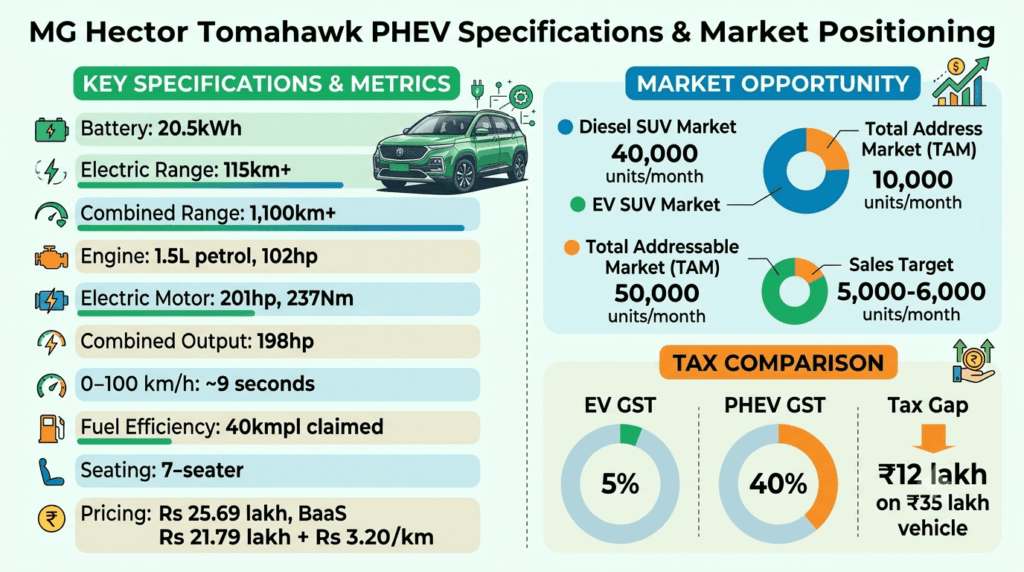
PHEV vs EV: why India's first mass-market plug-in hybrid could reshape the market — infographic showing MG Hector Tomahawk PHEV with 115km electric range, 1,100km combined range, Rs 3,000-4,000 running cost versus diesel at Rs 10,000-12,000 per 1,000km
EV charging

PHEV vs EV: Why India’s First Mass-Market Plug-In Hybrid Could Reshape the Market — The Honest Complete Guide

PHEV vs EV: why India’s first mass-market plug-in hybrid could reshape the market — and the honest answer is that the Tomahawk PHEV represents a significant moment for India’s electrified vehicle landscape. This complete guide breaks down the 115km electric-only range, the 1,100km combined range, the “diesel killer” positioning targeting the 40,000-unit diesel SUV market, the running cost advantage (Rs 3,000-4,000 vs Rs 10,000-12,000 per 1,000km), the tax barrier (5% GST for EVs vs 40% for PHEVs), the BaaS pricing option, and whether PHEVs are a bridge or a competitor to full EVs.
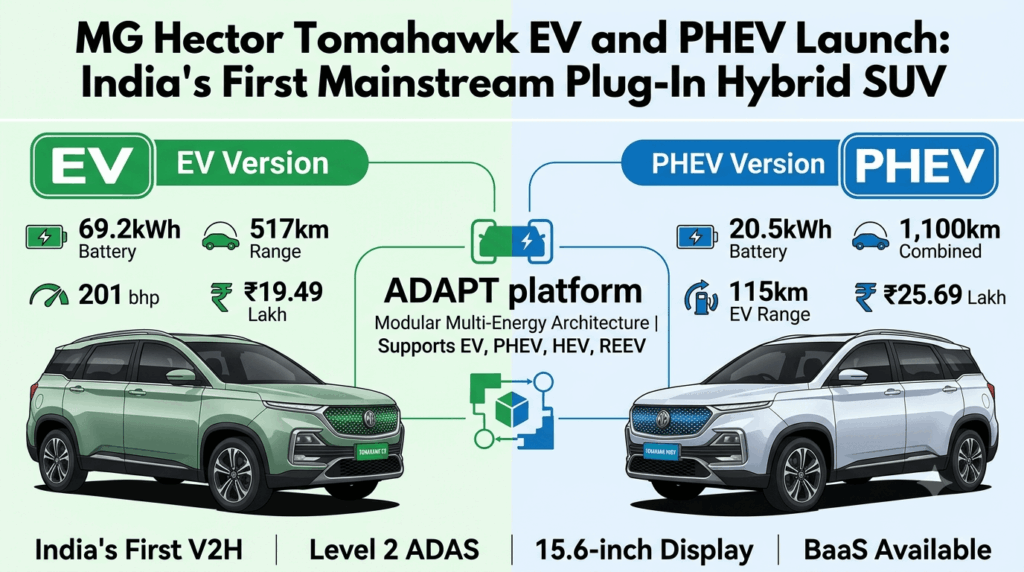
MG Hector Tomahawk EV and PHEV launch: India's first mainstream plug-in hybrid SUV — infographic showing EV with 69.2kWh battery, 517km range at ₹19.49 lakh and PHEV with 20.5kWh battery, 1,100km combined range at ₹25.69 lakh, built on ADAPT platform with V2H capability
EV charging

MG Hector Tomahawk EV and PHEV Launch: India’s First Mainstream Plug-In Hybrid SUV — The Honest Complete Guide

MG Hector Tomahawk EV and PHEV launch: India’s first mainstream plug-in hybrid SUV — and the dual launch represents a significant moment for India’s electrified vehicle market. This complete guide breaks down the pricing (EV from ₹19.49 lakh, PHEV from ₹25.69 lakh), range (EV: 517 km, PHEV: 1,100 km combined), the ADAPT platform (MG’s modular multi-energy architecture), the features (India’s first V2H technology, Level 2 ADAS, 15.6-inch infotainment, six cabin modes), and what this launch means for India’s evolving EV landscape.

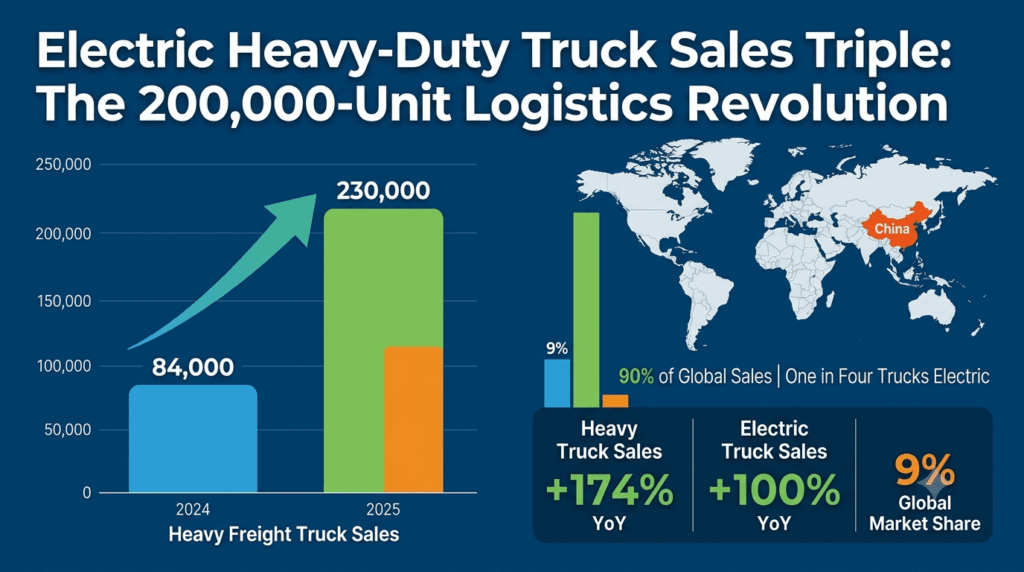
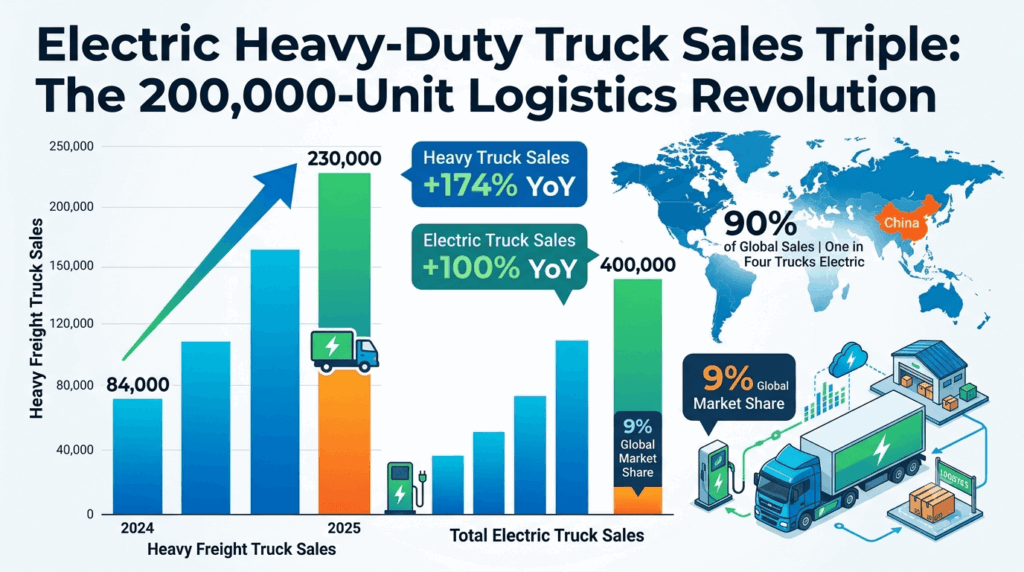
Electric heavy-duty truck sales triple: the 200,000-unit logistics revolution — infographic showing heavy freight truck sales surging from 84,000 in 2024 to 230,000 in 2025, total electric truck sales exceeding 400,000 units with 9 percent global market share, and China accounting for over 90 percent of global sales
EV charging

Electric Heavy-Duty Truck Sales Triple: The 200,000-Unit Logistics Revolution — The Honest Complete Guide

Electric heavy-duty truck sales triple: the 200,000-unit logistics revolution — and the data confirms that the commercial transport sector has crossed a decisive threshold. This complete guide breaks down the IEA Global EV Outlook 2026 data (electric truck sales exceeded 400,000 units, 9% of global truck sales, heavy freight segment tripled from 84,000 to 230,000 units), China’s dominant role (over 90% of global sales, one in four trucks electric, 28% of heavy truck sales), the regional breakdown (US 12,000 units, Europe 4.5%, Tesla Semi production), the policy and economic drivers (TCO parity, scrappage scheme, 2030 targets), the challenges (charging infrastructure, supply chain concentration, start-up failures), and what it means for the future of global freight.

Electric heavy-duty truck sales triple: the 200,000-unit logistics revolution — comparison chart showing China leading with 400,000+ electric truck sales and 90 percent global share, European Union at 23,700 units, United States at 12,000 units produced, with timeline from 2024 to 2030 targets
EV charging

Electric Heavy-Duty Truck Sales Triple: The 200,000-Unit Logistics Revolution — The Honest Complete Guide

Electric heavy-duty truck sales triple: the 200,000-unit logistics revolution — and the data confirms that the commercial transport sector has crossed a decisive threshold. This complete guide breaks down the IEA Global EV Outlook 2026 data (electric truck sales exceeded 400,000 units, 9% of global truck sales, heavy freight segment tripled from 84,000 to 230,000 units), China’s dominant role (over 90% of global sales, one in four trucks electric, 28% of heavy truck sales), the regional breakdown (US 12,000 units, Europe 4.5%, Tesla Semi production), the policy and economic drivers (TCO parity, scrappage scheme, 2030 targets), the challenges (charging infrastructure, supply chain concentration, start-up failures), and what it means for the future of global freight.

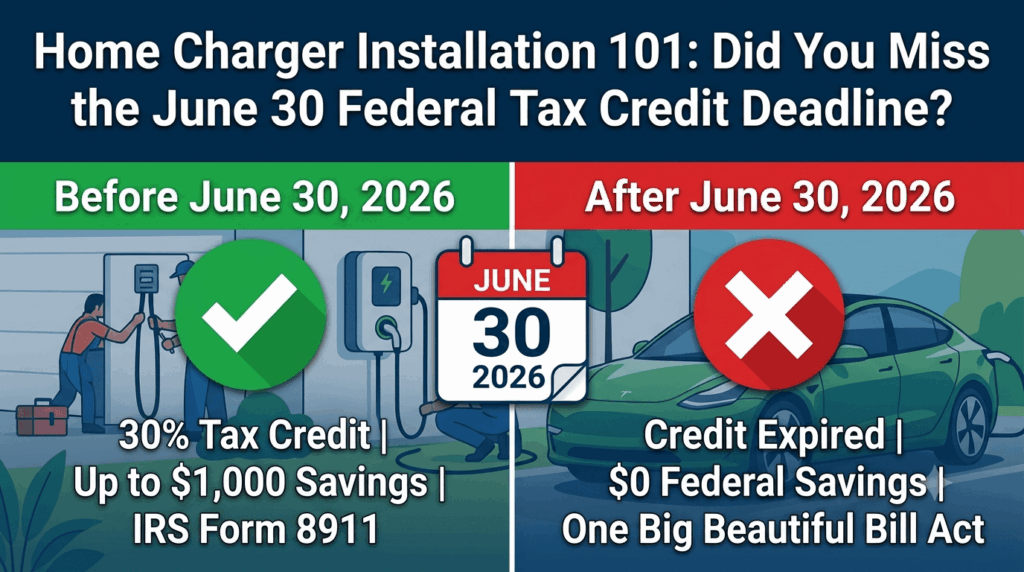
Home charger installation 101: did you miss the June 30 federal tax credit deadline? Infographic showing 30C tax credit offering 30% up to $1,000 before June 30, 2026, and credit expired after deadline with $0 federal savings
EV charging

Home Charger Installation 101: Did You Miss the June 30 Federal Tax Credit Deadline? The Honest Complete Guide

Home charger installation 101: did you miss the June 30 federal tax credit deadline? The honest answer is that if you did not complete your installation before that date, you missed out on a tax credit worth up to $1,000. This complete guide breaks down the 30C federal EV charger tax credit (30% of costs up to $1,000, expired June 30, 2026), what the One Big Beautiful Bill Act changed, what to do now (claim the credit if you installed before the deadline, look for state rebates and utility incentives), and a state-by-state checklist of what is still available (California up to $4,200, New York up to $3,000, Colorado $500, Massachusetts up to $700, Maryland up to $700).

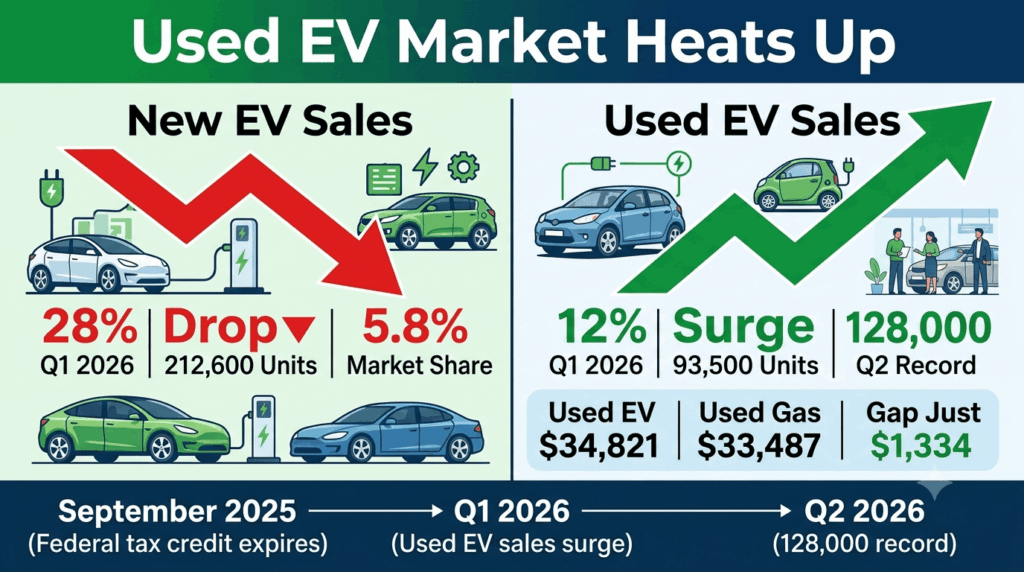
Used EV market heats up: are they the best investment after federal credits vanished? Comparison chart showing used EV price gap shrinking from $10,000+ in 2023 to $1,102 in 2026, sales surging to 93,500 in Q1 and 128,000 in Q2, and off-lease EVs flooding the market with 300,000+ in 2026
EV charging

Used EV Market Heats Up: Are They the Best Investment After Federal Credits Vanished? The Honest Complete Guide

Used EV market heats up: are they the best investment after federal credits vanished? The honest answer is that used EVs are not an investment in the traditional sense, but they are a much better financial decision today than they were two years ago. This complete guide breaks down the surging used EV market: Q1 2026 sales up 12% to 93,500 units, March record of 42,924 units (27.7% YoY growth), Q2 record of 128,000 units (29% YoY growth), price parity with gas cars ($34,821 vs $33,487, gap down from $10,000+ in 2023), the lease return wave (300,000+ off-lease EVs in 2026), the oil price spike ($4+ per gallon gas), the best-selling models (Tesla leads, Equinox EV up 1,223.7%), and what it all means for buyers.

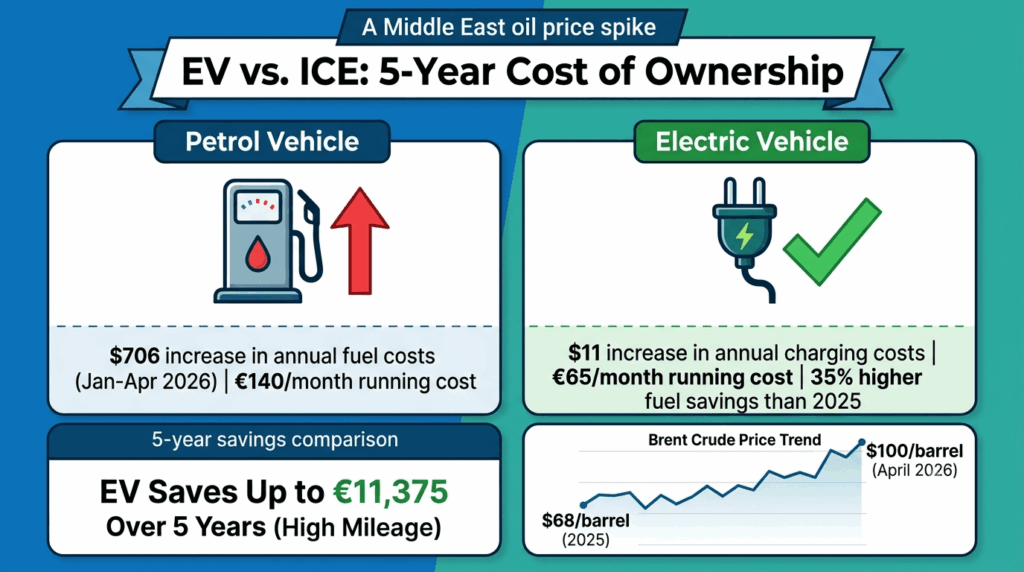
EV vs. ICE: 5-year cost of ownership post-Middle-East oil price spikes — infographic showing petrol vehicle costs rising $706 with €140/month running costs versus EV with $11 increase, €65/month, and 35 percent higher fuel savings than 2025
EV charging

EV vs. ICE: 5-Year Cost of Ownership Post-Middle-East Oil Price Spikes — The Honest Complete Guide

EV vs. ICE: 5-year cost of ownership post-Middle-East oil price spikes — and the honest answer is that the math has fundamentally changed. This complete guide breaks down the IEA Global EV Outlook 2026 data (35% increase in EU fuel cost savings, up to $2,800 annual savings for high-mileage drivers), the oil price spike from $68 to $100 per barrel, the 5-year total cost of ownership comparison (EVs 67% cheaper per mile in the UK, €75 per month savings in Europe), the regional differences (Europe leads, US mixed, emerging markets surging), the hidden costs (public charging penalty up to 240% more than home charging), and what it all means for today’s buyers.

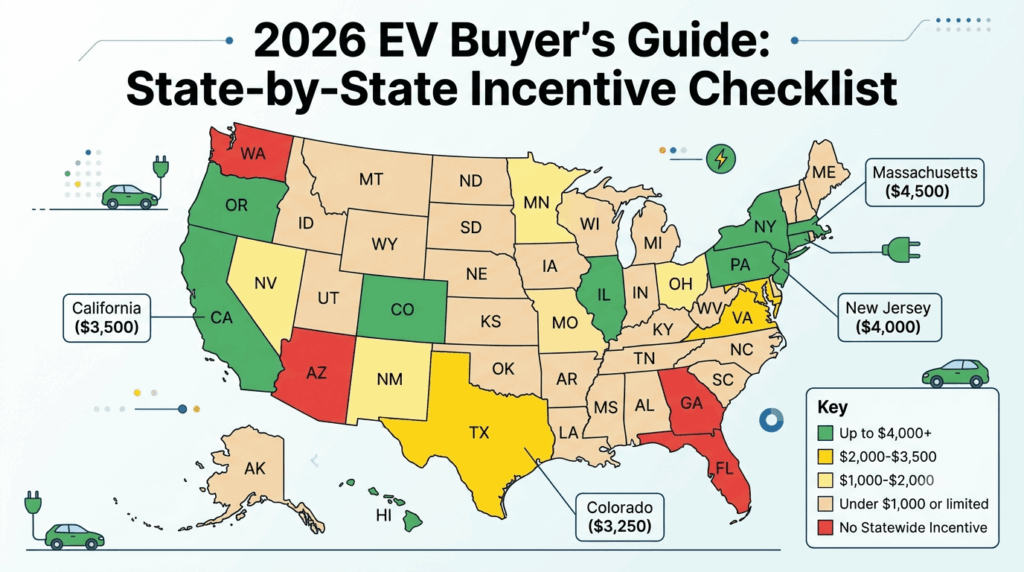
2026 EV buyer's guide: a state-by-state incentive checklist for the US — colour-coded map showing California $3,500 rebate, Colorado up to $3,250 tax credit, New Jersey up to $4,000, Massachusetts up to $4,500, and states with no statewide purchase incentives
EV charging

2026 EV Buyer’s Guide: A State-by-State Incentive Checklist for the US — The Honest Complete Guide

2026 EV buyer’s guide: a state-by-state incentive checklist for the US — and the honest answer is that where you live matters more than ever. This complete guide breaks down every state’s EV incentives after the federal $7,500 tax credit expired: California ($3,500 MyFirstEV rebate), Colorado (up to $3,250 state tax credit), New York (Drive Clean up to $2,000), New Jersey (Charge Up up to $4,000), Illinois ($2,000 rebate), Massachusetts (MOR-EV up to $4,500), Oregon (Clean Vehicle Rebate $2,000), Connecticut (CHEAPR up to $4,500), Texas (LDPLIP up to $2,500), Pennsylvania (AFV rebate up to $4,000), and states with no incentives (Arizona, Florida, Georgia, Virginia, Washington). It also covers utility programs, sales tax exemptions, HOV lane access, and the expiring federal charger credit.

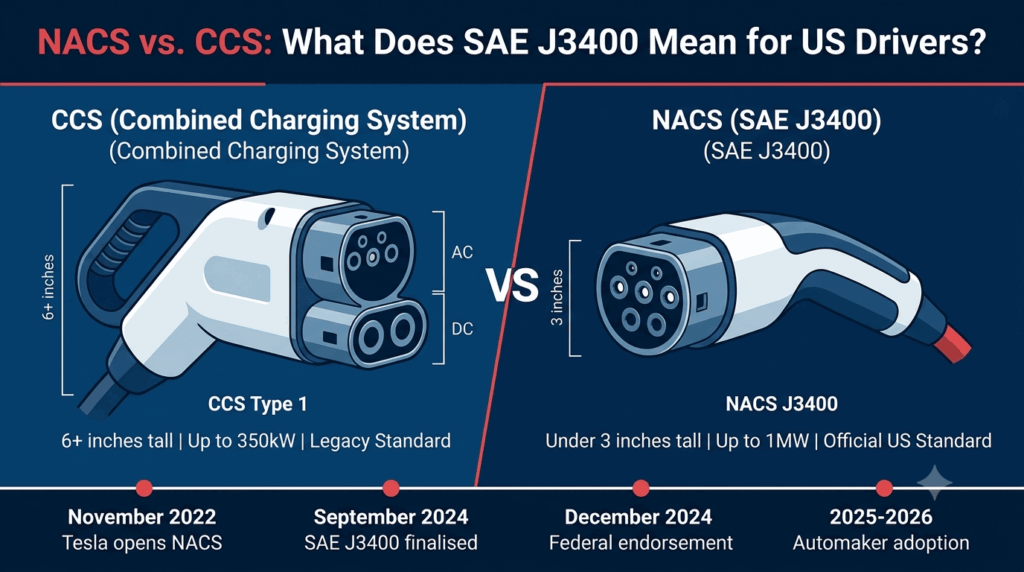
NACS vs. CCS: what does the standardization (SAE J3400) mean for US drivers? Infographic comparing CCS connector (6+ inches, up to 350kW) with NACS/SAE J3400 connector (under 3 inches, up to 1MW, official US standard) with timeline from 2022 to 2026
EV charging

NACS vs. CCS: What Does the Standardization (SAE J3400) Mean for US Drivers? The Honest Complete Guide

NACS vs. CCS: what does the standardization (SAE J3400) mean for US drivers? The honest answer is that it means the end of connector chaos in North America. This complete guide breaks down the SAE J3400 standardisation of Tesla’s NACS connector (formalised September 2024, federal endorsement December 2024), the technical advantages (1000V capability, up to 1 MW power, half the size of CCS, native bidirectional support), the automaker adoption timeline (every major OEM committed, native NACS becoming the norm by end of 2026), the transition challenges (CCS remains substantial, adapters essential), and what it all means for current and future EV buyers.

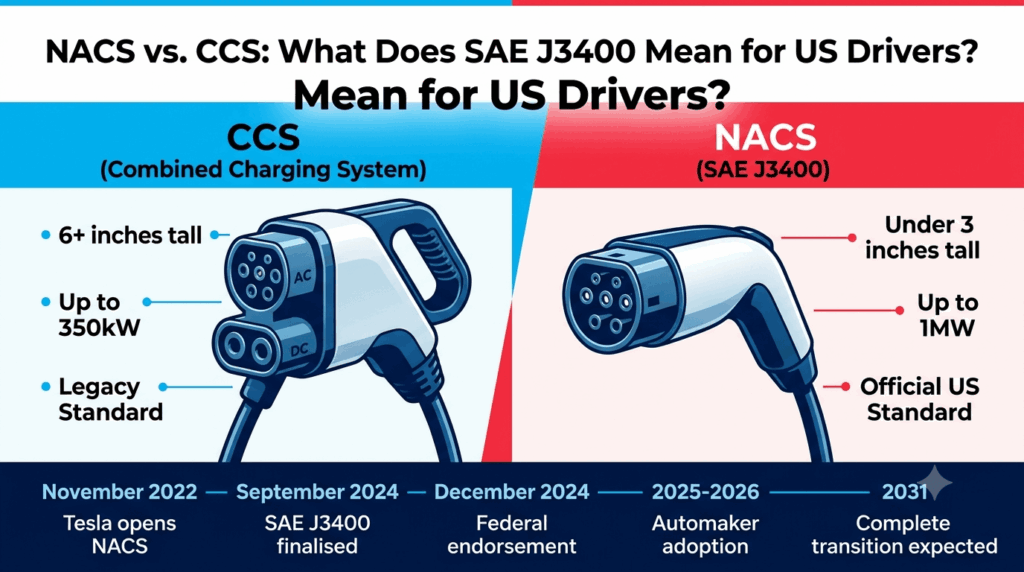
NACS vs. CCS: what does the standardization (SAE J3400) mean for US drivers? Infographic comparing CCS connector (6+ inches, up to 350kW) with NACS/SAE J3400 connector (under 3 inches, up to 1MW, official US standard) with timeline from 2022 to 2031
EV charging

NACS vs. CCS: What Does the Standardization (SAE J3400) Mean for US Drivers? The Honest Complete Guide

NACS vs. CCS: what does the standardization (SAE J3400) mean for US drivers? — and the honest answer is that it means the end of connector chaos in North America. This complete guide breaks down the SAE J3400 standardisation of Tesla’s NACS connector (formalised September 2024, federal endorsement December 2024), the technical advantages (1000V capability, up to 1 MW power, half the size of CCS, native bidirectional support), the automaker adoption timeline (every major OEM committed, 90% NACS by end of 2026), the transition challenges (CCS remains 40% of network, complete transition unlikely before 2031, $660 million retrofit cost), the adapter solution, and what it all means for current and future EV buyers.

Scroll to Top