For more than a decade, $100 per kilowatt-hour has been the number that mattered most in the electric vehicle industry. It was the threshold at which battery packs would become cheap enough for EVs to compete with internal combustion engine vehicles on upfront purchase price, not just running costs. It was the line that separated niche products from mass-market ones.
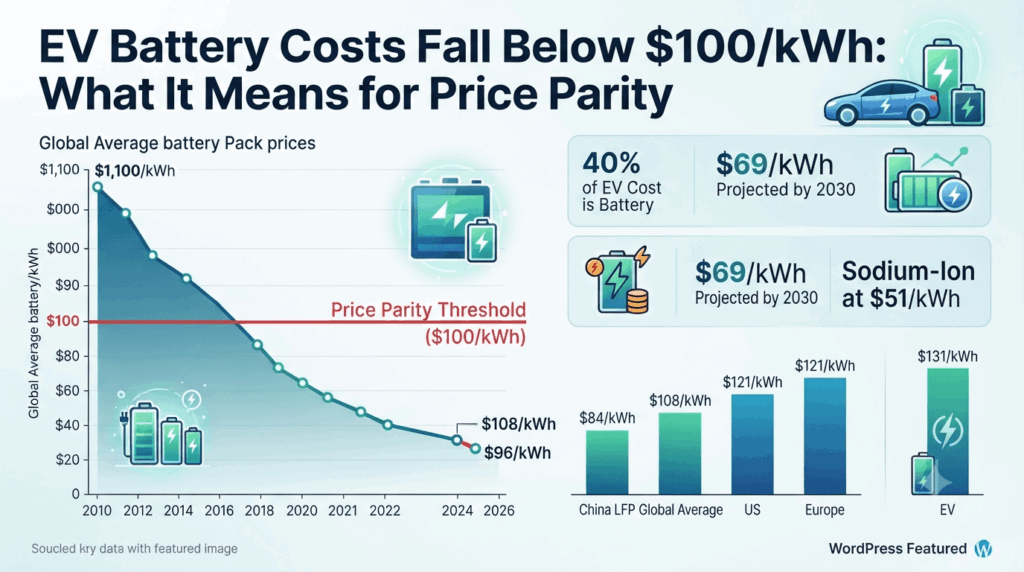
That line has now been crossed. In 2025, the global average price of a lithium-ion battery pack fell to a record low of $108 per kWh, down 8% year on year. Argonne National Laboratory’s 2026 cost model puts the volume-weighted pack cost at $96/kWh. China’s LFP packs are already at $84/kWh. The question is no longer whether battery costs will fall below $100/kWh. It is what happens now that they have.
This is what EV battery costs falling below $100/kWh actually means for price parity.
The Numbers Behind the Threshold
The global average tells only part of the story. The regional variation is where the real picture emerges.
According to BloombergNEF’s 2025 survey, the global average lithium-ion battery pack price fell 8% to $108 per kWh. That figure represents the cost of a complete battery pack, including cells, cooling, electronics, casing, battery management systems, and integration. Cell-only prices are significantly lower. For LFP chemistry, which now dominates the volume segment, pack prices averaged $81 per kWh globally in 2025, down from $97 the previous year and $120 at the end of 2021.
The regional gap is substantial. China’s LFP pack costs averaged around $84 per kWh in 2025, down 13% year on year. Pack costs remained materially higher in the United States, approximately 44% above the global average, and in Europe, approximately 56% higher.
Argonne National Laboratory’s 2026 cost model, developed using the BatPaC battery cost modeling software, projects a combined weighted average pack price of $96.25 per kWh for 2026. That figure averages NMC packs at $96.31/kWh and LFP packs at $95.52/kWh, based on a production volume of 200,000 batteries per year.
The IEA confirmed the trend in its 2026 assessment, stating that the average price of a battery pack in electric vehicles dropped below $100 per kilowatt-hour, describing it as a key threshold for competing on cost with conventional models.
Why Costs Fell: The Four Drivers
The decline in battery prices was not the result of a single breakthrough. It was the product of four converging factors.
Oversupply of raw materials. Lithium prices dropped by more than 85% from their peak in 2022. The collapse reflected a surge in mining and processing capacity that outpaced demand growth. Lower lithium carbonate prices fed directly into lower cell costs.
Manufacturing scale. Global battery manufacturing capacity reached 3 TWh in 2024, and the IEA projects another tripling of production capacity over the next five years if all announced projects are built. China alone operates capacity at four times current market demand, creating intense competitive pressure that drives prices down.
The shift to LFP. Lithium iron phosphate chemistry now accounts for nearly 50% of global EV battery sales and dominates the stationary storage market. LFP batteries cost approximately 40% less than nickel-manganese-cobalt variants. The shift toward LFP has lowered the average cost of a battery pack across the market, even where NMC chemistries remain necessary for premium applications.
Manufacturing know-how and supply chain integration. Chinese manufacturers, particularly CATL and BYD, have developed manufacturing expertise and vertically integrated supply chains that give them a structural cost advantage. The IEA attributes China’s price advantage to four factors: manufacturing know-how, supply chain integration through acquisitions and cooperation, cheaper battery chemistry, and fierce domestic competition among nearly 100 producers.
What Price Parity Actually Means
The $100/kWh threshold matters because the battery pack accounts for approximately 40% of an electric vehicle’s total manufacturing cost. When pack prices fall, automakers have the option to pass those savings to consumers.
But price parity is not a single event. It is a moving target that depends on vehicle segment, region, and the comparison being made.
In China, parity is largely achieved. Many EVs in China are now cheaper than their conventional counterparts. The combination of low battery costs, domestic manufacturing scale, and intense competition has pushed electric vehicle prices below equivalent petrol models across multiple segments.
In Europe, parity is approaching. The ICCT’s 2026 assessment found that in the three main passenger car segments, medium, upper-medium, and luxury, the purchase cost of battery electric vehicles has essentially reached parity with equivalent internal combustion engine vehicles. Battery costs fell 35% globally between 2020 and 2025, creating scope for further reductions in vehicle prices.
In the United States, the gap persists. Despite falling global battery prices, the US market has not experienced the same degree of price convergence. The absence of affordable Chinese models, higher manufacturing costs, and the expiration of federal purchase incentives have kept EV prices elevated relative to comparable petrol vehicles.
For smaller vehicles, parity remains elusive. BMW has noted that small and affordable EVs will continue to be more expensive than equivalent petrol models because the additional cost of the battery is more difficult to absorb in lower-priced vehicles. The battery represents a larger percentage of total vehicle cost in a €20,000 car than in a €50,000 car.
The Honest Assessment: Where the Gap Remains
The $100/kWh threshold is a genuine milestone. But it does not mean that electric vehicles are now universally cheaper than petrol cars.
The most visible evidence of this gap comes from India. Tata Motors cut the price of the Punch EV when it launched the facelift in February 2026, with the base version starting at Rs 9.69 lakh and the top version becoming up to Rs 1.85 lakh cheaper than before. Yet the petrol Tata Punch starts at Rs 5.75 lakh, while the Punch EV starts close to Rs 9.8 lakh. The comparison is not perfect because equipment and powertrains differ, but it illustrates why purchase price remains a barrier even when running costs are lower.
Tata Motors has explicitly targeted full price parity by 2030 across its broader portfolio. Anand Kulkarni, Chief Products Officer at Tata Passenger Electric Mobility, stated that the company expects to achieve cost parity with Chinese manufacturers from a landed cost perspective within 12 to 18 months.
The regional disparity in battery costs remains the largest obstacle to global price parity. A battery pack that costs $84/kWh in China costs approximately $121/kWh in the United States and $131/kWh in Europe. Until those regional gaps close, price parity will arrive at different times in different markets.
What Happens Next
The trajectory of battery costs points toward continued decline. BloombergNEF forecasts an average pack price of $105 per kWh in 2026, a further 3% reduction driven by manufacturing overcapacity in China, increased competition, and the ongoing shift to LFP chemistry. The firm projects prices could reach as low as $69/kWh by 2030.
Goldman Sachs Research had projected battery prices to fall to $111 per kWh by the close of 2025, a forecast that proved conservative. The pace of cost reduction has consistently exceeded expectations.
Sodium-ion batteries are emerging as the next cost-reduction lever. CATL has reduced the manufacturing cost of its sodium-ion cells to as low as $51 per kWh, entering mass production in passenger vehicles in 2026. Sodium-ion offers cost parity with LFP by the end of 2026, according to CATL’s forecasts, and could push battery costs lower still.
Solid-state batteries remain years from cost competitiveness. The technology promises higher energy density and faster charging, but current production costs remain well above $100/kWh. Solid-state will not be the technology that delivers price parity. It will be the technology that delivers performance beyond what price parity enables.
What This Means for Buyers
For EV buyers, the crossing of the $100/kWh threshold has practical implications that vary by market.
In China, buyers already benefit from price parity or better. Electric vehicles are cheaper to buy and cheaper to run than equivalent petrol models. The transition is no longer a financial question for most buyers.
In Europe, buyers are approaching the point where the purchase price premium disappears. Running costs already favour EVs. The remaining gap is narrowing as battery costs decline and manufacturers pass savings through.
In the United States, buyers face a more complex picture. Battery costs have fallen, but the market has not delivered the same degree of price convergence. The expiration of the federal tax credit has removed a significant source of price support. Buyers in states with their own incentive programmes have access to meaningful savings. Buyers elsewhere do not.
In emerging markets, price parity is arriving through a different route. Chinese-made EVs are entering markets where domestic manufacturing does not exist, and their cost advantage is driving adoption. Vietnam, Thailand, Indonesia, and Brazil have all seen rapid EV growth driven by affordable Chinese imports.
The honest assessment is that battery costs falling below $100/kWh is a necessary condition for price parity. It is not a sufficient one. Manufacturing scale, supply chain localisation, competitive dynamics, and policy all determine when and where price parity actually arrives. The threshold has been crossed. The transition it enables is still underway.