On April 21, 2026, CATL hosted its Super Technology Day in Beijing and did something unusual for the battery industry. Instead of unveiling a single breakthrough and declaring victory, the world’s largest battery manufacturer presented six distinct innovations that collectively reframe what electric vehicle batteries can do.
The event was not about one chemistry winning over another. It was about CATL’s chief scientist, Dr. Wu Kai, standing on stage and systematically explaining why the industry needs multiple chemistries coexisting. LFP is nearing its theoretical energy density limit and is better suited to a roadmap centred on extreme fast charging. NCM’s high energy density keeps it at the forefront of premium vehicles. Sodium-ion batteries offer potential for extreme temperatures and energy storage. The conclusion was unambiguous: the lithium-ion battery industry must pursue coordinated development across multiple chemical systems.
Robin Zeng, CATL’s Chairman and CEO, framed the strategic context: “Industrial innovation must be driven by a rigorous scientific spirit. For Chinese technology to go global, it relies not just on speed and scale, but on the quality of innovation, the ability to validate, and the credibility of the brand”.
This is CATL’s Super Technology Day: six innovations that redefine battery performance.
Innovation 1: Third-Generation Shenxing Superfast Charging Battery
The headline act was the third-generation Shenxing Superfast Charging Battery, and the numbers are genuinely extraordinary.
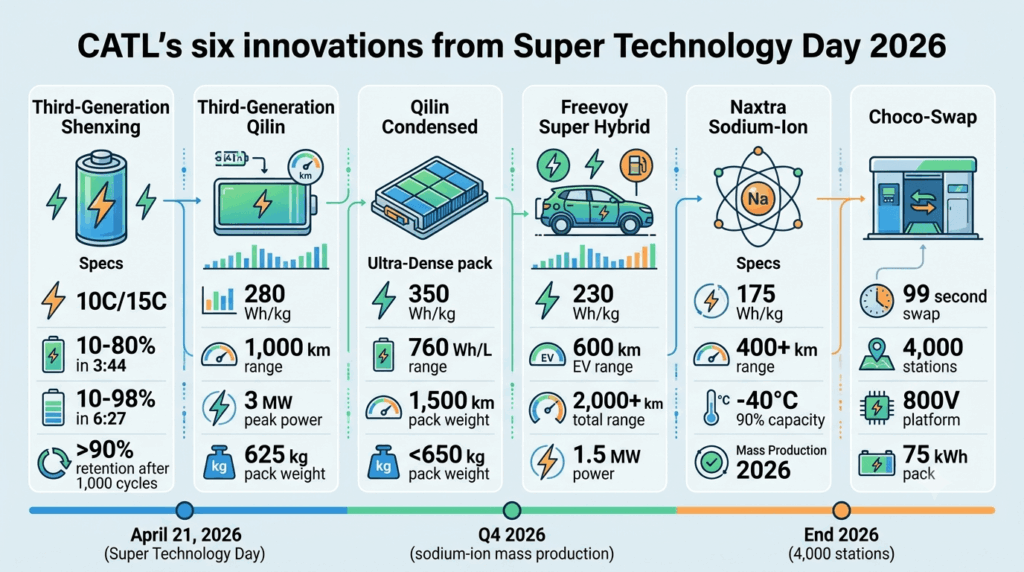
The battery achieves what CATL describes as the industry’s strongest charging capability: an equivalent 10C continuous rate and a peak 15C charging rate. In practical terms, charging from 10% to 35% state of charge takes just one minute. From 10% to 80% takes 3 minutes and 44 seconds. From 10% to 98% takes 6 minutes and 27 seconds.
That last figure deserves emphasis. Six minutes and 27 seconds to near-full charge. For context, the current generation of mainstream fast-charging EVs typically takes 18 to 30 minutes to reach 80%. The third-generation Shenxing compresses that to under four minutes.
The engineering challenge is not simply pushing more current into the battery. It is managing the heat that high-rate charging generates. As CATL explained, the Arrhenius equation shows that a 10°C increase in battery temperature can roughly double the rate of internal side reactions that shorten cycle life. The third-generation Shenxing addresses this through three measures: reduced heat production during operation, stronger thermal propagation, and higher precision control.
The result is that after 1,000 complete cycles, the battery’s capacity retention remains above 90%. This is the critical achievement. Fast charging has historically come at the cost of cycle life. The third-generation Shenxing appears to have broken that trade-off.
Cold-weather performance is equally significant. Even at minus 30°C, charging from 20% to 98% takes approximately nine minutes. By combining battery self-heating technology with an integrated supercharging and battery-swapping network, CATL has designed a system that enables low-temperature superfast charging that is not limited by charging pile capability.
The third-generation Shenxing is based on LFP chemistry. This matters because LFP is the dominant chemistry for mainstream electric vehicles. A breakthrough in LFP charging performance benefits the largest segment of the EV market.
Innovation 2: Third-Generation Qilin Battery
Where the Shenxing battery prioritises charging speed, the third-generation Qilin Battery prioritises energy density and power output for premium vehicles.
The cell-level energy density is 280 Wh/kg, enabling a claimed vehicle range of up to 1,000 kilometres. The battery supports 10C superfast charging and delivers peak power of 3 MW, doubling the output of the second-generation Qilin track battery that competed on the Nürburgring at 1,330 kW.
The weight reduction is the most commercially significant specification. The entire battery pack weighs 625 kg. Compared with equivalent LFP systems, this represents a weight reduction of 255 kg and space savings of 112 litres.
The lightweighting delivers cascading benefits that compound across the vehicle. Energy consumption per 100 km decreases by more than 6%, saving approximately 0.78 kWh per 100 km. Across a fleet of one million vehicles travelling 20,000 km annually, this equates to 156 million kWh in electricity savings and a reduction of 78,500 tonnes of CO₂ emissions.
Performance improvements include a 0.6-second reduction in 0 to 100 km/h acceleration, a 12% shorter overtaking risk window, an 8% higher moose test speed, and a 6.5% lower body roll angle. Braking distance is reduced by approximately 1.44 metres. Durability is enhanced, with chassis component life extended by 40% and tyre life by over 30%.
Safety is strengthened through what CATL calls “thermal-electrical separation”. Each cell incorporates an independent sealed exhaust channel to isolate thermal events and prevent propagation. The principle is straightforward: heat takes the heat path, electricity takes the electrical path.
Innovation 3: Qilin Condensed Battery
The Qilin Condensed Battery is the most technically ambitious product CATL unveiled. It applies aviation-grade technology to passenger vehicles for the first time.
The specifications are striking. Cell energy density reaches 350 Wh/kg and volumetric energy density reaches 760 Wh/L, setting a new record for mass-produced batteries. This enables 1,500 kilometres of range for sedans and over 1,000 kilometres for large SUVs, with pack weight controlled within 650 kg.
The technology builds on CATL’s electric aviation programme, where 500 Wh/kg systems have completed maiden flight validation on 4-tonne aircraft, with further validation underway on aircraft exceeding 8 tonnes.
Three engineering innovations enable the performance. First, a high-nickel cathode and low-expansion silicon-carbon anode boost energy density by 50 Wh/kg. Second, an aviation-grade titanium alloy case reduces thickness by 60% and weight by 30%, while tripling unit strength and delivering an additional 20 Wh/kg in energy density. Third, replacing liquid electrolyte with a condensed system eliminates risks associated with leakage and combustion. As CATL put it: no liquid to leak, no liquid to ignite.
A composite current collector acts as a fast self-fusing fuse in extreme cases of internal short circuits, adding a layer of safety protection that conventional designs lack.
The condensed battery represents a bridge between conventional lithium-ion and true solid-state technology. It is not a solid-state battery in the strict sense, but it moves significantly closer to that goal while retaining manufacturing compatibility with existing production processes.
Innovation 4: Second-Generation Freevoy Super Hybrid Battery
The second-generation Freevoy Super Hybrid Battery addresses a segment that is often overlooked in discussions of battery technology: plug-in hybrid and range-extended electric vehicles.
The innovation here is the integration of LFP and NCM materials within a single cell through what CATL calls “super hybrid technology”. The olivine crystal structure of LFP serves as the core backbone, enabling a uniform hybrid of LFP and NCM materials at the powder particle level. This achieves an energy density of 230 Wh/kg and increases range by over 15% without increasing pack weight compared with single LFP systems.
The results are significant. The LFP version delivers up to 500 kilometres of pure electric range, enabling a “once-a-week charging” experience for daily commuting. The NCM version extends pure electric range beyond 600 kilometres, with total vehicle range exceeding 2,000 kilometres when combined with a combustion engine.
Power output is another focus. The battery can deliver 1.5 MW at full charge and 1.2 MW at 20% state of charge, addressing the power drop-off that typically occurs at low charge levels in conventional hybrid batteries.
Safety testing has produced remarkable results. The battery’s bottom coating can withstand an impact of approximately 1,500 joules of energy, equivalent to the shooting power of a standard rifle. That is significantly above the Chinese national average of 150 joules. Its sealing and waterproofing capabilities allow it to withstand 200 hours submerged under two metres of water, compared with the national standard of 30 minutes in one metre of water.
The Freevoy battery matters because it addresses the reality that hybrids and range-extenders will remain a significant portion of the market for years. CATL claims that more than 95% of EREVs sold with a pure-electric range exceeding 300 kilometres are fitted with its batteries. The second-generation Freevoy extends that leadership into the 600-kilometre pure-electric range territory.
Innovation 5: Naxtra Sodium-Ion Battery
The Naxtra sodium-ion battery is not new. CATL unveiled the brand in April 2025. What is new is the confirmation that mass production is imminent.
Dr. Wu Kai stated at Super Technology Day that key manufacturing bottlenecks of sodium-ion batteries had been resolved, clearing the path for commercialisation. “Sodium-ion batteries are ready for scale,” he said, positioning them as both a complement and, in some scenarios, an alternative to lithium-based systems.
The Naxtra battery achieves an energy density of up to 175 Wh/kg, setting the current benchmark for mass production. Its Cell-to-Pack system and intelligent BMS enable a pure-electric range exceeding 400 kilometres. As the sodium-ion supply chain advances, ranges are projected to reach 500 to 600 kilometres for pure-electric variants.
Cold-weather performance is the headline advantage. The battery delivers nearly triple the discharge power of equivalent LFP batteries at minus 30°C, while maintaining over 90% capacity retention at minus 40°C and stable power delivery at temperatures as low as minus 50°C.
Safety testing has produced equally striking results. Under crush, drill, and saw testing, the Naxtra battery remains smoke and fire free and continues to provide power.
CATL began sodium-ion research in 2016, investing nearly 10 billion RMB and developing close to 300,000 test cells. The research and development team comprises more than 300 personnel, including 20 PhDs. That decade of investment is now producing commercial results.
In February 2026, Changan Automobile and CATL unveiled the Changan Nevo A06, the world’s first mass-production passenger vehicle equipped with sodium-ion batteries. CATL will supply Naxtra batteries across Changan’s full brand portfolio, including AVATR, Deepal, Qiyuan, and UNI. CATL expects to equip between 10,000 and 20,000 electric vehicles with sodium-ion batteries in 2026.
Innovation 6: Integrated Supercharging and Battery-Swapping Solution
The sixth innovation is not a battery. It is the infrastructure that makes the batteries useful.
CATL introduced a fully integrated supercharging and battery-swapping solution that combines high-power fast charging with swap capability at the same location. The system uses shared infrastructure to reduce energy losses, achieving a reduction in power loss of more than 13 percentage points compared with conventional designs.
The Choco-Swap system enables battery replacement in 99 seconds. An 800V Choco-Swap battery platform was also introduced, starting with a 75 kWh pack.
The network deployment plan is ambitious. CATL plans to deploy 4,000 combined charge-swap stations across China by the end of 2026, covering nearly 190 cities and a highway network of 12 vertical and 11 horizontal corridors.
As of April 2026, CATL’s Choco-Swap network had already built more than 1,470 battery-swapping stations nationwide, covering 99 cities.
The integration of charging and swapping addresses a fundamental tension in EV infrastructure. Fast charging requires high-power grid connections that are expensive and time-consuming to install. Battery swapping requires inventory of charged batteries and mechanical systems for exchange. Combining both at a single location allows infrastructure to serve vehicles that support either or both technologies, increasing utilisation rates and reducing the cost per vehicle served.
The Choco-Swap stations are also designed to accommodate CATL’s Shenxing supercharging piles, upgrading them to what CATL calls “super-swap integrated stations”. This ensures that vehicles that support fast charging but not swapping can still use the location, and vice versa.
The Multi-Chemistry Strategy: What It Means
The six innovations are not a product portfolio. They are a strategic statement.
CATL is explicitly rejecting the idea that one battery chemistry will dominate. Dr. Wu Kai’s presentation made the case that LFP, NCM, sodium-ion, and condensed-state technologies each have distinct strengths and will serve different applications. The company’s research and development resources are being allocated across all of them.
This strategy has implications beyond CATL. For automakers, it means that different vehicle segments will use different chemistries. Entry-level and mid-range vehicles will increasingly use LFP and sodium-ion. Premium long-range vehicles will use NCM and condensed-state batteries. Hybrids and range-extenders will use integrated LFP-NCM systems. The assumption that all EVs will use the same battery technology is no longer valid.
For consumers, the practical implications are mostly positive. Sodium-ion batteries will reduce costs and improve cold-weather performance in affordable vehicles. LFP batteries will continue to improve in charging speed. NCM batteries will continue to push the limits of range and performance. The competitive pressure across chemistries will drive improvement everywhere.
For the battery industry, the multi-chemistry approach raises the bar for manufacturing flexibility. Companies that can produce multiple chemistries on compatible production lines will have a cost advantage. CATL has already demonstrated this capability by designing sodium-ion products with the same form factor as its lithium-ion cells, allowing integration with existing manufacturing lines.
The year 2026 is proving to be a pivotal one for battery technology. Sodium-ion is entering mass production. LFP charging speeds are approaching the refuelling times of petrol cars. Condensed-state batteries are pushing energy density toward solid-state territory. And the infrastructure to support all of it is being built at scale.
CATL’s Super Technology Day was not a celebration of a single breakthrough. It was a demonstration that the battery industry has entered a new phase, one where multiple technologies advance simultaneously and the competition between them drives progress faster than any single approach could achieve.