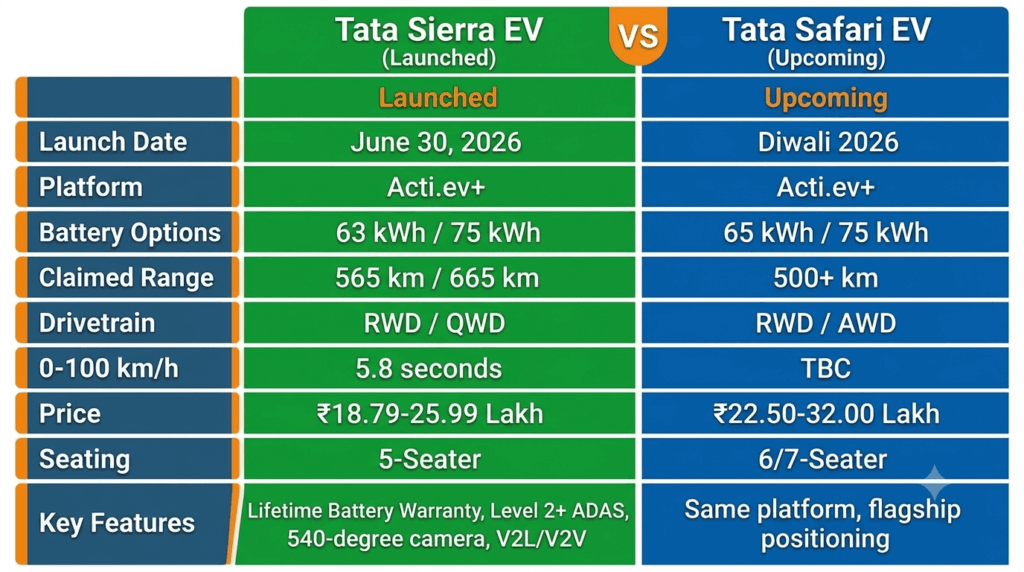
Tata Motors has placed a clear bet on the electric future of India’s SUV heartland. On June 30, 2026, the company launched the Sierra EV, bringing back one of India’s most recognisable SUV nameplates in an all-electric avatar. Priced from ₹18.79 lakh (ex-showroom), the Sierra EV offers a claimed range of up to 665 kilometres, a 5.8-second 0-100 km/h sprint, and a lifetime battery warranty.
But the Sierra EV is only half the story. Tata Motors is preparing to launch the Safari EV around the festive season of 2026, positioning it as the brand’s flagship three-row electric SUV. Built on the same Acti.ev+ platform as the Sierra EV, the Safari EV will extend Tata’s popular Safari moniker into the zero-emission era.
This guide on Tata Motors’ EV offensive: Sierra EV launch and Safari EV coming soon provides the complete, honest analysis. It covers the Sierra EV’s pricing, variants, battery options, real-world range, performance, and features. It also details everything we know about the upcoming Safari EV, including its expected launch timeline, pricing, platform, and positioning.
Part One: The Tata Sierra EV — A Nameplate Reborn
The Launch and Pricing
The Sierra EV was launched on June 30, 2026, with bookings opening immediately and deliveries scheduled to begin from July 15, 2026. The introductory pricing starts at ₹18.79 lakh (ex-showroom Mumbai) for the base Pure variant.
Variant-wise pricing:
| Battery | Drivetrain | Pure | Pure S | Adventure | Empowered | Empowered A |
|---|---|---|---|---|---|---|
| 63 kWh | RWD | ₹18.79L | ₹19.99L | ₹20.99L | ₹22.79L | – |
| 75 kWh | RWD | – | – | ₹22.19L | ₹23.79L | ₹24.79L |
All prices are introductory, ex-showroom Mumbai, excluding charger and installation cost.
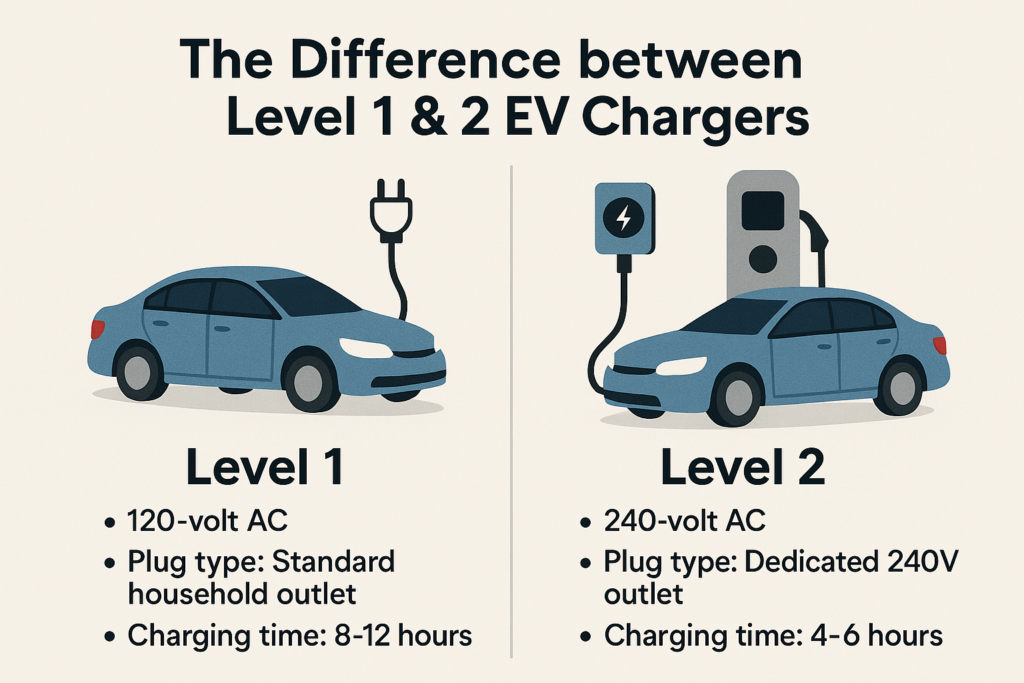
The Quad Wheel Drive (QWD) system is available on the 75 kWh Empowered A variant for an additional ₹1.2 lakh, taking the top-spec price to ₹25.99 lakh. A 7.2 kW AC fast charger is available as an option for ₹49,000.
More than 40,000 units of the internal-combustion Sierra are already on Indian roads, and Tata is increasing production to meet demand. Shailesh Chandra, Managing Director and CEO of Tata Motors Passenger Vehicles, said bookings for Tata’s electric vehicles are now more than three times the level recorded a year ago, indicating that EV demand is moving beyond early adopters. “The mainstream customer has arrived, and this shift is already visible,” he said.
Battery Options and Range: 63 kWh and 75 kWh, Up to 665 km Claimed
The Sierra EV is offered with two lithium iron phosphate (LFP) battery pack options: a 63 kWh unit and a 75 kWh unit. Tata claims a class-leading energy density of 141 Wh per kilogram.
Claimed range figures (MIDC-certified):
Real-world range:
The real-world figures are more relevant for buyers. Tata claims the 75 kWh version delivers between 510 and 530 kilometres of real-world range, placing the Sierra EV among the top quartile of electric vehicles globally for usable driving range. The 63 kWh version offers a C75 real-world range of 440 to 460 kilometres.
Charging capabilities:
The Sierra EV supports 120 kW DC fast charging. Using a compatible DC fast charger, the Sierra EV can recover 263 kilometres of range in just 15 minutes, while a 20 to 80 percent charge takes approximately 26 minutes under ideal conditions.
The Sierra EV also supports Vehicle-to-Load (V2L) and Vehicle-to-Vehicle (V2V) functionality, allowing the SUV to power external devices or even charge another compatible EV.
Lifetime battery warranty:
In a move that could help ease long-term ownership concerns for EV buyers, Tata has introduced a lifetime warranty on the high-voltage battery for the first owner, covering a 15-year period from the date of registration.
Performance: 5.8-Second 0-100 km/h Sprint
The Sierra EV’s performance credentials are among its most striking features.
Powertrain specifications:
- Rear-wheel-drive (RWD) variants: Rear-mounted motor producing 209 PS (206 bhp) and 315 Nm of torque
- Quad Wheel Drive (QWD) variants: Dual-motor all-wheel-drive layout with a 234 bhp rear motor and a 138 bhp front motor, producing a combined 225 kW and 504 Nm of torque
0-100 km/h acceleration:
With Boost Mode engaged, the Sierra EV QWD can sprint from 0 to 100 km/h in a claimed 5.8 seconds. This is half a second quicker than the Harrier EV.
Terrain modes:
The QWD version gains six terrain modes for off-road capability: Normal, Grass/Snow, Mud/Gravel, Sand, Rock Crawl, and Custom. Low-speed cruise control and a 540-degree camera system (combining 360-degree surround view with an underfloor feed) round out the off-road suite.
Design and Interior
Exterior design:
The Sierra EV retains much of the styling of its internal combustion engine counterpart, including the same silhouette, wheel design, and clamshell bonnet and tailgate. However, it features a distinct closed-off grille in place of the black element seen on the ICE model.
Key exterior highlights include:
- Full-width connected LED daytime running lights and LED tail lights
- Flush door handles
- 19-inch alloy wheels with aerodynamic inserts
- 205mm ground clearance
- 622 litres of boot space (to the roofline), expanding to 1,257 litres with rear seats folded
- Panoramic sunroof measuring 1,525 mm by 925 mm
Interior and features:
The Sierra EV’s cabin largely mirrors the well-received interior of the Sierra ICE. It features the Horizon View triple-screen setup comprising two 12.3-inch displays and a 10.25-inch instrument cluster.
Other key features include:
- 12-speaker JBL audio system with Dolby Atmos
- Wireless Android Auto and Apple CarPlay
- AirConsole in-car gaming feature
- DrivePay for in-car UPI payments
- Powered and ventilated front seats
- Powered tailgate with gesture control
- Heads-up display with augmented reality graphics
- Level 2+ ADAS suite comprising 22 advanced driver assistance features
- 540-degree HD surround-view camera with transparent underbody view mode
- e-Valet suite enabling remote parking, summon mode, and automatic park assist
- 5G-enabled connected car services through the iRA.ev suite with over 70 functions
Positioning and Rivals
The Tata Sierra EV will compete primarily with the Mahindra BE 6 and Hyundai Creta Electric in the Indian market. Its lower and mid variants will also rival the MG ZS EV and MG Windsor EV Pro, while the top-end versions could overlap with the larger Mahindra XEV 9e on price.
Within Tata Motors’ own portfolio, the Sierra EV is positioned above the Curvv EV and alongside the Harrier EV. Tata is targeting a different set of buyers with each model. As Kulkarni put it: “If the Harrier EV celebrates achievement, the Sierra EV celebrates possibilities”. The Sierra EV was developed for customers seeking one vehicle for city commuting, family journeys, chauffeur-driven use, and off-road travel.
Part Two: The Tata Safari EV — India’s First Three-Row Electric SUV
Launch Timeline and Positioning
The Tata Safari EV is the next major piece of Tata Motors’ electric offensive. The company is planning to launch the Safari EV around the festive season of 2026, likely around Diwali (November 2026). Production is expected to commence by August 2026.
Once launched, the Safari EV will take over as Tata’s flagship EV, sitting above the Harrier EV. It will mark Tata’s first-ever three-row electric SUV for the Indian market.
Expected launch date: November 15, 2026
Platform and Powertrain
The Safari EV will share its core architecture and powertrain setup with the Harrier EV. It will be built on Tata’s Acti.ev+ platform, an adapted EV architecture derived from an ICE base rather than a dedicated skateboard platform.
Expected battery options:
- 65 kWh battery: Ideal for regular city commutes and intercity transit, offering an estimated range of 420 to 450 kilometres
- 75 kWh long-range battery: Designed for long-distance highway cruising, delivering a claimed range exceeding 500 kilometres on a single full charge
Drivetrain options:
Charging:
- DC fast charging: 10% to 80% in approximately 40 to 45 minutes
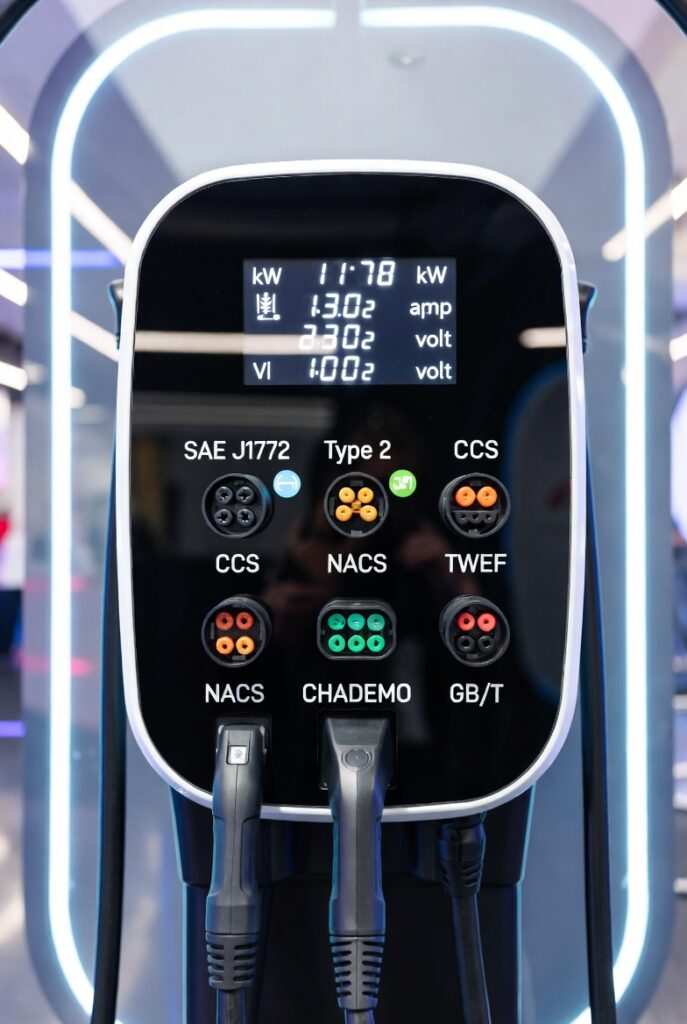
- AC home charging: Supports 7.2 kW to 11 kW wall-box chargers
- Vehicle-to-Load (V2L) and Vehicle-to-Vehicle (V2V) functionality
Design, Features, and Comfort
Design:
The Safari EV is expected to adopt a restrained design update in line with Tata’s EV design language. Expect elements such as a sealed grille, reworked bumpers, EV-specific badging, and aerodynamically optimised alloy wheels. Dimensionally, it should remain identical to the ICE-powered Safari.
Interior and technology:
The layout will largely mirror the existing Safari, but with a significant tech upgrade. The inclusion of Tata’s TiDAL (Tata Intelligent Digital Architecture Layer) will unlock a host of connected and convenience features.
Expected features include:
- Over-the-air (OTA) software updates
- 540-degree surround view system
- Enhanced Level 2 ADAS
- Auto park assist
- Low-speed off-road cruise control
- UPI-enabled in-car payment system
- Remote summon function
Terrain modes:
The Safari EV is expected to retain the Harrier EV’s advanced mechanical package, including a multi-link rear suspension with frequency-dependent dampers. Terrain response modes such as Snow/Grass, Mud-Ruts, Sand, Rock Crawl, and Custom are also likely to be carried over.
Pricing and Rivals
The Safari EV is expected to command a premium over the Harrier EV.
Expected price range: ₹22.50 lakh to ₹32.00 lakh (ex-showroom)
- Base variant (65 kWh RWD): ₹22.50 lakh – ₹25.00 lakh
- Mid & long-range variants (75 kWh RWD): ₹26.00 lakh – ₹28.50 lakh
- Top-spec AWD variant (75 kWh AWD): ₹30.00 lakh – ₹32.00 lakh
Primary rivals: Mahindra XEV 9S
The Bigger Picture: Tata Motors’ EV Strategy
Completing the EV Portfolio
The Safari EV will play a crucial role in rounding out Tata’s electric SUV lineup, ensuring that each of its current SUVs is offered with both ICE and electric powertrains. This “twin-powertrain” strategy allows Tata to cater to buyers at different stages of the electrification journey.
Alongside the Sierra EV and Safari EV, Tata has also showcased the Sierra EV Sanctuary Edition — a heavily modified version built specifically for wildlife safari use, featuring 8 seats, all-terrain tyres, and no roof. This demonstrates the versatility of the Sierra EV platform and Tata’s willingness to explore niche applications.
The Mainstream Customer Has Arrived
Shailesh Chandra’s comment that “the mainstream customer has arrived” is significant. Tata’s EV bookings are now more than three times the level recorded a year ago. The Sierra EV and Safari EV are designed to capture this mainstream demand, offering the range, performance, and practicality that buyers expect.
The LFP Battery Strategy
Tata’s decision to use LFP chemistry for the Sierra EV’s batteries was based on the safety, durability, and long-term value required for Indian conditions. The technology has been used across more than 300,000 Tata electric vehicles that have collectively covered over 15 billion kilometres. The lifetime battery warranty further reinforces Tata’s confidence in its battery technology.
What This Means for Today’s Buyers
The Practical Implications
If you are considering the Sierra EV:
The Sierra EV offers a compelling package at an aggressive price point. With a starting price of ₹18.79 lakh, a claimed real-world range of over 500 kilometres, and a 5.8-second 0-100 sprint, it is competitive with the Mahindra BE 6 and Hyundai Creta Electric. The lifetime battery warranty and LFP battery chemistry provide long-term peace of mind.
The Sierra EV is available in seven colours, including Rishikesh Rapids (marketing colour), Nainital Nocturne, Pristine White, Coorg Cloud, Andaman Adventure, Bengal Rouge, and Pure Grey.
If you are waiting for the Safari EV:
The Safari EV will be Tata’s flagship three-row electric SUV, offering 6-seater and 7-seater layouts. It will be positioned above the Harrier EV and will compete with the Mahindra XEV 9S. Production begins in August 2026, with a launch around Diwali (November 2026). Pricing is expected to range from ₹22.50 lakh to ₹32.00 lakh.
If you are comparing Tata’s EV lineup:
The Sierra EV and Safari EV represent different ends of Tata’s electric SUV spectrum. The Sierra EV is a five-seater positioned for buyers seeking a single vehicle for city commuting, family journeys, and off-road travel. The Safari EV is a three-row flagship for buyers who need seven-seat practicality without compromising on electric range and capability.
Internal Links: Further Reading on Clean Energy Bazaar
The Tata Motors’ EV offensive: Sierra EV launch and Safari EV coming soon guide connects to the EV market and policy guides on cleanenergybazaar.com.
For the MG Hector Tomahawk EV and PHEV launch guide covering India’s first mainstream plug-in hybrid SUV, our MG Hector Tomahawk EV and PHEV launch: India’s first mainstream plug-in hybrid SUV guide covers the dual launch in detail. For the PHEV vs EV analysis covering whether plug-in hybrids are a bridge or a competitor, our PHEV vs EV: why India’s first mass-market plug-in hybrid could reshape the market guide covers the broader market implications. For the tax barrier guide covering the 40% GST on PHEVs versus 5% on EVs, our tax barrier holding back PHEVs in India: a call for lower GST guide covers the policy debate.
Final Thoughts
Tata Motors’ EV offensive: Sierra EV launch and Safari EV coming soon — and the data confirms that Tata is positioning itself as India’s dominant player in the electric SUV segment.
The Sierra EV is a statement of intent. At ₹18.79 lakh, it offers a claimed real-world range of over 500 kilometres, a 5.8-second 0-100 sprint, a lifetime battery warranty, and a technology-heavy cabin. The Quad Wheel Drive variant adds genuine off-road capability with six terrain modes. The Sierra EV is not just an electric version of an existing SUV. It is a genuine competitor to the Mahindra BE 6 and Hyundai Creta Electric.
The Safari EV, launching around Diwali 2026, will take Tata’s electric SUV ambitions to the next level. As the brand’s flagship three-row electric SUV, it will offer seven-seat practicality, a range exceeding 500 kilometres, and the same advanced technology as the Sierra EV. It will compete directly with the Mahindra XEV 9S.
The honest verdict: Tata Motors is executing one of the most aggressive electric SUV rollouts in India. The Sierra EV is available now. The Safari EV is coming soon. For buyers in the market for an electric SUV, the choices have never been better.